A Daily History of Holes, Dots, Lines, Science, History, Math, Physics, Art, the Unintentional Absurd, Architecture, Maps, Data Visualization, Blank and Missing Things, and so on. |1.6 million words, 7500 images, 4.9 million hits| Press & appearances in The Times, Le Figaro, Mensa, The Economist, The Guardian, Discovery News, Slate, Le Monde, Sci American Blogs, Le Pont, and many other places… 5000+ total posts since 2008.

Category: History of Holes

  • Darwin, the Movie “Tremors” and the Attack of Giant, Human-Heritage-Eating Worms, 1881

    JF Ptak Science Books   Post 1517

    In the last year or so of his life, Mr. Darwin (who died 19 April 1882, aged 73) published a work that was somewhat outside his main thrust in publishing for the preceding 25 years or so–a work that proved to be quite popular, evidently selling at a better clip than the Origin of Species of 1859.  

    http://www.astrolabium.be/IMG/jpg/img10.jpg

    This was a book on mould, and earthworms. 

    The formation of vegetable mould, through the action of worms, published in  London (in October)  by John Murray in 1881, actually went through a number of printings, with more than 7,000 copies sold by the end of 1882.  It is a delightful book, and I can well picture the Old Man at Downs, studying the Worm Stone, thinking deeply about these little dirt-eating bits of nature, thinking about their actions on the landscape and what it meant over Very Long Periods of Time.  The book of course is a tour de force, a lovely piece of thinking.  It was also the target of this popular, anti-intellectual stab at the man’s work, a cartoon appearing in the satirical Punch magazine for 1881, decrying The Descent of Man for bringing the lofty human down to less lofty heights, and then stating that Darwin’s newest reached even lower and into the very muck.  Well that certainly wasn’t the reach of this work, which was a pretty straightforward affair hailing back to Darwin’s early interests in geology, returning to a subject of moulds which he had published on in 1839 and 1840.  Punch did take a stab at Darwin, trying to open up a hole into which the man might follow his worms, but of course that dog just wouldn’t hunt.

    Formation... is just a very smart book, with fantastic observations and ideas.  And it hasn’t much to do with getting Man muddy. Or dirty, for that matter.

    On the other hand….

    http://3.bp.blogspot.com/_WkKZJVG5wTk/TCRgu4bhEQI/AAAAAAACl-k/vPXu6kJS-cA/s1600/tremors-poster.jpg


  • One of the Most Beautiful Books in the History of Holes

    JF Ptak Science Books   Post 1513

    Pound-for-pound, hole-for-whole, this well may be the most beautiful book ever written on holes–it is at the very least one of the most beautiful botanical works ever published, which is saying a lot.  The point about the holes though is that they are mostly simply there; the author (and no one yet on the face of the planet at that time) didn’t and couldn’t understand their function as “cells”. 

    Stephen Hales (1677-1761)1, a long-lived medically-trained,  amateur scientist and clergyman from Kent, was  a pioneering plant physiologist whose widespread interests and experimentation established fundamental areas of that science, and whose overall impact on that field was not to be surpassed by any other individual for hundreds of years.  Among his momentous discoveries was his realization that the flower was the sexual organ of plants, which lead to a reorganization of thinking on the life of plants and propagation. 

    These images come from his Anatomy of Plants, which was published in 1682–the first of which (below)  shows a terrifically-sectioned piece of a vine stem, presented laterally-horizontally-laterally.  (Grew’s monumental work was more or less begun in 1672 with the publication of his The Anatomy of Vegetables Begun, a smallish 200+ page book illustrated with three images, and then incorporated his An Idea of a Phytological History Propounded (1673), and The Comparative Anatomy of Trunks (1675)  and ten years more of work and careful observation into  the Anatomy, which is a folio-size volume of 83 spectacular engravings and which runs 350 or so pages.)  In the work it is obvious that Hales was familiar with the micro-appearance of cells–as was Anton van Leeuwenhoek and of course Robert Hooke, who basically found and named the things in his Micrographia of 1665–but they what they were seeing were the thickened walls of dead cells, and could not have any understanding of what we think of as “cells” today.

    Minor point, really, given the overall importance of the work, which was perhaps among the most important publications (including the works by Fuchs, Caesalpino, Malpighi, Ray and  the 1483 Theophrastus) in the history of botany from Gutenberg’s invention and deep into the 18th century. 


    Makers of British botany, Plate 7 (plate from Grew's Anatomy) - right figure.png

    ·Posted by :

    ·in:

    — —

  • Newton and his 351st Trinity Anniversary: a Note on Ending his Research in Alchemy.

    JF Ptak Science Books  Post 1505

    http://www.rebeccastott.co.uk/webimages/trinity.jpg

    I’ve made a number of posts on this blog regarding the anniversaries of the Trinity atomic test explosion on 16 July 1945, out there in the desert–actually in the Jornada del Muerto, the Journey of the Dead Man/Dead Man’s Walk, near Socorro,  New Mexico.  Its a bad piece of land if you wanted to cross it, especially if you went north-to-south, a hundred mile bit of an unrelenting waterless world.

    But that’s not the Trinity I want to talk about now–today’s Trinity is about as far removed from the flat piece of dry New Mexican earth as you can get, being the beautifully maintained Renaissance grasses of Trinity College at Cambridge. The call to this Trinity, today, is in observation of the 351st anniversary of the arrival of Issac Newton (1642-1727) at that college.  1660 is not an auspicious year in Newton’s history, necessarily, but it is the beginning–Newton’s enormous years would come in just a little bit, getting well underway during the Plague Years in 1665/1666, when he left the school to ride out the nasties in his native Woolsthorpe1.

    Myk favorite image of Trinity is the one above, printed not too long after Newton’s return2, and after he had set up his own alchemy lab in a lean-to shack against the wall of the school (slightly visible here in the lower right corner.). Newton’s decades-long run in the alchemy turnstile is well known, but what I’d like to know is why he gave it up.

    My feeling is that Newton believed he was missing a big something in his way of looking at and understnanding, expressing, the world.  I think that he recognized the failing of physics and math to explain the vitalism (in the alchemical sense) of the world, and that alchemy might provide it.  Thinking that this vital agent was in a way divine, in a way a product of divine interaction and participation, Newton may have used  alchemy in the hopes that this area of study .would get him closer to that cause of all spontaneous processes that would explain all of the varieties and vagaries of living stuff.  He might have viewed this creative process in the Old Testament sense of god using light at the beginning of the world, activity life in nothingness; Newton may have actually thought of this process as alchemical in nature.

    There has been much written on Newton and alchemy, and I  know almost nothing about it. Knowing the anniversary was upon us, and seeing the print of Trinity, and seeing again that little shack where Newton spent so much concentrated effort, all conspired to make me think about what led Newton to give it all up.  He stopped just as he was leaving the school for London to become director of the Mint, undertaking a big change in his life.  His superhuman insight was about done by this point, even though his Optics would come a little later on, in 1704–most of that work was already completed, with Newton waiting, perhaps, for any troubles that he felt he was going to have upon the book’s publication to fade away.  And in this case, the problematic part did fade away, into dust, with the death of his long-worn enemy, Robert Hooke, in 1703.  And its not that Newton faded away over the next few decades, he was still an exceptional powerhouse of an intellect to the very last, molding the new Scientific Revolution from his position as president of the Royal Society.  And hen there was the oversight of the Mint.

    But he pretty much gave up alchemy around 1697, and that, as they say, was that.  I wonder what it was that he found or didn’t find; whatever it was, it wasn’t among the million or so very chosen/careful/hidden/coded words in his (very) private (and not-intended-to-be-published) writings on the subject.  What was in that final dot at the end of the last recorded sentence on alchemy, I wonder?

    The other part of this print of Trinity that I so love is in the foreground, where the artist–or engraver–decided for whatever reason to include a tiny scene of two fighting/playing dogs.  Dogs and the shack, and the rest of the grandeur. 

    Notes:

    1. Newton graduated in 1665 without any particularly noted academic achievement.   Of the plague years, Newton wrote:  “All this was in the two plague years of 1665 and 1666, for in those days I was in my prime of age for invention, and minded mathematics and philosophy more than at any time since.”

    Newton returned to the school in 1667 and was made a (minor) fellow; he took his masters in 1668, and in 1669, by the appearance and promise of his great genius, Newton was named Lucasian professor, filling the seat of Isaac Barrow.  Newton was 27 years old. 

    “The more Newton’s theological and alchemical, chronological and mythological work is examined as a whole corpus, set by the side of his science, the more apparent it becomes that in his moments of grandeur he saw himself as the last of the interpreters of God’s will in actions, living on the fulfillment of times.”–F.E. Manuel, The Religion of Isaac Newton (1974).


  • The Weight of War–Bombing and Shelling During World War I and a Lesson in Orders of Magnitude

    JF Ptak Science Books  Post 1389

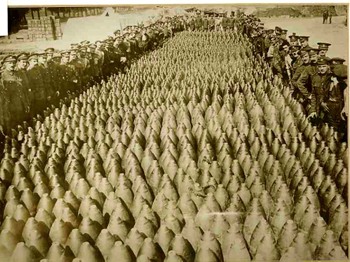
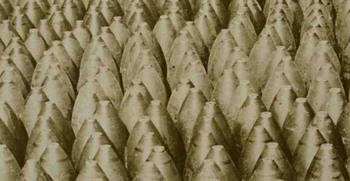
    Blogbomb_master This indelible image was made by an anonymous photographer for the Central News Service of New York City in 1918.  The Central News Service was a photographic supply house that would send requested photos to newspapers throughout the United States for publication as illustrations for  a story.  They would’ve been sent rolled in a tube  with a description of the image and with the stern warning to “Watch Your Credit Line”, making sure that once the newspaper had paid for the use of the photo that it also told its readers the source of the (agency) photographic.

    The image is insatiable–it demands that you look at it and look at it long and hard, as it tries to give some sort of idea of the tremendous number of shells that were shot from canons by the just British against the Germans during the First World War..  There were something like one million tons of these fired against Germany; this picture represents about .001% ( of that total).  We see approximately 800 shells at two hundred pounds apiece, surrounded by a group of about 150 soldiers. 
    Blogbomb_detail_rear

    I looked very closely at this photograph.
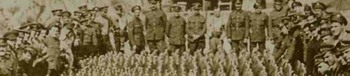
    Of this single line of soldiers along the perimeter of the bomb cache, of the 150 of them, there are, it looks like, only five of them who have placed their hands on one of the bombs, and four of them are touching the fuse with just their middle finger.  It is an odd picture of restraint, these soldiers paying the weapons of mass destruction the respect of room.
    Blogbomb_detail_front

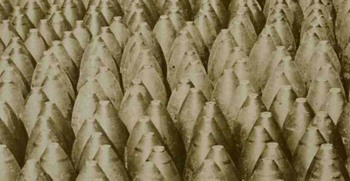
    I think that this is an extraordinary photograph of the testament of understatement and small, small percentages–even with this photo being so enormously graphic it still gives you absolutely no idea of how much explosive material was hurled back and forth, even knowing in your mind’s eye that this image represents something like FOUR ORDERS OF MAGNITUDE less than the total tonnage of bombs used.  By the British.
    Blogbomb_detail_front_2

    This difference in orders of magnitude is roughly equivalent to the difference in size between an ant and a human being, or between an amoeba and an ant, or between a human and one of the pyramids, or between the earth and the sun.  Basically, the shells in this photo meant nothing whatsoever to the total of shells used during the war.


  • An Episode in the History of Holes: Electricity, Punched Cards and the Computer, 1878.

    JF Ptak Science Books  Post 1382 [Part of our series in The History of Holes.]

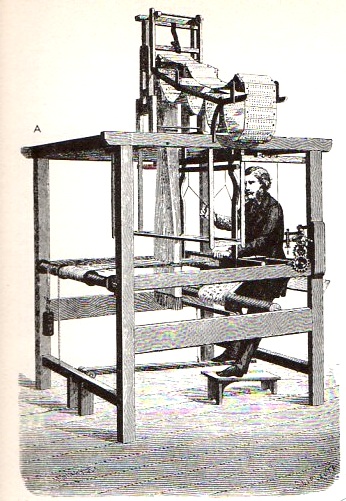
    Jacquard loom142 Kepler saw music in his study of planetary motions; Newton saw it too in relation to optics and the foundation of color–I wonder if the early people working with punched cards and tape saw a similarity between horizontal versions of their work and musical scales as well?  Did Jacquard or Hollerith see something through their holes to points beyond?  Well, I doubt the later, though there is no doubt that there are true relationships between music and the work of Kepler1 and Newton.  Perhaps one could make a score by arranging the punched holes of computer tape or a series of Jacquard loom cards, though they have less a relationship to what we identify as music than transcribing hundreds of resting pigeons as notes on a five-line utility pole.

    The idea of automatic control comes way before M. Jacquard (1752-1734) and the punched cards that he used to control his loom (which began about 1805), though I must say that Jacquard’s man-in-the-machine design does have a great, far-reaching elegance to it.  Even in his own field here were predecessors: Jacques de Vaucanson, for example, and Basile Bouchon (1725) and M.F Falcon (1728).  But it was with Jacquard that the idea of the punched card for design control took hold, and just seven years after the loom was introduced there were more the 10,000 Jacquard machines in operation in France alone. 

    Alfred Barlow2 wrote a splendid history of weaving in 1878, and in that books later pages–and I suspect much overcome with the recent developments in the electrical field (not the least of which were the newly invented light bulb and telephone)–Mr. Barlow waxes considerably on the application of electricity to the Jacquard process:

    He writes, “It is scarcely to be wondered at that men acquainted with the application of electricity to telegraphy and other purposes should have believed it equally serviceable in some of the operations of weaving.  As it might be expected, the Jacquard apparatus seemed to offer and excellent opportunity for the needles [reading the holes ion the loom punch cards] to be worked, not by the direct pressure of a card, but by the connecxion of a series of electro-magnerts.  By this means it was believed that paper may be substituted fir the cards, and the magnets might operate upon the needles through the perforations in the paper, or by passing a current of electricity through the medium of a metallic conducting surface on a sheet of paper or cloth representing the design to be woven, and thereby acting without the use or need of perforations.” (Pages 424-5)   It was certainly a capital idea.  Barlow may have been referencing the work of Alexander Bain and his punched-tape telegraph of 1841, though he does not mention him specifically.  Barlow does mention several inventors from the 1850’s who managed to make improvements with electricity in Jacquard-style machines, though none with the great effectiveness which he described here.  The real, great advancement in computation waited for quite some time, even beyond the great innovations of Hermann Hollerith (who began his tabulating successes in the 1880’s, coming into international recognition with his work on the 1890 U.S. Census.  But Barlow’s imagination here is quite full,  and just a little beyond his time. 

    [This work by Barlow is available for purchase here.]

    Notes

    1. Kepler used the ratios between the velocities of the planets at their closet and furthest distances from the sun to construct musical intervals, which do work.  What an enormously encompassing feeling this must have been to set the motions of the celestial spheres into polyphonic tones that fit right inside the octave!  Newton’s seven colors could be set side-by-side with seven notes of the octave, color in music, giving them the notes A, B, C, D, E, F and G. 

    2.  The excellent Mr. P.J. Mode first brought this reference to my attention 15 years ago.  The work:  Barlow,m Alfred:  The History and Principles of Weaving by Hand and by Power.  London; Sampson & Low, 1878, xii, 443, iv pp, illustrated throughout with text illustrations. 


  • What a Fascist Really, Really Is: Defining Things, June 1945

    JF Ptak Science Books   Post

    In the history of words and the history of writing them, the history of writing down what words mean came relatively late in the word game.  The first dictionary for the English language is difficult to establish–it wasn’t Dr. Johnson’s 1746 effort, as fabulous as it was.  There were more than a hundred earlier efforts, the earliest of which may be Robert Cowdry’s A Table Alphabeticall… as the first English dictionary, which was written in 1604. (Its more easy to determine the first American dictionary, Dr. Webster’s, 1828 .) It may be that dictionaries and assemblies of rogue/thieves language appeared well before Johnson, by perhaps as much as 175 years, providing the good readers and listeners in England with a ready tool for understanding “non-standard” (slang) words of the English language (with A New Dictionary of the Terms Ancient and Modern of the Canting Crew, by “B.E.”, being the best known of these early works, published in 1698.)

     It is interesting to me that in addition to Johnson et al another  writer–or rather set of writers–were responsible for the first Johnsonian-first dictionary in German, the  Deutsches Wörterbuch by the Brothers Grimm.  These are good examples of modernity, though there are earlier examples for other languages–Petrus de Alingio’s manuscript of 1286 and the Catholicon as the first printed alphabetical listing of Latin words appeared very shortly after Gutenberg’s Bible did on the same press.  But then these were both many centuries into the use of the language.

    WWII--Italy Fascist a042

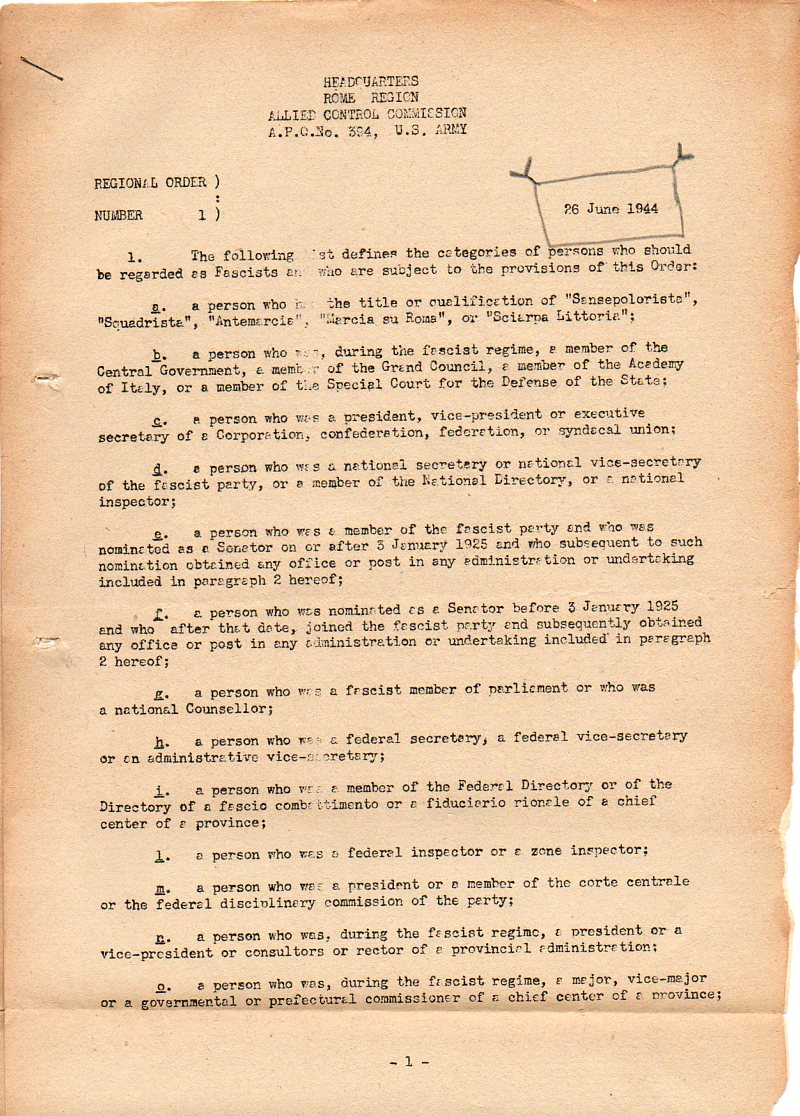
    And this just to say how much I like the road to words–especially when they come from unexpected places. One fine example of this is the directive below, issued by the headquarters of th Allied Control Commission (“APO No 394″) in Rome in the summer of 1944.  (This would actually be the American arm of the ACC, which was commission set up by the Allied Powers to deal with the administration of defeated countries at the end of the war.  Three weeks after D-Day the end of the war was in sight (Bastogne and Co. not withstanding), though far more so in Italy than just about anywhere else, and so the implementation of governing and occupying plans needed to be established.  One of the primary features here was to ensure that the old Fascists not be included in the new Italian governments (along the lines of denazification in Germany, which had a more laissez-faire approach to defining Nazis, especially wealthy and useful ones), and the primary issue in finding and excluding Fascists was to define what was meant by “fascist”1.  These are those working guidelines, at least on 25 June 1944. 

    Notes

    1. The first use of “fascism” in English reported by the Oxford English Dictionaries occurs in 1921:
    1921    19th Cent. July 148   The Fascismo was born in the provinces, where the extremistic menace was stronger.      

    Other interesting reports of the usage of the word continue in the OED:

    1922    Q. Rev. Jan. 148   A section of the Press..now veered completely round to the cause of Fascism. The Fascist terror increased in intensity.
    1923    Contemp. Rev. Jan. 44   We do not want Fascismo in this country.
    1923    Contemp. Rev. Nov. 557   Fascism in Germany will never be more than one of several factors.
    1925    Weekly Westm. Gaz. 10 Jan. 320/2   The outrages which have been associated with Fascism have gradually alienated much of the support which it won two years ago.
    1934    tr. K. Heiden’s National Socialism xvii. 354   The electoral victories all over Europe with which the Labour Parties have replied to German Fascism.
    1936    Discovery Dec. 378/1,   I have strongly criticised modern education and the methods of handling youth generally as inculcating excessive respect for authority and thereby conducing to the growth of Fascism.
    1939    A. Cobban Dictatorship v. 124   In March 1919..Fascism was still..a revolutionary and socialist movement, hostile to the monarchy, to finance, and to parliamentary government, demanding social reform and workers’ control, but separated from the other branches of the socialist movement by its intense nationalism.
       
    And the definition of the word “fascist” from the same year, 1921:
     “One of a body of Italian nationalists, which was organized in 1919 to oppose communism in Italy, and, as the partito nazionale fascista, under the leadership of Benito Mussolini (1883–1945), controlled that country from 1922 to 1943; also transf. applied to the members of similar organizations in other countries. Also, a person having Fascist sympathies or convictions; (loosely) a person of right-wing authoritarian views. Hence as adj., of, pertaining to, or characteristic of Fascism or Fascists…”


  • Reporting the Hiroshima Bomb the Day After, 7 August 1945. AND the First Graphic of NYC A-Bombed

    JF Ptak Science Books   Blog Bookstore  Post 1257 (continuing post 669)    Atomic and Nuclear Weapons Series

    ==Blog July 26=PM cvr bomb

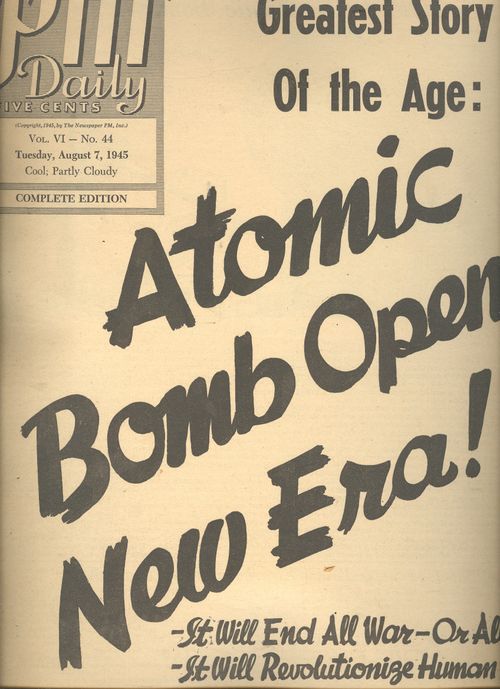
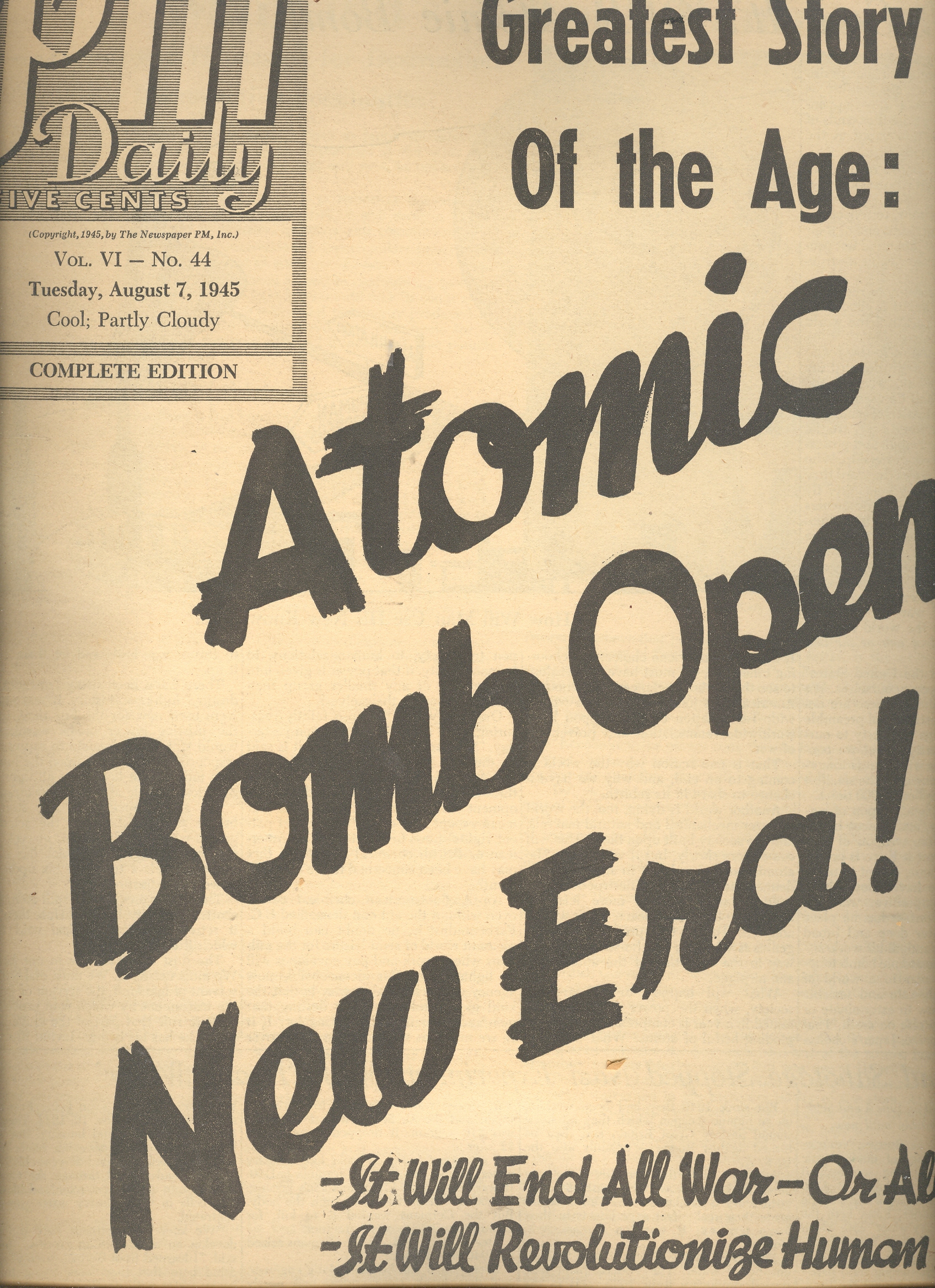
    The news coverage of the 6 August 1945 bombing of Hiroshima was covered in spectacular (all things and time considered) detail in the 7 August issue of the daily newspaper, PM.1  The entire issue of 12 pages (with no advertising2) was dedicated to the event—I have no idea, really, how they were able to put together this amount of good tough data so very quickly, nimbly and intelligently, as the bomb was detonated at Hiroshima only the day before. 

    It is odd how well the case is covered, and it is positively issued on the day after –it isn’t the case that it was issued for the week of 7 August and released on 13 August, which I thought was a possibility of explaining the deep coverage.  But there’s no mention of Nagasaki (which would come in two days), so I am certain that the coverage was all accomplished within 24 hours of the use of the weapon.  The newspaper distinguishes itself by not screaming something about the “Jap city” being wiped out (as so many other newspapers did), with its front page summarizing beyond the bomb.  (“It Will End all War—Or all Men” and “It Will Revolutionize Human Life” as sub-heads; the first being accurate, while the second being nearly so.) 

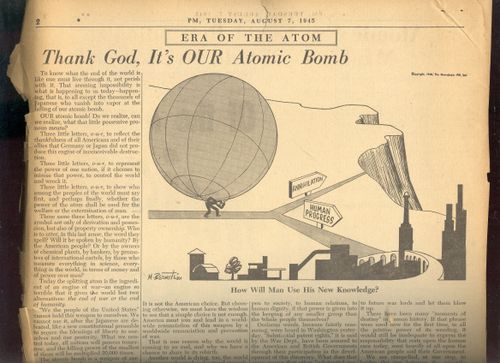
    The editorial, “Thank God its OUR Bomb”, by Irving Brant, is a lovely piece of thoughtful interpretation in the opening moments of the nuclear age. He writes: “America must join and lead in a worldwide renunciation of this worldwide renunciation and prevention of war”,and “What will happen to industry, to society, when the power of all the coal mined in a year is compressed into an exploding fistful of atoms?” And further:“There is no escape.  The split atom may shatter humanity, but not before then will it retreat into the physical void from which it came.  The dust of creation is in our hands.  We must master it.” Not bad stuff for having a few hours or so to think this  through. 


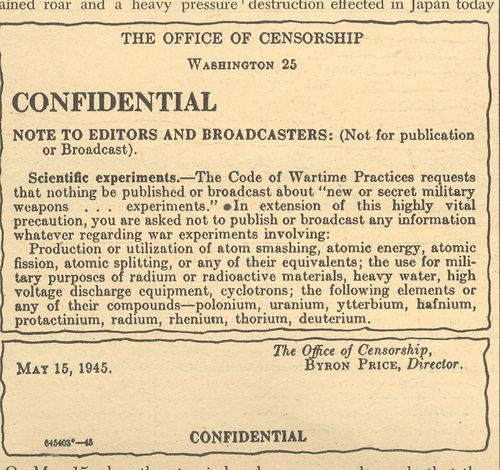
    ==Blog July 26=PM cvr bomb censor


    The other articles included “Bombs and Sabotage Stopped Nazi Experiment with Heavy Water”, “New Atomic Era Could Revolutionize Mankind’s Whole Manner of Life/Power Harnessed for Destruction Has Limitless Constructive Possibilities”, big two-page story “Stimson Reveals How Work on Bomb Was Organized”, “Bomb’s Death Range Believed to be 4 Miles”, “Four Scientists who Will Plan Postwar Uses of Atomic Energy”, “Harnessing of Atomic Power research Strengthens US Research”, “If a Piece of the Sun Were Placed on Earth”, “End Not Yet Truman Tells the Japanese”, and another 12 articles.

     ==Blog July 26=PM cvr bomb artoon

    There’s another baffling article “Steel Tower Vaporized in First Test”, discussing the shot at Alamagordo—it must have been the case that there was an enormous amount of material divulged by the government in the hours after the explosion at Hiroshima .  The work at Columbia is also chronicled, as is the personal life of the man in control, General Leslie Grove (and how completely in the dark his wife was, and so on). 

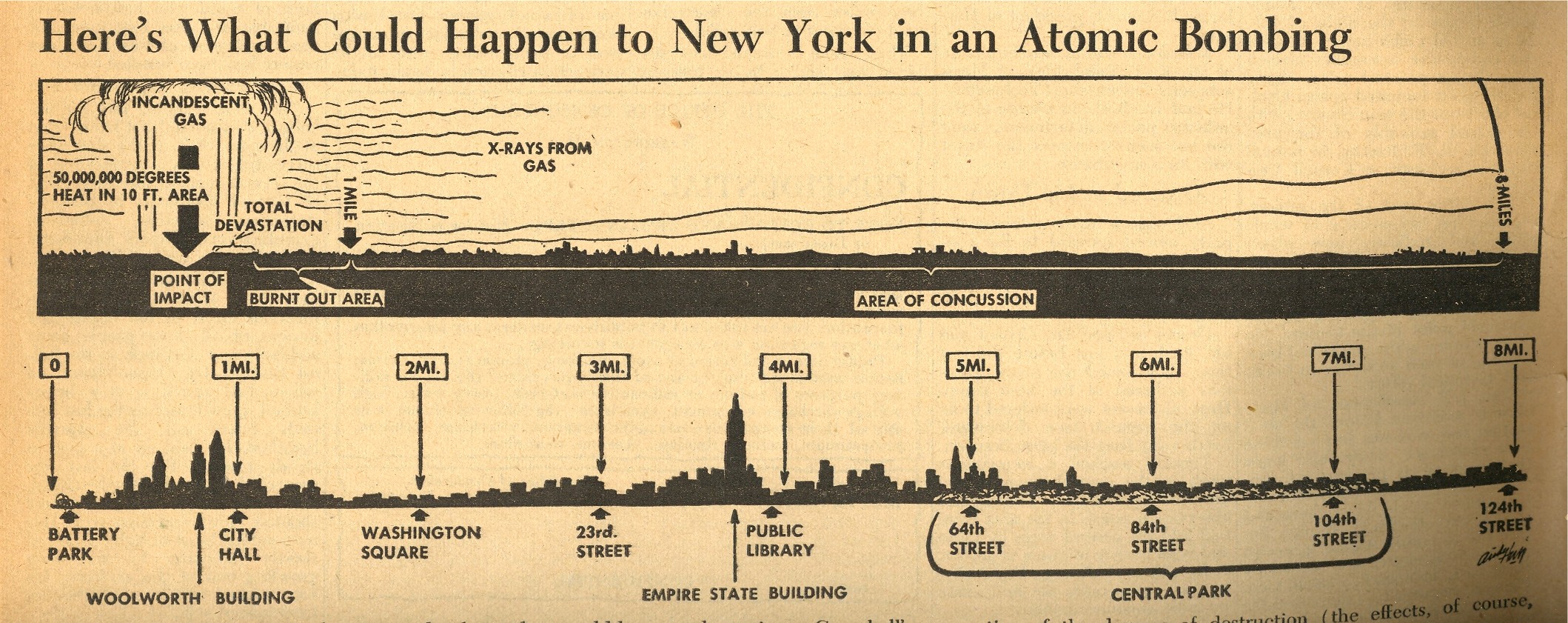
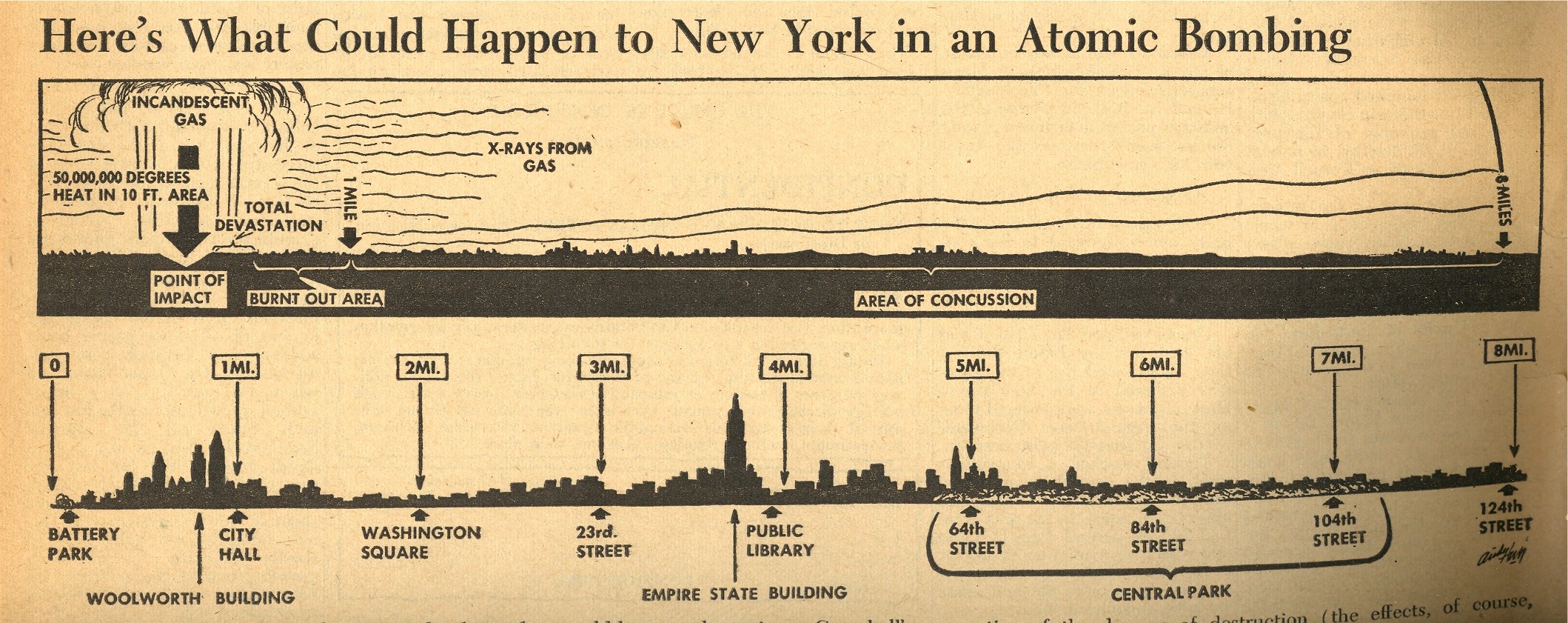
    One of the most interesting objects to me though is the small graphic on page 7 which shows what effect the Hiroshima atomic bomb would have if dropped on New York City—it was no doubt gigantically sobering to anyone who looked at it, and brought the power of the bomb and its destruction to a common, understandable point.  I’m not an historian of the first newspaper coverage of the bomb, but it strikes me that this may well be the first graphic to depict the effects of an atomic bomb exploded over NYC.

    ==Blog July 26=PM cvr bomb map
     

    In any event, the overall coverage of the event was stunning given the short amount of time to do the research, writing, and publication.  Truly a great effort. 

    Notes:

    1. PM (1940-1948) was a left-wing newspaper funded by Marshall Field III, and was home to excellent reporting.  See here for more details. Among the staff writers was I.F.Stone and staff photographers Margaret Bourke-White.  Other contributors included Heywood Hale Broun; James Thurber; (the great) Dorothy Parker; Ernest Hemingway; Eugene Lyons; Ben Stolberg; Malcolm Cowley; Tip O’Neill;and Ben Hecht.

    2. Actually, NO issue of PM had advertisements–it was entirely ad-free. (And even so it still came close to making money after 8 years.)

    PM‘s stated mission:

    PM is against people who push other people around.   PM accepts no advertising. PM belongs to no political party. PM is absolutely free and uncensored. PM’s sole source of income is its readers–to whom it alone is responsible.PM us one newspaper thayt can and dares to tell the truth.

    Theodore Geisel (Dr. Seuss) was a cartoonist for PM (see here for his War cartoons) as was the great Crockett Johnson.


  • Millions of Miles of Hole-Filled Paper–Dystopia, Entertainment, Vonnegut and Prison

    JF Ptak Science Books  Poat 1236

    {Part of this blog’s History of Holes and History of the Future series.]

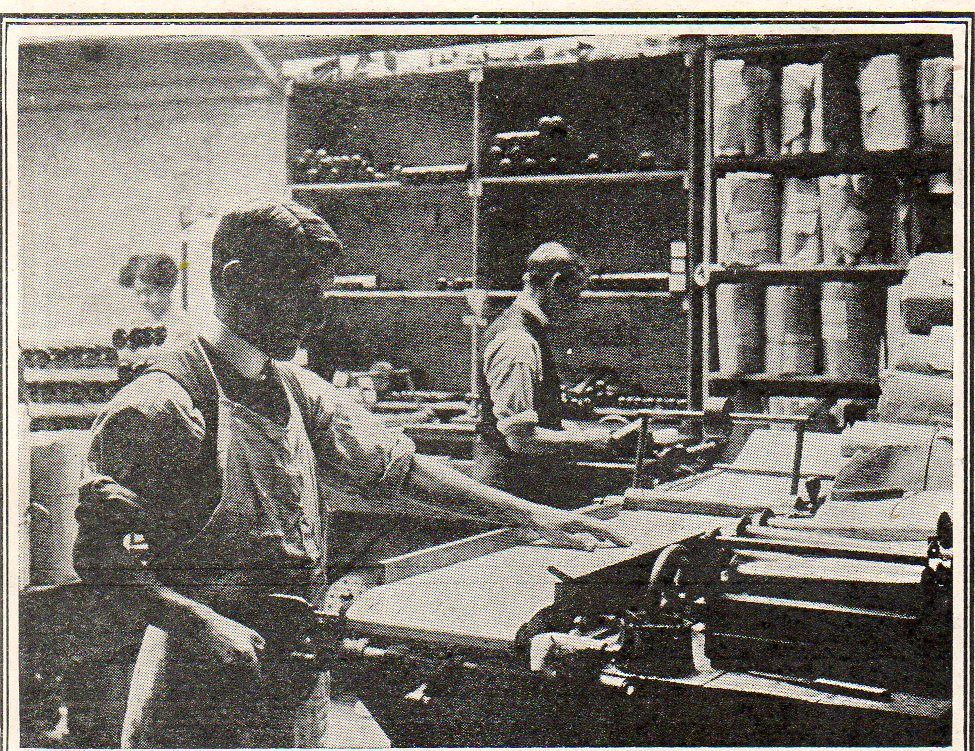
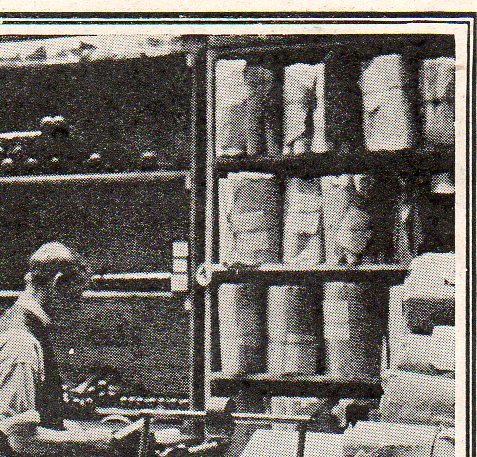
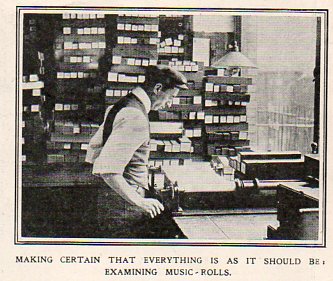
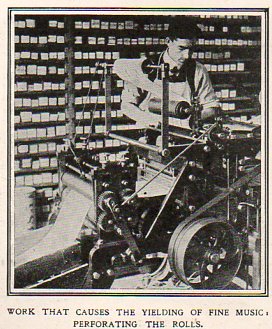
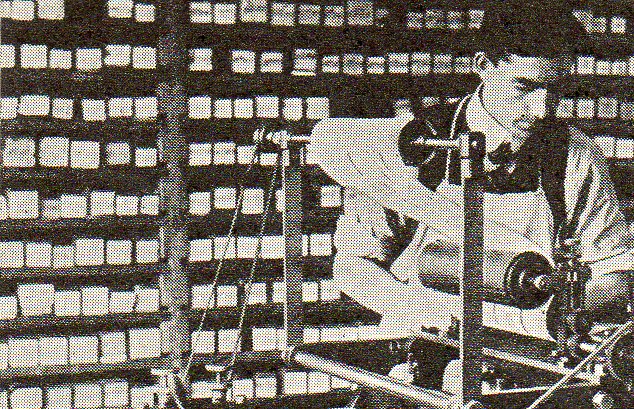
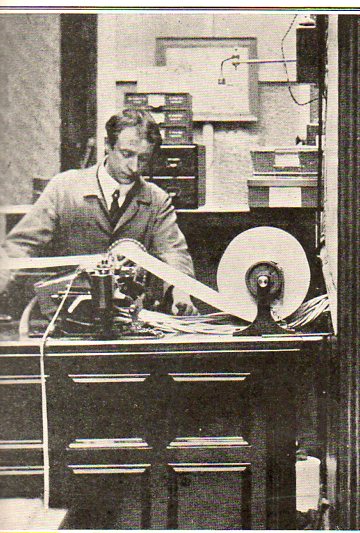
      Music role making--1871 There is a certain layered, geological dystopic quality to the  images of these men laboring at producing piano rolls for player pianos (and found in The Illustrated London News for 18 December 1909). This is true especially for the details, the small boxes in the background to where the rolls are being “processed”–music pounded out with metal points on a hard surface, as though produced by whatever it was that was in those little labeled wooden containers, far removed from the artistry of melody. These are images of a culture being made into hundreds of thousands of miles of hole-filled paper.

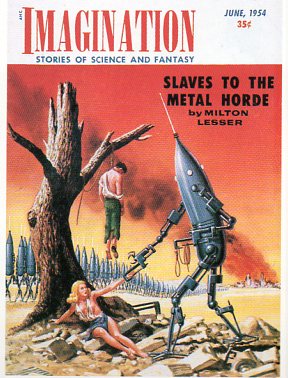
    The piano roles remind me of automatons replacing humans in entertainment, and then replacing the humans making the piano roles; of machines taking over the jobs of people writ large.  There’s a long and rich literary history of this idea, not the least (or first) of which is the appropriately-named Player Piano, Kurt Vonnegut’s first novel, written in 1952.  Like a tiny idea-machine, Vonnegut manufactured part of his tale from Brave New World, with Huxley having taken his bit from an earlier novel, We, written by Yevgeny Zamyatin in 1921–they’re all bleak images of a future dominated by machines, the humans acquiring numbers for names, like the replaceable and expendable units they became. 
    (Artwork by Malcolm Smith for Imagination, June 1954.)

    Robots in ocntrol--hanging human879

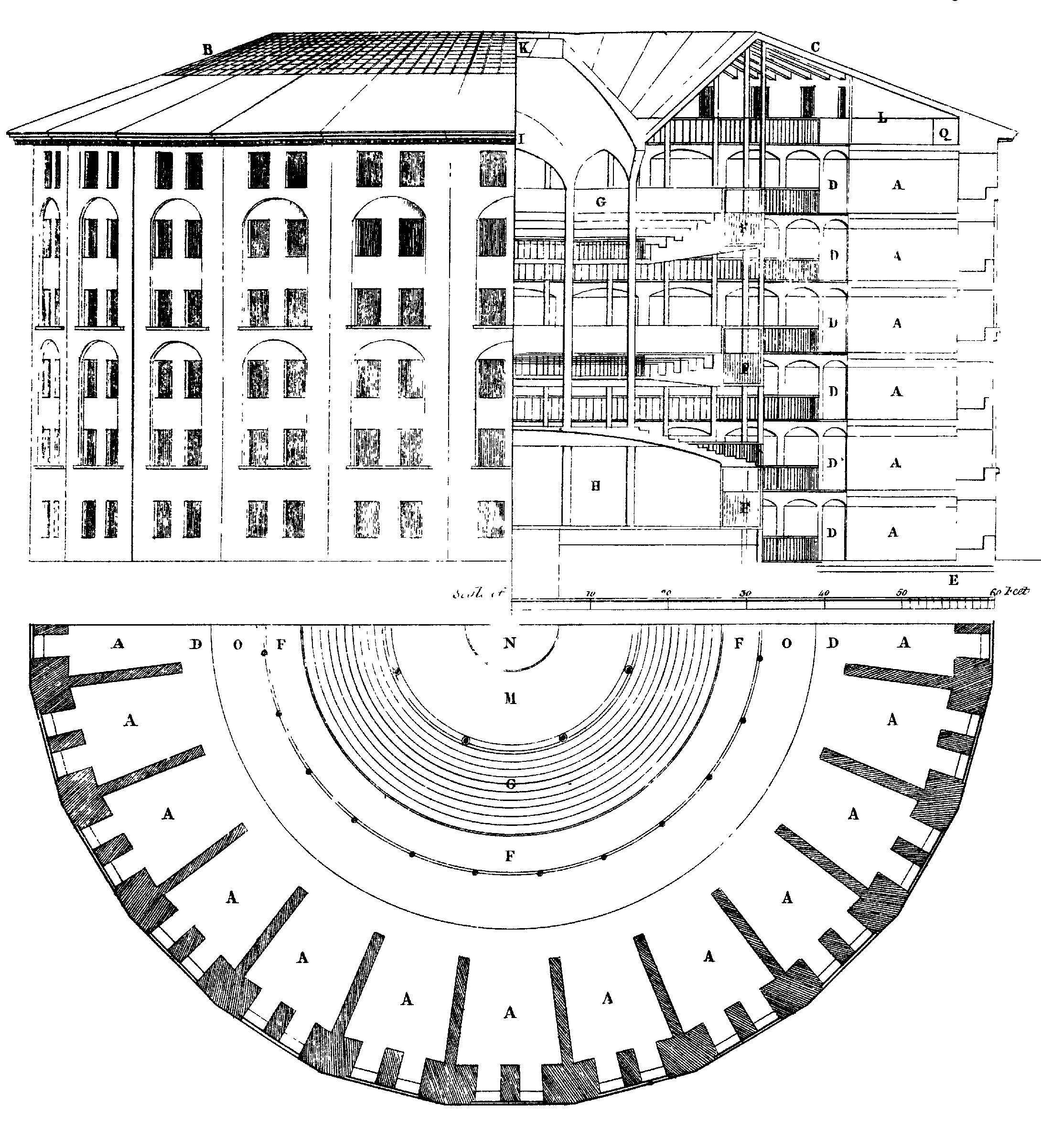
    The devices for producing the roles remind me of Jeremy Bentham’s panopticon, a functional prison designed so that all of the prisoners could be viewed from one central point.  The profile of the place reminds me of the geared punch machine for the piano roles; I’m not at all sure about what the function of the prison reminds me of.  But in the history of holes, I guess all it foes it fill u its empty holes with people, keeping them there for months or years or decades, and then replacing them with other people, part of a long and continuing series.

    File:Panopticon.jpg

    Here’s the panopticonal prison at Presidio Modelo, Isla De la Juventud, Cuba–with the walls laid flat, and some cells filled-up, and reduced, you may be able to make a certain music with it, like reading the scores made by pigeons roosting on a five-wire-strung staff of utility poles. My daughter Emma just suggested that there could be a Morse Code crossover as well!)

    File:Presidio-modelo2.JPG

    The plan and elevation of these prisons relate to the player paino paper, like the early dots and dashes of communication, like the punched cards that Vonnegut had in mind when he was writing his early classic. 

    Now, the rest of the Illustrated London News story (available here on my blog bookstore):

      Music role making--1det872
      Music role making--3865

    Music role making--4866

    Music role making--4det870
    Music role making--5867


  • Making Tubes of out Holes–the History of Holes, Extended

    JF Ptak Science Books  Post 1184  [Part of this blog’s History of Holes series.]

    Taking inspiration from Edwin Abbott’s Flatland1 (a superb book  excursion into perception and difficult envisioning in which a two-dimensional world tries to comprehend three-dimensional objects) I’ve decided to extend my History of Holes section with their extruded, cylinderized extension cousin–the tube.  After all, If you take a hole by its edges, shack it out, rough it up, reposition and throw some sides on it you wind up pretty much with a tube, which could be seen as elongated holes with (generally) defined beginings and endings. Sometimes.  This is a natural continuation of my series on dots, which can be regarded as holes, or points, and thus into tubes.  “Spots” on the other hand really doesn’t work into the dot/hole thing, as spots can be irregularly-shaped, and I like the dots/holes to be more rounded than the potentially jagged spot, or blotch.

    When you start thinking of tubes, though, they turn up everyhwere: from gigantic cannon, to impossible flying machines, to telescopes, pneumatic railways and delivery systems, test tubes, subways, pressurized health restorers, television screens, and so on.

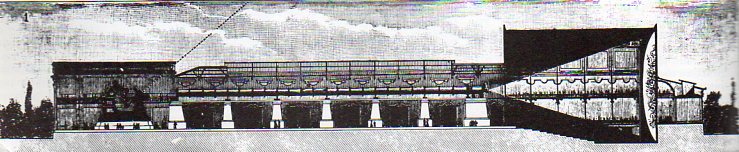
    I’m not sure where this idea came from–perhaps in the post on massive tubeless telescopes (here), reminding me of the most massive tubed telescope, the longest telescope with a tube, belonging to James Bradley, who produced a monster over 200′ long. Connecting the tubeless and tubed telescopes was the image that I had in mind; the hole following naturally from that. Anyway the Bradley  tubed construction–antithetical to the DNA/carbon/membrane nanotubes–were enormous for their time, and as moveable tubes are still very impressive.  Another massive telescope was constructed on speculation for the Paris Exposition of 1900 {the cross section of which is depicted below)–it was 187′ long, spectacularly made and exhiited, and could find not a single buyer.  Positioning the scope of course would’ve been very problemtaic. 
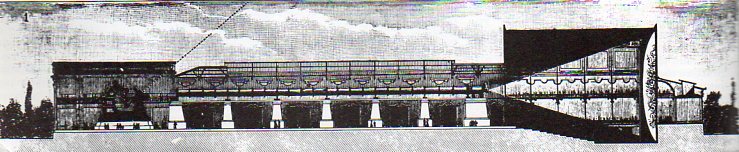
    Tube 1500 ft telescope621
    There are other, more massive and mobile tubes, like, say the smokestacks of the Titanic (which were 24×19 feet, with a fall of 150′ from the top of the smokestack’s sweep to the boilers)–these weren’t mobile in and of themselves, but they did move, if only for a short time (laterally), and then for a very short and cold time (vertically).

    http://www.titanic-titanic.com/pic/funnel_bogie.gif

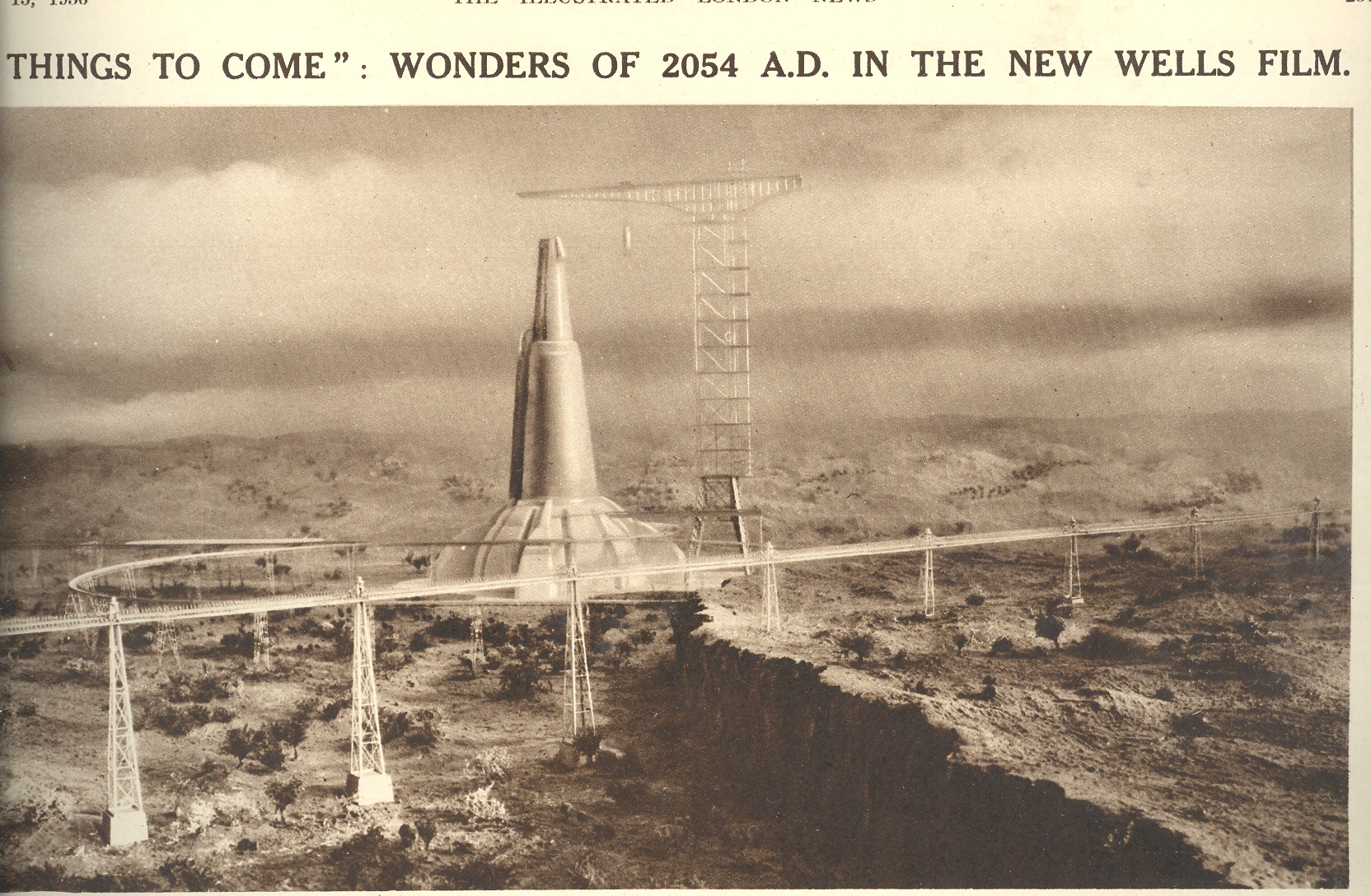
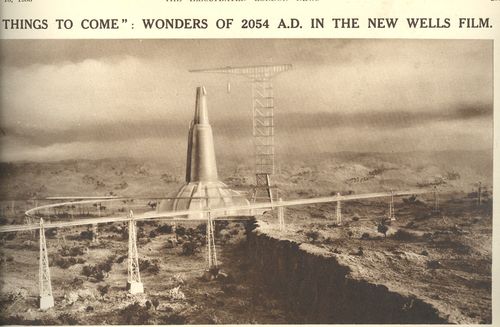
    Massive, monster canons have existed for many years in idealized and theoretical, speculative worlds, like Tom Swift and his Monster Canon.  In the history of early imaginary big gun tubes H.G. Wells’ Babel-like cannon (pictured below in a still from the movie Things to Come (1936), an adaptation his The Shape of Tings to Come (1931)) is fabulous–1500 feet tall, with I figure a  750′ base, it launched a 75′ tall capsule beyond the Earth’s
    Blog jan 6 wells

    gravitational pull with a spectacular explosiveness that would’ve made its occupants into instant jelly.  (Paul Drye points out that one of the biggest sci-fi guns comes to us via Arthur C. Clarke, who had his Lunar inhabitants fashion a gun by drilling into the Moon’s surface until they reached a depth where it would tap and “shoot” molten rock at attacking space ships.  This is more of a hole than a tube, and as such probably ranks it as the biggest hole gun ever constructed, even in science fiction. In the same veinish vein is Robert Heinlein’s railguns, seen in The Moon is a Harsh Mistress.  It has been suggested that E.E. Smith may have concocted gravitational weapons enabling planets and entire galaxies as wepaons, but I’m not sure about this, and they’re definitely not tubes.)

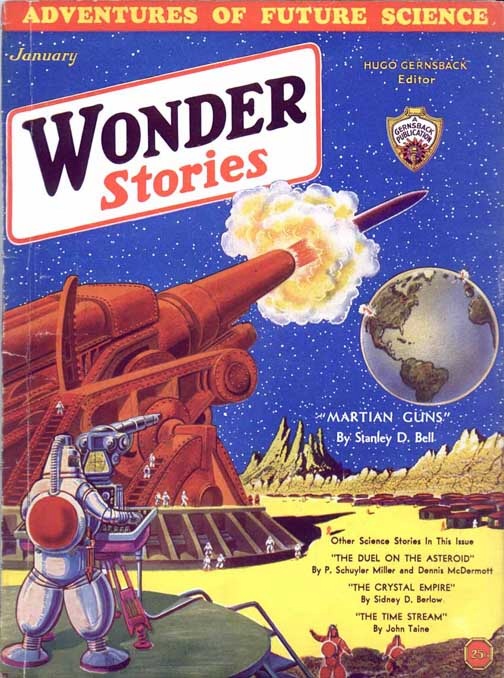
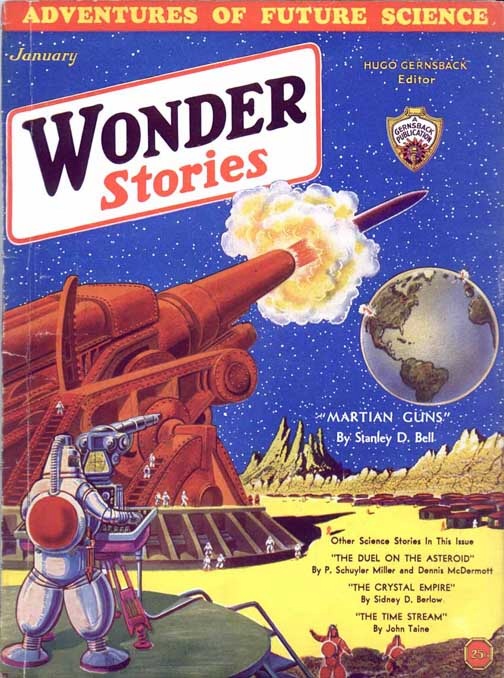
    Just to round out the Solar System cannonry a bit, here’s an example of a gigantic tube coming from the fabulous Frank R. Paul for Stanley D. Bell’s “Martian Guns” found in the January 1932 issue of Wonder Stories.  There’s really no way to determine how big the gun is except to say that it is probably “big”–there’s just nothing to place the thing in perspective, as the figures in the foreground, being Martian, don’t have a specific height.  They could be 6′ tall, or 60′–perhaps they’re only 1/10 of an inch tale, and the projectile they’re firing to the earth is so devastatingly powerful that size doesn’t matter.
    Strange things in sky--martian guns

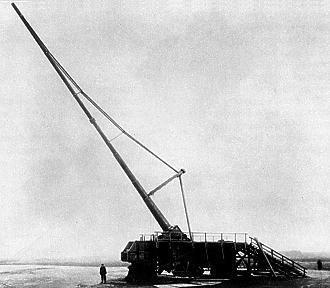
       Back here on Earth and in the real world,  the Kaiser Wilhelm gun (or “Paris Gun”, the Kaiser Wilhelm Geshutz) was
    http://farm4.static.flickr.com/3169/2951816593_c2d2e5c875_o.jpg


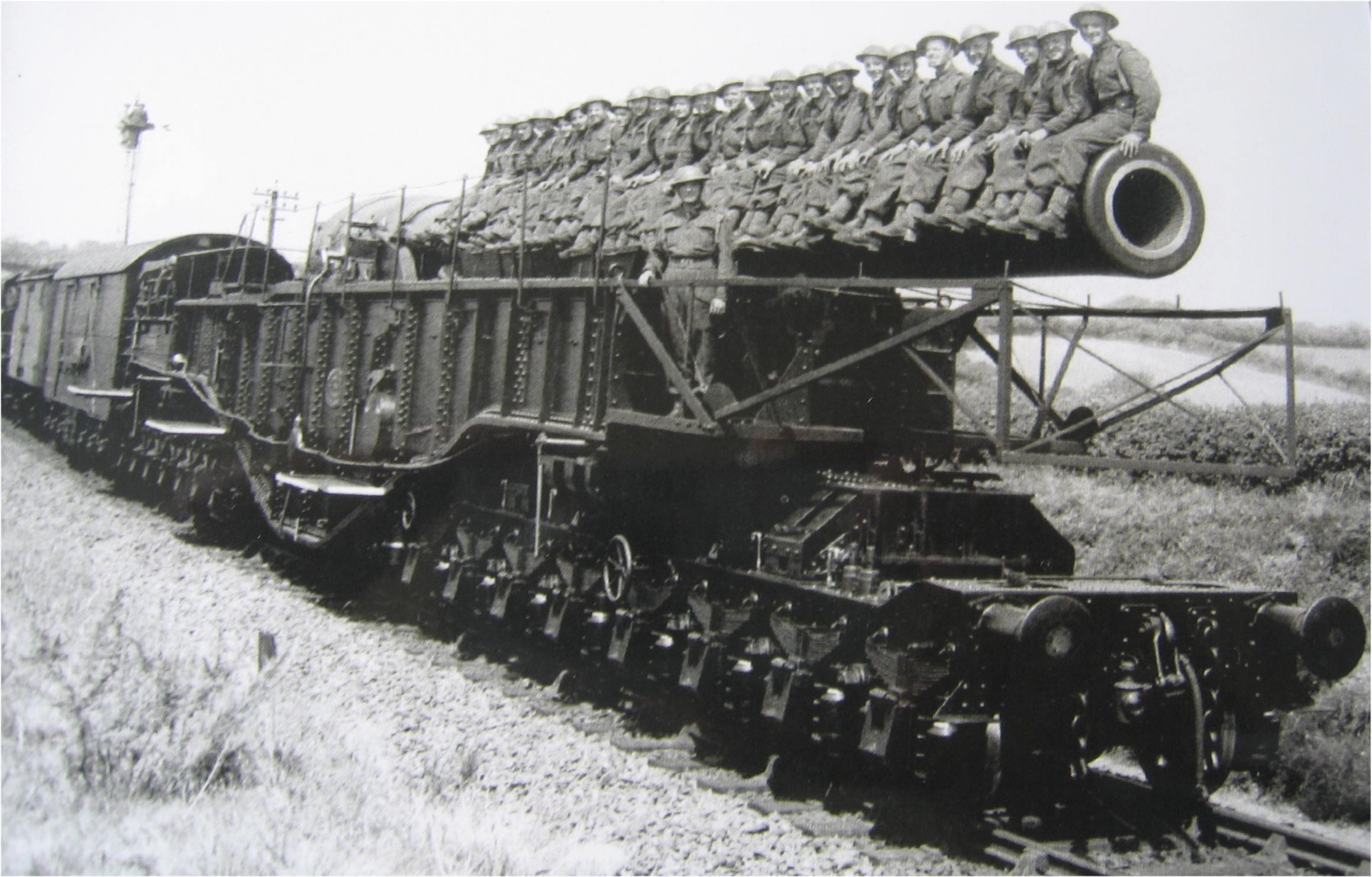
    a long-barreled, light shelled monster: its 92′ long barrel (plus a 20′ extension) launched a 94kg shell about 130 km, reaching a maximum height of 40km (about 25 miles) high. For all of its mass (the gun weighed 256 tons without the railway cars) the shell that it fired didn’t weight much at all….though the shell did reach an extreme height. (Ironically, the gun was built for attacking the deepest of the deep bunkers of the fortresses along the Maginot Line; it was never needed for that, as the Maginot Line was simply left behind in the Nazi assault on France.)  The British Ordnance BL 18 inch howitzer (below) was developedjust as WWI was enidng, but did not enter service until nearly two years after the war ended.

    File:BL 18 inch Howitzer Ashbury Station WWII.jpg

    The Schwerer Gustav was a 1350 ton beast which fired a 14,000 pound shell (!) about 20 miles. A  little later came the Nazi V-3 (the lesser known of the V-weapons), the Vergeltungsewaffe 3, a 130 metre (!) long, 150mm gun built alongthe side of a hill, launching a 140 kg shell. The Iraqi Big Babylon gun was sort of like this one, though never built–it was to have a 500′ barrel and would be supported by a hillside. Then there was the Nuclear Tube: the Atomic Annie (M65) cannon, which was another bruiser, being an enormous 85′ cannon that delivered the worst punch of all cannons, a nuclear warhead.  The weapon was test-fired in 1953 at Frenchman Flat at the Nevada Test Site and delivered a 15kt explosive device to a target seven miles away. There were 20 of these made, but given their diffiult-to-deploy-and-keep-secret status, and the nature of the shells, and the development of more sophisticated weapons, the M65 was obsolete almost as qickly as it was introduced, but was removed from the frontline only in 1963. 

    VWM240mmAtomicAnnie01.jpg

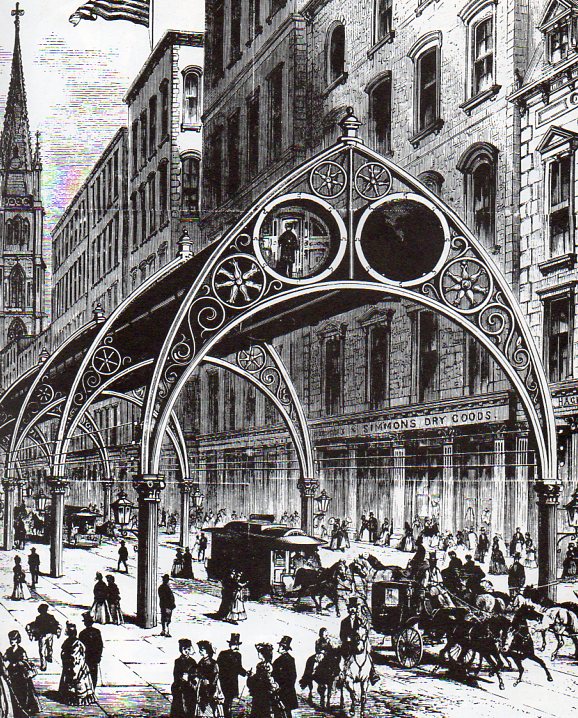
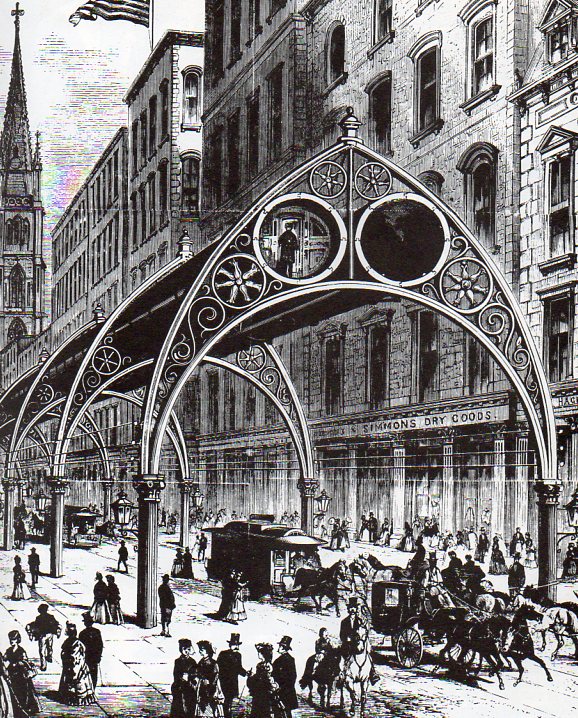
    I guess what people think of first though in regard to tubes in “The Tube” in London, though a more tubey tube was presented here in the pages of the Scientific American for the NewYork City subway:
    Tube nyc623

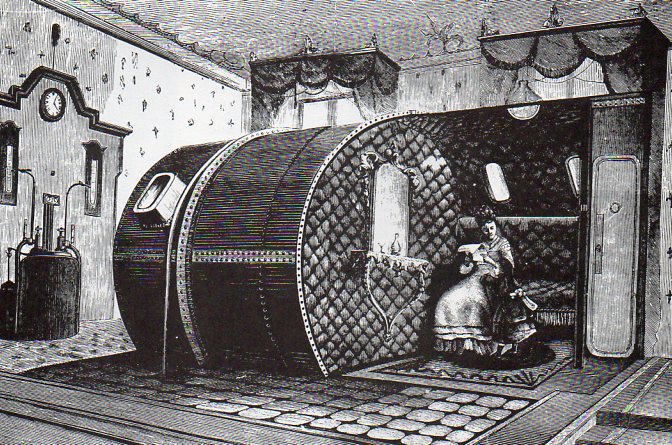
    Here’s yet another strange tube, this a tube-within-a-rectangle, an aerotheraphy device that was supposed to cure people of whatever they needed curing for, just like any other good quack device, though this may well have been the heaviest of them all.  Cushioned, well-appointed, and with a hint of luxury, this burst of fresh air was inteneded to render diseases and other complaints harmless–only for a lot more money than electro-shock or beer cures or massive purgatives or bleedings or copper amulets or whatever else you can come up with.  It does make a nice image, though:
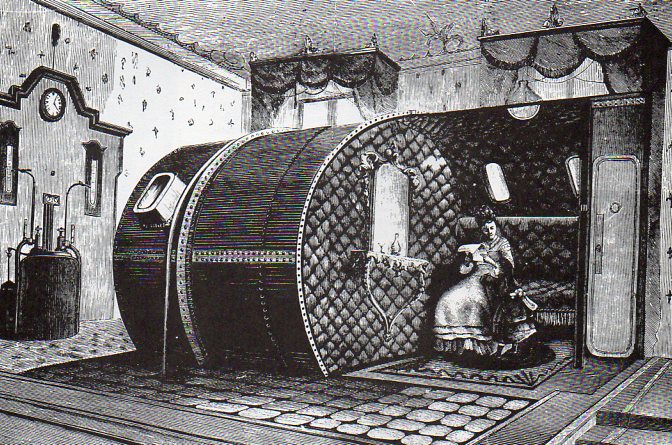
    Tube aerotherapy625

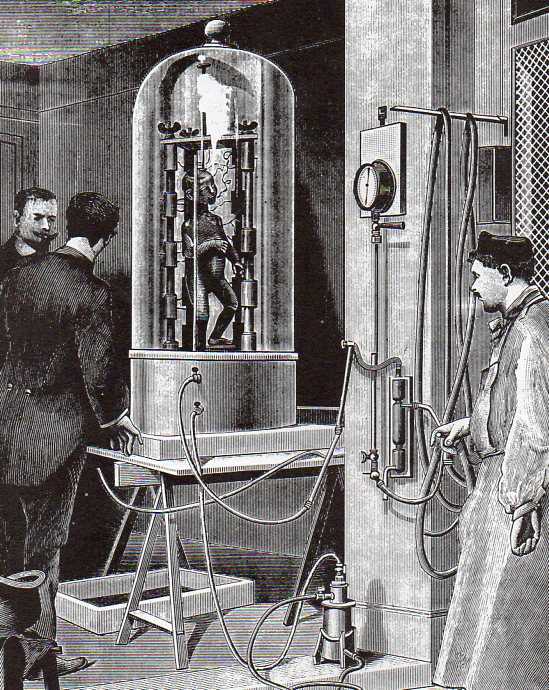
    The tube below may well have been the largest glass tube to hold the body of a dead person–and in this case, a dead child.  It was design for a practice that was evidently not practiced–electroplating the dead.  Someone thought it might make a good practice to deposit a one millimeter coating of copper on the skin of a cadaver, and published their success (and image) in the Scientific American for November, 1891.  The practice didn’t catch on.
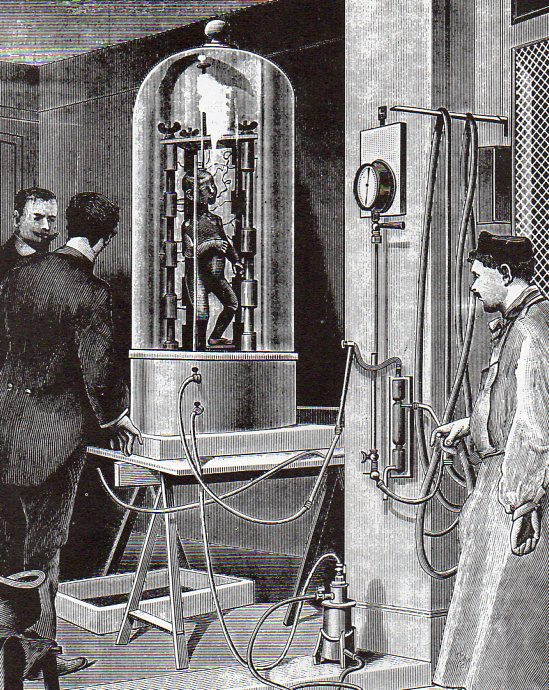
    Tube test tube dead622

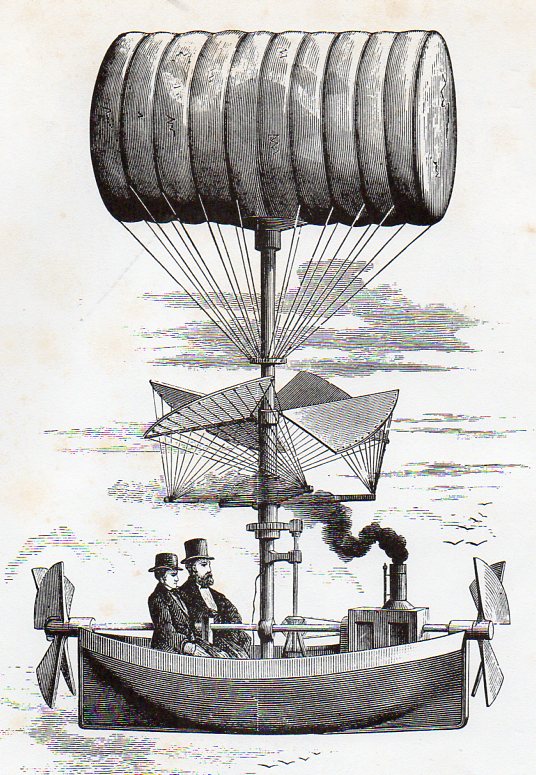
    Then of course there are submerged and flying tubes; submarines have certainly become a long-established part of the technological landscape, and the flying tubes, not. 
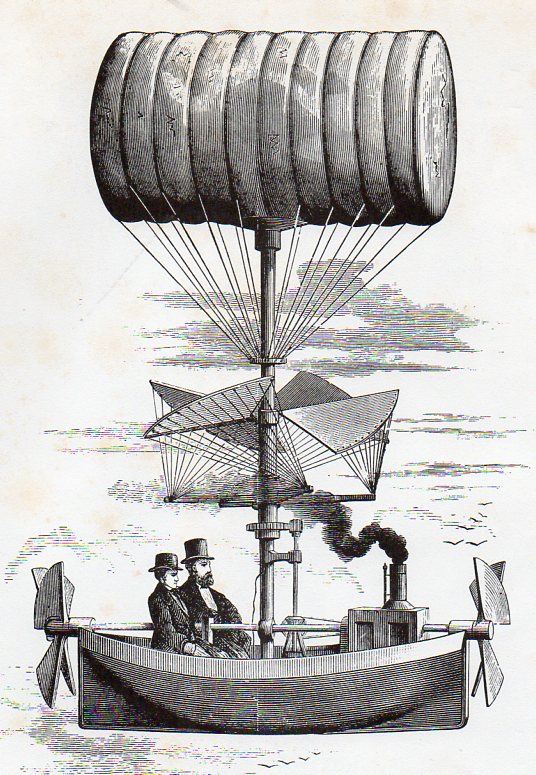
    Tube  flying620
    Still, the steam-driven helium-filled flying tube boat looks dignified and lovely, if impracticable.

    There were proposals in the late 19th and early 20th centuries for pneumatic railroads and pneumatic people movers (in one case in the 1930’s, for a plan to move individuals from New York to Philadelphia in chair-like objects in one of these tubes), but for all intents and purposes the closest that these plans came to fulfillment were pneumatic operations like thoe found in R.H. Macy in New York.  It was in the massive department store where you could find miles of pneumatic vacuum tubing that connected department tellers to a main counting office, where little cylinders were filled with cash and receipts and sent along for accounting.  The logical outocme of Macy’s tubular world for Terry Gilliam was seen in the director’s masterpiece dystopic flic, Brazil, where we see a world crowded with gargantuan and suffocating nothinness, filled with bazillions of miles of ductwork whose purpose is a mystery, making for a cold and disturbed world. 

    Brazil screen capture

    End part I of Making Tubes of out Holes–the History of Holes, Extended.

    Notes
    l. Edwin Abbott’s slender Flatland is perhaps one of the best books ever written on perception and dimensions, a beautifully insightful book that was quick and sharp, and in spite of all that was also a best-seller.  Written in 1884 when Abbott was 46 (Abbott would live another 46 years and enjoy the book’s popular reception), it introduces the reader to a two dimensional world with a social structure in which the more sides of your object equals power and esteem.  Thus the lowest class would be a triangle (three sides) while the highest (priestly) class would be mega-polygons whose shape would approach a circle.  Abbott’s magistry comes in explaining to the three-dimensional reader what it was like to be in a two-dimensional world.


  • A History of Holes: the Hole in the Clouds over Nagasaki

    JF Ptak Science Books   Post 1106   [Atomic and Nuclear Weapons Series]

    This post is one in a continuing series on the history of holes–the appearance of this particular hole meant the difference of life and death for hundreds of thousands of people, and it killed almost as many people as it didn’t kill. 

    The hole was in a cloud.  It was a corollary cloud to missing clouds from a few days earlier. 

    NagasakiCloud1Large


    On 6 August, 1945, the primary target of the first atomic bomb to be dropped on Japan was Hiroshima1–had there been unfavorable weather conditions, had the target been obscured by clouds or haze, a second target would be engaged–that was the Kokura Arsenal on the north shore of  Kyushu.  But conditions were bomb-favorable on that day, and Hiroshima was the city that was killed. Little Boy, the U-235 bomb dropped by Paul Tibbets from the Enola Gay  exploded 1,900 feet above Hiroshima. The bomb detonated and–with blast and shock wave and the ensuing damage and conflagration–70,000-80.000 people were killed (and at least double that number within five years).       

    It was a day before the news of the bombing was verified for Tokyo, and another day before the Big Six leaders of the Japanese army and government decided that they couldn’t decide in what to do with the Potsdam declarations and order of surrender.  It was a raging debate among those leaders, and it was a failure.           

    The second bomb, the plutonium Fat Man, was to be dropped by Major Charles Sweeney from Frederick Bock’s  B-29  Superfortress Bock’s Car on the next target, which was decided to be the  Kokura Arsenal.  And so Fat Man was taken over Kokura on 9 August, but by the time Major Sweeney (who had piloted the Great Artiste behind the Enola Gay on the Hiroshima bombing)  had arrived the previously comfortable atmospheric conditions had turned cloudy, overcast, the target obscured. Sweeney made three runs over the target, but it stayed hidden from the bombardier, and so the people of Kokura were spared. Major Sweeney tuned to his secondary target, Nagasaki.  With fuel running out, the clouds were also running thick over Nagasaki, until the last moment, when a hole opened in the canopy and the bomb was released through it,  exploding  with the impact of 22,000 tons of TNT at about 1640 feet above the city, killing 70,000 people (by the end of the year, 140,000 by 1950).

    The hills around Nagasaki confined the blast and protected those on the other side of them.  Kokura had no such terrain, which means that had the bomb been dropped there, even more people would have been killed outright and many more so over time. 

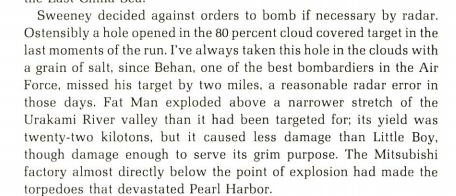
    The hole theory though is not necessarily complete–there may not have been a hole. Nobelist (physics) Luis Alvarez, who made major contributions to the firing mechanism for the weapon and a genius-in-general, and who flew as part of an Aerial Observation Team to assess the yield of the bombs, thought that perhaps there was a hole in the clouds and perhaps there wasn’t–“ostensibly” there was a hole, he wrote. Perhaps the bombardier saw the target, and perhaps not. In his Adventures of a Physicist (1989), Alvarez writes about the misery and the snaufedness of the mission, the clouds over Kokura and the multiple runs, the very low fuel which allowed only for one run on the Nagasaki secondary, and the growing accuracy of the flak from below. On page 145 he states that pilot Sweeny had decided against orders to attempt a radar-guided bombing of the 80% cloud-covered target–until suddenly the famous hole appeared, and bombardier Kermit Behan found the target and released the weapon.  Alvarez records that the bomb detonated about 2 miles off-target, which he said would have been an acceptable margin of error for a radar-controlled drop, which would fit nicely with the his claim that Behan was Air Forces’s “best bombardier”.  Alvarez said that he took the report of the hole “with a grain of salt”2.  (See extract below.)

    In any event, some sort of hole opened for Nagasaki, and closed for Kokura.

    Notes:

    New York Times correspondent William L. Laurence flew in the Great Artiste, following the   that delivered the bomb 1640 feet over Nagasaki. His report on Nagasaki appeared a month later in the newspaper, and the full text is available via the Atomic Archive blog here.  

    1. The targets discussed  by the Targeting Committee (“Minutes of the second meeting of the Target Committee, Los Alamos, May 10-11, 1945″) on 10 and 11 May 1945 included the following:
    (1) Kyoto (the former capital with one million people, a center of religious and intellectual life in Japan This target is an urban industrial area with a population of 1,000,000. It is the former capital of Japan and many people and industries are now being moved there as other areas are being destroyed. From the psychological point of view there is the advantage that “Kyoto is an intellectual center for Japan and the people there are more apt to appreciate the significance of such a weapon as the gadget”;  (2) Hiroshima (listed as an Army depot though “due to rivers it is not a good incendiary target”; (3) Yokohama (one of the largest remaining untouched industrial centers in Japan); (4) Kokura Arsenal (one of the largest in Japan and situated by urban industrial sprawl); (5) Nigata (port on Honshu) and (6)the Emperor’s palace (which was discussed  as a possible target but dismissed almost immediately).[Yawata was also considered (as an industrial center) (during the preliminary meeting of the targeting committee on 2 May 1945) (along with Tokyo, Nagoya, Osaka, Kyoto, Kobe, Hiroshima and Nagasaki.]
    .
    The members of the targeting committee (source for this material is Gene Dannen at Dannen.com, transcribing targeting material of the U.S. National Archives, Record Group 77, Records of the Office of the Chief of Engineers, Manhattan Engineer District, TS Manhattan Project File ’42-’46, folder 5D Selection of Targets, 2 Notes on Target Committee Meetings) included (on 10 May): “General Thomas  Farrell,  Dr. Charles C. Lauritsen, Colonel L.E. Seeman, Dr. Norman Ramsey, Captain Parsons,  Dr. Robert L. Dennison, Major John A. Derry, Dr. John von Neumann, Dr. Stearns, Dr. Robert R. Wilson, Dr. Richard C. Tolman, Dr. William G. Penney, Dr. Robert Oppenheimer.”  In attendance for the 11 May discussion was  Dr.Hans Bethe and Dr. Brode, plus: Colonel Seeman,  Dr. Stearns, Captain William S. Parsons, Dr. John von Neumann, Major Derr, Dr. Robert L. Dennison, Dr. Richard C. Tolman, Dr. Penney, Dr. Oppenheimer , Dr. Ramsey and Dr. Wilson.”

    2.  Alvarez on the hole:

    Alvarez nagasaki[Source, Luis Alvarez, Adventures of a Physicist, 1989, p 145.]