
Source: Kircher at Stanford University, here.
This image makes the “image engine” a little clearer:
Source:
Tratado da Catoptrica, (manuscript, 1716); from the Biblioteca Nacional Digital,
here.
It’s a romance of images machine, a box of antique wonder, a peepshow of centuries before, putting more things into a space than could exist. It was a relatively simple machine of great ingenuity: the interior of the free-standing box with rows of holes along its top edge perpendicular to the ground, and was lined with mirrors (as shown above in the Spanish document), with some mirrors set of at 45% angles; when objects were placed within the imaging-area of the angled mirrors, the object was multiplied, and then multiplied over and over as a result of the surrounding mirrors, creating in effect a “hall of mirrors”, leaving the observer with a sense impression of many dozens of objects that were contained within a container that was impossibly too small for what was being seen.
This of course is a property of some holes–they tend to make things larger than they could previously possibly “be”.
In this case, the viewer would look through a hole into a Borgesian box which would contain a multitude of its possible interiors. Looking through a hole in the end of a glass and mirror-ended tube and pointing it at the sky at night would reveal an enormous multiplication of a small part of that sky. In the early case of Galileo, what was first seen with the telescope was the multiplication of what was believed to be a finite and god-granted sky of perfection–he was seeing into some other sky, into a new vault of heaven, something never before seen, above-and-beyond what was known to exist. Hooke and Louwenhoeck had a similar experience with their (second generation) microscopes, seeing details and life never before encountered, entire worlds in a place no bigger than the head of a pin.
Sometimes a hole is just a dark thing; but more often than not, it isn’t.
Notes:
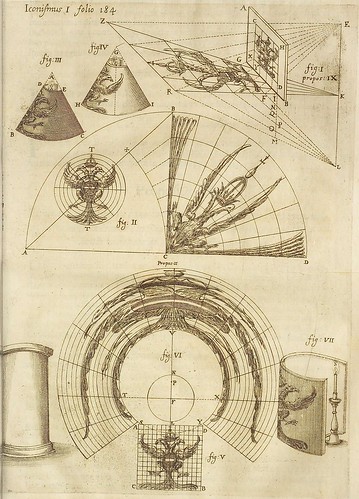
1. From the Greek, katoptron, mirror or pertaining to a reflected image or reflected light, such as from a mirror. There is another sort of catoptric that has been sort of widely used in antiquarian painting and parlor entertainments, which involves a canonical mirror reflecting a wide-field and distorted image into its proper perspective, which is known as catoptric anamorphosis. Another version of this sort of optic imaging is optical anamorphosis, which requires the viewer to stand at a particular (usually sharp) angle to a painting containing a semi-hidden image whose proper perspective is revealed only at a particular angle of viewing.
An example of catoptric anamorphosis, from the Kircher mentioned above:
See here: http://hyperphysics.phy-astr.gsu.edu/hbase/geoopt/catoptric.html
2.
Ars Magna Lucis Et Umbrae In X. Libros digesta. Quibus Admirandae Lucis & Umbrae in mundo, atque adeo universa natura, vires effectusque uti nova, ita varia novorum reconditiorumque speciminum exhibitione, ad varios mortalium usus, panduntur. Editio altera priori multo auctior. The work is presented at Bibliodyssey,
here.
Mr. P.K.hauls out a great quote and summarization of the work of Kircher by Robert Moray in his letter to the great guiding post of the Royal Society, Henry Cavendish, which really captures the spirit of the very busy/very curious and curious old man:
“Whatsoever Mr. Huygens & others say of Kircher, I assure you I am one of those that think the Commonwealth of learning is much beholding to him, though there wants not chaff in his heap of stuff composted in his severall peaces, yet there is wheat to be found almost every where in them. And though he doth not handle most things fully, nor accurately, yet yt furnishes matter to others to do it. I reckon him as usefull Quarries in philosophy and good literature. Curious workmen may finish what hee but blocks and rough hewes. Hee meddles with too many things to do any exquisitely, yet in some that I can name I know none goes beyond him, at least as to grasping of variety: and even that is not onely often pleasure but usefull.” (My bold.)
[Sir Robert Moray in a letter to Henry Oldenburg, 1665]


![desd [757 KB]](http://purl.pt/14540/1/1709123_JPG/1709123_JPG_24-C-R0150/1709123_0111_desd_t24-C-R0150.jpg)