A Daily History of Holes, Dots, Lines, Science, History, Math, Physics, Art, the Unintentional Absurd, Architecture, Maps, Data Visualization, Blank and Missing Things, and so on. |1.6 million words, 7500 images, 4.9 million hits| Press & appearances in The Times, Le Figaro, Mensa, The Economist, The Guardian, Discovery News, Slate, Le Monde, Sci American Blogs, Le Pont, and many other places… 5000+ total posts since 2008.

Category: History of Holes

  • Constellations of Bomb Craters and Trench Defense, 1917

    JF Ptak Science Books   Post 2028   Follow Me on Pinterest Series on the History of Holes  

    Also see: The Exploding Dots of Falling Dominoes: Dien Bien Phu, 1954
     

    Holes bomb313
    In the efficacies of categories for this blog I wonder about the placement of holes in the history of digging.  Most acts of digging results in making a hole, and some digging results in holes that are far longer or wider than they are deep, as in the case of trenches, and especially in the case of trenches dug during WWI, when many thousands of miles of them were dug and filled with millions and millions of men, perhaps as many as a million of them dying right there in the trench.

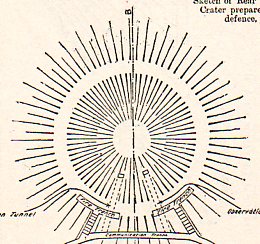
    Digging though is not a necessary condition for making a hole, or supporting a trench for that matter.  There were many millions of shells fired during WWI, and many of the craters produced by their explosions were converted  for use in conjunctions with trenches. 
    Holes bomb314There is a lengthy section of the relatively short (104pp) book Notes on the Construction and Equipment of Trenches–published by the Army War College in April 1917– dedicated to the employment of bomb craters in trench warfare. (This was 2.5 years into a war that Woodrow Wilson and most Americans south to avoid–not only to not fight, but to not necessarily take sides, to stay neutral, and it lasted about 900 very bloody days.) And as it turns out, of course, there are many ways to use a big area of scooped-out/blown-away earth in a complex geometry of narrow and interconnected diggings.  The hole could be used as a hole filled with barbed wire as a front line of defense–and here we are told (reminded?) about the scope of the so-called “wiring entanglements”, which should be 20 yards out from the lip of a  crater which should also be 30′ deep (!), the bowl of the hole lined with 3′ high runs of barbed wire that should be irregularly posted . At the rear for anyone who thought of trying to make it through such a hellhole would be a machine or Lewis gun.  (The wooden posts should be strong–“light posts are useless”.) Great numbers of these craters would be used like star points in a complicated astrological sign of want and destruction, and this book would aid in the education of how to bring these changes about.  (Of particular interest is the advisory that entanglement construction should be undertaken in 40/50-yeard chunks, and that the installation of these defensive measures at the very front of a line “should take place at night”.  Ineed. 

  • Heavy Stuff in Elegant White-on-Black Lines

    JF Ptak Science Books  Quick Post

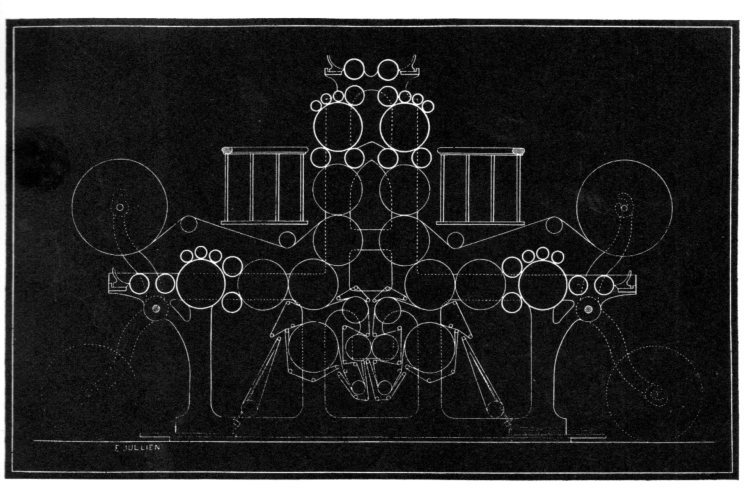
    Henry Jullien produced a beautiful work with schematics of printing machinery rendered in white-on-black, though I’m reasonably certain that the images were printed in black. The work was a catalog for the leading Belgian firm of printing presses and bookbinding apparatus.  The design is simple and very elegant and reminds me of some of the kinetic and non-represntational artwork that would come a few decades later.  (Heny Julien, Construction de Machines Typographiques, Lithographiques et Chromo-typographiques et Chromo-Lithographiques, 1881)

    Typography machine265

    ·Posted by :

    ·in:


  • History of Holes: the Battle of the Bulge, 1944-5

    JF Ptak Science Books   Post 2013  History of Holes

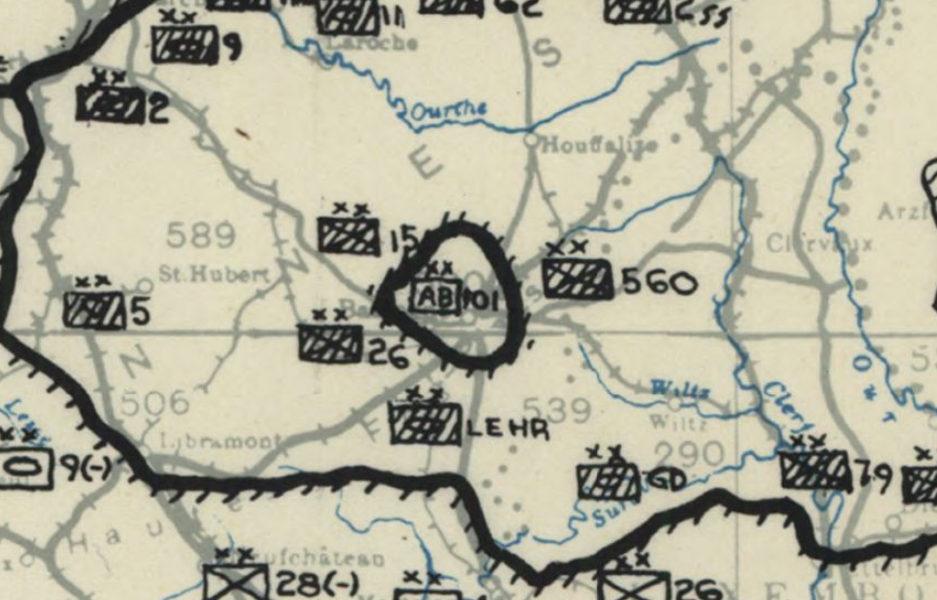
    This detail is from a pivotal moment in time in a crucial battle in the endgame of the European Theatre of WWII.  It is Christmas, 1944, and the action takes place in the Ardennes.  The German forces made a very unexpected assault through thick and very problematic wood, pushing Allied forces back along a long front, forcing a very perceptible bulge in the line–a bulge pointed the wrong way.  The bulge was pretty much in the middle of the line and in the middle of the bulge was a famous circle, and inside this circle was the 101st Airborne division in the town of Bastogne, and it was surrounded for the time being by overpowering elements of the Wehrmacht, including three infantry divisions and a panzer division  The boxes with the cross-hatches are all enemy forces, and for a time, the “AB101” stood quite by themselves.

    Bulge Dec 25

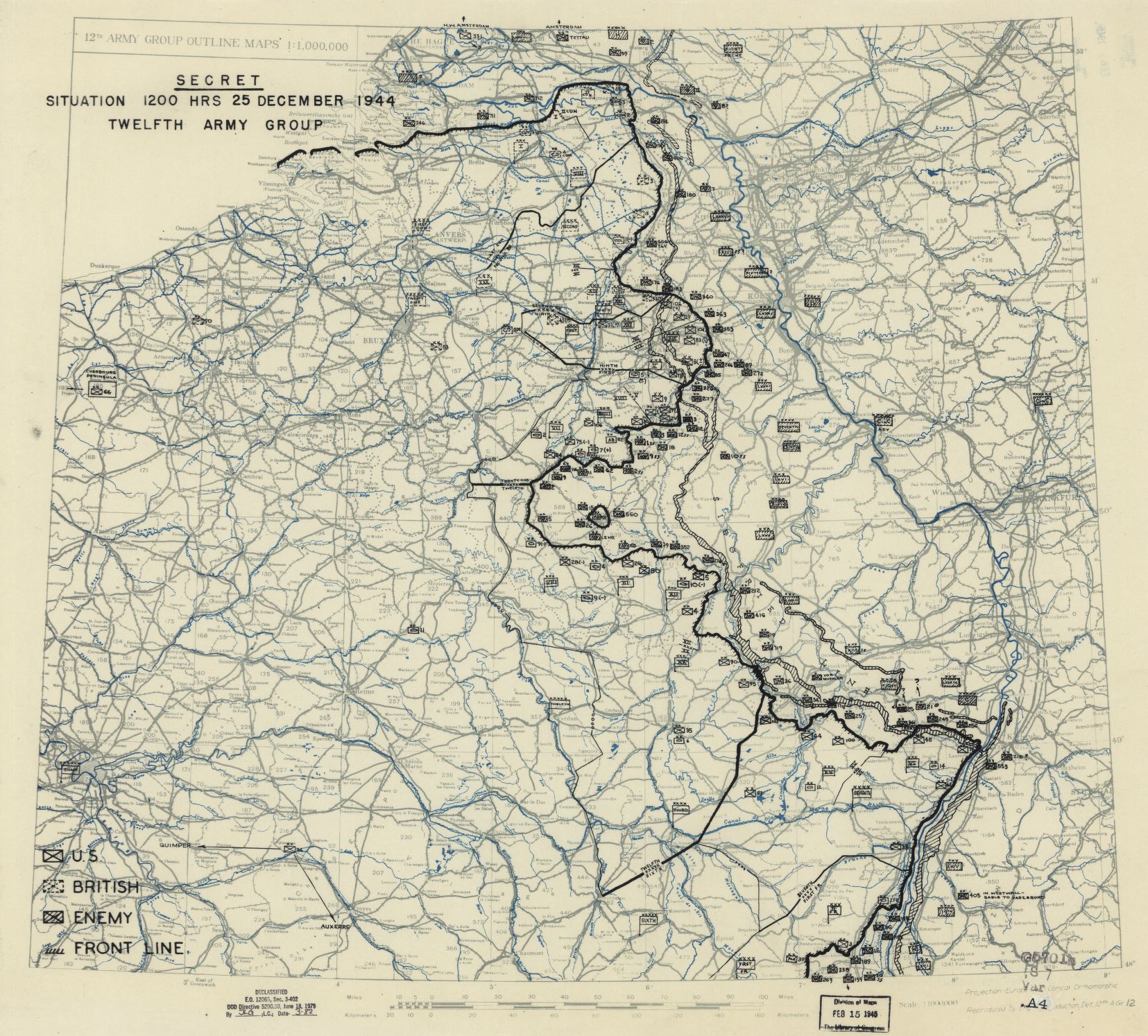
     The full map from which this detail is made is found at the Library of Congress site, here; the full suite of eleven maps showing the development of the battle from 16 December 1944 to 18 January 18, 1945 is also found here.

    Bulge dec 25 larger still


  • Decimals, Holes & Dots in the History of Mathematics

    JF Ptak Science Books   Post 2011

    There is an interesting side note to this blog’s series on the histories of holes and dots–a mathematical aspect involving decimal points, decimal notation and placeholders.  This is exclusive of the number zero, however, which is an entirely different topic. 


    Reisch b

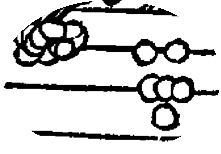
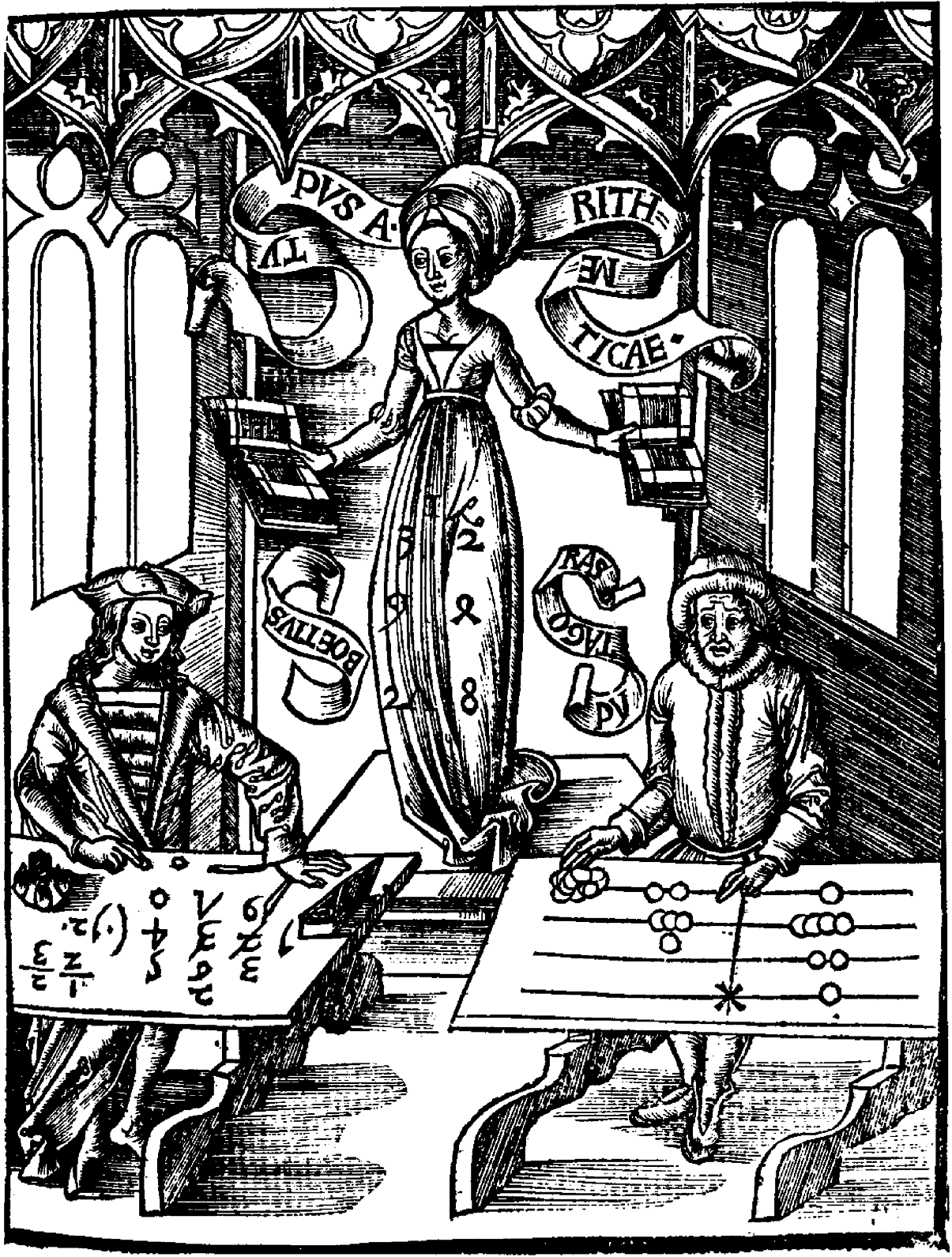
    The book that this  beautifully-illustrated counting board (below) is found is in Gregor Reisch’s  (1467-1525) Margarita Philosophica (1503)  and depicts (amidst much else in the greatly humanist volume) representations of the mathematicians Boethius and Pythagoras working math problems on the given tools of their day. The tools on the right seem to be circles, but they’re not–they’re counting stones, and for our intents and purposes here, they shall be dots, and in the history of dots in math and business reckoning they have had a strong and long life. 

    Reisch

    We can see in his expression that Boethius, on the left, is rather enjoying himself, knowing the superiority of his system of counting, which was the the Hindu-Arabic number notation–he definitely has a sly, self-appreciating smile on his face.  Pythagoras, working with the old counting table, definitely looks worried, or at least unhappy, unsettled.  Never mind that Pythagoras (570-495 b.c.e., none of whose works exist in the original, another sort of entry in our Blank History category) was at a definite disadvantage in the calculating department, being dead and all that for hundreds of years before the Arabic notation was more widely introduced in the West, probably being introduced by Pisano/Fibonnaci in the 12th century.  But it does fall to Boethius, the smirker, to have introduced the digits into Europe for the very first time, deep into the history of the Roman Empire, in the 6th century.

    The numerical stand-ins in the Reisch book with which Pythagoras worked were blank, coin-like slugs used as placeholders, and would be used in place of rocks or pebbles or whatever other material was at hand. It is interesting to note that the Latin expression, “calculos ponere”, which basically means “to calculate”or “to compute”, is more literally translated into  “to set counters” or “to place pebbles” (upon a counting board) or to set an argument2,  which is exactly what some of the Roman daily reckoners would do at their work. And also used, in this case, by the unhappy Pythagoras.

    The foundation for the .14159… that comes to the right of the integer 3 in pi is a relatively recent idea in the history of the maths–at least so far as the represrntation of the ideas in numbers and the decimal point is concerned. 

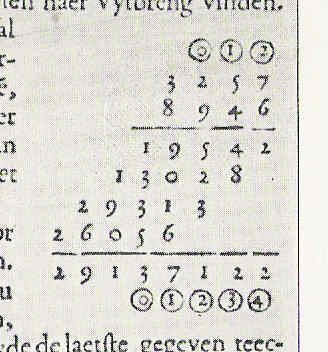
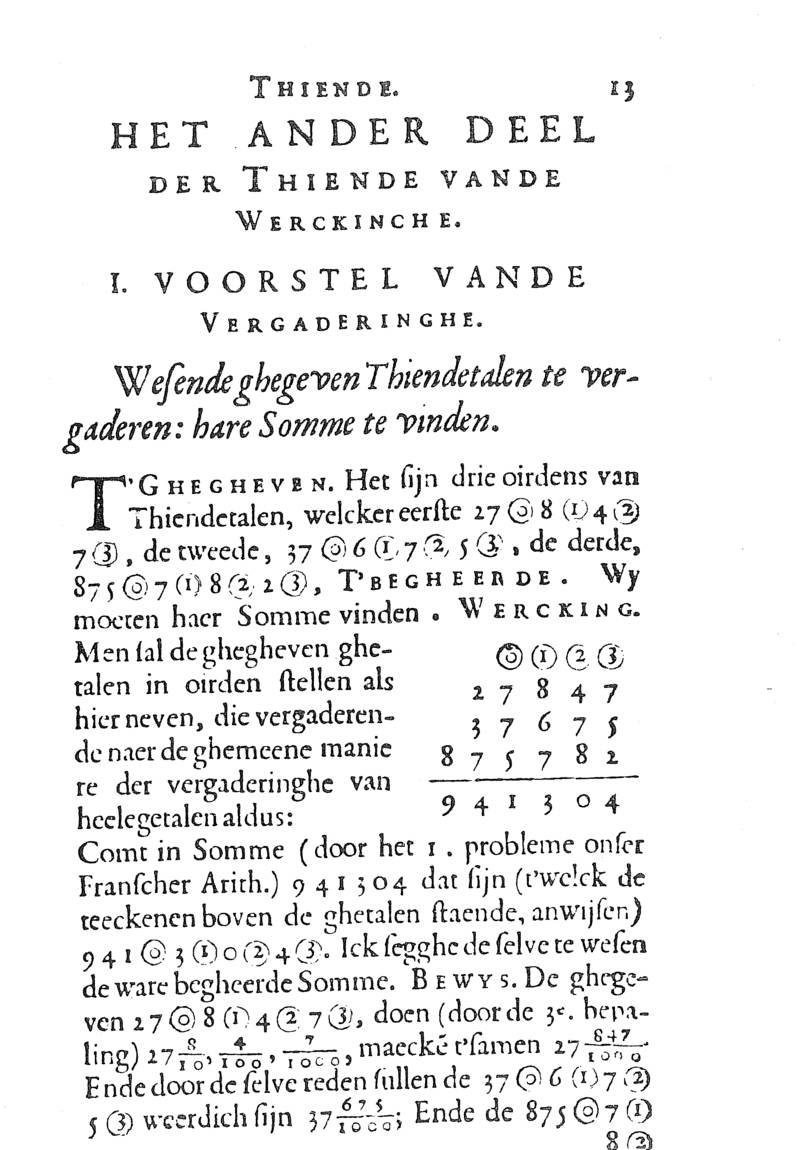
    Simon Stevin (1548-1620) introduced the idea of decimal numbers in his 36-page De Thiende (‘The Art of Tenths”1) in 1585, an idea that replaced much more cumbersome earlier methods of representation.  So, the number 3.14159 would be written in the Stevein notation as (where in this case numbers enclosed by brackets, i.e. “[9]” would have been represented in print as a 9 within a circle) 3[0]1[1]4[2]1[3]5[4]9[5].  It is also seen here:

    Stevin decimal
    [Source:  math Words, here.]

    Stevin decimals[Full text available here.]

    The importance of the introduction of this idea is difficult to underestimate, according to many and by example the  The Princeton Companion to Mathematics by Timothy Gowers:

    The Flemish mathematician and engineer Simon Stevin is remembered for
    his study of decimal fractions. Although he was not the first to use
    decimal fractions (they are found in the work of the tenth-century
    Islamic mathematician al-Uqlidisi),it was his tract De Thiende (“The tenth”), published in 1585 and translated into English (as Disme: The Art of Tenths, or Decimall Arithmetike Teaching ) in 1608, that led to their widespread adoption in
    Europe. Stevin, however, did not use the notation we use today. He drew
    circles around the exponents of the powers of one tenth: thus he wrote
    7.3486 as 7�3�4�8�6�4. In
    De Thiende Stevin not only demonstrated how
    decimal fractions could be used but also advocated that a decimal system
    should be used for weights and measures and for coinage.

    This idea would be further developed by Bartholomeus Pitiscus (1561-1613) who was the first to introduce the decimal point in 16123.   It was a far more robust and simple was of dealing with decimal notation than anything that had come before.

    Notes:

    1. Decimal arithmetic: Teaching how to perform all computations whatsoever by whole numbers without fractions, by the four principles of common arithmetic: namely, addition, subtraction, multiplication, and division. 

    2. The Reisch book is remarkable: it is basically a Renaissance encyclopedia of general knowledge, divided into twelve books:  grammar, dialectics, rhetoric, arithmetic, music, geometry, astronomy, physics, natural history, physiology, psychology,  and ethics.

    3. Pitiscus was also the first to introduce the term “trigonometry” earlier in 1595 in a highly important and influential work he produced in 1595.


  • History of Holes: Lakes and Holes and Imaginary Tears

    JF Ptak Science Books   Quick Post

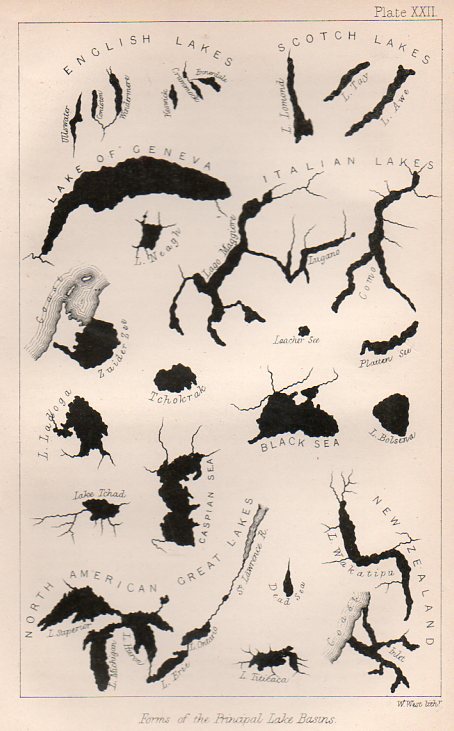
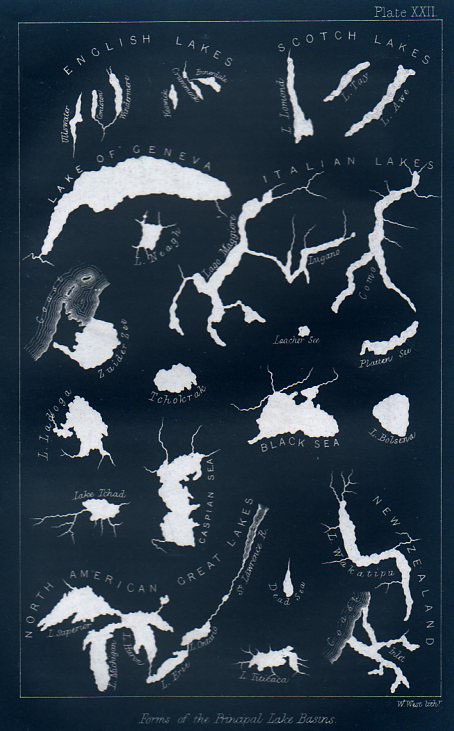
    This engraving was very nearly very interesting–I mean, it is interesting in that it shows the shapes of lakes together on a single sheet of paper, their shapes presented devoid of any other non-lakes.  Its really quite an arresting presentation, and coming at a relatively early time in presenting data in this fashion.  What the engraving doesn’t relate, unfortunately, is the size of the lakes relative to one another. 

    LAkes161

    And if the lakes were to be presented proportionally, Lake Geneva (surface area of 225 miles2 would be quite a speck compared to the likes of the Great Lakes, and Lake Superior (31,000 miles2) would speck-ish compared to the great Caspian (clocking in at 152,000 miles2). 

    This graphic appears still in the first decade or so of cartographic physical attributes being placed together, and was published in 1865 in the Popular Science Monthly. 

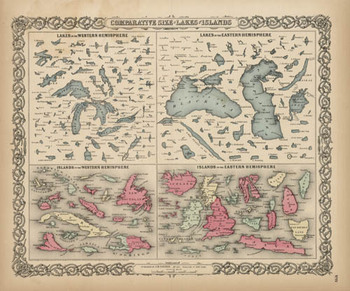
    Blogjuly_19_comparative_big_colton Here we go with a good representation of an engraving (above), this from 1856 and which may have been the first time that these 150+ lakes and islands of  the Western and Eastern Hemisphere were ever been printed on the same  page and in the same scale exclusive of their associative land masses  and placed contiguously, side-by-side.  They were, of course, seen in a  common perspective before on any world map, but I think that this is the  first year in which the islands and lakes of the world were displayed  without oceans and land masses, and the effect is a little odd.  If you  take away the color and the text the image takes on a very definite  biological flavor (I keep thinking of that tiny bone in the ear for the  small lakes…)  In any event it is far easier to compare these features  without the distractions of the non-lakes and non-islands clouding and  confusing our perspective fields.
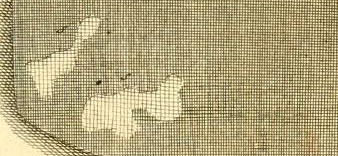
    The largest lakes, here.

    And as long as we’re at, let’s have a look at the first image inverted, which gives the lakes a good healthy dose of anthropomorphism via imaginary rips, tears, moth- and bullet-holes.

    LAkes inverted


  • History of Holes–the First Images of Holes Made by Insects?

    JF Ptak Science Books   Post 1995   Part of a series on The History of Holes #45Follow Me on Pinterest

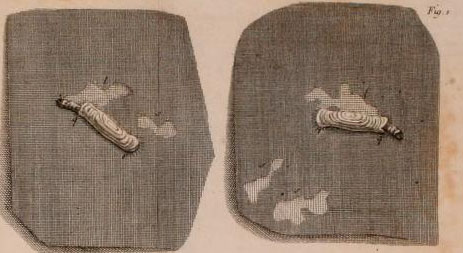
    Reaumur close-up det
    [Detail from one of the earliest images of holes made by insects? From Reaumur, citation following.]

    There are many different ways of looking at antique (or any other) scientific images.  Sometimes you see exactly what they’re supposed to be showing, and other times the viewer sees something more. Sometimes this “something more” is useful, and sometimes it is simply a side bit, not adding to the understanding of the image content, but curious nonetheless, useful in other ways.

    And so is the case with this miniature/micro observation of this engraving which appears in the great work on the lives of insects by  René-Antoine Ferchault de Réaumur:  Memoires pour servir a l’histoire des insectes, which was printed in six impressive volumes (some 26cm tall) in Paris from 1734 through at least 1742,  illustrated throughout with 269 engraved plates, many depicting more than one subject. This was the masterwork of its time on insects, a great effort made and achieved on insect architecture, biology, and behavior–it was a careful and exacting work, magisterial.  Reaumur (1683-1757) was an exceptional talent and observer, writing for the Academie des Sciences on a really wide variety of subjects for over fifty years–and even with this large output, most of his work was delivered posthumously to the Academy.   

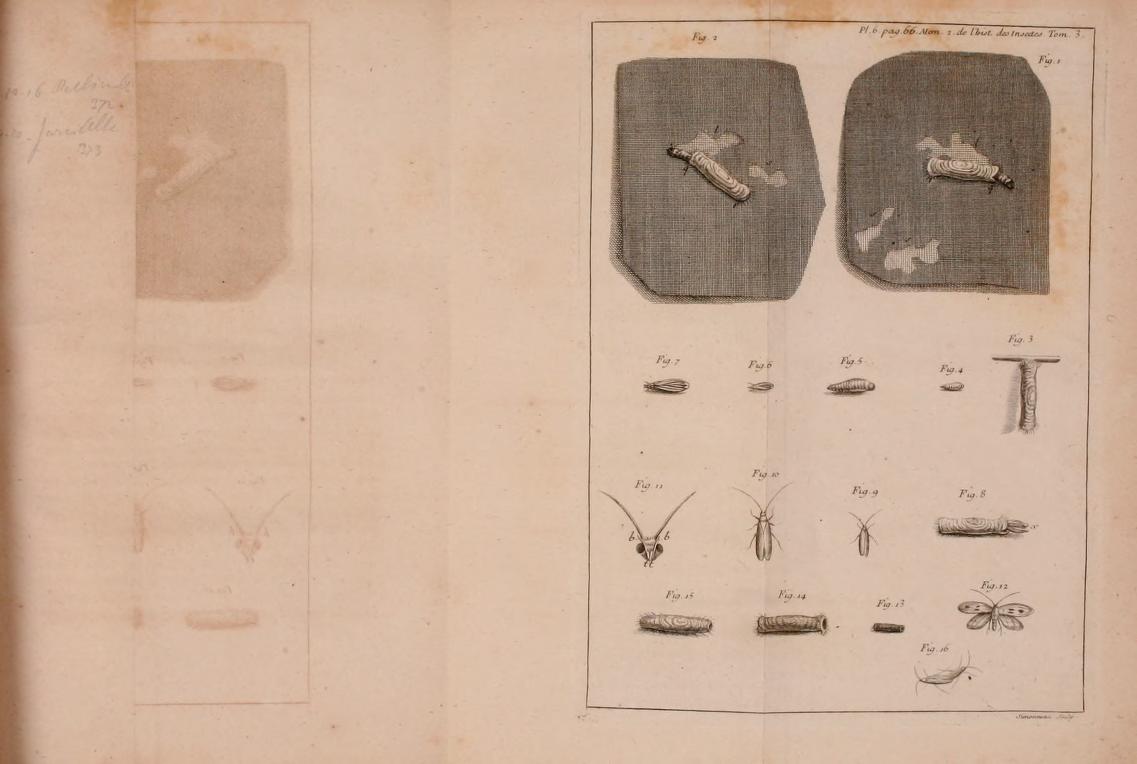
    My attention was drawn to him from an illustration in Barbara Maria Stafford’s Good Looking, Essays on the Virtue of Images (MIT, 1996, palte 93), which depicted the holes made by moths in cloth in volume 3 of the Memoires.  The first image, above, is a detail from the Reaumur engraving, with the full plate, following:

    Reaumur holes detail
    [Reaumur, Memoires pour servir a l’histoire des insectes… volume III,  from the Internet Archive, here.]

    And more:

    Reaumur holes
    The series on this blog concentrating on the history of holes may or may not make any contribution to anything at all, save for perhaps serving as an outpost on looking at images from a different perspective. 

    And just for good measure, here’s an image of the ghost of the image of the mothy hole, an image imprinted on the page opposite the page on which the original image was printed, the ghosted mirror image of the hole captured in an ink/iron impression on paper. 

    Reaumur holes ghost

     Here are the links for the six volumes of Reamur’s Memoires:

    Mémoires pour servir à l’histoire des insectes (1734-1742)

    • Tome I : Sur les Chenilles et les Papillons, Imprimerie royale, Paris, 1734, 654 p., 50 pl. ;
    • Tome II : Suite de l’Histoire des Chenilles et des Papillons et l’Histoire des Insectes ennemis des Chenilles, Imprimerie royale, Paris, 1736, 514 p., 38 pl. ;
    • Tome III : Histoire des Vers mineurs des feuilles, des Teignes, des fausses Teignes, des Pucerons, des ennemis des Pucerons, des faux Pucerons et l’Histoire des Galles des Plantes et de leurs Insectes, Imprimerie royale, Paris, 1737, 532 p., 478 pl. ;
    • Tome IV : Histoire des Gallinsectes, des Progallinsectes et des Mouches à deux ailes, Imprimerie royale, Paris, 1738, 636 p., 44 pl. ;
    • Tome V : Suite de l’Histoire des Mouches à deux ailes et Histoire de plusieurs Mouches à quatre ailes, savoir des Mouches à Scies, des Cigales et des Abeilles, Imprimerie royale, Paris, 1740, 728 p., 44 pl. ;
    • Tome VI : Suite de l’Histoire des Mouches à quatre ailes avec un supplément des Mouches à deux ailes, Imprimerie royale, Paris, 1742, 608 p., 48 pl. ;
    • Tome VII : Histoire des fourmis, Paul Lechevalier éditeur, Paris, 1928, 116 p. & Histoire des scarabées, Paul Le Chevalier éditeur, Paris, 1955, 340 p., 21 pl.

    ·Posted by :

    ·in:

    — — —

  • On Holes in and Life on the Sun, 1787

    JF Ptak Science Books    Post 1982   History of Holes series  #44  Follow Me on Pinterest


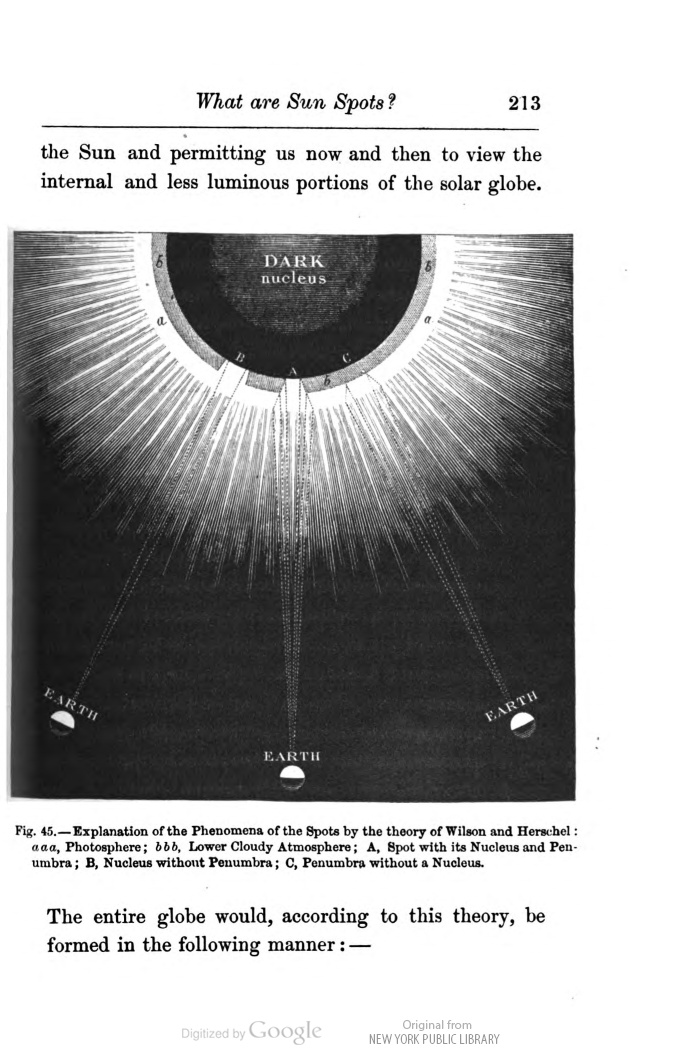
    Sunspot hole
    The composition of the sun remained basically hidden to scientists until relatively recently–certainly it was well into the 20th century before astronomers/astrophysicists got a good idea of what the sun is, exactly.  The perfection of god’s creation and Aristotle’s unchanging nature of the sun must’ve been suspected for a long time given its coronal displays during total eclipse and ancient unaided observation of sunspots (which at least suggested that the sun rotated), but the true nature of the “imperfect” nature of the star wasn’t firmly exhibited until the work of Thomas Harriot and the Fabricus and Galileo and Scheiner–but then there wasn’t that much that could be employed from the data. So too true even with Bunsen and Kirchhoff in their profound invention and discovery in 1859 of the spectrographic analysis of the sun revealing its chemical composition (finding the absorption lines in the spectrum of the sun contained hydrogen,m nicekl, iron, sodium,cacium, and magnesium as starters)–this information was essential in establishing discoveries that would come much later on. (Interesting to note here that the first record of a solar flare is made in this same year by Richard Carrington, and also that this year saw the publication of On the Origin of Species as well as Riemann’s hypothesis and Maxwell’s kinetic theory of gases–a big year in the history of science).

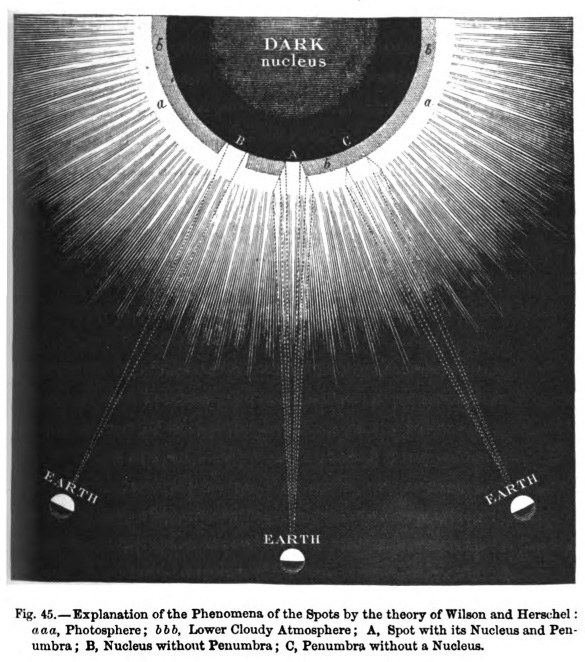
    The interesting hypothesis of sunspots as “holes” in the surface of the sun was made by Alexander Wilson (professor of astronomy at the University of Glasgow) in his paper “Observations on the Solar Spots” on 1 January 1774 and published in the Philosophical Transactions  (volume 64, pp 1-30, and available here).  It was one attempt at an explanation for the mysterious black spots that also opened the door to the possibility of the sun being inhabited.  The spots then would have been conical holes in the sun’s photosphere, with the dark part coming from a glimpse of the interior (and presumably cooler) part of the sun. 

    From the vantage point here in the future this looked like not such a great idea, especially coming only a few years before the (1787) discovery by William Herschel that the sun and the rest of the solar system was in motion relative to the stars and was slowly moving towards a point in the contellation Hercules, which was an enormous scientific breakthrough as well as philosophical-theological chllenge, a cosmological “aha!” moment.  That said, Mr. Herschel also held the view that sun spots were possibly cavities in the surface of the sun, the reasoning for which was very good and at times convincing in the absence of anything better, a pretty good product for its time

    The beautiful image introducing this post was designed about a hundred years after the Wilson paper, and appeared in the prolific Amédée Guillemin’s (1826-1893) The Sun (translated from the original French in 1875), and which is available in full text pdf from The Haiti Trust. Guillemin spends a chapter on sunspots and holes and presents a convicing history of the idea, and that according to Wilson and others the spots were cavities in a liquid globule envelope and revealed the solid mass of the sun “through a cloudy atmosphere with a grey tiny all around” (page 214). 

    The epilogue of Guillemin’s book addresses the issue of life on the sun (“Is the Sun Inhabited?”)  and in his review Guillemin very plainly makes the case that it is “absolutely impossible to support life” on the sun due to the heat–presently. He qualifies his assessment finally by asking “Will it become habitable?”, and responding that it was “very possible” (page 295), but that it would have to take place in a future where the rest of the planets and everything else has gotten colder. 


    ·Posted by :

    ·in:

    —

  • Fantastic Square(s), 1840

    JF Ptak Science Books  Post 1960

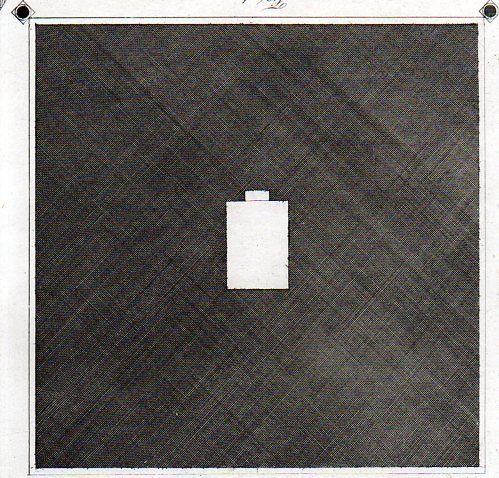
    I was shocked to investigate this seemingly magically-produced engraving under magnification–it was a small piece of inset work used to illustrate an idea within a much larger overall engraving.  The detail is about a 5% cropping of the full image:

    Square detail982

    It is a subset of this detail:

    Square detail981
    Which in turn is a detail from this beautiful work which is itself a four-by-four inch detail in a larger engraving, the footprint of an elevation of the Sepolcro di Caio Cestio, which was printed in 1840. 

    Square 983

    The craftsman who produced this engraving incised 250 lines on one side of this 4-inch-square, then proceeded to incise another 250 lines on the other–or so. This means that there are something on the order of 62,000 (or thereabouts) squares produced by the draftsman in order to make a mostly-black background for the image. 

    The plan is for the pyramidal tomb of Caius Cestius who was a monied Roman who demanded that for the disbursement of his will to be complete had to have this tombstone built to himself in a prescribed period of time–mostly very quickly.  The result has been captured by Piranessi and others–a very sharp-pointed pyramid about 130′ at its base and 145′ tall.  When finished the builders incised their victory and documented it on the side of the pyramid so:

    Opus absolutum ex testamento diebus CCCXXX, arbitratu (L.) Ponti P. f. Cla (udia tribu), Melae heredis et Pothi l(iberti). (“The work was completed, in accordance with the will, in 330 days, by
    the decision of the heir [Lucius] Pontus Mela, son of Publius of the Claudia, and Pothus, freedman”.)

    All I really wanted to comment on here though is the craftsmanship of producing this finely-lined and remarkable detail


  • Looking at the Sun (Winter Solstice, 2012)

    JF Ptak Science Books   Post 1948
    Follow Me on Pinterest 

    Astro art943

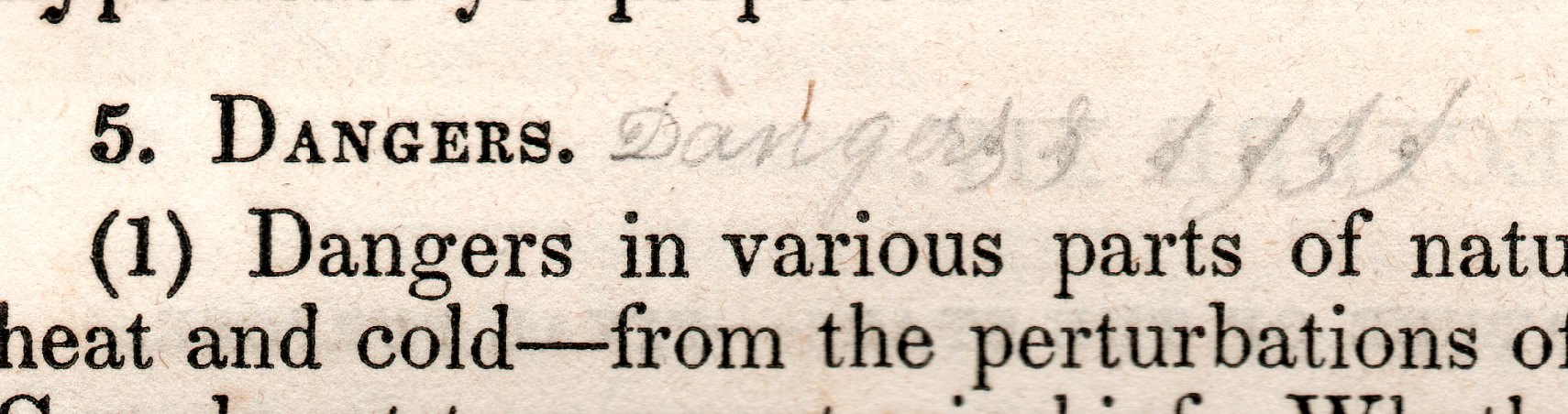
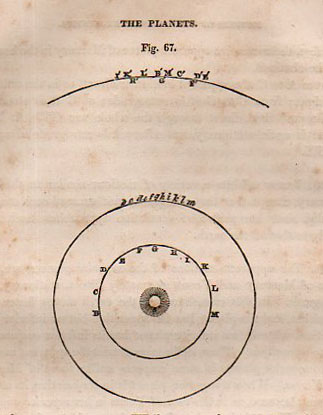
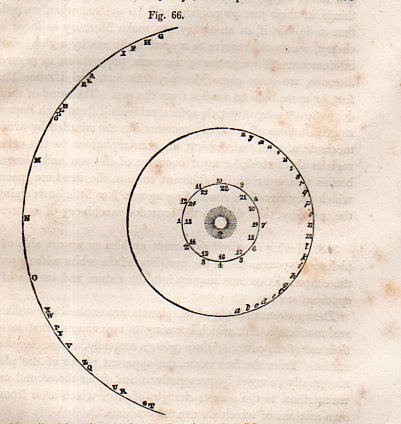
    Given that today is the winter solstice I thought to have a look at some artwork or imagery depicting the sun.  I went to bookcase where there were some astronomy books and plucked out one at random–it turned out to be Denison Olmsted’s (1791-1859) Practical Astronomy  textbook sort of written for his 12 students at Yale in 1839 (and bound with Ebenezer Porter Mason’s Introduction to Practical Astronomy, which was a supplement published ten years later).  Its a fine not-big/not-little book (320 pages plus Mason’s 135 pages), and it still reads pretty well. (There’s also a very sweet 16-page outline of the course he taught, breaking the lectures down into fairly small chunks.  There’s an interesting part of lecture XII entitled “DANGERS” which addresses heat and cold and bad business that could come from “perturbations of the moon and planets” and comets, of course, particularly the one like the “threatening circumstances attending the great comet of 1843”.  As it happens the only annotation made by the 19th century owner of this book was right here, in the danger section, where they wrote the word again followed by five check/whatever  marks.

    Astro art944
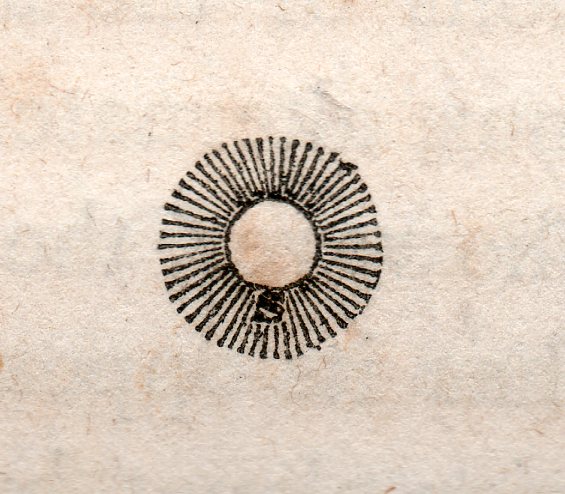
    There would of course be images of the sun in the book, and so was found this lovely small woodcut within the astronomical image (above), measuring in real life at about 5mm.  There are a lot of lines on the circumference of this tiny circle.

    The “S” stands for Sun. 

    Astro art det
    And another beautifully-design illustration from the same source: 

    Astro art945


  • Antique Microscopy of Holes

    JF Ptak Science Books  Quick Post

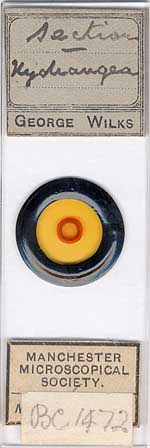
    This is a simple posting of some images found at the Manchester Microscopical Society website–beautiful 19th century preparations in which the circular specimen or stain happened to appeal to a sense of design, and which also fits snuggle into my long series on The History of Holes .  

       Follow Me on Pinterest

    Source for all images: Manchester Microscopical Society

    Micrscope slide e

    ·Posted by :

    ·in: