A Daily History of Holes, Dots, Lines, Science, History, Math, Physics, Art, the Unintentional Absurd, Architecture, Maps, Data Visualization, Blank and Missing Things, and so on. |1.6 million words, 7500 images, 4.9 million hits| Press & appearances in The Times, Le Figaro, Mensa, The Economist, The Guardian, Discovery News, Slate, Le Monde, Sci American Blogs, Le Pont, and many other places… 5000+ total posts since 2008.

Category: Women, History of

  • Women in Sports–Early and Vintage Photographs

    JF Ptak Science Books   Quick Post

     I’ve scouted some interesting photographic images of women in sports from the fine New York Public Library Digital Collections (here). They’re mostly from the ‘twenties, though there are some earlier imges from the 1890’s, as well as some later ones from the 1939 World’s Fair. Enjoy.

    Sports - Boxing - Women in Trylon and Perisphere sweaters boxing

  • Quiet, Beautiful Bathing Beauties, 1900

    JF Ptak Science Books    Quick Post

    [Bathing beauties, Atlantic City, N.J.]

    These images are just quietly magnificent.  They were made by the Detroit Publishing Company, and published sometime between 1890 and 1900.  The original is a glass negative, and this digital copy appears on the Library of Congerss site, here. 

    [Bathing beauties horsing around, Atlantic City, N.J.]

    ·Posted by :

    ·in:

    —

  • The Topography of Antiquarian Sisters

    JF Ptak Science Books    Quick Post

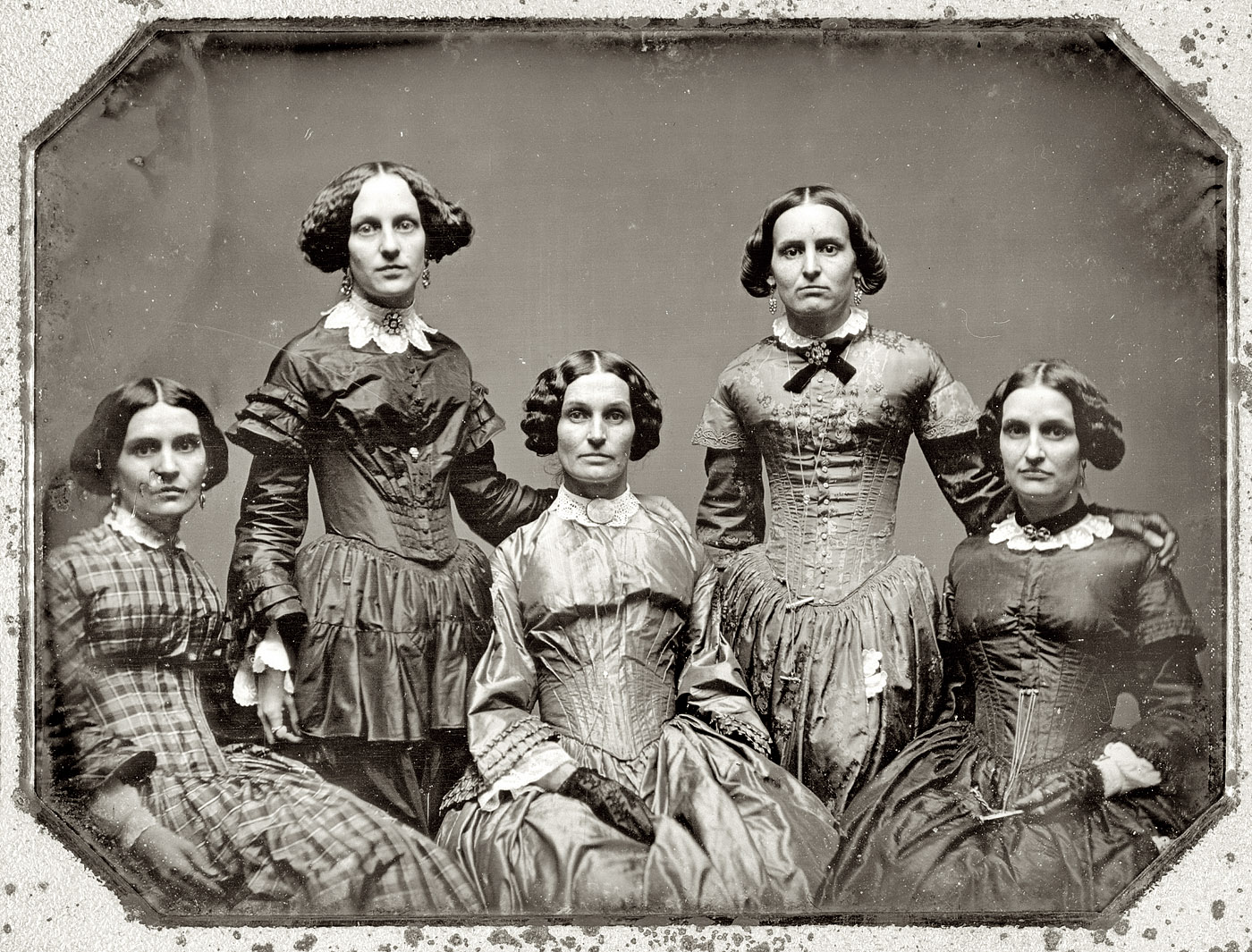
    Sisters

    Photo source: Library of Congress, via Vintage Photography, at retro-vintage-photography.blogspot.com

    This photograph–a daguerreotype, really–is both extraordinary and terribly common, at the same time, and is so in a way that is difficult to define, just that it is so.  It is the work of Frances Benjamin Johnston (whose collection resides at the Library of Congress) and was completed between 1845-1860, and shows the photographer’s aunts.  They make a formidable group.  I’d like to be able to find the data that the outline of their portraits form, because to me they look lik a graph.

    The photographer, Frances Johnston (1864-1952),  was one of America’s first successful female workers in the field of photography and photo-journalism.  She opened a studio around 1890, and went into business, no doubt helped along by her wealthy family’s social clipboard.  That it took 50 years or so and the application of a family’s small fortune to firmly establish a woman at this rank in photography, so close to the year 1900, so far into the advance of photography, is remarkable. The self-portrait, below, shows her mind:

    File:Frances Benjamin Johnston, full-length portrait, seated in front of fireplace, 1896 (altered).jpg

    she reveals herself a woman of the modern age, with her petticoats flaring and obvious, a cigarette in one hand, and a beer stein in the other, secrets no longer.

    Sisters 1


  • 1902’s Women of the Future Trading Cards

    JF Ptak Science Books   Quick Post

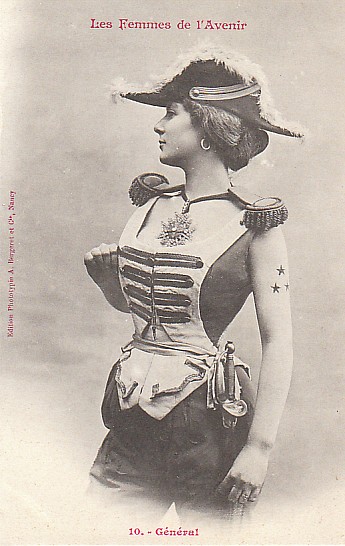
    Again from the interesting and charming La Boite Verte website I’ve found an interesting suite of French photographic postcards.  This set concentrates on the possible occupations of women in the  future (“avenir”/”future”), and printed in 1902 by A. Bergertet in Nancy, France.  The images are slightly odd, most tbeing a little on the “swimsuit issue” side, but then again not without the women exhibiting a kind of coy pride in spite of what they looked like.  In spite of the attire, the women depicted as the “general”, the firefighter (“pompier”), student (complete with a jauntily-held cigarette), and the sailor (“marin”), for example, are all taking their future positions seriously, even though their uniforms have been arranged for a 1902 man’s viewing pleasure. 

    Its interesting to see that seeing into the future of professions and callings for women didn’t habe to “see” all that far, with all of the professions being attained within the next 50-75 years. Of course the pay is largely still not same for women as it is for men, nor is women’s percentage share (for most) anywhere close to a proportional share, but it is a good start. 

    [Image Source: Le Boite Verte and Fantasies Bergeret]

    les femmes de lavenir phototypie bergeret 13 Les Femmes de lAvenir   1902


  • The Female Doctor Gets a Vote of Confidence, 1865

    JF Ptak Science Books   Post 1727

    “Life for both sexes—and I look at them, shouldering their way along the pavement—is arduous, difficult, a perpetual struggle. It calls for gigantic courage and strength. More than anything, perhaps, creatures of illusion that we are, it calls for confidence in oneself.”–Virginia Woolf, A Room of One’s Own

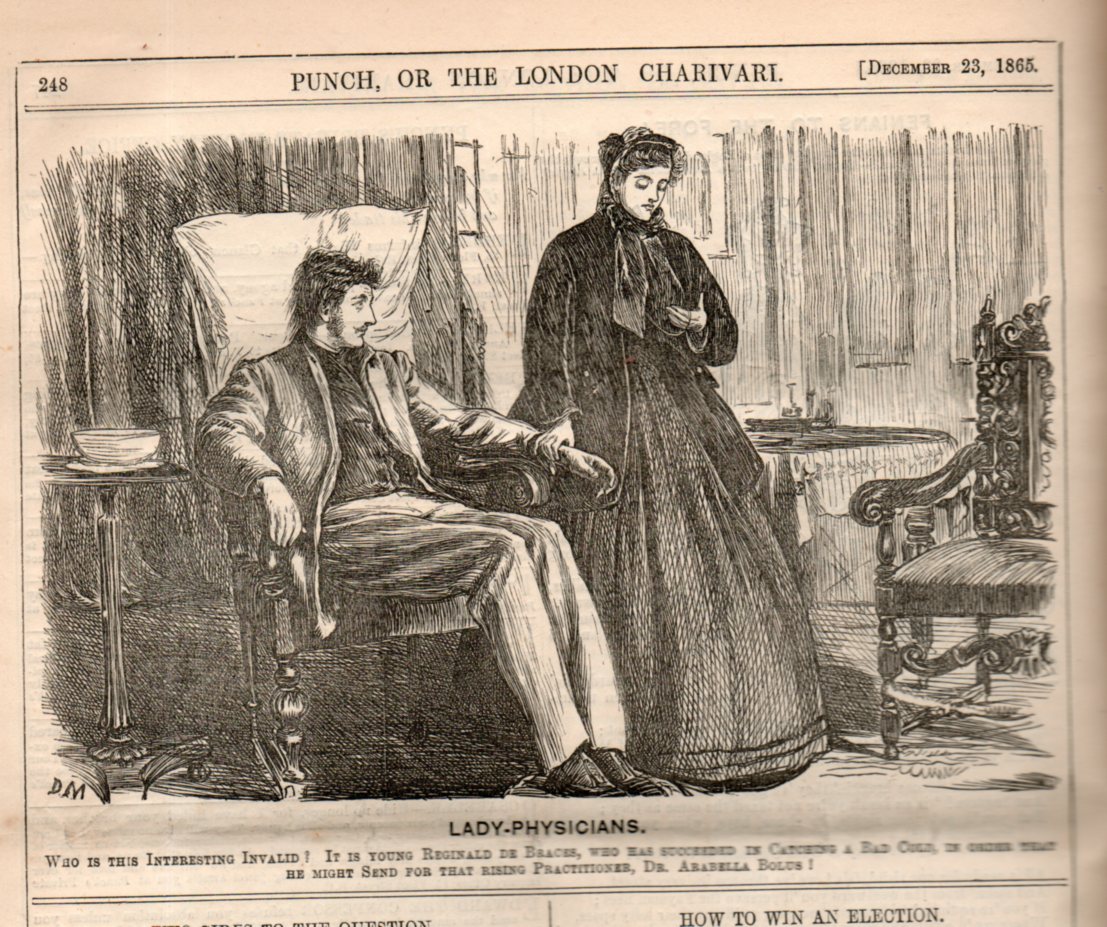
    I’m sorry to have stayed for so long in Punch magazine, but it is a very interesting read.  I’ve a run of 50 years or so of it here and on occasional a few volumes get pulled out and I make my way slowly/quickly through them.  Earlier this morning a cartoon lampooning British scientists (and a screaming zero) caught my eye–and now, after tea, comes a chance find of this image of a female doctor that seems to my interpretation to be an endorsement of sorts to the general idea of female education.

    Woman dr234

    Punch can be a very cranky periodical, lampooning everything, taking few (or no) prisoners.  On occasion I’ve noticed (and this is hardly an academic summary, just an exposure-to-a-lot-of-pages identification) that the idea of educating women and girls has fallen in and out of favor with Mr. Punch–the idea of the general intellectual capacity of woman seems occasionally to be in crinoline-entombed confusion in Punch‘s pages, even though it does seem to be a not-irregular contradiction for the large-headed, small-bodies, world-balancing Mr. Punch.

    But not this time.  It seems the cartoon, the “Lady-Physicians”, takes the high road for the woman doctor, portraying her as a competent professional while her limpid cold-attracted patient is portrayed as a pillow-encrusted dandy who has called upon his doctor than for no other reason than to gain her fancy.  Its an interesting position for the magazine to take, here in its 23 December 1865 issue.  A pro-woman professional, pro-female education stance is not a common one for many magazines at this time, not even in Punch itself, which seems at this point to be throwing off its own earlier opinions on the question sagacity of advanced instruction and education for women. 

    It seems to me as though Punch, even as early as 1865, is getting ready to grant women a room of their own in which to do what needs to be done. 

    ·Posted by :

    ·in:


  • Are YOU the Girl for the Job? 1952

    JF Ptak Science Books    Quick Post

    These were the helpful hints to get the working woman out the door and into a job that she could keep–following the reimine of daily healthcare and body awareness as suggested by Bristol-Myers, the maker of the list as well as most of the products that one could buy to help keep pace with it.

    girl6

    ·Posted by :

    ·in:


  • The Awful Revelations of the Future of Emancipated Women, 1904

    JF Ptak Science Books    Quick Post

    http://prints.encore-editions.com/500/0/concerning-the-american-girl.jpg

    Should woman be allowed to vote such are the tragedies that awaited, via 1904 sensibilities


  • On the Intellectual Power of Bathrooms–the British Museum, Education & Poor People in the 19th c.

    JF Ptak Science Books     Post 1649

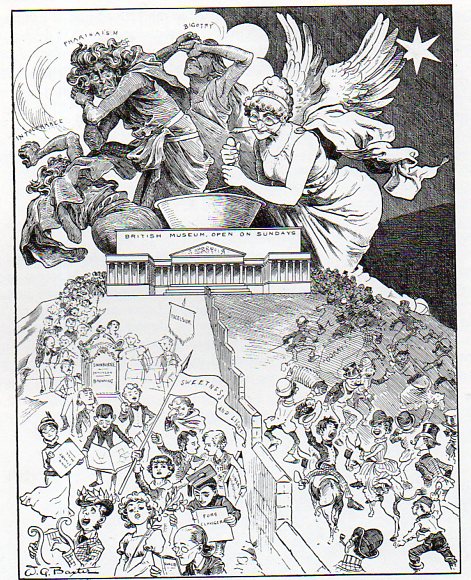
    People, working people, the so-called “vulgar classes”, sailors, unescorted women, married women with babies, people who worked with their hands, people who worked (in general), all began their assault on the previously-just-for-the-“correct”-classes knowledge base of England–the British Museum–in the first third of the 19th century.  It was a failed attempt, really, because the powers-that-be of the Museum were repulsed by the idea of the underclasses coming in to the place were the proper people came to learn, fearful that they would be repelled by their lowered and unfortunate brethren.

    Sunday975

    [“A Dream of the Future”–the Sunday Opening, from Judy, 1885.  Source: Lynn Barber, The Heyday of Natural History, Doubleday, 1980, page 166.]

    The Museum wasn’t open very much at all–only three days a week, receiving people between the hours of 10 and 4, restricting access to women with children, to women in general, as there weren’t any restrooms for females.   I’m not sure when the first women’s facilities came into being at the Museum, but it took them until 1879 before the place was opened daily.  And “daily” means every day, every day but Sunday, Sunday being a day not only of various religious obligations (which I think was the least of it), but also a day in which the greater percentage of the working class was not working ( which I think was the root of the issue).  That privilege of opening the Museum to the great unwashed, opening the place on Sunday, didn’t occur until 1896. I imagine even then that there was resistance to the innovation of reaching out to working people.

    The odd thing, now, is that many museums and libraries have been limiting their public hours, closing on Sundays, the day on which most people today find themselves not at work, restricting themselves to availability to a population of people who may mot be working a 5/6 day workweek. Plus ca change, plus c’est la meme chose.


  • The Sci-Fi Call to Women in Past-Future Distress

    JF Ptak Science Books   Quick Post

    This adventure (“Radio Planet vs. the Ant Men”) sounds more like a Captain Beefheart song than a fantazine for kids/young adults/whatever, but there it is–and what the cover for the magazine features in spite of the article title was yet another (dazed) woman in sci-fi distress. In the panoply of sci-fi-danger-women this one is pretty composed and dressed relatively, this of ccourse is relative to all of the other who have their dresses falling/slashed/dissolving/torn/falling of, revealing the Great Secrets of Composed and Dangerous Sexuality.  In any event, there seemed to be many instances of women-needing-rescue–and in many circumstances they are tending towards nakedness or its suggestion, and have their arms dangling at their sides. Here’s a quick review of some of the covers that might have put the “X” in “se_uality”:

    AP1474 - Famous Fantastic Mysteries, Pulp Magazine Cover, Artsit: Virgil Finlay, 1942 (30x40cm Art Print)

    robot_monster_poster_01


  • Battle of the Future: a Note on the Value of Women from Two Different Utopian Novels of the Same Title

    JF Ptak Science Books    Post 1599
    http://afflictor.com/wp-content/uploads/2011/02/Grandville_-_Un_Autre_Monde_-_Juggler_of_Universes-J.-J.-Grandville.jpg

    This is a short tale of two novels of the future.  They both speak of utopias, they both were written in the 19th century, and (unusually) they both have the same title–but so far as the future of women goes, they have little in common.

    Three Hundred Years Hence, the novel title in question, was first published in 1836, and was the property of  Mary Griffith (1772–1846) who presented what was at the time a strongly pro-woman utopia set in the future, –and which was also as it turns out the first novel of its kind written by a woman in the United States.

    A lesser and unhappier story for women of the high Victorian mold belongs to William Delisle Hay1, whose own Three Hundred Years Hence, a Voice From Posterity (published in 1881) , elevates females to a supreme position, though without any real power or effect.  (Hay has a difficult history, or so it seems to me; he also wrote on mushrooms and other fungi, as well as the Maori “problem”, and had a wide strain of white suprematist running through his works.) In Hay’s future, in the 23rd century, there would be a global community, and at the head of the global body would be a perfect woman, a woman who would serve a ten-year term of glory and grandeur. She would not have any real duties, however, because she was didn’t have the intellectual powers of man, and so her brain would no tbe called on to perform tasks outside of womanly chores. He writes:

    “…the Empress does not possess one particle of actual power…for the facilities of women are not capable of following out the highest intellectual processes, since she has a less degree of pure Reason than the man.”

    And:

    “…Woman (is) most emphatically fitted to display in herself the ornamental part of government…and…she is manifested as the proper director of all that relates to domestic life”.

    This of course is 1881.

    Hay hardly stands alone in his misanthropic approach to women.   Percy Greg’s tale of the future in his Across the Zodiac, the Story of a Wrecked Record (1880) shows the extent of the intellectual calamity and inferiority of women extending to Mars.  In this novel2 Greg’s Martians have come to realize that it is not possible to elevate their women to the intellectual status of men, and that their grand experiment of equality was a failure.  There were many others, of course, like  Walter Besant (The Revolt of Man, 1882), who could not abide the thought of equality. 

    And according to the wonderful I.F. Clarke (The Pattern of Expectation, 1644-2001), there were many more who looked into the future and saw greatness and expansiveness in the equality of women.  There was E.B. Corbett (New Amazonia, 1889), H.R. Dalton (Lesbia Newman, 1889), Lady Dixie (The Revilution of 1900, 1890), G.N. Miller (The Strike of Sex,1891), A.G. Mears (Mercia the Astronomer Royal, 1895), R. Buchanan, (The Rev. Annabel Lee, 1898), and Sir Julius Vogel’s (Anno Domini 2000, or, Woman’s Destiny, 1889), where “woman became the guiding…force of the world”. 

    I think, that, overall, the people who saw the restriction of women in the future (near and distant) held sway, or at least the majority, of writers envisioning the sexes int he future. 

    Notes:

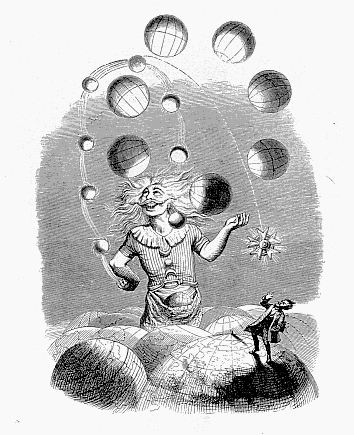
    * The first image is by the great and prolific and short-loved  J.J. Grandville (1803-1847) for his Autre Monde (1844).

    1. I have found another reference to a bitter world of the future written by Hay in the excellent Airminded blog, which records his effort at a novel of doom and destruction of the overtaken London of the future.

    2. Greg’s characters visit Mars via the benefits of a sort of anti-gravity spacecraft called the Astronaut, and, interestingly, the Martians had seem themselves as the only life forms in the galaxy.  It is also in this novel that the first attempt at creating an alien language appears.  There was also another science fiction effort by this title as well, though it really doesn’t apply to what we’re talking about, here.  (I wonder how prevalent duplicating titles is in the sci fi genre?)