A Daily History of Holes, Dots, Lines, Science, History, Math, Physics, Art, the Unintentional Absurd, Architecture, Maps, Data Visualization, Blank and Missing Things, and so on. |1.6 million words, 7500 images, 4.9 million hits| Press & appearances in The Times, Le Figaro, Mensa, The Economist, The Guardian, Discovery News, Slate, Le Monde, Sci American Blogs, Le Pont, and many other places… 5000+ total posts since 2008.

Category: Women, History of

  • John Stuart Mill and the Early De-gendering of the Subject–Inventing “Person-kind”

    JF Ptak Science Books   Post 1587

    File:Mill's logic 1867.jpg

    “That the principle which regulates the existing social relations between the two sexes — the legal subordination of one sex to the other — is wrong itself, and now one of the chief hindrances to human improvement; and that it ought to be replaced by a principle of perfect equality, admitting no power or privilege on the one side, nor disability on the other.”–On the Subjugation of Women, John Stuart Mill, 1861.

    Perhaps one of the most devastating logical displays in the history of the struggle for equality for women was that of John Stuart Mill.  He makes a powerful and inescapable argument on what he considered the basic enslavement of women in his The Subjugation of Women in 1861–that, and of course a complementary argument for the recognition of women as moral/ethical/legal equals of men.

    If Mill was the doctor of the state of England, he would have said that his patient was suffering a necrosis, that women as slaves would be the eventual death of the United Kingdom, and that equal freedoms and individual rights needed to be granted to them to ensure the survival of the state.  Women needed to be added to the equality register so far as the law was concerned, to be equal beneficiaries of everything that society had to offer.  and that equality extended to the family unit, where the married partners would share the domestic scene, and that the husband would live more of his social life within the family rather than without, changing the basic structure of the family for the better.  It was to this political end that as a Member of Parliament Mill–on 20 March  1867–introduced the idea of female suffrage to the House of Commons as a stipulation to the Representation of the People Bill, which would lead to the Reform Bill of 1867.  Mill suggested changing the word “man” to “person”. It was not a success, of coure, and women would not get the vote for another 50 years. 

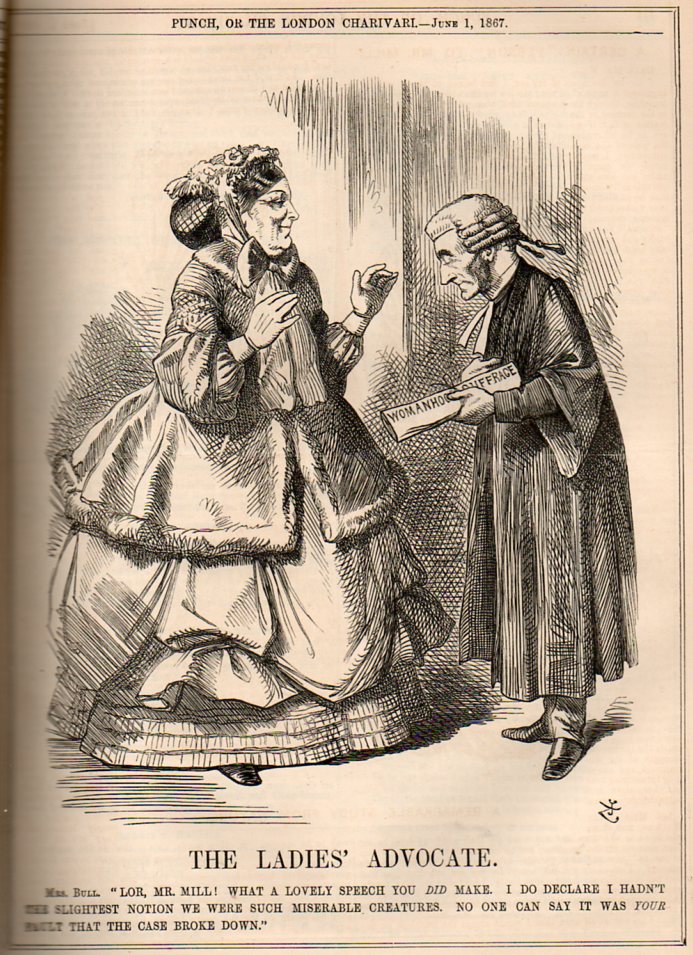
    Punch, or the London Charivari, the leading satirical and social-commentating periodical of Great Britain, took a relatively neutral position on Mill a week later (30 March 1867) with a full-page cartoon (above).  Mill is daintily bu8t forcefully trying to clear a path for the women at his right hand, trying to open a way through a crowd of men being anchored by John Bull.  I’m no authority on any of these matters, but it seems to me that if Punch had decided to take a hard line against the vote for women they might’ve made the group of women depicted here more tawdry or “manish” or un-ladylike or something, anything, than the relatively benign group that was depicted. 

    A few weeks later another cartoon appears (on 1 June 1867) with Mrs. (John) Bull greeting Mill with some level of amusement, this time the editors carrying more of a challenge to the whole idea.  Mrs. Bull  says “I  hadn’t the slightest notion that we were such miserable creatures”, with a good smile and crinkling eyes, looking down at the diminutive Mr. Mill, whose head is bowed and eyes downcast in defeat of the bill. 
    Women vote 658

    I’ve not studied Punch but I have sat down with a few decades of it, and I’ve gotta say that I don’t see very much there at all regarding the vote for women–and even here, when it does, twice, the rebuke–if any–for thinking such thoughts as Mill is surprisingly mild. 

    Mill’s closing paragraph of his Subjugation, summing up:

    “When we consider the positive evil caused to the disqualified half of the human race by their disqualification — first in the loss of the most inspiriting and elevating kind of personal enjoyment, and next in the weariness, disappointment, and profound dissatisfaction with life, which are so often the substitute for it; one feels that among all the lessons which men require for carrying on the struggle against the inevitable imperfections of their lot on earth, there is no lesson which they more need, than not to add to the evils which nature inflicts, by their jealous and prejudiced restrictions on one another. Their vain fears only substitute other and worse evils for those which they are idly apprehensive of: while every restraint on the freedom of conduct of any of their human fellow-creatures (otherwise than by making them responsible for any evil actually caused by it), dries up pro tanto the principal fountain of human happiness, and leaves the species less rich, to an inappreciable degree, in all that makes life valuable to the individual human being.”

  • The Vast VD Landscape of “Procurable” Women: the Big WWII Poster Post on Veneral Diseases

    JF Ptak Science Books  Quick Post

    http://1.bp.blogspot.com/_Xq1_QVuOUV4/S_LGzpQOxBI/AAAAAAAAQlI/AAD8hijEhBk/s1600/1a4.jpg

    [All images from John Brown’s Public Diplomacy Press and Review Blog, here.]

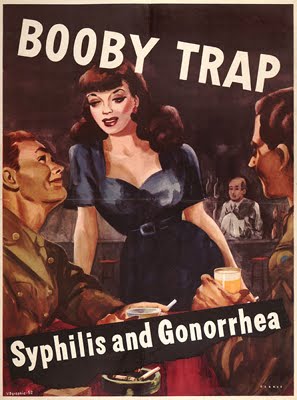
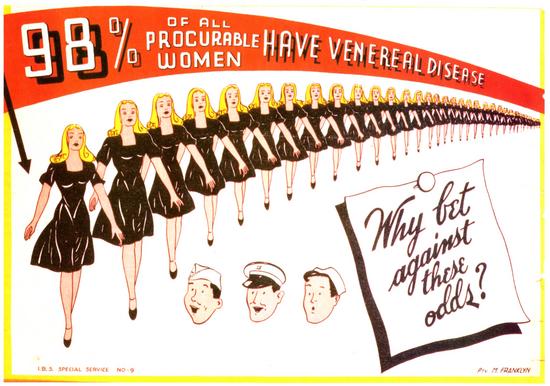
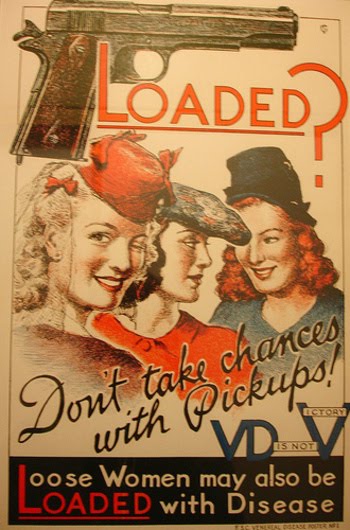
    Almost all of these posters were printed by the U.S. government as a preventative measure to help eradicate the costs of venereal diseases to the American armed forces.  They look a little outre and goofy and unbelievable in their way, but their message was very clear.  The effects of venereal disease too is a very clear one to military forces, because as important as it is to feed and clothe your troops, it is equally important to keep them healthy, for since the beginning of keeping armies there are always episodes of armed forces being decimated by disease, some percentage of them being sexually transmitted. 

    So I understand that the powers that be were trying to limit the lovelust interests of a (conquering) military force by scaring them,but sometimes the message came with a price, as with the lead poster on this post, which basically shrank the individuality of women down to the nexus, eliminating their individuality and robotizing them into VD-carrying sex toys.   .

    The percentage enough would carry this message, but a detailed view of the poster shows how it enunciates the mechanization of the female love receptacle:

    VD Poster det

    I don’t disagree with the underlying purpose of these posters, or even most of their sentiments–except of course for the lobotomized-disease-carrier-women parts.

    http://1.bp.blogspot.com/_Xq1_QVuOUV4/S_LHeo_CJQI/AAAAAAAAQlg/YU8fmOgsSxA/s1600/1a10.jpg

    http://4.bp.blogspot.com/_Xq1_QVuOUV4/S_LJt4wc0kI/AAAAAAAAQmg/ObWc9HCcJq8/s1600/1a22.jpg


    http://1.bp.blogspot.com/_Xq1_QVuOUV4/S_LI0YVjLQI/AAAAAAAAQmI/SQkMpPp6Wu8/s1600/1a18.jpg


  • The Savage Distress of Women in Science (Fiction); Pulp Covers, 1930-1960

    JF Ptak Science Books   Post 1566

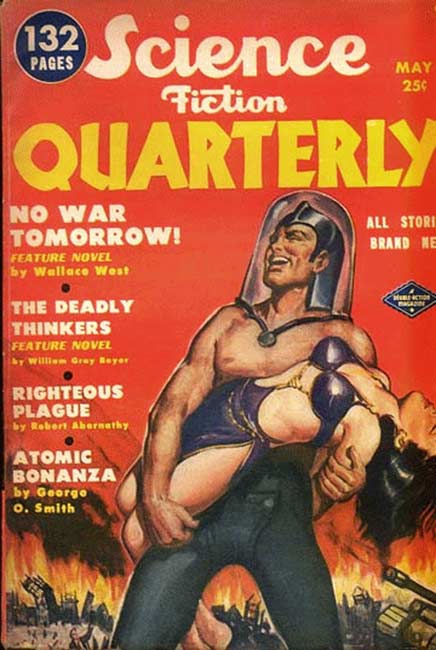
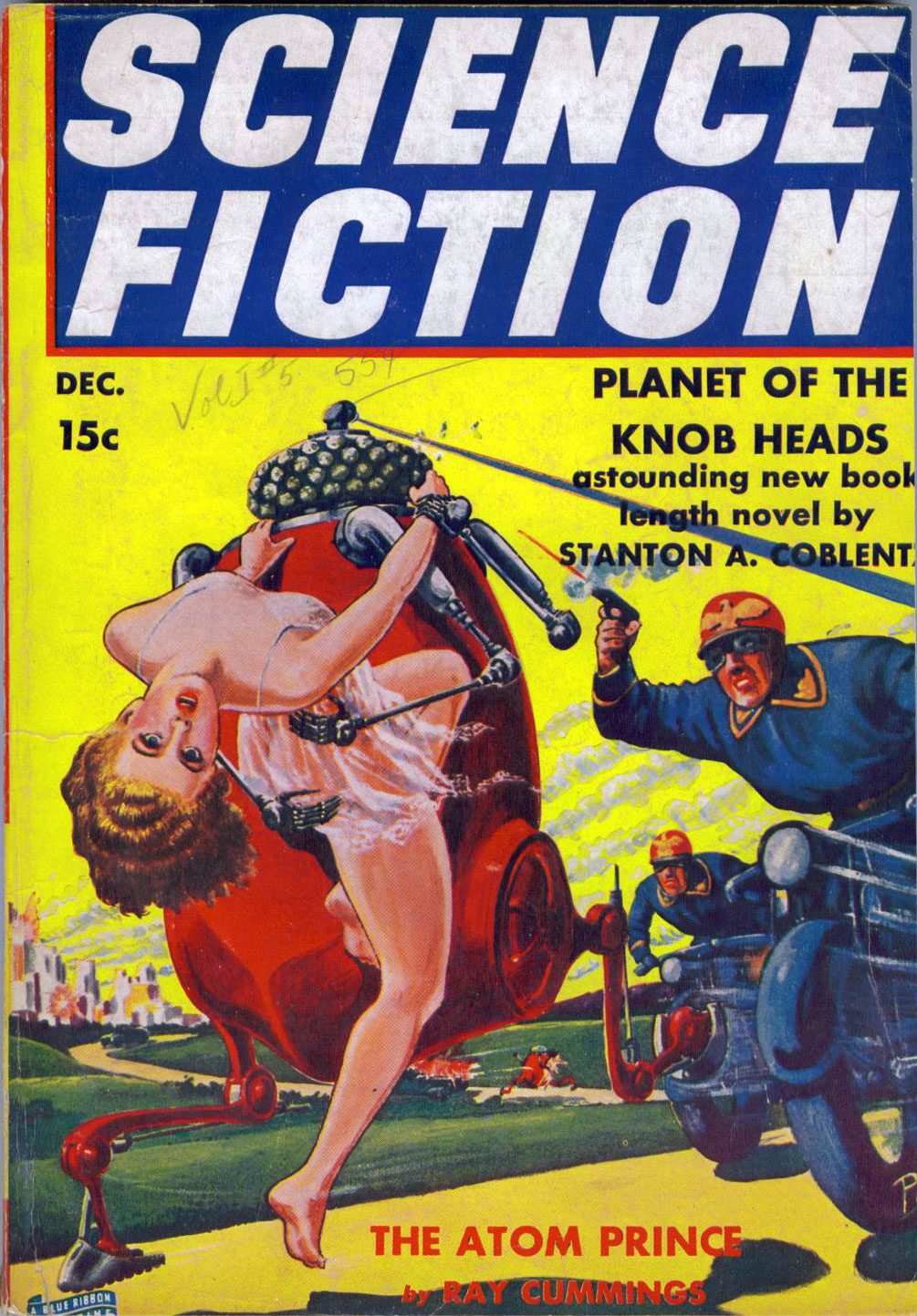
    According to most of these big, spongy pulp magazines, women were made to be rescued, and rescued not only from Enormous Situations, but also from unnameable, unknowable Enormous Things.  I guess they were slightly soft-porny, or at least the cover art was, attracting young readers by promises of  an “easily read” with excitement and voluptuous women in need of saving.  It was yet another turn on the fateful screwing of the tale of the damsel in distress, seen and heard countless times in art and story.  Only in these sci fi mags the damsel showed a lot more skin–it is extraordinary how cleavage attracted so much alien danger/romps.

    http://farm3.static.flickr.com/2671/3835444058_13c02d1279.jpg

    http://3.bp.blogspot.com/-JuUxvfWOlns/Tfx9MIjUoZI/AAAAAAAAKNs/D1M99vnx25M/s1600/sci%2Bfi%2Bcover.jpg


  • Women with Guns–a “First” in Women/Pistols/Advertising?

    JF Ptak Science Books   Post 1548  [Abdullah Cigarettes Revisited]

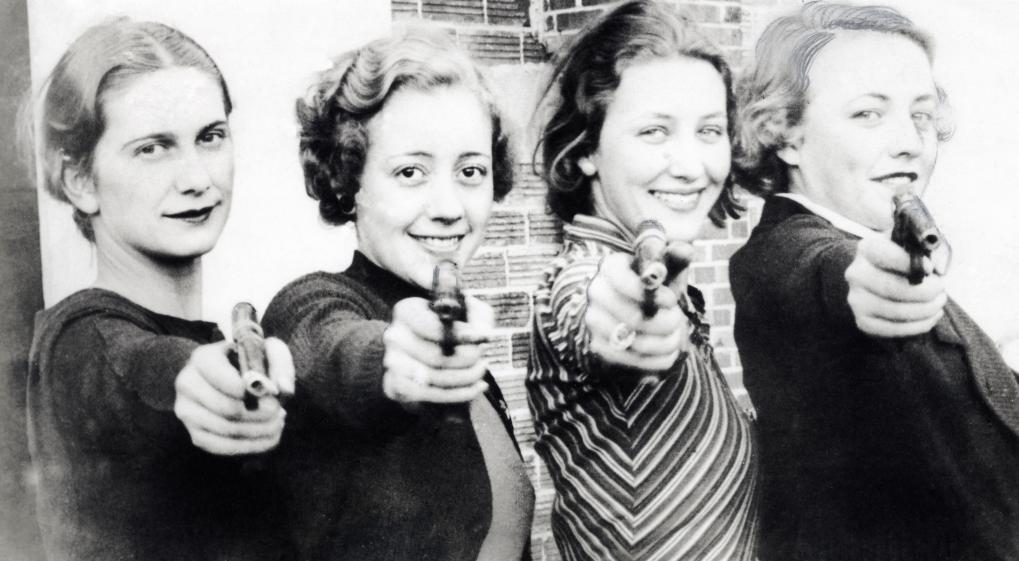
      Women with pistols

     
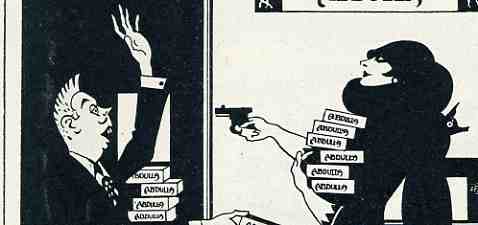
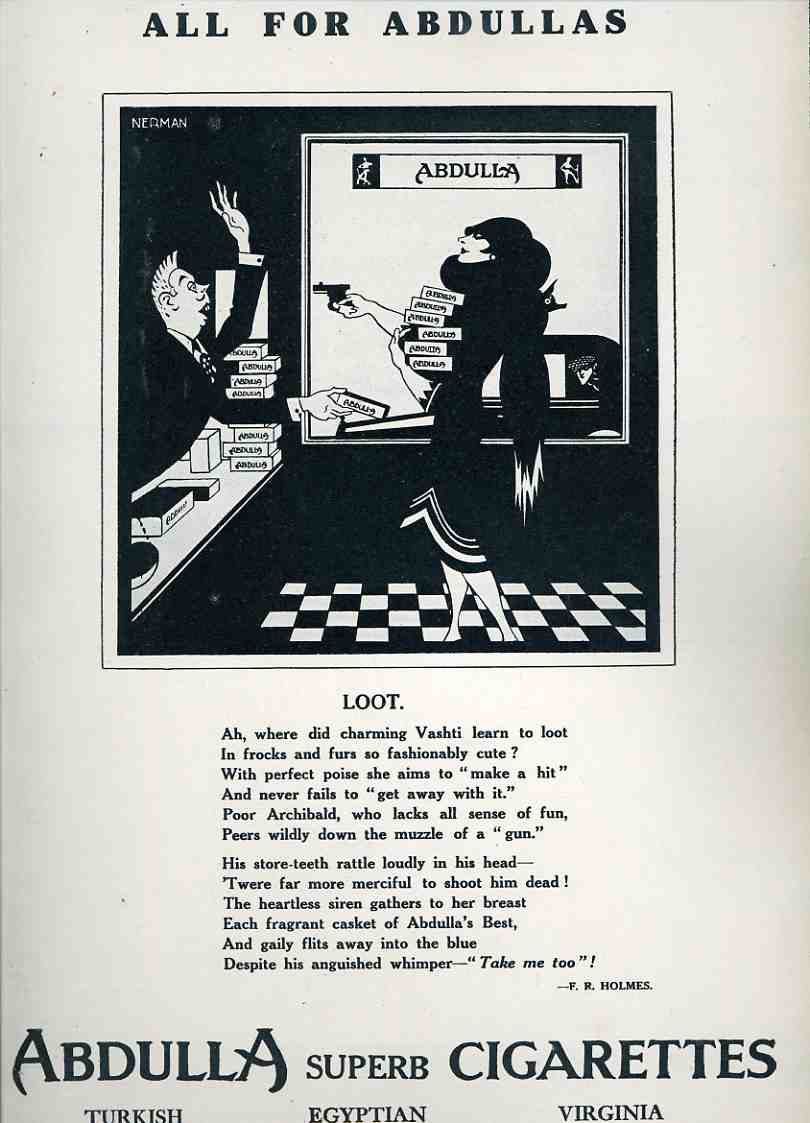
    Here’s a not-usual question:  when was the first image printed of a woman pointing a gun in the commission of a felony who was NOT an American Western leather-slapping, bronc-ridin’, Buffalo gal?  I have a funny feeling that it wasn’t until relatively recently, 20th century, or thereabouts.  I thought about this when I saw this ad in the Illustrated London News for 21 August 1926, calling for women to rush out and buy the ciggy that was worth stealing–Abdulla (“Superb”) cigarettes.

    0 blog feb 26630


    The doggerel of the poet-izer F.R. Holmes that decorates this page (and who recognizes that the clerk named Archibald who was handing over the cigarettes was chattering through “store-teeth”, which is kind of nice) did absently grind out a factual bit when he referred to the packaging of the Abdulla cigarettes as “Caskets”. Of course he had something else in mind in line with his time, but he did mistakenly have a peep into the future when he labeled the box of coffin0 blog feb 26629 nails so, though not so “fragrant” as he was thinking.  (I also like the masked male accomplice peeping into the scene from the safety of the getaway car.)

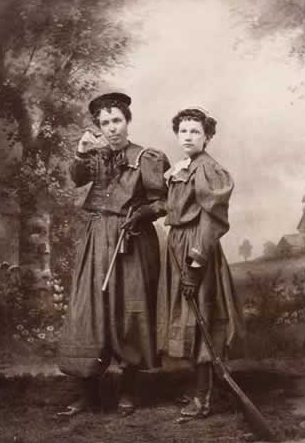
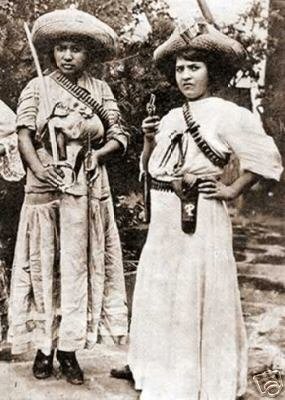
    Offhand, though, I cannot bring up an earlier image of a non-cowgirl-performing woman pointing a gun at someone to achieve a criminal end–especially not in an advertisement. 

    It is interesting considering this ad as a statement of sorts of women in the marketplace purchasing stuff that had previously been considered male terrain.  Woman had been he target of cigarette manufacturers in some small ways in the late 1880’s and early 1890’s, but it seems not until after the War and then after the Vote was there a full-on effort to sort women into some consuming fields that they had been excluded from previously.  Unfortunately, in this case, the advertisers recognized that they were missing perhaps half of their possible market, and that new market was pursued and resulted in tens of millions of cancer-related deaths. 

    Well!  Now that I’ve finished this short post, it just came to mind that a good alternative and much earlier source might be images of she-pirates, though it might still be a stretch to find one of those women with their sword at someone’s neck…

    Women and guns

    ·Posted by :

    ·in:

    — —

  • A Terribly Short Note on the History of Bras, U.S. Patent Office, 1892-1930

    JF Ptak Science Books  Quick Post

    Most of the following  relate U.S. patent reports on brassieres–for shaping, reducing, electrifying, supporting, warming and preventing “breast cake”–but I’ve added a few other associated undergarment creations. It seems that there was so very much “underneath”sections to the bodies of the dressed woman during this time that there could scarcely be any room for anything on top of them.  There was just so much fabric and texture and belts and straps and loops and metal and fasteners and looseners and ties and wraps that, once the onion was peeled, there was nothing left but peel, which may well have been the overall societal message draped over women during this period of time.

    Garter Attachment, 1892

    Simple Underwear, 1893


    Armpit Armor, 1893


    Brassiere & Corset and More, 1898


    Brassiere, 1899


  • Disturbing and Disturbed Obstetrical Devices: Straps, Belts and Iron Bits

    JF Ptak Science Books   Post 1501

    Where does a device like the one, below, belong, exactly?  Where in the long rolls of intellectual history should it be found?

    E.A. Agerton is actually Ella C. Agerton–it was easy for me to assume that the person Agerton was a man, because to my experience when I find such devices in the patent office archives they are usually made by men. What Ms. Agerton was attempting with this device is something I don’t understand, though she does make the following statement in her Patent Office record:


    Here’s another, earlier version of this beast, displayed in practical use.  I have to say that the drawing of the woman’s face is deeply disturbed:

    I’ve also found quite by chance that the drawings of the faces of the women drawn as “patients” of these devices can be very unsettling, hardly faces at all, even though the representation of the rest of the body is functional.  For example, the face of the woman below looks as though it is part of the furniture/device:

    The drawings of faces can be so bad that I wonder if anyone can actually be that bad of an artist without trying to be.

    None if this even reads comfortably; I don’t know what it would have been like to been trussed up in such a thing. 

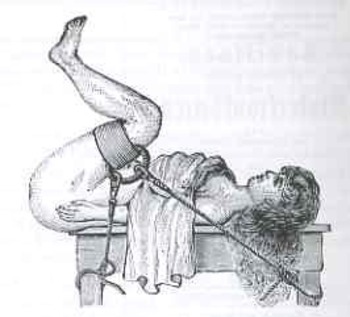
    Blogonbstetrics271 This leads to another uncomfortable image.  At first glance I thought it was part of a delivery procedure, but it turns out that this was the rigging for a woman undergoing a gynecological examination.  The woodcut appears in the first volume of Sammelband von 7 Kleinschriften zu gynakologischen Spezialthemen, 1858-1901, and more exactly in the contribution by Ludwig Neugebauer on an examination with a “speculum bivale l’ecarteur vaginal a trios branches…”  published in 1884.  I know that the prissy prejudices brought about with the coming of Queen Victoria in 1837 still had another 17 years to go at this point, which could explain why, perhaps, a doctor would want an aid in helping a woman maintain an examination position without him having to touch his patient, but, well, just look at the massiveness of the restraints!  Also, the woman’s arms are *inside* the ropes—not down, not holding the ropes, but inside the binding, restrained.  Either way, it isn’t good, treating the woman—in either case of pregnancy or obstetric examination—as the inferior vessel.
    This is also part of a long history of the subjugation of women—the medical aspects of that indoctrination were perhaps somewhat more heinous than the social/legal/ethical/pedagogical/moral constituents.  This illustration, even coming at the end of the Victorian era and approaching the dawn of encroaching bits of equality for (white) women, is a fair example of their subordinate status.

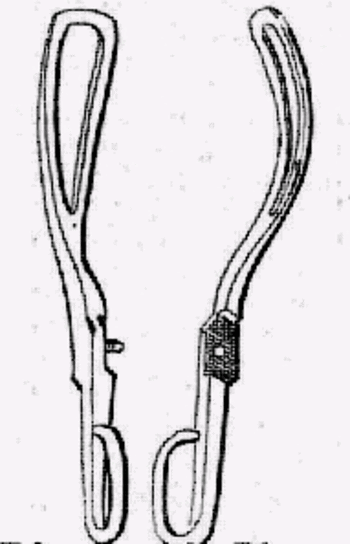
    I just happened upon this picture during the course of my business day—a random image compiling these thoughts.  If I were to try and choose another example of the medical aspect of the subjugation of woman I think that I would choose the story of the Chamberlen family.  For several generations, beginning around 1680, this family of medical doctors practiced a secret—their secret—in delivering breeched babies.  Breeched babies are those who were born feet first, which was usually a death sentence for both the child and the mother.  Patriarch William Chamberlen invented a device that would greatly aid in delivering babies in this position—the forceps.  And evenForceps though everyone today knows what these things are, the Chamberlens kept them a secret from the inquisitive medical world for more than a century.  Their instrument was shrouded—literally!—in secret(s), used under cover, with ceremony, conveyed to the delivery area in a box and brought out with no witnesses.  The Chamberlens felt their invention to be their own, for their own particular use and monetary gain, and the rest of the world be damned, and at least three generations (grandfather, father, son) kept the family secret. If their family could not be in charge of such a delivery then there would be no use of their extraordinary invention.  This of course would save their income from being chipped away by other physicians or midwives or whatever competent person could be found to utilize the forceps—their economic gain coming at the cost of (savable but imperiled) pregnant women who would either pay the Chamberlens for aid in their breeched births or, well, probably die.     To what degree this revolting behavior damaged other people can not be calculated. I’m not even sure about how to translate this into something more recognizable—would it be like Robert Koch keeping his isolation of Bacillus anthracis (1877), or  tuberculosis bacillus (1882) a secret?  Or Wilhelm Roentgen shrouding his discovery in secrecy somehow? (I know, I know, this is impossible.)  Or isolating a secret, proprietary cure for cancer?
    There is a large part of me that believes that if the Chamerlens had figured out something like this that affected only men, a silver bullet for something or other, that their secret wouldn’t stayed a secret for 100 hours, let alone 100 years. 


  • Electro-IronPunk Centrifugal Birthing Machine–a Fantastically Bad Idea

    JF Ptak Science Books   Post 1500

    I found this by accident, and needed to share it immediately, because in the splendid and chilly vastness of the infinite Encyclopedia of Bad Ideas, this entry would seem quite the poster child for such a stupendous effort–the mud to which all dust aspires. 

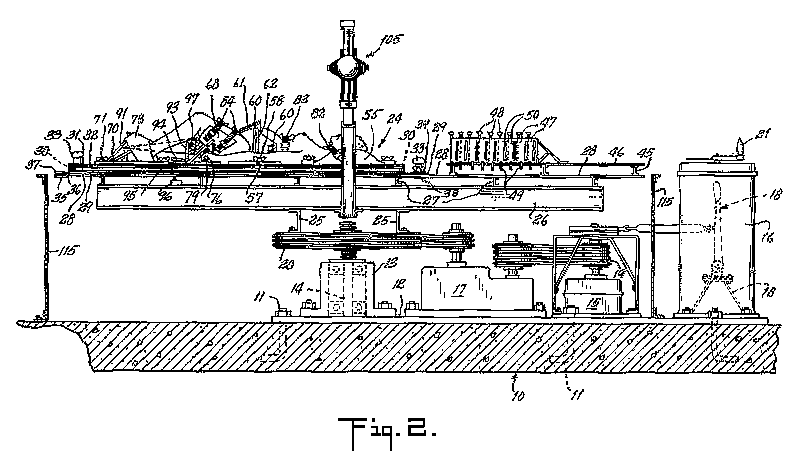
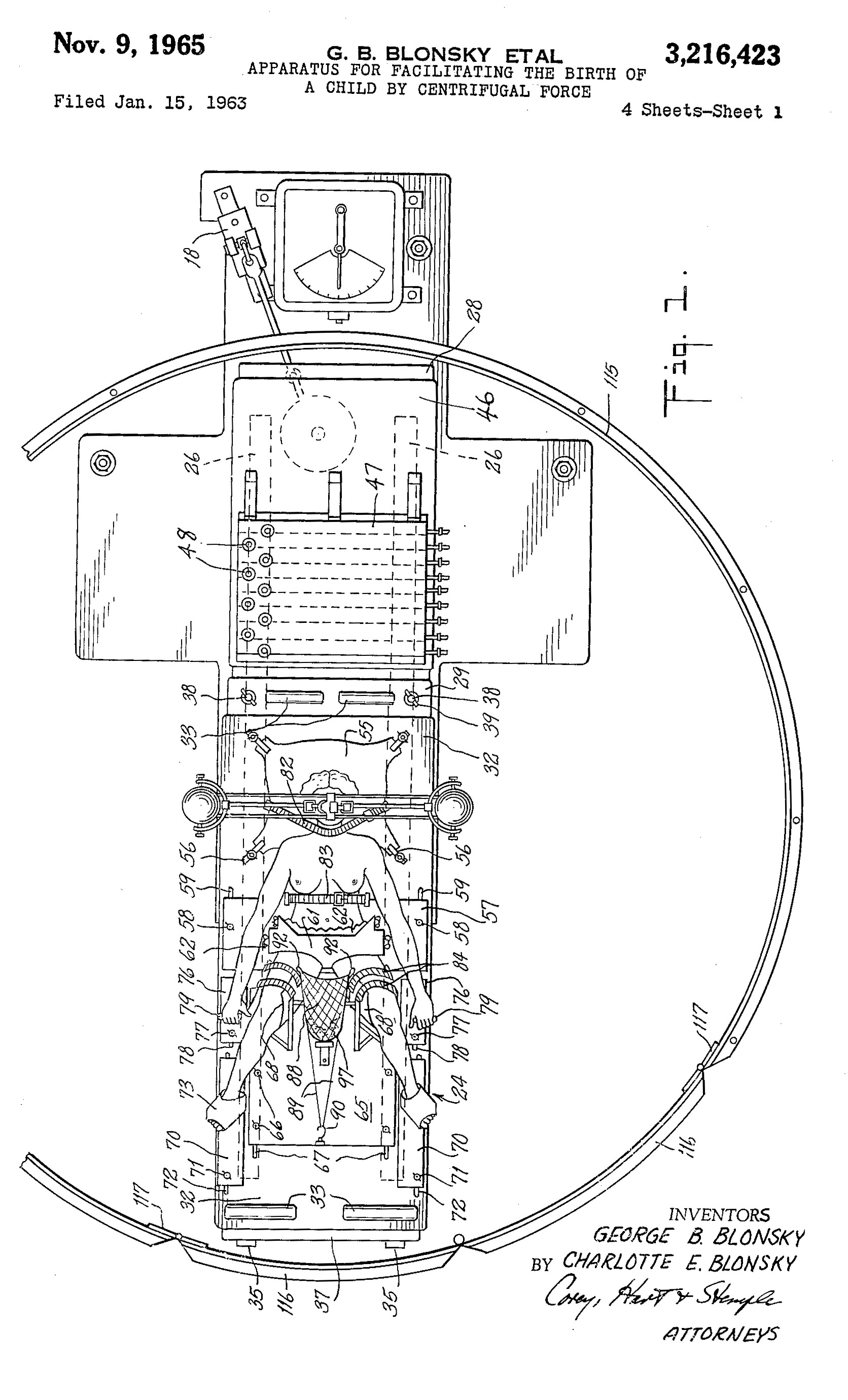
    The centrifugal machine for human birth…its hard to even finish that sentence, let alone finish it without wincing. What could possibly go wrong, or right, with spinning a pregnant woman strapped like Hannibal Lechter on a spinning turntable?  

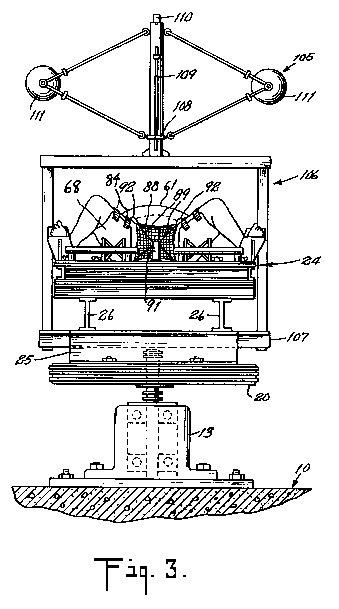
    I think what we have here is the Vitruvian Woman of Bad Ideas relating to human birth, the patent described more fully in this great piece by Marc Abrahams (of the Annals of Improbable Research) in The Guardian, 2006). And how could the symbology of the thing get any weirder? It looks like this poor woman has her head resting on a stretched piece of animal skin, all of which is located on a cross–but since there is a person on it the medical device become a crucifix. And let’s not forget the counterweights on either side of the governor, which in detail below are suspend to either side of the woman’s head; and also the baby sack, for, well, catching the baby…

    Image source:  Google Patents

    Centrifugal birth patent a overview fixed

    And the excruciating, inexorable detail:

    Centrifugal birth

    In their patent application, Blonsky and Blonsky explained the grievous and imaginary need:

    “In the case of a woman who has a fully developed muscular system and has had ample physical exertion all through the pregnancy, as is common with all more primitive peoples, nature provides all the necessary equipment and power to have a normal and quick delivery. This is not the case, however, with more civilised women, who often do not have the opportunity to develop the muscles needed in confinement.”–from the Blonsky patent.

    “Therefore, wrote Blonsky and Blonsky, they would provide “an apparatus which will assist the under-equipped woman by creating a gentle, evenly distributed, properly directed, precision-controlled force, that acts in unison with and supplements her own efforts”.–Marc Abrahams, quoting the Blonsky patent in The Guardian (referenced above).

      Centrifugal birth b

      Centrifugal birth c


    The text of the patent report, below, in full:


  • Electro-LUXurious 6: Electrical Probing Stimulator, 1898

    JF Ptak Science Books   Quick Post

    This is the sixth in a new series of posts on interesting, early applications of electricity, most of which are taken from the archives of the U.S. Patent Office.  Unlike the general post in this blog, many of the Electro-LUXurious post images and documentation can be presented without commentary.

    This, simply put, is  a vibrator, and in the 19th century was a medical response to female sexual arousal, which at the time was termed “hysteria”.  And so women were sent to their medical practioner to be treated for hysteria with much larger units until the apparatus became small and portable enough to be used at home and without the assistance of the doctor. 


    No doubt.

    We read further that figure 3 “is a side view of a cylindrical electrode for internal treatment”. 


  • The First Woman to Fly in an Airplane Was When?

    JF Ptak Science Books   Quick Post

    I wondered about how long after the Wright’s first powered flight (17 December 1903) that it took for a woman fly in an airplane, either as passenger or pilot.  I was a little surprised–when I found my answer, my glasses weren’t quite up to seeing the date on the top of the page very clearly, and on closer inspection I was a little taken aback to see how wrong my assumption was.  It didn’t take five weeks or five months, but five years before this happened.

    Aviation--first woman502

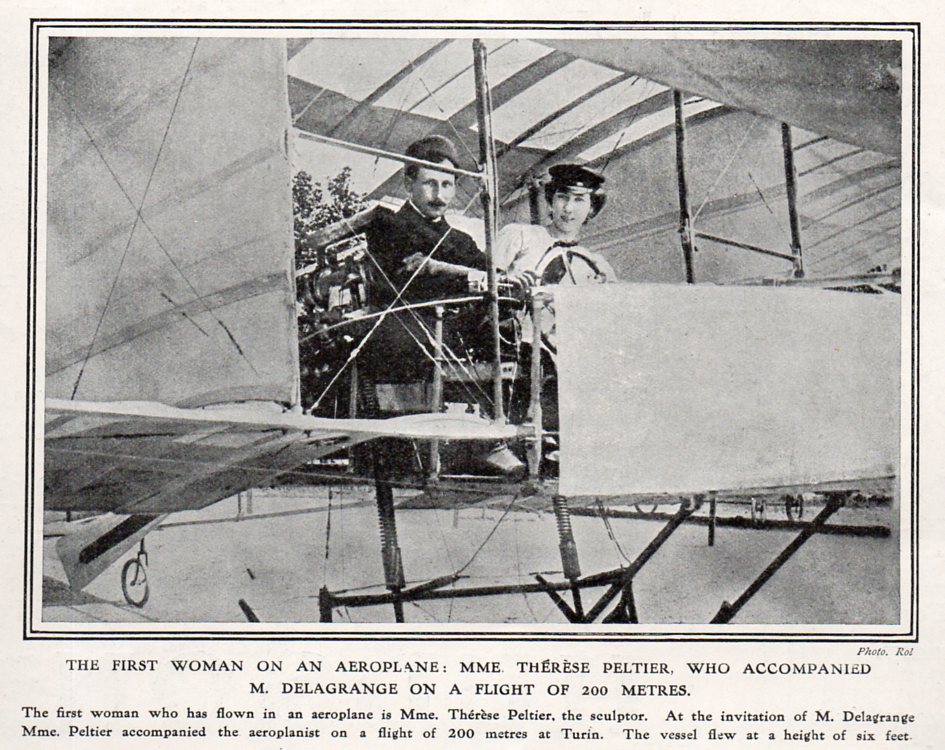
    It seems as though this honor belongs to Therese Peltier, who on 8 July 1908 was a passenger in the aircraft of her significant other, Leon Delagrance, flying a distance of about 700 feet1.  An earlier great name for the history of women in aviation, E. Lillian Todd, was the first to design and build an airplane, though she was not able to fly the unflyable aircraft.  A half-dozen or so women aviators appear in 1909, and by 1910 the course for women in aviation expands dramatically. (An interesting chronology of “firsts” for women in aviation can be found here; another site, Women in Aviation Web Magazine, can be found here.)

    The image above, from the Illustrated London News for 25 July 1908 (the original issue of which is available at our blog bookstore), shows Ms. Peltier getting ready for the flight.  It is interesting to note that the picture and story occurs in a section of the magazine called “Chronicle of the Car”

    Aviation--first woman503

    which is where reporting on aeroplanes and flight occurred, the subject not quite at the point where aviation deserved its own category.  Of course the automobile was new, then, too, so it makes a little sense to have them lumped together…but not much.  The “Chronicles” part of the magazine was a half-page affair, the last page before the advertisements began, the last leaf before the rear cover. 

    Notes:

    1.  It seems as though there is debate on this, mostly over the Delagrance aircraft was indeed “modern” enough to be considered a modern heavier-than-air airplane, this over the way the control of the plane was handled.  I’d say we just left Ms. Peltier alone on this one.

    From the Smithsonian Institution, National Air and Space Museum site


  • The Future of Hope and Fear: Fortune-Telling Questions for Men and Women, 1540

    JF Ptak Science Books  Post 1456

    In 1540 Francesco Marcolini (or Marcolino), a typographer born in Forlì, published in Venice Le sorti intitolate giardino d’i pensieri (“The oracle called garden of thoughts”). This book is among the earliest known documents of cartomancy (divination with cards), a card-playing fortune-telling and future-telling game and belief system. (I’ve written about other beautiful if not proud accomplishments in this area, other products of the 16th century, here.)  I find the illustrations of the combinations of cards to be rather beautiful, a suggestion of an unknown alphabet or hieroglyphic for a civilization of hope or distress or both that hangs somewhere out there in the gauzy future, the characters capable of change and interpretation depending on the needs of the viewer.  Therefore the story that is told can easily become the story that could be told, the characters permeable to whimsy and insight.  It seems unlikely that there is a numeral system associated with this quicksand.

    Image:Marcolini fraude.jpgThe tarot encyclopedia website provides an interesting insight to the times if not so much to the gearing of this wonder machine–this mainly in the form of the fifty questions to be asked of the players of this game/amusement/hopenet, including thirteen each to be answered solely by men and women. 

    Questions Asked of Men

    It turns out that for the men, 8 of the 13 questions deal with his wife or mistress–4 about wives, 3 about mistresses, and 1 that can go either way.  The remaining few questions then are left to cover the range of All Other Things

    1.Will the destiny of the man will be good or bad? [Fato - Fate]
    2.Is the lover loved by his mistress? [Fama / Fame]
    3.Is it better to marry a beautiful woman or an ugly one? [Beneficio - Gain]
    4.Will the desire of the man be fulfilled? [Tempo - Time]
    5.In which will the man be more lucky? [Fortuna - Fortune]
    6.Will the man have to suffer for his beloved? [Dolore - Pain]
    7.Is the man appreciated by the other people? [Virtu' - Virtue]
    8.How many wives will the man have? [Punizione - Punishment]
    9.Will he that goes to war gain victory? [Vittoria - Victory]
    10.Will a strange wife become humble? [Pertinacia - Obstinacy]
    11.Is it good to change mistress? [Peccato - Sin]
    12.Is it good to take a wife? [Matrimonio - Marriage]
    13.Which is the best mistress: the widow, the married woman or the unmarried woman? [Timore - Fear]
    

    Questions to be asked by women

    The questions for the women actually seem a little more balanced, or at least don't 
    deal with the blossoming aspects of additional/multiple lovers, though the question of

    whether her husband will be faithful does come up, as does the issue of whether it
    is good or not to change lovers. And the issue of how often she will be married.
    And whether or not she will suffer for her lover--I'm not sure what this one means
    in the antiquarian sense, but there seems to be a follow-up
    on whether the bad
    husband will become good. But overall these seem not so extra
    ordinarily self-indulgent
    as do the questions for the men.
    14.Is the woman appreciated by the man she adores? [Vanita' - Vanity]
    15.Will the destiny of the woman will be good or bad? [Destino - Destiny]
    16.Will the woman will give birth to a boy or a girl? [Natura - Nature]
    17.In which will the woman be more lucky? [Honore - Honour]
    18.How many husbands will the woman have? [Penitenza - Penitence]
    19.Will the woman have children? [Sterilita' - Sterility]
    20.Will the woman suffer for her lover? [Dipserazione - Desperation]
    21.Will the desire of the woman be fulfilled? [Insidia - Danger]
    22.Will the bad husband become good? [Sorte - Chance]
    23.Is the woman loved by everyone? [Disgrazia - Disgrace]
    24.Is it good for the woman to change lover? [Odio - Hate]
    25.Is it good to get married? [Servitu' - Slavery]
    26.Will the husband be faithful? [Occasione - Occasion]

    Questions that can be asked both by men and women

    Certainly the non-gender-specific questions are most interesting, some even poetically
    captivating ("will two lovers make peace?")
    , most of which could be asked today, and
    some still demanding long thought. In general though they do mostly have an
    adult-version of a Ouija experience, with a few golden nuggets tossed in for higher
    cortical seasoning.
    27.Is a certain courtesan infected with the French disease? [Difetto - Defect]
    28.Is it good to take vengeance of an offense? [Virilita' - Virility]
    29.Will the world find peace? [Parche - Moirae]
    30.Will art or trade produce gain? [Industria - Industry]
    31.Will some trouble bring happiness in the end? [Ricchezza - Richness]
    32.Is the rule of a Lord appreciated by the people? [Verita' - Truth]
    33.Is it good to serve Lords and priests? [Infingardo - Idler]
    34.Will a promise be kept? [Fraude - Fraud]
    35.Is the person that traveled far alive or dead? [Sapere - Knowledge]
    36.Will the exile return? [Esilio - Exile]
    37.Is it better the wife or the husband? [Poverta' - Poverty]
    38.Who loves with more passion, the man or the woman? [Nobilta' - Nobility]
    39.Will a dream come true? [Ignorantia - Ignorance]
    40.Is it good to start a certain enterprise? [Otio - Idelness]
    41.Will the person that went away be back soon? [Desiderio - Desire]
    42.Will the awaited new be good or bad? [Malinconia - Melancholy]
    43.Does the appearance of the person give a good impression? [Menzogna - Lie] 
    44.Must one trust what people say? [Discordia - Conflict]
    45.Will two lovers make peace? [Pace - Peace]
    46.Which will be the end of a very deep love? [Caso - Chance]
    47.Will changing place bring better luck? [Consiglio - Counsel]
    48.Will the person be the winner of a dispute? [Corruttella - Corruption]
    49.Will someone get free of a certain vice? [Furto - Theft]
    50.What will be the reward for faithfulness in serving? [Calamita' - Calamity]

    In short, much of this seems modern to me, at least with a little editorial clean-up.
    The big difference seems to be that people in 1540 actually interacted and answered
    these questions, while in 2011 most folks would be watching other folks talk about
    answering these questions on a reality t.v. show.