JF Ptak Science Books Post 1649
People, working people, the so-called “vulgar classes”, sailors, unescorted women, married women with babies, people who worked with their hands, people who worked (in general), all began their assault on the previously-just-for-the-“correct”-classes knowledge base of England–the British Museum–in the first third of the 19th century. It was a failed attempt, really, because the powers-that-be of the Museum were repulsed by the idea of the underclasses coming in to the place were the proper people came to learn, fearful that they would be repelled by their lowered and unfortunate brethren.
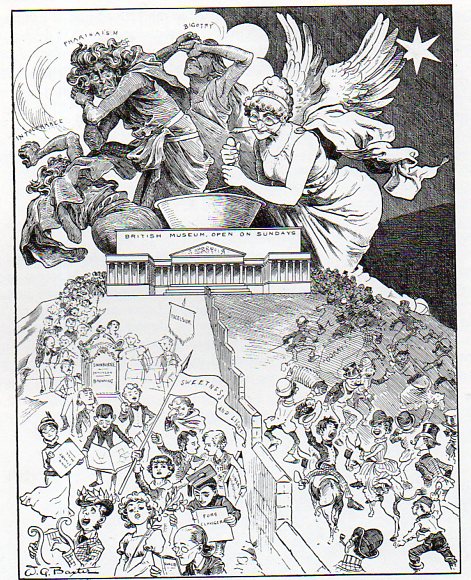
[“A Dream of the Future”–the Sunday Opening, from Judy, 1885. Source: Lynn Barber, The Heyday of Natural History, Doubleday, 1980, page 166.]
The Museum wasn’t open very much at all–only three days a week, receiving people between the hours of 10 and 4, restricting access to women with children, to women in general, as there weren’t any restrooms for females. I’m not sure when the first women’s facilities came into being at the Museum, but it took them until 1879 before the place was opened daily. And “daily” means every day, every day but Sunday, Sunday being a day not only of various religious obligations (which I think was the least of it), but also a day in which the greater percentage of the working class was not working ( which I think was the root of the issue). That privilege of opening the Museum to the great unwashed, opening the place on Sunday, didn’t occur until 1896. I imagine even then that there was resistance to the innovation of reaching out to working people.
The odd thing, now, is that many museums and libraries have been limiting their public hours, closing on Sundays, the day on which most people today find themselves not at work, restricting themselves to availability to a population of people who may mot be working a 5/6 day workweek. Plus ca change, plus c’est la meme chose.