A Daily History of Holes, Dots, Lines, Science, History, Math, Physics, Art, the Unintentional Absurd, Architecture, Maps, Data Visualization, Blank and Missing Things, and so on. |1.6 million words, 7500 images, 4.9 million hits| Press & appearances in The Times, Le Figaro, Mensa, The Economist, The Guardian, Discovery News, Slate, Le Monde, Sci American Blogs, Le Pont, and many other places… 5000+ total posts since 2008.

Category: History of Dots

  • A History of Dots: Microscopical Embryology, 19th Century

    JF Ptak Science Books LLC   Post 501
    0 blog feb 3 dots518

    0 blog feb 3 dots517

    In 1837 the hemispheric frontal lens for the compound achromatic
    microscope developed by Giovan Battista Amici (1786-1863) vastly
    improved magnifying power to open an entirely new submicrospic
    world–this somewhat on the order of the introduction of Robert
    Hooke’s (1635–1703), investigation in Micrographia (1655).  G.C. Ehrenberg (Die Infusiontheirschen als volkommene Organismen,
    Leipzig 1838) was among the first to use this new development, showing
    almost immediately that infusoria was not what was seen to be as
    Buffon’s “organic molecules” (or unified wholes) but something far more
    complex.  Theodor Schwann and Jacob Mathias Schleiden  in just the next
    year, using this same new technology, put forward the cell theory, with
    images produced in Schwann’s Microscopical Researches
    (1847)–according to Pearce Williams this development of cell theory
    “did for biology what Lavoisier’s definition of chemical elements had
    done for chemistry”.  The bottom line here was that the cell theory was
    the best, basic element in biology. 

    All of this to get at dots.  My goodness.  Before Amici (who by the way
    as an astronomer and microscopist, working both ends of the optical
    visual field like few before him had), most of these elucidated
    complexes seemed to even the slight magnification of earlier
    microscopes as dots.  Unexplained, seemingly inexplicable, dots.  (And
    the same could be said too of the planets and stars, and our moon and
    sun, before the introduction of Galileo’s introduction of the
    telescope).  Some of the most famous of these post-cell-theory dots
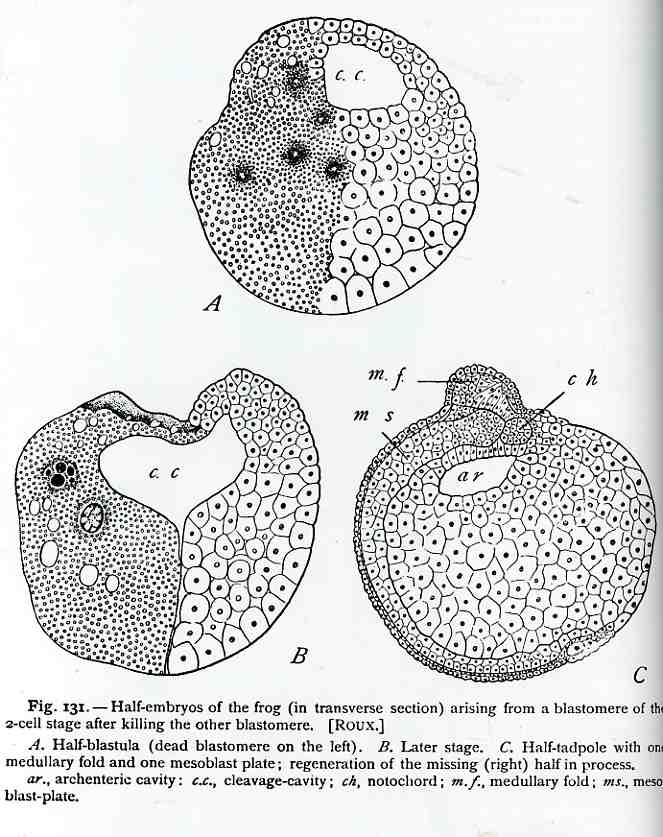
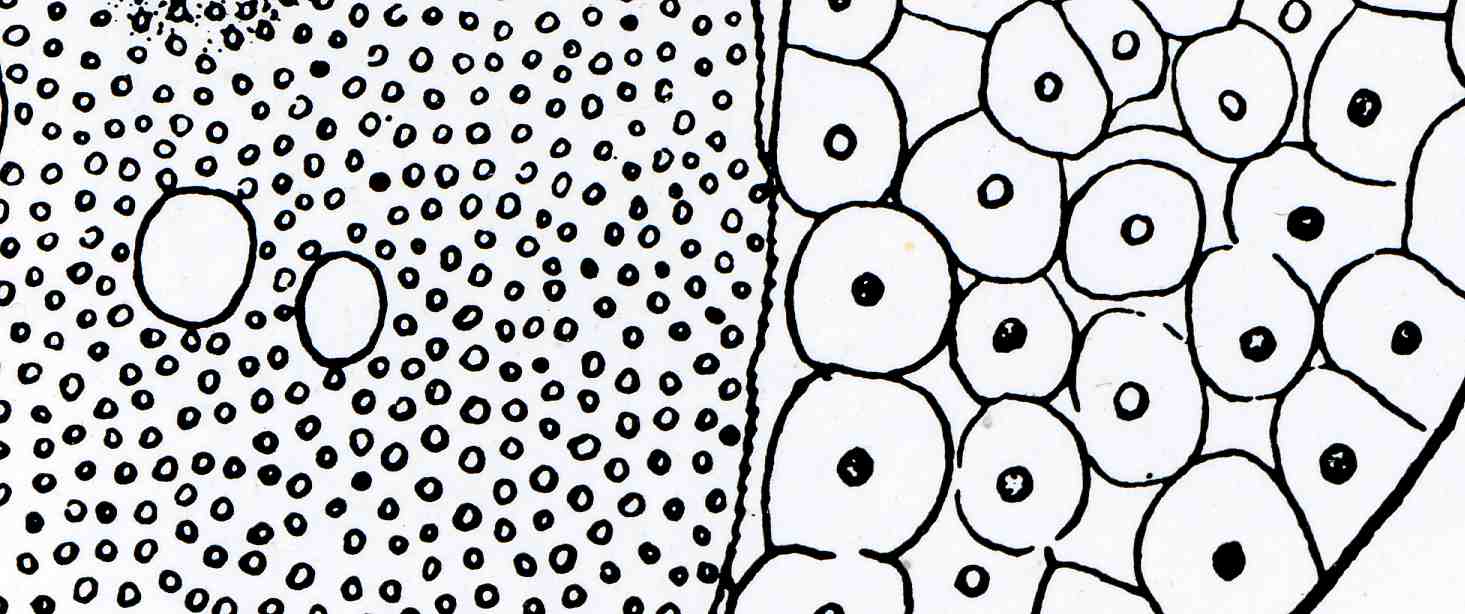
    belong to Wilhelm Roux (1850-1924) who in his Über die Entwicklungsmechanik der Organismen (1890)
    offered the first experimental intervention and experimentation at the
    embryological level.  The “dots” here are frog cells, half of which
    Roux destroyed in his attempt to influence the development of the
    embryo.  The experiment resulted in some results that would be abandoned within two decades, but the methodology employed by Roux (but not his reductionism) would be one of the most significant biological events in the 19th century. 
     

    ·Posted by :

    ·in:


  • A History of Dots, Periods & Points, Part I: Descartes and a Year-Ending Post

    JF Ptak Science BookS   Post 450

    In closing out my first year of blogging [2008], I’d like to take an incidental look at one of our language’s most important fragments.  Like Mr. Eliot’s observations of Baudelaire being a fragmentary Dante, and like the brilliantly arranged frammenti of Piranesi, the great bits of our communication processes owe a breathy thanks to the lowly period.  A dot.  A point.  It separates to provide analysis and coherent recognition of thought. 

    0 blog dec 31 descartes330

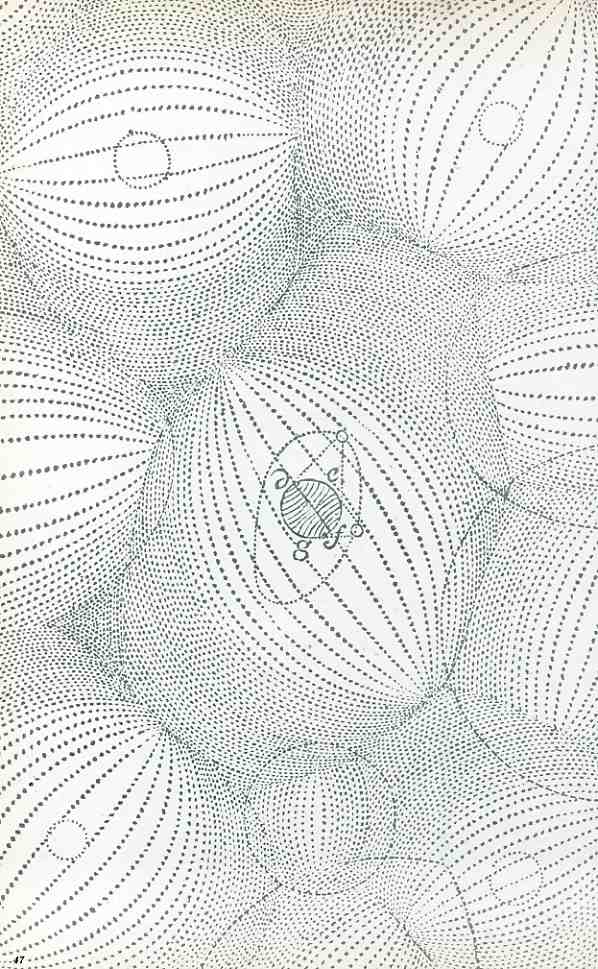
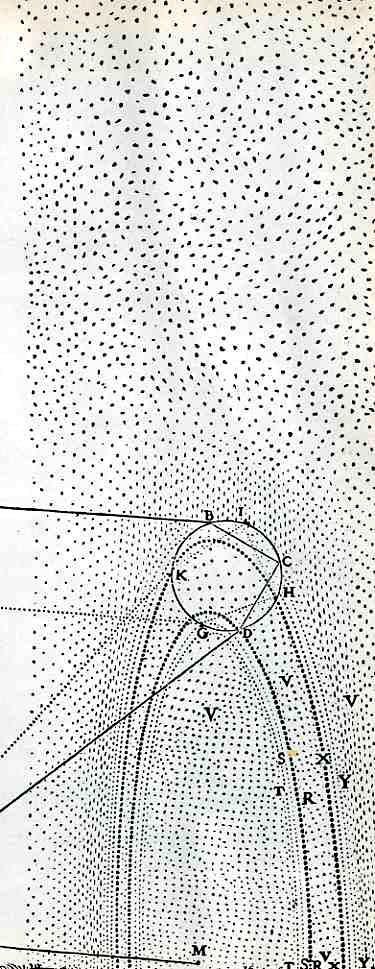
    A simple dot.  (.)  But dots are as little or as big as you need:  there’s “Little Dot” (the cartoon character of Harvey Comics, created 1947, who was fascinated bylines and dots and dashes), “Admiral Dot”, polka dots, Mama Dots.  Dots get considerably ratcheted up in quantum dots, and then expanded beyond that with the idea of the dot as an abbreviation for the multiplication sign, both of which increase things rather than bringing them to an end, a conclusion.  The dot used after a musical note delineates that there is an increase in time by half, which would be an interesting notation to adopt in literature, if we were somehow able to magnify and increase that which would normally have been ended by the same notation.

    Dots have formed the background to some of the most significant scientific illustrations of all time, like these two images, the first of which Descartes’ illustration of the decomposition of the rainbow, found in his Dioptrics, a fabulously important illustration. The second is from Descartes’ Principia Philosophiae (1684) which display his theory of vortices, accommodating an idea of physics eliminating atoms and vacuums and joining matter and space, matter being constantly deflected from moving in a straight line, moving in vortices.  Then of course there’s the fantastically appreciated advancement of Samuel Morse’s telegraphic instrument and his abbreviated transmitting alphabet (his “code”), which fascilitated the distribution of information in the 1840’s  in the same sort of way that the internet increased the flow and ease of data in the 1990’s. (Actually that’s only half correct for Morse, as his was a system of dots and dashes.)

    0 blog dec 31 descartes331


    Things get more interesting if we expand the idea of the “dot” to a “point”, as just about everything we have discussed in math for thousands of years has been based upon the idea of a “point in space”, forming the bits of the coat hanger on which the whole fabric of the heavens has been hung.  Going the other way, there’s the decimal point, which brings us to negative powers of ten, into smaller and smaller worlds, to the incomprehensibly small, showing that “nothing” probably doesn’t exist. (We’ll leave the idea of “spot” alone, tonight.)

    That’s quite a bit of expansion from a word that starts out life in Middle English as the definer of the head of a boil.

    But this year will end in about 50 minutes from now, and I wll be able to put the final keystroke to the final sentence to my final post of the year, and put it all to sleep.  And the year will end, at 12:00, precisely.  On the dot.

    ·Posted by :

    ·in:

    — —