A Daily History of Holes, Dots, Lines, Science, History, Math, Physics, Art, the Unintentional Absurd, Architecture, Maps, Data Visualization, Blank and Missing Things, and so on. |1.6 million words, 7500 images, 4.9 million hits| Press & appearances in The Times, Le Figaro, Mensa, The Economist, The Guardian, Discovery News, Slate, Le Monde, Sci American Blogs, Le Pont, and many other places… 5000+ total posts since 2008.

Category: Patents

  • Balloons I Know But Do Not Love–Deaths from Above, Ads and Bombs

    JF Ptak Science Books   Post 1771

    In the early days of aviation aerial assault must have seemed incredible–and an abomination.  Hurling stones and other offensive weapons by trebuchet and catapult is one thing, and  launching balls and shot from cannons and mortars is quite another–but actually having your weapon flown over an enemy’s position and dropped, remotely or via cable, must have been ab excruciating achievement, militarily speaking.  To be able to direct an explosive charge over a position not reachable by an infantry (say in 1915) must’ve been a short-lived comfort on the offensive end, though the user of such a technology would also have to contend with the contrary, as the enemy would be able to do the same thing themselves. 

    This idea was not limited to just military purposes.  Companies could now wage an advertising war war against competitors  in a thee-sky’s-the-limit campaign, hoisting their ads on balloons anchored over a city, making it possible for the first time to have your message so universally read, a pre-intertubes version of smoke signals. 
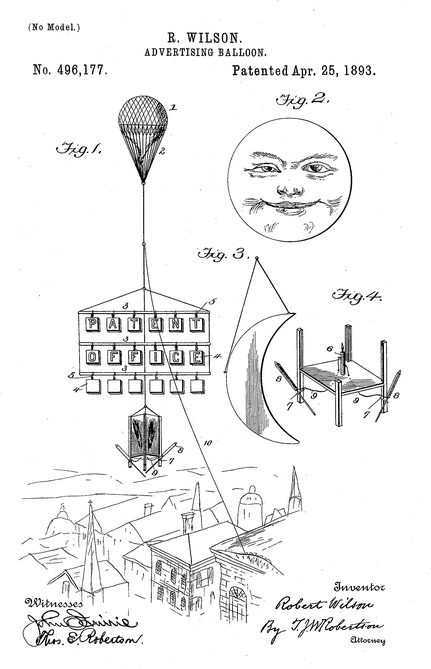
    Patent balloon advertising 1893[Source:  Google patents, http://www.google.com/patents/US496177?dq=balloon]
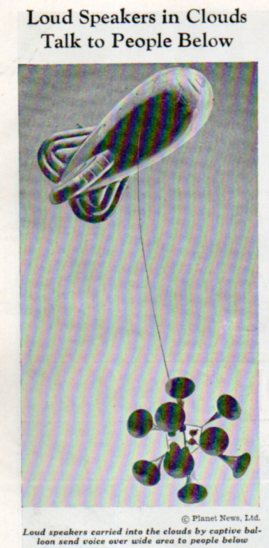
    Sky speakers413

    And this, seeming more on the Orwellian/1984 side, or perhaps more contemporary as an instrument of the Dear Leader in North Korea (left, from Popular Mechanics, July, 1939).


    Here’s an interesting, pre-airplane, airship-delivered explosive device: floated over an enemy’s position, the chord would be pulled at the desired time to create a tear in the balloon’s top, sending the craft down, with the bomb exploding on impact:
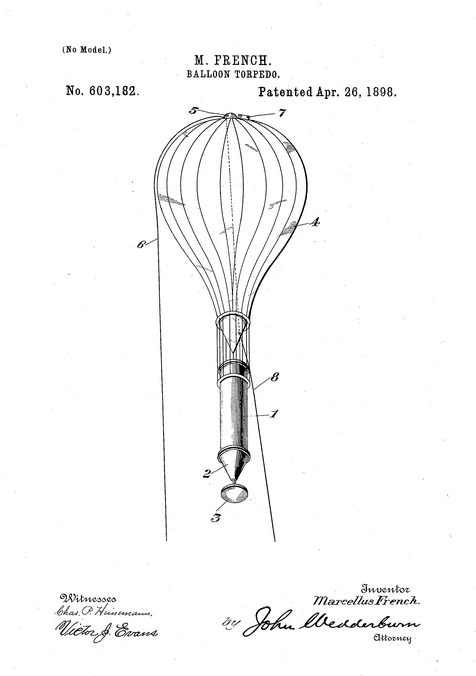
    Patent balloon torpedo[Source: Google patents, http://www.google.com/patents/US603182?dq=balloon]

     Another sort of slow death from above advertising scheme:
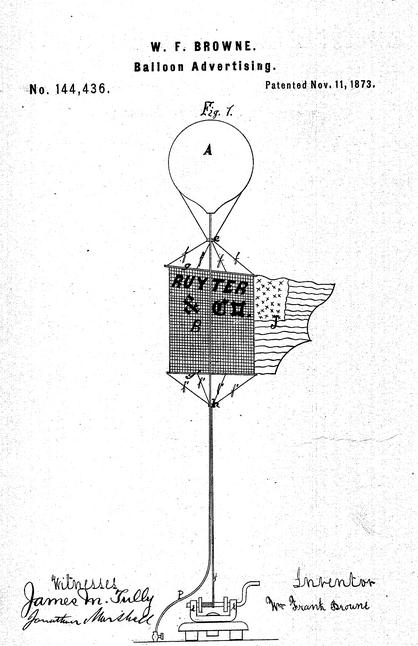
    Patent balloon 1873

    [Google patent:  http://www.google.com/patents/US144436?dq=balloon]

    In this device patented by Steinmetz the explosive device is still actually attached to the aircraft when exploded–not a very common way of delivering your weapon.  The airship would advance on the enemy, with the bomb  attached to a cable just above an anchor at bottom; the anchor would grapple the target, and the bomb detonated from the  gondola of the airship:
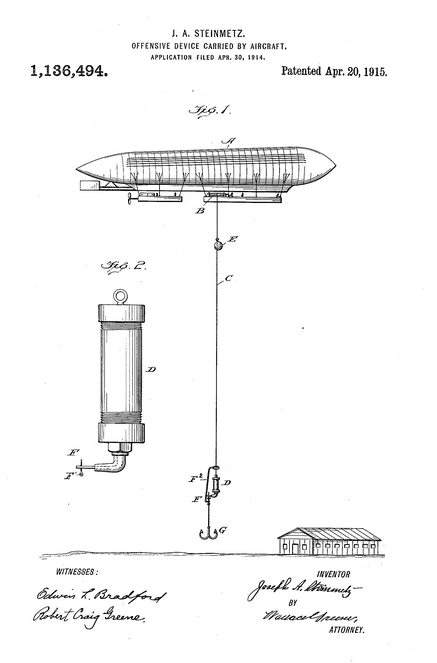
    Patent Balloon gondola


  • An Early–and Patented–“Flying Saucer”, 1898

    JF Ptak Science Books   Quick Post

    This magnificent flying thing was perhaps among the earliest of its kind, at least according to shape, which as we can see really wasn’t quite a flying saucer,, though it was a flying disk.  And a big one, at that.  From the ladder that led to the major axle we can infer that the aircraft was at least 60 feet high, which made its disk apparatus a very ferris-wheel-like 40′ or 50′ in diameter.  If nothing else, the patent drawings are quite pretty.


  • A Few Examples of “Heavy Stuff”: Patent Drawings for Flying Machines, 1877-1900

    JF Ptak Science Books  Quick Post

    This is as beautiful as it is heavy; and it is in its way very beautiful, so I guess that also means that is is very heavy…

    And speaking of heavy, this balloon doesn’t seem large enough to lift the very heavy ship-like carriage:

    Another flying boat:  I don’t see a power source to drive the “fans”/propellers on this one, though there is a tail for its “kite” body:


  • Drop-Dead Gorgeous Flying Man/Ornithopter Patent Drawings, 1889

    JF Ptak Science Books    Post 1746

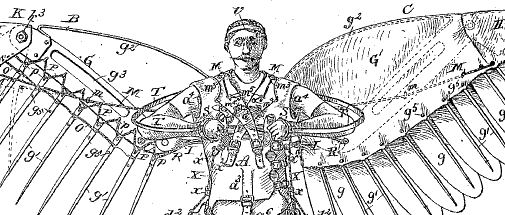
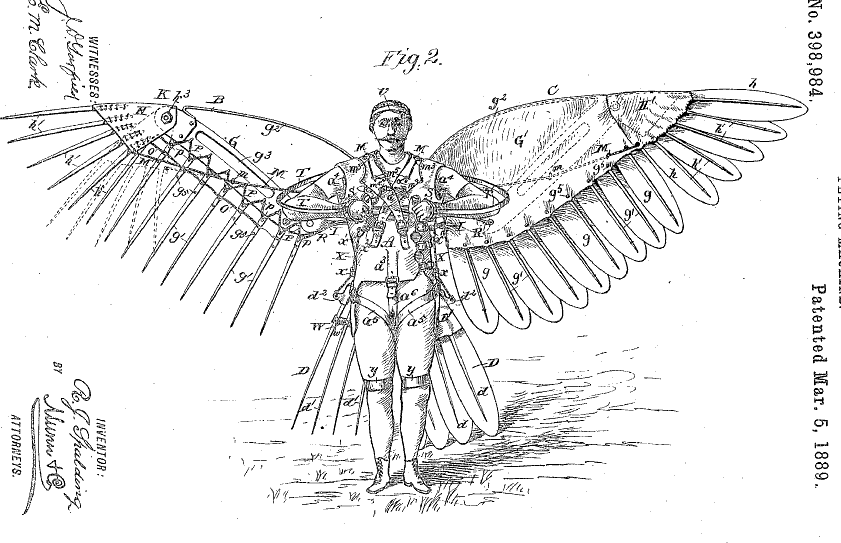
    This is one of the most appealing sets of “flying” or manned aerostation patent drawings that I have seen in the USPTO collection for the 19th century. The machine is a human-powered ornithopter, applying the structure of a human against that of a bird, and outfitting the flyer accordingly to combat their human weaknesses as adapted to bird flight.  Needless to say, and in spite of the beauty of the thought, this arrangement was destined to deep failure.  (The patentee, Reuben Jasper Spaulding, of Rosita (“Little Rose”), Colorado (south of Pueblo), may have been the same Reuben J Spaulding who made the first gold strike on the Blue River on Colorado’s Western Slope in 1859.)  Spaulding’s design is interesting also for the balloon device for getting the aero pioneer off the ground. 

    [Source:  Google Patents (and also for the extensive annotations for the images).]  I note that there was a model constructed for this patent–I’d love to see that.

    Patents--spalding flying_edited-1

    Patents--spalding flying

    And along this same vein of ornithopter-y thought is this, another American solution to the man-bird-mechanical-flight continuum, produced a dozen years earlier–it is similar, though not nearly as glorious (at least in presentation) as the later Spaulding effort: 


    The work really ins’t quite as awesome as Spalding’s beautiful Lazarusian resurrection, and not as detailed, but still quite interesting:


  • Blank, Empty and Missing Things: Stone and Wood

    JF Ptak Science Books   Post 1742  [Part of the series on Blank, Empty and Missing Things.]

    Ogardus335
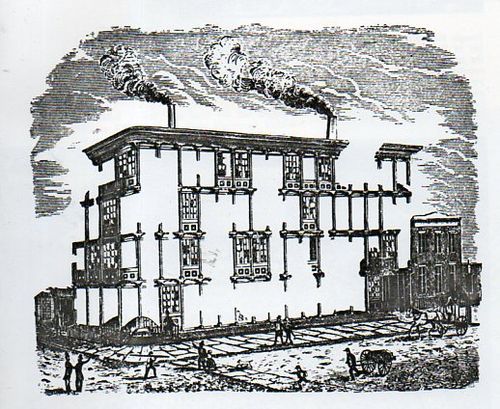
    This short post is about this remarkable illustration from a 16-page pamphlet by the inventor, architect and cast tion pioneer James Bogardus (1800-1874, Cast Iron Buildings, their Construction and Advantages, 1856 and 1858 second edition). 

    But before I get to that, I started to wonder about why it was that NYC developed up rather than out, vertically rather than horizontally? There was plenty of room for outward growth–and in mid-1850’s, the period that this post addresses, most of the city had already been laid out, or at least up to 96th street.  But in the city of about 900,000 people, there were few people living that far north (and not that many structure), with half of the population living below 42nd street.  So, the largely flat, largely unoccupied island could well have been developed northward rather than skyward.  My feeling is that the reason for vertical development was “running”.  That in the pre-telephone days and the earliest days of electrical telegraphy, that in order to conduct business rapidly messengers were used to take documents and communication back and forth. And so for the sake of speed of business, rather than have messengers traveling for 20 or 40  or 80 minutes to a more-removed uptown location, that it made more business sense to keep businesses together; and to do that on limited land, one needed to go up.  Not out.  I’ve never thought about this, ever, but this seems to make sense to me…

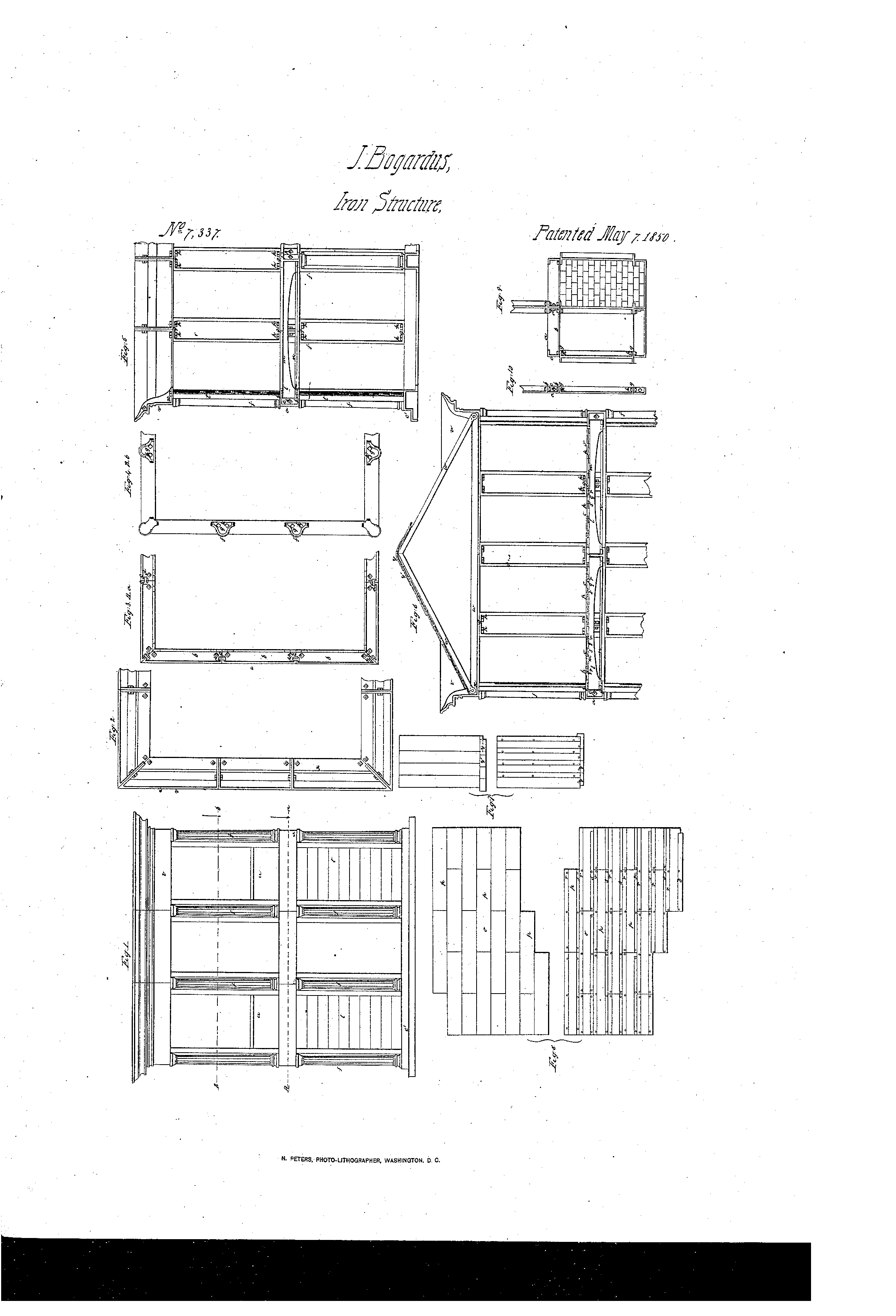
    Now, getting back to the Bogardus illustration: what was missing was the building, or the pieces of the building that had previously been thought of as being absolutely essential for a structure of this size to maintain itself.  But what Bogardus had done was to figure out a way of using cast iron rather than other building materials–a building tool that was stronger and with greater engineering chops than anything else that had been previously seen, which meant that there were different forces at play in structures using it, and which meant therefore that even though there were large pieces of the building’s shell that were “missing”, that this structure could and would still stand.  It was a fabulous way of communicating a new idea. 

    What happened with the Boagardus idea is that it developed into the use of steel-framed buildings, which made for very light, very strong structures, which led to skyscrapers, which led to modernity.

    The Harper Brothers building (built in 1854 at 331 Pearl Street) was an iron-facade building that was engineered by Bogardus (with the architect John B. Corlies) and was built in response–and partially as a safe, fire-proof building–following the devastating fire (and enormous liability payout) in the previous Harper building.  One thing that was certainly different in the face of this building–owing to the efficiency of the cast iron, there could be plenty of windows in place of where there used to be building materials.  And there was certainly plenty of glass in the Harper building.

    Bogardus patent

    [Patent source: the very easily usable Google Patents, much more nimble than the UST&PO, somehow.]

    The trip to modernity didn’t necessarily start here with Bogardus of course, but he was a considerable and significant chunk in the engineering developments necessary for the construction of tall buildings…and here it is interesting to note that another big piece of that development that came into being at nearly the same time (1854) as the publication of Bogardus’ pamphlet and the construction of the Harper building was the installation of Otis’ safety elevator int eh Haughtwout (five storey) store. And of course the elevator was necessary for the creation of tall buildings, just as the invention of the braking systems was essential for the creation of the elevator. And on the story goes. 

    The Bogardus achievement (patented May 7, 1850) was certainly an important step–it was pragmatic, efficient, and strong, and also led to the possibility of mass production and pre-fabricated structural elements.  And for the mid-1850’s, this was certainly a big deal.

    One of the few remaining Bogardus structures, at 254 Canal Street, today:

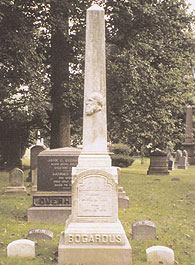
    And the Bogardus monument in the famous Green-Wood Cemetery, in Brooklyn:


  • Tech-Quiz–What is It? (#7, 1893)

    JF Ptak Science Books   Quick Post   [Part of the Tech-Quiz series.]

    Generally with these questions I provide a detail of a patent drawing and from that the application is supposed to be derived.  Here, though, is the full drawing, and is seems pretty straightforward, I think, though the ultimate use of the contraption might not be so obvious.  Or perhaps it is?   What was the intended purpose of this object?


    Answer in the “extended reading” section, below:


  • Hydrogen Balloon Properller Pseudo-Steampunk Downton Abbey Airship, 1882.

    JF Ptak Science Books   Quick Post

    I think that there must have been a certain satisfaction for Mr. R.L. Downton when he had the idea for hydrogen-filled propellers–I mean, they must have made a lot of sense to him, sitting there in the Abbey, pondering the elegances of flight, while letting Maggie Smith walk away with all of the best lines.  Well, I’m kidding of course about Maggie Smith and the Downton Abbey remark, but I can well imagine Mr. Downton feeling as though he came to some sort of breakthrough by making the propellers for his flying machine its lifting device as well.  We can see in the first image that the “aerial ship” has side-by-side propellers and is driven by steam–the airship is still a little too refined and relatively light to fall into a classic “Steampunk” mold. 


    The second drawing shows a modification to the somewhat-large ship above, with the airship being a flying gondola, with the hydrogen-filled propeller being hand-cranked.  It wasn’t a great idea by any means, but it was very interesting, at least to me. 


  • Questionable Quidity: on Rowing Flying Boats, 1889

    JF Ptak Science Books  Quick Post

      This remarkable flying machine was patented by N.H. Borgfeldt (of Brooklyn, NYC) on 1 October 1889.  It really seems to be not that much more than the rowing-section part of a Roman galleon, except that it is in the air;  there are five “rowers” int his aircraft, plus someone to operate the rudder. And a flag.

    This certainly is not the most effective way of using human muscle, even in an odd application like this one:


  • Tech-Quiz 6: A Square Peg in a Round Hole?

    JF Ptak Science Books  Quick Post

    Or is it a round hole fitted around a square peg?  And what is it that is patentable about what follows?

    Answer in “continue reading”, below:

    ·Posted by :

    ·in:

    — —

  • Tech-Quiz #5–Not a “What is It?”, but “Who Done It?”

    JF Ptak Science Books   Quick Post

    This was a major piece of early thinking on spread spectrum communications and frequency hopping–butter for the bread (or bread for the butter?) of wireless communication–with the piano roll tapes replaced by electronics. The idea didn’t go anywhere in 1942–it did, however, go far, beginning in the late 1950’s. The major name listed on the patent report is a major name, but not in this form, and not in this area–some might find it very surprising to know the more popular version of the inventor’s identity, and the industry in which the inventor worked.


    H.K. Markey and G. Anthiel produced this:

    Hint: the “H.” stood for

    Answer, in continued reading, below: