JF Ptak Science Books Post 1549
(The following images are taken from the U.K. Intellectual Property Office Espacenet patent search page, here. The quotations following the illustrations for the patents are from that page.)
Close Straightening Encounters for Children of the Reading Kind
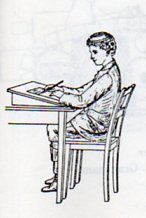
Here’s an interesting implement that no doubt brought secondary thoughts about reading to any child made to wear this thing–the unhappy child is at left, and the skull-cap, at right.

Abstract of GB 190421618 (A)
“Lorenz, H.. For indicating when wearer deviates from an upright position; caps.-A cap I is made in the form of an inverted bottomless saucer with holes 3 in the side for lightness and ventilation. It is intended to be worn by school children to prevent stooping, inasmuch as it only remains on the head so long as the wearer remains in an erect posture…”
Hand Guard for Cutting Things

Francis John Crell: GB190402703 (a) “A Hand Guard for use in Cutting Bread and for Other Like Purposes”. I’m not sure how this works as a glove-protective unit given the spaces in-between the springy fingers–mostly it seemed to increase the cutter’s grip rather than protect them for accidental cutting.
Walking and Running Anti-Deformation Appliance
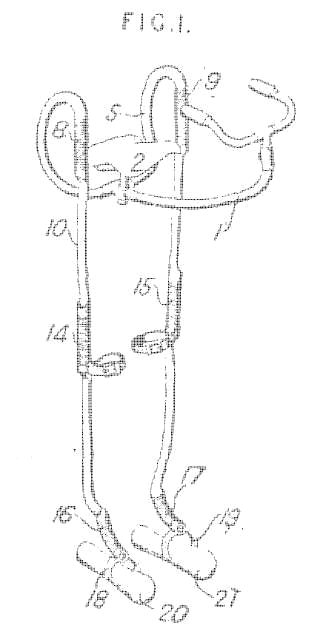
Abstract of GB 190414477 (A)
“Skorzewski, Comte V. Walking and running, appliances for aiding.-A n appliance for aiding walking and running is adapted to store up, and to give up at the required moment, the energy resulting from the alteration in height of the centre of gravity of the body. The user sits on a saddle 2 adjustably attached to a tube 1 provided with handle – bars. The tube 1 branches into two tubes 5, which are connected by joints 8, 9, 14, 15, 16, 17 to other tubes of narrower crosssection, conforming in shape to the legs of the wearer, who is strapped to the appliance. The joints 16, 17 are connected by means of stirrups 18, 19 to soles 20, 21, or to straps by means of which soles may be attached to the appliance. The tubes are filled with compressed air through a suitable cock or valve. The joints are preferably formed of armoured rubber tubes, coated or not with para rubber.”