A Daily History of Holes, Dots, Lines, Science, History, Math, Physics, Art, the Unintentional Absurd, Architecture, Maps, Data Visualization, Blank and Missing Things, and so on. |1.6 million words, 7500 images, 4.9 million hits| Press & appearances in The Times, Le Figaro, Mensa, The Economist, The Guardian, Discovery News, Slate, Le Monde, Sci American Blogs, Le Pont, and many other places… 5000+ total posts since 2008.

Category: Computer Tech/History

  • Manuscript Material on the Installation, Operation and Maintenance of the UNIVAC, 1949-1957

    JF Ptak Science Books   Post 1619

    This is a group of materials from the estate of Ralph Mullendore (see below), an early and integral team member of the electronic computation section of the U.S. Bureau of the Census, who was responsible for the installation and maintenance of the UNIVAC there, at Census.  The papers are on their way to a history of computer science section at the library at North Carolina State University where they will hopefully be enjoyed by any and all who have an interest in the early stages of the maintenance and tinkerings on America’s first commercial computer. It should be remembered that the hands of the man who wrote all of these notes were the same hands that worked on this monumentally important machine, the first of its kind in existence.

    Mullendore a751


    Mullendore f782

    Many mor eimages, below.

    ·Posted by :

    ·in:


  • History of Holes: Making Tiny Holes & the Art of Compiling Statistics (I)

    JF Ptak Science Books     Post 1612

    Part of this blog’s  History of Holes series.  (See, for example: An Episode in the History of Holes: Electricity, Punched Cards and the Computer, 1878, here; History of Holes–Filing Holes Up, here.  And fifteen others. 

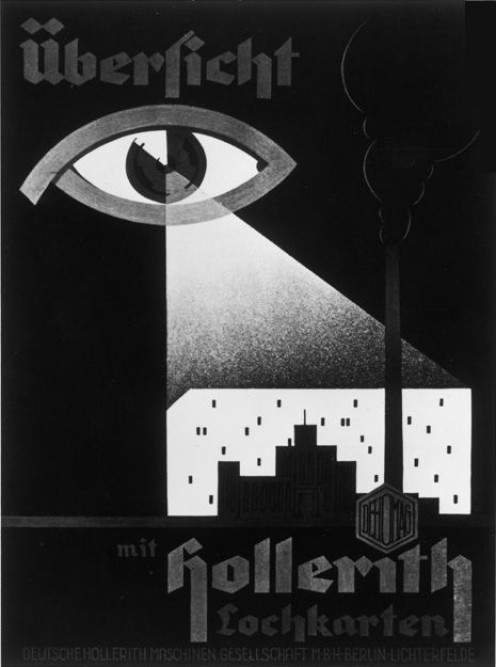
    I was thinking about holes and hole-making in the history of the art form of compiling statistics, and in the process of accumulating a few images of the machines that actually made the holes in tabulating cards, I found an interesting/unfortunate/depressing illustration.  It  belonged to the Deutsche Hollerith Maschinen Gesellschaft (“Dehomag”), which was the German arm of IBM. (Herman Hollerith created his Tabulating Machine Company in 1896; it was consolidated with the International Recording Company and Computing Scale Company of America into Computing Tabulating Recording Corporation (CTR) in 1911, and then, in 1924, changed once again into something with the name that we all recognize , International Business Machine (IBM).)

    Edwin Black’s one-trick pony, IBM and the Holocaust, I’m sure was a consolidation of grand assertions that helped to sell a book.  As a history I find it manipulative, like a person on a mission to say something and uses only what is positive to that end.  On his website, Black states: “IBM and its German subsidiary custom-designed complex solutions, one by one, anticipating the Reich’s needs. They did not merely sell the machines and walk away. Instead, IBM leased these machines for high fees and became the sole source of the billions of punch cards Hitler needed.” If you read between the lines this sounds like standard operating procedure that IBM would’ve followed with anyone; but on the face of it Black creates the case for IBM automating the Holocaust. 

    Keypunch hollerith det
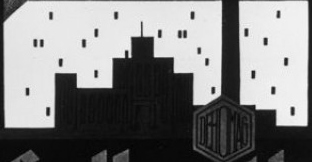
    The poster has a very provocative cache, and taken somewhat out of context it might be viewed as dustjacket artwork for Black’s book.  The all-seeing eye absorbing the information of teh punched card, with the unfortunate, looming, belching smokestack there in the foregoround, reminiscent of the chimneys in the concentration and extermination camps.  But this poster was executed around 1925, well ahead of any of those events–the design by serendipity happens to visually support the author Black’s assertions.  Its just a nasty-looking object.

    Keypunch hollerith


  • First Use of the Term “Super Computing”

    JF Ptak Science Books   Quick Post

    The Columbia Difference Tabulator – 1931

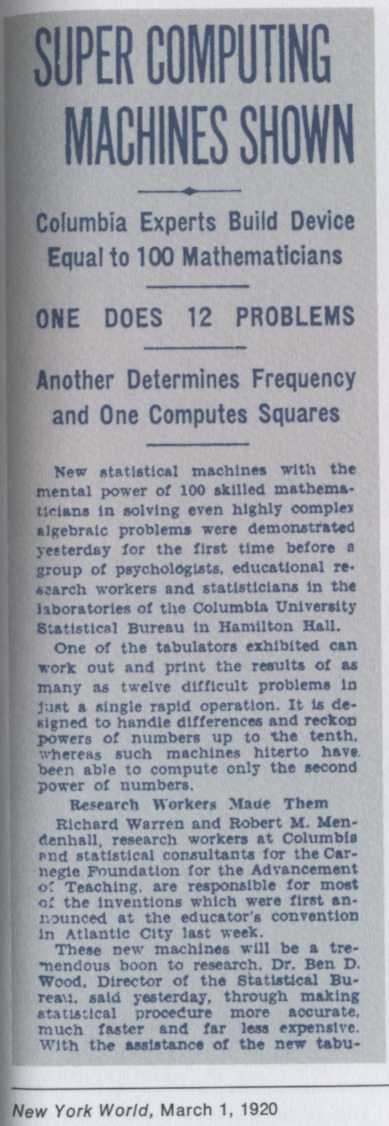
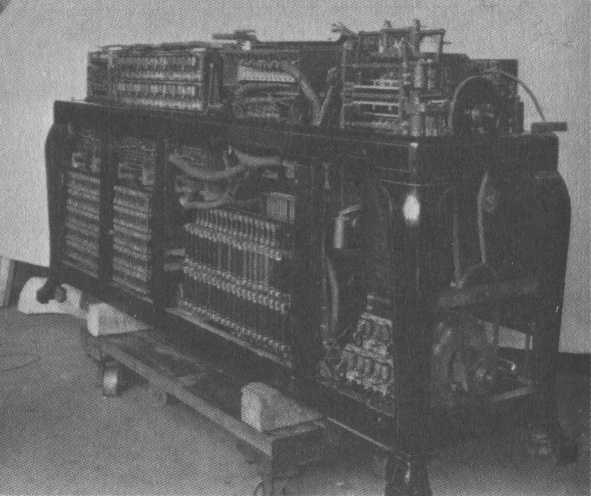
    The earliest use of the term “super computer” seems to com from the New York World, (“1920” though actually 1929), and was applied  to a unique instrument made by IBM for Columbia University.  The The Columbia Difference Tabulator, completed that year, was nicknamed the “Packard”, after the large, streamlined-but-bulbous American luxury car of enormity.

    http://www.columbia.edu/cu/computinghistory/statlab-clipping.jpg

     And a picture of the great beast, below.

    [Picture source:  Columbia University computer history page,  here. .]


    http://www.columbia.edu/cu/computinghistory/packard-emitter.jpg

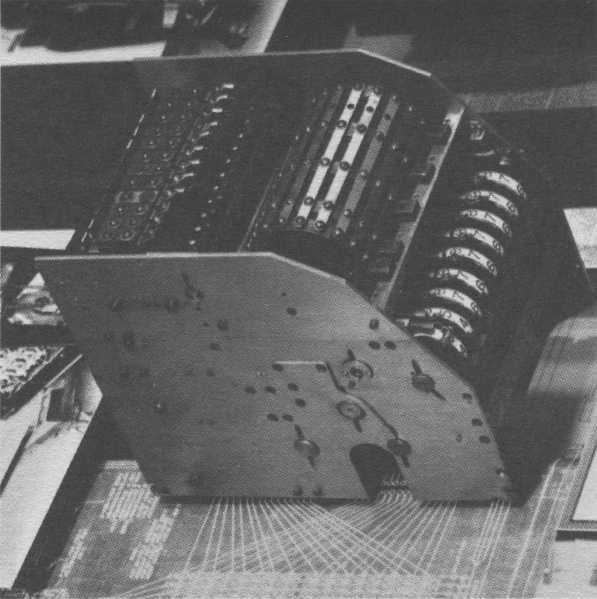
    “The new machine “mass-produced the sums of products by the method of progressive digiting and read punch cards at the rate of 150 per minute. It contained ten 10-position counters with provision for shifting totals internally from one counter to another – a capability that anticipated a future function of computers.” [9]. The new machine, variously called the “Columbia Machine”, the “Statistical Calculator”, the “Difference Tabulator”, and (because of its massive size) the “Packard“, was delivered and installed in 1931.”–From the Columbia University site, here.

    Idea source: Eames, Charles; Eames, Ray (1973). A Computer Perspective. Cambridge, Mass: Harvard University Press. p. 95.  More links and references at Columbia University’s computer history page,  here.


    Notes:


  • Looking Backwards: How Far Back in Time is 1949 (in Computer Years)?

    JF Ptak Science Books  Quick Post

    The history of computing, in its inception, could be measured in decades, beginning, say with Babbage; by the time of the earliest large machines (1945-1950), computer time could be measured in a decade.  Come the deacade of 1960, the computer year could be measured finally in years.  After that, after microminiaturization, and the personal computer, the year started to be measured in months.  And then, of course, the year really sped up–I’m not sure if there is only a week or two in the year, now; maybe its measured in days. [This piece of computer history ephemera is available at our blog bookstore, here.]

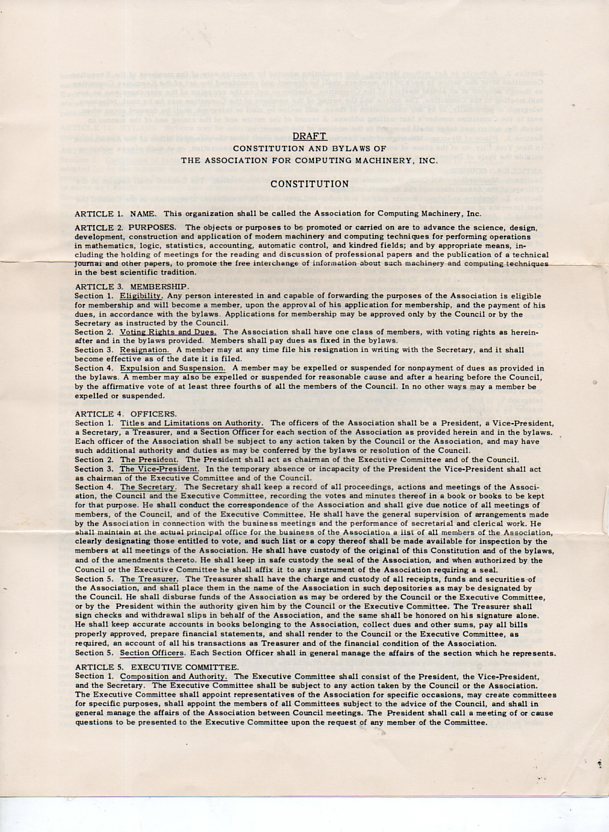
    Acm draft713 [Click to expand]

    Looking at this document from the beginning of the first tweeks of mass professionalism in the development of the computer emphasizes this business of time.  This draft of the constitution and bylaws of the Association for Computing Machinery (the ACM) was complete in four pages, including the establishment of its members, officers, executive committee, meetings, bylaws, meetings–the whole deal, in four pages. 

    Acm draft717

    The document is undated, but as far as I can determine, I believe that this document was printed in late 1949, soon after the ACM dropped the “Eastern” that used to appear as the first word in the title of the organization.   

    Its quite a spectacular thing, seeing what would become a vast organization be summed up in its infancy on one sheet of folded paper.   

    The rest of the document follows:

    ·Posted by :

    ·in:


  • The Steampunk God and the non-Computer Internet, 1865

    JF Ptak Science Books   Post 1521

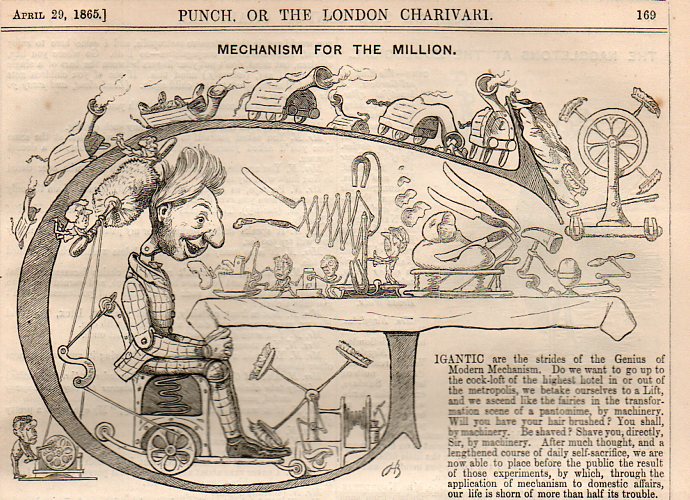
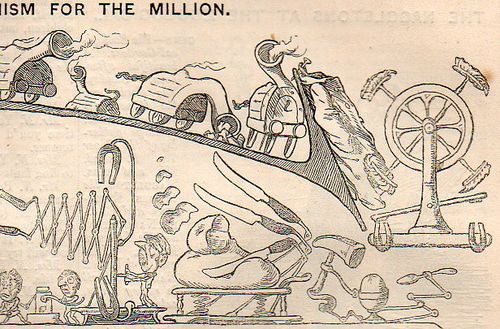
    In the weeks following Lincoln’s assassination (14 April 1865) the editors of Punch, or the London Charivari printed this arresting image of an imagined near-future:

    Mechanism545

    And what the future holds is this: the automatic hydraulic teapot (already “sugared and milked”), automatic boot and clothes brushing, auto bread-cutting, carving, cork drawing, sweeping, letter writing, reading…”all done by machinery”.  “We shall cook by machinery; we shall have our mashed potatoes by machinery.”

    There is no specification about how all of this was going to happen–I’d be very interested about the automatic “letter writing and reading” would be,  particularly when we read in the next paragraph, that “Mr. Babbage’s Calculator is a mere mechanical infant to our gradually matured inventions”.   The article continues: “From thinking of machinery we shall at last arrive at thinking by machinery, and Man himself shall be, as presented in this initial etching, a mere machine.”

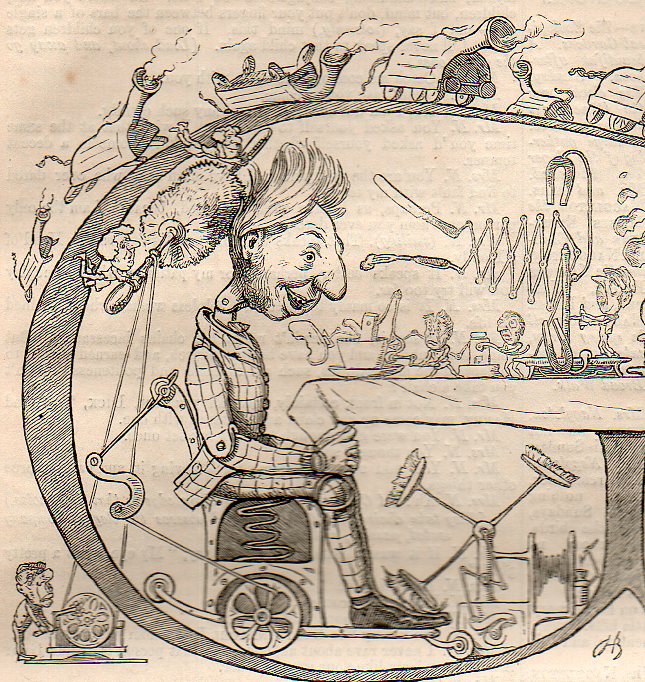
    We see in the image that there are all manner of automatons pleasing the seated (mechanical) man, though they are all powered by steam, or friction, or by magnets, all existing power sources and almost everything being doable at that point in time. 

    And the detail:

    Mechanism547  And this:

    Mechanism546

    There is a suggestion of a “Finding Fault Machine” but this goes barely beyond its mention–except to say that it would destroy something and become our next “Infernal Engine”.  I initially liked the sound of the title of this machine, though it quickly started to seem like a god machine to me–something that could and would have the ability to find faults in things, and then, I guess “correct” them in some sort of Steampunk God way. I’m not very educated in the world of speculative/science fiction to determine how early people began to imagine constructing their own supreme deity, though it seems to me that this must be considered an early effort.  I do have large doubt that the Steampunk God is what these folks were talking about since it would most probably be a blasphemy, but there is certainly room to reach that conclusion.

    The idea of a popular machine that was somehow associated with either Babbage’s (1791-1871) difference engine or analytical engine (which was a programmable machine that would function with punch cards) and automated or mechanical reading and writing is very intriguing.  It is unsure whether the editor was crediting the future with a machine that would provide the imagination behind writing, or provide an instrument that would record thoughts and creativity directly to some medium as they occurred, or what have you.  It is an interesting idea left very open-ended to the reader, which remains so even to the modern eye, because what happens with statements like this is that they get back-filled with whatever current technology exists.  In 1865, the other innovations depicted for the future were mainly driven by steam, and perhaps this automated writer/reader would be too, something very primitive by our standards today, perhaps some sort of small steam engine that would help dip a quill into an ink pot….or perhaps it was simply something as exotic as a pen with endless ink.  But I think if you look hard enough at the statement it is possible to see something like an internet.

    And there were 19th-century something-like-an-internet things being imagined, if you can imagine the internet as an entity not created by a computer network, since the “computer” as we know it would not exist for these inventive folks (below) for another 50 or 75 years. 

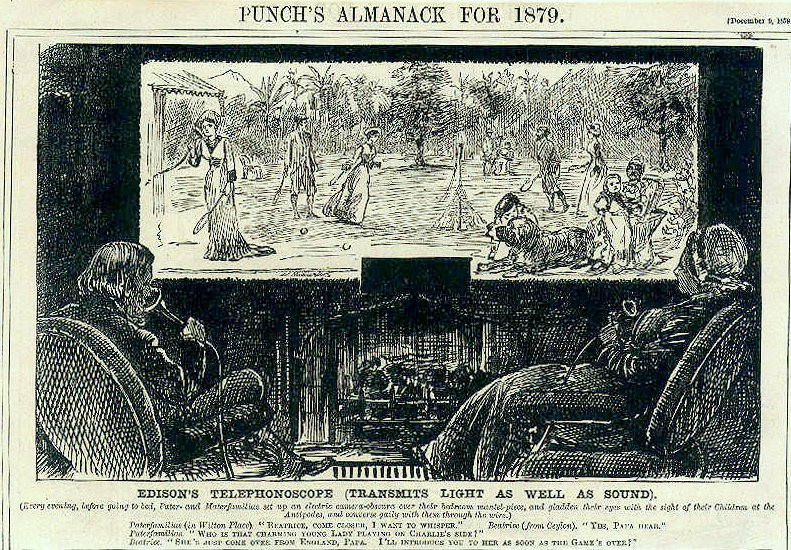
    Edison’s was there, of course, imaging a communication device that would show live-action events in which two remote parties could see and talk to one another.  A version of his Telephonoscope: appeared in Punch’s Almanack for 1879 and was aimed at the imagination and experience of only the classes of leisure and privilege:

    File:Telephonoscope.jpg

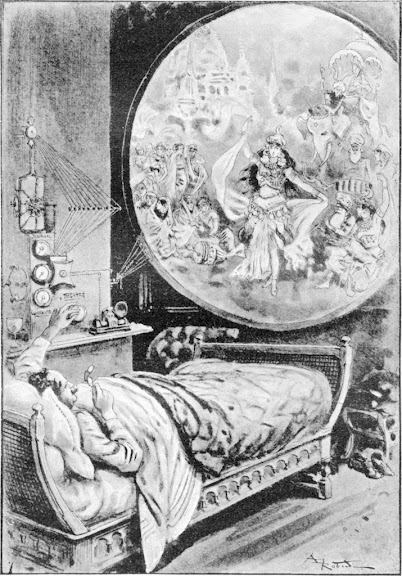
    There is also a device like this that appears in Albert Robida’s Le Vingtieme Siecle:  la Vie Electrique (1890) , which is  an odd but very nicely illustrated look into the future of 1955–most of which has come to pass.

    http://www.gloubik.info/livres/robida/images/robida-06.jpg

    http://cultureandstuff.com/wp-content/uploads/2011/05/levingtiemesiecle.jpg

    Another sort of live-action and direct communication device was depicted in Camille Flammarion’s La Fin du Monde (1893):

    I think though that the most interesting part of Punch’s view of the future must lie in the possible creation of the creator of the universe. 


  • A History Blank, Empty and Missing Things #77–Blank Enumerators in Sand, Pebble and Dust Computers

    JF Ptak Science Books   Post 1512

    Reisch c
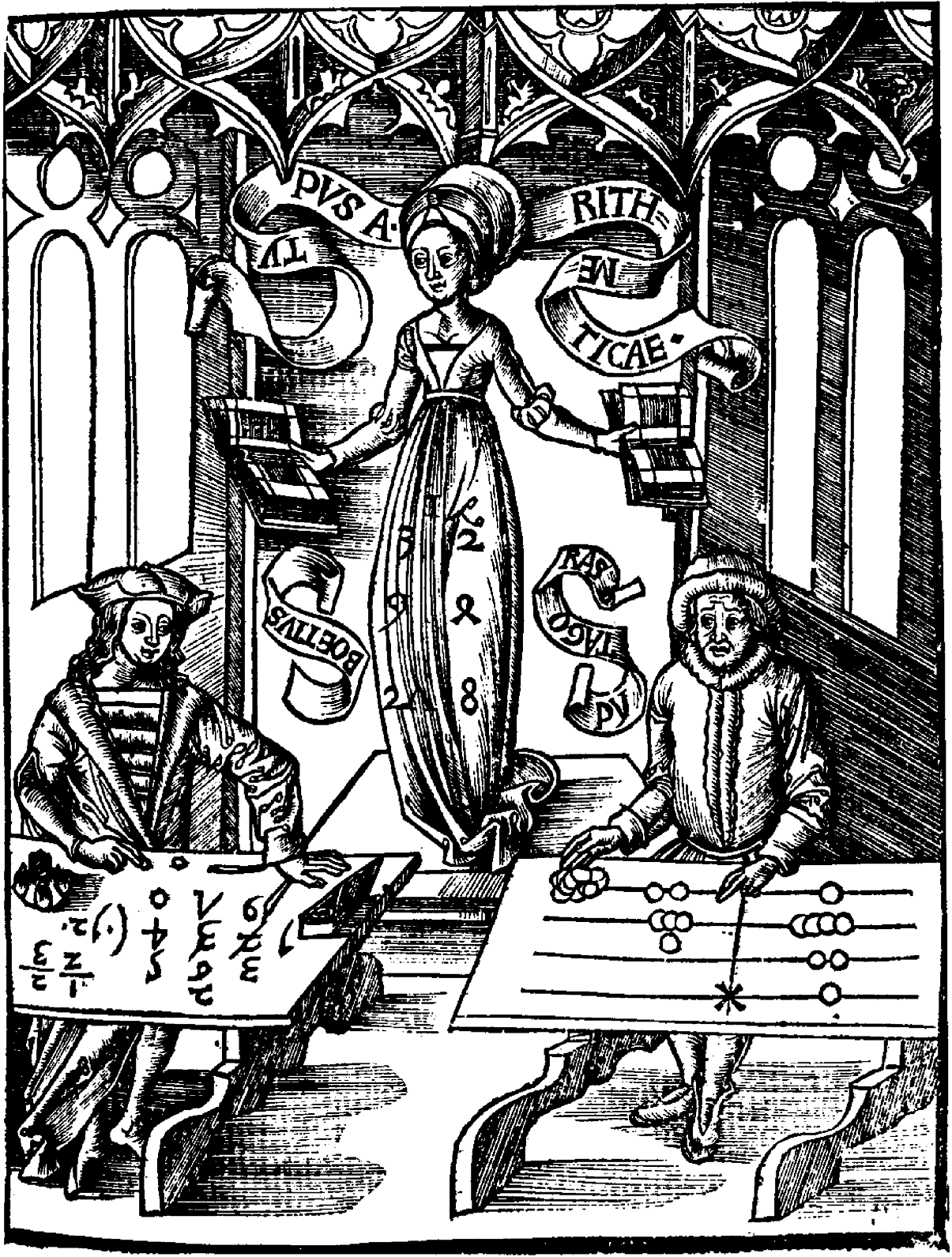
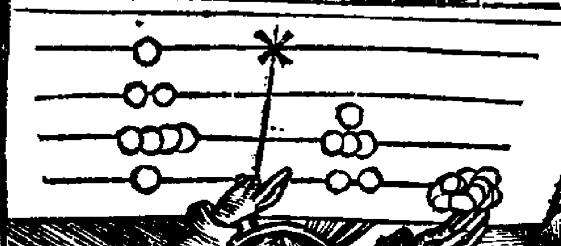
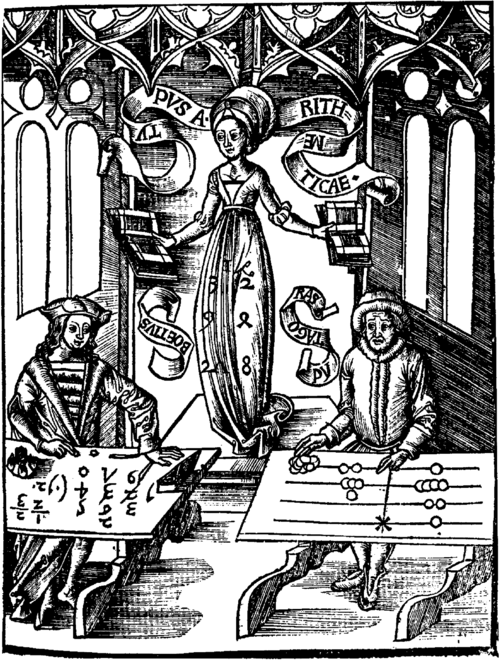
     This is a short note on the blank nature of the “checkers”, the place-holders, the missing numbers, of ancient computing machines,  the counters (jetton, or jeton1) used in early/ancient arithmetical reckoners, the material pieces used to aid in addition and multiplication “devices”. These bits were sometimes pebbles or shards of pottery or rocks, and placed on the ground with a grid drawn in dust, or in sand, or on any surface that could hold a line.  There are fancier and more permanent types of these instruments, as we see in the right side of this iconic woodcut image from a 1503 universal compendium of knowledge–a simple wooden table with incised counting lines, with the jettons being blank disks.

    The book that this  beautifully-illustrated counting board is found is in Gregor Reisch’s  Margarita Philosophica,  and depicts (amidst much else in the greatly humanist volume) representations of the mathematicians Boethius and Pythagoras working math problems on the given tools of their day. (The Reisch book is remarkable: it is basically a Renaissance encyclopedia of general knowledge, divided into twelve books:  grammar, dialectics, rhetoric, arithmetic, music, geometry, astronomy, physics, natural history, physiology, psychology,  and ethics.)  We can see in his expression that Boethius, on the left, is rather enjoying himself, knowing the superiority of his system of counting, which was the the Hindu-Arabic number notation–he definitely has a sly, self-appreciating smile on his face.  Pythagoras, working with the old counting table, definitely looks worried, or at least unhappy, unsettled.  Never mind that Pythagoras (570-495 b.c.e., none of whose works exist in the original, another sort of entry in our Blank History category) was at a definite disadvantage in the calculating department, being dead and all that for hundreds of years before the Arabic notation was more widely introduced in the West, probably being introduced by Pisano/Fibonnaci in the 12th century.  But it does fall to Boethius, the smirker, to have introduced the digits into Europe for the very first time, deep into the history of the Roman Empire, in the 6th century. 

    The numerical stand-ins in the Reisch book with which Pythagoras worked were blank, coin-like slugs used as placeholders, and would be used in place of rocks or pebbles or whatever other material was at hand. It is interesting to note that the Latin expression, “calculos ponere”, which basically means “to calculate”or “to compute”, is more literally translated into  “to set counters” or “to place pebbles” (upon a counting board) or to set an argument2,  which is exactly what some of the Roman daily reckoners would do at their work. And also used, in this case, by the unhappy Pythagoras. 
    Reisch

    Here’s a small close-up of the blanks:

    Reisch b
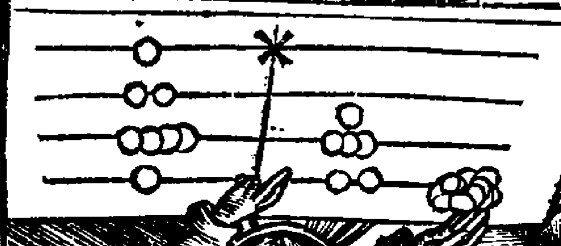
    The problem that the Pythagoras-person was working on (flipped 180  degrees) shows him adding the numbers 1241 and 82.  A jetton occupying the the top of the mark on the counting board, counting as one unit of 1000; followed by two units of hundreds; four tens; 2 on the ones.  The other number interestingly keep one jetton in between two lines, signifying an easy wade of enumerating 5 of any one kind, in this case depicting 8 tens units, coupled with two ones., thus making the number 82.)
    Reisch d

    For an excellent explanation of the many and varied methods of ancient calculations see the article by Steve  Stephenson3 on how ancient computers worked, found in the IEEE Global History Network site,  here. 

    It is a simple observation, but interesting to me nevertheless, that there was so much about these early counting systems that even though extremely useful they were also highly ephemeral–the counting boards being  inscribed in dust or sand or dirt, the counters/numerical placeholders being blank disks or pebbles or pottery shards–and so so much of the counting world depended on so little.

    Notes

    1. I should point out that these markers seem to have been decorated more often than not–its really just those items that appear in the Reisch book that I am addressing.   On jettons, in general, see here ;  also,  Jetons, Their Use in History.

    2. See Jen  (1998, April 25). “Roman Counting Instruments”, in The Math Forum at Drexel University. Also see Karl Mennigner’s  (1969) Number Words and Number Symbols: A Cultural History of Numbers, a big, academic/coffee table book on the history of numbers.  Also in general, see: Barnard, Francis Pierrepont, (1916). The Casting-Counter and the Counting-Board, A Chapter in the History of Numismatics and Early Arithmetic. Oxford University Press, London.

    3. This is a deep and nicely-explained effort looking at the development and different sorts of these instruments, as well as how they functioned.  Regarding the Reiwch woodcut, Stephenson says:

    1. Pythagoras has his abacus oriented with a vertical median line;
    2. The lines are equally divided so the same number of jettons can be accommodated on either side of the median line;
    3. The top horizontal line is marked with an X, (perhaps) to indicate the unit line; and
    4. On the right side of the abacus is a jetton in a space, all other jettons are on horizontal lines.

    On pp.313-314, Prof. Barnard describes and quotes from Legendre, François, 1753. L’Arithmétique en sa perfection, Paris, pp. 497-528, Traité de l’arithmetiqué par les jetons:

    It was permissible to set and to work the jettons of the sum without using the spaces [between lines], … But it was much more convenient to anyone who was expert at the practice, and less confusing to the eye, to reduce the number of jettons by using the spaces.
  • A 16th Century Wooden Internet: Agostino Ramelli’s Magnificent Technologies

    JF Ptak Science Books  Post 1386

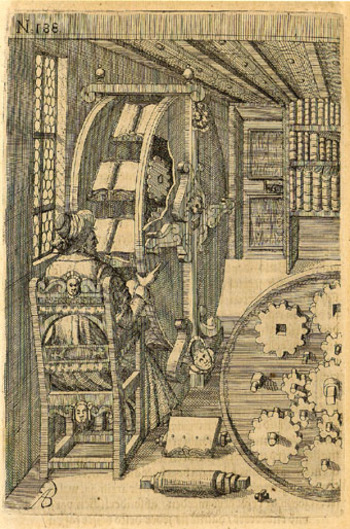
    Bloginternet Okay, it wasn’t really the internet, or ARPANET1 or any of those things—the invention did however deliver reading material to a waiting reader/researcher in a novel way, bringing twelve already-opened books into the line of sight within seconds.  And insofar as the internet delivers reading material in such a way, well, then, so does this, so long as you chose the right twelve books.  This was a great innovation though I cannot say how many might have been constructed via the representation of this machine in Agostino Ramelli’s (1531-1600) :masterpiece Le diverse et artificose machine, which was published in 1588, the same year that England sent the Spanish Armada to Davy Jones’ locker.  
    The book was a wonderland of contrivances and engineering feats of pumps, fountains, logging mills, mining materials, bridges, hydraulic material, dredges, derricks, metal-working machinery, bellows, looms, foundry materials and (my favorite) cranes—they were all of Ramelli’s design, and the book, which contained 198 engraved plates of these splendid illustrations, had a remarkable and deep impact on engineering in the 17th century.  There really wasn’t anything else quite like it in the whole of the Renaissance, except for Agricola’s book on mining.  Ramelli touched on so many subjects and in such great detail that I believe he simply had no equal.

    As it turns out most of the devices in the Ramelli book had to do with raising water, which included piston pump machines, rotary pumps, well buckets and a host of other more unusual devices.  The faintest majority of these devices were powered by water itself, the other 49% ere powered by people, people walking on treadmills, or turning a giant wheel, or using a hand crank, and many other such energy-transfer devices.  Of the 198 plates, fully 110 displayed water-raising devices, and of these 54 were powered by man. The rest of the deices were grain mills (21), sawmills (4), machines for dragging heavy objects (7), machines for raising and moving excavated earth (2), and cofferdams (2, both absolutely beautiful engravings).  Rounding out the rest of the book were 15 engravings of military bridges, 14 images showing lockbreaks/barspreaders and other means of gaining entry through re-enforced doors and window coverings, 4 images of fountains, 1 of a gunner’s quadrant, and 4 of some very impressive military hurling machines. (One of the throwing machines was specifically designed ot hurl barrels of dirt and other debris so as to fill up moats.)   And of course there was one entry for a movable, rotating bookshelf, our first wooden internet.

    Ramelli’s  attention was fixed by the growing solidification of the use of mathematics in engineering as the basic structure of construction, as found in such earlier works as was greatly influenced by the increasing importance placed on mathematics and geometry as an important tool for engineers and artists, and particularly by the writings of Guidobaldo del l Monte (1545-1607) and Petrus Ramus (1515-1572).

    What I particularly like about these images is that Ramelli shows us the guts of the apparatus—if you really wanted to build this thing, you actually could, given the details in the engravings. And in spite of the fact there there was only one edition of this book–and that it was the only book of Ramelli’s to make it into print, regardless of the fact that as he states on his title page the book press was in his own house–there must have been a fair number of them printed, because there are so many examples of the work existing today.  So, it was a popular book I have no doubt–it was easy to use, displayed its data splendidly, and there were no other books quite like it. Why didn’t it go into a second edition?   Perhaps Ramelli felt no need, perhaps he felt he got things right, perhaps there were so many books printed in the first edition that there was no need for a second.  And perhaps it was that Ramelli would be dead in a dozen years.  One thing is for sure, though–the book did get reprinted, or many of its images did, as publishers and authors seemed to steal his work and images with some regularity…maybe these people filled the need gap.

    Returning to our reader in his high-tech biblio-turntable–it was hardly the stuff of the internet, but it was adventurous, and it did allow folks to have a good, quick look at twelve books at a sitting–which as Ramelli points out would be good news to sufferers of gout. But everything that you needed to build this thing is shown int eh engraving, and if you had some gifts in woodworking and a few tools this device could’ve been your’s for the doing, as all of the key ingredients are shown.   . 

    Notes:

    1) I’ve got to point out that it also wasn’t the 1961 paper on packet switching theory, Leonard Kleinrock’s , “Information Flow in Large Communication Nets.”, (RLE Quarterly Progress, Report) or his 1965 Communication Nets–both of these were foundation works for the construction of the Internet..  Nor was it J.C.R. Licklider & Welden Clark’s  “On-Line Man Computer Communication”, which was the first true paper on the Internet concept; nor was it the Lawrence Robert’s (MIT Lincoln Lab) 1965 experiment on the first actual network experiment; nor was it Douglas C. Engelbart’s 1963, “A Conceptual Framework for the Augmentation of Man’s Intellect,” in P.W.Howerton and D.C.Weeks, eds., Vistas in Information Handling. Washington.D.C.: Spartan Books, 1963, but you get the idea.
    A nice chronology lives here.

     Later we’ll get to a much more bona fide aspirant for the Very Early pre-Internet Internet status:  Vannevar Bush and the Memex Machine of  1945. 

    2) See Ron Brashear’s (Smithsonian, Dibner Library) article on Ramelli  for a good introduction to the man and the milleau.


  • An Episode in the History of Holes: Electricity, Punched Cards and the Computer, 1878.

    JF Ptak Science Books  Post 1382 [Part of our series in The History of Holes.]

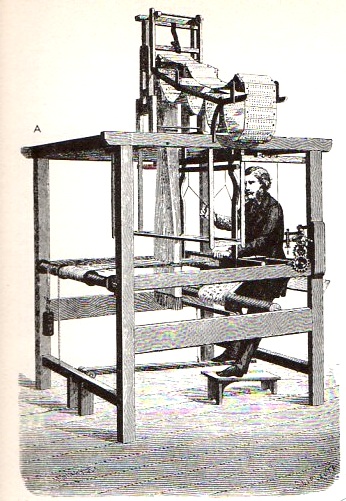
    Jacquard loom142 Kepler saw music in his study of planetary motions; Newton saw it too in relation to optics and the foundation of color–I wonder if the early people working with punched cards and tape saw a similarity between horizontal versions of their work and musical scales as well?  Did Jacquard or Hollerith see something through their holes to points beyond?  Well, I doubt the later, though there is no doubt that there are true relationships between music and the work of Kepler1 and Newton.  Perhaps one could make a score by arranging the punched holes of computer tape or a series of Jacquard loom cards, though they have less a relationship to what we identify as music than transcribing hundreds of resting pigeons as notes on a five-line utility pole.

    The idea of automatic control comes way before M. Jacquard (1752-1734) and the punched cards that he used to control his loom (which began about 1805), though I must say that Jacquard’s man-in-the-machine design does have a great, far-reaching elegance to it.  Even in his own field here were predecessors: Jacques de Vaucanson, for example, and Basile Bouchon (1725) and M.F Falcon (1728).  But it was with Jacquard that the idea of the punched card for design control took hold, and just seven years after the loom was introduced there were more the 10,000 Jacquard machines in operation in France alone. 

    Alfred Barlow2 wrote a splendid history of weaving in 1878, and in that books later pages–and I suspect much overcome with the recent developments in the electrical field (not the least of which were the newly invented light bulb and telephone)–Mr. Barlow waxes considerably on the application of electricity to the Jacquard process:

    He writes, “It is scarcely to be wondered at that men acquainted with the application of electricity to telegraphy and other purposes should have believed it equally serviceable in some of the operations of weaving.  As it might be expected, the Jacquard apparatus seemed to offer and excellent opportunity for the needles [reading the holes ion the loom punch cards] to be worked, not by the direct pressure of a card, but by the connecxion of a series of electro-magnerts.  By this means it was believed that paper may be substituted fir the cards, and the magnets might operate upon the needles through the perforations in the paper, or by passing a current of electricity through the medium of a metallic conducting surface on a sheet of paper or cloth representing the design to be woven, and thereby acting without the use or need of perforations.” (Pages 424-5)   It was certainly a capital idea.  Barlow may have been referencing the work of Alexander Bain and his punched-tape telegraph of 1841, though he does not mention him specifically.  Barlow does mention several inventors from the 1850’s who managed to make improvements with electricity in Jacquard-style machines, though none with the great effectiveness which he described here.  The real, great advancement in computation waited for quite some time, even beyond the great innovations of Hermann Hollerith (who began his tabulating successes in the 1880’s, coming into international recognition with his work on the 1890 U.S. Census.  But Barlow’s imagination here is quite full,  and just a little beyond his time. 

    [This work by Barlow is available for purchase here.]

    Notes

    1. Kepler used the ratios between the velocities of the planets at their closet and furthest distances from the sun to construct musical intervals, which do work.  What an enormously encompassing feeling this must have been to set the motions of the celestial spheres into polyphonic tones that fit right inside the octave!  Newton’s seven colors could be set side-by-side with seven notes of the octave, color in music, giving them the notes A, B, C, D, E, F and G. 

    2.  The excellent Mr. P.J. Mode first brought this reference to my attention 15 years ago.  The work:  Barlow,m Alfred:  The History and Principles of Weaving by Hand and by Power.  London; Sampson & Low, 1878, xii, 443, iv pp, illustrated throughout with text illustrations. 


  • A Note on Some Important Punches of Post-War America, 1952. The IBM 519.

    JF Ptak Science Books  Post 1379

    “Gang punches, summary punches and reproducing punches….such are the guts and glory of all good punch dreams”–No one, ca. 1957. 

    IBM 519121 This story has to do more with Jacquard than with Marciano.  One of the mainstays of the pre-computer computer room, the ubiquitous instrument as prevalent then as the desktop is now, was the unit record machine,  which operated with punched cards for program entry and data storage. This machine–like the IBM Type 5191 Electric Document-Originating Machine (1952) described below–functioned to read and reproduce the mainstay of the calculating instrument of the 1930’s to the early 1950’s.  

    Their functions included lots of punching:  gang punch, which would produce a large number of identically punched card; reproducing punch,   which “could reproduce a deck of cards in its entirety or they might just reproduce selected fields…a payroll master deck might be reproduced at the end of a pay period with the hours worked and net pay fields blank and ready for the next pay period’s data. Computer programmers who created their programs in the form of punched card decks used these to make backups”; a  summary punch, which were attached to tabulating machines and could punch new cards with details and totals from the tabulating machine;  and the mark sense reader, “which could detect pencil marks on ovals printed on the card and punch the corresponding data values into the card”.

    The IBM 519 was one such punching machine, sitting in command of vast legions of data that had previously been exceptional if not impossible to corral.  Improvements like this, these sorts of technological breakthroughs, allowed for the nervous system of the second industrial revolution to occur.  Of course one needed electricity, and then the machines that would be powered by them, and then the distribution capacities to get the electricity to the millions of end-users who would in turn purchase the new electrical goods–all of this was necessary.  However, without the ability to get this electricity paid for by it subscribers, without the power company being able to collect revenue, this stuff doesn’t happen.  And the way that the power company collects is by sending out an ocean of bills, which means that the ocean needed to be controlled in some way, all of the data handled and audited, which means that there was a new, mechanical way of dealing with the vast transfer of data.  And that’s where machines such as the Grunts and Gruffs come in. Like the 519.  IBM 519122

    (These IBM manuals are available for sale at our blog bookstore, here.)

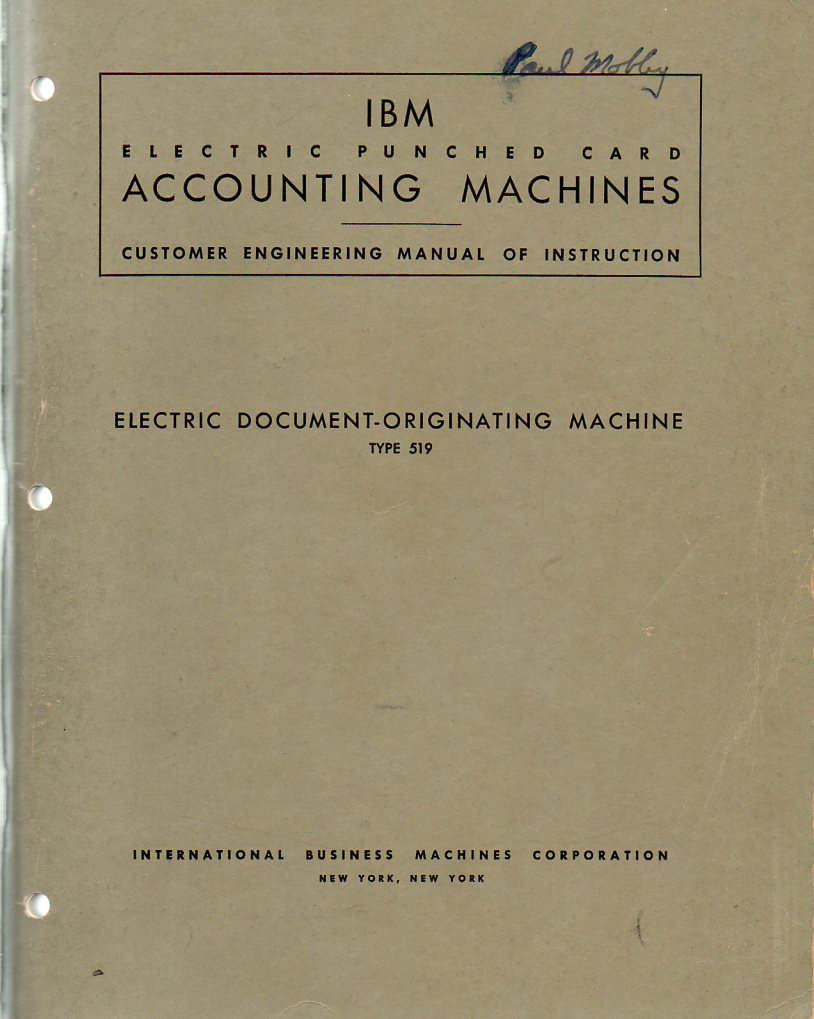
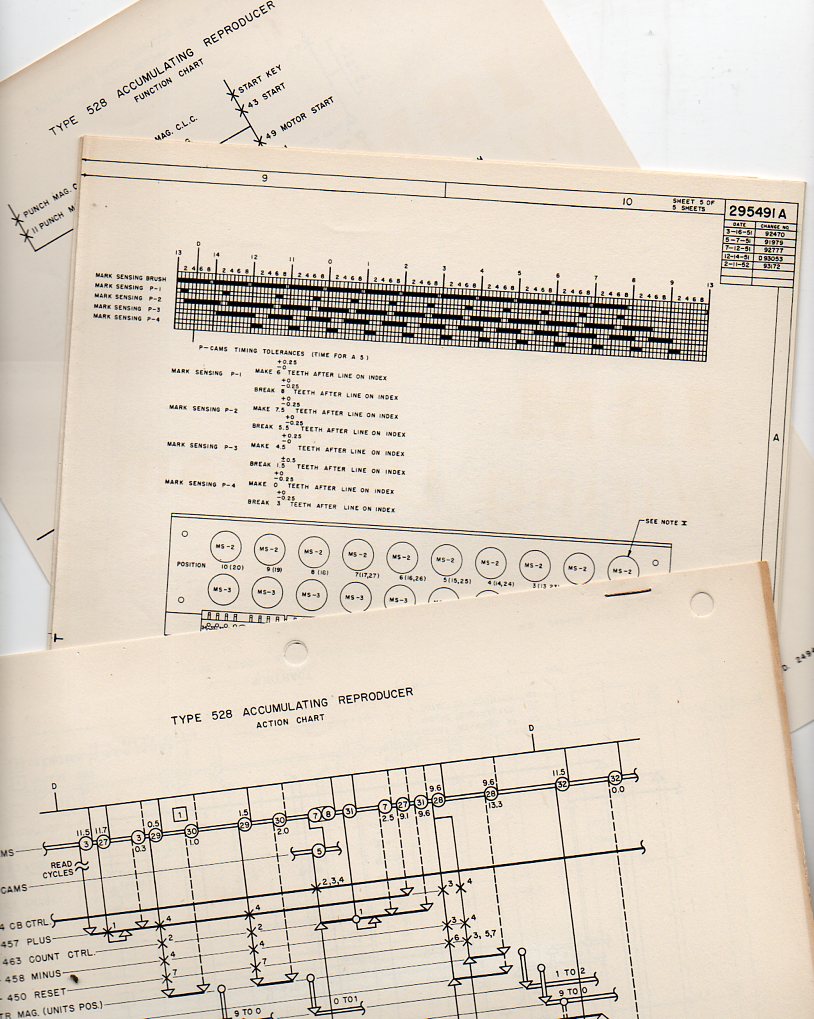
    This thought bubbled to the top while I was looking through a user’s manual for the 519, an updated 1952 version of the first edition of 1943. It is a beautiful work, filled with all of the information that a user would need to operate the machine as well as the specs necessary for the engineer to maintain the thing.  It was bound in a heavy, plasticized flexible cover, intended for wear and tear, and also came with an additional six pamphlets ,mostly wiring diagrams, one of which–the wiring diagram for the 519–unfold its 11 inch height out to five feet in length, a gorgeous panorama of organized and directed electricity.  It has two mates,a pair  not quite as long–four feet or so–in the wiring diagram for the 519’s reproducing punch,  lovely things in and of themselves. 

    The documents just have a satisfying feel ot them, manuals for maintenance and repair for machines that could be maintained and repair.  IF they were still needed, I’m sure that they would be running today. 

    Notes:

    1. “Early computer installations used punched cards for program entry and storage. A typical corporate or university computer lab would have a room full of keypunch machines for programmer use. An IBM 407 Accounting Machine might be set up to allow newly created or edited programs to be listed (printed out on fan-fold paper) for proof reading. An IBM 519 might be provided to reproduce program decks for backup. The 519 could also punch sequential numbers in columns 73-80 of COBOL or Fortran program decks. Those languages and others did not use those columns; the use of only 72 columns is a convention tracing back to the IBM 704 computer’s card reader, the 711, which could only read 72 columns (selectable by a plug-wired control panel). An IBM 80 series sorter would be used to put things back in order if a sequenced deck was dropped. A quicker, but less effective, protection against dropped card decks was drawing a diagonal line across the top of the deck with a marking pen.”–from Wiki on the IBM 519.”

    And from WorldLingo comes this:

    “The IBM 519 Electric Document Originating Machine, introduced in 1946, was the last in a series of unit record machines designed for automated production of punch cards. It could reproduce all or parts of the information on a set of cards; copy the information from a master card onto a group of detail cards; printing up to eight digits on the end of the card; compare two decks of cards, punch summary information provided by an accounting machine. It could operate at 100 cards per minute.”

    “Optional features allowed the 519 to read pencil marks on cards and punch the data they contain, and to number cards consecutively. The 519 was programmed by wiring a removable control panel. IBM called the operation of converting cards marked with pencil marks into punched cards “mark sensing.” Mark sensing allowed a person to enter data to be used in punched-card data processing without using a key punch machine. It was used for tasks like recording long distance calls and meter readings. Unlike other types of IBM unit record equipment, the 519 fed cards face down 12 edge first. The advantage of this was worn out decks from other equipment (which fed cards face down 9 edge first), having frayed 9 edges would still feed reliably through the reproducer, allowing a fresh copy to be made.”

    2.  The Electric Document-Originating Machine Type 519, IBM Electric Punched Cards Accounting Machine, Customer Engineering Manual of Instruction.  IBM, NYC: 1952.  1×8 inches,  124pp, illustrated. 


  • Note on an Alphabet of Computer Names in Fiction

    JF Ptak Science Books   Post 1375

    First of all let me say that I know almost nothing about Science Fiction–this  list started out  while looking for questions asked of computers in works of fiction and movies, but the question on questions is far deeper than I can deal with in a simple sit-down, though I did collect some interesting names of fictional computers along the way.  For this very preliminary list of computers in fiction I include computers with actual names–therefore, and unfortunately, beasts like the NORC-like computer that let loose Hell’s Kitchens in Kubrick’s Dr. Strangelove…. is not included because so far as I can remember it has no actual name, and names are important when you’re creating an alphabet.  Also I tried to look for images of the computers themselves, but since I stayed mostly in the 1940’s-1960’s, there are not many of those. 

    So here this is and please take pity–again this is preliminary and I hope to start filling in what made these machines interesting quite soon. In the meantime there’s an excellent list compiled at Wikipedia, here.

    AM, from Harlan Elison’s short story I Have No Mouth, and I Must Scream (1967).  AM “speaks” via paper tape, as below, using International Telegraph Alphabet No 2 (ITA2), a (much) earlier pres-ASCII-ite language, in this case saying “I think, therefore I am”. 

    AM Talkfield #1
    ALPHA 60.   From the film Alphaville, Jean-Luc Goddard, 1960.