A Daily History of Holes, Dots, Lines, Science, History, Math, Physics, Art, the Unintentional Absurd, Architecture, Maps, Data Visualization, Blank and Missing Things, and so on. |1.6 million words, 7500 images, 4.9 million hits| Press & appearances in The Times, Le Figaro, Mensa, The Economist, The Guardian, Discovery News, Slate, Le Monde, Sci American Blogs, Le Pont, and many other places… 5000+ total posts since 2008.

Category: Computer Tech/History

  • On Doing and Done: the Differences in describing the Difference Engine of Charles Babbage, 1832.

    JF Ptak Science Books  Post 2792
    Babbage difference engineThere’s a big difference being “inventing” and “invented”. You virtually never hear or read of someone declaring “I am inventing thus-and-so” imply that they’re working on something; “I invented the letter number seven” implies that you’ve completed the act of invention and the number seven exists. 

    In cataloging a book for my bookstore I came upon this difference in reference to Charles Babbage and his early calculating machine, and proceeded to make a mountain of a molehill, and then the reverse. 

    The “incident” was sparked by a volume of the Journal of the Franklin Institute1 with the appearance of a very early mention of Babbage having built his Difference Engine  (No. 1) found in a one-paragraph mention in the article “The Results of Machinery”:

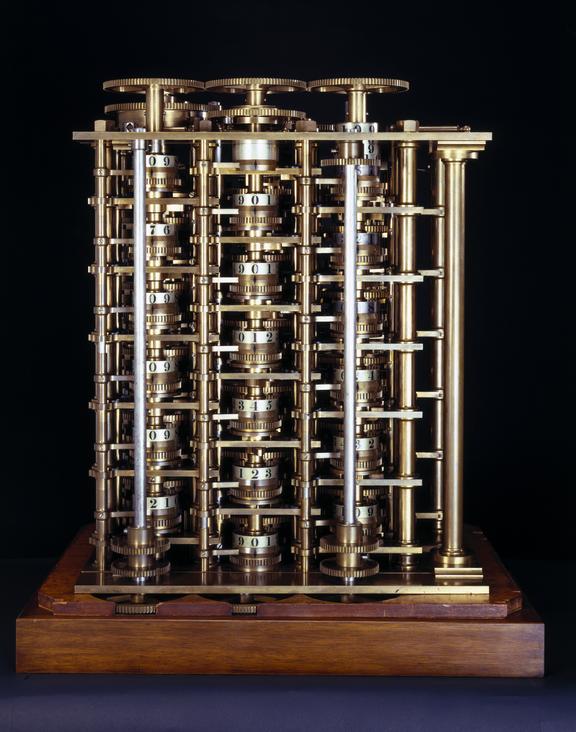
    [Image at left of Babbage’s machine in 1832, from the Science Museum http://collection.sciencemuseum.org.uk/objects/co62243/difference-engine-no-1-difference-engine-portion-only]

    “Mr. Babbage…has invented a calculating machine…” referring to the newly (1832) “completed” 1/7th  of the machine. (The Difference Engine No. 0 announcement came June 14, 1822; the Difference Engine No. 1 appeared in this year, 1832, though work was suspended on it in 1833 (with government funding removed);’work soon to begin on Difference Engine No.2 (1846-9), (and with A. Lovelace’s famous “Notes” appearing on the Analytical Engine in 1843.)

    The article is a review/abstract of the book by Charles Knight, The results of machinery : namely, cheap production and increased employment exhibited : being an address to the working-men of the United Kingdom, which appeared in a second edition in London in 1831 (and a fifth in 1832) with a first American appearing in 1831. The Babbage calculating machine bit from the JFI is taken very nearly verbatim from these editions, where in the original the mention of the machine is referred to as “almost perfected”–here in the JFI it shows up as “invented”, which as they say is something quite different, the world of “almost-perfecteds” being much wider broader deeper than that of “the perfecteds”.

    Leaving out the fact that the machine was yet really built is of course a minor thing compared to the overall message of the paper and the book in general, but I just got my scarf wrapped around the axle on it. 

    The full note on Babbage reads:

    “The inventions for saving mental labour, in calculations of arithmetic, have been carried so far, that Mr. Babbage, a gentleman whose name we have twice before mentioned, has invented a calculating machine, which not only does its work of calculation without the possibility of error, but absolutely arranges printing types of figures, in a frame, so that no error can be produced in copying the calculations, before they are printed. We mention this curious machine, to show how far science may go in diminishing mental labour, and ensuring accuracy.”

    This was part and parcel the principle thrust of this article: investigating the application of machinery in a positive way to production and labor and showing its “…effects of saving unprofitable labor”.

    The few paragraphs of background leading to the Babbage reads as follows:

    “The foot-rule of the carpenter not only gives him the standard of a foot measure, which he could not exactly ascertain by any experience or any mental process; but it is also a scale of the proportions of an inch or several inches, to a foot, and of the parts of an inch to an inch. What a quantity of calculations, and of dividing by compasses does this little instrument save the carpenter, besides ensuring a much greater degree of accuracy in all his operations! The common rules of arithmetic, which almost every boy in England now learns, are parts of a great invention for saving mental labour. The higher branches of mathematics, of which science arithmetic is a portion, are also inventions for saving labour, and for doing what could never be done without these inventions.

    There are instruments, and very curious ones, for lessening the labour of all arithmetical calculations; and tables—that is, the results of certain calculations, which are of practical use, are constructed for the same purpose. When you buy a joint of meat, you often see the butcher turn to a little book, before he tells you how much a certain number of pounds and ounces amounts to, at a certain price per pound. This book is his “Ready Reckoner,” and a very useful book it is to him; for it enables him to despatch his customers in half the time that it would otherwise require, and thus to save himself a great deal of labour, and a great deal of inaccuracy.

    The inventions for saving mental labour, in calculations of arithmetic, have been carried so far, that Mr. Babbage, a gentleman whose name we have twice before mentioned, has invented a calculating machine, which not only does its work of calculation without the possibility of error, but absolutely arranges printing types of figures, in a frame, so that no error can be produced in copying the calculations, before they are printed. We mention this curious machine, to show how far science may go in diminishing mental labour, and ensuring accuracy.”

    So in this message of insight and hope I got stuck on one word, which ultimately really doesn’t mean anything. The message was significant and an interesting and insightful way of phrasing the possibilities for the application of more advanced machines in the future, and was much bigger whatever the state of completion of the Babbage machine was.
  • A Good Survey of 1950’s Computer Science

    JF Ptak Science Books   Quick Post

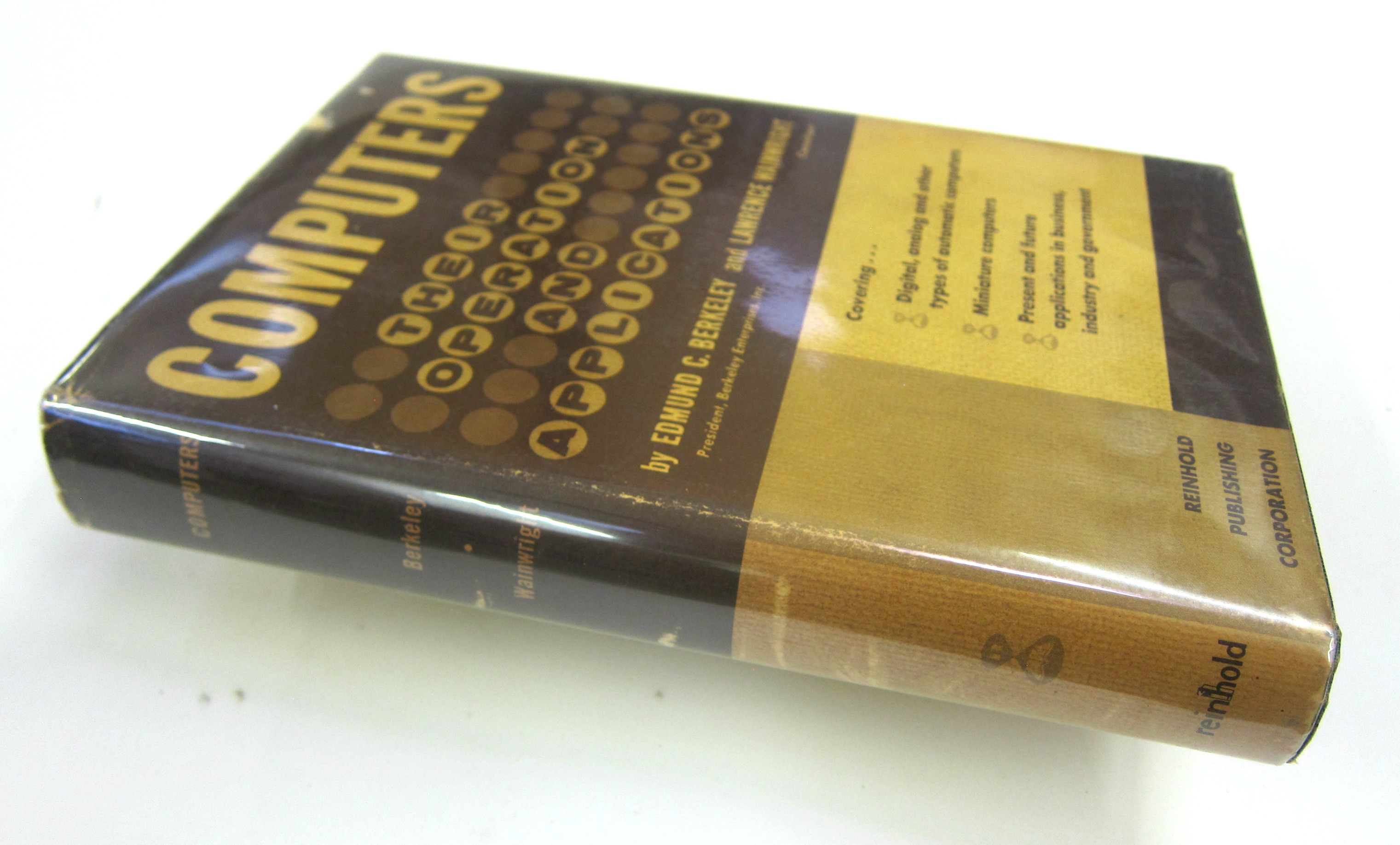
    Computer book berkeley COmputers 1956Edmund C. Berkeley and Lawrence Wainwright’s Computers, their Operation and Applications is a comprehensive, well-documented, and pretty-well referenced early-ish work in the field by one of the busiest men (Berkeley) in the computer field from 1948 (when he wrote Giant Brains or Machines that Think) to 1958. (Berkeley in many ways is like Gil Hodges of the Brooklyn Dodgers—one of the most productive  participant in his field for a decade but not in the HOF not so greatly acknowledged. even after long periods of major contributions. The difference is that Hodges has his champions; not so much for Berkeley.)

    The book’s chapters/sections include: Machines that Handle Information; Automatic Digital Computing Machines; Automatic Analog Machines; Other Types of Automatic Computing Machines; Miniature Computers and their Use in Training; Some Large-Scale Automatic Digital Computers; Applications of Automatic Computing Machines, followed by a good 24pp glossary “of terms and expressions”. The digital computer section is pretty nice, and includes at the end a five-page list of 200 or so digital computers; ditto that for a list of automatic computers.

    The “Miniature computers” section includes a long (pp 174-210) treatment of the history and main features of Berkeley’s own 1950 machine, “Simon”–certainly it is the longest piece I’ve seen dedicated to this machine outside of Berkeley’s series of articles on it in Radio-Electronics magazine in 1951. Some consider Simon to be the first personal computer, but the 39-lb machine had very little functionality outside of a demonstration device. That said, Simon was expanded in the interim, and those modifications are described here. There’s also a 15pp section on the Bush Differential Analyzer (“MIT II”),  6pp on the Harmonic Analyzer; 15pp on UNIVAC I, 8pp IBM 700 series, and 6pp ERA 1103. 

    Notes:

    1. . Reinhold Publishing Co., 1956. First edition. (8), 366pp, illustrated.

    ·Posted by :

    ·in:


  • Android Artists (1785 and 1903)

    JF Ptak Science Books  Post 2777

    Jacquet-Droz 1903This is a very short post on a much more involved issue, but for right now I just want to scribble out this note in the sand.

    While looking for the Wright Brothers not-appearing in the Scientific American in 1903 and 1904 and 1905 and 1906 and 1907 I found in the May 3, 1903 issue  “The Jacquet-Droz Androids”. It was seeing the word “androids” that was so unusual–usually when you see references to the great machines built by Pierre and Henri-Louis  Jacquet-Dros1 you nearly always seem the inventions as “automatons2” or “automata”. This time, it was “android”. 

    “Android3” as it turns out is pretty old as a word, though I do not know how common its usage was, though just weighing that against decades of reading it seems to my experience not to pop up very much at all before WWI.  

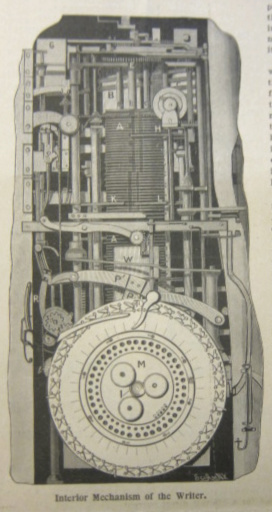
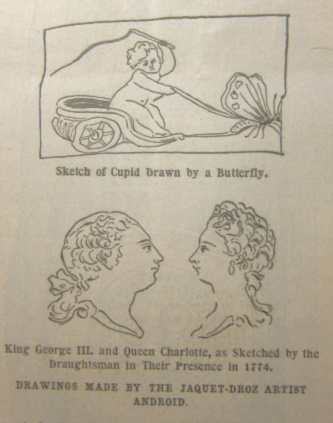
    This gets us to the truncated history part. The Jacquet-Droz machines were built during a relatively short period, 1768-1774 or so. One of the machines was called “The Draughtsman”, which had the capacity to render at least several different drawings. This would make them among the earliest machines to ever produce art. The “android”–which was about half-life size and quite human-like–sits at a small desk and renders its creations, looking like a mechanical artist. In fact the machine had a very sophisticated cam-based memory, which to some extent meant that the machine was “programmed”, and so becomes the first (?) computer-generated artworks4. 

    What distinguishes this article in Scientific American further is that it reproduces the artwork of “The Draughtsman”.  The question here then is when are these android drawings first reproduced? There were many exhibitions of the Jacquet-Droz creations over the years, and the popular portrayal so far as I can recall has been the machine itself and then a small reveal of the mechanism. Were the drawings reproduced in the 18th century? Right now, I just don’t know. I did do a search under “Jacquet-Droz” in Gallica over thousands of publications and at first blush there (1) seems to be not many hits and (2) none that I have seen have any illustrations. Also even though the machines of Jacuet-Droz and, say, Maillardet’s writing/drawing machine (le Jeune artiste”) were popular in the late 18th and early 19th c, they seem to not have been so afterwards. One source says that Maillardet falls completely off the RADAR in 1833 and resurfaces only in 1928.  

    Jacquet-Droz _2_

    This all makes for an intriguing question. Right now though all I can really say is that the end-date for the range of possible first-publication dates for Jacquet-Droz is 1903.

    Notes:

    1.  “Constructed between 1768 and 1774 by Pierre Jaquet-Droz, his son Henri-Louis (1752-1791), and Jean-Frédéric Leschot (1746-1824), the automata include The Writer (made of 6000 pieces), The Musician (2500 pieces), and The Draughtsman (2000 pieces). Pierre Jaquet-Droz (French: [ʒakɛ dʁo]; 1721–1790) was a watchmaker of the late eighteenth century. He lived in Paris, London, and Geneva, where he designed and built animated dolls, or automata, to help his firm sell watches and mechanical birds.”–Wikipedia

    2.  From the Oxford English Dictionary: “Automatons. A moving device having a concealed mechanism, so it appears to operate spontaneously. Frequently (and in earliest use) in figurative and similative contexts. Now chiefly hist.Originally denoting various functional instruments including clocks, watches, etc., as well as moving mechanical devices made in imitation of human beings; later (from the early 19th cent.) usually restricted to figures simulating the action of living beings and widely regarded as toys or curiosities, as clockwork statues or animals, images striking the hours on timepieces, etc.”

    • 1616   W. Cornwallis Essayes Certaine Paradoxes sig. G3   The soule doth quicken and giue life to the body, the body like an Automaton, doth moue and carry it selfe and the soule.
    • 1660   H. More Explan. Grand Myst. Godliness ii. iii. 37   God will not let the great Automaton of the Universe be so imperfect.
    • 1742   J. T. Desaguliers tr. M. Vaucauson (title)    An Account of the Mechanism of an Automaton or Image Playing on the German Flute.
    • 1784   P. Thicknesse Speaking Figure 5   That an Automaton can be made to move the Chessmen properly, as a sagacious player,..is..utterly impossible.
    • 1790   J. Imison School of Arts (ed. 2) 284   Those automata..do by little interstices, or strokes, measure out long portions of time.
    • 1815   Scott Guy Mannering I. xx. 315   Sprawling out his leg, and bending his back like an automaton.
    • 1821   New Monthly Mag. 1 443   Archytas’ flying dove..is another of the ancient automata… It was made of wood

    3.  Citations of “android” in the Oxford English Dictionary:

    • 1728   E. Chambers Cycl. (at cited word),   Albertus Magnus, is recorded as having made an Androides.
    • 1819   Pantologia (new ed.) (at cited word),   M. de Kempelen..constructed an androides capable of playing at chess.
    • 1847   J. Craig New Universal Dict.   Android
    • 1951   C. D. Simak Time & Again (1956) i. 1   Human gossip as well as android and robot gossip.
    • 1958   Spectator 19 Sept. 379/1   Today SF must be more than a blood-and-sex day~dream spattered with words like androids (robots made of flesh and bone).

    4.  Another long history is that of computer generated art. Suffice to say here that the very earliest period of this genre begins probably with Ben Laposky’s “Oscillons” in 1952 where he manipulated electronic waves in an oscilloscope to produce interesting and complex figures. 


  • Humans as Numbers

    JF Ptak Science Books  

    Computer art154The idea of the human machine, the machine human, the technological man, the robot, the anthropomorphization of artificial life, Computer man automationgoes back a long way. One of my favorites comes from the 1830s and features a steam-driven automaton of some sort that was also a preacher–that was very cool, and was the subject of an article I wrote for the magazine at Mensa. I mean, an artificial semi-replacement life form that was created by humans that was having-forth on the gods and associated interpretations that humans also created–seems like an uncomfortable (and temporary?) middle space to be in. And that is a clear-cut anthropo image. There are many others that have appeared over the years showing gearworks in the brain, min-staffed miniature computer consoles in a head cutaway, tiny versions of the brain’s owner running around in the brain looking for paper in file cabinets (that one is just Spongebob Squarepants), and so on.

    These two images, however, are a little different than what I have seen over the years. 

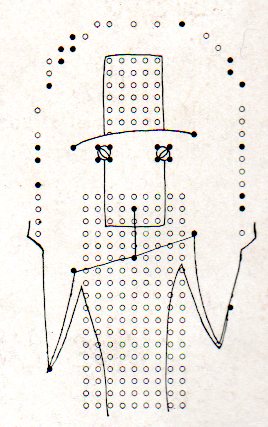
    The first one, on the left, is almost computer art, and almost art imaging a human as a computer component, but not quite. It is on the cover of one of the early issues of the “new” Physics Today magazine (volume 2, number 10), in October 1949–it is the artwork of Paul Bond, who created this portrait of a juggler “on a matrix sheet used for plotting computor [sic] plug board diagrams”, and is one of 11 such images. So, it does show a person composed of computer bits, and is pretty early for whatever it is that it is, so long as we’re talking about the modern computer and not something that was made-up in 1932.

    I wrote about this in more detail here: https://historyofideasblog.com/thesciencebookstore/2014/10/human-computer-art-1949.html

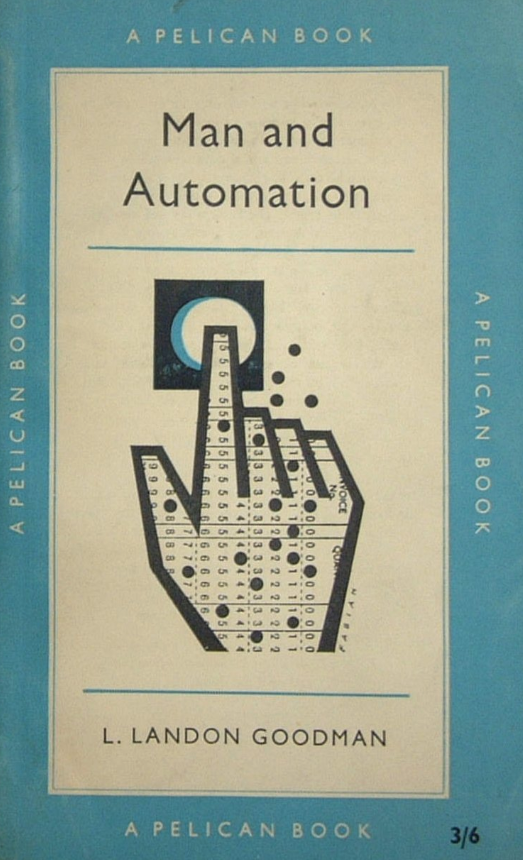
    The second image was one I found today, and was published in 1957. The cover implies some sort of human control being replaced by a computer-driven machine, hence the punch card. It is in some way similar to the compu-juggler, though the control aspect is far more obvious. 

    In any event even though I have looked at a lot of material in this field for a long time I don’t see very many computer-anthropomorphic images at all, and so present these two side-by-side today.  


    ·Posted by :

    ·in:


  • The “Does-All” Doesn’t.

    JF Ptak Science Books   Quick Post

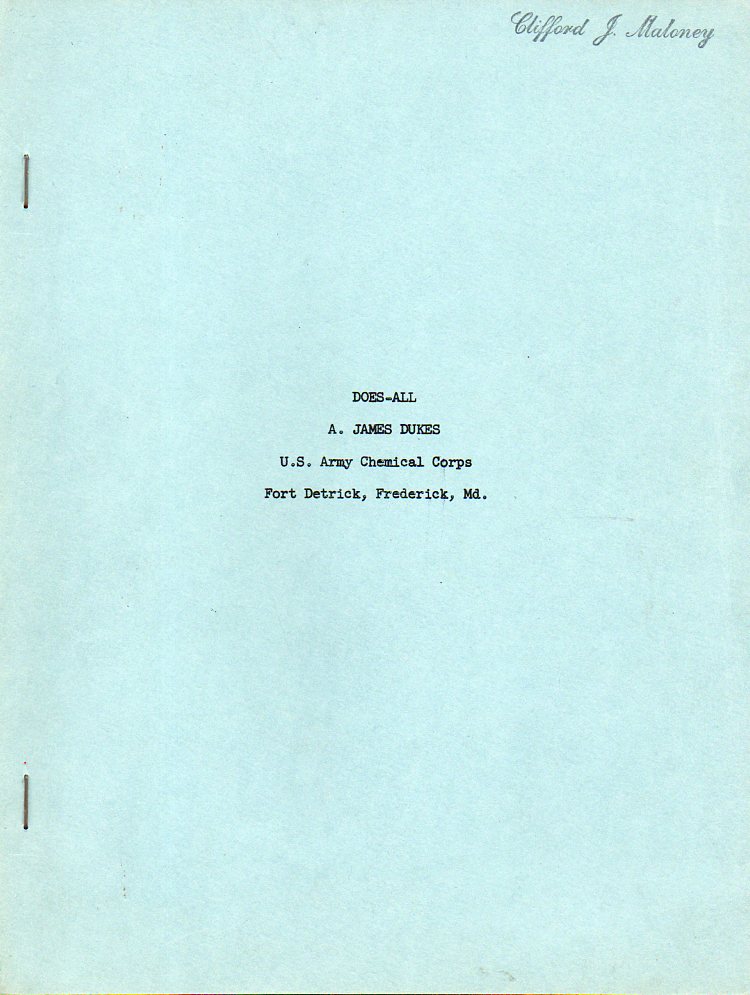
    Computer does-all916I’ll get right to it: there was no program called the “Does-All”.  This was an ironic suggestion for the name of a program to illustrate this slightly lengthy and relaxed introduction1 to computers (hardware and software) written by A. James Dukes of the U.S. Army Chemical Corps at Fort Detrick2. He has a very light pen and a good sense of humor, and writes with a great deal of clarity, and given the time period and his place of business (!) I’d say it was about the funniest intro to compsci that I’ve seen in the relatively early stuff. Dukes spends the first dozen pages or so on the hardware, with the remainder dedicated to writing programs–the writing is filled with insight and analogies.

    Charming, really.  

    Notes:

     1. A. James Dukes. Does-All.  U.S. Army Chemical Corps, Fort Detrick, Maryland. This 11×8 inch mimeographed/stapled publication does not have a date of publication, but as near as I can determine it was assembled in the early 1960’s.  It does mention several computers by name, the last of which,. the LARC, was suggested in 1960.  39pp(+3pp).  . Rare. (No copies located in WorldCat.) 

    2. Before it became more of a household name in popular movie culture Fort Detrick started out as Detrick Field (1931-1946), and then became Camp Detrick (1943-1956), and then on to Fort Detrick (U>S. Army Medical Command, plus dozens of other commands based there). When this pamphlet was printed Detrick was the seat of the U.S. bio-weapons program (1943-1969).  


    ·Posted by :

    ·in:


  • “Hand it Over to the Machine” (1878)

    JF Ptak Science Books   Post 2742

    WIlliam Spottiswoode (1825-1883),  an English mathematician and physicist, president of the Royal Society from 1878 to 1883, and of the British (Science) Association in 1878 as well, wrote a very appreciable piece on the state of Science in Nature in 1878.  At 15 pages this was a one-percenter for Nature so far as length goes–the pagination sounds short, except that the text was printed in about 8-pt, 90 columns per page, double columns, so the article was no doubt 15k+ words. There were numerous nuggets in this review and state of affairs of the sciences and technology, including sections on mathematics, literature and art, physics instrumentation, manifold space, imaginaries,  and so on, not the least of which was 1500 words on Non-Euclidean Geometry.

    What struck me most in all of this was the half-column entry for “Mechanical Methods” (on page 413), which turns out to be “mechanical appliances”, or calculating machines/engines.  It starts with an unusual assertion:

    “Mr Babbage, when speaking of the difficulty of insuring accuracy in the long numerical calculations of theoretical astronomy, remarked that that “most accurate science” had become “inaccurate and uncertain in some of its results”.

    Spottiswoode continues with an explanation and a dig:

    “It is doubtless, some such consideration as this, coupled with his dislike of employing skilled labour when unskilled labour would suffice, which led him to his invention o the calculating machine”.

    The author then makes another—again, to my experience—unusual observation, referring to the replacement of human thinking capacity by a machine:

    “The idea of substituting mechanized for intellectual power has not lain dormant…”

    It is a very short comment, but I think makes a strong if understated point.

    The author then moves onto the “recent” machine of James Thomson (“by its aid it seems an unskilled laborer may, in a given time, perform the work of ten skilled arithmeticians…reduced to the simple process of turning a handle”), before finishing with a flourish, though it is easy to read through. In telling the story of Michael Faraday, who after muscling through some concept and determining that the next step would be to hammer it all out mathematically, would “irreverently “ say “hand it over to the calculators”, which at that point was a team of human calculators, arithmeticians, and perhaps more famously known now as “computers”.

    And the finish:

    “But truth is stranger than fiction; and if he had lived until our day, he might with perfect propriety have said, ‘Hand it over to the machine’ ”.

    It is a small statement with a lot of possibility. Even though this comes seven years after Babbage gave up the ghost in Marleybone, it still seems remarkably early to be talking about this sort of major impact in the conduct of the sciences, lending part of the process over to machines. The Industrial Revolution is well into it second century by this point, and human effort in all manner of manufacturing has been replaced by machines—except here the active part of the human experience in the creation of ideas is the thing that is becoming “machinized”.

    This brought to mind an earlier piece in the same journal by James Clerk Maxwell, who also wrote an assessment of recent developments in science2. 

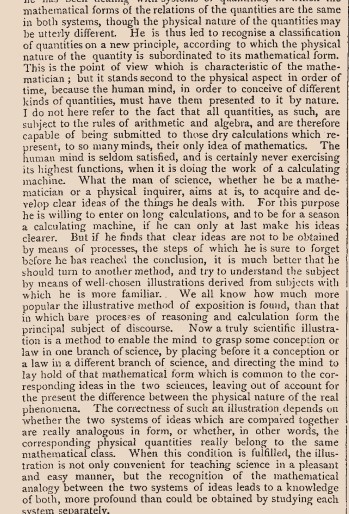
    What I find to be most interesting here is Maxwell pulling back the reins and directing the idea of clear scientific discourse by means of analogy. He does speak of “calculating” and “calculating machine”, which is referring to human calculators and not mechanical ones–the issue being that “spending a season” doing this stubborn and consuming work could turn the person occupied with in into a “machine”. He writes: 

    “What the man of science, whether he be a mathematician or a physical inquirer, aims to do, to acquire and develop clear ideas of the things he deals with. For this purpose he is willing to enter on long calculations, and to be for a season a calculating machine., if he can only at last make his ideas clearer.”

    “But if he finds that clear ideas are not obtained by the means of processes,  the steps of which he is sure to forget before he has reached the conclusion, it is much better that he should turn to another method, and try to understand the subject by well chosen illustrations derived from subjects with which he is more familiar.”

    “We all know how much more popular the illustrative method of exposition is found, than that in which bare processes of reasoning and calculation form the principal subject of discourse…”

    Calculators Maxwell NAture 1870

     Notes:

    1. SPOTTISWOODE, William. “British Association”, address on the state of the British Association by the president, in Nature, vol 18, no. 459, occupying most of the weekly issue, pp 403-425 in the issue of pp 401-428.
    2.  MAXWELL,  James Clerk.  Mathematical and Physical Sciences–address to Section A of the British Association.  London:  1870.  Nature, vol 2, Sept 22, 1870.   Maxwell addresses the British Science Association meeting in a long (for Nature) entry of about 4,000 words, over 4 pages. 

    ·Posted by :

    ·in:


  • “We are, then, gas engines.” Turing and Some of his Childhood Reading.

    JF Ptak Science Books  Quick Post

    The enduring intellectual legacy of Alan Turing’s childhood reading in the delightful (and deeply insightful) book Natural wonders every child should know (1912, 1939), by Edwin Tenney Brewster (1866-1960) can clearly be seen throughout the book, given its absorbing and penetrating curiosity. It is a very disarming book, and I think could be easily under-read, even though it has some semi-lofty writing given its audience, but if you give it a chance, there is a LOT going on in it.  The possible influence of the book, for example, in relation to Turing’s relationship with thinking machines, can be seen in chapter 35, “The Living Automobile”, on pp 238-240, something that must have given the young Turing some considerable stuff to think about: 

    “If you will think back over what you have already learned in this book, you will see that we began by finding out something about how we men, the animals, and the plants come to have any such things as bodies at all…. We found about something of what animals cannot do, and what they can do, and how they do…We learned how animals of various sorts, and plants as well, see and feel and act; and we learned also something about how we ourselves do our thinking, which is so very different, and so very-much better done, than that of any animal or plant.

    “Now we turn to a different matter. We have taken up being, and doing, and thinking. Now we shall consider living. We shall learn about how the body of the plant or animal feeds itself and keeps alive, and how the different parts of it, the bones and skin and leaves and bark, manage to get on with one another, and work together like a well-made machine.”

    “For, of course, the body is a machine. It is a vastly complex machine, many, many times more
    complicated than any machine ever made by hands; but still after all a machine. It has been likened to a steam engine. But that was before we knew as much about the way it works as we know now. It really is a gas engine; like the engine of an automobile, a motorboat, or an airplane.”

    “We are, then, gas engines.”

    Full text of the 1939 edition is found here: https://babel.hathitrust.org/cgi/pt?id=coo.31924001126055;view=2up;seq=8

    ·Posted by :

    ·in:


  • Burroughs, Batman, and Bullets in the History of Holes and Punched Card Computation

    JF Ptak Science Books   Post 2722

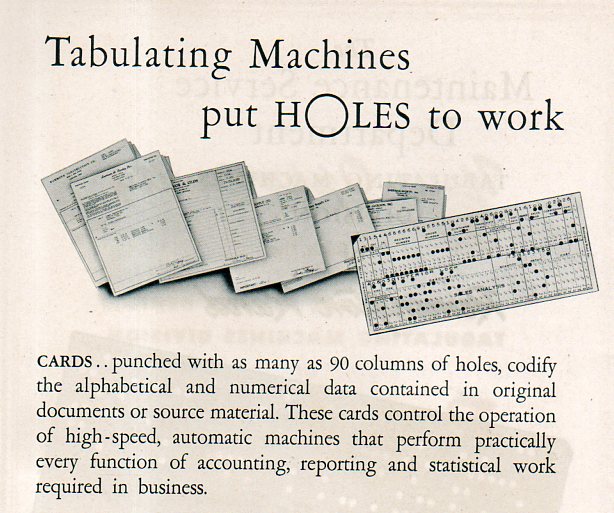
    There is a continuing thread on this blog on The History of Holes–it is a series about, well,  holes and what isn’t in them/what used to be in them/what you can see through them, and so on. This particular section of holes relates to the control and distribution of data and the great efficacy of utilizing holes punched into cards which would be arranged and tabulated in such a way as to order and manipulate mountains of data.  That said I don’t recall seeing anything in print from the heyday of keypunching that actually mentioned the holes, as it does here–nor have I seen a non-William-Burroughs connection made between handguns, bullets, holes, and tabulation. Oddly enough, there is a connection with a crime fighter who didn’t use a gun and whose sidekick used the exclamation “Holy ______ (computer, etc., and no expletives). And so we get to unite punched cards, computers, W.S. Burroughs, Batman, and The Time Tunnel.  (The Time Tunnel?–yes indeed, the tv show from the 60’s can be brought into this as well..)

    Remington rand holes057

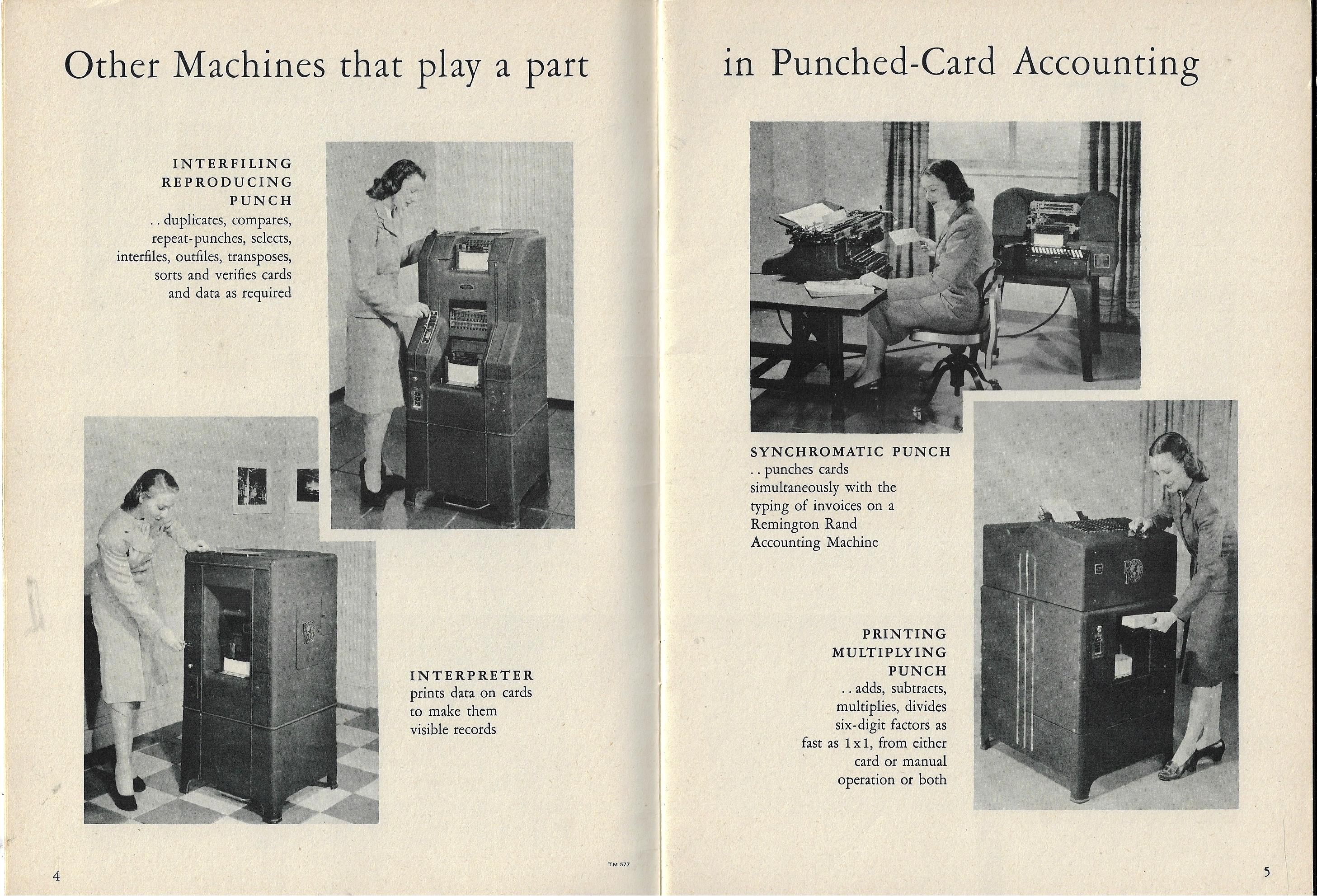
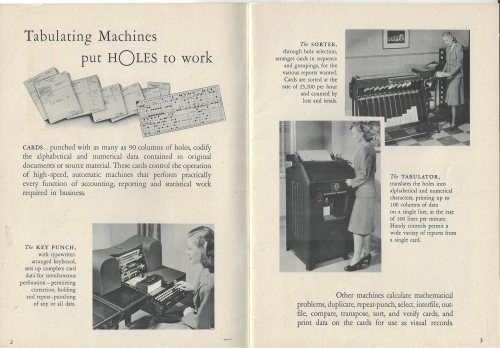
    This is one of the first pages in a promotional pamphlet entitled Your Opportunity with the Maintenance Service Department Tabulating Machines Division of Remington Rand (ca. 1935-40). The title is stubby and factual, and the company was putting out a feeler for future engineering employees who could be trained to service and repair the many machines produced by Remington Rand that could be found in a largish business. 

    Remington Rand at one time was Remington Arms, and then diversified to produce all manner of light and heavy electrical goods (and of course famously producing the standard U.S. Army sidearm, the 45-calber Remington M1911 pistol), and by the end of WWII the company produced a vast line of tabulating equipment (of another order of high caliber).  Interestingly the pamphlet exclaims that a person working for RR could work there for as long as they wanted, that the company was there to stay.  

    Remington rand holes058

    Certainly the company would hang on for some time in one form or another, but the tabulating card division was about to change drastically.  In 1950 RR purchased Eckert-Mauchly Computer Company (ENIAC) and a few years later (1952) secured another giant computer pioneer, Engineering Research Associates (ERA), making Remington Rand about the largest computer company in the world. RR would be purchased a few years later by Sperry in 1955, becoming Sperry Rand, and then simply Sperry a short time after that; later, in 1986, Sperry would merge with Burroughs and become Unisys. Somewhere in there all of these tabulating machine repairmen and techs hired fresh in 1946 would be out of their lifetime job less than a decade later.  

    Now back to William S. Burroughs–the gun/tabulating connection there is that Mr. Burroughs accidentally shot and killed his wife in a game of “William Tell”–he is also the grandson of William Seward Burroughs of Burroughs Adding/Tabulating Machine and computer mainframe fame. (Burroughs was founded in 1886 and became Burroughs Corp in 1953 and was one of the nine major computer manufacturers in the U.S. 100 years after its founding Burroughs Corp merged with Sperry–which had absorbed Remington Rand–to become Unisys.) 

    On to The Batman of the 1960’s tv show where the connection between punched holes and “holy” is obvious and obscure–the caped crusader and Robin used a Burroughs computer (the B205) in the Batcave. The same goes for The Time Tunnel, where we see another use of the B205, used to enable the intrepid time travelers to jump into their funnel-shaped time machine and dive into a hole in time much like Harry Potter at platform 9 3/4.   I suspect that there are more examples, but I’ll stop here.

    • (A big salute to the “Starring the Computer” website, which has an extensive list of the B205 appearing in movies and television: http://starringthecomputer.com/computer.html?c=45  as well as a very long list of appearances of many other non-fictional computers. It is an excellent effort!)

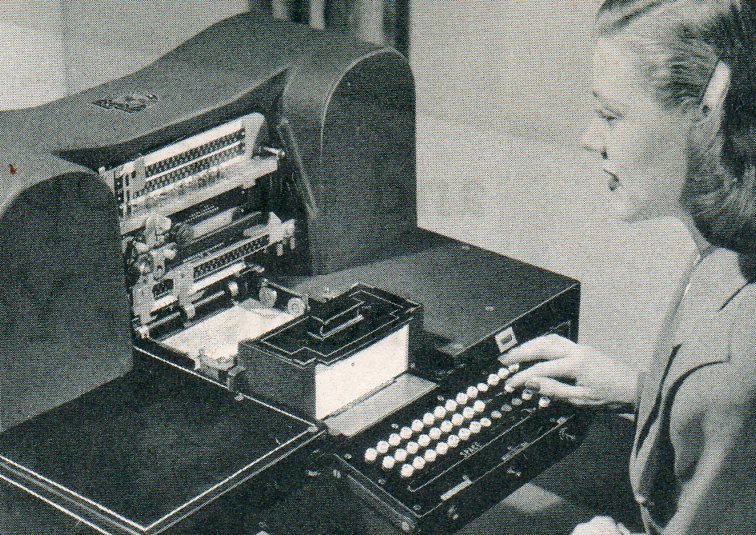
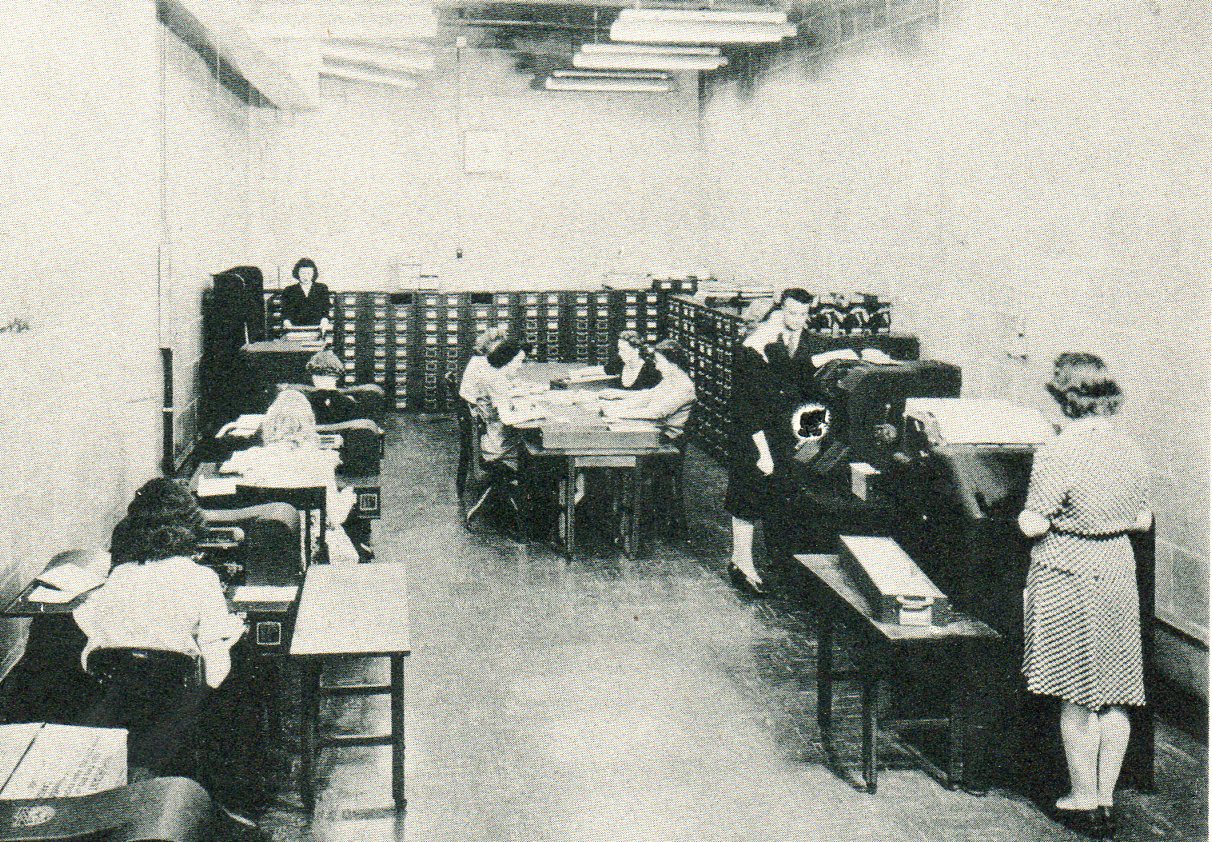
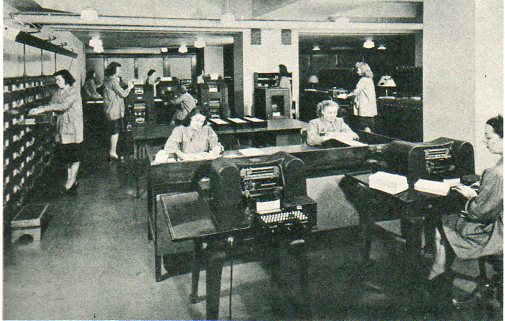
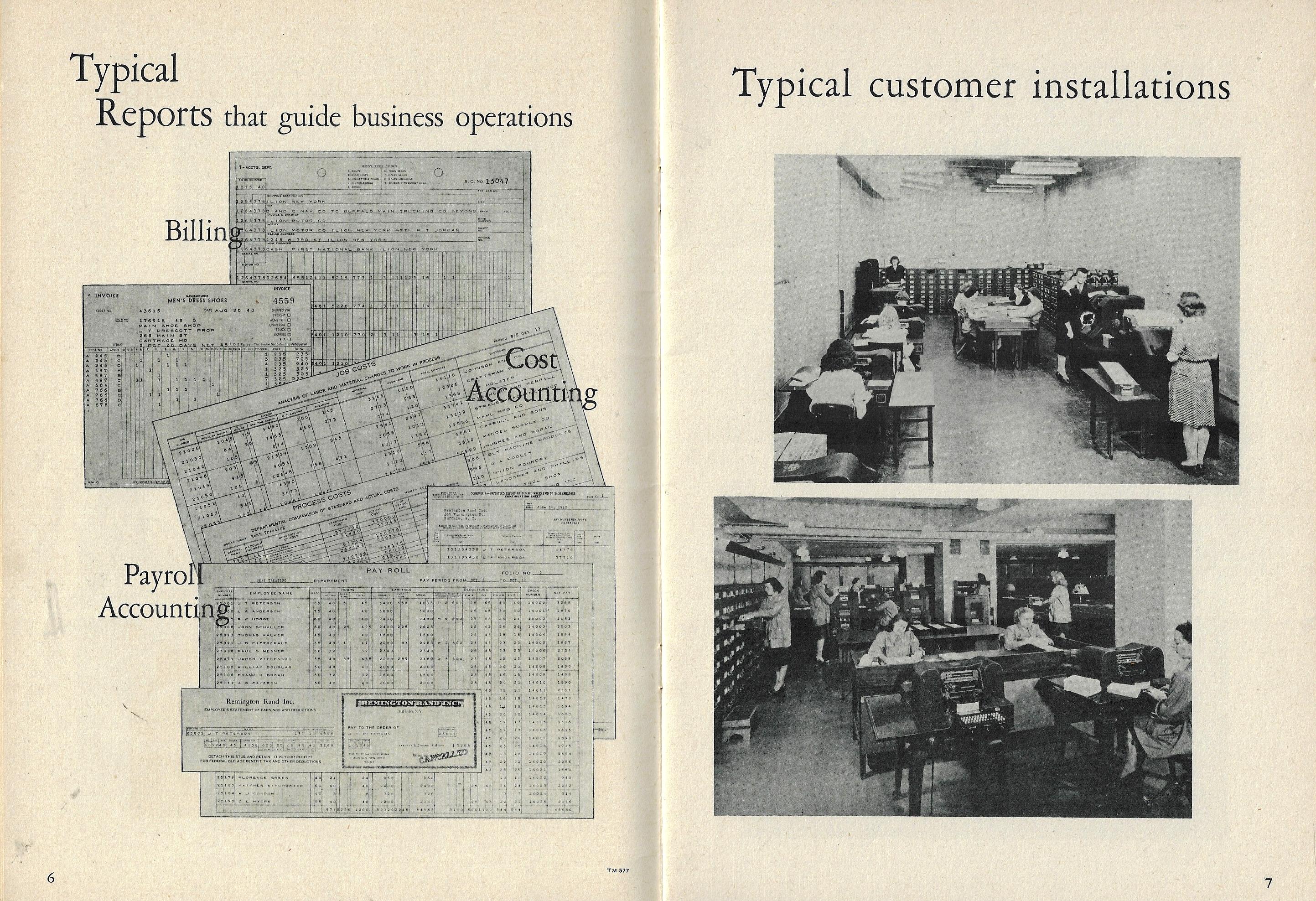
    Lastly, some illustrations from the pamphlet, which surpisingly does not show up at all in WorldCat/OCLC.


    Remington rand holes059

    [“Typical office installations of Remington Rand equipment”]

    Remington rand holes060

    Remington Rand Opportunity _2__0001
    Remington Rand Opportunity _2__0001
    Remington Rand Opportunity _2__0001
    Remington Rand Opportunity _2__0001


  • On Expanding the Boundaries of Things I Don’t Know

    JF Ptak Science Books  Post 2720

    Here’s a good example of “where do I go with this puzzle now?” from the daily work that I do. The stages in working with odd material like the following goes from (1) recognizing that this junky-looking bit isn’t nothing; (2) identifying the something in the nothing that an outsider like me can recognize; (3) figuring out where the thing might fit in context with its development of whatever; (4) seeing how it may or may not be significant in the development of its subject; and (5) trying to figure out if I know what I was talking about in #s 1-4 (this is usually the most difficult step). In an event, I worked with something just now where it seemed to strike interesting chords along several areas, but in the end I was back at the beginning.  

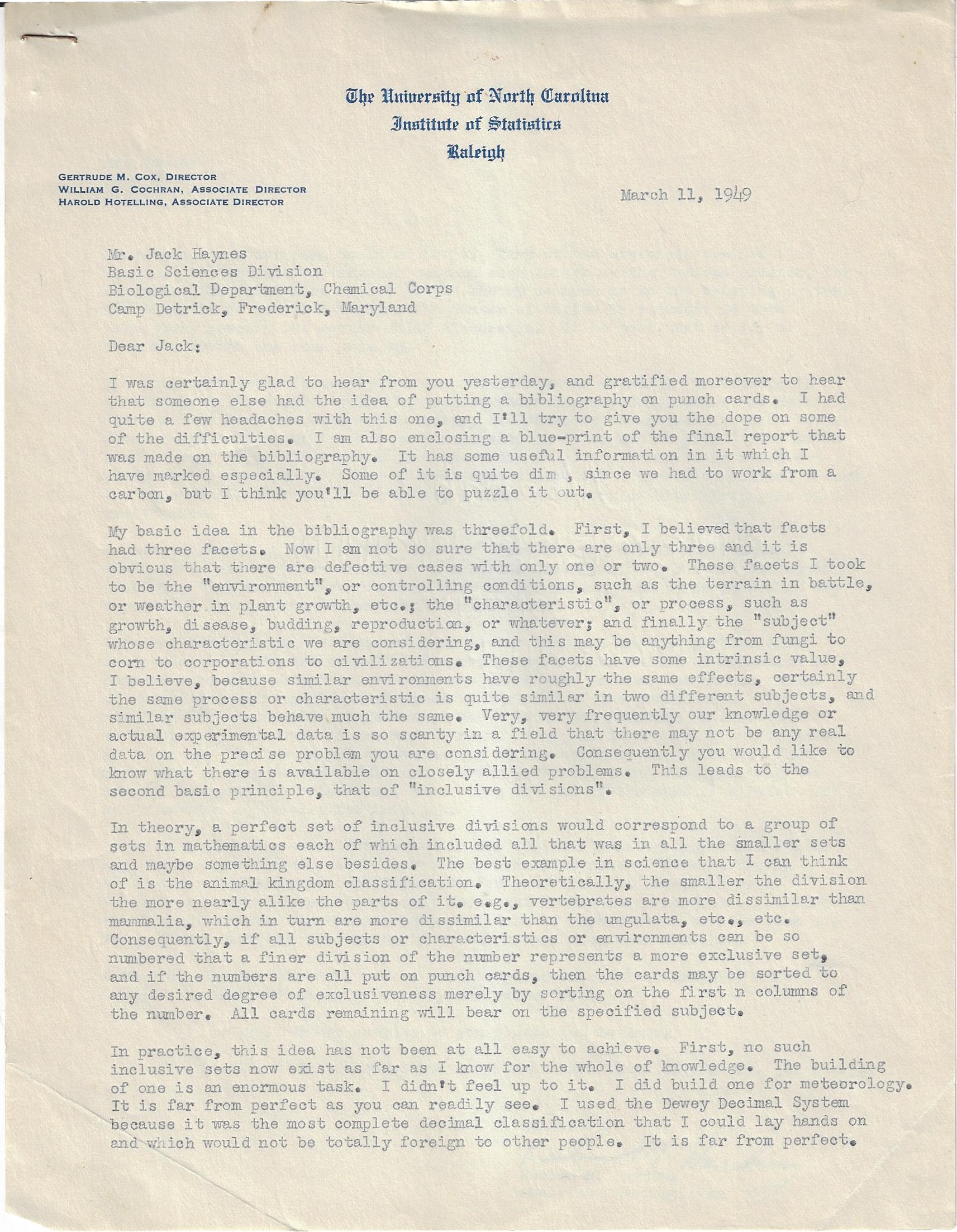
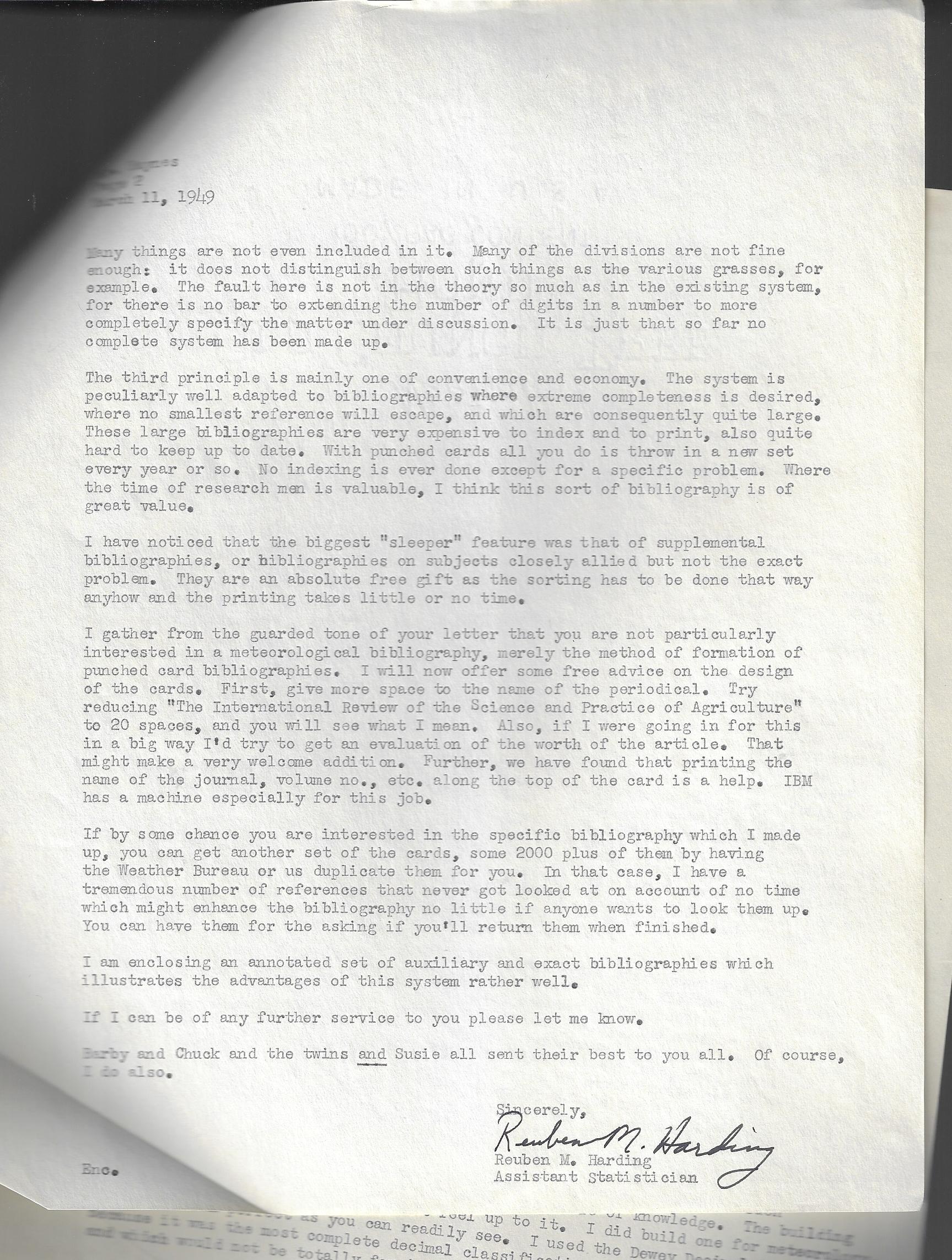
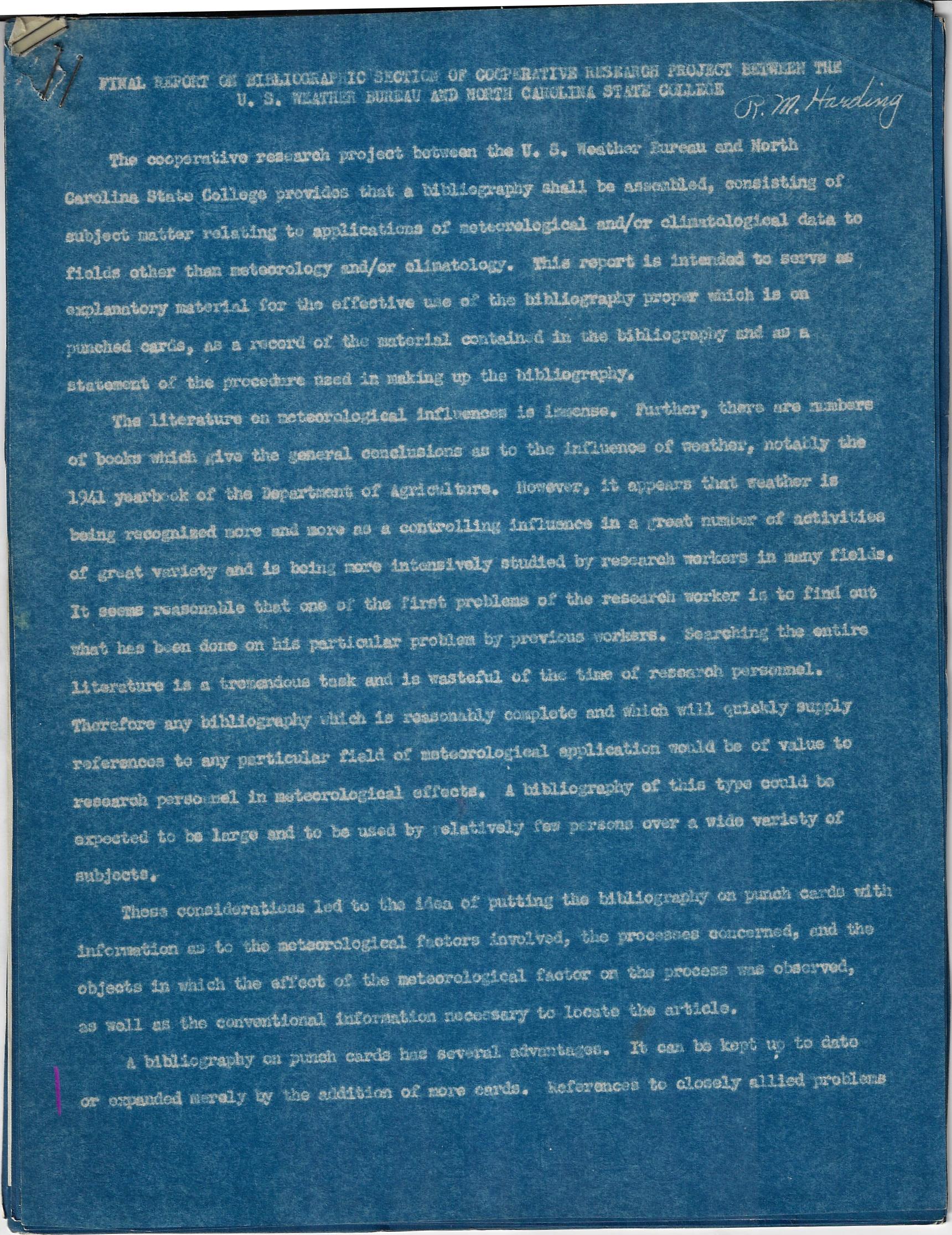
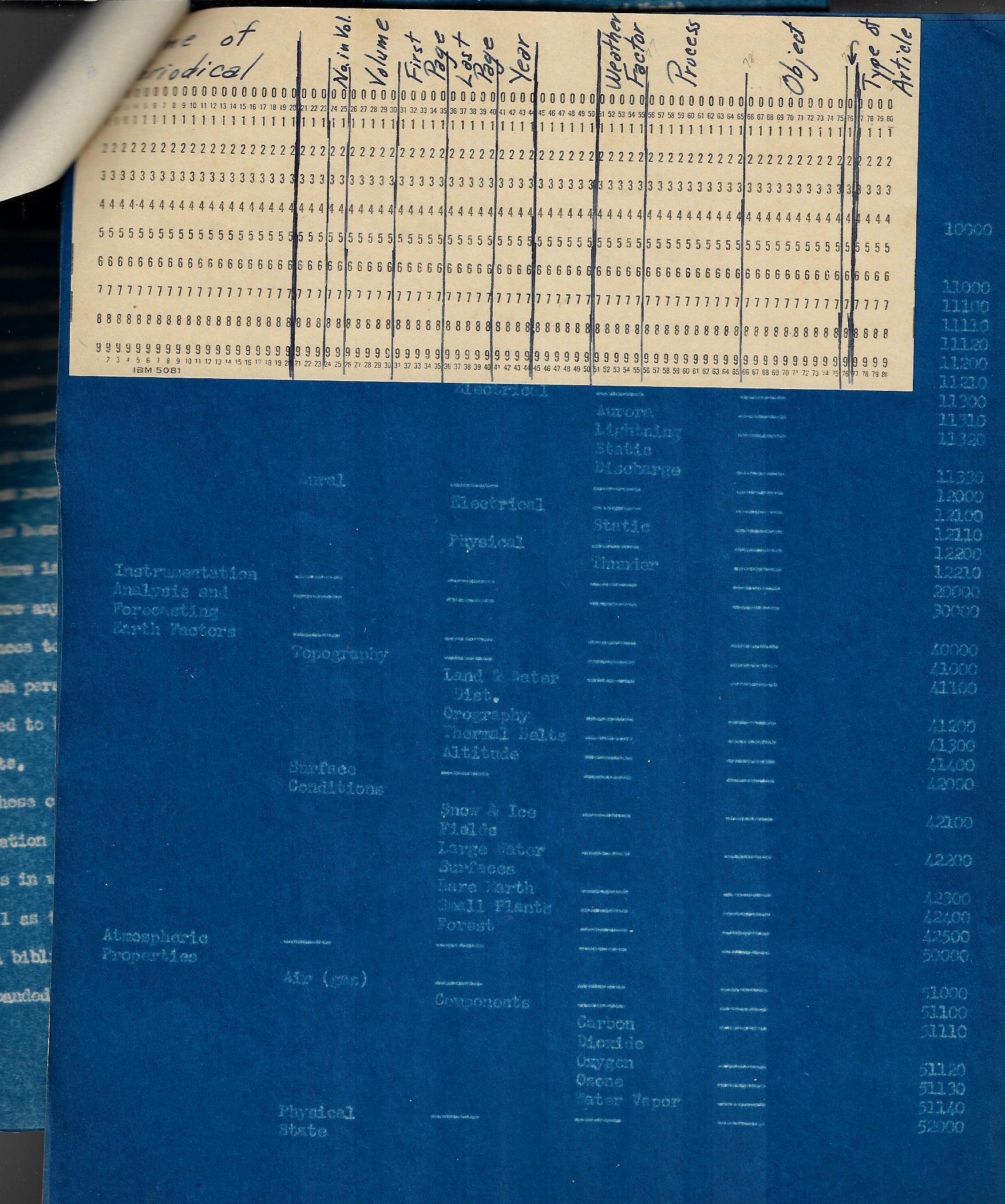
    The item in mind is an early application of computers in forming a bibliographic meteorological database: Final Report of Bibliographic Section of Cooperative Research Project Between the U.S. Weather Bureau and North Carolina State College, which was produced in 1949 in 11 sheets, 9 of which are blueprints of text (including“Final Report…” pp 1-6, “Appendix 2 [sic], Meteorological Factor Codes”, 3pp).  Also included is a sample IBM card mock-up with hand-printed notation.  It is accompanied by an extensive two-page cover letter explaining the bibliography project in some detail, and was written by Reuben M. Harding (“assistant statistician”) on the UNC at Raleigh Institute of Statistics letterhead. (The director and associate directors were all heavy hitter statisticians, including Gertrude Cox, William Cochran, and Harold Hotelling.)  The letter is dated March 11, 1949, and written to Jack Haynes (“Basic Sciences Division, Biological Department, Chemical Corps, Camp Detrick”. “Camp Detrick” was named so from “Detrick Field” in 1943, and became after great expansion in Biowar “Fort Detrick” in 1953.) I cannot find out anything about Harding save for his dates (1919-1997) and I found nothing on Mr. Haynes, though given the nature of Fort Detrick, this does not surprise me at all, as those guys–being at the center of biological and chemical weaponry establishment in the U.S.–were doing work that generally was not published or publicly shared.

    Basically it seems that Haynes wrote to Harding for general information on creating database on punch cards, though not necessarily for meteorological purposes. There is a mention for example of “battlefield conditions” which would not necessarily appear in a meteorological bibliography, but there is no hint in the letter at all regarding the ultimate applied interest of Detrick might’ve been. So my guess is that Haynes was interested in structure and not content. Harding responds mostly outlining the weaknesses of his project, though this critique is very highly useful in itself, and for all I know may have been the most significant contribution of the entire affair. 

    Here’s the cover letter, which makes for interesting reading in itself, with some good insight on how to convey information on a proposed project and what the troublesome issues were–it is worth a read from that perspective alone.

    Punch card meteorology

    Punched cards meteorology _2_

    And the first page of the blueprinted document:

    Punch cards meteorology_3_

    And the punch card mock-up:

    Punch card meteorology _4_

    And so, it was an interesting time figuring out some of the parts of this document, but after everything was said and done, I really didn’t know where I was. The document itself didn’t show up as a published entity in WorldCat, and general academic searches revealed nothing of use on my early attempts, which means all I have thus far are discrete bits of information, explaining more deeply what I don’t know. Sometimes these things are a challenge, and sometimes they need to be let go, in spite of the convincingly-interesting bits that surround them.  We’ll see what happens to this…

    And speaking of things that I don’t know, I’m not even sure what post number this really is–I say “2720” but I think in the last few hundred numbered post I’ve lost my numerical way, and I’m not positive of what number I am up to. It gets more confusing as there are unnumbered “quick posts”, which number probably now about 2k, and since there can be 5 or 10 or more of them spaced between numbered posts, I sometimes just forget what number I am pushing against. 

    ·Posted by :

    ·in:


  • The Twelve Leading Digital Computer Manufacturers in the U.S., 1954

    JF Ptak Science Books   Quick Post    

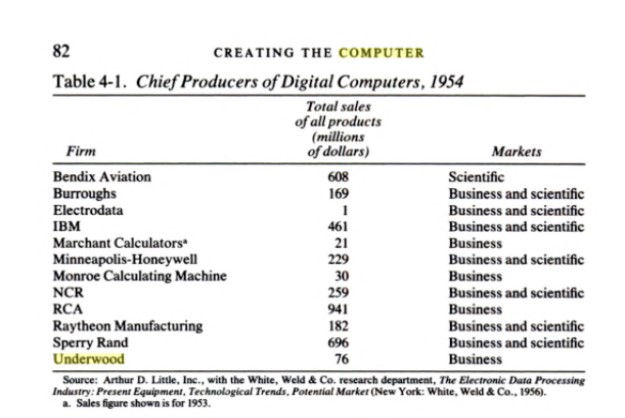
    I found something to share–this interesting table (based on numbers gathered by Arthur D. Little) showing the top-12 U.S. computer-producing firms and their incomes for 1956. [Note: the Bureau of Labor Statistics CPI calculator figures $1 in 1956 is “worth” nearly ten time that–$9.21–in 2017.] (This came as a result of researching the Elecom 100 digital computer for a manual that I found for the machine, finding that Elecom had been purchased by Underwood, which at that point was the 9th highest grossing computer manufacturing companies in the U.S.)

    Computer income

    Worth noting is that of the 12 in 1954 only 6 remained in 1965; in 1975 the number was 5, and in 1986, 4. Interesting to see the shares of the market by the standard office calculator companies like NCR, Monroe, Burroughs, and Marchant. 

    • Source:  Kenneth Flamm, Creating the Computer: Government, Industry and High Technology, Brookings, 1988, pg 82.


    ·Posted by :

    ·in: