A Daily History of Holes, Dots, Lines, Science, History, Math, Physics, Art, the Unintentional Absurd, Architecture, Maps, Data Visualization, Blank and Missing Things, and so on. |1.6 million words, 7500 images, 4.9 million hits| Press & appearances in The Times, Le Figaro, Mensa, The Economist, The Guardian, Discovery News, Slate, Le Monde, Sci American Blogs, Le Pont, and many other places… 5000+ total posts since 2008.

Category: Computer Tech/History

  • The Sudden, Unexpected, Ineffable Beauty of Pile Driving (1950)

    JF Ptak Science Books   Quick Post

    I was making my way through the IBM  Proceedings of the Industrial Computation Seminar for September, 1950, after having reported on the article by pioneer Wallace Eckert1 on the role of punched cards in scientific computation, when I read down the contents list and found a paper titled  “Pile-Driving Impact”.  The contents page listed the author (Edward A. Smith) but not their association, and so when I turned to the article I expected a vision-of-the-future-world-of-computer sorta paper. 

    Wrong! 

    The paper was far more interesting than that, and Mr. Smith–from the Raymond Concrete Pile Company–was writing about piles, pile driving, and the impact of the application of computing in the course of doing pile driving…and teh people who loved them. Well, not that last part, but everything preceding it. Of course it makes sense to be writing about this, though I had never before considered the role of computation on pile-driving before this–and I must report that Smith’s paper was sort of beautiful, in its way.  I was very happy to have read it.  

    Here’s a part of the Smith piece to enjoy, followed by a link for the rest of the paper.

    • Pile-Driving Impact, by EDWARD A. SMITH (Kaymond Concrete Pile Company ) “[Calculations] performed in the IBM Technical Computing Bureau, provided a complete numerical analysis of the behavior of a pile when struck by a pile-driving hammer. The results indicated what stresses occurred within the pile and capblock, as well as the penetration of the pile into the earth. This is an example of the replacement of costly experimentation by economical calculations…”
    • “Previously, using only key-driven calculators, it has been possible to study only partially a few isolated cases of the behavior of a pile under an impact. This was due to the high cost in time and money associated with each case studied. By employing the high speed and accuracy of IBM electronic calculating machines to perform this repeated formula evaluation, it is possible to study the behavior of numerous pile types. The cost of each case studied thereby will be substantially reduced.”
    • Source, and for the rest of the paper, see Internet Archive: https://archive.org/stream/bitsavers_ibmproceedmputationSeminarSep50_8283585/IBM_Industrial_Computation_Seminar_Sep50_djvu.txt

    Notes: 
    1. Eckert was professor of astronomy at Columbia from 1926 to 1970 (!), as well as the Director of

    the US Naval Observatory Nautical Almanac Office, and founder and Director of the Watson
    Scientific Computing Laboratory at Columbia University).

    "As Director of Watson Lab and IBM's Director of Pure Science, he oversaw construction of the SSEC
    (arguably the first true computer) and NORC (less arguably the first supercomputer), the most
    powerful computers of their day, as well as of the IBM 610 – the world's first "personal
    computer" – and he installed the first computers at Columbia open to research and instruction,
    meanwhile initiating what might very well be the first computer science curriculum, in 1946,
    including his own course, Astronomy 111-112: Machine Methods in Scientific Computing, along
    with other courses that same year taught by Watson Lab scientists Grosch and Thomas."
    --http://www.columbia.edu/cu/computinghistory/eckert.html
  • On “Long” and “Short” Time in the History of Modern Computers

    JF Ptak Science Books   Post 2714

    The history of computing, at its inception, could have its fluidity measured in decades, beginning, say with Babbage; by the time of the earliest large machines (1945-1955) computer time could be measured by less than a decade, and probably half of that.  In the 1960s the computer year could be measured, finally, in single years.  After that, after microminiaturization, and the personal computer, the year of currency started to be measured in months.  And then, of course, the year really sped up–I’m not sure if there is only a week or two in the year, now; maybe the year of progress in 1955 is today measured in days, or hours. I suspect that this will all continue to get faster, as it has been only 70 years or so that the computer world started to bulk up; I imagine that the changes that will come in 2087 will have us looking at least as “quaint” as 1947 looks to us. 

    And how far back is “way back”, or “waaay back”, in terms of (computer) history?  I’ve written earlier in this blog about going deep into history in various disciplines, but perhaps in no discipline is time so compacted than in the computer sciences.   Mr. Peabody would probably agree (though he wasn’t a very agreeable person), finding that in terms of other big leaps into the past that to go “way back” in his “way back machine” to get chronologically deep in computer history wouldn’t take very much at all. 

    Acm draft713

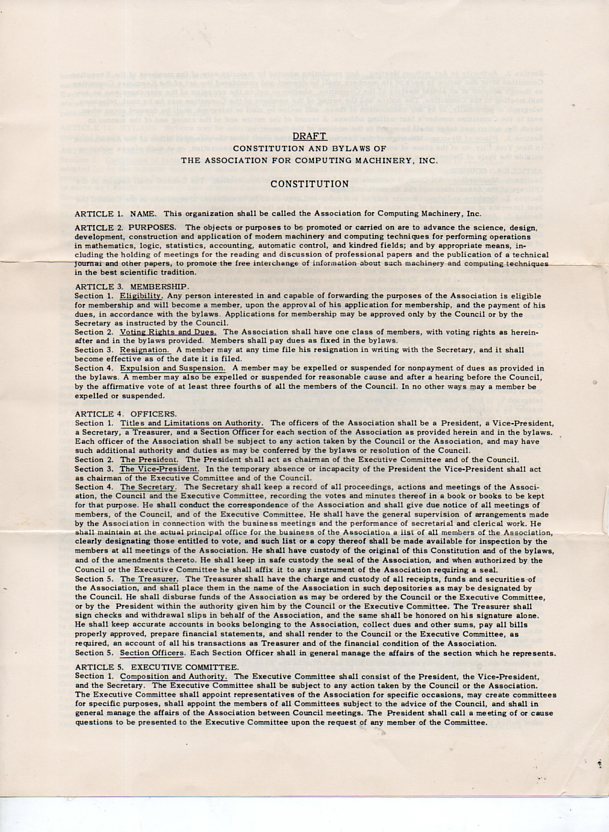
    Anyway, some of these senses of time and how only 50 years ago seems like much longer can be seen in the bits and pieces of computer science ephemera. Looking into the “archives” here I found a document from the beginning of the first tweaks of mass professionalism in sompsci.  This draft of the constitution and bylaws of the Association for Computing Machinery (the ACM) was complete in only four pages, including the data on the establishment of its members, officers, executive committee, meetings, bylaws, meetings–the whole deal, in four pages. 

    Acm draft717

    The document is undated, but as far as I can determine, I believe that this document was printed in 1953, soon after the ACM dropped the “Eastern” that used to appear as the first word in the title of the organization, and after it moved to 2 East 63rd St 

    Its quite a quietly, unspectacular spectacular thing, seeing what would become a vast organization be summed up in its infancy on two sheets of folded paper.   


    Acm a835

    1954 is extremely deep in the history of electronic calculation–it is three years before Backus et alia created FORTRAN, five years before the integrated circuit was created, eight years before the first compsci department is established at Purdue, eleven years before the first Ph.D. is awarded in computer sci from a computer science department (Wexelblatt), and fourteen years before the first woman (Liskov) earned a Ph.D.(whose dissertation was A Program to Play Chess Endgames) in the field.  All of which sounds like ancient history, but almost all of which takes place during my own lifetime, which doesn’t make it sound so terribly “ancient”.

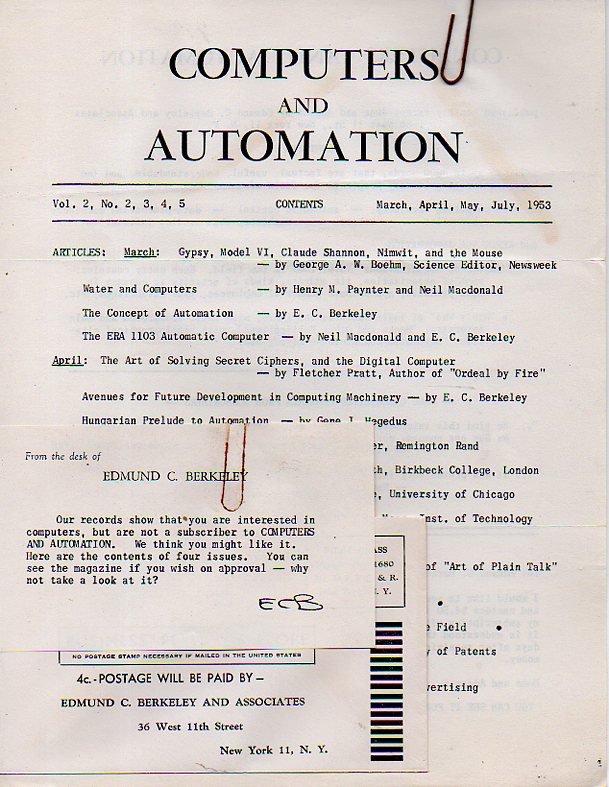
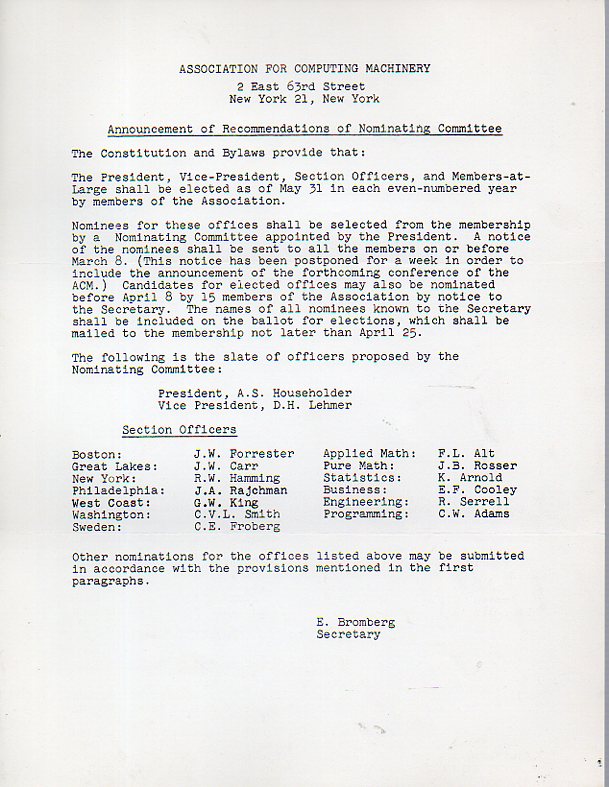
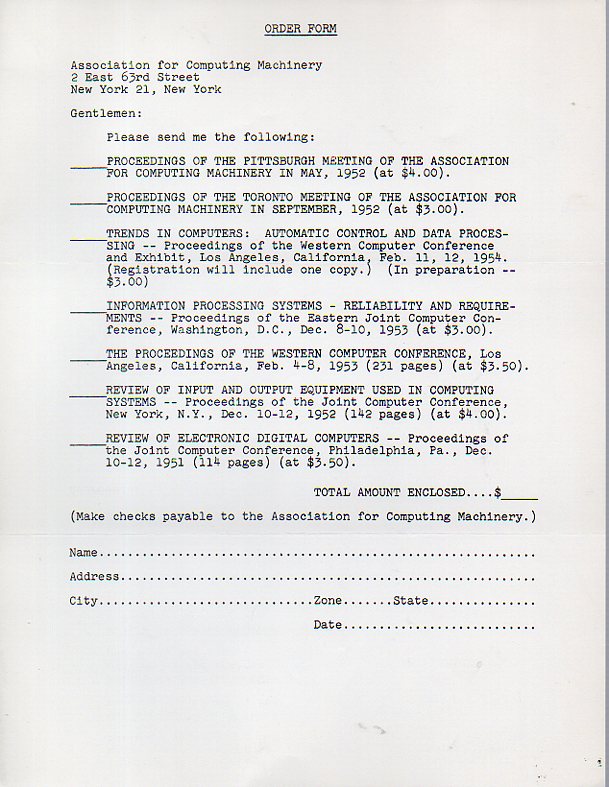
    But looking at this ephemera on membership and dues and voting on the Constitution for the Association for Computing Machinery certainly makes it seem as though so–the voting and bylaws ballot is a few mimeographed pages long and is hand-stapled at the top, the announcements for meetings fits on one sheet of paper, and Edmund C. Berkeley is hand signing his initials on pleas for new subscribers to his Computers and Automation journal.  Everything looks so fresh and new and uncomplicated–and that’s because it was, relative to what we experience now.  In 1954 there weren’t 10,000 people working in the field of computing; 63 years later the growth in involvement of people working in the field is at least three orders of magnitude more, the growth in the sheer volume of printed and digitally-circulated material is probably somewhere on the order of the differences between post-Gutenberg European printing and the printing industry in the year 1990.  The changes are tremendous, and they seem to be so much more appreciable when one looks at the foundation efforts from the early years.


    Acm a830

    Acm a831 


    ·Posted by :

    ·in:


  • A Map of an Early Electronic Brain (1948)

    JF Ptak Science Books   Quick Post

    Eniac

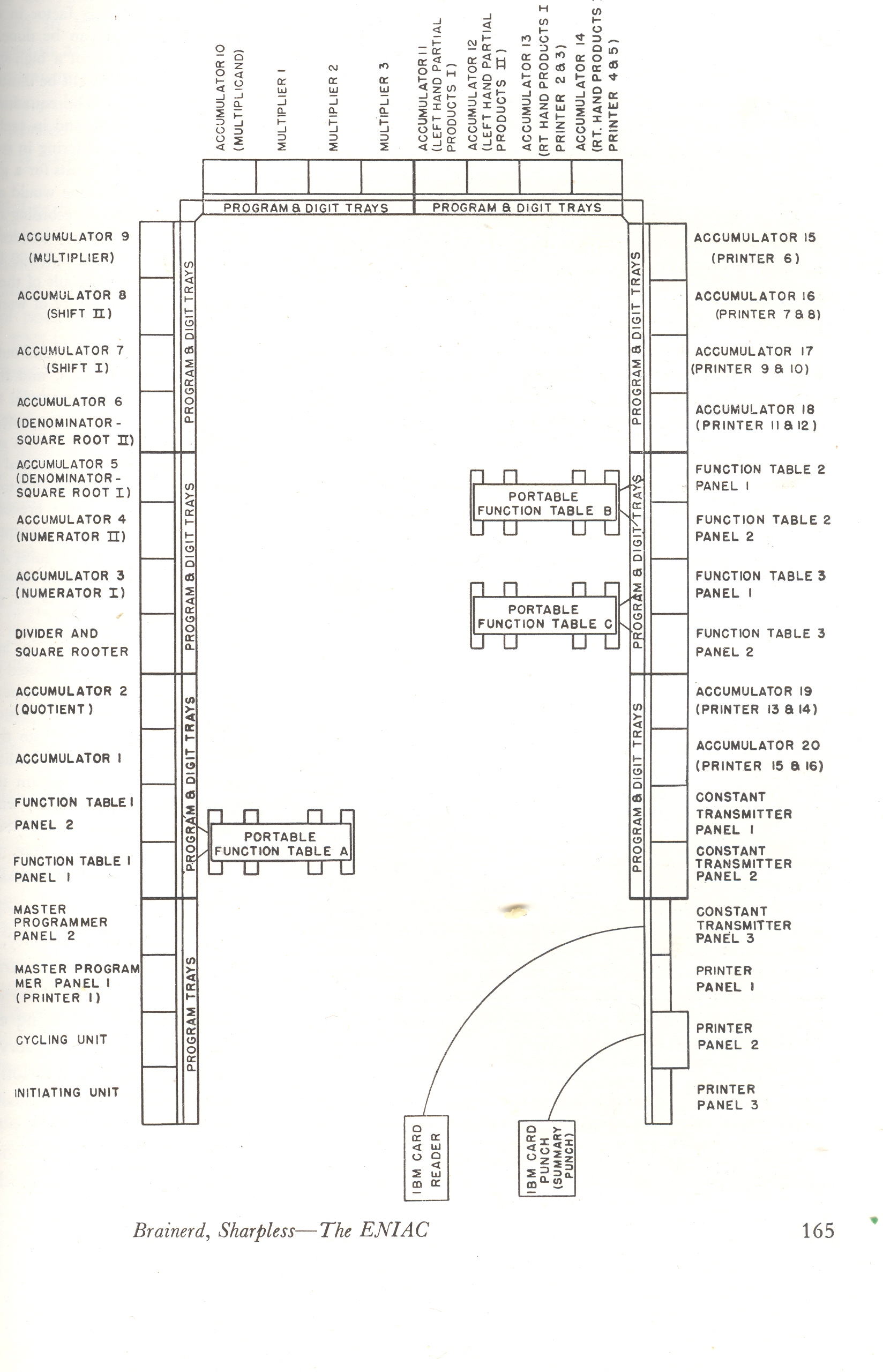
     This is the floor plan for the ENIAC (Electronic Numerical Integrator And Computer, b. 1943-45) which was, basically, the world’s first operational, high-speed digital computer, and (about) marked the beginning of the next stage of technological revolution.  What we see above is the floor plan for the computer-with-no-monitor—I know to most people working today with a computer that the idea of a “floor plan” for anything that is not in a dark place at NSA is not easily conceivable.  The 30-ton, 18,000 tube, 125 KHz ENIAC’s space was about 1800 square feet, where it was able to add about 5000 numbers/second, which was vastly faster than anything else in existence. It operated with 70,000 resistors, 10,000 capacitors, 5 million hand-soldered joints and 6,000 manual switches. It was a magnificent achievement.

    [Source: J.G. Brainerd & T.K. Sharpless. “The ENIAC.”  Article occupying pp 163-172 of the February 1948 issue of Electrical Engineering. ]


  • When Did the Term “Computer Science” First Appear?

    JF Ptak Science Books   Quick Post

    Some time ago I wrote a post on the origins of some scientific words, just to see how long they have been around–some are well-known in their newness (like “scientist” coming along in 1834, 1  anonymously referenced in the Quarterly Review, volume 51, page 59), others not so.

    Babbage eyes

    And so when an interesting word relating to artificial intelligence appeared I wondered when AI itself did (J. McCarthy 1955 and then Marvin Minsky 1956)…which led to the question of how old the term “computer science” is, and so on. Not wanting to spend more than a half hour on this I decided to establish the Oxford English Dictionary as the baseline for earliness in the first (or at least very early) appearances in English of these words and let it go at that. So here’s the list, a quick shake-and-bake on the early origins of some standard and not-so-standard words in computer science.

    A footnote here is that 10 of the 38 words here appear during the life of Charles Babbage (whose eye are posted above). 

    Notes:

    1.  The word is provided to us in the text of an article on Mary Somerville by William Whewell who references the word “scientist” coming from “a gentleman” who was  I guess himself; he uses the word under his own name in 1840.

      • Computer Science. 1956   N.Y. Times 28 Oct. iii. 21 (advt.)    “Unparalleled opportunities to associate with the prominent pioneers of computer science, at outstanding salaries. Electronic engineers (circuit designers and magnetics engineers), logical designers, [etc.].”

      • Computer programming: 1952   Proc. ACM National Meeting (Toronto) 20/1   “In fact three principles should apply to computer programming and operation in general, and not just to code checking.” This was followed by “computer programmer” after three years.  

    • And so:
      • computationalism, n.1979

      • computationalist, n….1956

      • computatist, n.1611

      • computative, adj.a1538

      • computator, n.1591

      • compute, n.1483

      • compute, v.1579

      • computed, adj.1680


  • Introducing the 6 bit Core Memory UNIVAC 1004 (1962)

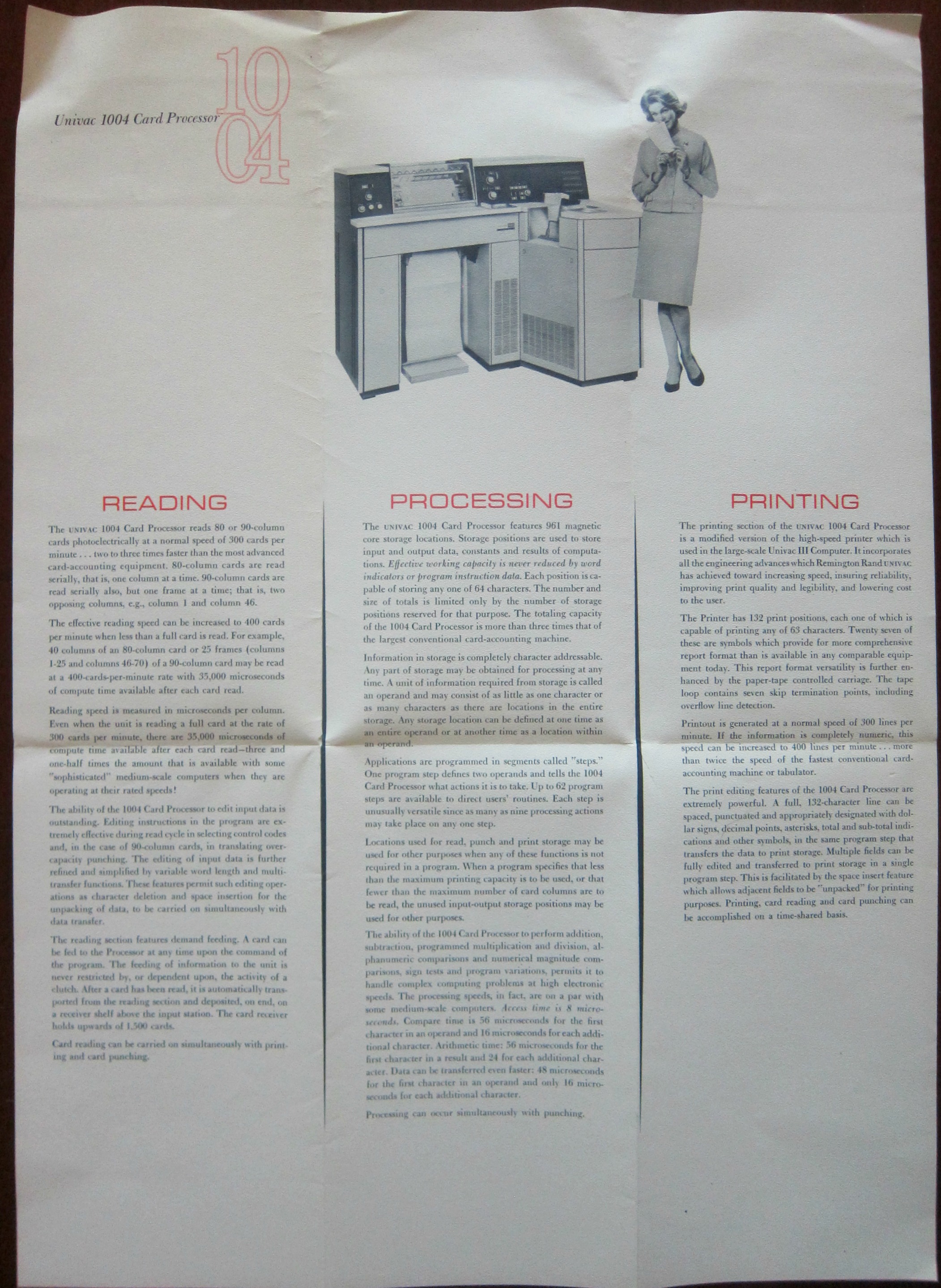
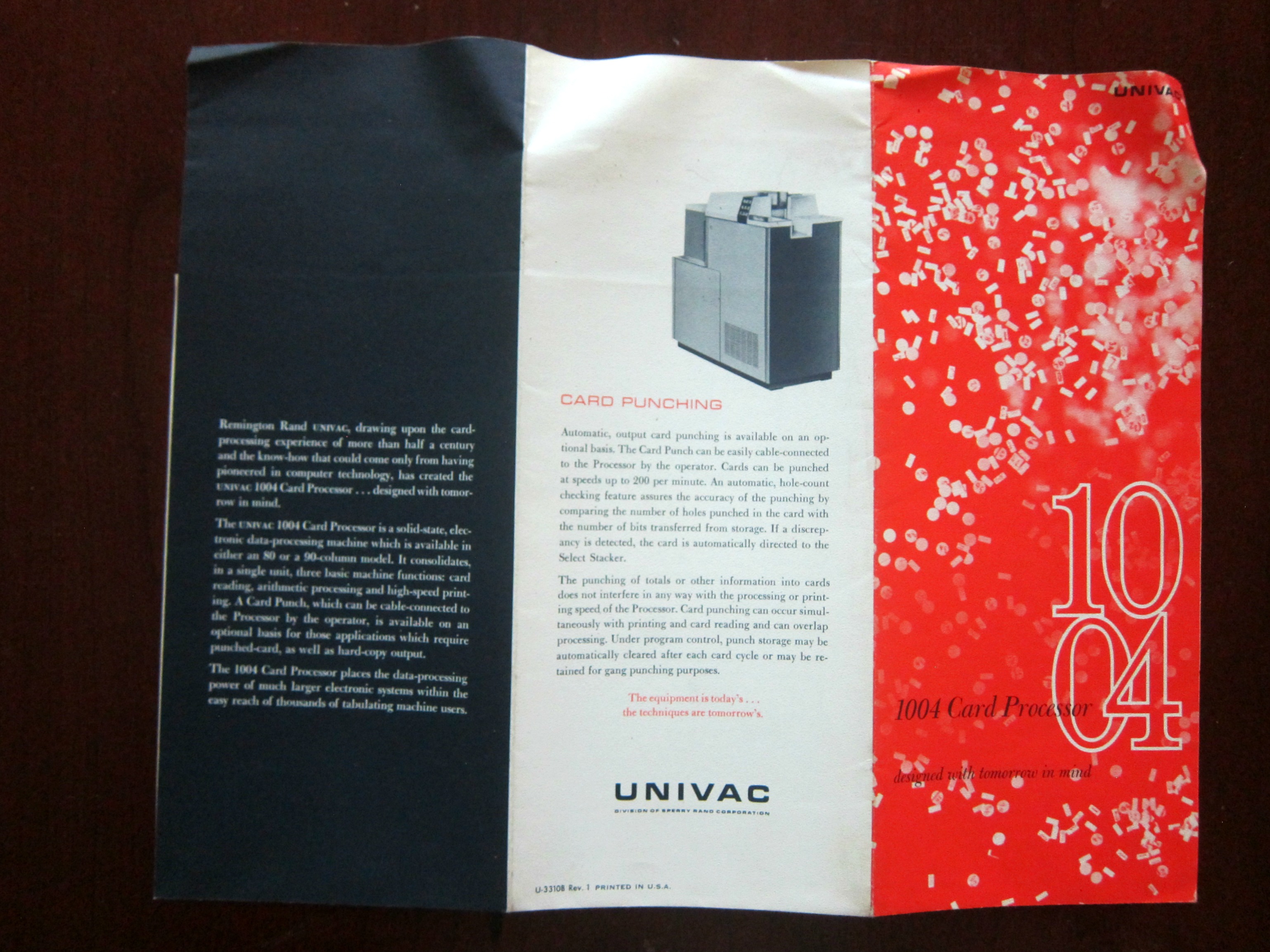
    UNIVAC 1004_2_New for 1962, the UNIVAC 1004 Card Processor 1004. The text of the ad for this tri-fold/broadside advertisment tells us that the UNIVAC machine is “faster” than its human variants, and allows for more reports to be generated at a quicker pace. This was state of the art for 1962, and no doubt companies would want one, if they could afford it.  And just for the record, this unit cost about $148,000 when new, or about $1.2 million in 2017 dollars (computed by the BLS inflation calculator).  

    (Be careful of the UNIVAC trademark, which was registered by Eckert-Mauchly Computer Corporation, Remington Rand Corporation, Sperry Rand Corporation, Sperry Corporation, and Unysis.) 

    The pamphlet-y object is an 11×4.5″ tri-fold which opens to a display of 19×14″ demonstrating the fabulous new and fast features of the machine (and improved by 1966 as the 1005). The image also shows the 1004 printer and a model coyly holding a few punch cards like a geisha fan. 

    “The UNIVAC 1004 was a plug-board programmed punched card data processing system, introduced in 1962, by UNIVAC. Total memory was 961 characters (6 bits) of core memory. Peripherals were a card reader (400 cards/minute), a card punch (200 cards/minute) using proprietary 90-column, round-hole cards or IBM-compatible, 80-column cards, a drum printer (400 lines/minute) and a Uniservo tape drive. The 1004 was also supported as a remote card reader & printer via synchronous communication services. A U.S. Navy (Weapons Station, Concord) 1004 was dedicated to printing from tape as a means of offloading the task from their Solid State 80 mainframe, which produced the tapes. A plug-board program called Emulator was widely installed to convert 1004s to stored-program operation, reading in instructions from program decks of cards which determined the processing of the following data decks.”–Wikipedia on UNIVAC

    UNIVAC 1004


  • A Fine Display of Pie Charts 1893

    JF Ptak Science Books   Quick Post

    “This apparatus works unerringly as the mills of the gods, but beats them hollow as to speed”–Electrical Engineer, November 11, 1891

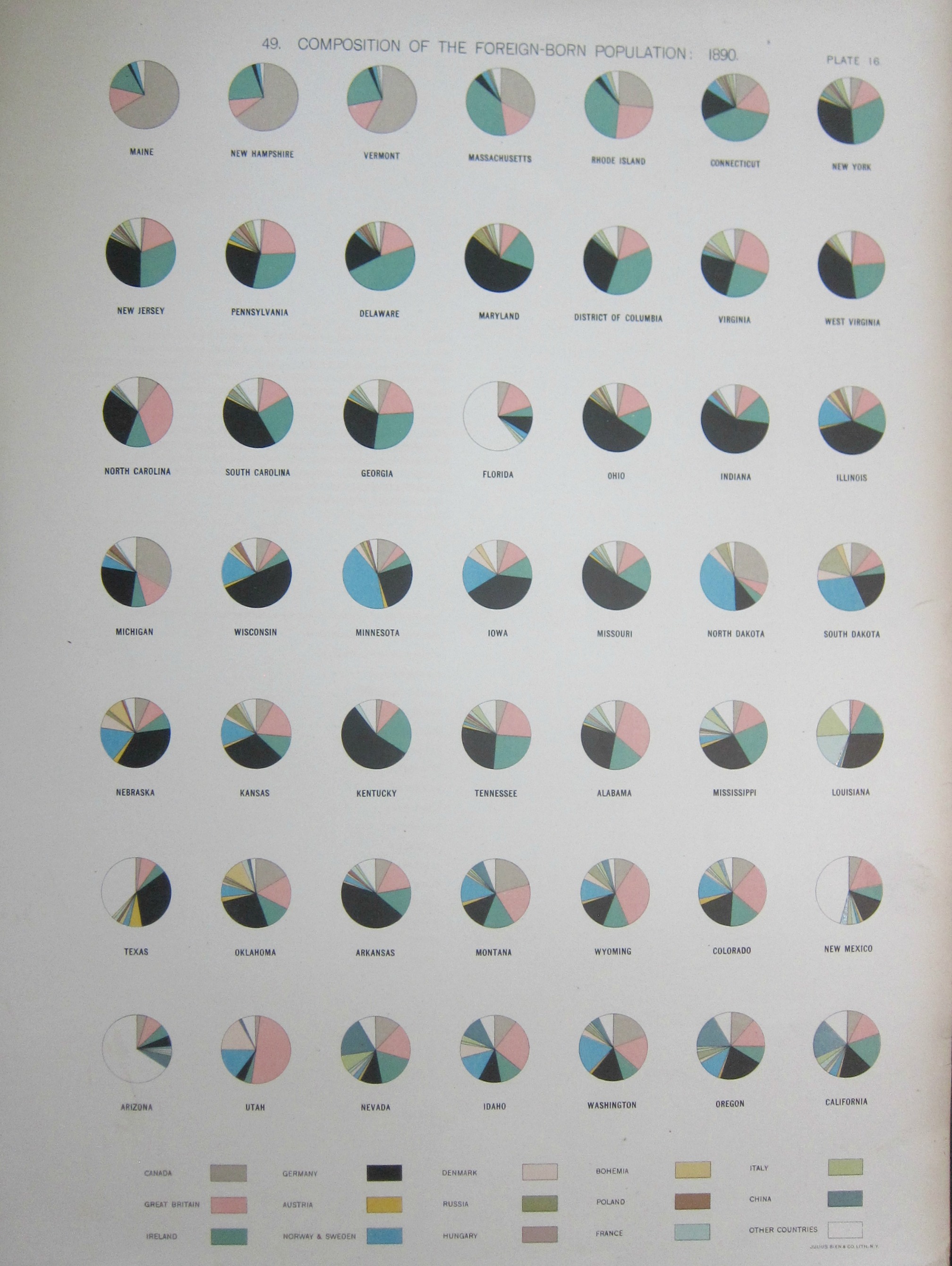
    Hollerith foreign born detail _3_

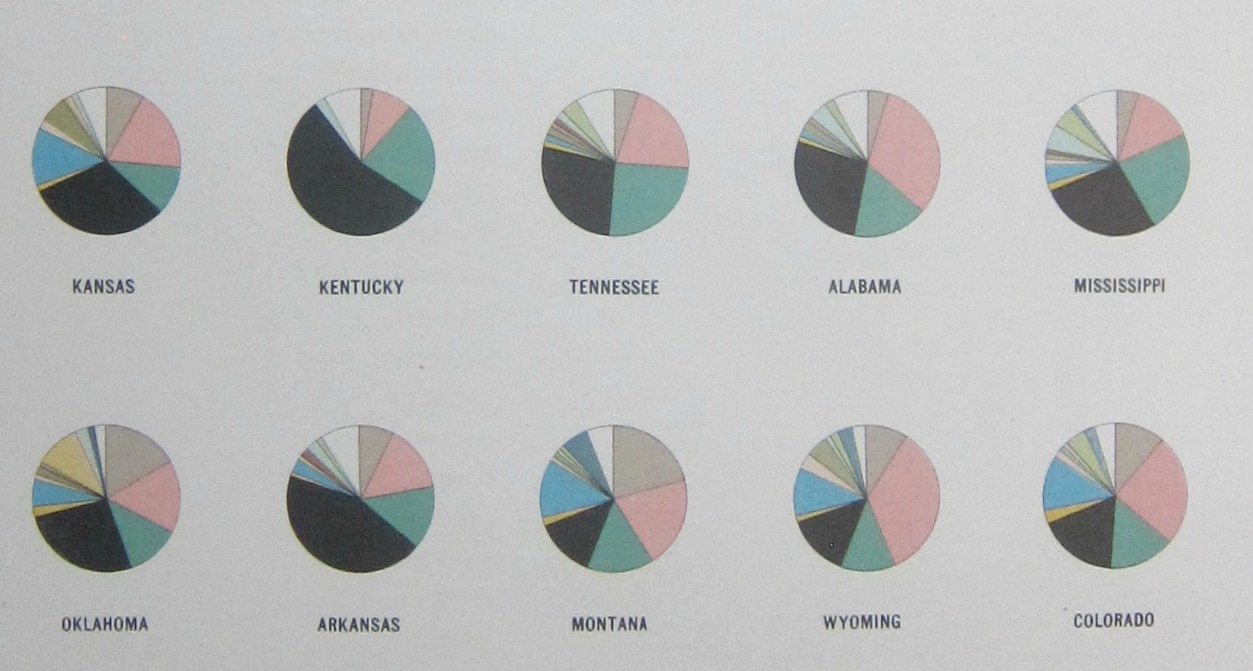
    Many splendid displays of newly-manipulable data made their appearance in the Henry Gannet atlas to accompany the great U.S. census of 1890 –this example displays the composition of foreign born inhabitants of each of the states.  Part of this was due to the use of the Herman Hollerith tabulators, which made their appearance for the census office to work their electromechanical magic to process data faster than the 8-year-long process of the 1880 census. As it stands, the Gannet atlas and the census report was published beginning just two years after the completion of the 1890 census, a job made possible by the “mills of the gods” machine and some 48,000 enumerators (who completed returns for 13,000,000 households).  With prodigious thanks to Hollerith, the census was completed quickly and with a wider variety of data collection rather than what would have been the opposite without them. 

    Hollerith foreign born pop _2_


  • Robot/Computer Anthropomorphic Brains

    JF Ptak Science Books  Post 2570 (continued)

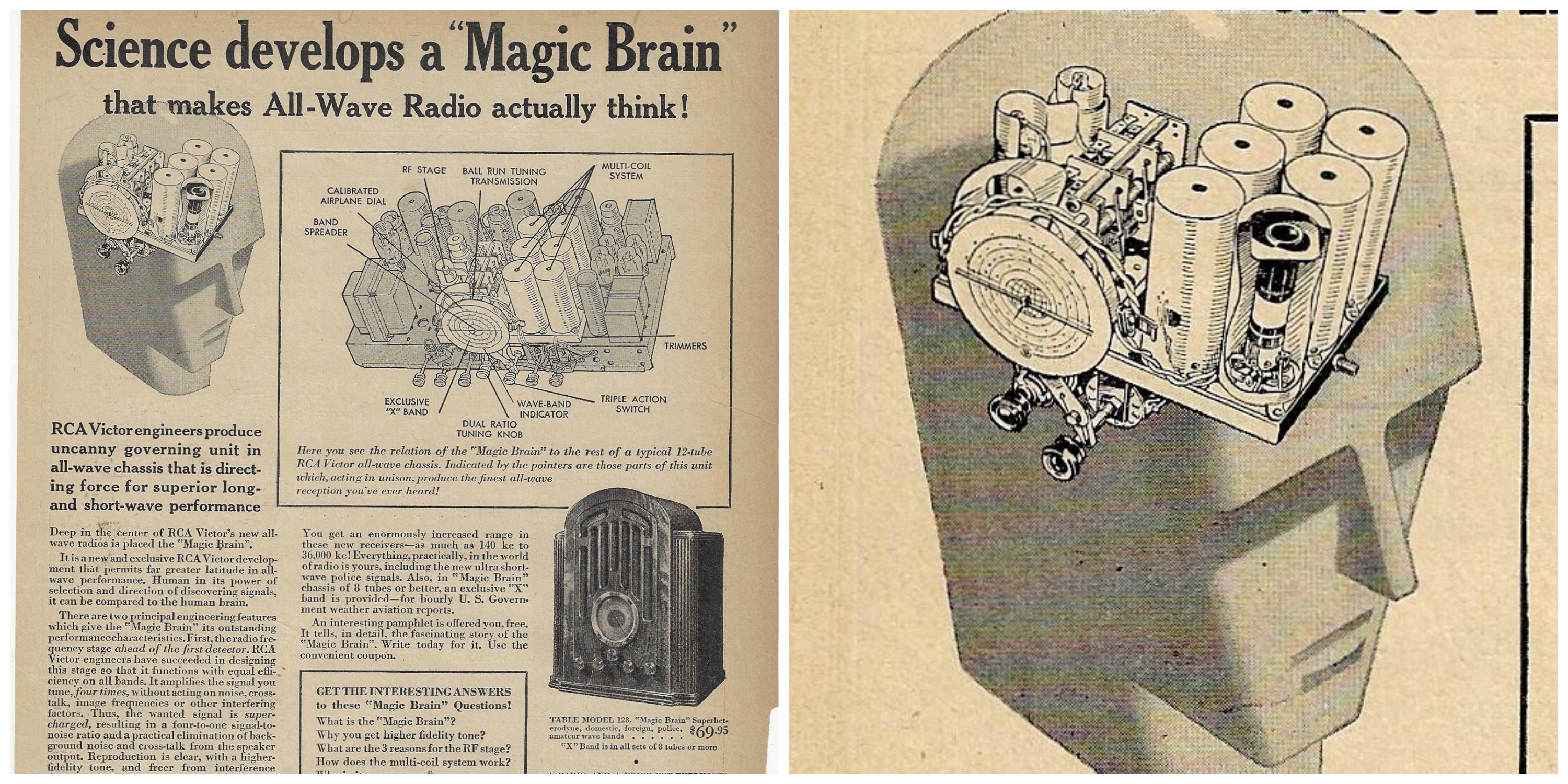
    There seems to be a developing thread in the stuff I’ve been saving on the history of anthropomorphic robots pre-1955 or so–and that is, the robotic or computer brain.  These are not nearly as plentiful as the robot-entire, or at least that is the way it seems from a general impression of long and sloppy reading in the area. I bumped into another brain post, this one still on the early-ish side, coming from Popular Science Monthly for 1930. It really is a stand alone, and an illustration for an advertisement for radios, but it still sent a message to the reader, and it seems that it probably was still very uncommon territory in the application of images like this:

    Robot magic brain montage

    That really is beginning to put the hot tube-scented “logic” into biological.  

    Here’s another, one that I wrote about some time ago, though this one has more the makings of a computer in place of some tubes and a dial.

    Robot brain harvard
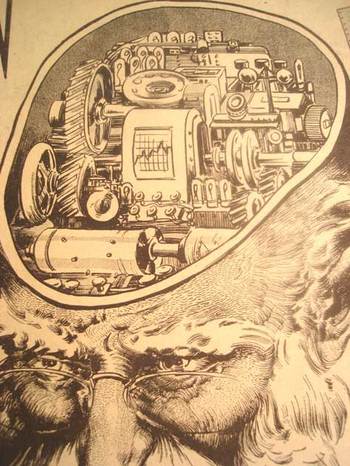
    This may well be the first public, popular, report on the Harvard Automatic Sequence Controlled Calculator (ASCC) (appearing in the American Weekly, 15 October 1944), the first automatic, general-purpose, digital calculator.  Known as the MARK 1, it was the brainchild of Howard Aiken (1900-1973), a graduate student at Harvard, who started it all in 1937 by proposing a series of coordinated Monroe calculators to function as a unified whole  that would cross the threshold of the physically-impossible calculation (though theoretically possible) to the eminently doable. Here’s a detail of the inset:

    Robot brain harvard detail

    There are some others in the category, including this fine image from the Burroughs people:

    Robot brain wheel burroughs

    The Burroughs Adding Machine company did about as much as anyone to objectify the worker in America during the 1880-1915 period, making the worker a part of a machine within the machine. In a way it was like creating the Ford assembly line for people sitting down. 

    The company was founded on the work of William S. Burroughs’ grandfather, William Seward Burroughs (1857-1898 and native son of Rochester, NY), who created a mechanical calculator to help him add long columns of numbers in his job as a bank clerk. American Arithmometer Company was founded by him and others in 1886, later evolving into Burroughs Adding Machine Company (1904), Burroughs Corporation (1953), and then into Unisys (combining with Sperry Univac in 1986) before sliding away.

    In any event the adding machine connected millions of people to a mechanizing process of what had previously been a mental operation–the flywheel in the side of the head of the clerk/accountant in this add for Technical World (More Fascinating than Fiction) for August 1915 wasn’t too terribly far from the truth. Interesting that on the other side of the head of this fellow, behind the other ear, is a pencil. 

    Another in this line of depicting human brains as sort-of machines is this very entry-level bit of gearing in an advert for a tech correspondence school for folks to “modernize make more money”, and found in  Popular Mechanics, August 1936. As these things go, it would be difficult to imagine a less complex depiction of a mechanical brain:

    Robot brain few gears Pop Mech 1936

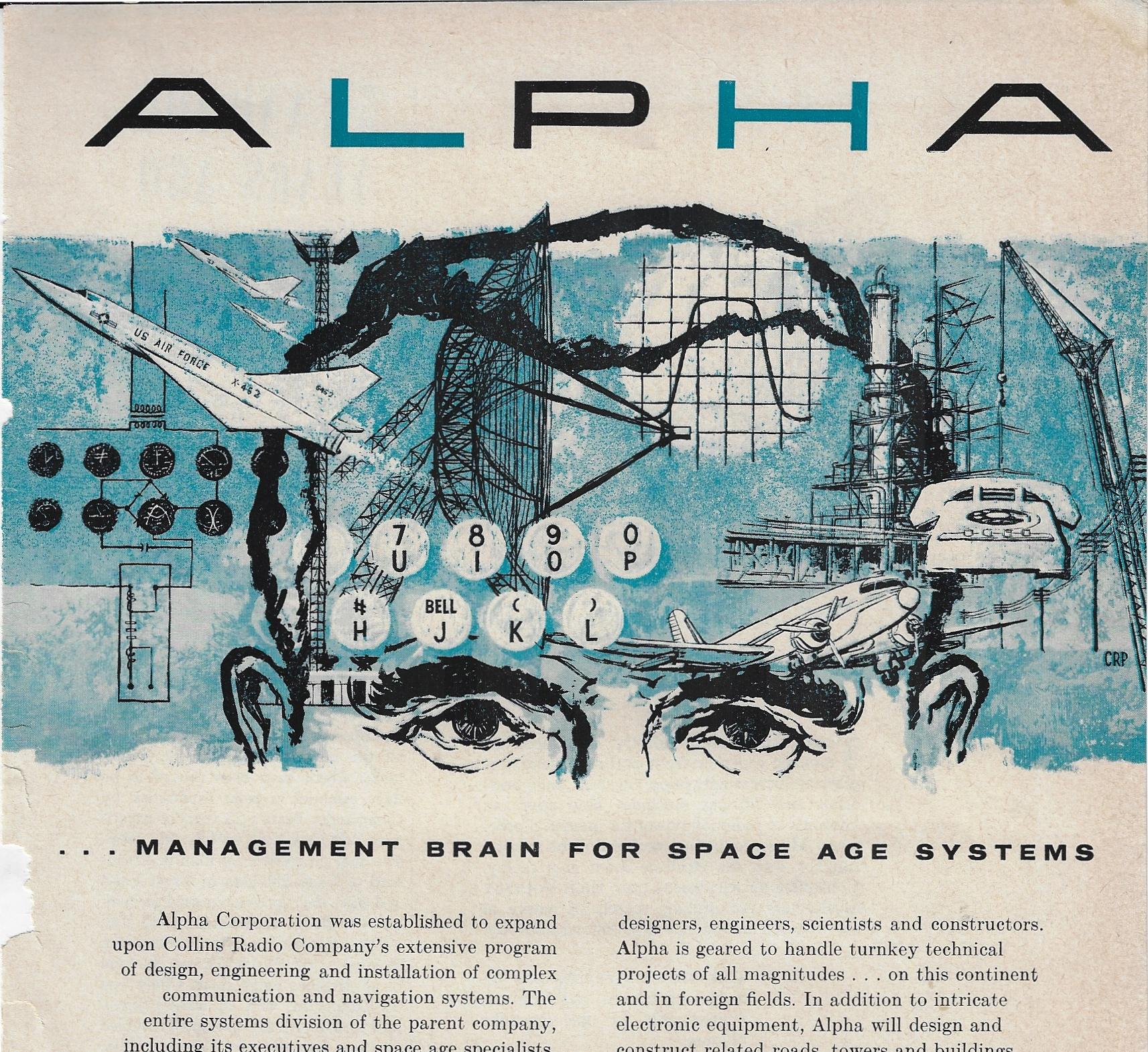
    And another–again, this is not much of an electronic brain, but it does get across the point of the ad for the Alpha Corporation (“A subsidiary of Collins Radio Company”) for 1958:

    Robot brain alpha 1958_0001


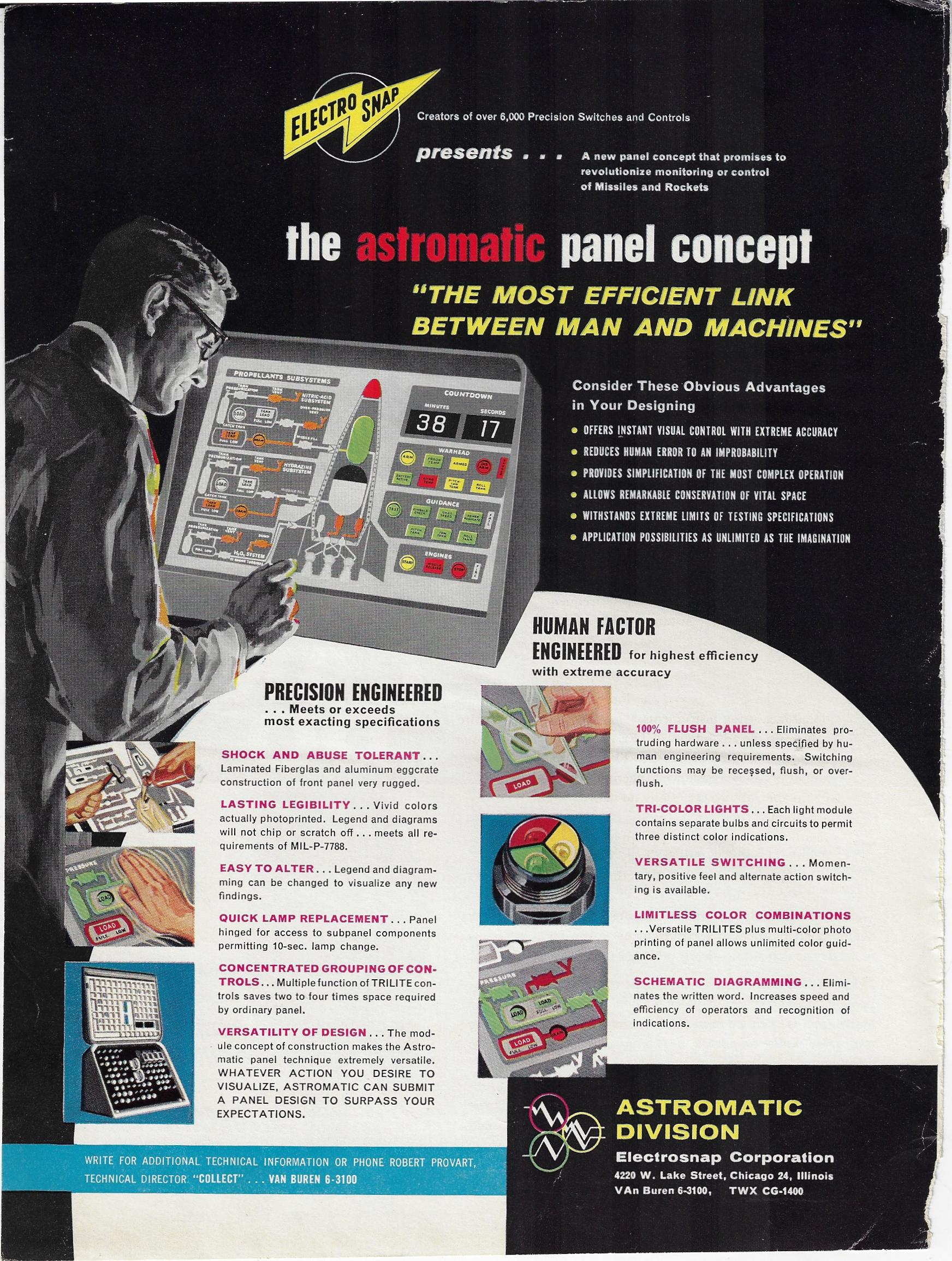
    And yet another boundary is threatened with the astromatic panel concept of the Electrosnap corp (of Chicago), showing the interaction of biological and electronic systems, as shown in this advertisement in Missile and Rockets in 1959:

    Robot brain link machine human

    In any event, these are three of this developing collection of metalizing/electrifying the brain for its robot-y future.  


  • On Finding Mr. Babbage and a Very Early Mention of the Future of Computing (1822)

    JF Ptak Science Books   Post 2657

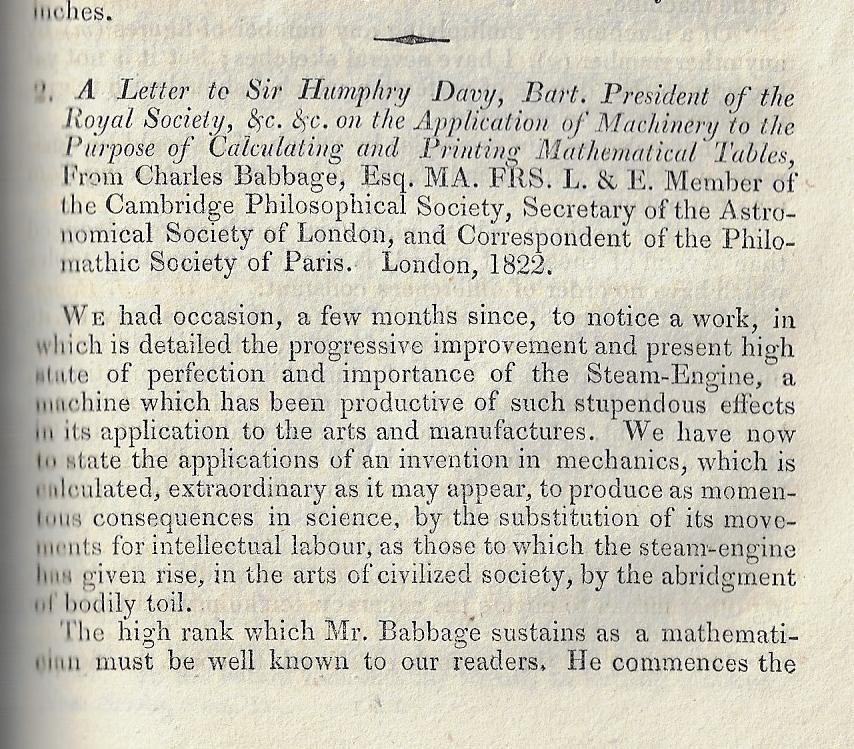
    I was browsing though a volume of Annals of Philosophy1 (1822) for my business, looking for interesting and significant contributions.  Making my way nearly to the end I was not able to come away with anything of particular importance, though there were enough bits in it to make it an interesting purchase for someone, and to probably get a nice blog post out of it. (My main “hook” in the volume’s story for the blog was a happenstance opening of the volume to a page exhibiting two short articles “Definition of a Straight Line” followed a paragraph late by “Black Urine”.) Nearly at the end of the book, though, I came upon a very unexpected “find”: “A Letter to Sir Humphrey Davy, Bart., President of the Royal Society, &c &C, on the Application of Machinery to the Purpose of Calculating and Printing Mathematical Tables…London, 1822” by Charles Babbage (appearing on pp 383-388).  This appeared as a book review in the “Analysis of Books” section of the Annals with the running header of “Mr. Babbage’s Letter to Sir H. Davy”, and published in November 18222.

    Babbage 1822 _1_

    [The beginning of the article in the Annals…; the full text appears below]

    This is a review of a 12-page paper–an open letter–written by Babbage to Davy on July 3, 1822, which was the first public discussion and detailed description of Babbage’s Difference Engine. (I should note that the printers of this privately-printed paper and that of the Annals are the same.) This paper would make its way to the Royal Society which in turn, on May 1 1823, advocated the support (and funding) of Babbage’s machine. 

    The original publication of the Babbage letter is a great rarity, and I would say that for me finding that would be impossible if I wasn’t willing (and of course not able) to afford the very high entry price for the item.  So, finding this in the Annals, finding a review of this very important and rare publication issued just months following the original paper was fascinating.  

    And I nearly missed it.

    Most of the contents of this review are quotes taken from Babbage’s work. A review of the paper also appeared in the British Critic, 1822 (full text found here: http://babbagedifferenceengine.blogspot.com/2014/09/article-in-british-critic-october-1822.html)

    The full text of the rriginal Babbage paper is here:  https://sites.google.com/site/babbagedifferenceengine/babbagelettertosirhumphrydavy

    Other papers of interest in the volume include: M. Prechtel, “On the Foundational State of the Magnetic Phenomena of the Electrical Connecting Wire”, pp 1-6;Charles Sylvester, “On the Specific Gravity of Gases”, pp 29-31; [Anonymous] “Definition of a Straight Line”, p 71; [Anonymous], “Black Urine”, pp 71-2;  T. Weaver, ” Geological Remarks”, pp 81-93; William Buckland, “Account of Fossil Teeth and Bones discovered in a Cave in Kirkdale”, pp 133-146 and concluded pp 173-195;  [Note on] “Frauenhofer’s Experiments on the Illuminating Power of the Prismatic Rays”, p 157; William Hyde Wollaston, “On the Finite Extent of the Atmosphere”, pp 251-256; James Smithson, “Some Improvements of Lamps”, pp 363-364;

    Notes:

    1. Annals of philosophy, natural history, chemistry, literature, agriculture, and the mechanical and fine arts, edited by Thomas Thomson, printed in London for Baldwin, Craddock, and Joy, 1822; volume IV, July to December, 1822. Vii, (ii), 480pp, 6 engraved plates (half folding). Provenance: R. Crum Brown for the University Library of Edinburgh, with their bookplate.

    2. The full title of Babbage’s work as it appeared in 1822:  Letter to Sir Humphry Davy, Bart, President of the Royal Society, &c.&c. On the Application of Machinery to the Purpose of Calculating and Printing Mathematical Tables, from Charles Babbage, Esq. M.A. F.R.S. Lond. and Edin., Member of the Cambridge Philosophical Society, Secretary of the Astronomical Society of London, and Correspondent of the Philomathic Society of Paris. 4to 12pp Baldwin & Co. 1822.  July 3, 1822

    ·Posted by :

    ·in:


  • Brevity and Complexity–ALGOL 1960

    JF Ptak Science Books     

    I think that I’d like to start a new category of observation for this blog–complicated work explained with celebrated brevity and clarity.  Earlier today I wrote a post on a 24-page effort by the great polymath and mathematical titan, Henri Poincare, describing his Newtonian-clad version of relativity, and it certainly classifies as a superior effort in a short, clarifying description of a wide and complex topic.  Wittgenstein’s Tractatus Logico-Philosophicus is another–it is considerably longer though incredibly short for the work that it undertakes, ending with a sentence that has become an independently-standing aphorism, “Whereof one cannot speak, one must pass over in silence”.

    But for right now, I’d like to look at a splendidly short work.

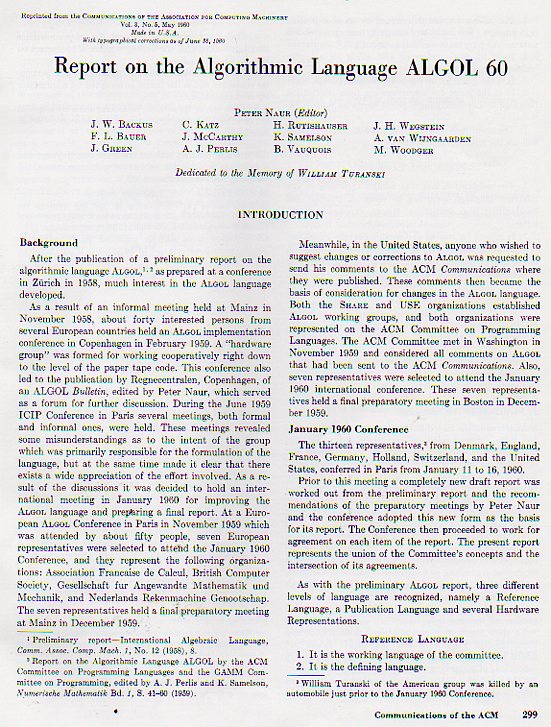
    ALGOL 1960

    Much is owed to people like Peter Naur1, a Dane who made an enormous contribution in the development of computer languages by being the lead developer in the creation of ALGOL.  As a matter of fact Naur (b. 1928) received the computing world’s equivalent of the Nobel Prize (“highest distinction in Computer science”)–the Turing Award–for this work, receiving the high honor in 2005. The official short description–again in the manner of the Nobel Committee– was “(f)or fundamental contributions to programming language design and the definition of ALGOL 60, to compiler design, and to the art and practice of computer programming”.         

    This all came to mind while looking through Report on the Algorithmic Language ALGOL 60 (published in the Communications of the Association for Computing Machinery, May 1960) which was edited by Naur.  ALGOL was the creation of 40+ minds, twelve of whom were listed contributing to this paper-–it is a great testament to Naur to control all of that input, producing a superb fifteen page report of great brevity, beautiful logic and utter accessibility.  Perhaps If the team was given a lot more time Naur could’ve made his work even more succinct, but I really doubt it.  It is written in a language that is somewhat foreign to me, but I can certainly appreciate the way the work is structured its precise manner of presentation.  It seems to me a hallmark of communicating complicated ideas in a small space.

    NOTES:

    1.  NAUR, P. (with J. W. Backus, F. L. Bauer, J. Green, C. Katz, J. Mccarthy, P. Naur, A. J. Perlis, H. Rutishauser, K. Samelson, B. Vauquois, J. H. Wegstein, A. Wijngaarden,M. Woodger) . Report on the algorithmic language ALGOL 60. Offprint:  Communications of the ACM,  May, 1960, vol 3, #5. 25x21cm, pp 299-314.  Rare.  There is evidently an two months earlier-but-not-circulated report (no citation for this), as well as a later printing appearing in  Numerische Mathematik, 2/1, December, 1960, followed in 1962 with a longer edition.


  • Charles Babbage, Humorist

    JF Ptak Science Books   Quick Post

    Babbage eyes

    There are certain sections of Charles Babbage’s surveys of his life–Passages in the Life of a Philosopher, 1864–that are very unexpectedly, well, funny. I mean, there are stories told with a bald/dry sense of humor, a stony-faced delight, that I think are actually intentional. Perhaps I’m reading this all wrong–and if so someone will just have to correct me.  But rounding out long sections on the Difference Engines (1&2) and calculation and the future of  railroading and so on are long complaints regarding  the quirkiness of his day, as with the “destruction” of his time via a chapter named “street nuisances”, into which Babbage dives fairly deeply with some occasionally comic recountings of what pisses him off, which was frankly a lot. 

    What most intrigues me in this interpretation is the possible found-comedic or intentionally-comedic running page titles.  These are the several word descriptions of what is on the page that floats centered and above the text at the head of each page, which was a common practice in the 19th century.  It is here where Babbage really soars with the eagles, and I prefer to believe that he and not an editor put together these mot juste–they seem cranky and irritating enough to have been somewhat carefully selected.  In any event, I recorded a number of them below, for your amusement:

    • 52 Eggs
    • Artificial Swedes
    • Weight of Nepotism
    • Game of Tit-Tat-Toe
    • Occulating Sun Signals
    • The Story of the Two Pumps
    • The author in Want of Cash
    • The Learned Ponder Dunder
    • Disturbed Vision
    • The True Use of Figures
    • Various Shakes and Smashes
    • Conversion of Attics into Cellars
    • Space Too Large for Itself (!!)
    • A Decent Waist Coat
    • Awful Crash
    • The Value of a Button
    • Winking Statues
    • Primitive Purity–It Won’t Do
    • Biscuits and Whisky
    • A Finite Machine May Make Unlimited Calculations
    • and so on

    Many of these are pure clickbait–who could see “Conversion of Attics to Cellars” and not read on?  Science would demand you do so.  

    In any event, the book is well worth a read, of course–I mean it is Charles Babbage, and he does discus some very interesting things with razor-sharpness. And I’m sorry somewhat for concentrating on the funny bits, but they were just so unexpected I thought I needed to haul them out and get them some sun. 

    The full text via Internet archive: https://archive.org/stream/passagesfromlif01babbgoog#page/n2/mode/2up

    ·Posted by :

    ·in: