A Daily History of Holes, Dots, Lines, Science, History, Math, Physics, Art, the Unintentional Absurd, Architecture, Maps, Data Visualization, Blank and Missing Things, and so on. |1.6 million words, 7500 images, 4.9 million hits| Press & appearances in The Times, Le Figaro, Mensa, The Economist, The Guardian, Discovery News, Slate, Le Monde, Sci American Blogs, Le Pont, and many other places… 5000+ total posts since 2008.

Category: Computer Tech/History

  • Babbage on Chess (1817) and “Miracles”, Among Other Things

    JF Ptak Science Books  Quick Post

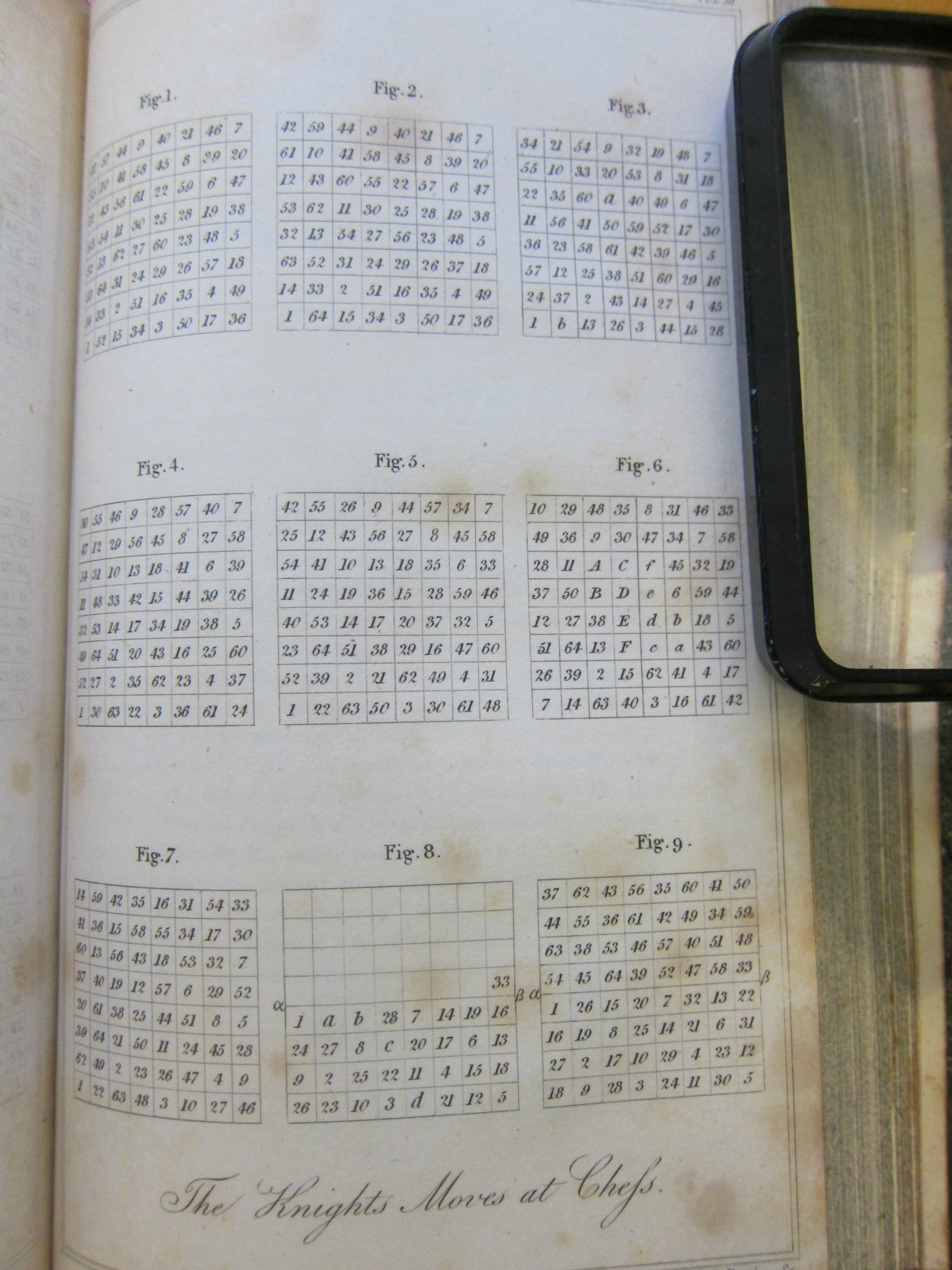
    When reading through a volume of the Royal Society’s quarterly publication on the stuff of science (for the year 1817) I came across an article on the Knight’s Tour puzzle: “An Account of Euler’s Method of Solving a Problem, relative to the Move of the Knight at the Game of Chess, from a  Correspondent”, published in  The Quarterly Journal of Science, Literature, and the Arts, edited at the Royal Institution of Great Britain, published by John Murray for the Royal Institution, London, 1817-1818. After a little digging to find the authorship, I found that the “Correspondent” here is Mr. Charles Babbage himself, with the authorship established at least by the time of his Passages from the Life of a Philosopher if not before. The Knight’s Tour puzzle–in which a  knight is moved around a chessboard (8×8 grid, though smaller and much larger have been used) so that every square is touched only once–is ancient, with the host of the famous 18th century mathematical revelers3 positioning the problem in the dim past, with Lucas in 1882 and then Kraitchik in 19272 fixing it more resolutely in India over 2000 years ago.Passages from the life of a philosopher
    Babbage Chess


    Babbage identifies the paper as his own in the section of his own “contributions to human knowledge” in his retrospective, Passages in the Life of a Philosopher, published in 1864. I’ve never read this book though I’ve used bits and pieces for research, though last night and today I’ve read in it quite a bit. And apart from the sheer enjoyment of the power of this guy’s mind, I’m finding the book to be unexpectedly amusing. The man is actually funny, plus witty, and an entertaining write–why this is so surprising, I don’t knw; perhaps it is because he is associated in a personal sense in my mind with General Winfield Scott, as they resemble one another, both looking Very Highly Contentious and gassy. In any event, I can safely say that this is a Good Read. 

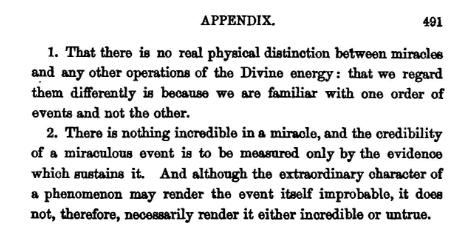
    For example, here’s a bit in the appendix, Babbage writing on “miracles”:
    Bsbbsgr miracles

    There’s a few pages of reasoning before we get to his enumerated “prepositions”, but this should do nicely.  The guy was a very very good thinker. 

    Full text here: https://archive.org/stream/passagesfromlif01babbgoog#page/n510/mode/2up

    Notes
    ·Posted by :

    ·in:


  • Computers, Nuclear War, and Afterwards (Full text document, 1964)

    JF Ptak Science Books   Post 2628

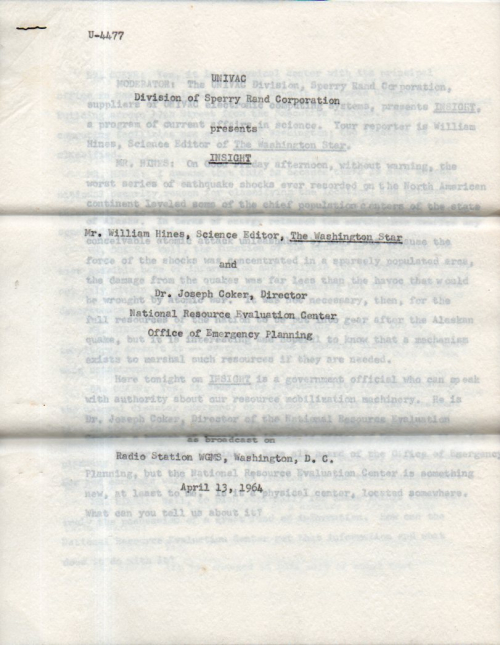
    This title may sound overly dramatic, but it really isn’t. As part of the Mutually Assured Destruction game plan there was an absolute necessity for calculating the leftovers from a nuclear exchange in order to convince the aggressor nation (which of course in 1964 would be the Soviet Union) that in spite of massive destruction the U.S. would be situated to carry out acting as a government/society/military in the post-war world. Part of figuring all of that out would entail a massive amount of bean counting for personnel, materiel, natural resources, and so on in a nearly endless list of stuff that runs the U.S., and then figuring out where it all was, and how it would/could be affected by a nuclear strike at XX locations, and that with different yields, and weather patterns, and so on, on into the night, of how a nuclear attack of x-capacity would affect the tactical and strategic and social base of the U.S.  So you’d have to gather all of that data, and then lay it all on in XX scenarios that would all be played out in computer simulations.  

    And that is what this interview is all about–explained on the radio to a general listening audience by Joseph Coker, who was at the time chief of the NREC (the National Resource Evaluation Center). All of this made its own crazy sense, and all of it had to be done, running both towards and away from the black hole that did and didn’t exist.  

    UNIVAC Coker544


  • A Paper Internet, 1917 (and 1932, and 1945)

    JF Ptak Science Books

    Paper internet466

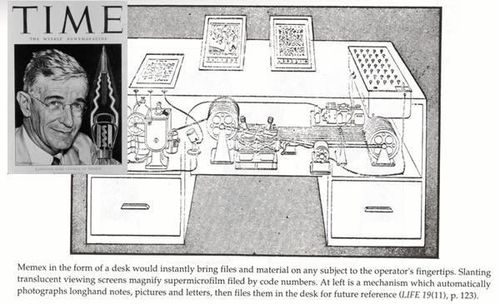
    Before the internet the idea to the idea of the internet existed to some extent in the head of a great unsung hero of the U.S. WWII figure, Vannevar Bush, a person who may well have invented the notion of hypertext.  Vannevar (pronounced “van ee var”) was a flinty no-nonsense New Englander who was an organizational and mechanical genius who as a professor at MIT developed a remarkable analog computer that greatly advance computation capacities for solving differential equations.  This was in the 1930’s, and even after creating an improved electromechanical version of the machine still chose the wrong way to go in the soon-to-materialize digital computer revolution. During WWII Bush was one of the most important Americans in the war effort, overseeing the entire scientific effort of the U.S.—an enormous effort dispatched beautifully (and successfully).  His importance in this regard is difficult to overstate. He also published a short paper on the hypertext idea in an article in The Atlantic in 1945.

     The article, “As We May Think”, outlined his idea for a device he called the MEMEX (“memory” and  “index”), which compressed and organized all that its user could remember and whatever information would be obtained in the future via electromechanical apparatuses, and available with associative tracking between the microtext frames.  So all manner of book and papers and reports and newspapers and images would be microphotographed and stored in a beautifully-indexed mechanical retrieval system where it would live with the information of others.  There was also the possibility of real-time textual additions to whatever it was that was retrieved, the genetic precursor of hypertext.  Bush’s thinking has been deeply recognized (and also by the creators of the internet) as the intellectual grandparent of the modern internet. 

    Bush internet

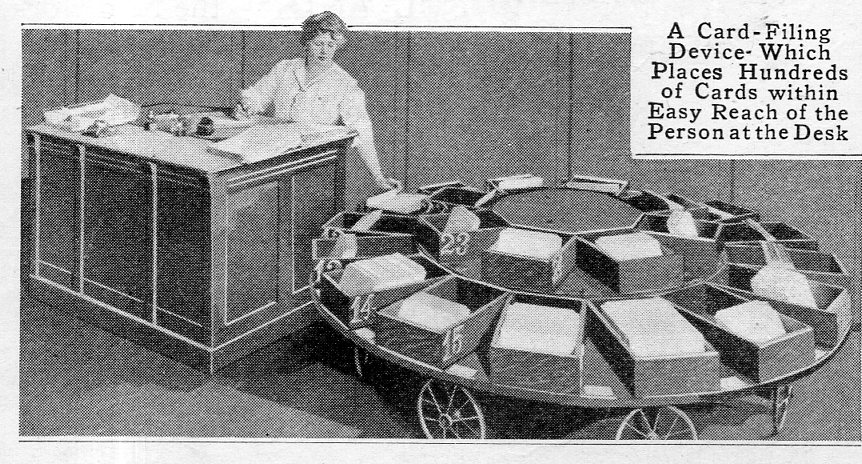
    This brings me to the image leading this note–the index card train. It appears in the pages of Popular Mechanics for January 1917, and was certainly a step forward in organizing finger-tip data–it just wasn’t quite a database, or Google, though the idea was present, after a fashion. 

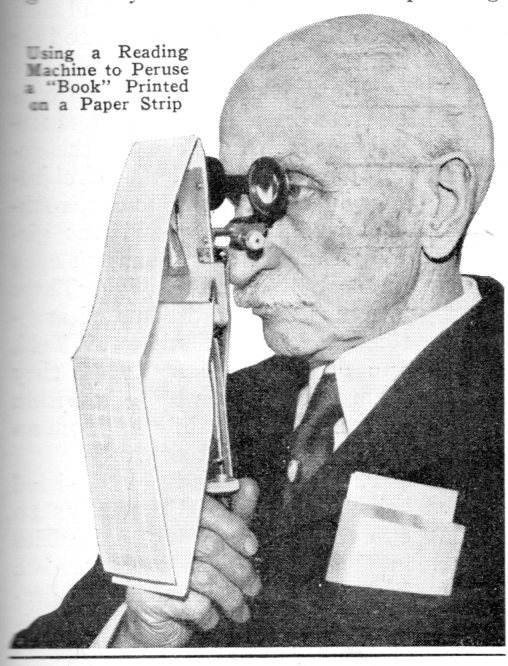
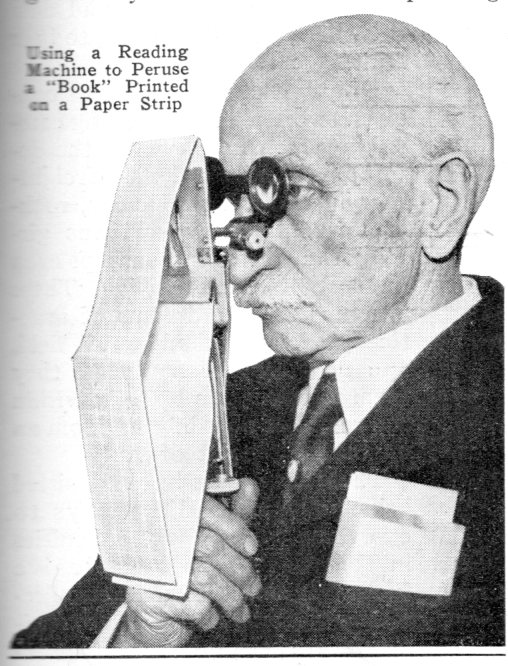
    And then I had a mostly-comical response to the image that I found in the pages of the March 1932 issue of Popular Mechanics–it was actually on the back of the page that I was looking for (on passenger rocket travel across the Atlantic).  With Bush in mind, this image of a man reading a miniaturized book using the system of Rear Admiral Bradley A. Fiske (1854-1942), and the photo shows the reader with the equivalent of a 100,000-word novel.  The article only mentions this one book, and doesn’t venture out into imagining anyone carrying a library with them, nor does it mention searches of organizing systems, but it does bring to bear the possible power of having access to a vast amount of info held on a strip of paper about the size of a newspaper column.  And for 1932, that was a strong idea.


    Paper interrnet145


  • A Fine, Hand-Held Adding Machine, 1869

    JF Ptak Science Books  Quick Post

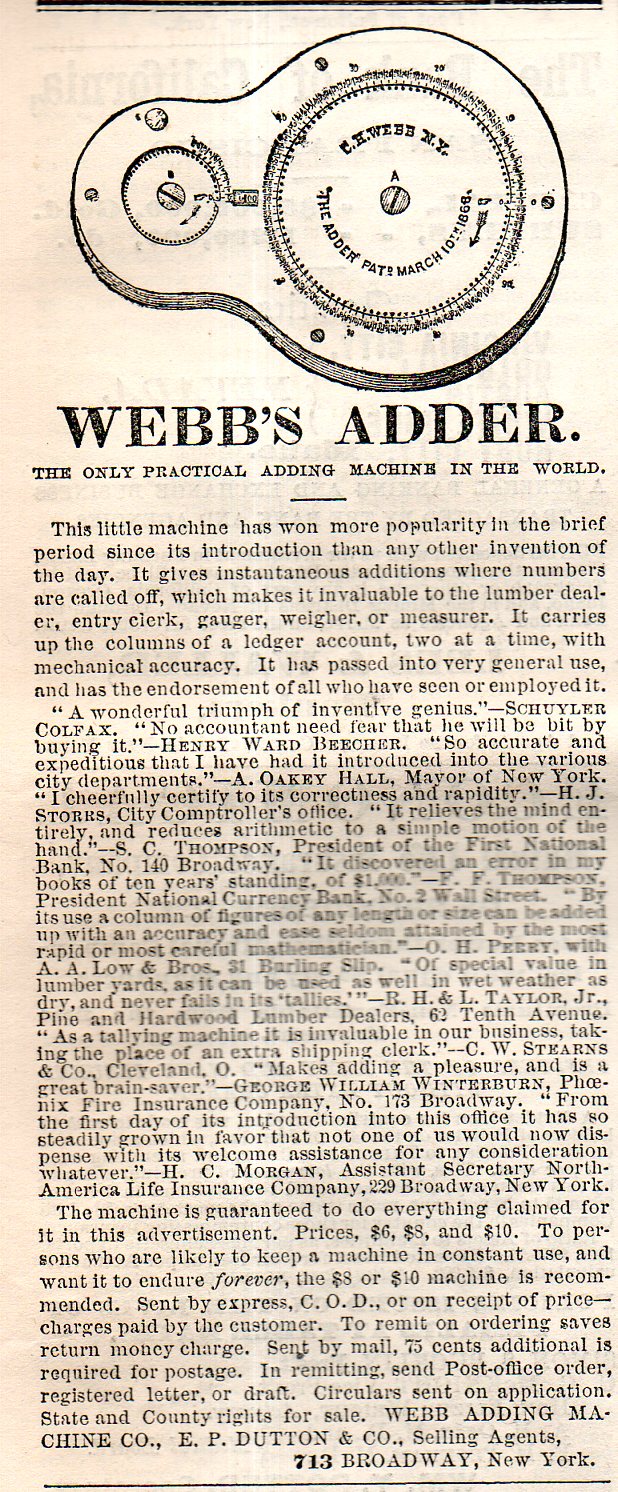
    I found this wonderful ad in the July, 1869 issue of American Agriculturalist--in real life the woodcut is about 1.5″x 4″ and was designed well enough to attract the attention of a practicing farmer needing arithmetical help. It was an intelligent design and speaks well of the readership. The adder–patented just a year earlier by Charles Henry Webb (1834-1905)–would have a long life in various incarnations, a history of which can be found in this excellent article at History-Computer.com (http://history-computer.com/CalculatingTools/Gadgets/Webb.html)

    Webb adder 1869465


  • What Computers Cost, 1959

    JF Ptak Science Books  

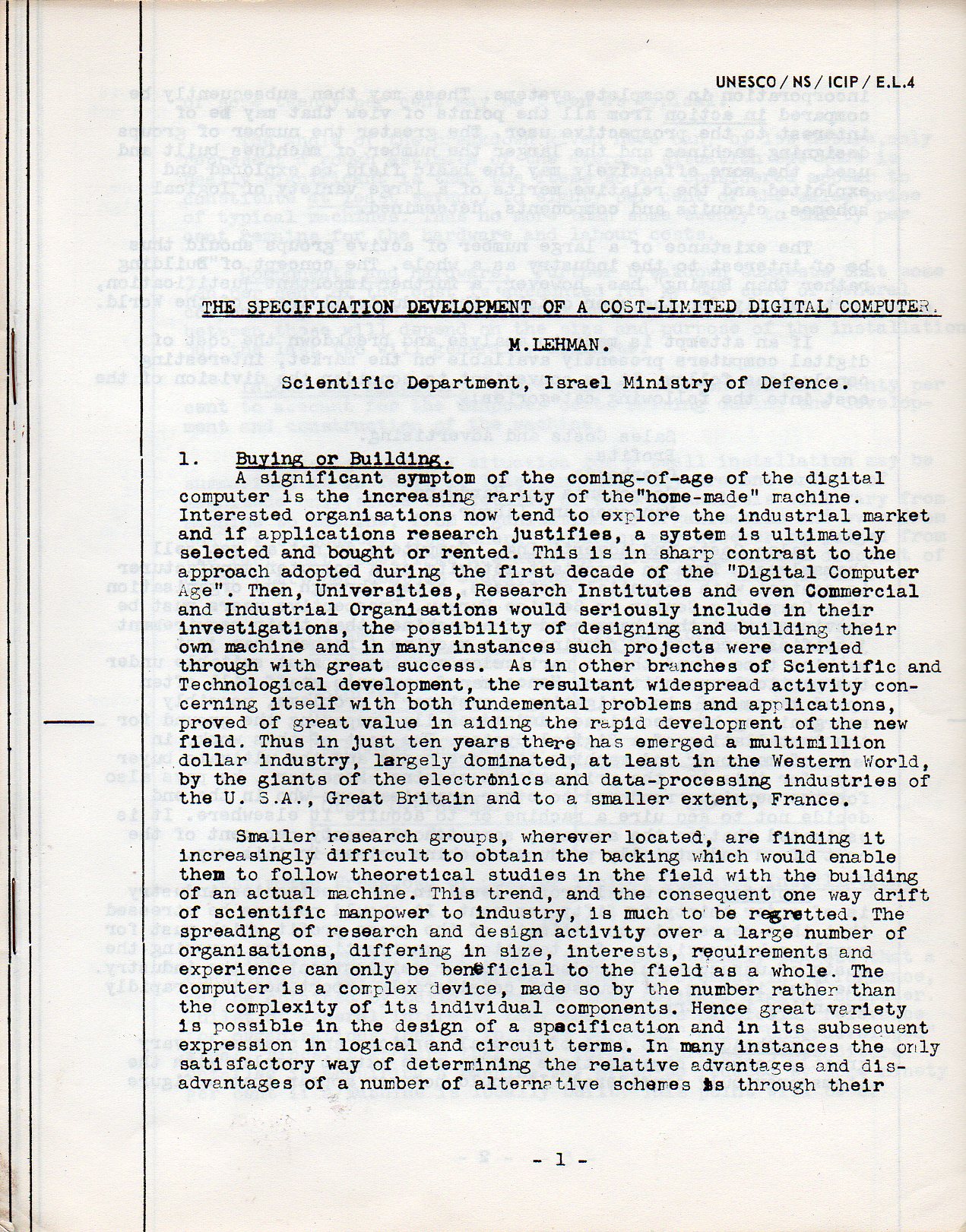
    “Computers do not as yet sell themselves.”–Lehman, 1959

    Computer--lehman223Question:  what had 1000 transistors, 5000 diodes, 2000 resistors and 1000 capacitors, a team of ten and took 18 months to build?  

    Answer: an inexpensive, $12,000 digital computer in 1959.  

    Mind you this is legions better than what was happening in the mid-1940’s, with teams of hundreds and costs in the many millions, and much better than in the early 1950’s, when these numbers were of an order of magnitude greater.

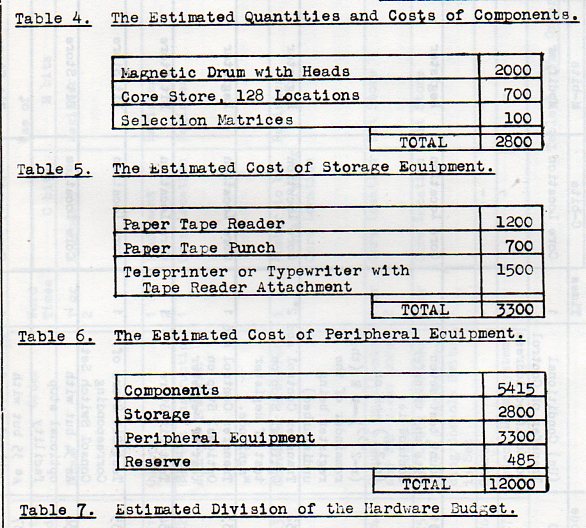
    It seems to me that this short 1959 paper is at the upper end of a beginning concern–costing-out the price of a digital computer for second-tier interests.  “The Specification Development of a Cost-Limited Digital Computer” (by M. Lehman of the Israeli Ministry of Defense) was written for those businesses and schools with a definite low-end budget, the upper range of which was set by Lehman at $12,000 for “peripherals, hardware and programming  (or about $125,000 in 2016 dollars, sort of). This figure was also exclusive of maintenance outside of the cost (at 15-20% of the construction costs overall) of designing and building the machine.

    This was some new thinking on providing lower-cost digital computers to a new market:  “in just ten years there has emerged a multimillion dollar industry largely dominated….by the giants of the electronics and data-processing industries…”.  Lehman was saying that there was a new opportunity for business to supply computers to “smaller research groups” who were “finding it increasingly difficult to obtain the backing which would enable them…to build an actual machine”.  There were other ways of doing it, and Lehman laid out the basic understanding of that procedure.  

    Lehman’s leading quote for this post was accurate–computers needed to be “sold”, as in salesmen and businesses actively engaged in contacting clients who would (“might”) benefit from having computeriaed part of their business. The computer manufacturer’s “staff will often spend many months investigating customer’s problems, possibly reorganizing his techniques and generally preparing teh ground for the installation of a Digital System…”

      Computer--lehman224

    (The figures in the right column are dollars.)

    Lehman was doing some groundbreaking work here at the end of the ’50’s, still far ahead of the time–and probably a full generation–where computers didn’t necessarily have to be shown as being ‘needed” let alone
    “necessary”.  The computer would be “selling itself” on the low-end of the market soon enough, but really not until the Reagan years when it was beyond question that the computer could be used by virtually any person or business–at affordable rates.  

    ·Posted by :

    ·in:


  • A Paper Internet of 1932

    JF Ptak Science Books   Post 2605 

    Paper interrnet145Before the internet the idea to the idea of the internet existed to some extent in the head of a great unsung hero of the U.S. WWII figure, Vannevar Bush, a person who may well have invented the notion of hypertext.  Vannevar (pronounced “van ee var”) was a flinty no-nonsense New Englander who was an organizational and mechanical genius who as a professor at MIT developed a remarkable analog computer that greatly advance computation capacities for solving differential equations.  This was in the 1930’s, and even after creating an improved electromechanical version of the machine still chose the wrong way to go in the soon-to-materialize digital computer revolution. During WWII Bush was one of the most important Americans in the war effort, overseeing the entire scientific effort of the U.S.—an enormous effort dispatched beautifully (and successfully).  His importance in this regard is difficult to overstate. He also published a short paper on the hypertext idea in an article in The Atlantic in 1945.

     The article, “As We May Think”, outlined his idea for a device he called the MEMEX (“memory” and  “index”), which compressed and organized all that its user could remember and whatever information would be obtained in the future via electromechanical apparatuses, and available with associative tracking between the microtext frames.  So all manner of book and papers and reports and newspapers and images would be microphotographed and stored in a beautifully-indexed mechanical retrieval system where it would live with the information of others.  There was also the possibility of real-time textual additions to whatever it was that was retrieved, the genetic precursor of hypertext.  Bush’s thinking has been deeply recognized (and also by the creators of the internet) as the intellectual grandparent of the modern internet. 

    And so I had a mostly-comical response to the image that I found (left) in the pages of the March 1932 issue of Popular Mechanics–it was actually on the back of the page that I was looking for (on passenger rocket travel across the Atlantic).  With Bush in mind, this image of a man reading a miniaturized book using the system of Rear Admiral Bradley A. Fiske (1854-1942), and the photo shows the reader with the equivalent of a 100,000-word novel.  The article only mentions this one book, and doesn’t venture out into imagining anyone carrying a library with them, nor does it mention searches of organizing systems, but it does bring to bear the possible power of having access to a vast amount of info held on a strip of paper about the size of a newspaper column.  And for 1932, that was a strong idea.  


  • The Big Stuff–Heavy Numbers, 1939

    JF Ptak Science Books   Quick Post

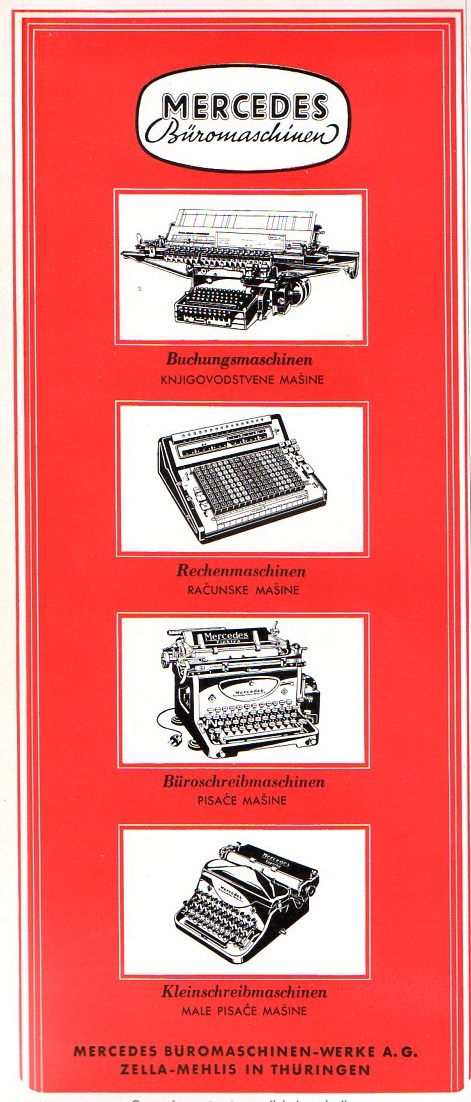
    Mercedes-Buromaschinen* evidently came into existence in 1906 in Berlin before moving on to other cities, including expanding into Zagreb and Beograb, Yugoslavia, which published this ad. It was big and red and covered a half-page in the Illustrirte Zeitung (Leipzig), where it appeared in print two months before the invasion of Poland in 1939. I I just wanted to share its redness, and of course the massive accounting machine listed first in the ad.  

    Burroughs machine021

    *Initially I thought that this was a generic/export name for Burroughs Adding Machines, but I was wrong. Reader Frank Wilhoit (thanks!) pointed out that the “bur” part of “buromaschinen” is simply the word “office”–so, office machines. Now that I look at it the accounting machine doesn’t look like the Burroughs machine as I thought it did–ditto for the calculator.


  • Troncet’s Arithmographe, the “Instant Calculator” (1892)

    JF Ptak Science Books  Quick Post

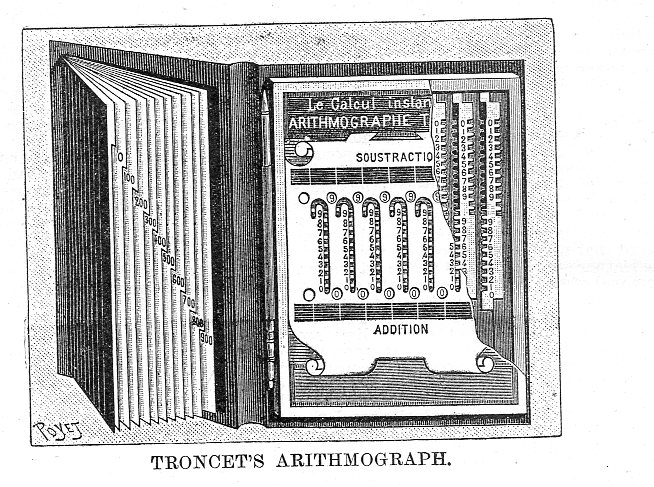
    I came upon a short notice in the Scientific American (January 30, 1892) for Louis-J. Troncet’s ingenious and very popular instant-calculator. It was a small and powerful machine  (10x6cm) that Troncet had patented in 1889, and was issued in a small book-like folding case, with the accordion folding bit containing multiplication tables. It was quick and easy to use, sold for a few dollars, and became a cheap arithmetic staple for decades. 

    Troncet arithmometer430(I’m pretty sure that the image that appeared in Scientific American, above,  was the one used in the article by G. Mareschal, “Calculateur mecanique instante,”  in La Nature,  in 1890 (pp. 307-308).

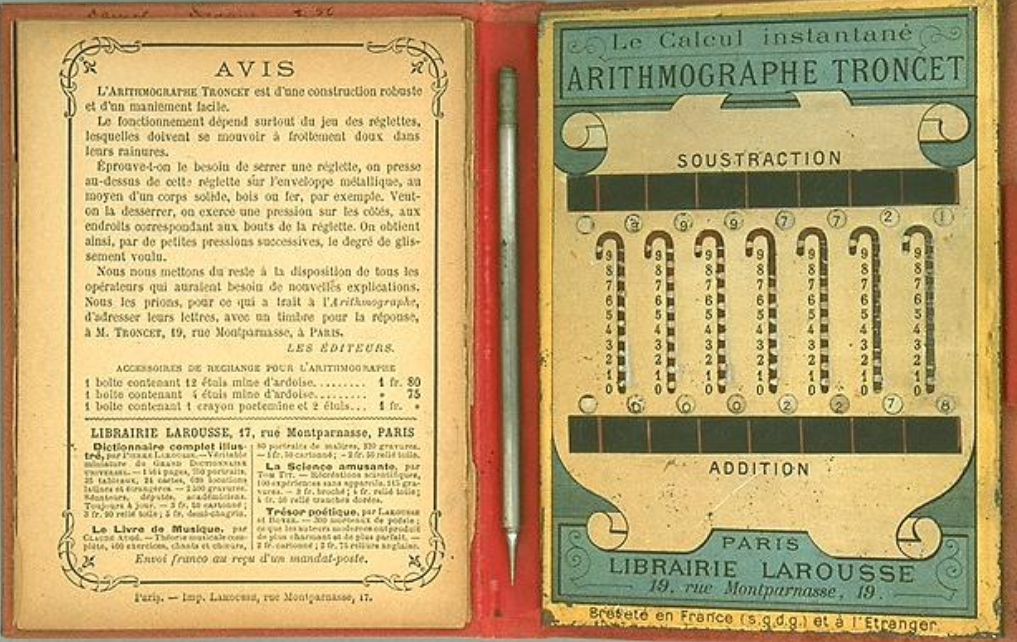
    Here’s a color image of the Troncet at the National Museum of American History:

    Troncet in color two

    [Source: http://americanhistory.si.edu/collections/search/object/nmah_690248  For another visit with the Troncet see the History of Computers site  http://history-computer.com/CalculatingTools/Gadgets/Troncet.html]


  • A Beastly and Beautiful Number Cruncher, 1889

    JF Ptak Science Books   Quick Post

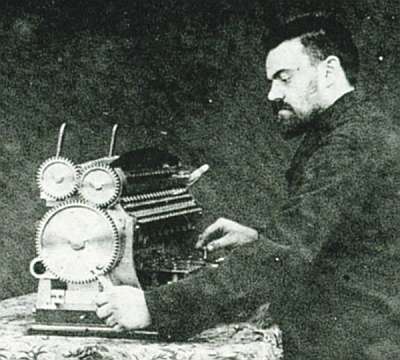
    It was a surprise, finding M. Bollee’s article (“Sur une nouvelle machine a calculer”) in this 1889 Comptes Rendus, peeking around in that big 10-pound volume looking for something else.  It was very easy to miss if you weren’t looking for it, just a few pages long in a 1000-page book.  But there it was, nestled comfortably in pp 737-739.  It these few pages Bollee describes his machine and with particular reference to his innovative approach to direct multipilication–a fine addition (ha!) to the long line of contributions by Babbage and Clement, Scheutz, Wiberg and Grant and Hamann. 

    Bollee

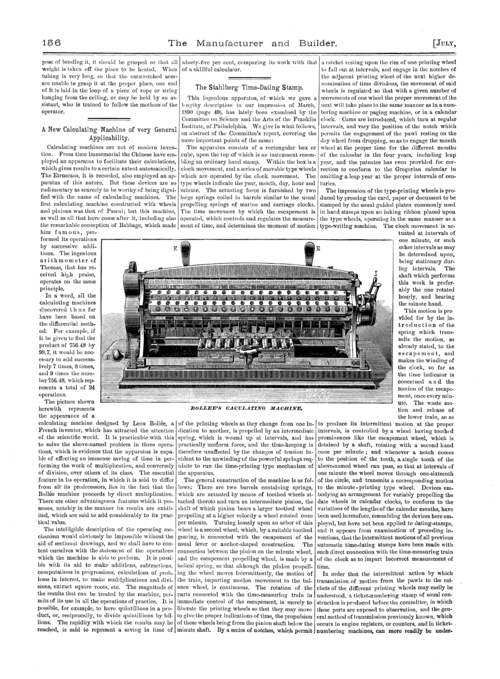
     The article in the Comptes Rendus is not illustrated, though I did find an image of the machine in The Manufacturer and Builder:

    Bollee


  • A Lot of Computer Data on One Sheet of Paper (1956)

    JF Ptak Science Books   

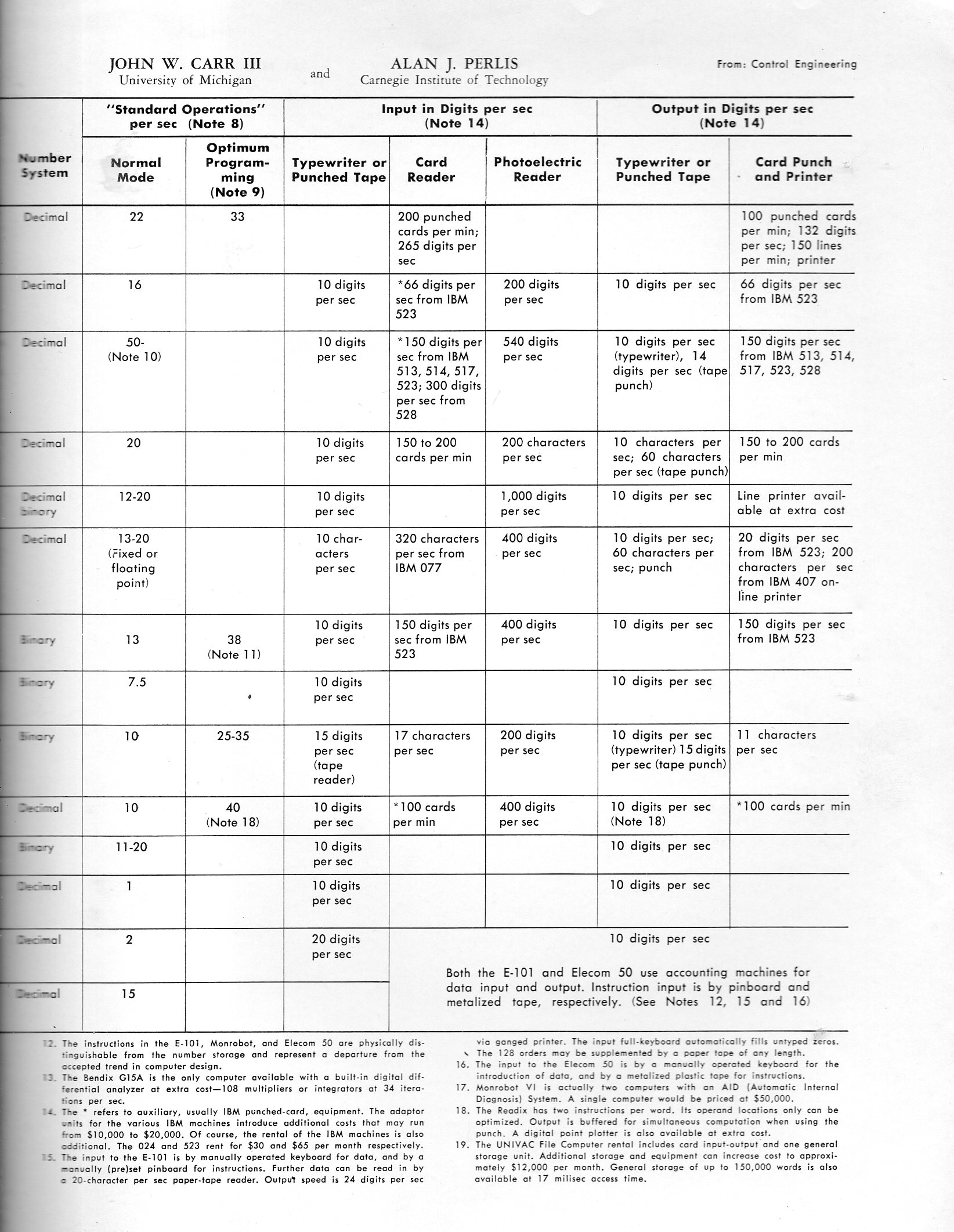
    A.J. Perlis’ and John Carrs’  “Characteristics of the Small-Scale Computers” looked innocent enough, 12″ tall and one folded piece of paper, and published in 1956, but there was a lot more to the simple publication than you’d expect from something so modest. The authors–John W. Carr III and Alan J. Perlis–were heavy hitters, and so I really wasn’t very surprised to see what they had done “inside”, though I was impressed and happy to see the data. Displayed on the 12×16″ sheet of paper are 15 data points on 14 computers, many of them classic/famous:  the 650 IBM, UNIVAC, Elecom, Alawac.  (Remember that when you’re looking at purchase price and monthly rental amounts that the 1956 dollar is equal to about $8.70 in 2015 dollars, so that $3275/month for the 650 would be about $30k.  The $136k for the Datatron is about a million today.)   

    Perlis795


    ·Posted by :

    ·in: