A Daily History of Holes, Dots, Lines, Science, History, Math, Physics, Art, the Unintentional Absurd, Architecture, Maps, Data Visualization, Blank and Missing Things, and so on. |1.6 million words, 7500 images, 4.9 million hits| Press & appearances in The Times, Le Figaro, Mensa, The Economist, The Guardian, Discovery News, Slate, Le Monde, Sci American Blogs, Le Pont, and many other places… 5000+ total posts since 2008.

Category: Computer Tech/History

  • A Lot of Computer Data on One Sheet of Paper (1956)

    JF Ptak Science Books   

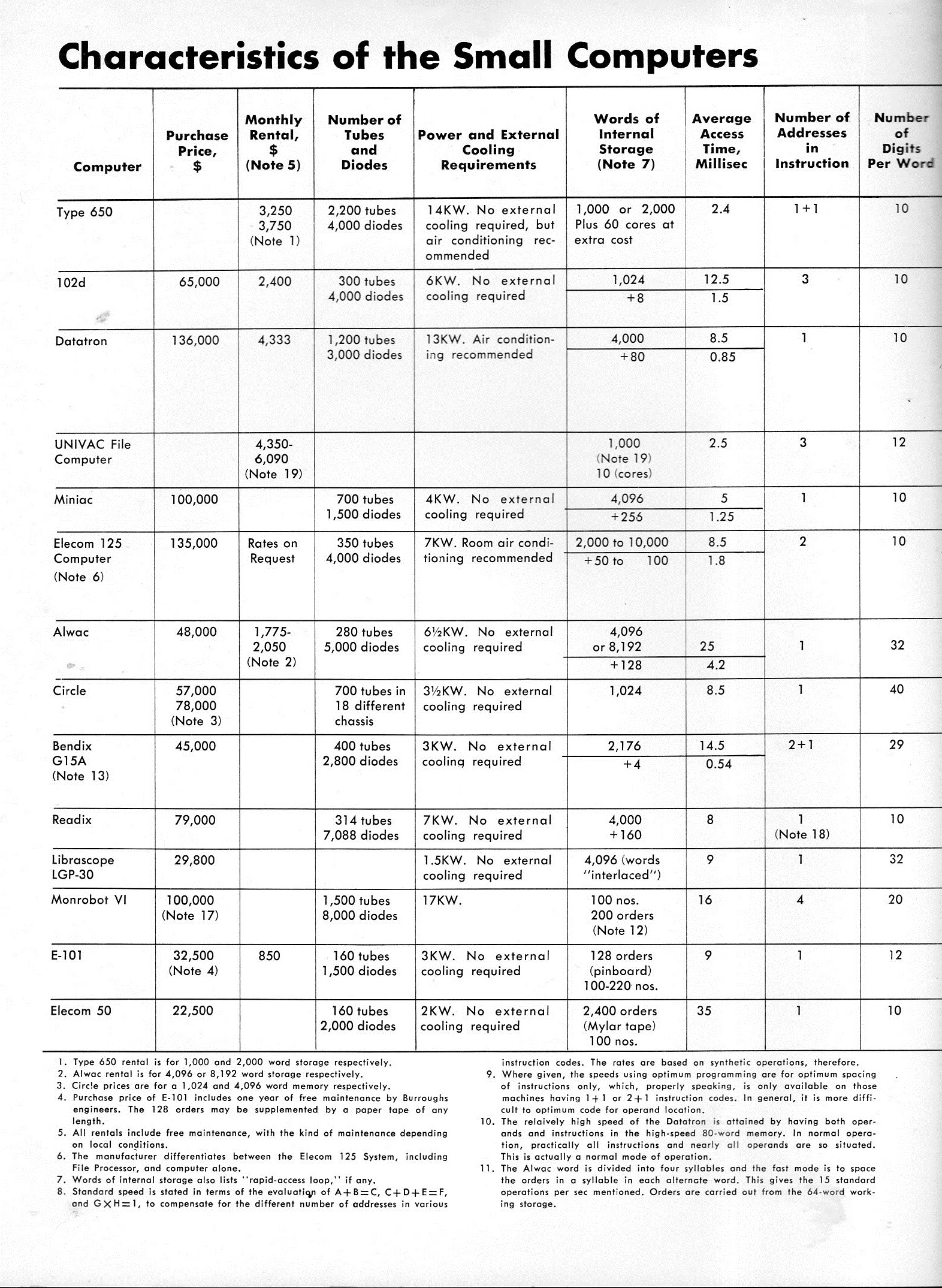
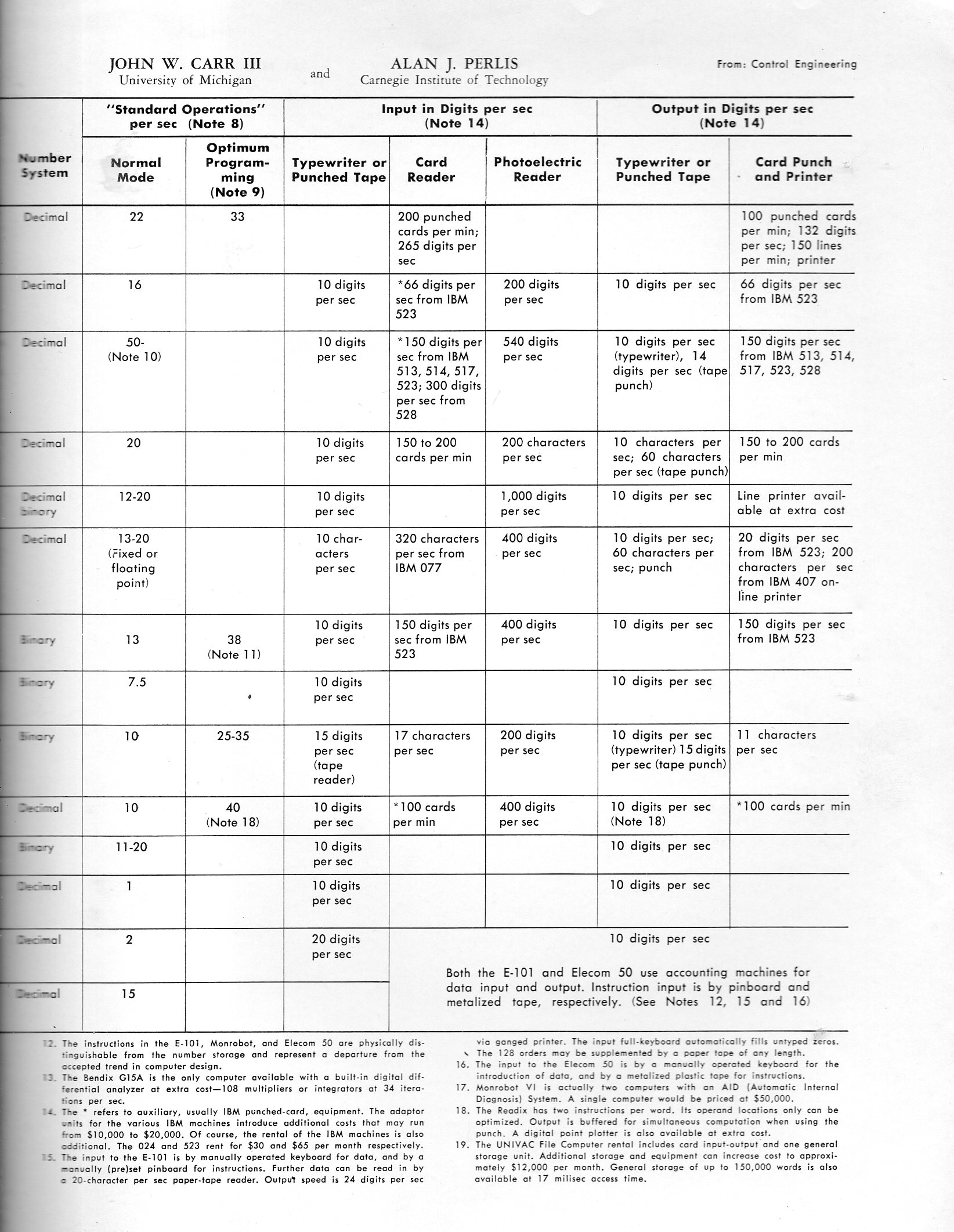
    A.J. Perlis’ and John Carrs’  “Characteristics of the Small-Scale Computers” looked innocent enough, 12″ tall and one folded piece of paper, and published in 1956, but there was a lot more to the simple publication than you’d expect from something so modest. The authors–John W. Carr III and Alan J. Perlis–were heavy hitters, and so I really wasn’t very surprised to see what they had done “inside”, though I was impressed and happy to see the data. Displayed on the 12×16″ sheet of paper are 15 data points on 14 computers, many of them classic/famous:  the 650 IBM, UNIVAC, Elecom, Alawac.  (Remember that when you’re looking at purchase price and monthly rental amounts that the 1956 dollar is equal to about $8.70 in 2015 dollars, so that $3275/month for the 650 would be about $30k.  The $136k for the Datatron is about a million today.)   

    Perlis795


    ·Posted by :

    ·in:


  • The Big Push-Button of the Future: a Vision from 1945

    JF Ptak Science Books  Quick Post

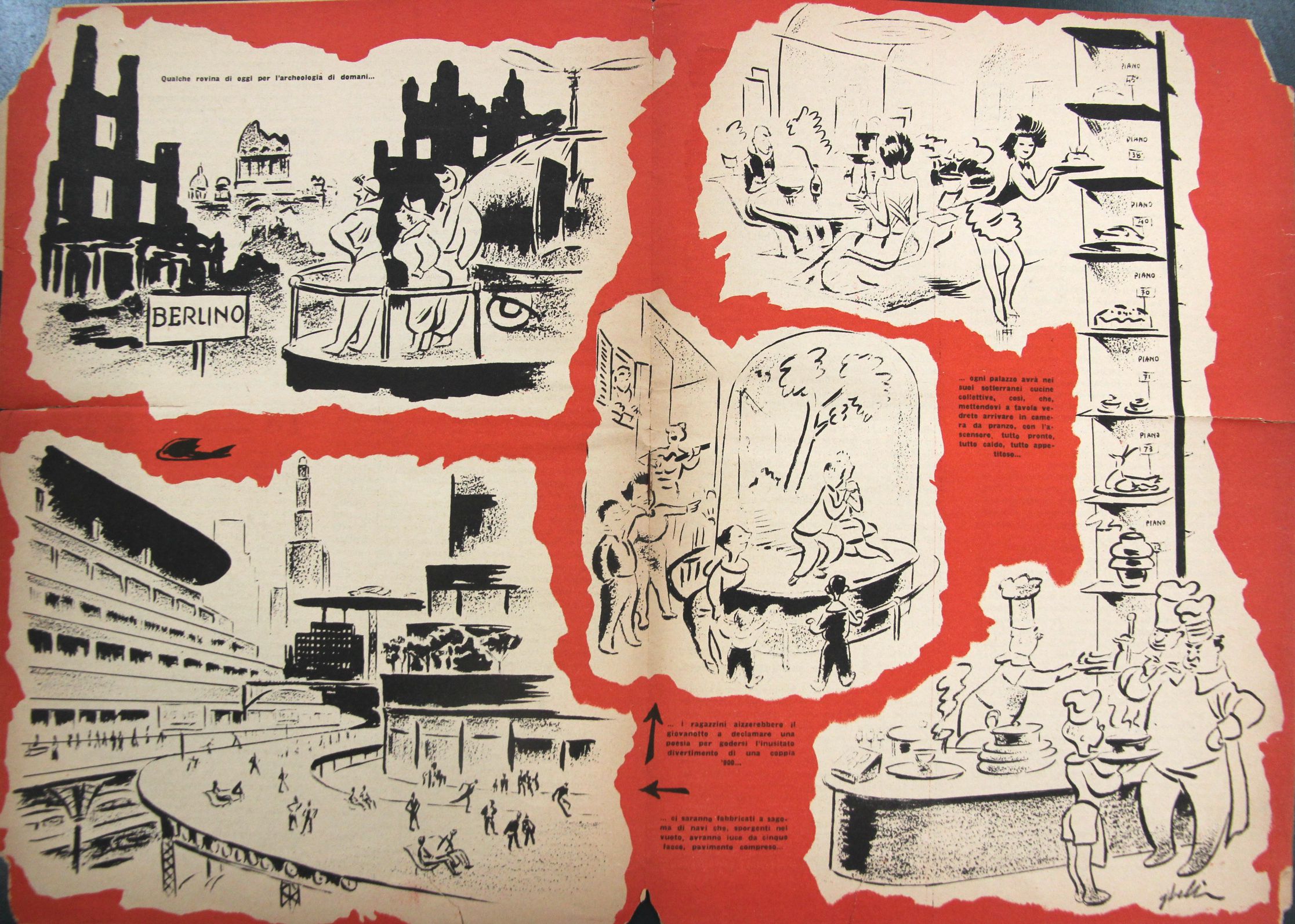
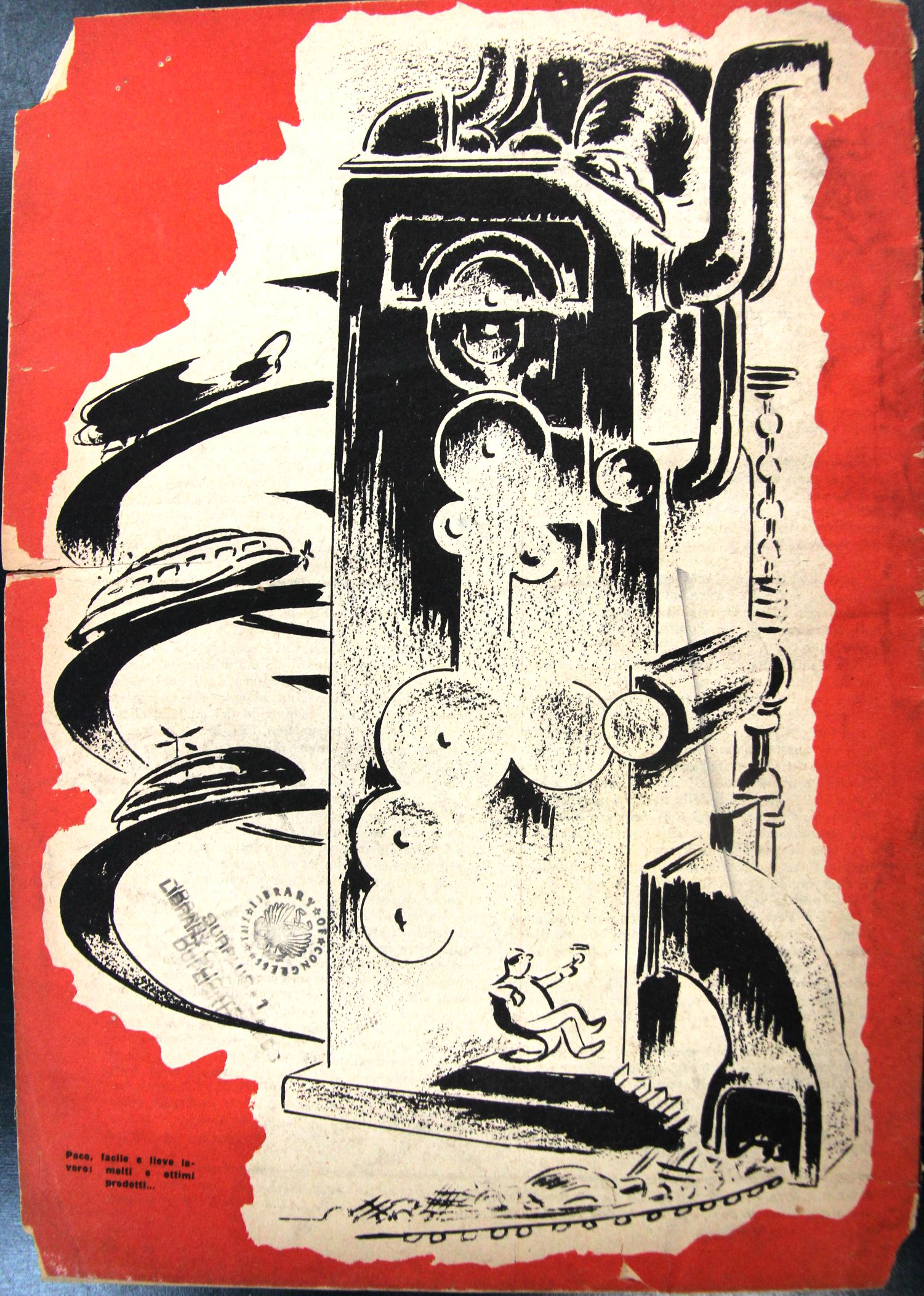
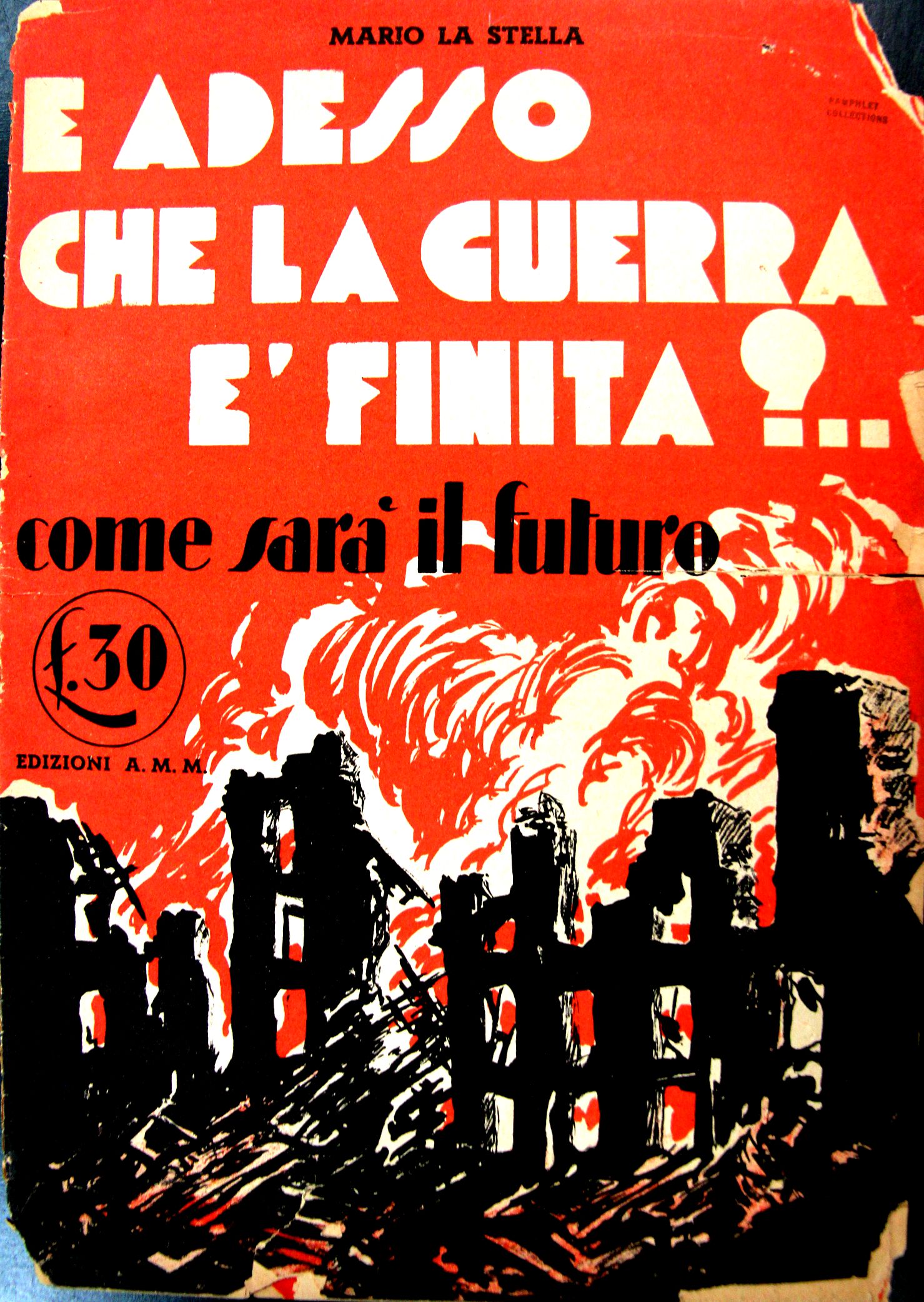
    I found this curious publication the other day, one that takes a look at the near future at the end of WWII. It is by Mario la Stella (“And Now that the War is Finished? What Will the Future Be?”), and unfortunately there is no date in the pamphlet, and I cannot find a listing of the work in WorldCat/First Search, and there are no clues for me about dating it, though I suspect it could have been published as early as 1944 (as Italy was finished with the war by 1943 but the Germans were not finished with them) but probably it the real date was 1945.  That said, the most interesting part of this work is the design in the illustrations, which in their breezy and suggestive way remind me of a style in the 1950’s rather than the 40’s–with the exception of the cover, that is, because there is nothing light and airy about that.  

    Future Italian b

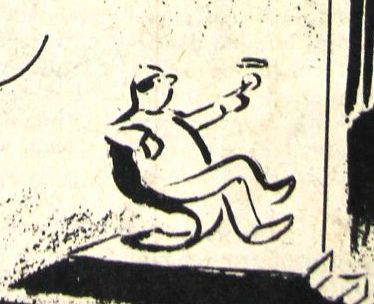
     The future vision of la Stella is not very penetrating, though the final panel does display a huge machine regulating traffic or something that is controlled by a lounging operator with just one button.  

    I think it would be an interesting thing to have a look at “The One-Button1 Solution to Everything” following the development of the ultimate state of the push-button world, where most things/everything is automated.

    Future Italian C detail

    And just a note here: la Stella was the author of several books, including a history of Rome, and a textbook or two in the sciences. There was also a work on Marconi (published in the year of the inventor’s death in 1937) that contains a very early public reference to Marconi’s possible work on the “death ray”, which sounds like it was some sort of directed energy weapon/EMP device that would disable powered vehicles

    Future italian

    Future Italian c

    Notes:

    The OED definitions of “push button” follows: 


  • The World’s First Journal Devoted to the Computer

    JF Ptak Science Books   Quick Post

    I was grazing in the warehouse and came upon this terrific volume: Mathematical Tables and Aids to Computation (volume 1&2, 1943-1947). It is the collection of the first two volumes of the world’s first journal devoted to the computer, with a big gap in publication caused of course by WWII. There are a number of gems in the 900-odd pages in this volume, including the following papers. (Note that all of the below and more are readable online from Utah at of the MTAC, here.)

    • G. R. Stibitz “Should Automatic Computers be Large or Small?”
    • 3 tight pages on the first appearance in English on the Zuse Z4 computer (1947, “This may be the earliest published description of Zuse’s early computers available to post-World-War-II researchers outside of Germany and Switzerland. See \cite{Ceruzzi:1981:ECK} in an histcomput.bib for many more details)”, 
    • J. H. Curtiss “A Symposium of Large Scale Digital Calculating Machinery” (April 1947), 
    • G. R. Stibitz “Film Slide Rule” (October 1947), 
    •  L. J. C(omrie), “The Application of Commercial Calculating Machines to Scientific Computing” (April 1946), 
    • H. H. Goldstine and Adele Goldstine “The Electronic Numerical Integrator and Computer (ENIAC)” (July 1946), 
    • R. C. A(rchibald) “Conference on Advanced Computation Techniques” (April 1946), 
    • W. G. Bickley and N. W. McLachlan “Mathieu functions of integral order and their tabulation” (January 1946),  
    • W. J. Eckert “Mathematical Tables on Punched Cards” (October 1945), 
    • J. S. Frame “Machines for solving algebraic equations” (January 1945),

    and more. See math.utah.edu for a very full and link-filled list of the papers.

    • The volume is available for purchase int he blog’s bookstore, here.  


    ·Posted by :

    ·in:


  • Trying to Find the First Computers in Comic Books

    JF Ptak Science Books   Post 2460

    Fresh from the fields of a near-victory in trying to find the first time concentration camps were mentioned in a U.S. comic book (the story quickly told yesterday, here), today the question is about the first mention of a computer. This is a little more tricky, since “computer” can mean a lot of things, including mechanical beings. And with an open-ended definition of the word, I think that you could trace the elements of a computer all the way back to Jonathan Swift’s thinking engine/machine1, which for 1726 makes it about the earliest of such imagined inventions. (See here for a post on Swift and Lull.)
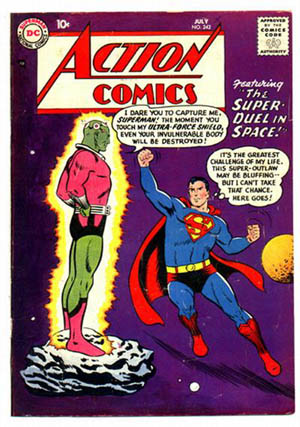
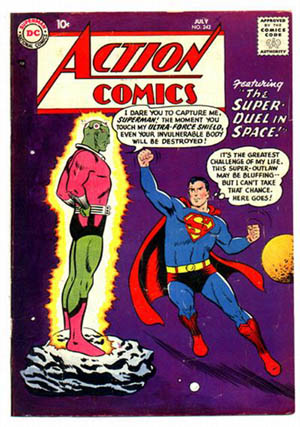
    Brainiac[Image source:  comics.org]

    A while ago I wrote a post here on an alphabet of names of fictional computers, though none of those machines appeared in a comic book.  I did check a few likely sources, including the massive comic.org site, looking for early-ish mentions of “UNIVAC” and “ENIAC” and of course “computer”. Offhand there aren’t many hits before 1960, with nothing at all for ENIAC and a 1955 mention of UNIVAC ( “Scarecrow, the Human UNIVAC”,  appearing in Little Wise Guys, October 1955)  and again  in 1955 (in Daredevil Comics, #125) some five years after the UNIVAC was installed at the Department of the Census.  There is a mention of a s “super-brain” in a 12pp story in September/October 1949 issue of Superman, but I have no artwork for that. 

    With such slim pickings any portmanteau will do in a storm, and in this case it is “Brainiac” (ENIAC+maniac?), which was an alien computer/cyborg and Superman’s chief arch-enemy, finding first light in July 1958 Superman.  

    There are a few scattered references that I can find that comes close, but they also feel a little late to the computer part. For example, the near-UNIVAC “ULITVAC is Loose!” appears in “Challenges of the Unknown”, Showcase Comics #7, March-April 1957. ( “Synopsis:Felix Hesse, a German scientist, comes pleading to the Challengers to save him from Ultivac, “a creature of my own making… but now out of control!” He explains. Interned as a war criminal, he met Floyd Barker, a bank robber. Released, they team to build a giant machine – Suddenly a giant robot hand crashes through the window and seizes Hesse. Spouting propellers, it flies off with Hesse. The Challengers have their next job, “Track down ULTIVAC!”–comics.org)

    One thing is for certain, though–the first all computer-generated artwork for a comic book appeared in the series Shatter, which ran from 1985-1988, which is an altogether different sort of comic book computer “first”.

    I’ve started a list of early appearances in U.S. comic books of odd parts of the components of the computer culture, including computer crime, dating, and other bits:

    “Computer crooks”, 1965: “

    • Challenge of the Computer-Crooks!” (The Atom) / Gardner Fox, story ; Gil Kane and Sid Greene, art. 13 p. in The Atom, no. 20 (Sept. 1965)

    Computer Dating, 1975:

    • “Sexy Computer Dating” by Bob Mende ; art, Don Orehek. p. 24-25 in Best Cartoons from the Editors of Male & Stag, v. 6, no. 2 (Feb. 1975).
    --which I guess should be accompanied by:
    • “I Think It’s For Real This Time. He Even Told Me His Computer Password” (Windows on Work, Oct. 25, 1993) / Carol Simpsmo. — “Romance on the Information Highway.”
    Rodney Dangerfield moments, 1975:
    • “Only the Computer Shows Me Any Respect!” (Killraven) 18 p. in Amazing Adventures, 32 (Sept. 1975)
    Crazy Computers, 1974:
    • “The Computer that Went Bananas” in The Flinstones, / story by Horace J. Elias. — Ottenheimer, 1974.
    Computer Wars, 1980:
    • “CPU Wars”, created, produced, directed & finally scrawled by Chas Andres. — Westford, MA : Chthon Press, 1980.
    --All data of the above list is derived  from the fantastic database created at Michigan State University, http://comics.lib.msu.edu/rri/crri/compo.htm#end

    Computers and Pigs, 1959
    • Porky Pig Sept-October 1959 #66. (“Synopsis: Porky eats a lot of fish as “brain food” before taking an intelligence test. The electronic brain gives him a score of 301, a super genius. But there’s a catch…”–comics.org

    My general impression thus far is that the computer in comic books  before 1955 seems to be nowhere near the interest rate of computers in speculative fiction, which is interesting.  

    Notes:

    1. Swift describes the machine so:  “… Every one knew how laborious the usual method is of attaining to arts and sciences; whereas, by his contrivance, the most ignorant person, at a reasonable charge, and with a little bodily labour, might write books in philosophy, poetry, politics, laws, mathematics, and theology, without the least assistance from genius or study.” He then led me to the frame, about the sides, whereof all his pupils stood in ranks. It was twenty feet square, placed in the middle of the room. The superfices was composed of several bits of wood, about the bigness of a die, but some larger than others. They were all linked together by slender wires. These bits of wood were covered, on every square, with paper pasted on them; and on these papers were written all the words of their language, in their several moods, tenses, and declensions; but without any order. The professor then desired me “to observe; for he was going to set his engine at work.” The pupils, at his command, took each of them hold of an iron handle, whereof there were forty fixed round the edges of the frame; and giving them a sudden turn, the whole disposition of the words was entirely changed. He then commanded six-and-thirty of the lads, to read the several lines softly, as they appeared upon the frame; and where they found three or four words together that might make part of a sentence, they dictated to the four remaining boys, who were scribes. This work was repeated three or four times, and at every turn, the engine was so contrived, that the words shifted into new places, as the square bits of wood moved upside down.”
  • 1931 M.I.T. Integraph Calculator

    JF Ptak Science Books   Quick Post

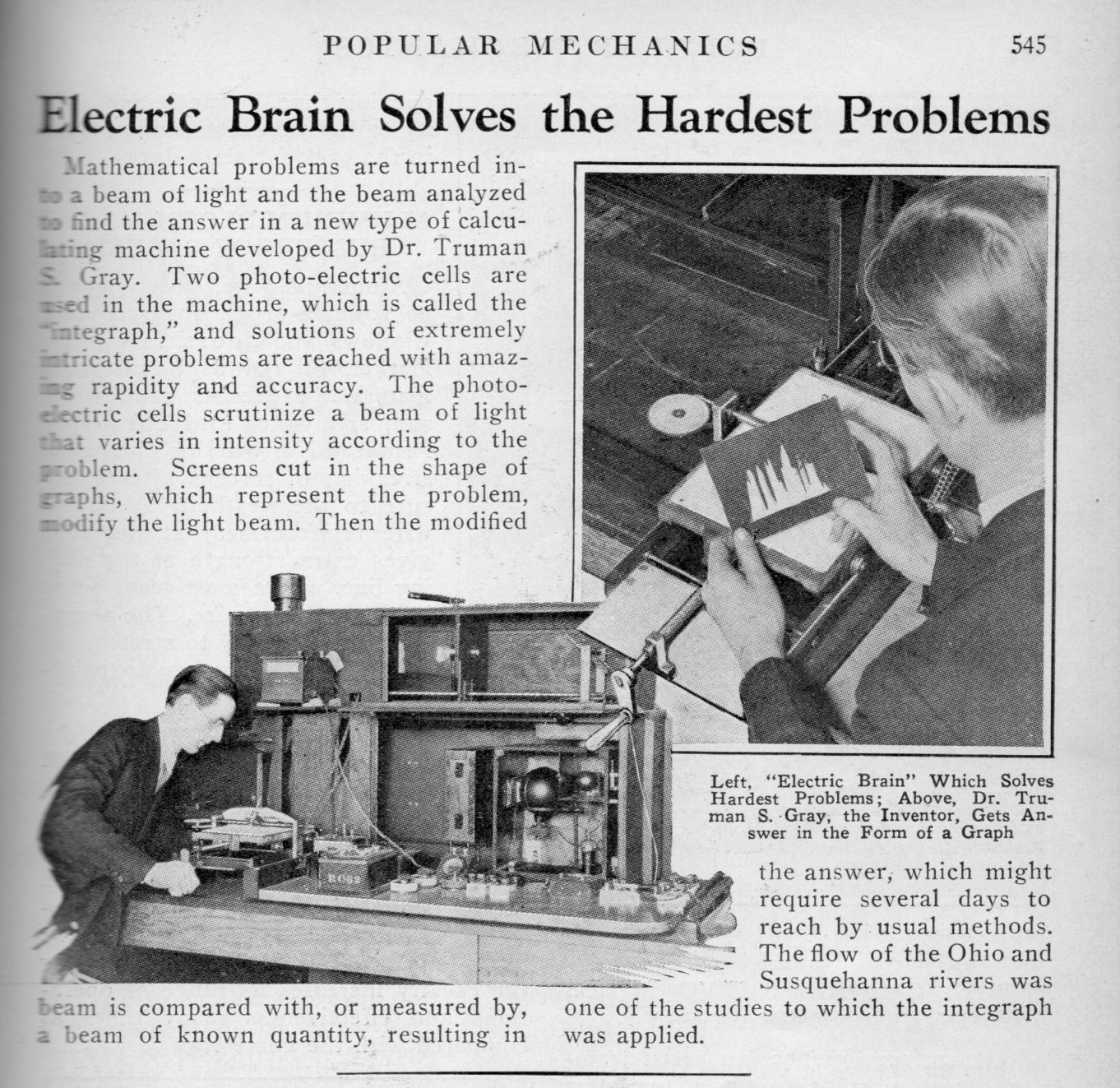
    I’ve looked around quite a bit now and without success about this calculator designed by Thomas Gray–except for this small notice in Popular Mechanics.  “Electric Brain Solves the Hardest Problems” pops up in the September 1931 issue of Popular Mechanics, and is a nice description of the machine:  

    Thomas gray869

    Bush, V. (October 1931). “The differential analyzer. A new machine for solving differential equations”. Journal of the Franklin Institute 212 (4): 447–488

    Notes:

    Thomas S. Gray (1906-1992) “was professor emeritus of engineering electronics at M.I.T… best known for the development in 1931 of the Photo-Electric Integraph, a calculating machine that solved complex mathematical problems in minutes by turning them into rays of light…out of this work came his book “Applied Electronics,” an authoritative text, published by M.I.T. Press in 1954.–New York Times 1992 obituary

    ·Posted by :

    ·in:


  • Chess-Playing Computers and “Mechanized Thinking”, 1950

     JF Ptak Science Books   Quick Post

    ShannonI was reading the great Claude Shannon’s article, “A Chess-Playing Machine”, in the Scientific American issue for February 1950 (volume 182, No. 2, pp 48-52). It is the first popular appearance of Shannon’s technical paper (which would appear a month later in the Philosophical Magazine), and is one of the earliest appearances of an attempt to understand the necessities of a computer for playing a game of chess.

    David Shenk in his wonderful The Import Game: a History of Chess sums up the background to the Shannon very nicely: 

    “Since the mid-1940s, scientists had aimed to create a thinking machine, an apparatus that could compete with or even surpass the human brain in logical operations, pattern recognition, problem solving and even language. Chess was found to be a useful testing ground because of its combination of simple rules and mind-bending complexity… Shannon was fascinated by chess’ potential in the pursuit of what he called ‘mechanized thinking.’ But he became convinced that computer chess and other AI pursuits should not be modeled on human thought… Computers, at least as they were understood then, could calculate very quickly, following programmed instructions. This particular strength—and limitation—of computers suggested a different route for AI, a new sort of quasi-intelligence based on mathematical computation. Chess would be a central proving ground for this new type of intelligence. Theoretically, at least, the game could be fully converted into one long mathematical formula” –Shenk, pp 201, 211

    “The father of the modern chess computer was MIT’s Claude Shannon, a mathematician regarded as the founder of information theory, who in 1950 published a paper called ‘Programming a Computer for Playing Chess. Shannon identified some of the algorithms and techniques that form the backbone of chess programs today.”–Nate Silver, The Signal and the Noise


  • Claude Shannon as the Father of (1) Info Theory or (2) Information Age or (3) Both?

    JF Ptak Science Books  Quick Post

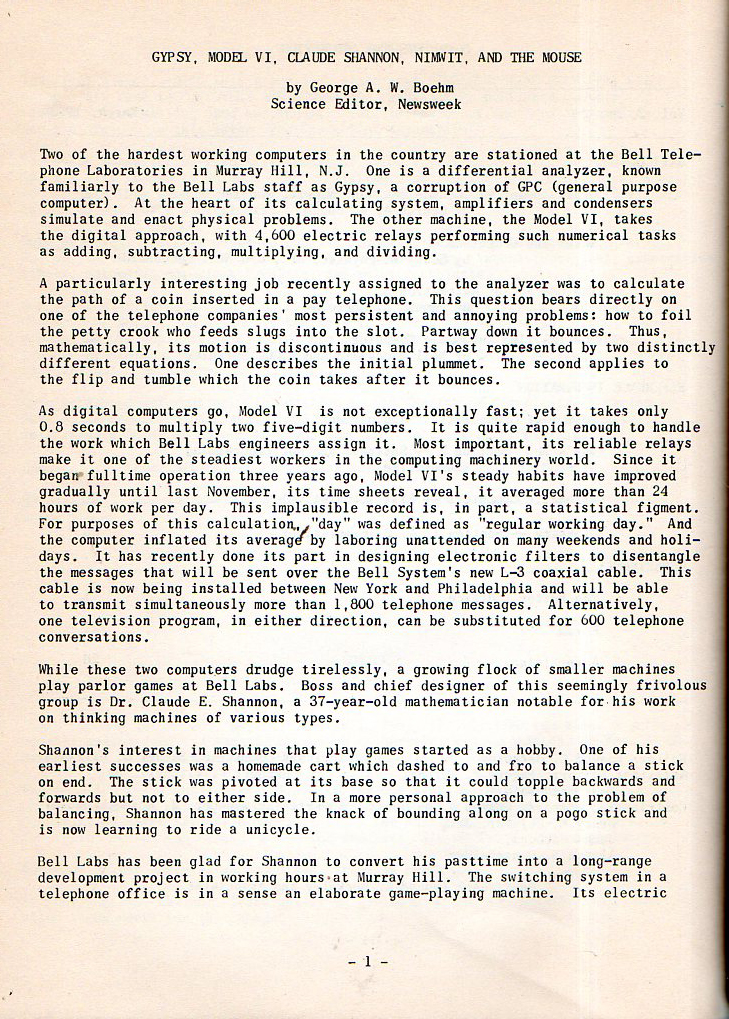
    George Boehm wrote a fine, semi-offhanded paper on Claude Shannon’s inventiveness: “Gypsy, Model VI, Claude Shannon, Nimwit, and the Mouse”, in Computers and Automation, volume 2, number 2, March 1953.  (The article is found on pp 1-4 in the issue of 37pp.) 

    Shannon (1916-2001) is widely seen as being the “father of information theory” though it might be more accurate to refer to him as the “father of the information age”–either title will do just fine.

    Shannon basically established the foundation of the digital circuits in his 1937 A Symbolic Analysis of Relay and Switching Circuits, which was also one of those great dreams-come-true parts of graduate school, when your masters’ thesis is actually something that means something, and with Shannon’s paper that “something” was exponential. It is the stuff of dreams but Shannon actually did it and did so with this paper at the age of 21. In the midst of a brilliant young career he also produced (in 1948, 11 years later) another great landmark effort,  A Mathematical Theory of Communication, which is the pioneering paper on information theory and which was so brilliantly composed that its framework is still in place after 67 years. A year later came Communication Theory of Secrecy Systems, a work which established cryptography as a science more than a system. And on and on. 

    I like that Shannon was born in Petosky, Michigan, up there on the choppy Little Traverse, and all of those big-pebble Petosky fossil/stones.

    This is a very insider-y semi-offhand but solid review of some of the gadgetry and robotic work of Claude Shannon:

    Shannon512


  • Superior Table of Early Computers (1956)

    JF Ptak Science Books  Quick Post

    “Characteristics of the Small-Scale Computers” looked innocent enough, 12″ tall and one folded piece of paper, and published in 1956.  The authors–John W. Carr III and Alan J. Perlis–were heavy hitters, and so I really wasn’t very surprised to see what they had done “inside”, though I was impressed and happy to see the data. Displayed on the 12×16″ sheet of paper are 15 data points on 14 computers, many of them classic/famous:  the 650 IBM, UNIVAC, Elecom, Alawac. 

    (Remember that when you’re looking at purchase price and monthly rental amounts that the 1956 dollar is equal to about $8.70 in 2015 dollars, so that $3275/month for the 650 would be about $30k.  The $136k for the Datatron is about a million today.)  


    Perlis795

    Perlis794

    ·Posted by :

    ·in:

    —

  • The Not-90′-Long Slide Rule

    JF Ptak Science Books    Quick Post

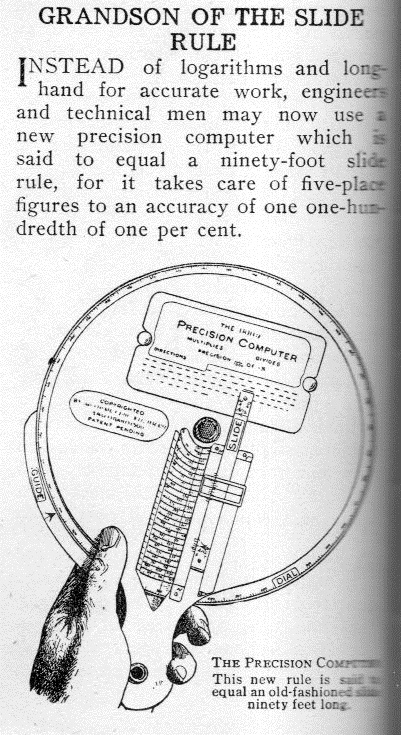
    I bumped into this short notice in the magazine Illustrated World for May 1916 and at first didn’t recognize the instrument.  It turns out that it is a skeleton drawing of the Ross “Precision Computer”, an 8″, multiple circular spiral (with 25 windings) circular slide rule.  It might have had the same effectiveness as a 90′ slide, though I read something elsewhere that it was more like 60′.  In any event, it was made of metal, and glass, and celluloid, and was an effective and elegant instrument. 

    Computer precision742

    [Illustrated World, May, 1916, page 388. Apologies for the fuzziness–the book was too thick and too old to force it flat on the scanner.]

    For more information as well as a photo of the instrument, see the Smithsonian Institution entry here:  http://americanhistory.si.edu/collections/search/object/nmah_690756


  • Quick List of Alan Turing Publications

    JF Ptak Science Books   Reference Series

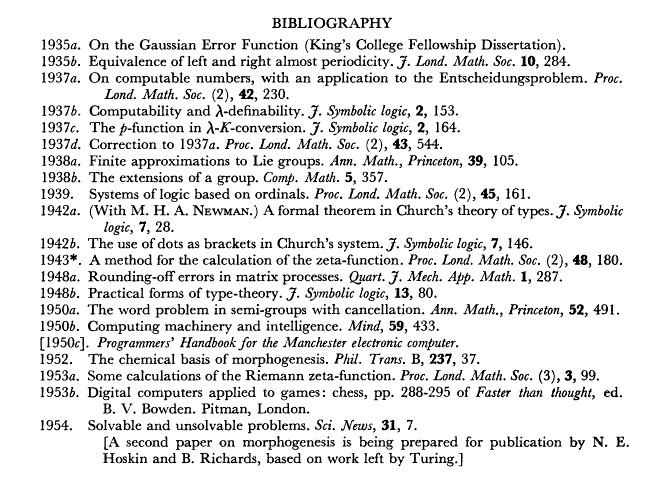
    Alan Mathison Turing. 1912-1954

    Bibliography of his works by M. H. A. Newman from Biographical Memoirs of Fellows of the Royal Society, volume 1, November 1955, pp 253-263 (with the bibliography of page 263). 

    (I’m posting this simply because I thought some readers here could use it.)

    Bibliography Turing Roy Soc