A Daily History of Holes, Dots, Lines, Science, History, Math, Physics, Art, the Unintentional Absurd, Architecture, Maps, Data Visualization, Blank and Missing Things, and so on. |1.6 million words, 7500 images, 4.9 million hits| Press & appearances in The Times, Le Figaro, Mensa, The Economist, The Guardian, Discovery News, Slate, Le Monde, Sci American Blogs, Le Pont, and many other places… 5000+ total posts since 2008.

Category: Computer Tech/History

  • Old Electronic Brains: 1950

    JF Ptak Science Books   Post 2349

    Berkeley simon915

     
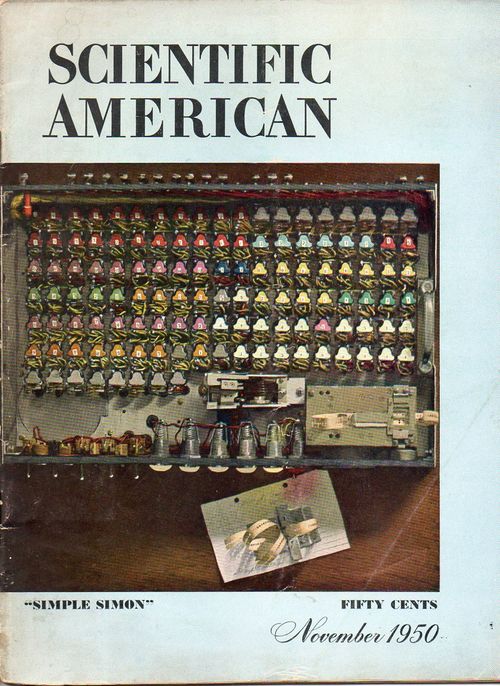
    The first exposure of the American public in general to a “personal computer” may have been in this issue1 of the Scientific American for November 1950–an article called “Simple Simon” by Edmund Berkeley.  ( Berkeley also wrote a book called Giant Brains, which seems to me to be the first mass-consumption book–written in terns for the general public–on how the computer works, and the design of “how a machine will think”.  Berkeley looks at the MIT Differential Analyzer #2, the Moore School ENIAC, Bell Labs’ General-Purpose Relay Calculator, and the IBM Automatic Sequence-Controlled Calculator.) 

    The Simon was a five-hole paper tape (which was its data entry and memory) 2-bit storage relay-based computer that could use numbers from 0 to 3.  It was extremely limited, but it worked, and it was real.  And affordable.  And a baseline for things to come.

    Berkeley introduced the idea for Simon in Giant Brains:

    “We shall now consider how we can design a very simple machine that will think.. Let us call it Simon, because of its predecessor, Simple Simon… Simon is so simple and so small in fact that it could be built to fill up less space than a grocery-store box; about four cubic feet….It may seem that a simple model of a mechanical brain like Simon is of no great practical use. On the contrary, Simon has the same use in instruction as a set of simple chemical experiments has: to stimulate thinking and understanding, and to produce training and skill. A training course on mechanical brains could very well include the construction of a simple model mechanical brain, as an exercise…”–Edmund Berkeley, in Giant Brains, 1949, p. 22 

    In the Scientific American paper Berkeley introduced the machine and how it functioned; he also described three  three outcomes for Simon:

    • First: “Simon itself can grow.  It possess all the essentials of a mechanical brain…”
    • Second: “It is likely to stimulate the building of other small mechanical brains.  Perhaps the simplicity and relatively low cost of such machines may make them attractive to amateurs as the radio set and the small telescope.”  [The “low cost” in 1951 was $600–equal to about $3000 today.]
    • Third:  “It may stimulate thought and discussion on the philosophical and social implications of machines that handle information…”

    Berkeley finishes the three-page article with the following paragraph, looking into the not-too-distant future:

    “Some day we may even have small computers in our homes, drawing their energy from electric-power lines like refrigerators or radios … They may recall facts for us that we would have trouble remembering. They may calculate accounts and income taxes. Schoolboys with homework may seek their help. They may even run through and list combinations of possibilities that we need to consider in making important decisions. We may find the future full of mechanical brains working about us.”

    Scientific American in that same year published another early computer effort of high marks: the great Claude Shannon’s “A Chess-Playing Machine.” This is the first (and popular) appearance of Shannon’s technical paper (which would appear a month later in the Philosophical Magazine), and it is the earliest appearance of an attempt to understand the necessities of a computer for playing a game of chess.

    “Since the mid-1940s, scientists had aimed to create a thinking machine, an apparatus that could compete with or even surpass the human brain in logical operations, pattern recognition, problem solving and even language. Chess was found to be a useful testing ground because of its combination of simple rules and mind-bending complexity… Shannon was fascinated by chess’ potential in the pursuit of what he called ‘mechanized thinking.’ But he became convinced that computer chess and other AI pursuits should not be modeled on human thought… Computers, at least as they were understood then, could calculate very quickly, following programmed instructions. This particular strength—and limitation—of computers suggested a different route for AI, a new sort of quasi-intelligence based on mathematical computation. Chess would be a central proving ground for this new type of intelligence. Theoretically, at least, the game could be fully converted into one long mathematical formula” –David Shenk, The Immortal Game of Chess, pp 201.

    This was another fantastic advance in thinking about computers and their applications at a very early stage of the computer game–perhaps more so with Berkeley than with Shannon, at least for the popular consumption end. In any event, they are both very interesting papers.  

    Notes

    1. Berkeley, E.C. (1950). “Simple Simon” in Scientific American No. 183, November 1950, pp. 40-43. 

    2. Shannon,  Claude E. “A Chess-Playing Machine.” New York:  Scientific American,  1950. Volume 182, No. 2, February 1950, pp 48-52.


  • Alan Turing and How the Chicken Gets Inside the Egg

    JF Ptak Science Books   Quick Post 

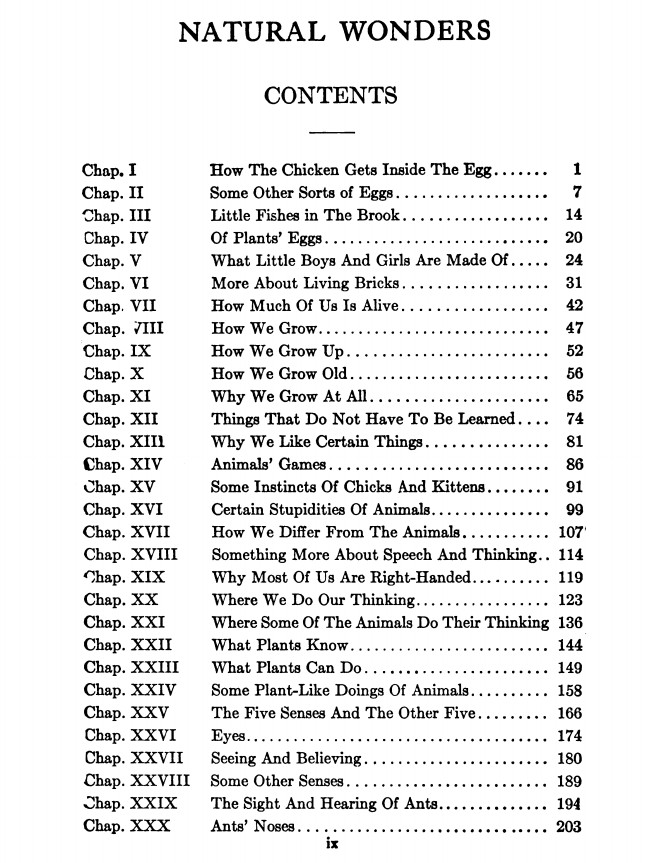
    Turing as a childThe most influential book in the young life of Alan Turing is said to be What Every Child Should Know Library–it is a six volume work1, and it seems as though the volume of interest was Natural Wonders Edwin Tenney Brewster2 printed in 1912 (and 1927, 1928, and 1939). David Newton3 believes that Turing’s fascination with the book was in part due to a statement by Brewster discussing the machine aspects of the human body. Andrew Hodges in his own biography of Turing (Alan Turing, the Enigma) wrote elegantly that the joy in the book was Turing finding that “such a knowledge of ‘science’ could exist”, which is a great and arching statement and also as broad as it was concise, and poetic.  

    [Turing image via ComputerWorldUK.]

    I’m going to side with poetry on this one.  And I do so because of the extraordinary structure of the book and its lovely chapter headings, the table of contents as elegant as a poem itself. They are an invitation to wonder, these thoughtfully prodding and engaging statements, and I can easily see how a creative child could react very positively to them.  

    Turing reading


    [Full text available via UC Davis, here.]


  • Human Computer Art, 1949

    JF Ptak Science Books   Post 2321  A Post called “Computer Art, 1949”, revisited and much expanded

    This is a great example of an exactly-what-is-this object, something that seems to be one thing, then the other, but then neither.  
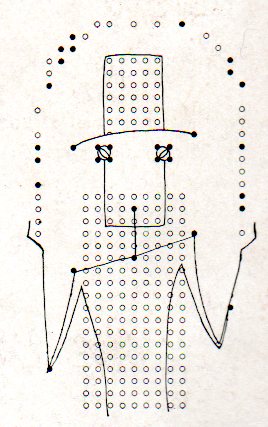
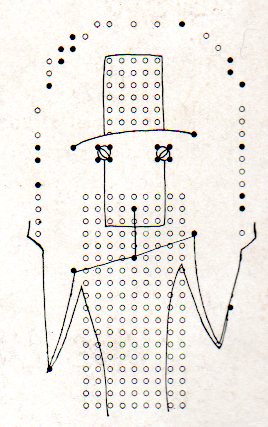
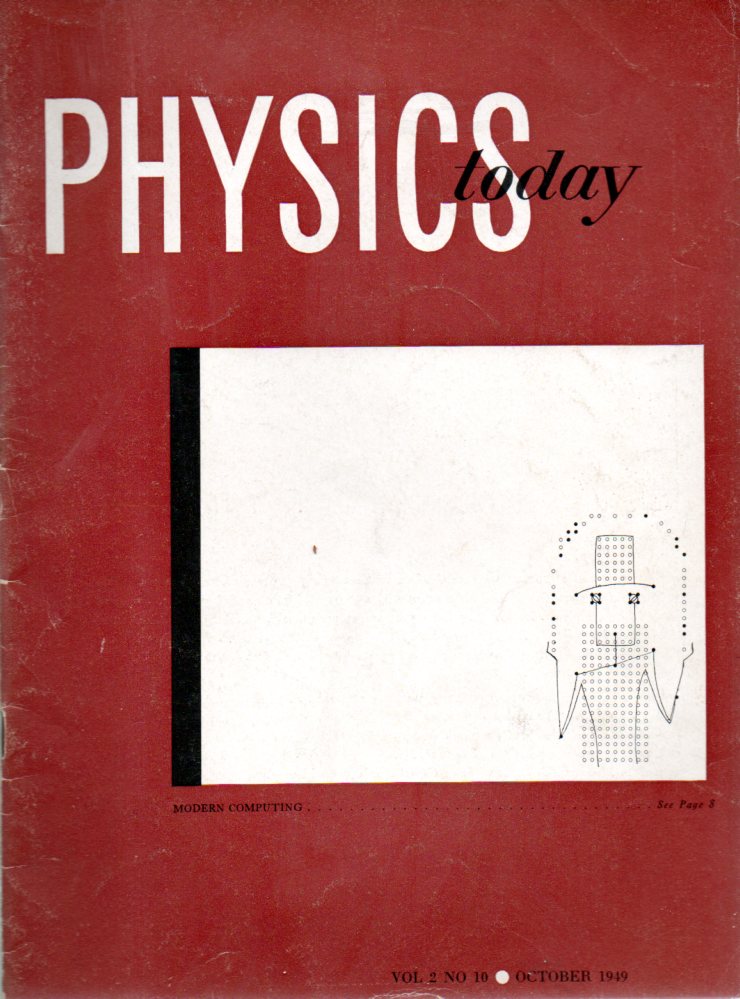
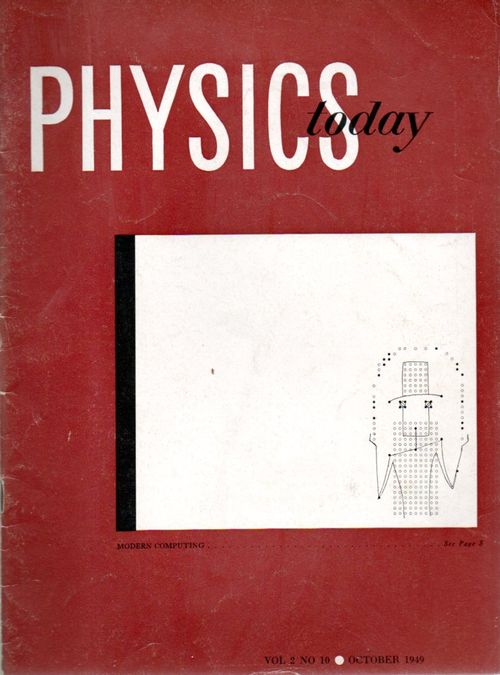
    Computer art154I’m not sure how to investigate this right off-hand, but I think that there is a special category in the history of art, subcat history of art and technology, subcat history of computer art, subcat using the technical aspects of the computer in art.  The image above comes from the front cover of one of the early issues of the “new” Physics Today magazine (volume 2, number 10), in October 1949–it is the artwork of Paul Bond, who created this portrait of a juggler “on a matrix sheet used for plotting computor [sic] plug board diagrams”, and is one of 11 such images.  So, while not computer art–artwork generated by the computer–it is artwork using items designed to operate the computer, a sort of very early computer-material montage.  (It would be in the first-time-ish category, but I can’t say this with any surety–it is however very very early for what it is.)

    It reminds me in a way of a magazine article using the illustration of a photograph–it was in the curious category of the first time an image of a photograph was published, that is to say it was a woodcut of a photograph though not the photograph itself.  This appeared in Golding Bird’s series of articles, “A Treatise on Photogenic Drawing”, which was five papers found and bound in the London-published journal, The Mirror.  and were extremely works on the new science of photography, appearing in issues from April 20-May 25, 1839. The image appears on page 241 (issue no. 945, Saturday April 20) and displays this first image of a photogenic drawing, which was the first publication of an image produced by any sort of photographic process.  (The process here is the ‘sun picture” , a photographic process, making this the first published “photographic” image, but really it is more like the first publication of a photographic image that was produced via woodcut.  It predates the first mass-published photograph by four years and the first (entirely) photographically illustrated book (The Pencil of Nature ) by six years.)

    Our computer artwork illustrates an interesting article (“Modern Computing”) by pioneers R.D. Richtmyer and N.C. Metropolis . Richtmyer/Metropolis have a very sober approach to the computer–and mostly speaking about the ENIAC–and address its romance, possibilities, and seemingly (to me) most of all “a need for defining the limits of computing machine operation, as well as its promise”. In effect, the authors really only address the known quantities of computing capacity in 1949, and even though tempted by looking into the future, they really do not. Their vision of the future is very pragmatic, and so far as speaking to future applications of the machine they choose the very Bartlebian philosophy and chose not to: they conclude “by their very nature, these applications are not easy to foresee, and perhaps, therefore, this is the point at which this discussion should close”, preferring to watch the beautiful and complex whirlwind in a thicket from the outside.  

    There have been much earlier images of automated steam-driven robots with some sort of calculating brain, and images of imaginative computer-like objects, and stretching back into the 18th century, so the idea of creativity and thinking and human-like qualities made by things constructed of metal and wood with a power source of steam or electricity and so on was well-established, though lurking in deep-background. Art made with the computer seems to come a fair bit later than this issue, later still than what might be considered the first art generated via the computer (which were images made from manipulating an oscilloscope) in 1952. This was the work of Ben F. Laposky (1914-2000) an Iowan and mathematician/draftsman and former sign-painter who took long time exposure photographs of waves motions on a cathode ray oscilloscope with sine wave generators and found beauty in them. His work was first exhibited at the Sanford Museum in Cherokee, Iowa, in 1952, as “Oscillons or Electronic Abstractions”1 –hundreds of other shows would follow.2 One of the earliest appearances in print of the oscillons is in Scripta Mathematica, Sept-Dec, 1952, pp 305 (and then somewhat later in Design, May 1953).

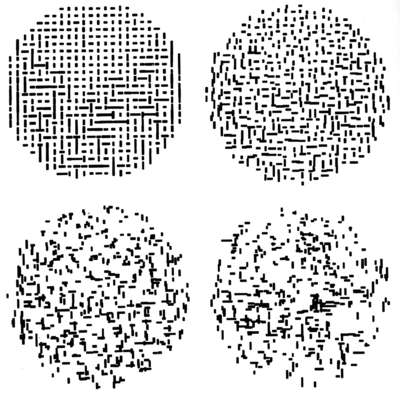
    Among the earliest computer-generated art–that is, art made via an automatic process input by humans by created by the machine–was created and noted by A. Michael Noll (b. 1939) with an IBM 7094 and described as “computer art” in “an August 1962 technical memorandum”3. Noll has written extensively (and interestingly! and early) on human/computer interfaces including computers and dance, fourth dimensional imaging, and much else4, including a fabulous comparative study of an original Mondrian and a computer-generated alternative5. (Noll is today widely recognized as one of the first in the field of digital art and 3-D animation.) 
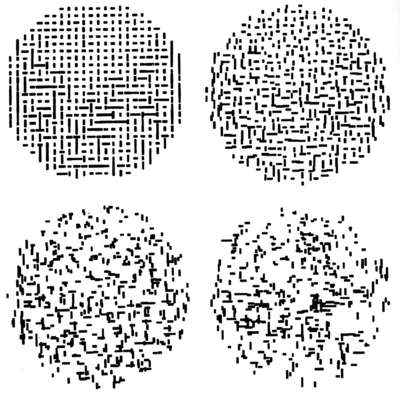
    Noll

    [Image source: Compart, Cener for Excellence in Digital Art, here.]

    In any event, I think at the very least that the Bond artwork is very curious, interesting, and probably very early for what it is.
    Computer art153Notes.

    1. This reference was first found in Arthur I. Miller’s Colliding Worlds, (Norton, 2014) on page 66.  Miller is perhaps the most upper tier in upper tier historians of science with the specialty of art/science interface–over the years I have enjoyed his work enormously.

    –See here for a full text of Electronic Abstractions.

    2.  “Electronic Abstractions are a new kind of abstract art. They are beautiful design compositions formed by the combination of electrical wave forms as displayed on a cathode-ray oscilloscope. The exhibit consists of 50 photographs of these patterns . A wide variety of shapes and textures is included. The patterns all have an abstract quality, yet retain a geometrical precision . They are related to various mathematical curves, the intricate tracings of the geometric lathes and pendulum patterns, but show possibilities far beyond these sources of design.”—Sanford Museum, Gallery notes for Electronic Abstractions, 1952 (Wiki)  For a good appreciation of Laposky, see Alison Drain, “Laposky’s Lights Make Visual Music” in Symmetry 4/3, pp 32-33.

    3.  Miller, page 68.

    4. See the following: 

    Noll, A. Michael, “Short-Time Spectrum and Cepstrum Techniques for Vocal-Pitch Detection,” Journal of the Acoustical Society of America, Vol. 36, No. 2, (February 1964), pp. 296–302

    Noll, A. Michael, “Computers and the Visual Arts,” Design and Planning 2: Computers in Design and Communication (Edited by Martin Krampen and Peter Seitz), Hastings House, Publishers, Inc.: New York (1967), pp. 65–79.

    Noll, A. Michael, “The Digital Computer as a Creative Medium,” IEEE Spectrum, Vol. 4, No. 10, (October 1967), pp. 89–95

     Noll, A. Michael, “Choreography and Computers,” Dance Magazine, Vol. XXXXI, No. 1, (January 1967), pp. 43–45

     Noll, A. Michael, “The Effects of Artistic Training on Aesthetic Preferences for Pseudo-Random Computer-Generated Patterns,” The Psychological Record, Vol. 22, No. 4, (Fall 1972), pp 449–462.

     Noll, A. Michael, “Computer-Generated Three-Dimensional Movies,” Computers and Automation, Vol. 14, No. 11, (November 1965), pp. 20-23.

    Noll, A. Michael, “Computer Animation and the Fourth Dimension,” AFIPS Conference Proceedings, Vol. 33, 1968 Fall Joint Computer Conference, Thompson Book Company: Washington, D.C. (1968), pp. 1279-1283

     Noll, A. Michael, “Art Ex Machina,” IEEE Student Journal, Vol. 8, No. 4, (September 1970), pp. 10-14.

    5.  Noll, A. Michael, “Human or Machine: A Subjective Comparison of Piet Mondrian’s ‘Composition with Lines’ and a Computer-Generated Picture,” The Psychological Record, Vol. 16. No. 1, (January 1966), pp. 1–10.


  • In the Enigma Machine Family: the Hagelin Cryptographic Machine, 1942

    JF Ptak Science Books   Post 2320

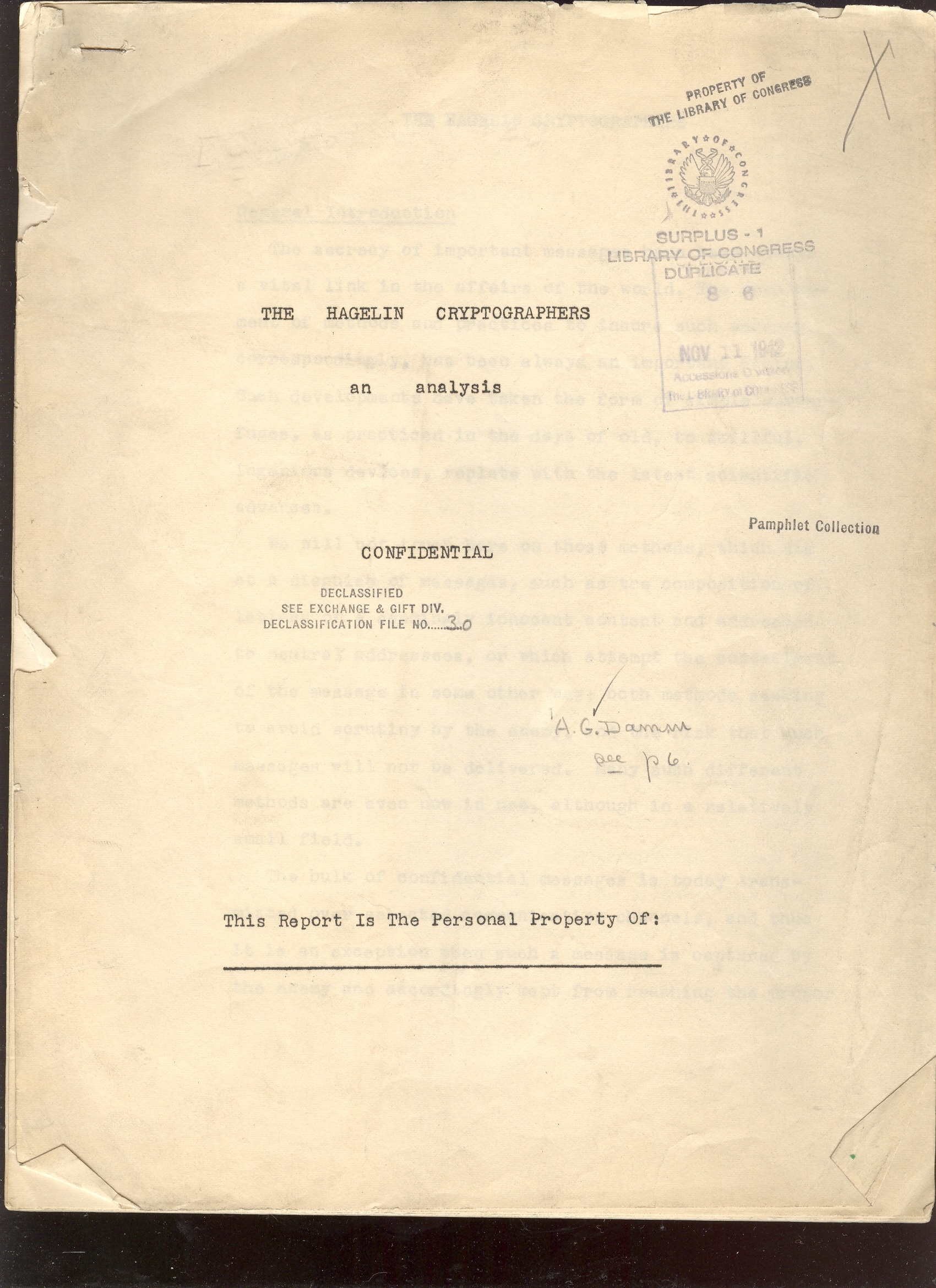
    This is a general report on the origin, development and status of the Hagelin “cryptographers”–a word used here to describe the physical machines (rather than the people working on codes). After his father invested in Aktiebolget Cryptograph, Boris C.W. Hagelin (1892-1983) took over ht leadership of the company in 1925, producing several fine models of encoding crypto machines, using Arthur Scherbius’ (as in the “Scherbius  Principle”, 1878-1929) rotor designs, some of which were marketed under the name “Enigma” (models of which were purchaed by the Wehrmacht in 1926 and modified for heavy use in the ’30’s and through WWII).  The company produced 140,000 units during WWII (while headquartered in the U.S) and is still in business today as Crypto AG, in Zug, Switzerland.

    Books--hagelin

    (The Hagelin Cryptographers, an Analysis. Stamped  CONFIDENTIAL, mimeographed in New York, by Ericsson Telephone,  1942.)    

    Sections in the document include “Models Built at Express Demand of the French Authorities”, “Evolution of Hand Cryptographer Type C-362”, “Hagelin Cryptographer Models” (BC-38 and C-362), “Methods of Operation”, “Superiority of Hagelin Cryptographers over Competing Makes”, and others, including a final section “How to Sell Cryptographers”. There is a mention of the “Enigma” machine on page 14, which is limited to mentioning that it is not sold outside of Germany. Although the Swiss firm founded by Boris Hagelin has manufactured, and continues to manufacture, many kinds of cipher machines, the words “Hagelin machine” will normally inspire thoughts of their unique lug and pin based machines.


  • Map of the Information Dirt Road, 1971

    JF Ptak Science Books   Quick Post

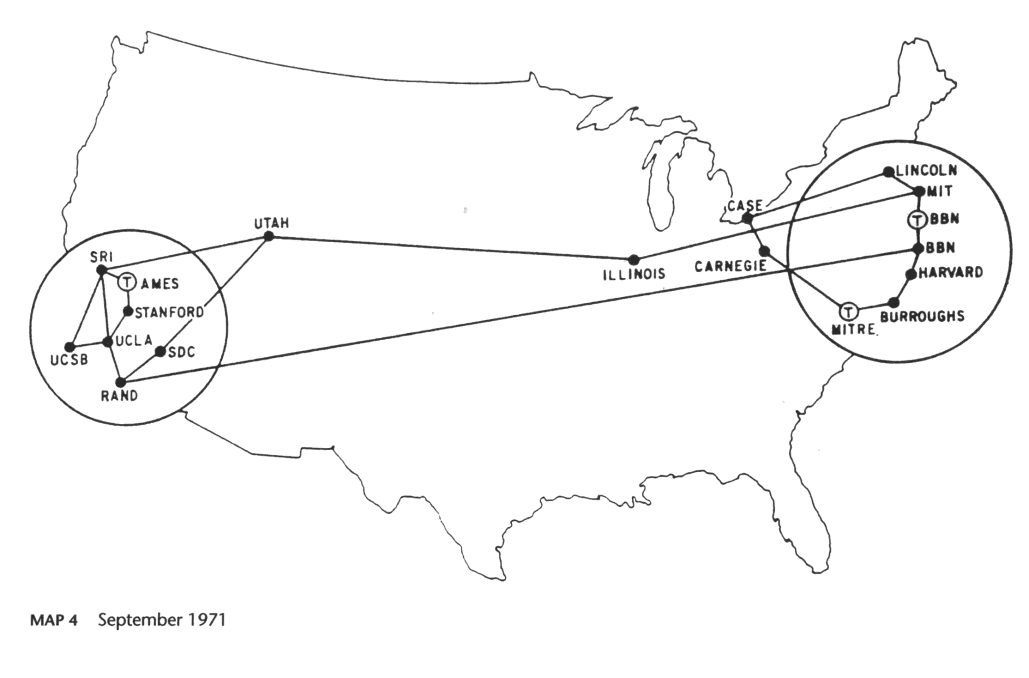
    Arpanet3

    [Source: An Atlas of Cyberspace. See also Mappa Mundi for a good article on the 1980 version of this map, here.]

    I can feel the enormous hail coming down on me right now for this title–but by comparison, this 1981 map of ARPAnet must seem somewhat like the first three minutes of creation in the Big Bang saga, in its way.  This was absolutely, positively a remarkable accomplishment for the time, but compared to what it would become–measured in any number of different ways–this map seems proto-historic.  Compared to not being able to construct this map because there was no ARPAnet–well, that would have been a devastating thing. 

    The other thing about looking at the picture of the birth of something was that–unlike many other revolutionary creations–there were many people of high influence who saw the possibilities of the expansion of the thing.  Even Graham Bell and Edison had a difficult time looking into the future of the telephone…


  • Grace Murray Hopper and “Compiling”: Computers, 1953

    JF Ptak Science Books  Post 2305

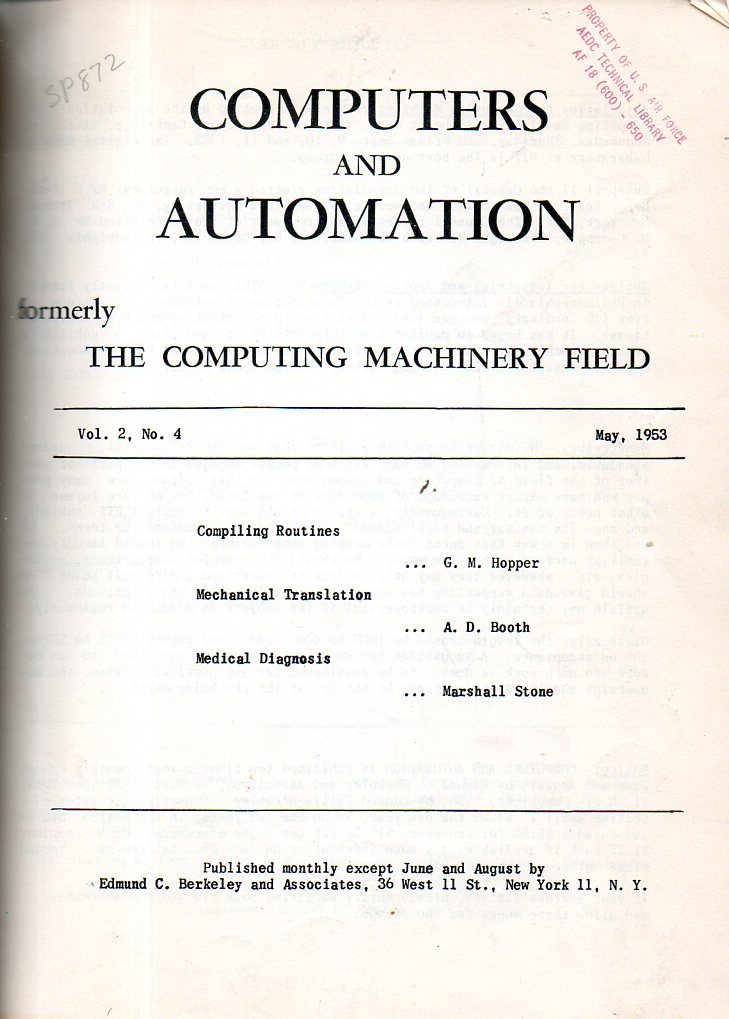
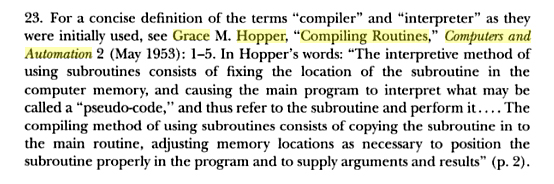
    Hopper511Grace Murray Hopper.  “Compiling Routines”, in Computers and Automation, volume 2, no.4, May 1953.  11×8 inches, ii + 33pp.  The Hopper article occupies pp 1-5.  Also in this issue, keeping Hopper good company: A.D. Booth “Machine Translation” and Marshall Stone, “Medical Diagnosis”, plus a Who’s Who in Computers (A-D) and section 2 (C,D,E) of  the first edition of the computer glossary.

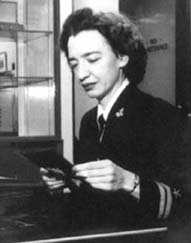
    It was in the article “Compiling Routines” that the pioneer and visionary Grace Murray Hooper (1906-1992, and at last, Admiral Hopper) laid out the foundations of compiling (which is a program that translates a program written in a high-level language into another language, usually machine language). Vassar ’28 and Princeton Ph.D. ’34, she worked at the Harvard Computation Lab on the Mark I, II, and III, and then seemed to be at a high level just about everywhere else.

    Grace hopper[Image source: National Women’s History Museum, here.]

    The following from Paul Ceruzzi, A History of Modern Computing, page 367:

    Hopper compilerComputers and Automation, the brainchild of the brainy not-child Edmund Berkeley, was the first popularly-published magazine published regarding the computer, its applications, it programming, and really just about everything else. (It appeared seven years after the Mathematical Tables and Aids to Computation was published in 1943, almost entirely to the mathematics and engineering communities.) Computers was published by Edmund Berkeley & Associates in NYC beginning in 1952., beginning its publishing journey as The Computing Machinery Field, its name changing toComputers and Automation in February 1953 (in volume 2, number 2). All issues have some fair space devoted to advertising, even though the issues generally ran between 32 and 40pp. Berkeley was a real-enough mathematician, engineer and computer pioneer, but he also had a pretty large taste for making these interests pay–which was essential, as the original print runs were not very large, though his advertisers were impressive. (According to the first issue, approximately 1200 people were on the mailing list for the journal, with around 2000 issues being printed each number. All told, this is not a large print run, and thus not many of the early issues have survived.) He was not averse to being somewhat outre with his journal—in addition to having contributors like Grace Hopper and Alton Householder, he also had Fletcher Pratt and Isaac Asimov writing some pretty arresting pieces from the SciFi/Futurama point of view.

    ·Posted by :

    ·in:


  • Single-Line Entries of Revolutionary Ideas: the Transistor, (1949)

    JF Ptak Science Books   Post 2298

    Transistor 066
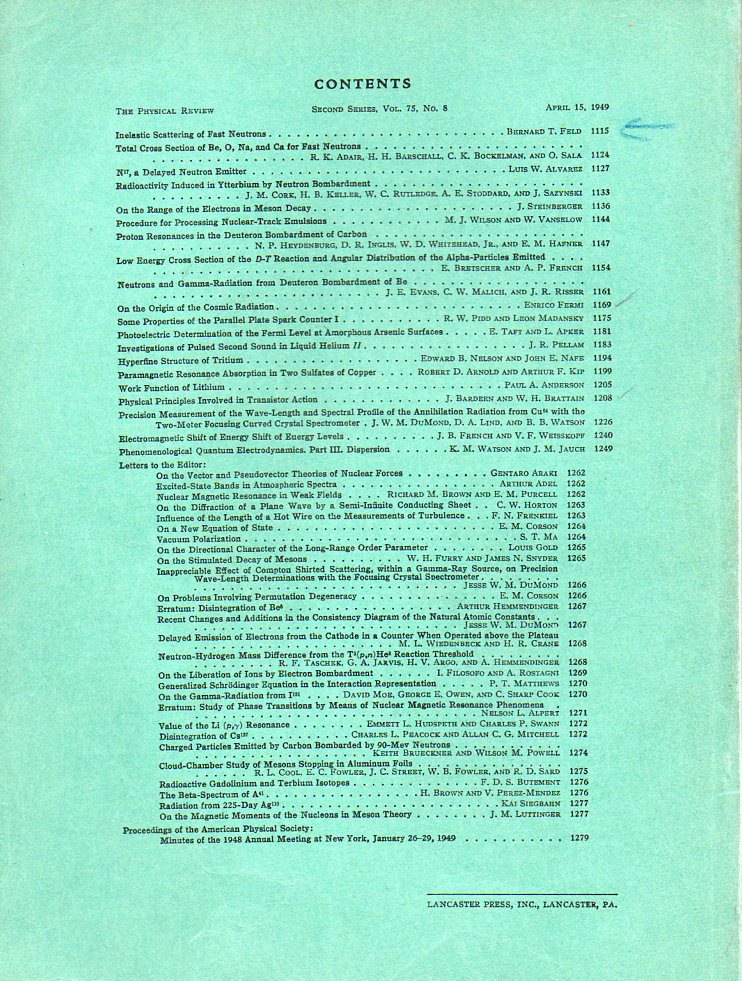
    One of the things I love about working my way through old scientific journals is when I find the issue that I’m looking for and scroll down the list of contributors to find the significant article that I want.  Long list, usually; and then, after making my way through 30 or 40 lines of tight type of the index I find it. [This by the way is one of those experiences that is being replaced by the digital library.]   Even though the paper on pp 1208 through 1226  of the 15 April 1949 issue of The Physical Review looks like any other, it is today seen as revolutionary. The entry for “Physical Principles Involved in Transistor Action” by John Bardeen (two-time Nobel in physics) and Walter Brattain (Nobel ’72) shows up about halfway down the index, sandwiched in some very good company (Enrico Fermi’s “Origins of Cosmic Radiation” and a number of others), and does not show up bolded, or highlighted, or with an asterisk.  Such is the nature of publication in the academic journal world, everything delivered with equal weight–the bolding stuff will happen later, in other venues.  But to see it right there in the flesh, so to speak, fresh and new and revolutionary, and looking like everything else, is really thrilling.  [See this entry for a similar report on the most valuable patent in history.]

    Transistor 064

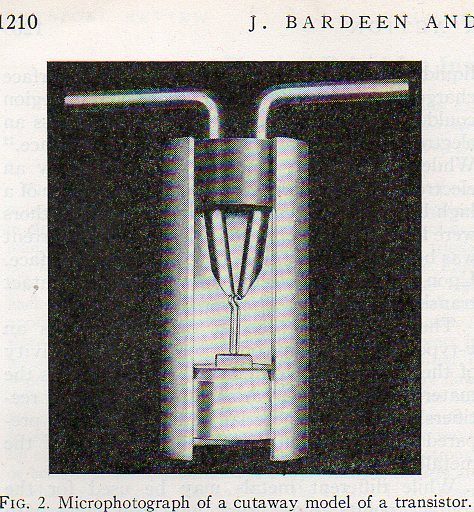
    It makes me wonder though how it would’ve felt to open this journal for the first time back there in mid-April ’49, turning to page 1210 to see the microphotograph of the cutaway of a model of the transistor.  This was the defining technical publication on the transistor1, which was the first massive step towards microminiaturization and the explosive new growth in the computer, allowing far more powerful machines to be designed in far less space, in far less amounts of time, and on and on.  It is one of the first steps in the Information Revolution, moving the computer from massive racks of electronic tubes to more simple, elegant, nimble and by-far faster circuit boards with transistors (and resistors, capacitors, inductors, diodes, etc.) to make an electronic circuit.  This would be the standard for computer construction, only supplemented by Jack Kilby (TI)  and Robert Noyce (Fairchild Camera) in 1958/9 with the integrated circuit, where transistors are made smaller still and produced in groups on circuit boards rather than individually.

    The photo above shows a cutaway of the transistor, and is the first time it was published–the first photo of what was one of the 20th century’s greatest inventions. 

    Transistor 065

    Notes

    1.  The paper was published simultaneously in the Bell System Technical Journal; Bardeen and Brattain were with the Bell Labs.  The Bell journal also contained another revolutionary paper in the same volume, Claude Shannon’s “Communication Theory of Secrecy Systems”, which is one of the most important early papers on electronics and cryptology.

    The full bit: BARDEEN,  John and Walter Brattain:  Physical Principles Involved in Transistor Action;  Lancaster, Pa:  Physical Review,  1949.  1st edition.  The Physical Review, Vol 75, Second Series, No. 8    8vo.


  • The Magnificent Comptometer, 1893

    JF Ptak Science Books Quick Post

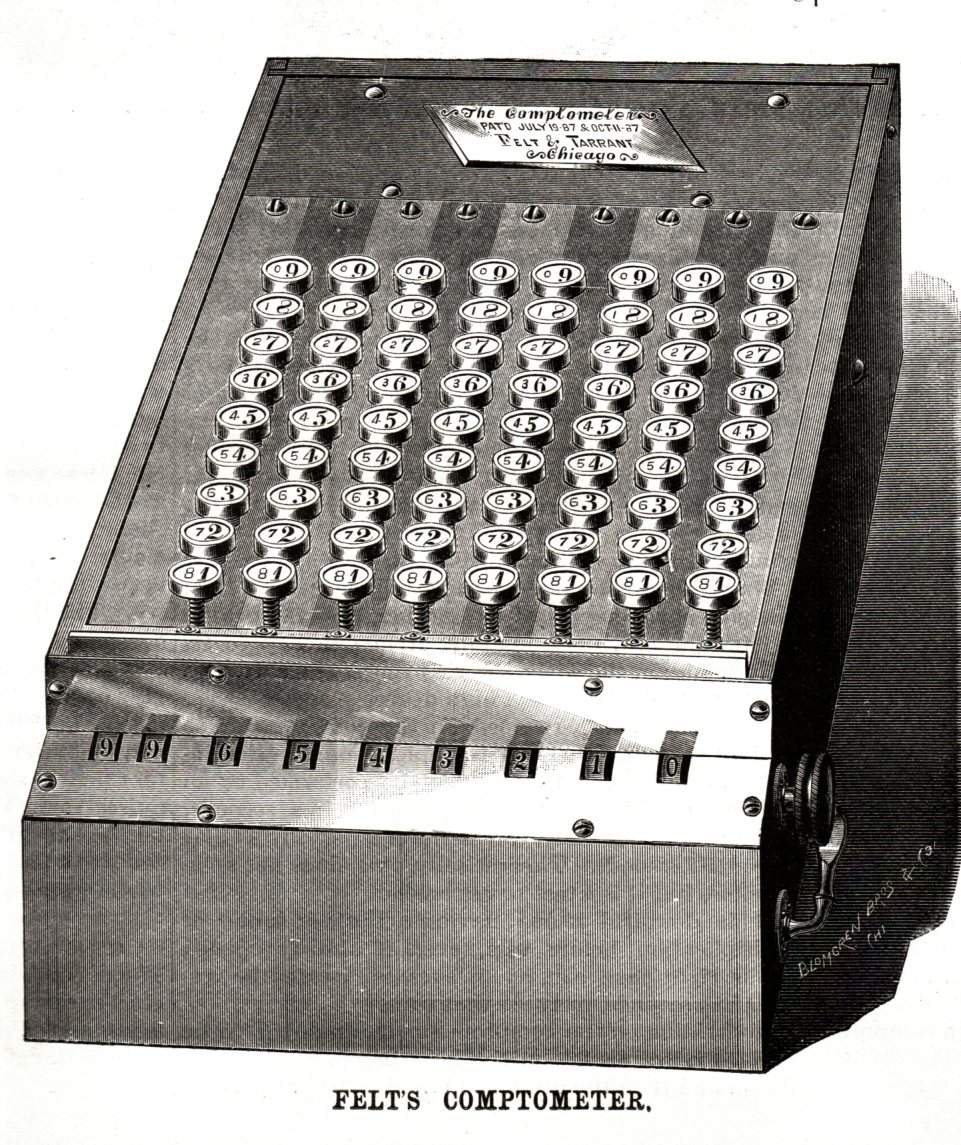
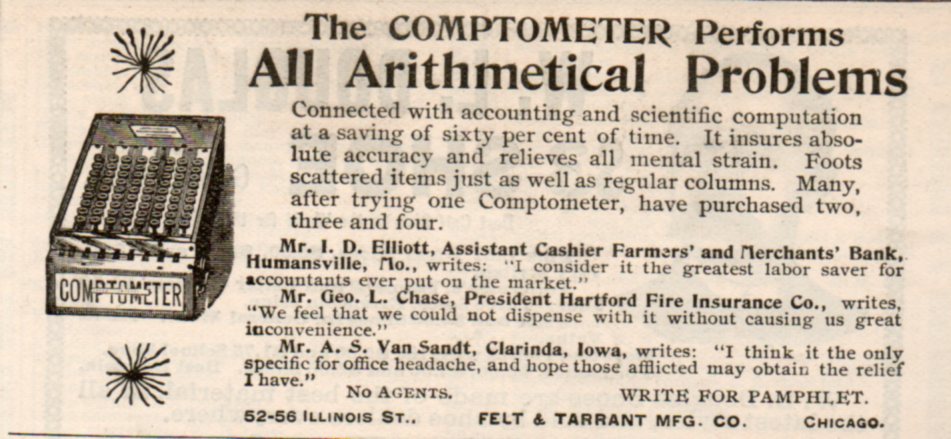
    This magnificent image was–is–The Comptometer, a key-driven calculating machine made by Felt & Tarrant Manufacturing Company, a glorious instrument, encased in coppery metal, and just larger than a large shoebox.  It was invented by Dorr E. Felt (1862-1930) in 1889, and in order to put his idea into production went into business with the Chicago businessman and entrepreneur Robert Tarrant, and the two made an enormously successful go of the whole operation, the machine being easy to carry, and easy to use, and saved a huge amount of time in calculating mounds of long figures.  

    The image (and ad, below) both appeared in the November 11, 1893 issue of the Scientific American.  

    Comptometer b230


    Comptometer229


  • The Heavy Number Crunchers: Table-Top Edition

    JF Ptak Science Books  Quick Post

    Bollee

    This was a surprise, finding M. Bollee’s article (Sur une nouvelle machine a calculer) in the issue of an 1889 Comptes Rendus spread out in front of me, pecking around in that big 10-pound volume looking for something else not Bollee.  It was very easy to miss this article if you weren’t looking for it, just a few pages long in a 1000-page book.  But there it was, nestled comfortably in pp 737-739.  It these few pages Bollee describes his machine and with particular reference to his innovative approach to direct multipilication–a fine addition (ha!) to the long line of contributions by Babbage and Clement, Scheutz, Wiberg and Grant and Hamann. 

    Notes:

    Léon Bollée: “Sur une nouvelle machine a calculer”, in Comptes Rendus de l’Academie Sciences (Paris), volume 109, 1889, pp. 737-9.  Offered in the original printed wrappers, removed from a larger bound volume.  

    An image of the machine from The Manufacturer and Builder:

    Bollee

    ·Posted by :

    ·in:


  • History of (Electronic) Holes, 1946

    JF Ptak Science Books  Post 2229           History of Holes series

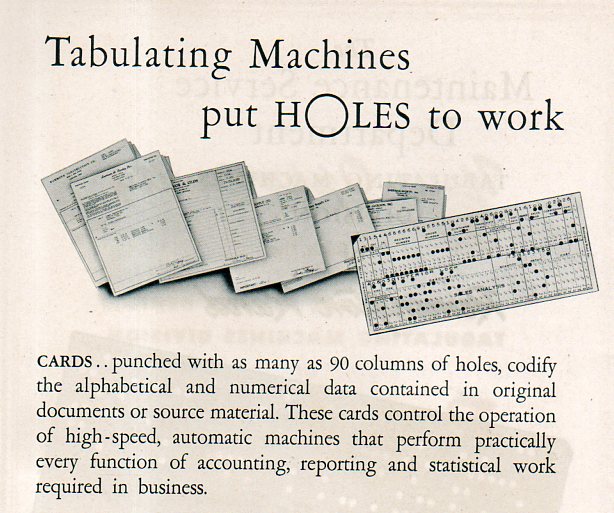
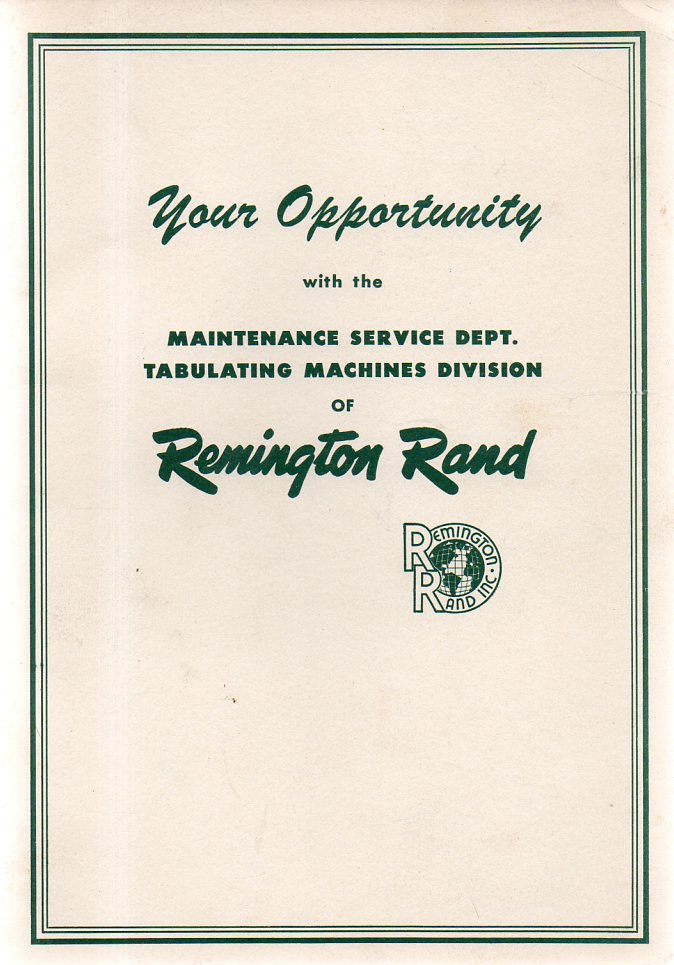
    I’ve written elsewhere in this History of Holes series about holes and electricity and the Jacquard loom and early tabulating machines–but I’ve never seen anything in-print from this period of time using the word “holes” to promote a tabulating device.  And here it is in a Remington Rand promotional for scouting field service technicians, and printed ca., 1946:

    Remington rand holes057

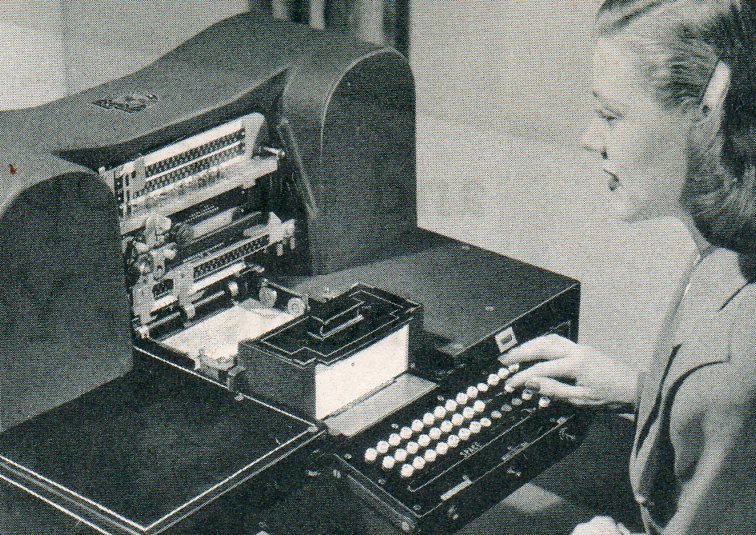
    Remington Rand at one time was Remington Arms, and then diversified to produce all manner of light and heavy electrical goods (and of course famously producing the standard U.S. Army sidearm, the 45-calber Remington M1911 pistol), and by the end of WWII the company produced a vast line of tabulating equipment (of another order of high caliber).  Interestingly the pamphlet exclaims that a person working for RR could work there for as long as they wanted, that the company was there to stay.  

    Remington rand holes058

    Certainly the company would hang on for some time in one form or another, but the tabulating card division was about to change drastically.  In 1950 RR purchased Eckert-Mauchly Computer Company (ENIAC) and a few years later (1952) secured another giant computer pioneer, Engineering Research Associates (ERA), making Remington Rand about the largest computer company in the world. RR would be purchased a few years later by Sperry in 1955, becoming Sperry Rand, and then simply Sperry a short time after that; later, in 1986, Sperry would merge with Burroughs and become Unisys. Somewhere in there all of these tabulating machine repairmen and techs hired fresh in 1946 would be out of their lifetime job less than a decade later.  

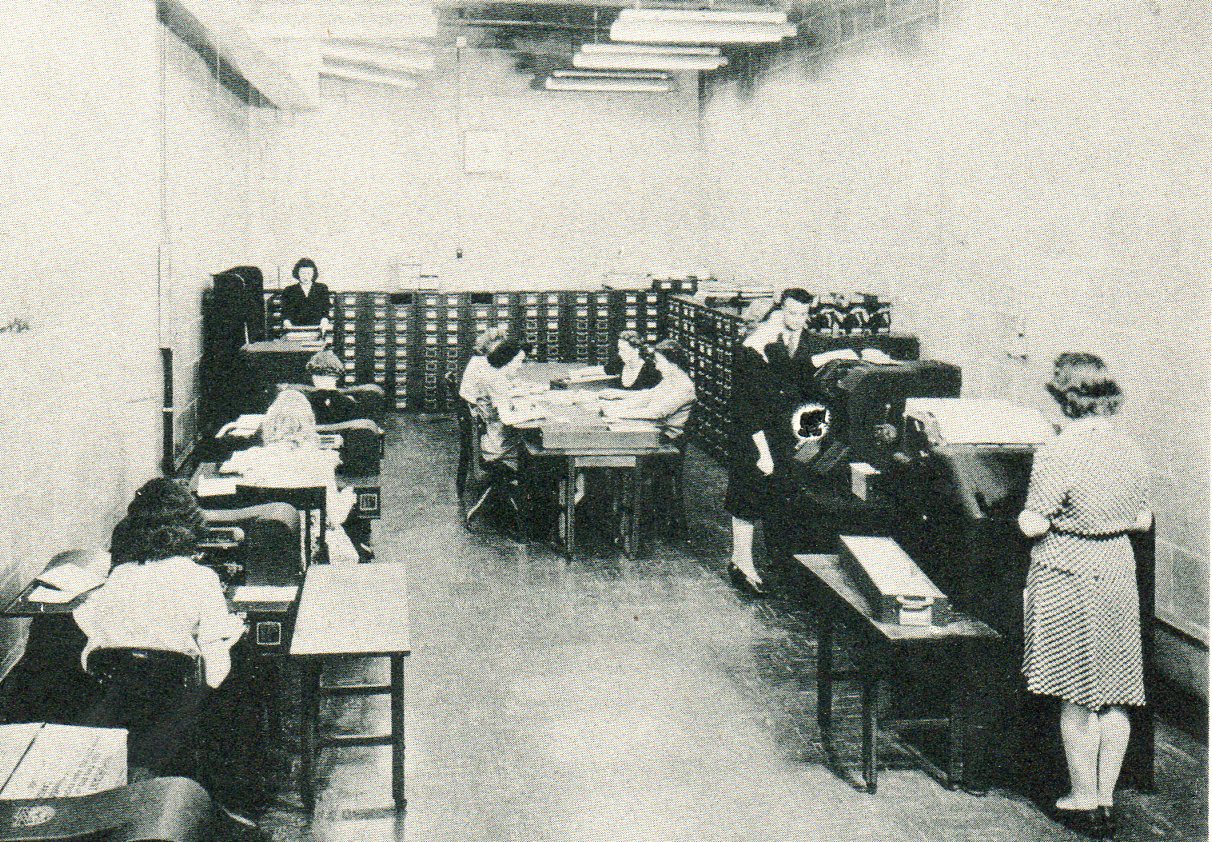
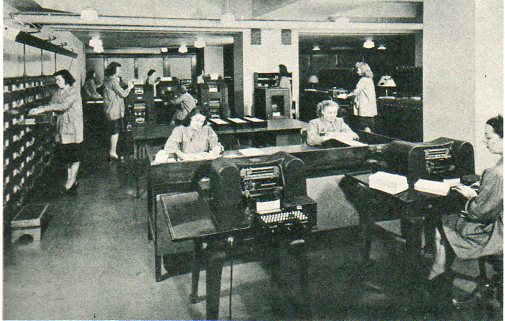
    [“Typical office installations of Remington Rand equipment”]

    Remington rand holes059

    Remington rand holes060

    Remington rand holes061