A Daily History of Holes, Dots, Lines, Science, History, Math, Physics, Art, the Unintentional Absurd, Architecture, Maps, Data Visualization, Blank and Missing Things, and so on. |1.6 million words, 7500 images, 4.9 million hits| Press & appearances in The Times, Le Figaro, Mensa, The Economist, The Guardian, Discovery News, Slate, Le Monde, Sci American Blogs, Le Pont, and many other places… 5000+ total posts since 2008.

Category: Physics

  • Quiet, the Quietists, and Not Finding a Missing “Principia Mathematica” (1687)

    JF Ptak Science Books  Post 2747
    Newton Principia

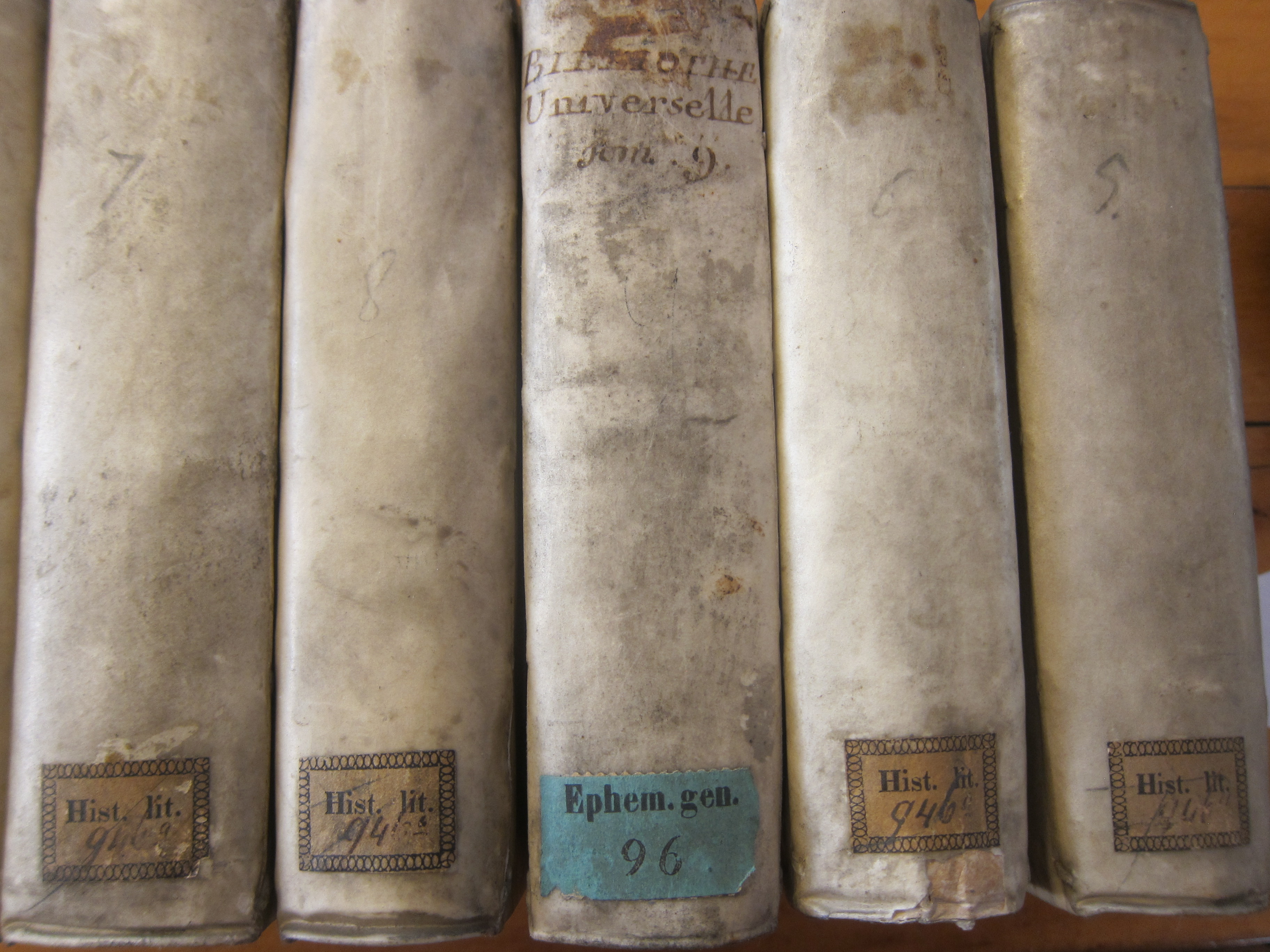
    Grazing through old scholarly journals is never a completed task—the more you have to bring to the adventure, the more you will take away from it. This is probably a general truth, though it is particularly so with journals that cut a broad path in the communication of ideas, and this is certainly the story with the late-17th century journal/magazine, Bibliotheque Universelle. It ran from 1672 to 1726, and the intellectually-thirsty editors ran a kind of review/abstract service for their readers—they found (mostly) newly published books in a wide variety of areas, and wrote summaries and statements on them, with background history, and the occasional editorial comment. Some of the articles were on significant works by John Locke and Antoine van Leeuwenhoek, but many and probably most were on obscure topics in nitty theological history and mostly-invisible philosophical issues, or at at least that is how the latter seems to me today. The Bibliotheque brought new ideas to the continent, and brought them in the Lingua Franca, which also happened to be French.

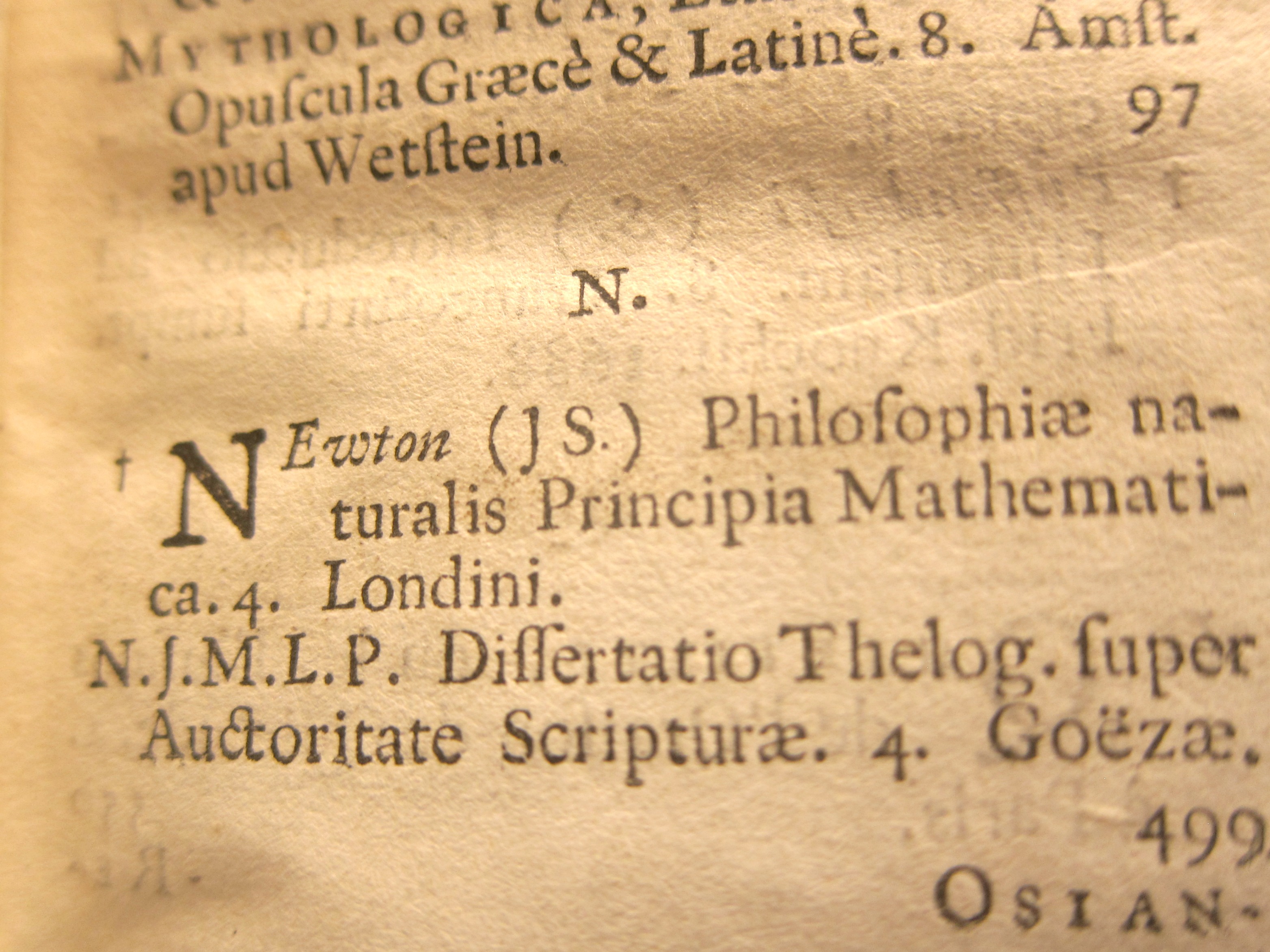
    This is the background as I thumbed my way through volume seven, one of several volumes for this year, finding few things that fired any nodule of memory or investigation in my head. 1687 is a big year in the history of science, seeing the publication in July of that year of what may one of them most important books ever published, Isaac Newton’s Pricnipa Mathematica.

    And then, suddenly, it was there. I knew from a previous experience that an interesting and uncommon review of the Principia by John Locke (of all people) in the next volume (8), which was the third statement on the book outside of Britain. But I hadn’t know about this appearance, which would have been published just a couple of months after the Principia appeared.

    There were just a few lines announcing the book in the table of contents, but no page reference. I consulted an online version of the journal and did a search on Newton, with no results. That of course made me go through the book—twice–page by page to make sure that the article wasn’t there. It wasn’t. I imagine that the mention of one of the world’s greatest books was, well, a mistake.

    The Principia was quiet.

    The funny thing was that there was another article on exactly that—quiet. And this was a dangerous quiet, at least for the originator of the theological movement, who would be cast into the flames of the Inquisition and die in prison for the temerity of quietude.

    In the next page of the table there was this fine find: “Le Quietiste, ou les Illusions de l’oration de Quietude”, (p 550-554) and “Receuil de diverse pieces concernant le quietisme et les quietistes”(pp 554-559).

    These two articles are statements/reviews of two books addressing the Quietism and Quiesiste movement as embodied by its founder, Miguel de Molino (1626-1696). Very long story short, Molino was seen as a threat to the pope and to the Jesuits, preaching a Christianity that seems quite personal and benevolent from where I sit, but at the time was seen as heretical, and for which Molino would be tried by the Holy Offices and condemned to life in prison, and as a matter of fact, Molino died in the (outwardly) beautiful Castel St. Angelo serving out his sentence.

    It seems to have a bit forward and backwards for Molino. Charges were brought against him chiefly through the work of pieces like the first presented above, by the Jesuit Paolo Segneri (1624-1697), whose first efforts were unsuccessful in dislodging Molino, with his own work finding its way to the Index. However, by 1685 he was again sent to the Inquisition, and just months before this book was published, he was already tried and imprisoned.

    William James (in his The Varieties of Religious Experience, 1902) found Molino to be a “spiritual genius” (p. 130) and his Quietism to be a ”transcendental idealism”, with “a healthy-minded opinion of repentance” (p. 130). He seems to have found nothing threatening in the man, and his imprisonment an “abomination”. The issues were longer and deeper than this, with 250+ points brought up before the Inquisition, including “moral deformity”), but on the whole Quietisme seems as destructive as George Fox’s Quakerism, which seems to have shared many spiritual practices with Quietism.

    So it seems that the established order in Rome found the message of the Quietists too loud, and the voice of the Principia was to be found in the next volume.
  • A Beautiful Diagram of Cyclone Activity (1922)

    JF Ptak Science Books  Post 2750

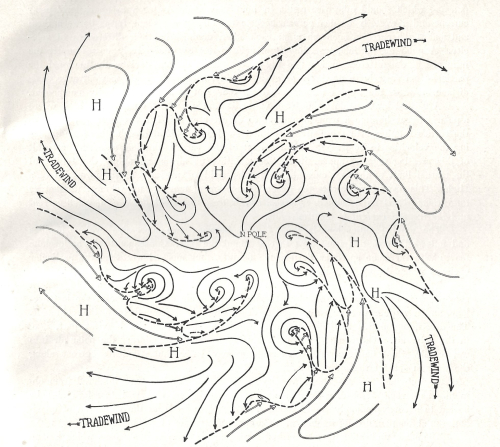
    This lovely and significant piece of sci-art appeared in Jacob Bjerknes and H. Solberg’s  “Life Cycle of Cyclones and the Polar Front Theory of Atmospheric Circulation”1 in 1922. This was an expansion of an earlier paper of 19192, and provided the basis for the motion of the atmosphere in terms of warm and cold fronts. “Although rapid transitions or discontinuities in temperature, pressure, and wind velocity had been noted in Jacob’s first model—and even by nineteenth century meteorologists—and although such discontinuities had been theoretically postulated, the 1919 Bergen cyclone model represented the introduction of discontinuities into meteorology as the major focus for practice and, eventually, theory. These “fronts,” as they later were termed, were endowed with scientific reality through the introduction of major changes in forecasting practice. The cyclone model based on fronts entailed the ability to specify in time and three-dimensional space important weather phenomena associated with cyclones to a much greater degree than earlier models could achieve. During the next few years the Bergen group of Vilhelm and Jacob Bjerknes, Ernst Calwagen, Halvor Solberg, and Tor Bergeron, among others, expanded this preliminary cyclone model and accompanying forecasting methods to a comprehensive system for explaining midlatitude weather changes. The polar front, the occlusion process, an evolving cyclone model, and air mass analysis were the conceptual foundation for a new era in meteorology.”3


    Bjernkes

    The two authors “…pictured the polar front as a string of families of cyclones, described by dashed lines linking successive warm and cold front”.–Mark Monmonier, Air Apparent: How Meteorologists Learned to Map, Predict, and Dramatize Weather, pg 64, with several reproductions of some of the lovely diagrams.

    Notes:

    1. J. Bjerknes and H. Solberg, Life Cycle of Cyclones and the Polar Front Theory of Atmospheric Circulation. Offprint/separate, Geofysiske Publikationer 3, no. 1, 1922. 12×9, 18pp (paginated 1-18). Bound in cloth, with a half-title and title, though no publication data save for a running abbreviation of the journal name and volume above the text. Nicely bound in buckram. Provenance: U.S. Navy, Naval War College. “Polar front theory is attributed to Jacob Bjerknes, derived from a coastal network of observation sites in Norway during World War I. … The convergence line ahead of the low became known as either the steering line or the warm front. The trailing convergence zone was referred to as the squall line or cold front.”–Wiki
    2. This was evidently a longer and more thorough version of a paper submitted by Bjernkes and Solberg to the Monthly Weather Review in 1919 on the findings of the Bergen group. –Robert Marc Friedman, Appropriating the Weather: Vilhelm Bjerknes and the Construction of a Modern Meteorology, p. 180; also noting that this article is “frequently cited”.
    3. Complete Dictionary of Scientific Biography.
    4. Wikipedia entry for Bjerknes. 

    “Bjerknes was part of a group of meteorologists led by his father, Vilhelm Bjerknes, at the University of Leipzig. (“Bjerknes’s father, Vilhelm. has often been called the father of modern meteorology. This title is doubly appropriate, for not only did Vilhelm’s vision and research programs lead to establishing new directions, methods, and the conceptual foundation for the science, but Vilhelm’s son also played a fundamental role in creating this new era in atmospheric science.”) Together they developed the model that explains the generation, intensification and ultimate decay (the life cycle) of mid-latitude cyclones, introducing the idea of fronts, that is, sharply defined boundaries between air masses. This concept is known as the Norwegian cyclone model.”–Wikipedia

    “The “Bergen School of Meteorology” is a school of thought which is the basis for much of modern weather forecasting. Founded by the meteorologist Prof. Vilhelm Bjerknes and his younger colleagues in 1917, the Bergen School attempts to define the motion of the atmosphere by means of the mathematics of interactions between hydro- and thermodynamics, some of which had originally been discovered or explained by Bjerknes himself, thus making mathematical predictions regarding the weather possible by systematic data analysis. Much of the work was done at the Geophysical Institute, University of Bergen, in Bergen, Norway.”–Wikipedia  It should be noted that Jacob was the chief forecaster and head at Bergen 1918-1931.–Complete Dictionary of Scientific Biography

    ·Posted by :

    ·in:


  • A Very Large and Very Early X-Ray Photo, February 1896

    JF Ptak Science Books  Quick Post

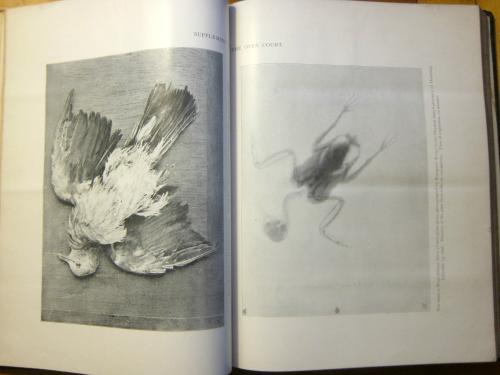
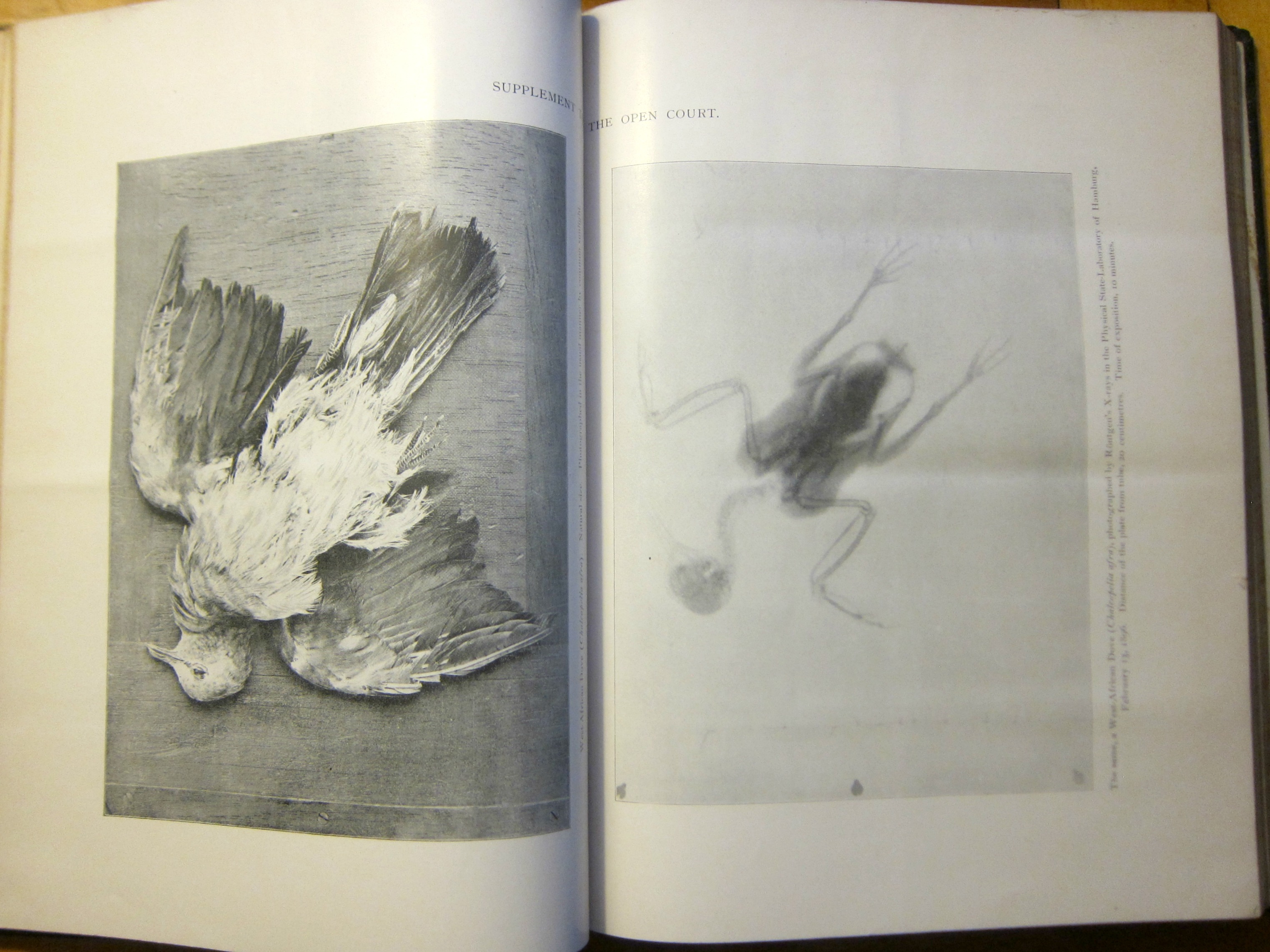
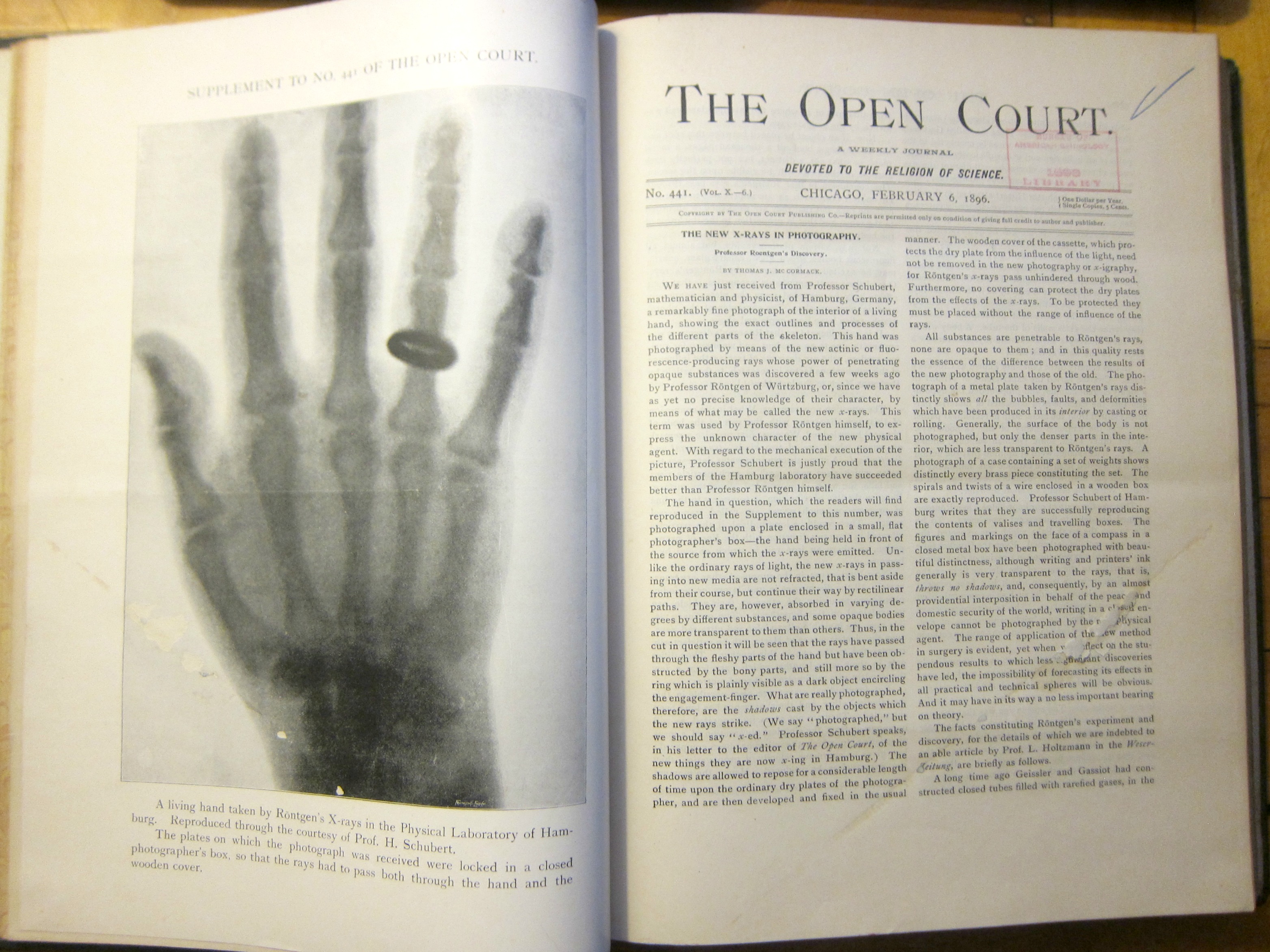
    I made an unexpected find today, poking around in a February 18961 volume of the probing, somewhat classically-radical and Easternist journal, The Open Court, a Weekly Journal Devoted to the Religion of Science.  The photo and article form a very early appearance in the U.S. of the weeks-old Roentgen discovery of the x-ray. The first journal edition in English appears to be 23 January 1896 in Nature (vol 53), and the first in a U.S. journal in Science on 31 January, though that is not illustrated.  (The Science article, written by Hugo Muinsterberg of Harvard, notes that this was a good thing for the reassurance of German stature in physics as they had in the last year lost Kundt, Hertz, and von Helmholtz, and now they had Wilhelm Roentgenfor a new placeholder of living greatness.) 

    X-ray _3_


    X-ray _2_

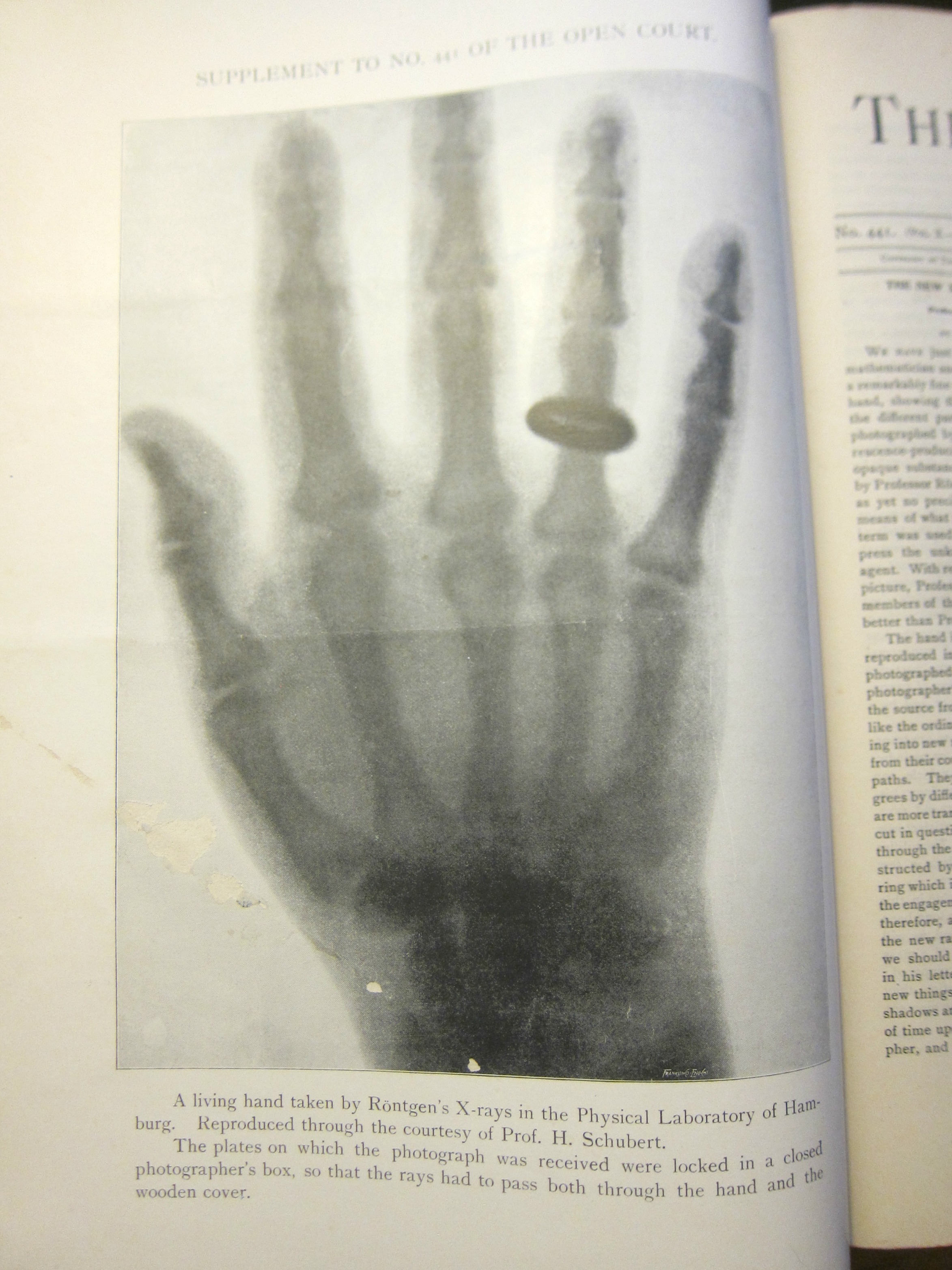
    A close-up of the 12″ tall image

    The illustrated article by McCormack, in the Taoist-historico-scientific journal Open Court, shares an example of x-ray photography by H(ermann). Schubert (1848-1911, and who would have his paper on the Rontgen rays translated for the Monist in April) ) of the Physical Laboratory in Hamburg which is very large, more than 12″ tall, and by far the largest of these famous photos that I have seen. There is a short discussion on what exactly to call the “photograph”, since it really wasn’t a photo by general standards, and the term “x-ed” is suggested…I’m not sure when the “X-Ray” as a term for the product of being exposed to x-rays and photographic film was, but it wasn’t long after this.)  There is a bit of history of the discovery of the x-ray, and a discussion on the idea of chance and discovery in scientific progress. 

    There would be an enormous wave of publications on the x-ray over the course of the next year–in fact, the Bibliography of X-ray Literature and Research (1896-1897) by Charles Phillips (published in 1906) is 68pp long and finds more than 1500 books and articles published over just two years. Oddly, the Open Court papers are not to be found in the Phillips bibliography, and I’m not sure why.  

    It seems to me that Open Court publishes on the of the first photographs of an x-ray in a U.S. journal. 

    McCormack (1865-1932) had an interesting career, translating Lagrange, Weismann, Mach, as well as the photographer and mathematician  Hermann Schubert’s books on recreational mathematics), and wrote several books in disparate disciplines.  

    X-ray _1_

    Notes:

    1. Thomas J. McCormack, “The New X-Rays in Photography”, in a bound volume of The Open Court, a Weekly Journal Devoted to the Religion of Science, February 6, 1896, no. 441, volume x-6, pp 4799-4801.  With a very large photographic image (12×9.25″ 31x24cm).
    Also appearing in this volume, again by McCormack,  “Roentgen’s Rays Again”, no. 446 vol X-11, March 12, 1896, pp 4483-4844, illustrated with a double-page photographic image. 

    ·Posted by :

    ·in:

    —

  • First Appearance in Print of the Terms “Relativity Theory” and “Theory of Relativity” 1906

    JF Ptak Science Books  Quick Post    Part of the series on “Naming Things”

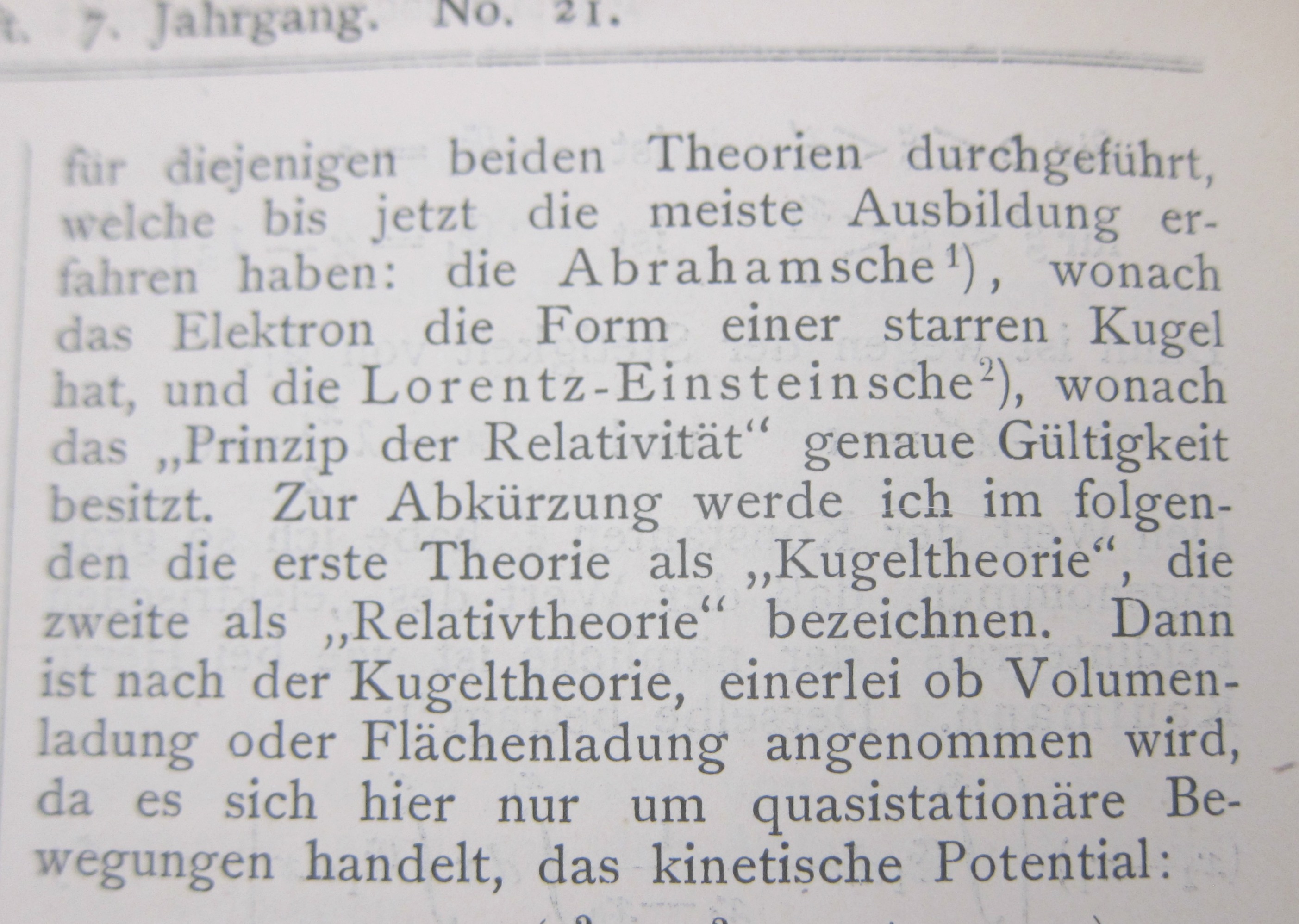
    It was very surprising, finding this, the first time that something so familiar as “relativity theory” appeared in its most familiar form. It appears very soon after the publication of the Einstein 1905 paper, a work by Max Planck1 that appeared in the Physikalische Zeitschrift in 1906:

    Einstein relativtheorie

    Prior to using the words “postulate” and “principle” associated with relativity (as in “Prinzip der Relativitat”, appearing in the second paragraph of Einstein’s June 1905 “Zur Elektrodynamik bewegter Körper” in Annalen der Physik)  it is first referred to as “relativity theory” (“Relativtheorie”) by Max Planck on p. 756 (col 2 line 9 and also on pp 758+759) of this volume. Then in the “discussion” part of the Planck paper the“theory of relativity” (“Einsteinische Relativitatstheorie”) appears for the first time in print just a few pages later (p. 760 col 2 line 15) by Alfred Bucherer.

    And there it is.

    Notes:

    1. Max Planck, “Die Kaufmannschen Messungen der Ablenkbarkeit der β-Strahlen in ihrer Bedeutung für die Dynamik der Elektronen” [The Measurements of Kaufmann on the Deflectability of β-Rays in their Importance for the Dynamics of the Electrons],Physikalische Zeitschrift in 1906, volume VII, the paper occupying pp 753-761 (printed in double columns), printed in Leipzig by S. Hirzel. There are other papers of relativity in VII including Wacker (p 300), Farkas (p 654), Stark (p 353), and Wilkens (p. 846).

    • “The term “theory of relativity” was based on the expression “relative theory” (German: Relativtheorie) used in 1906 by Planck, who emphasized how the theory uses the principle of relativity. In the discussion section of the same paper, Alfred Bucherer used for the first time the expression “theory of relativity” (German: Relativitätstheorie).”–Wikipedia

    ·Posted by :

    ·in:

    —

  • Found-Art in Scientific Journals–an Acoustic Kraken (1881)

    JF Ptak Science Books   Quick Post

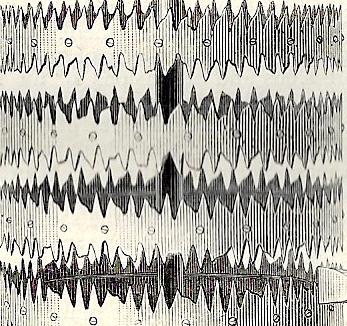
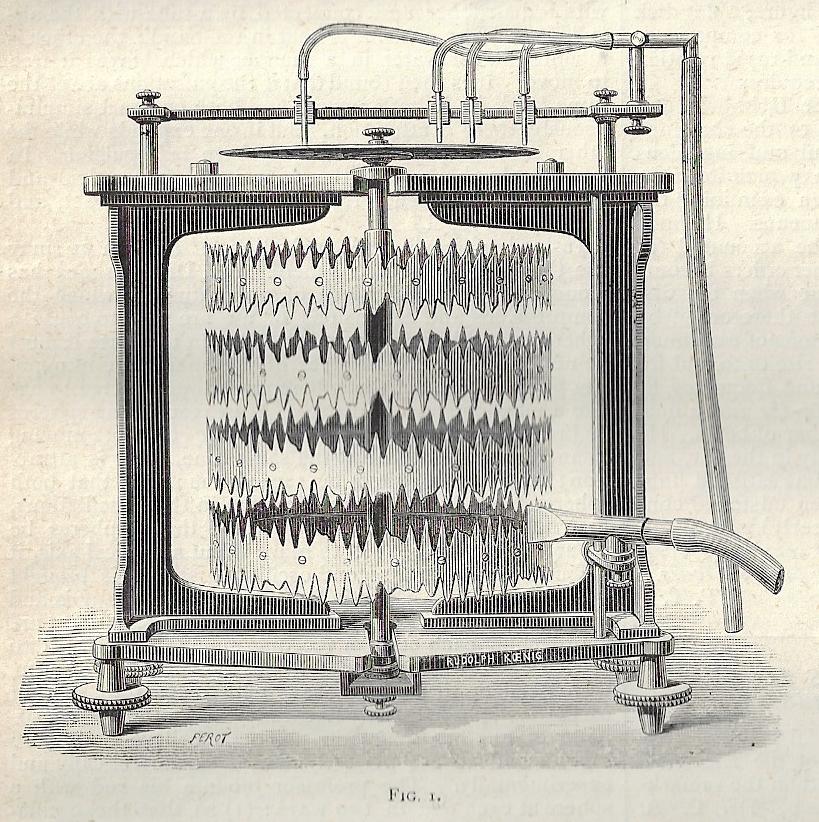
    This does for a moment look like a piece of Found Scientific Art–and I guess it is–reminding me of a multiply-layered steely jaw of some creature, which you can see if you look hard enough. In reality, it was the tonal guts of a wonderful scientific apparatus constructed by Rudolph Koenig, reported in the July 14, 1881 issue of Nature:

    Nature 1881 Konig wave siren detail

    And the full version of the original 3×3″ image

    Nature 1881 Konig Wave Siren

    “Prior to the advent of oscilloscopes and other electronic sound-analysis tools, even seemingly rudimentary tasks of acoustic analysis – determining the frequency of a musical tone, for instance, or making waveforms observable – were not simple jobs  with obvious solutions. It fell to researchers of the time to come up with mechanical devices, often quite clever and sometimes rather complex, to make these investigations possible.” “Though oriented differently [the wave siren]… is similar to the other wave siren shown in this collection, but with more complex wave forms in the undulating rims…”–Bart Hopkin, Instrument Maker, “Engravings of early Acoustical Apparatus”, from his website

    Rudolph Konig (1832-1901) “far and away the most accomplished among makers of [acoustical devices]” (Hopkin, above) was a very highly accomplished and discriminating instrumentalist, scientific instrument maker, and experimentalist. “Koenig will also be remembered as the inventor and constructor of many other beautiful pieces of apparatus for the investigation of acoustical problems, among which may be mentioned his wave-sirens, the first of which was shown at Philadelphia in 1876. His original work dealt, among other things, with Wheatstone’s sound-figures, the characteristic notes of the different vowels, a manometric flame apparatus, a vibration microscope, among others; but perhaps the most important of his researches are those devoted to the phenomena produced by the interference of two tones, in which he disputed the views of Helmholtz as to the existence of summation and difference tones.”–Wikipedia

    “Prior to the advent of oscilloscopes and other electronic sound-analysis tools, even seemingly rudimentary tasks of acoustic analysis – determining the frequency of a musical tone, for instance, or making waveforms observable – were not simple jobs  with obvious solutions. It fell to researchers of the time to come up with mechanical devices, often quite clever and sometimes rather complex, to make these investigations possible.” “Though oriented differently [the wave siren]… is similar to the other wave siren shown in this collection, but with more complex wave forms in the undulating rims…”–Bart Hopkin, Instrument Maker, “Engravings of early Acoustical Apparatus”, from his website


    ·Posted by :

    ·in:

    —

  • Finding Einstein ‘Neath the Liver Pills (1920)

    JF Ptak Science Books   Quick Post

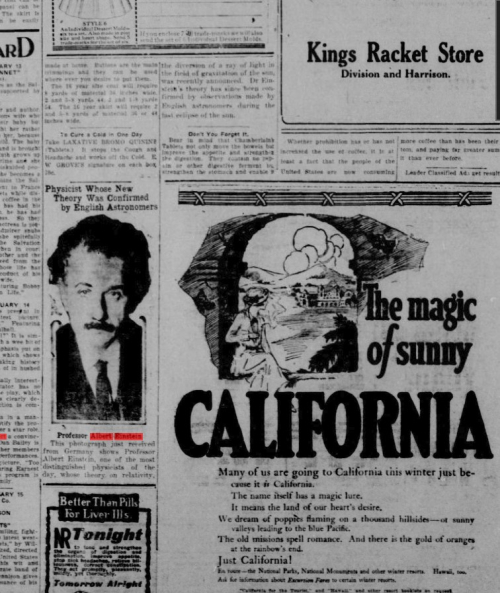
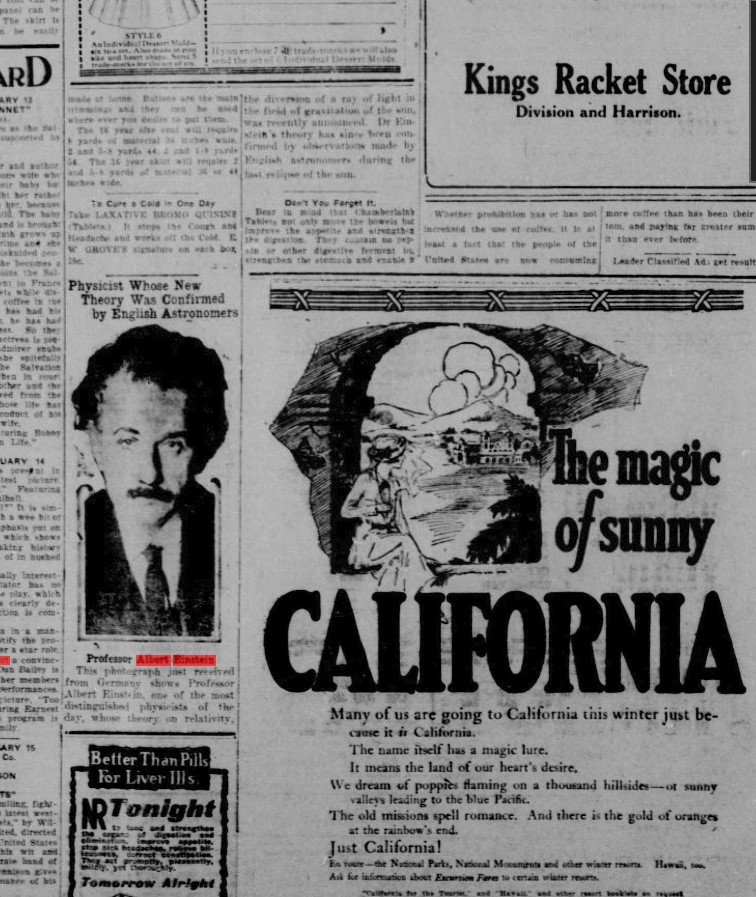
    If you were sitting in a cafe on a  cold winter morning in Guthrie, Oklahoma, on January 13, 1920, and opened to page two of the town paper, The Leader, and worked your way down the page, past the ads for KiMoids heartburn pills,  Jiff-Jell gelatin desserts, eczema cream, dress patterns, liver pills, adventures to sunny California, and Mr. Louis Bennison starring in a play called “High Pockets”, you’d find a picture of Albert Einstein.  Snugly nestled amidst this visual candy is a short report on one of the great experimental results of the 20th century, the verification of the general theory of relativity. Results of the observations made during the May 29 eclipse and then reported to a joint meeting of the Royal Society and the Royal Astronomical Society on November 6, 1919, confirming the theory was an enormous occasion. Einstein of course expected it; had the results not obtained, he quipped then that The Creator would have some explaining to do. But everything turned out just fine.  J.J. Thomson (as president of the Royal Society)  closed the great meeting and and remarked that  “This is the most important result obtained in connection with the theory of gravitation since Newton’s day, and it is fitting that it should be announced at a meeting of the society so closely connected with him. . . . The result [is] one of the highest achievements of human thought.” Thomson was not given over to being hyperbolic, and if anything was just stating the case as it was.

    The event was carried loudly by leading newspapers all in about a week or so after the event, the effect of which established the beginning of Einstein being about the most famous man in the world.  Two months earlier he more than likely would have been an unknown except to a very small percentage of a reading population. And so here he is, in  almost the center of Oklahoma, and then almost in the center of the U.S., in a tiny report–but the report had a photograph, and the story was at least on page two, making him a known-something in about the middle of the middle.  

    Einstein newspaper guthrie ok 1920

    Detail of page two, from the Library of Congress’ fantastic Chronicles of America (digitized) newspaper collections:

    • The Guthrie daily leader. (Guthrie, Okla.), 13 Jan. 1920. Chronicling America: Historic American Newspapers.

    ·Posted by :

    ·in:

    —

  • A Tiny Notice Foreshadowing a Great Announcement–Experimental Proof of the General Theory of Relativity, 1919

    JF Ptak Science Books   Post 2736

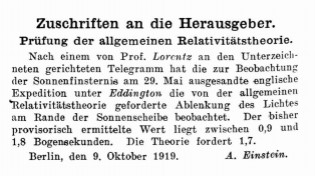
    According to Abraham Pais, an “excited” Albert Einstein contributed a very short note (“Zuschriften an die Herausgeber, Prufung der allgemeinen relativitatstheorie”/”A Test of the General Theory of Relativity”) to the editors of the journal Die Naturwissenschaften1 reporting on the telegram he had received from H.A. Lorentz on September 22 on the impending confirmation of the theory of relativity as it was tested in the May 29, 1919 eclipse experiments organized by Sir Frank Dyson. Chandrasekhar explains the situation so: 

    • “It was some months before the two expeditions returned to England and the participants were able to measure their plates and collate their results. But rumours of the successful confirmation of Einstein’s prediction reached Einstein in early September I919. And on 22 September I919, the Dutch physicist Hendrik Antoon Lorentz sent Einstein a telegram confirming the rumours to which Einstein replied (also by telegram).. Einstein’s own satisfaction with the outcome of the British expeditions is shown by the postcard (dated September 27, 1919) to his ailing mother in Switzerland. It said: Dear Mother: Good news today. H. A. Lorentz has wired me that the British expeditions have actually proved the light deflection near the Sun….”

    “The telegram that had announced the news to Einstein…was an informal communication. Nothing was definitive. Yet Einstein sent almost at once a very brief note to Naturwissenschaften for the sole purpose of reporting the telegram he had received. He was excited.” (Pais, Subtle is the Lord, p 303).

    Einstein’s note in Naturwissenschaften was concise and to the point: “…the English expedition, under Eddington…has observed the deflection of light at the limb of the sun demanded by the General Theory of Relativity3…”

    The results of the experiment were read on November 6, 1919 (the presentation begun by Dyson, followed by A. C. Crommelin, the leader of the Sobral expedition)  to a joint meeting of the Royal Society and the Royal Astronomical Society, and famously published in the Philosophical transactions of the Royal Society in 1920 as “A Determination of the Deflection of Light by the Sun’s Gravitational Field, from Observations Made at the Total Eclipse of May 29, 1919”4.  J.J. Thomson (as president of the Royal Society)  closed the meeting and “pronounced the canonization [of Einstein]”: ‘This is the most important result obtained in connection with the theory of gravitation since Newton’s day, and it is fitting that it should be announced at a meeting of the society so closely connected with him. . . . The result [is] one of the highest achievements of human thought.’ (Pais, Subtle…, in the chapter “The Suddenly Famous Doctor Einstein”, p 305) R.H. Folwer, president of the Royal Astronomical, also spoke and announced ‘“The conclusion is so important that no effort should be spared in seeking confirmation in other ways.”

    The Einstein note is dated October 9 in the text and was published a week later on October 17. It is one of the first appearances on the confirmation of the theory, with the exception, evidently, of a few notices in Berlin newspapers5 just days earlier. (Again, this according to Pais.) It would be on November 6 that “Lorentz sent another telegram to Einstein, confirming the news. On November 7, 1919, the Einstein legend began.” I assume that Pais is talking about the general article that appeared in the London Times on that day (and which would be written for the New York Times on the 9th, and then it was off to the races with the news, with Einstein himself contributing an article three weeks later to The Times). Well, except in Germany, where the reporting beyond this notice in Naturwissenschaften was more reserved, as noted by an article on the 1919 eclipse on the Max Planck Gesellschaft website: “In contrast to the enthusiastic reception shown by the foreign press, the media in Germany were more reticent on the subject. Not until 14 December 1919 did the Berliner Illustrierte Zeitung publish a photo of Einstein and an article entitled: “A new luminary for the history of the world: Albert Einstein, whose research means a total revolution in the way we see the world and whose findings are equal to those of a Copernicus, Kepler and Newton”. 

    Here’s the entire announcement from Naturwissenschaften:

    EInstein 1919

    Writing about the eclipse on his website, Simon Singh says that J.P. McEvoy, author of Eclipse: The Science and History of Nature’s Most Spectacular Phenomenon (Fourth Estate Ltd., 1999), “encapsulated the significance of the announcement” writing of the ironies of the event:  “A new theory of the universe, the brain-child of a German Jew working in Berlin, had been confirmed by an English Quaker on a small African island.” A further bit to add here is that the expeditions were undertaken by British scientists to prove the work of a German scientist, beginning their work before the end of WWI.

    S. Chandrasekar reports that in 1933 Rutherford expounded on the eclipse and Einstein’s fame, rather more broadly and more deeply:

    “The war had just ended: and the complacency of the Victorian and the
    Edwardian times had been shattered. The people felt that all their values and
    all their ideals had lost their bearings. Now, suddenly, they learnt that an
    astronomical prediction by a German scientist had been confirmed by
    expeditions to Brazil and West Africa and, indeed, prepared for already
    during the war, by British astronomers. Astronomy had always appealed to
    public imagination; and an astronomical discovery, transcending worldly
    strife, struck a responsive cord. The meeting of the Royal Society, at which
    the results of the British expeditions were reported, was headlined in all the
    British papers; and the typhoon of publicity crossed the Atlantic. From that
    point on, the American press played Einstein to the maximum…”6

    I guess this is where the ultra-fame of Einstein begins.

    Notes:

    1.  Die Naturwissenschaften, volume 7, heft 42, October 17, 1919. p 776

    2. S. Chandrasekhar, “Verifying the Theory of Relativity”, in Notes and Records of the Royal Society of London Vol. 30, No. 2 (Jan., 1976), pp. 249-260.

    3.  The Collected Papers of Albert Einstein, Volume 7 (English).

    4. W. Dyson, A. S. Eddington, C. R. Davidson, “A Determination of the Deflection of Light by the Sun’s Gravitational Field, from Observations Made at the Solar eclipse of May 29, 1919”, Philosophical Transactions of the Royal Society,  A 220 (571-581): 291–333 (1920). Eddington had written previously on the expedition, “The total eclipse of 1919 May 29 and the influence of gravitation on light”, in The Observatory, Vol. 42, p. 119-122 (1919)

    5. “An article by Alexander Moszkopwski entitled ‘Die Sonne bracht es an den Tag’ in the Berliner Tageblatt of October 8, 1919, must presumably have been based in information from Einstein himself”. (Pais, Subtle…, footnote p 306.) Also, Andrew Claude de la Cherois Crommelin contributed  “The Eclipse Expedition to Sobral”  in The Observatory 42, 368-371, and though it published in October there is no mention of definitive results yet.  Crommelin also publishes an article in Nature on 13 November (volume 104, p. 280-1), appearing about a week after the Royal Society meeting, in which he publishes the results, all on the equivalent of a single page.  

    6.  Chandrasekhar, ibid., pg 251.

     [Interesting to note here that in Maurice Lecat’s Bibliographie de la Relativite (1924) this contribution receives only a scant placement within the Einstein section, in part 13 (c).]

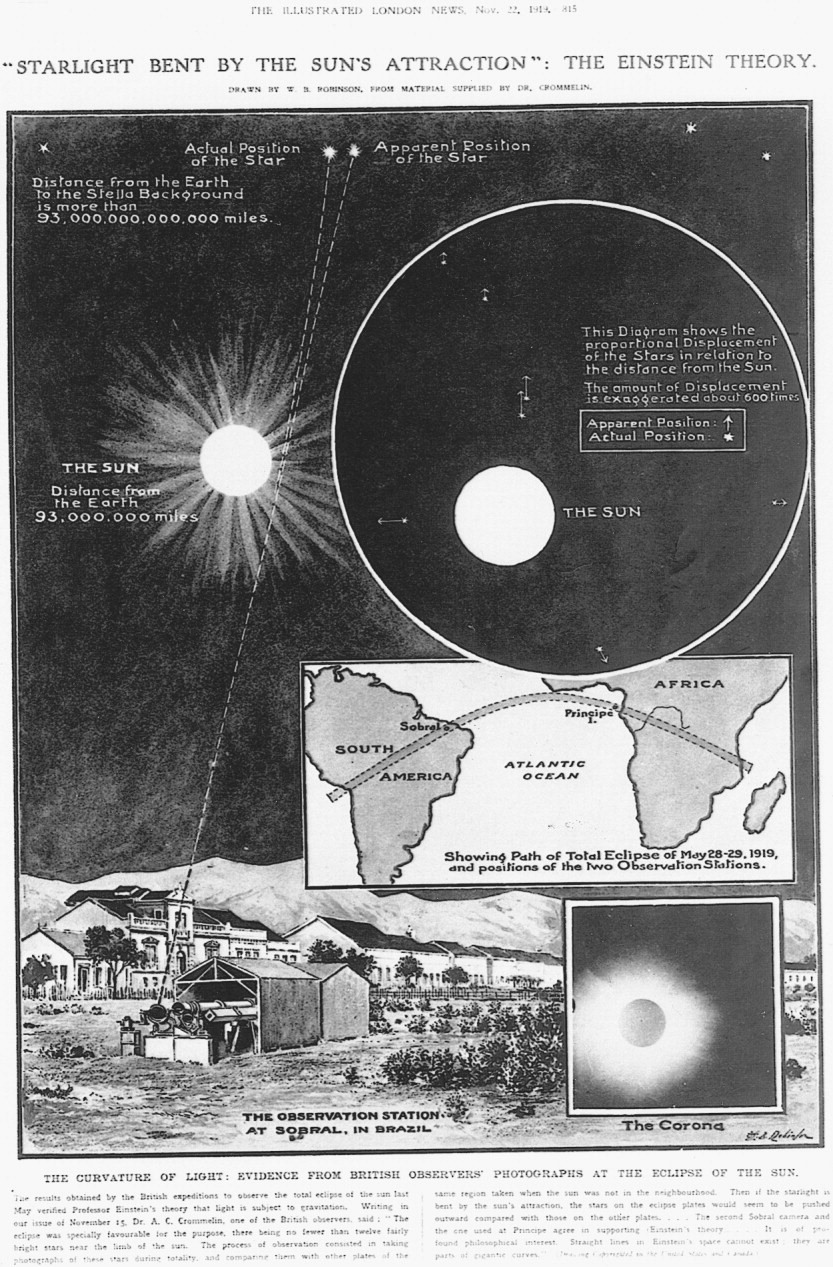
    And just for fun, here’s a good graphic drawn by the old hand W.Robinson for the Illustrated London News, for general consumption, based on information provided the magazine by Crommelin, and published November 22, 1919, page 820:

    1919 illus london news

     [Image source: University of Chicago, http://www.journals.uchicago.edu.prox.lib.ncsu.edu/doi/full/10.1086/376099, and this via the excellent article by Matthew Stanley, “An Expedition to Heal the Wounds of War” The 1919 Eclipse and Eddington as Quaker Adventurer”, In Isis, 94/1, March 2003. 

    ·Posted by :

    ·in:


  • On a Non-In-Incompleteness Theorem

     JF Ptak Science Books   Post 2726

    BIBLIOTHEQUE

    This is a short bit about incompleteness, the discharge of connection and of knowing. And no, I’m not talking about The Incompleteness Theorem, the big revolutionary one…just a little incompletelness, the small “i” incompleteness, that sometimes doesn’t even make it to the first “e”. It is the sort of frustrating incompleteness that holds you hard when you think you know something, but you really don’t—and then you wonder if you knew it at all, once the connections are made and the analysis done, when the answer is more surprising and insightful than you thought you knew.

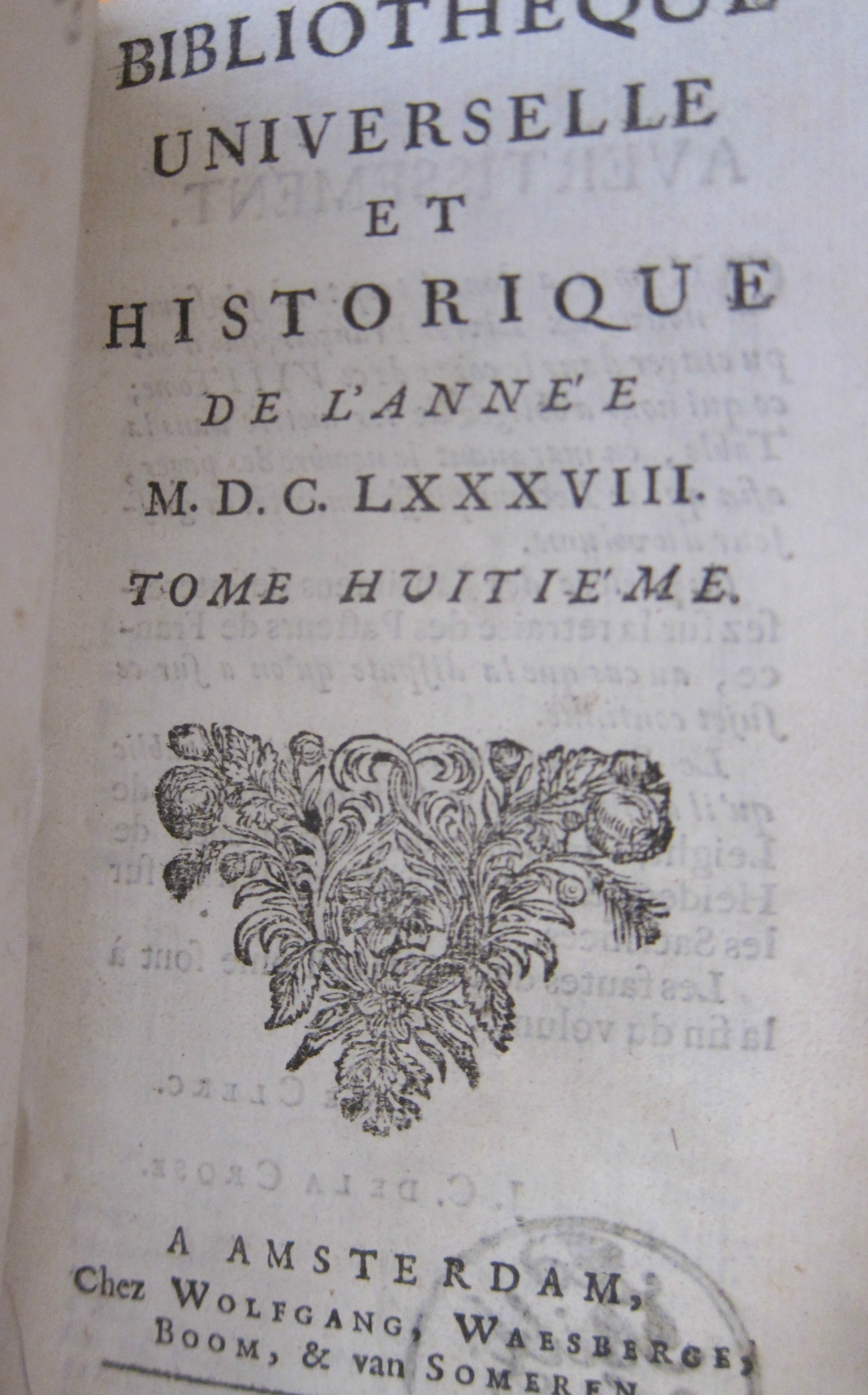
    Bibliotheque vol 8 title pageA big Incompleteness set in the two days ago, thumbing through a volume Jean Le Clerc’s mini-massive journal, Bibliotheque Universelle et Historique, which was printed in Amsterdam in the late 1680’s and early 1690’s, and in its 25 volumes or so covers only about five years in the history of ideas (covering 1688-1792). The books are as stubby as they are lovely, standing a little over 5” high, they are only about 3” wide, and generally about an inch-and-a-half thick. Pocket-sized.

    I did not recall this journal, though it does sound like a lot of other book titles that I’ve bumped into—so I thought I may have known it, but it turns out I didn’t. That was interesting because as it turns out it is a fairly significant publication, with Le Clerc (and other contributing writers and editors1) publishing works on and by some leading figures in the sciences and philosophy. I found out further that the journal was reprinted a number of times, here and there, over a 30-year period or so, which means it achieved some popularity. 

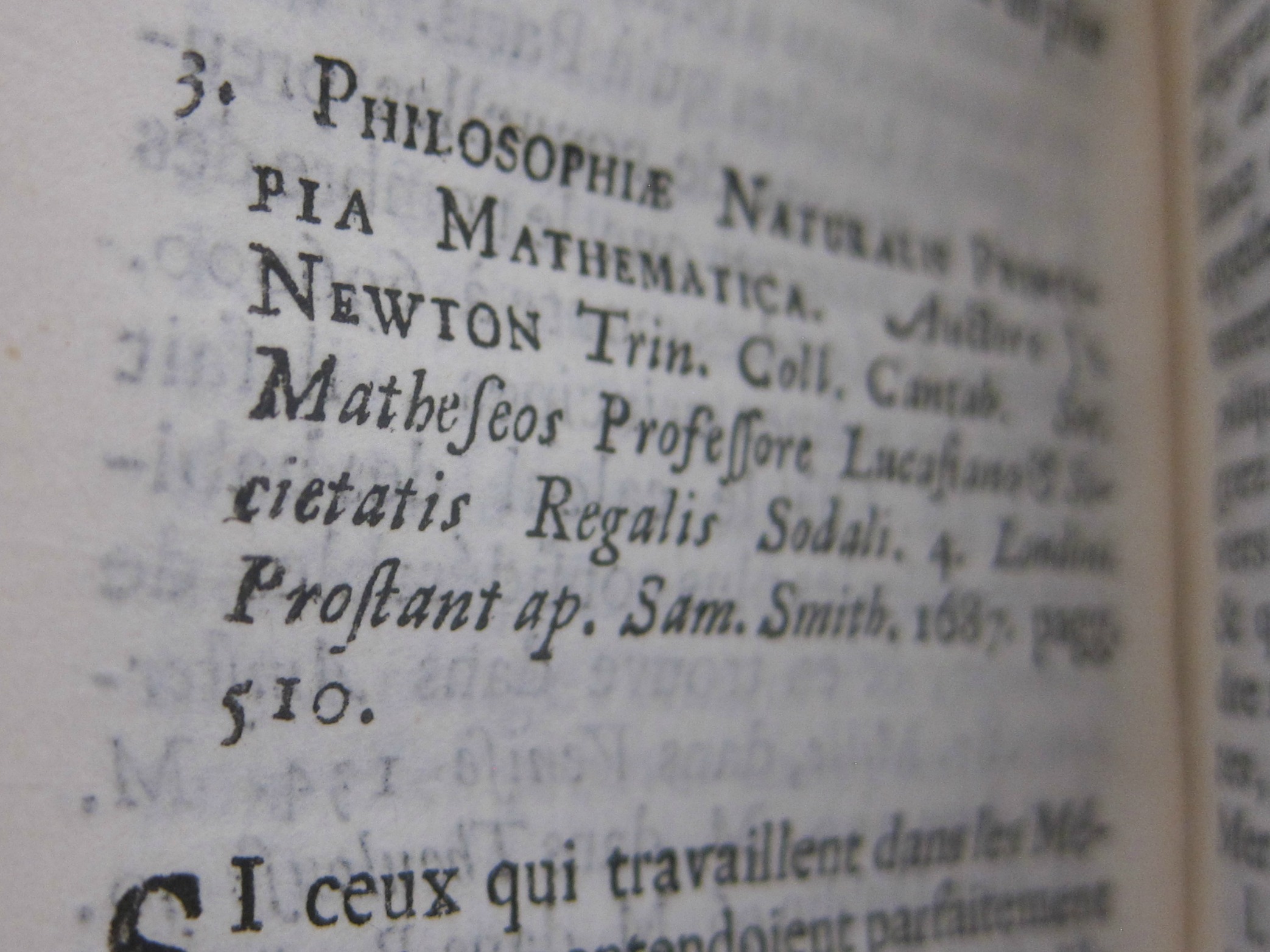
    The first thing I did with the volumes was to check the tables of contents for the biggest name in the sciences that would’ve been covered by this journal for the years 1687 and 1688. 1687 is one of the biggest years in the history of science, and the name that goes with it is Isaac Newton, as this is when he publishes his fully articulated theory of universal gravitation (and etc.) in Principa mathematica philosophiae naturalis [Mathematical principles of natural philosophy]. I worked my way through the volumes, finding interesting entries for Leeuwenhoek (in vols 1 and 5), but didn’t come across Newton until vol 7, where there is an entry for the book but no pagination for it–and then, looking through the volume, I couldn’t find any sight of it, even after finding a digital version and cruising that under the expected words. The big break came in volume 82, with an article on Newton and the book sitting there on page 436-450 (though running about 2000 words for the 14 pp). 

    The Principia was mostly universally well-received from inception, though there were very highly notable exceptions, with Leibniz and Huygens among others criticizing the work. The troubling part, though, for me in my memory, was that this conversation on the book didn’t seem to take place in print within a few years of publication. This is where the incompleteness comes in—I just couldn’t remember why I had this lingering thought about the scarcity of seeing this “review” of the book in print, and this within a year or so of the book’s publication, and why I was shocked to see one.

    Bibliotheque newton princiaWhen I researched the earliest records of published receptions or reviews or comments on the Principia, I was stunned to see that after Edmund Halley’s  notice of the work (which was published in July 1687) in Philosophical Transactions in September 1687, there were only three other notices made in the first year following publication. In that following year, 1688, there were articles in the Bibliotheque (which appeared in March);  the Acta Eruditorum  (in June) and the Journal des Scavans in (a one-page review in August), which makes it appear that the Bibliotheque published first on the Principia following its editor Edmund Halley’s piece in the Phil Trans. The other big surprise is that not only are there significant contributions by John Locke3 appearing in this same volume 8, but I found that the entry on the Principia had been edited by Locke himself4,5.  I have since found out that this is well known to scholars, though I was pretty happy to find this out in my poke-and-hunt operation.  In spite of it all, Locke was probably not the person to undertake the article, and the journal was not terribly science-y, but there it is–the author of the Acta paper, on the other hand, was Christoph Pfautz (1645-1711), who may have been as qualified to address the book, and the journal in which the review appeared was perhaps the most important of its kind at that time.  (This reference to Pfautz comes from Bernard Cohen, who also points out that although Newton seems not to have read any of the four reviews, there is some slight evidence that he may have seen Pfautz’s. The interesting piece here is that Pfautz seems to have been excited by a passerby reference to God the creator of the universe and presented it as important; in the next edition of the Principia, the book’s one reference to God is removed.) But it does seem that the Bibliotheque and Mr. Locke were the first on the continent to publish on the book. (I should note that the Journal des Scavans anonymous review was “hostile and derisive”.7)

    As J.R. Milton writes on Locke’s work on the Principia:

    “This is anonymous, and has generally been assigned to Locke on the basis of a considerable overlap with the notes Locke himself made while reading the Principia. Some writers on Locke and Newton have firmly attributed it to Locke, while others have been rather more cautious. The question of its authorship is, however, settled by a remark – hitherto overlooked – that was made by Le Clerc in 1714 in his own review of the second edition of the Principia: ‘The first edition of this book appeared in 1687 and we published a small extract, composed by Mr Locke, in volume VIII of the Bibliotheque universelle.’ “8

    And so this little journey into incompleteness ends, and I think I’ve figured out a tiny aspect of what I didn’t know and when I didn’t know it.

    Notes

    1. Editors and contributors included: Jean Le Clerc et Jean Cornande de al Crose, vols 1-9; Jean Le Clerc, 10, 12, 14-19; Jean Cornand de La Crose, vol 11; Charles le Cene and Jean Le Clerc, vol 13; Jacques Bernard and Jean Le Clerc, vol 20; Jacques Bernard, vols 24-5. The journal was published every 4 months in vols 1-3; every 3 in 4-19, and then twice a year for 20-25.
    2. According to Hans Botts, volume 8 appeared in January 1688.–Hans Bots, “Bibliotheque Universelle et Historique (1686-1693)” entry in Dictionnaire des journaux, 1600-1789  The article on Newton’s Principia has been established as March, 1688. 
    3. “Indeed the reports or extracts of books are the most numerous, but at the same time there are original contributions from some correspondents, such as The Philosophical Essay Concerning the Mind of John Locke, inserted in this journal two years before publication of the book same (v. VIII, Jan. 1688, pp. 49-I42)”–translated from Hans Bots, “Bibliotheque Universelle et Historique (1686-1693)” entry in Dinctionnaire des journaux, 1600-1789.  
    4.  “The publication in July 1687 of Newton’s Principia mathematica gave rise to only four reviews in the European periodical press. The first was Edmond Halley’s pre-publication notice in the Philosophical Transactions. Then a year elapsed before the Bibliotheque Universelle, the Acta Eruditorum, and the Journal des Scavans, approached the book. Of these reviews that which appeared in Jean Leclerc’s widely read Bibliotheque Universelle has received least attention from historians. This is unfortunate because, of several merits, two in particular are important for the intellectual history of the period: it was written specifically for the large and growing intellectual class of western Europe who for the most part were interested in the new physical sciences, but were untrained in the mathematics necessary to understand many of the newest advances in them. And the author of this review, which was the first independent account of Newton’s book to reach this Continental (largely French-speaking) audience, was John Locke, then a voluntary political exile…”–James L. Axtell, “Locke’s Review of the “Principia”, Notes and Records of the Royal Society of London, Vol. 20, No. 2 (Dec., 1965).   
    5. “(Bibliotheque Universelle…) was the only journal only journal in the Dutch Republic that had published a review of the Principia, anonymously written by John Locke.”–“Newton through the eyes of an amateur”, University of Utrecht website
        The Locke Digital Bibliography project also attributes this review as a work of Locke’s.
    6.  Bernard Cohen, “Reviews of the First Edition of the Principia“, in Peter M. Harman, Alan E. Shapiro (eds), The Investigation of Difficult Things: Essays on Newton and the History of … p 325.
    7. The University of  Florida Newton Timeline makes the following note: “1688 – An anonymous reviewer for the Journal des scavans (Paris 1688) raises objections concerning Newton’s Principia, suggesting quite pointedly that the Englishman should now write a second book where he finally addresses the ‘true motions [of the planets] instead of those that he [merely] assumes’ [JS, August 1688: 128].”– http://users.clas.ufl.edu/ufhatch/pages/13-NDFE/newton/05-newton-timeline-m.htm 

      Bernard Cohen remarks that this anonymous person may have been Pierre Silvain Regis, “a strict Cartersian” and “a hostile critic” (Cohen, Newtonian Revolution, p 96.

      Martin Schonfeld in his The Philosophy of the Young Kant: The Precritical Project notes the JdS review as “critical and derisive” (pg 254).

    8. J.R. Milton, “Locke’s Publications in the Bibliothèque Universelle et Historique”, British Journal for the History of Philosophy, 05/2011, Volume 19, Issue 3.

    ·Posted by :

    ·in:

    —

  • A Smart Piece of Thinking that also Touches on Extraterrestrial Origins of Life on Earth (1875)

    JF Ptak Science Books   Post 2683

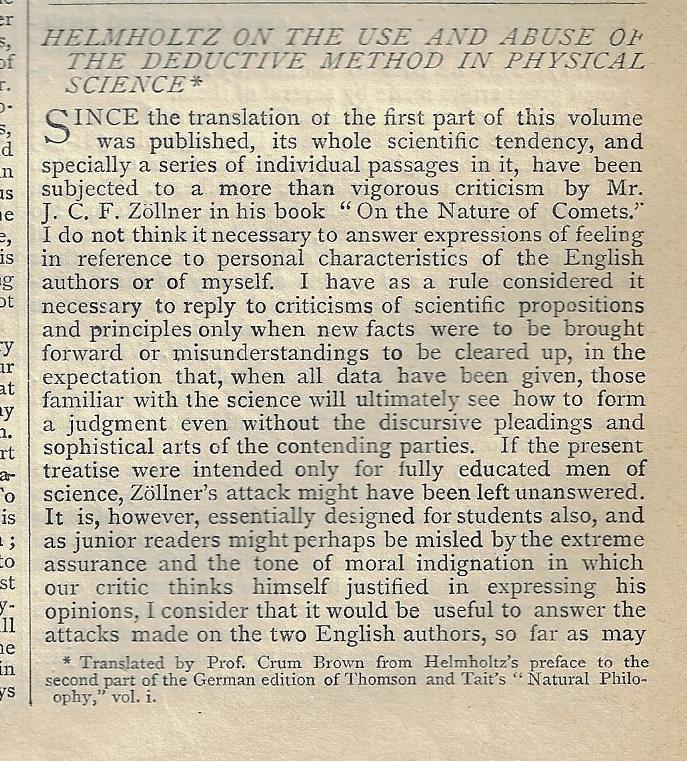
     A note on a short work by Hermann von Helmholtz. “On the Use and Abuse of the Deductive Method in Physical Science”, in a two-part article over two months in Nature:

    • December 24, 1874, pp 149-151 in the issue of pp 141-160 and
    • January 14, 1875,  pp 211-212 in the January 14, 1875 of 201-220pp.  


    Helmholtz pansperma one _1_

    These two pieces by von Helmholtz are just very nice pieces of thinking, delivering several wonderful insights into the nature of reasoning which spread out into other areas, one of which, interestingly, is on the origins of life. For example, in the first paper, in addition to defending his version of deductive reasoning he drops this bon mot into the equation in mentioning the infection of metaphysics in science:

    “Among the scientific investigators who have especially directed their efforts towards the purification of physical science from all metaphysical infection and from all arbitrary hypotheses, and, on the contrary, have striven to make it more and more a simple and faithful expression of the laws of the facts, Sir W. Thomson occupies one of the first places…”–pg 150

    In continuing in the second paper, von Helmholtz goes on to make a statement on the probable great longevity of life in the universe in general, and of the possibility that life could be as old as the universe (“whether it  [life] is as old as matter”), and that some germs could have been brought to Earth (for example) on meteorites, meaning that the origins of life could be extraterrestrial.  Helmholtz points out that William Thompson had addressed this issue in 1871, though Helmholtz himself ad spoken on the issue months before that. In any event, here is von Helmholtz again talking about the origin of life and cosmic pansperma, in 1875.

    “I will mention one other objection of similar scientific value, because it refers to Sir W. Thomson, though not to a passage of this book. The point in question is whether
    it is possible for organic germs to be present in meteoric stones, and so to be conveyed to worlds which have become cool. In his introductory address to the British Association at Edinburgh, in the autumn of 1871, Sir W. Thomson characterised this view as “not unscientific.” Here, too, if an error has been committed, I must profess myself a sharer in it. I had, in fact, indicated the same view as a possible explanation of the transmission of organisms through interstellar spaces at a somewhat earlier date than Sir W. Thomson—in a lecture which was delivered at Heidelberg and at Cologne in the spring of the same year, but is still unpublished. If anyone chooses to regard this hypothesis as highly or even as extremely improbable, I have nothing to object. But if failure attends all our efforts to obtain a generation of organisms from lifeless matter, it seems to me a thoroughly correct scientific procedure to inquire whether there has ever been an origination of life, or whether it is not as old as matter, and whether its germs, borne from one world to another, have not been developed wherever they have found a favourable soil. The physical reasons alleged by Mr. Zollner against the view in question are of very little weight. He points to the heating of the meteoric stones, and adds (p. 26) : ” Thus, even if we suppose that when the parent body was shattered, the meteoric stone covered with organisms escaped with a whole skin, and did not share the general rise of temperature, it was still necessary for it to pass through the terrestrial atmosphere before it could discharge its organisms to people the earth.”–pg 212

    There is a tremendous amount going on in just these few pages of created by one of the most able and expansive scientific minds of the 19th century.  

    ·Posted by :

    ·in:

    —

  • A Not-Very-Ornamental Notice for the First Lecture Given by the First Female Professor at the Sorbonne–Mme. Curie, 1906

    JF Ptak Science Books     Post 2705 (slightly expanded)

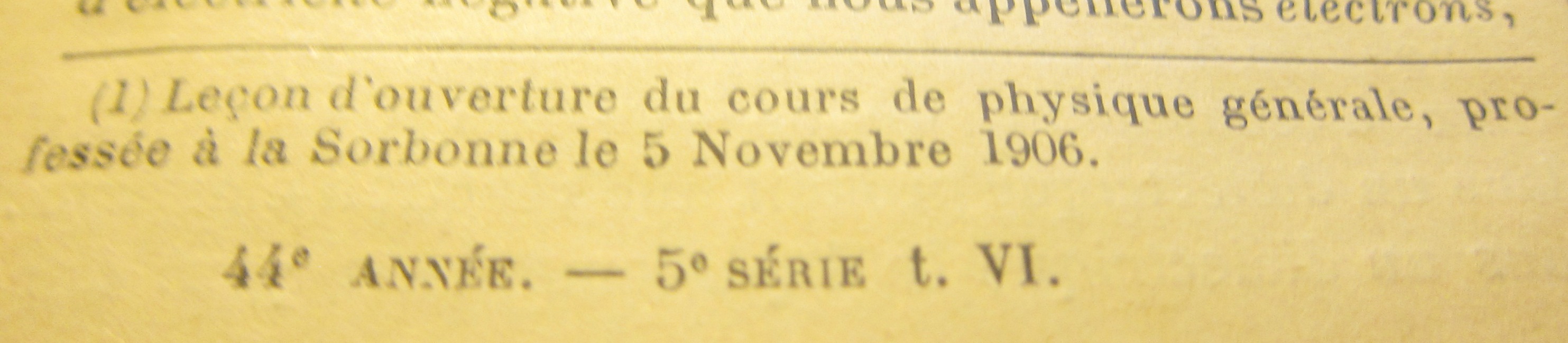
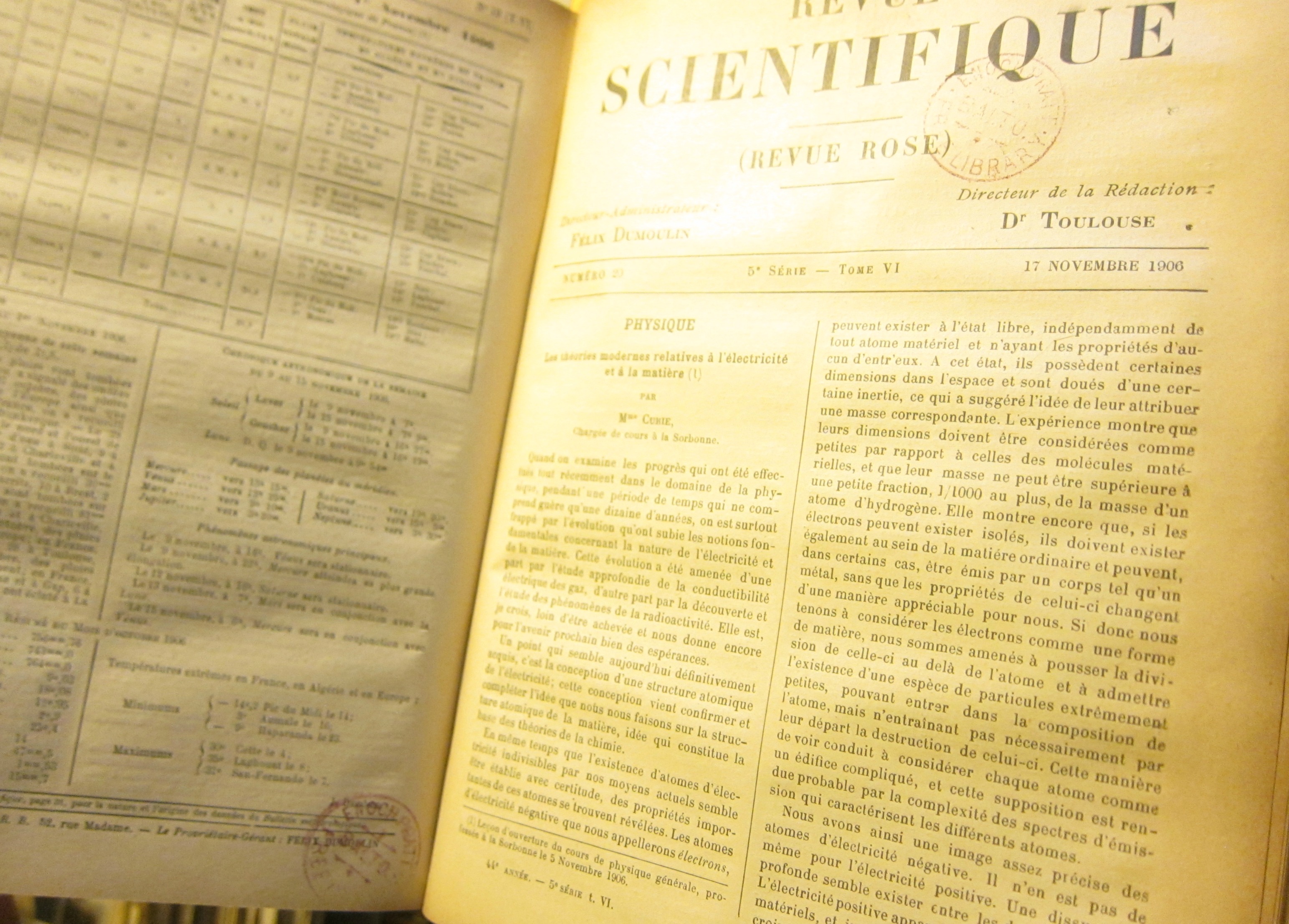
    The poetry and moment of the auspicious occasion of Marie Curie’s first lecture1 at the Sorbonne passed without notice in the page of the Revue Scientifique, which published the lecture a week later. Curie was the lead paper in the 15 November issue of the journal, though there was nothing to mark its historic nature–only a footnote at the bottom of the page referring to the Sorbonne lecture a week earlier. 

    Curie 1906

    This was the first lecture Curie delivered as the first woman to have a teaching position (the first lecturer and first professor) at the Sorbonne  She took the chair in May 1906, just a month after her husband Pierre was accidentally and tragically killed in a freak accident, being crushed by a street carriage. All of this came only a year after the Curies received their Nobel Prize (delayed due to their illnesses from the award year of 1903 to 1905, Curie being the first woman to receive the award).  The teaching chair Curie occupied was that of her late husband, who had only recently (and finally) been appointed to it. With such a history, Curie in her new position began the lecture with the final words that her husband used teaching in that same room.

    I’ve read that the impact may have been loosened somewhat given Curie’s methodical, removed, and monotonic delivery, which left many in the large crowd (attendance thrown open for the occasion) feeling underwhelmed. The Dictionary of Scientific Biography carries a contemporary description of the event so: “Mme. Curie compelled recognition from her first lecture (5 November 1906), despite her timidity, the emotion she was concealing, her weak voice, and her monotone delivery. She made no introductory remarks, took no notice of the sightseers mingling with the students, and began her lecture with the last sentence that Pierre had spoken in that very place. In every demonstration experiment she watched the result with as much interest as if she did not already know it…”2

    Curie 1906_2_

    And Dirac and many others wound up being not-engaged lecturers. So be it. But starting her lecture with the last words her dead husband spoke from the same spot is very powerful stuff, but evidently not powerful enough to move many people. 

    Notes:

    1. Curie, Marie. “Les Theories Modernes Relatives a l’electricite et a la matiere”, in Revue Scientifique (Revue Rose), 5th series, volume VI, #29, 17 November 1906, pp 606-612, and in the next issue, #21, 24 November 1906, pp 650-654. Offered in the full volume for the second half of 1906. Bound in a very stout red buckram with reinforced hinges. The volume contains 26 weekly issues, each title page having the former owner’s round rubber stamp

    2.  Dictionary of Scientific Biography, vol 3, p 501. 

    Also see Nobel Laureates in Chemistry, 1901-1992, by James K. Laylin, pg 92./

    Here’s a contemporary and congratulatory review of the event: 

    “MME. PIERRE CURIE THE FIRST WOMAN PROFESSOR IN THE SORBONNE. The academic year of the University of France may be said to have opened to day November 5 with the lecture by Madame Curie on electricity. The occasion was entirely unique in the history of the Sorbonne and was one of great interest. Never before has a woman had such an appointment at the Sorbonne and no other woman or man living has such a claim as Madame Curie to be heard on her special subject. The rector of the university and other prominent officials were present. The minister of public instruction M Briand who appointed Madame Curie to this professorship made vacant a few months ago by the accidental death of her husband had promised to be present but his presence was required at the opening of the parliament at the same hour. Madame Curie’s course of lectures is one of the so called open courses to which admission may be gained without fees or formal matriculation long before the lecture began the outer gates were closed against those seeking admission. Several hundred of those who filled the corridors were unable to get into the hall of physics in which the lecture was to be given. I almost despaired of getting in and was one of the last who succeeded I was well rewarded for my patience in waiting. Standing behind the last and highest tier of seats in the hall I looked down on three or four hundred people of both sexes and of all ages above twenty. Back of the long table at the opposite end of the room stood the modest self possessed woman who has made the civilized world her debtor by her discoveries…”–Journal of Education, December 6, 1906, p 611.