A Daily History of Holes, Dots, Lines, Science, History, Math, Physics, Art, the Unintentional Absurd, Architecture, Maps, Data Visualization, Blank and Missing Things, and so on. |1.6 million words, 7500 images, 4.9 million hits| Press & appearances in The Times, Le Figaro, Mensa, The Economist, The Guardian, Discovery News, Slate, Le Monde, Sci American Blogs, Le Pont, and many other places… 5000+ total posts since 2008.

Category: Physics

  • Einstein, Frisch, Cockcroft: Atomic Physics Film, 1948

    JF Ptak Science Books   Quick Post

    Archives Atomic Physics film

    I had never seen this video/film before last night–it is pretty solid, and interesting, and I’m a little surprised because for a general-public sort of production it makes some good-sized presumptions of its audience in relation to any physics background. Most of all though there are appearances of Albert Einstein (at 52:15 and 1:01:14), Otto Frisch (1:03:00) and J.D. Cockcroft (1:17:50).

    Source: U.S. National Archives  http://research.archives.gov/description/88106

    ·Posted by :

    ·in:

    —

  • Great Babies: Baby Einstein, Baby Feynman, Baby Schroedinger, and More

    JF Ptak Science Books   Post 2425

    Here’s an interesting set of delightful photographs (and one painting) of some great scientists as babies and kids.  Many of them are obvious, I think, and you can see their developed and mature faces in themselves from very early on.  For example in the first photo is Niels Bohr, his arched eyebrows and halfways-kinda-grin already there at age 4 or 5.  Paul Dirac is gorgeous as a kid and he keeps those eyes throughout his life. The Einstein is an uncommon images, plucking him from a class photo–I guess you can see him in there, somewhere, though it isn’t as Einstein-y as some of the other early photos of him where his eyes are just unmistakable.  Feynman looks like Feynman, sly and smart-as-hell; and the impish and sparkling Turing seems as he would be decades on.  On the other hand the fabulous Kurt Goedel baby could be almost anyone–though I have to say it isn’t often you see photos with the baby’s arm raised.  

    Four of these came from a very nice post on exactly this topic at Kuriositas: (http://www.kuriositas.com/2011/10/famous-scientists-as-children.html) though even at the outset there are more science babies and kids together here than I can find elsewhere.  

    Scientist childhood pics bohr

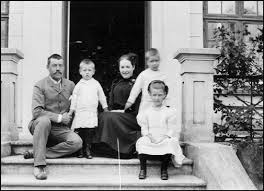
    Niels Bohr, 1890, age about 5. Source: http://www.nbi.ku.dk/english/www/niels/bohr/barndom/


    ·Posted by :

    ·in:


  • Einstein and Fermi Immigration Papers, National Archives

    JF Ptak Science Books   Quick Post

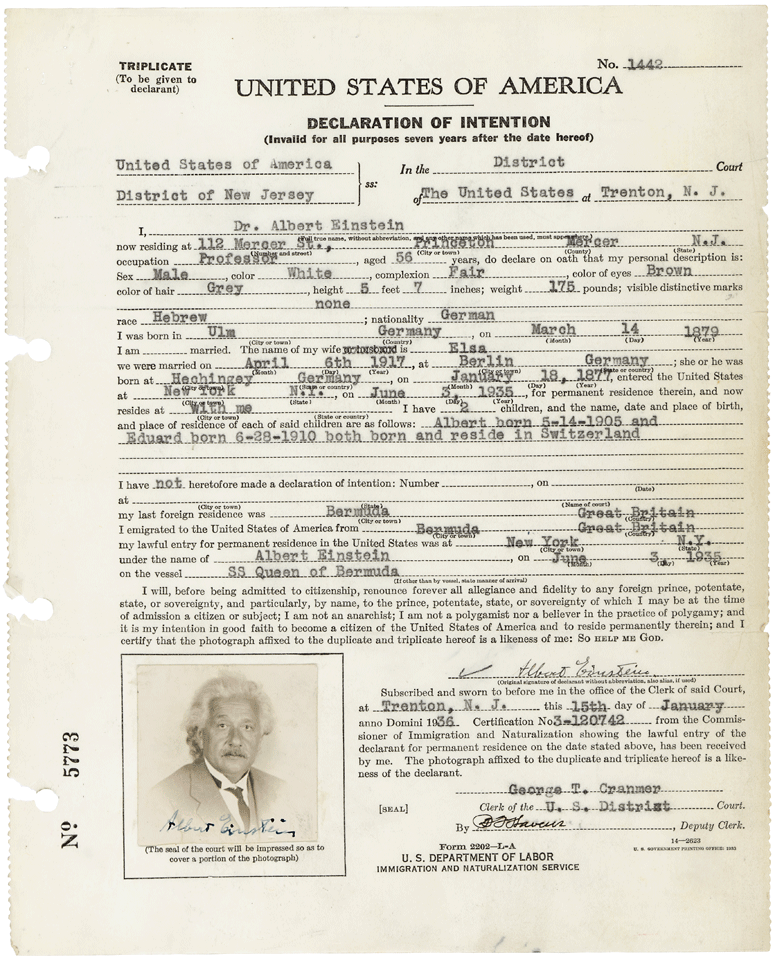
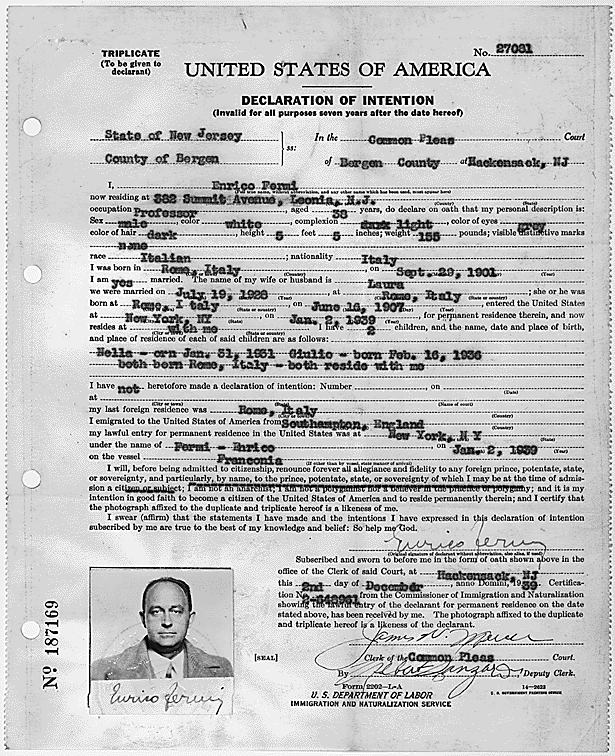
    Below are two immigration reports for Albert Einstein and Enrico Fermi–interesting how the Einstein is simply torn away from the loose leaf binder.  

    Immigration Einstein

    Albert Einstein, Declaration of Intention for Immigration

    Source: National Archives: http://research.archives.gov/description/596270

    Immigration--Fermi

    Enrico Fermi

    Source: National Archives: http://research.archives.gov/description/281852

    ·Posted by :

    ·in:

    —

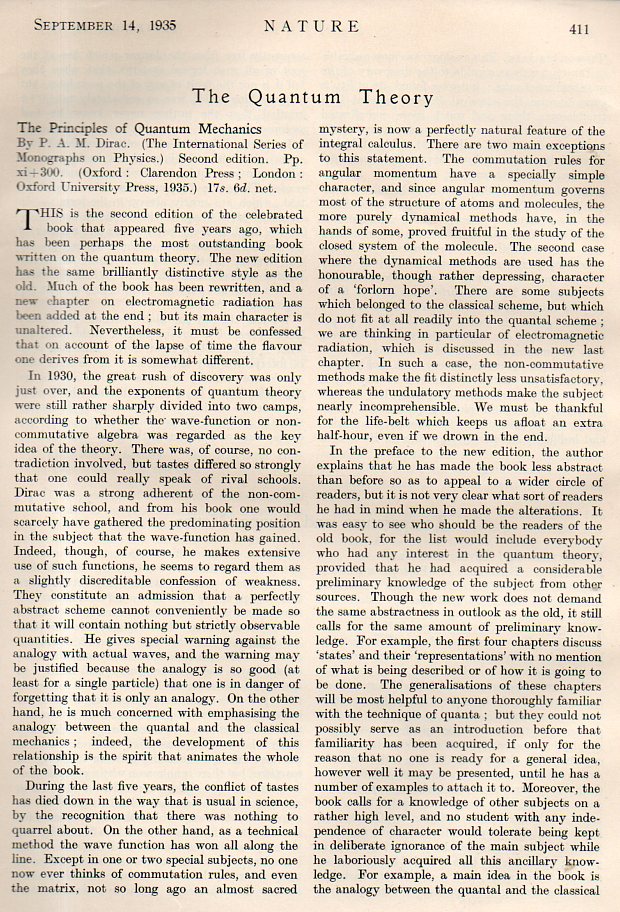
  • A Review of Dirac’s Quantum Mechanics (2nd Ed)

    JF Ptak Science Books   Quick Post

    Years ago when I still had a big, open bookstore specializing in books in used/rare physics/maths I had several bookcases dedicated to quantum mechanics. In general I had the standard works and great classics, and few were more “standard” and “classic” at the same time than P.A.M. Dirac’s  Principles of Quantum Mechanics.  

    Dirac in 1907

    [Paul Dirac (1902-1984), in 1907, Image source]

    On rare occasions I would have all four editions (the first of 1930 is very scarce and valuable nowadays) but usually there would be editions 2, 3, and 4. In order to respond intelligently to the differences between the editions I went to the library and photocopied reviews of each (this in the pre-intertubeweb days).  Today I managed to bump into the most interesting of the reviews (for the second edition of 1935 and published in the September 14, 1935 issue of Nature) which I reproduce below.  

    Direac qt 830

    ·Posted by :

    ·in:


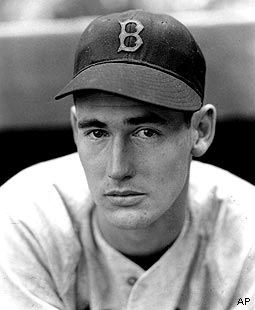
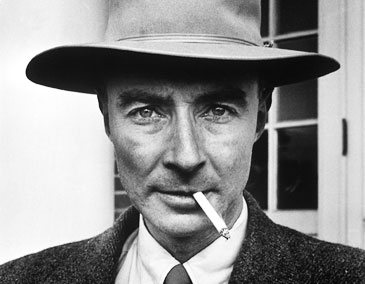
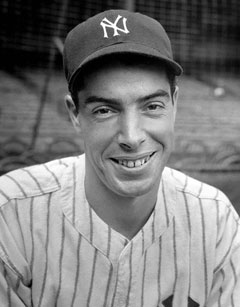
  • Robert Oppenheimer as a Ted Williams or a Joe DiMaggio?

    JF Ptak Science Books    Post 2407
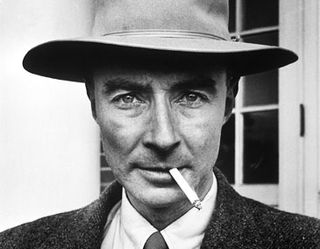
    Oppenheimer williamsOppenheimerOppenheimer dimaggio

    Years ago I phone-met the physicist Al Wattenberg. He started his long and fine career under the bleachers at the University of Chicago, working with Enrico Fermi where on December 2, 1942, they achieved the first controlled nuclear chain reaction.  (The moment was celebrated with a bottle of Chianti donated by Eugene Wigner, and it was signed by all those present at the creation.  It turned out that Wattenberg was the last man to leave the area, and he saw the abandoned Chianti bottle and rescued it–he gave it to the Argonne National Lab where it lives to this day.)

    One day I asked him about Fermi and what he was like when he wasn’t working. Wattenberg said that he used to play tennis with Fermi, who (paraphrasing here) played tennis like he did physics–meticulous, methodical, careful. He said he was frustrating to play with, and he never beat Fermi at the game.  

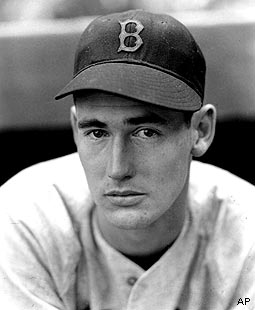
    I like these offbeat cross-interest metaphors for explaining complicated things. And it was this thinking that brought me to Oppenheimer and the New York Yankees–and that Boston team–in the hope of dislodging a little piece of insight that might come from comparing disparate things. And so far as I can tell discussing Robert Oppenheimer in terms of Ted Williams and Joe DiMaggio doesn’t get very much red carpet room as an idea, and I suspect that there are good reasons for it.  

    Let’s face it—Robert Oppenheimer left his theoretical physics career sorta behind when he went to win the war at Los Alamos in 1943. I was surprised to see today that his publishing career for the hard stuff stopped around 1950 He was an absolute brilliant light when he started out in 1926, and a massive influence in his field by 1940.

    Here’s what the production looked like: 

    • 1926-29:  16 papers
    • 1930-39   36 papers
    • 1940-42  10 papers

    Which makes 62 papers for the 1926-1942 period . After the war, from 1946-50, there were five papers. And after that, none. That’s not to say that he didn’t publish, because he did, and was prolific—it was just a different career. Also from 1926-1942 he was a theoretical physicist with wholly different responsibilities than those he would take on in 1942, when he became not only the brilliant physicist but also the brilliant administrator/director/curator, working an almost-impossible job with thousands of creative people and the U.S. Army in shacks  in the desert trying to beat the Nazis to a bomb that would end the war.

    After the war Oppenheimer helped to formulate the direction of physics in the U.S., leading Princeton’s Institute for Advanced Study as its director;  then he helped formulate American nuclear policy going into the Cold War as the Chair of the Atomic Energy Commission. And then there was the great tragedy of his “security hearings” (1954) which crushed him on a McCarthyite slab,  costing him much of the rest of his career. And then he was dead in 1967.

    Had he not gone to war, had he not taken the job only he could have done, what would he have become? His accomplishments were already large–the Born-Oppenheimer approximation, Oppenheimer-Phillips process, neutron stars, quantum tunneling. More than likely one of the things he would be well known for today would be his development of the discovery and understanding of black holes—a singularity that he discovered in with in a paper called printed in Physical Review on September 1, 1939, but this was somewhat premature for the time.  And then came the war.

    Millions of other people went to war, too, stopping their lives on one end, starting a new life on the other, and then returning to their previous lives with varying degrees of retention or creation. Two of those folks were Ted Williams and Joe DiMaggio.

    Ted Williams went to war too, from 1943-1945. Williams just started out in his brilliant career hitting .406 in ; then two years later, he was gone. Williams was 24-26 years old for the war. Oppenheimer 38-40, though Ted got to play from 1946-1960 when he came back, absent a year that he spent as a Marine fighter pilot during the Korean War (“strafing Commies”). No doubt Williams would have piled up the numbers in a big way had he played ball in those four years

    Then there’s Joe DiMaggio, who also served for those years when he was 28-30. He had finished up seven years with the Yankees before he left, brilliant—perhaps the most stellar thing about it all (long pointed out to me by my friend, Mr. Baseball, Andy Moursund) was that he hit 219 home runs while striking out 196 times in 7 years. His batting averages were very high, and he was a slugger, and he didn’t walk all that much compared to Williams. This seems more in-line with Oppenheimer—a different sort of precision, one where DiMaggio hit for power and rarely didn’t hit anything at all, going up swinging but rarely going down swinging at nothing on the third strike. Although he was relatively young went he left for the war, he came back at 30, and played another 6 years,

    It may be too weird or nonsensical to think of these sorts of things, let alone thinking of Oppenheimer in units of Joe DiMaggios, especially since Oppenheimer knew/cared nothing about sports2. Plus in the alternative histories world we really can’t express the potentials of missing years, especially in terms of metaphors from non-related entities.

    On the other hand, I did create a physicists vs. mathematicians chess set, matching up people with what their possible position of the board might be, we can probably Oppenheimer to his baseball equivalent.

    Perhaps this is also my pneumonia talking rather than my brain, what with Spring Training approaching, and perhaps this was all useless–but for some reason if Oppenheimer suddenly appeared out in the front yard wearing a baseball jersey, I’d see him in pinstripes, with a “5” on his back.  
    ·Posted by :

    ·in:

    —

  • A Wooden Mechanical Demonstration of Wave Propogation, 1897

    JF Ptak Science Books   Quick Post

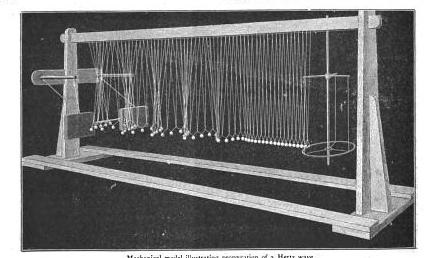
    This fine, geometrical wooden apparatus was made by electrician and physicist Sylvanus P. Thompson (1851-1911)–two metres long, the model was for a demonstration before the Physical Society of London, “illustrat(ing) the propagation of a transverse wave”.  The image appeared in Nature, August 12, 1897.

    Thompson mechanism

    ·Posted by :

    ·in:


  • Confirmation of Einstein’s Theory of General Relativity, 1919

    JF Ptak Science Books    Quick Post

    “It is concluded that the sun’s gravitational field gives the deflection predicted by Einstein’s general theory of relativity.”

    I’ve bumped into a famous piece of phsyics history, a semi-popular report on the verification of the Einstein theory of general relativity. The article is “Eclipse Photographs Verify Einstein’s Prediction” adn is found in  Popular Astronomy (published in Northfield Minnesota, volume 28, 1920, the issue for January, #1, 1920, with the notice appearing on pp 69-70.) At about the same time there appears the famous and deciding report by F. W. Dyson, A. S. Eddington, and C. Davidson, “A Determination of the Deflection of Light by the Sun’s Gravitational Field, from Observations Made at the Total Eclipse of May 29, 1919” which appeared in the Philosophical Transactions of the Royal Society of London. Series A, Containing Papers of a Mathematical or Physical Character for 1920 (pp 291-332). This is the integral report on  which Popular Astronomy reports on for a more general astronomy readership.

    This report repeats the famous finding: “It is concluded that the sun’s gravitational field gives the deflection predicted by Einstein’s general theory of relativity.”

    ·Posted by :

    ·in:

    —

  • Abstracts of Einstein’s 1905, 1907, & 1916 Papers

    JF Ptak Science Books  Quick Post

    I’ve nibbled away at a set of the Science Abstracts (Physics) and pulled away several reviews of Albert Einstein’s great papers of 1905, 1907, and 1916.  
    =>Einstein’s three monumental papers of 1905, as they appeared in Science Abstracts, Section A.–Physics, 1905, volume VIII, 1906, printed in London, E. & F.N. Spon, 


    ·Posted by :

    ·in:

    —

  • An Outstanding Issue on Relativity in NATURE, 1921

    JF Ptak Science Books  Quick Post

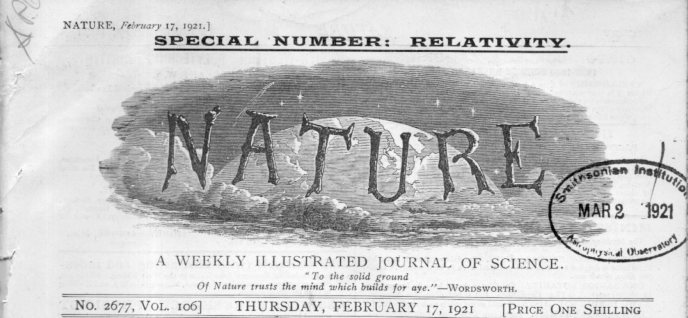
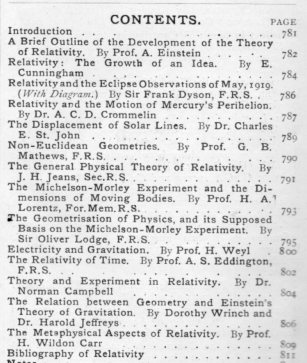
    I bumped in this issue of Nature  (volume 106, pp782–784) this evening, and as it turns out it is the “Special Number: Relativity” and published February 17, 1921–and it is packed. Somehow when I first looked at this weekly I mega-missed the Einstein entry–as is customary I work back-to-front, bottom-to-top (don’t ask) and was so taken by the collection of Big Names that Einstein’s escaped me. Einstein’s article is longish for this journal and concise, with numerous references in the influencing forces in his development of the theory of relativity (which he capitalizes).  Einstein nature 1921429

    The table of contents for this single week–though it is (roughly) a double issue of thirty pages or so–incoudes work by Cunningham, Frank Dyson, James Jeans, H.A. Lorentz, Oliver Lodge, Herman Weyl, A.S. Eddington, Norman Campbell, and Harold Jeffreys, plus a few pages of tight bibliography.  

    Einstein nature 1921430

    Here’s the beginning of the Einstein article, courtesy of Nature, with the rest of it available from their website, here. My copy (formerly in the Smithsonian Institution) is too tender to open fully for the scanner, but the cover’s masthead is certainly available, and pretty. Abraham Pais notes in his Subtle is the Lord : The Science and the Life of Albert Einstein, that Einstein delayed the publication of the issue somewhat in his attempts to make a complicated issue fit in the space allot (as in the old Mark Twain adage, “If I had more time I would have written a shorter letter”).  So, the Einstein:

    A Brief Outline of the Development of the Theory of Relativity, by Prof. A. Einstein

    [Translated by Dr. Robert W. Lawson] 

    There is something attractive in presenting the evolution of a sequence of ideas in as brief a form as possible, and yet with a completeness sufficient to preserve throughout the continuity of development. We shall endeavour to do this for the Theory of Relativity, and to show that the whole ascent is composed of small, almost self-evident steps of thought.

    The entire development starts off from, and is dominated by, the idea of Faraday and Maxwell, according to which all physical processes involve a continuity of action (as opposed to action at a distance), or, in the language of mathematics, they are expressed by partial differential equations. Maxwell succeeded in doing this for electro-magnetic processes in bodies at rest by means of the conception of the magnetic effect of the vacuum-displacement-current, together with the postulate of the identity of the nature of electro-dynamic fields produced by induction, and the electro-static field.

    ·Posted by :

    ·in:


  • History of Lines: the Big Little Lines of Richard Feynman (1949)

    JF Ptak Science Books   Post 2333

    Perhaps the only bigger five put-together lines than Feynman diagrams may be home plate; otherwise I’m hard pressed to come up with a better thing that can be drawn in this way with this many lines.  

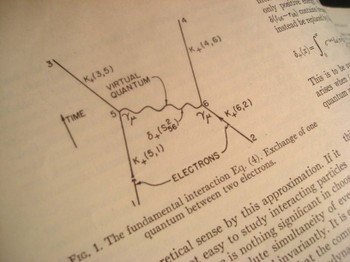
    The impossibly smart Richard Feynman (1918-1988, Nobel in 1955 for the development of quantum electrodynamics; physics of superfluidity; path integral formulation of QM, etc.) worked on a schematic that would  visualize quantum electrodynamical interactions, the scattering calculations in QFT describing interactions between particles The result is known by nearly everyone on earth as Feynman diagrams. (Murray Gell-Mann, another Nobelist and ueber diligent partner and competitor of Feynman’s, and perhaps as influential a physicist (with the Eightfold Way and etc.), refers to the diagrams as (Ernst) Stuckelberg diagrams, named for a once-obscure physicist who, among others, came up with an early schemata closely resembling Feynman diagrams.)  They are an elegant and powerful redistribution of complex arrangements that are more easily calculated when visualized.


    Dsc00016

    The images here are the first time the diagrams were published, and are found in the 15 September 1949 issue of the Physical Review after having been introduced in conference and class work (at Cornell int eh 1948/1949 QED course that Feynman taught there). They are among the top-10 prettiest pictures in physics of the 20th century.

    Their descriptive power is matched only by their crystalline simplicity—few diagrams have ever been constructed with a greater claim.

    Dsc00015


    ·Posted by :

    ·in:

    —