A Daily History of Holes, Dots, Lines, Science, History, Math, Physics, Art, the Unintentional Absurd, Architecture, Maps, Data Visualization, Blank and Missing Things, and so on. |1.6 million words, 7500 images, 4.9 million hits| Press & appearances in The Times, Le Figaro, Mensa, The Economist, The Guardian, Discovery News, Slate, Le Monde, Sci American Blogs, Le Pont, and many other places… 5000+ total posts since 2008.

Category: Physics

  • Addressing the Kinematics and Dynamics of One-Dimensional Motion: Jumping

    JF Ptak Science Books   Post 2324
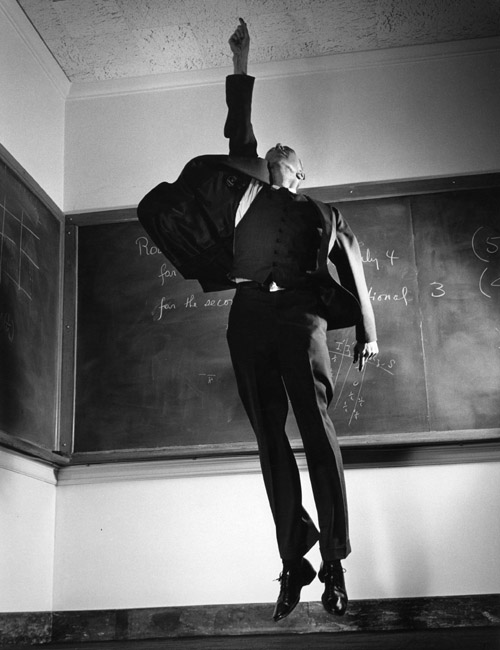
    Jump oppenheimer

    [Image source: http://rebelsintradition.com/wp-content/uploads/2014/05/tpp-13-halsman_Oppenheimer.jpg]

    The American Journal of Physics, published for the American Association of Physics Teachers by the American Institute of Physics (how many times did I use the word “physics”?) is a superb periodical, and for most of the time that I have been familiar with the journal it has published a very wide variety of physicsiana, including the history of physics, and (perhaps with the highest walk-by entertainment value) practical/applicable physics. I am working on a considerable stack of them right now, and the first one pulled at random began with an article by Leon Lederman on the history of the neutrino–this is an 8-page I-was-there deep-overview with 103 bibliographic references, and looks very useful.  (There’s much else of interest: Eastwood “Robert Grosseteste on Refraction Phenomena”, Bess’ “Supplementary Note on Brownian Motion”, and 20 others. Really fantastic. (This would be in volume 38/2, February 1970–but it lives behind a paywall…)
    Jump Mets

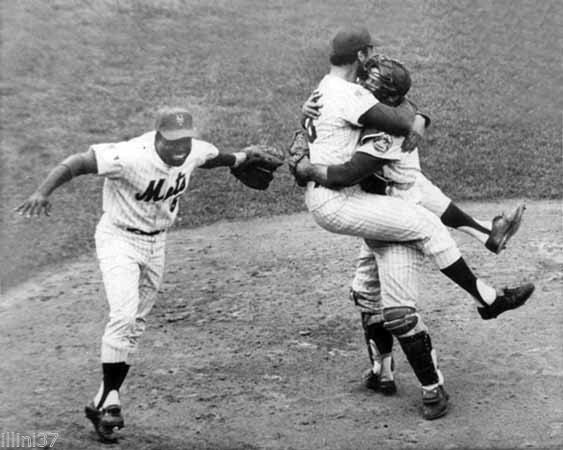
    The Lederman of course is serious stuff, but in the very next issue that I held in my hand was one of those in-my-mind-famous entries on applied physics, and serious, and fun:  Elmer Offenbacher’s Physics and the Vertical Jump” (July 1970).  Offenbacher relates a famous photo of Robert Oppenheimer jumping for Philippe Halsman’s Jump Book (1952) which was a book by the great photographer of images of people jumping.  And jump Oppenheimer did–one of the best jumps in the book, a jump reaching for something with an outstretched finger, coat open and flying, a big effort, jumping for something.  (Much different from the stunted and under-control “jump” by Richard Nixon, who tried to deceptive-jump without jumping and failed, unlike Tallulah Bankhead, who “jumped” without jumping and succeeded.) Anyway, the notion of jumping and relating it to physics with a picture of Oppie got students to think about the kinematics and dynamics of one-dimensional motion. Offenbacher also opened the article with a story of the celebration of the New York Mets winning their “impossible” World Series in 1969, referring to the jubilant players leaping  into each other’s arms. (The author doesn’t mention names but he must have been referring to two Jerrys–Jerry Koosman,m the winning pitcher, and Jerry Grote, the catcher, along with Ed Charles who was on the mound but not leaping, yet.) 
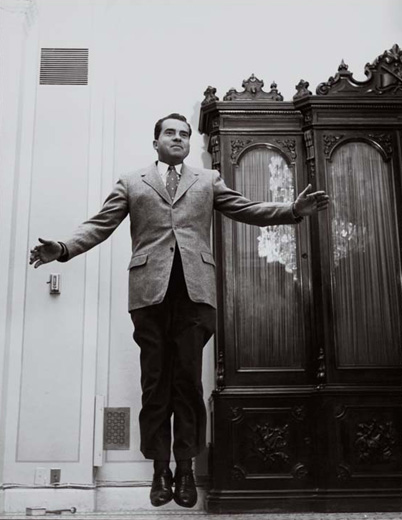
      Jump nixon[Image source: http://rebelsintradition.com/wp-content/uploads/2014/05/tpp-13-halsman_Nixon.jpg]

    This approach was perhaps a little more shiney and interesting than Galileo’s brass balls–the Oppenheimer pic certainly captured my attention. In any event, this was a brilliant idea, and a wonderful way of approach the mechnaics of different sorts of jumping.  
    ·Posted by :

    ·in:


  • Tables of Periodicals of Relativity Interest, 1896-1924.

    JF Ptak Science Books   Reference Tools  

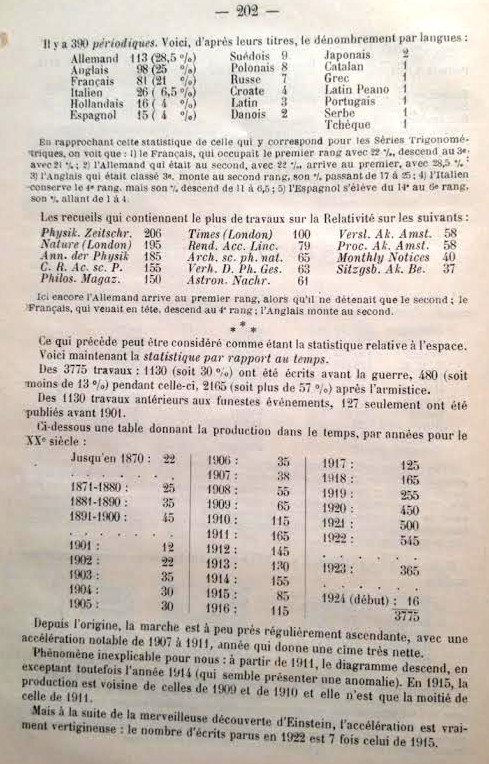
    Earlier in this blog I posted a great graph on the publications on relativity from 1896 to 1924 as published in Maurice Lecat’s Bibliographie de la Relativité, suivie d’un appendice sur les déterminants à deux dimensions, le calcul des variations, les séries trigonométriques, et l’azéotropisme (published in Bruxelles by Lamertin in 1924). Preceding that graph are a few tables of interesting bits on the history of relativity. though I can say that there aren’t too many surprises–the information is still very interesting.  The Physical Review does not make the top-14 list (in the middle table). [Also see here for a good summation of a 1921 bibliography of relativity.]

    Relativity Periodicals2

    The second set of tables shows the distribution by nationality of the contributor–it is interesting to note that the Americans made up 11% of the authors while the Physical Review came nowhere close to that percentage, meaning that the PR hadn’t yet come to its place of high regard as a premium publishing vehicle, though that would come soon enough, particularly by the early 1930’s.  

    ·Posted by :

    ·in:

    —

  • Fantastic Fish-Eye Portrait of Scientists, ca. 1855

    JF Ptak Science Books  Quick Post

    Scientist photo portrait

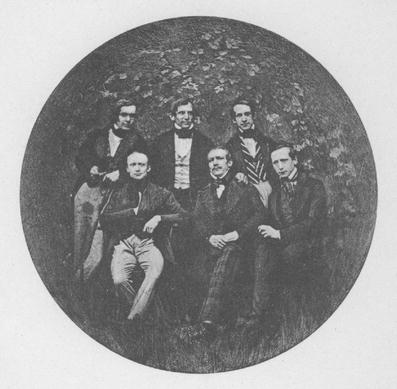
    The founders of the Physikalische Gesellschaft zu Berlin (1845, “Physical Society at Berlin”, which would become  the Deutsche Physikalische Gesellschaft (“German Physical Society”) in a lovely and very uncommon perspective, taken ca. mid-1850’s.  These founding membership pictured above included some first-class heavyweights in their fields:

    Top row: Gustav Karsten, Wilelm Heintz, Carl Hermann Knoblauch.

    Bottom row: Ernst Brücke, Emil du Bois-Reymond, Wilhelm von Beetz.

    [Source: a very interesting paper by Fritz Scholz, “From the Leiden jar to the discovery of the glass electrode by Max Cremer” published in the Journal of Solid State Electrochemistry  (Springer-Verlag, October 29, 2009, online). Apologies for not being able to link to this article behind the paywall.]


    ·Posted by :

    ·in:

    —

  • Ghosts and Neutrinos, 1930

    JF Ptak Science Books  Quick Post

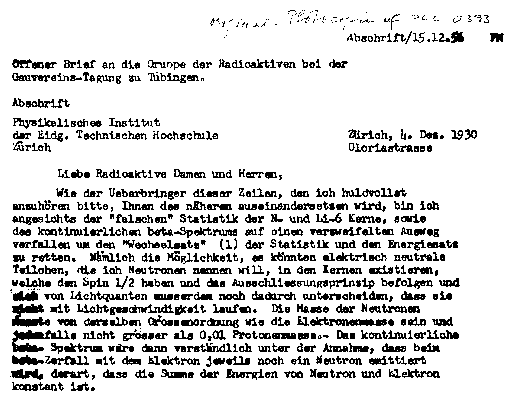
    I wanted to reproduce Wolfgang Pauli’s letter of 4 December 1930–in it he thinks very widely of missing stuff, of some of the basic bits of the universe, in a rather open and guarded way, about the ghost of the neutron.  He didn’t feel very comfortable with his ideas yet, at least for professional consumption–that would have to wait another three years when it was discussed at the 7th Solvay Conference (1933) and another three when it first came into print (1936). The name “neutron” would also be changed to the familiar “neutrino” (“little one”) by Enrico Fermi in 1933 to differentiate it from the much larger nuclear particle discovered the year earlier by James Chadwick–Chadwick’s paper was published in Nature, which would reject Fermi’s paper in 1934 as too radical a leap. 

    Pauli letter

    [Source: Exhibition of the ETH-Bibliothek to the occasion of the 100th birthday ofWolfgang Pauli  http://www.library.ethz.ch/exhibit/pauli/neutrino_e.html]

    ·Posted by :

    ·in:

    —

  • Videos: von Neumann, Gell-Mann, Bethe, Feynman, Oppenheimer…

    JF Ptak Science Books  Quick Post

    A few videos of some of the big folks to start the week…

     John von Neumann in 1956:


    ·Posted by :

    ·in:


  • Bombing and the End of the World: the Physics of 1932 And All That

    JF Ptak Science Books 

    1932 in my book turns out to be one of the most collectively epochal years in the history of science.  Certainly others stand out for individual achievements, like 1905 (Einstein’s four papers over two volume of the Annalen), 1687 (Principia), but there are other yeas with fabulous achievements by numerous people.

    Mar 7 airmen det


    1543 is one.  That year witnessed the published of Copernicus’ De revolutionibus and Andreas Vesalius’ De humani corporis fabrica, two giant achievements for the outer and inner worlds, one challenging the structure of the universe and the other the Galenic tradition of physiology and anatomy. (To a lesser extent is Peter Ramus’ Animadversions on Aristotle which was a very sustained and elegant attack on the ancient-precept Aristotle an physics.)

    1859 saw the publication of On the Origin of Species…JC Maxwell’s work on the kinetic theory of gases, Riemann’s hypothesis, and the spectacular invention of the spectroscope of Kirchhoff and Bunsen (that turned much of the invisible universe visible).

    Mar 7 airmen det 2


    1939 (nuclear fission, chain reaction, neutron stars, magnetic moments, penicillin (advancement), Vitamin K, FM) and 1948 (nuclear structure, QED, transistor, Big Bang) also come quickly to mind.

    1932, though is really quite something, seeing a sweeping array of discoveries in the large and small.  Carl Anderson identified the positron while James Chadwick discovered the neutron; also, the Joliot-Curies’ made their monumental discoveries in radiation.1 Iwanenko described the neutron as a constituent f the nucleus, while Heisenberg described the nucleus as composed of protons and neutrons.  Knoll and Ruska built the electron microscope, allowing a vision of the interior parts of the interiors of the smallest things, offering images almost as spectacularly new as Hooke’s two centuries earlier.  Looking up and out, in the same year, Lev Landau postulated the existence of neutron stars while Karl Jansky invented radio astronomy. There was also the perfection of the “Polaroid” process by Ed Land, and the isolation of ascorbic acid (Vit C, by  Charles Glen King, and the beginning of a long war between him and Szent-Gyorgyi on priority of discovery).  (In the non-sciences, there was the addition of Franklin Roosevelt and Adolf Hitler to their national agendas. It was also a banner year for literature: Death in the Afternoon, Ernest Hemingway; Light in August, William Faulkner; 1919, John Dos Passos; The Thin Man, Dashiell Hammett; Tobacco Road, Erskine Caldwell; Young Lonigan, James Farrell; Little House in the Big Woods, Laura Ingalls Wilder; and Brave New World, by Aldous Huxley…)

    Mar 7 airmen 

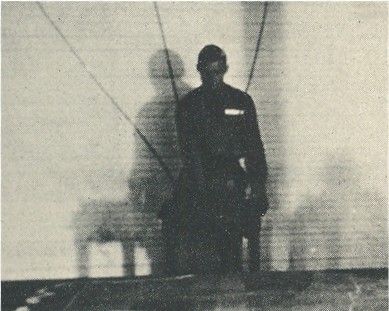
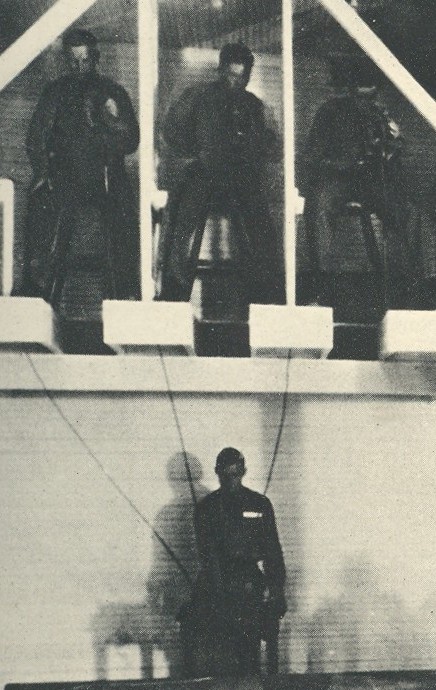
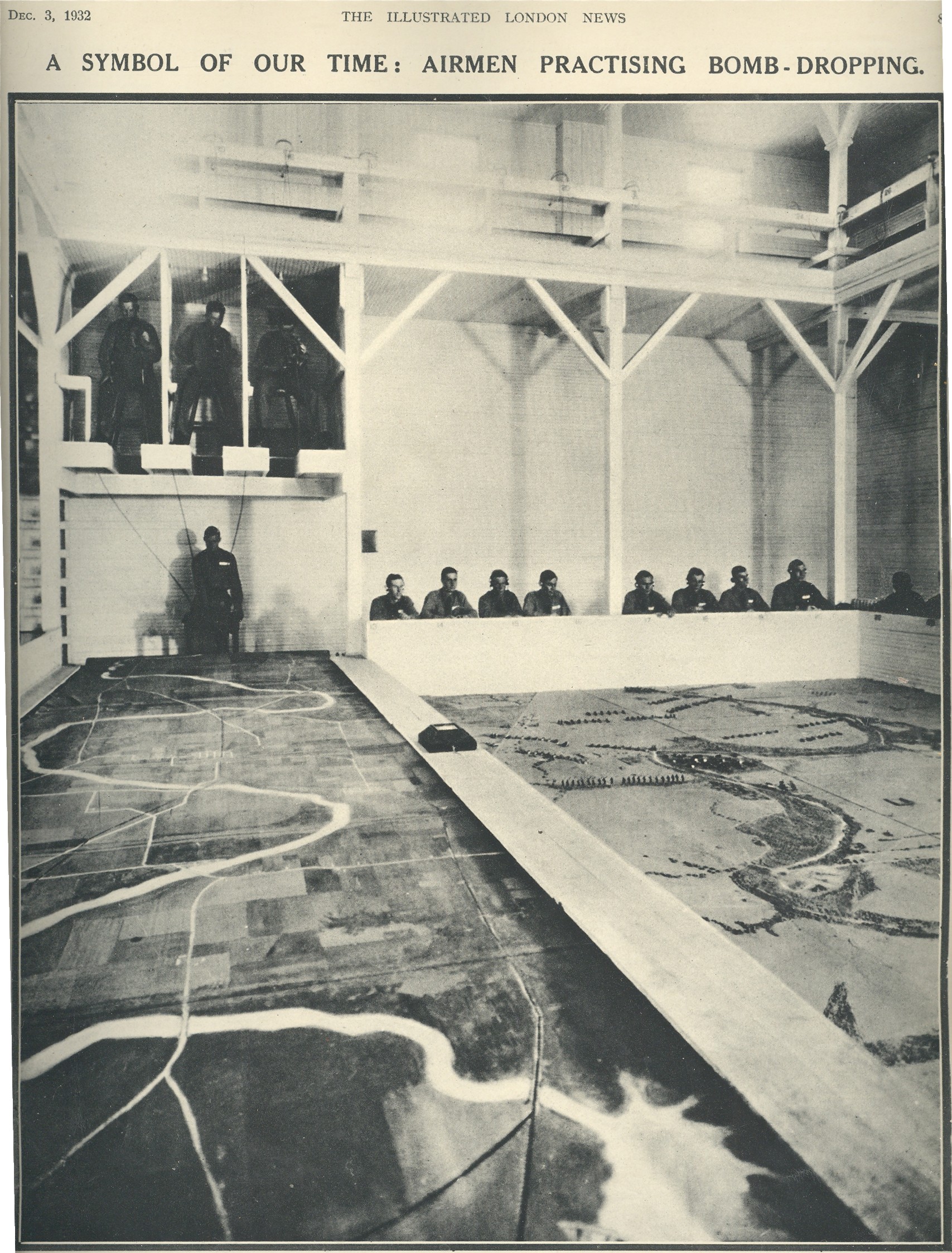
     The thread of thinking about all of this came to mind looking at this image of a bombing instruction room for aviation in England in 1932.  The image is also a great one; the aviator at far left looks like a marionette; the three men above responding to his piloting maneuvers as he concentrates on the endless panoramas of landforms that advances before him on a horizontal diorama.  It is a fabulous analog flight simulator constructed at a time of great change in aviation


    Wonder stories

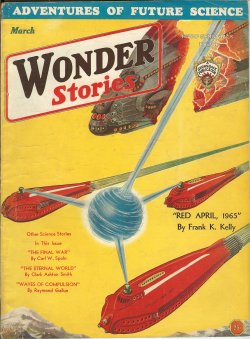
    1932 is also the year of the publication of Carl W. Spohr’s classic future-vision/speculative fiction apocalyptic-atom bomb end-of-the-world two-parter (so many hyphens!) that appeared in Wonder Stories.2 The story begins with a relatively simple series of catastrophic bombings that lead to a sort of détente, a kind of mutually assured destruction, which is then upset when the combatants discover and construct the atomic bomb.   MAD breaks down, and the ensuing massive exchanges result in a  devastated world.   Pretty prescient stuff, all-in-all, even so far as the policy goes—especially so when you wrap this sci-fi story around the elements of 1932—Chadwick, Anderson, Joliot-Curie—that made all of this stuff possible just 13 years later.

    Notes

    1 The Joliot-Curie discovery was called “one of the most important discoveries of the century… the consequences of the discovery of artificial radioactivity are immense” from Segrè, From X-rays to Quarks, 198-199).  

    2.  Part one appeared in the March issue, which also carried stories like“Red April, 1965” by Frank K. Kelly; “The Eternal World” by Clark Ashton Smith; “Waves of Compulsion” by Raymond Gallun; “Mutiny on Mercury” by Clifford D. Simak; “The Time Stream” by John Taine (Eric Temple Bell), and others.  Pretty good bumper crop of sci-fi writers in itself.

    ·Posted by :

    ·in:

    —

  • Very Early Paper on Four-Dimensional Space (1885)

    JF Ptak Science Books   Quick Post

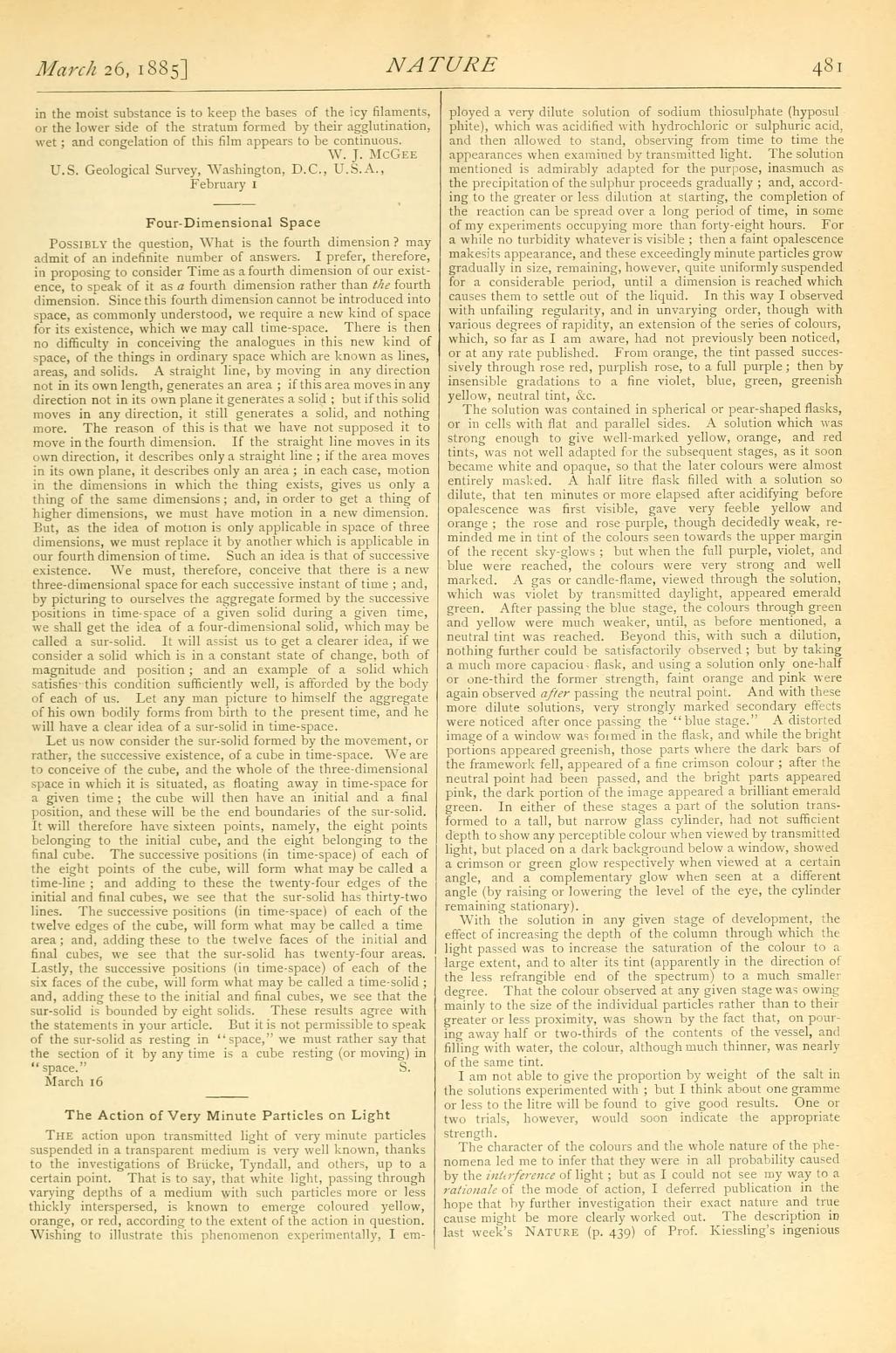
    Not only is this a very early article approaching the subject of space-time, appearing in Nature in 1885 (volume 31, issue 804, page 481), but it is also the most probable source for H.G. Wells’ earliest inspirational source for thinking that would result in such classics as The Time Machine. (See here for an earlier post in this blog for a review of Well’s book in Nature.)  I bumped into it recently on a graze through the endlessly interesting early-ish volumes of this great journal. 

    Four Dimensional Space

    And there were certainly many who came before Wells on the subject of the fourth dimension (though not many on the subject of time as the fourth dimension):  R.C. Archibald wrote on d’Alembert’s (1754) use of time as a fourth dimension (in the Bulletin of the American Mathematical Society for May 1914); Cayley’s “Analytical Geometry of n-Dimensions (Cambridge Mathematical Journal, 1843);  Grassmann’s Die Lineale aus Dehnungslehre (1844); Riemann’s 1854 effort on curved space (translated in 1873 for Nature by W. Kingdom Clifford); Beltrami’s introduction of the pseudosphere in 1868;  J.J. Sylvester (again in Nature for 30 December 1869); Hermann von Helmholtz and his curvature for three-dimensional spaces, and others.  Also,  according to Linda Dalrymple Henderson in her The Fourth Dimension and Non-Euclidean Geometry in Modern Art (Princeton, 1983) in Appendix B there were only a few other efforts before this Nature article. (Some of these include Halsted, “The New Ideas about Space”, in Popular Science Monthly, July 1877; Hinton’s “What is the Fourth Dimension?”, Dublin University Magazine, 1880; Lane “Transcendental Geometry” Popular Science Monthly, August 1882; and Fullerton, “On Space of Four Dimensions” the Journal of Speculative Philosophy, April 1894.)

    Text version: 

    Four-Dimensional Space, by Anonymous.

    From:  Nature, volume 31, issue 804, page 481.  

    ·Posted by :

    ·in:


  • An Unusual Engraved Portrait of Isaac Newton

    JF Ptak Science Books  Quick Post

    Newton engrav larger179

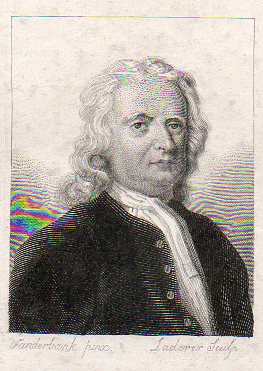
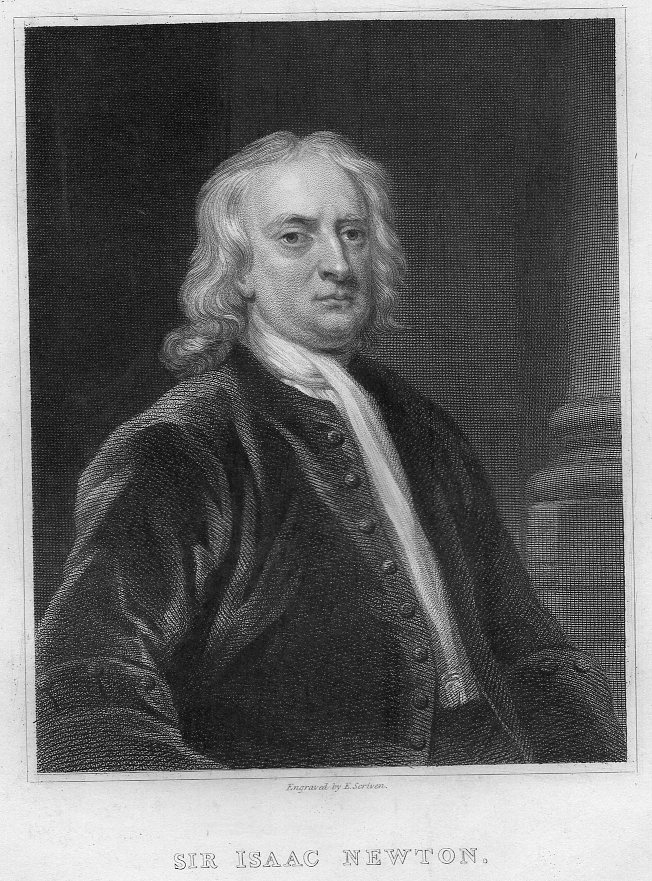
    Of the many portraits painted of Isaac Newton, the vast majority of them came after his death–some were fanciful, some were based on recollection, and others were based on the few examples that have survived painted of him in life.  This happened quite a bit–even someone as esteemed as his semi-counter-rival, the great Robert Hooke, received no attention at all from portraitists during his lifetime.

    I found this lovely portrait of Newton–a miniature, nearly–an engraving by Laderer after the 1726 painting by John Vanderbank, made just  a year before his death, and almost 40 years after he ascent to great fame. 

    Newton Laderer174It is an image I don’t see very often.  

    The original is about 1.5×1 inch on a 10×7 inch sheet, and printed in ca. 1820-30.  I’m unsure of the engraving’s origin. The full version is below.

    THere’s also this engraving, made of the same painting, and executed in the 1830’s, that shows Newton in a little less flattering light–at least here he looks as though he has some decent age on him. 

    Newton engrav larger178

    ·Posted by :

    ·in:


  • A Skelton Key of Blank Physicists, 1946

    JF Ptak Science Books   Quick Post

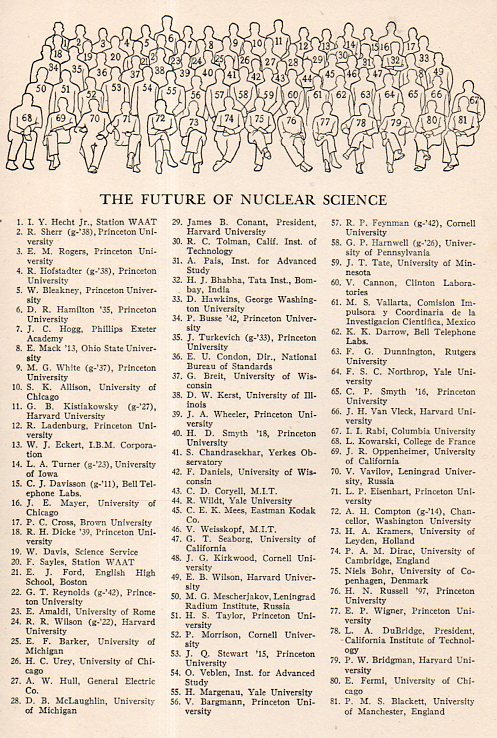
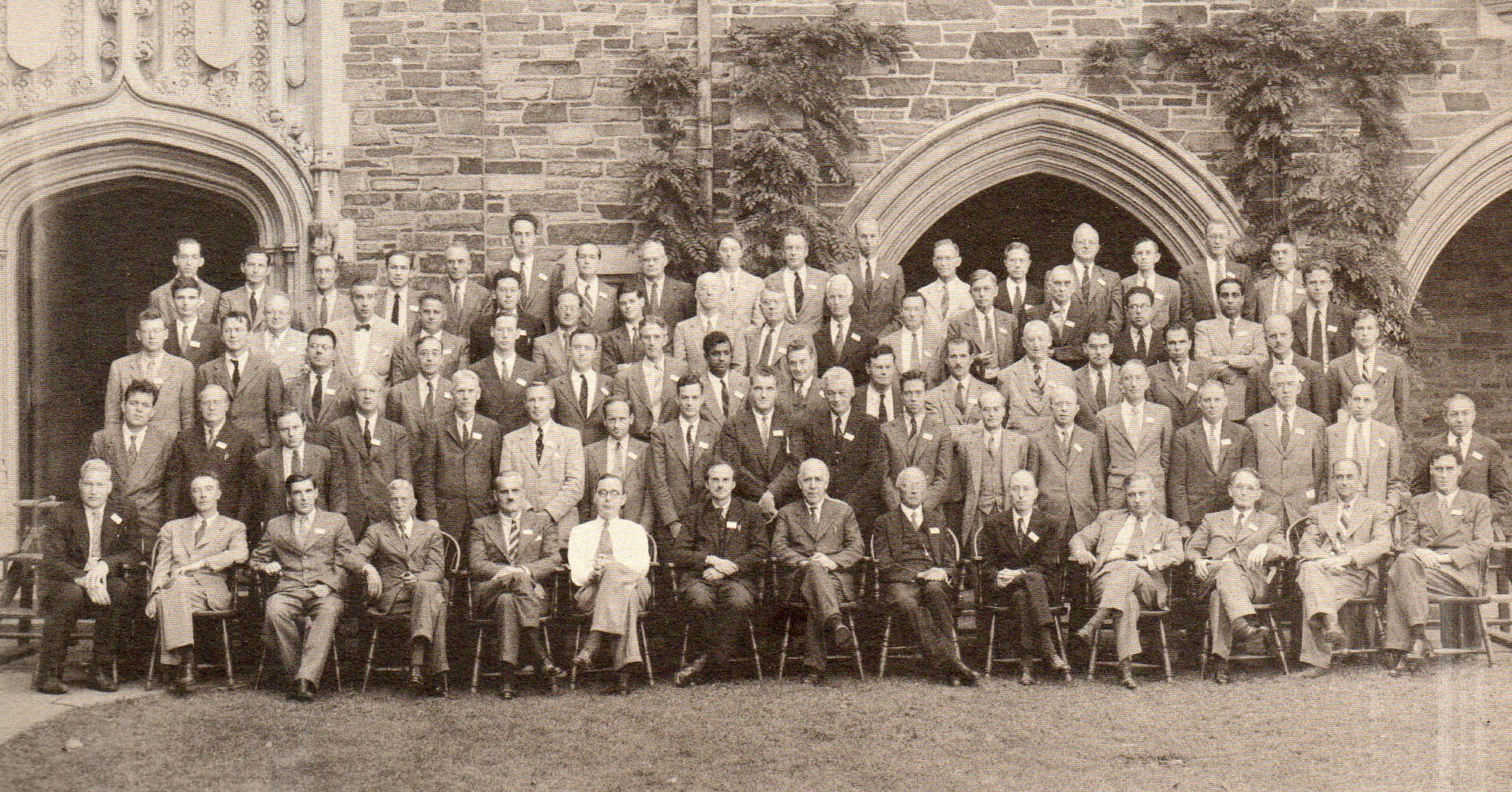
    The Future of Nuclear Science, Princeton University Bicentennial Series, Series I Conference I (1946), with a forward by the director of the conference, E.P Wigner, is mostly just a short (36-page) introduction to the conference, though it does contain a very nice and not commonly seen photograph of the conference’s participants. Of particular interest is the accompanying ghost/outline guide to identifying the group, which seems to take on its own life when viewed out-of-context.

    Skeleton 716
    It is a considerably heavyweight group of physicists–among them are Hofstadter, S.K. Alison, Kistiakowsky, Ladenburg, W.J. Eckert, L.A. Turner, R.H. Dicke, E. Amaldi, Urey, Conant, Tolman, Pais, Turkevich, Condon, Wheeler, Smyth, Chandrasekhar, Weisskopf, Seaborg, Wilson, Morrison, Veblen, Bargmann, Feynman, Van Vleck, Rabi, Eisenhart, Compton, Kramers, Dirac, DuBridge, Bridgman, Fermi, Blackett, and others.  It is a wonderful photograph:

    Skeleton det718
    Here’s a relatively-random detail featuring (bottom left -to-right) Compton, Kramers, Dirac, Bohr, plus (middle left-to-right) Margenau, Bargmann, Feynman, Harnwell, Tate, and (third row) Wheeler, Smyth, and Chandrasekhar.  This was an extraordinary group. 

    Skeleton det a718

    Full text via Hathi Trust via Cornell University.


  • James Clerk Maxwell, on Himself (“a profession was not necessary to a useful life”)

    JF Ptak Science Books  Quick Post

    Around 1870 James Clerk Maxwell–one of the great minds in the history of modern physics–responded to a request by Francis Galton to fill out  a questionnaire for Galton’s work on the characteristics of people-of-genius, and published as English Men of Science, their Nature and Nurture (1874).

    This is a set of Maxwell’s responses about himself, as well as his mother and father: 

    ·Posted by :

    ·in: