A Daily History of Holes, Dots, Lines, Science, History, Math, Physics, Art, the Unintentional Absurd, Architecture, Maps, Data Visualization, Blank and Missing Things, and so on. |1.6 million words, 7500 images, 4.9 million hits| Press & appearances in The Times, Le Figaro, Mensa, The Economist, The Guardian, Discovery News, Slate, Le Monde, Sci American Blogs, Le Pont, and many other places… 5000+ total posts since 2008.

Category: Physics

  • 50-Year Single-Line Timeline of Physics, 1950-2000

    JF Ptak Science Books   Quick Post

    PHYSICS Timeline, 1950-2000 (adapted from the weburbia.com site)

    1950: Paul Dirac, first suggestion of string theory
    1950: Seaborg, Ghiorso, Street, Thompson, element 98, californium
    1950: Jan Oort, theory of comet origins
    1950: Bjorklund, Crandall, Moyer, York, Neutral pion
    1950: Albert Einstein, Einstein’s failed unified theory
    1951: Smith and Baade, identify a radio galaxy
    1951: Petermann, Stueckelberg, renormalisation group
    1952: Courant, Livingston, Snyder, Strong focusing principle for particle accelerators

    ·Posted by :

    ·in:

    —

  • Descartes–Discourse on the Method of Rightly Conducting the Reason, and Seeking Truth in the Sciences

    JF Ptak Science Books  Quick Post

    DISCOURSE ON THE METHOD OF RIGHTLY CONDUCTING THE REASON, AND SEEKING TRUTH IN THE SCIENCES  by Rene Descarte. 

    Descartes contributed a towering amount in the history of science and in establishing modern Western philosophy, all accomplished in a relatively short period of time, as Descartes for all of his massive output only lived to be 54 (1596-1650)…and most of that was completed between 1630 and 1650.  Twenty years. Outstanding. 

    René Descartes. Engraving by Jacques Lubin, after Frans Hals. MS Hyde 77 (1.48.1)

    René Descartes. Engraving by Jacques Lubin, after Frans Hals (via Houghton Library blog, here).

    “PREFATORY NOTE BY THE AUTHOR

    If this Discourse appear too long
    to be read at once, it may be divided into six Parts: and, in the first, will
    be found various considerations touching the Sciences; in the second, the
    principal rules of the Method which the Author has discovered, in the third,
    certain of the rules of Morals which he has deduced from this Method; in the
    fourth, the reasonings by which he establishes the existence of God and of the
    Human Soul, which are the foundations of his Metaphysic; in the fifth, the
    order of the Physical questions which he has investigated, and, in particular,
    the explication of the motion of the heart and of some other difficulties
    pertaining to Medicine, as also the difference between the soul of man and that
    of the brutes; and, in the last, what the Author believes to be required in order
    to greater advancement in the investigation of Nature than has yet been made,
    with the reasons that have induced him to write.

    ·Posted by :

    ·in:

    —

  • “Where Light is declared to be not Similar”–Isaac Newton’s First Publication, 1672

    JF Ptak Science Books   Post 1907

    Next:  on Intitutionalized Nonthinking: the “Negro Pencil” 1938

    “…Where Light is declared to be not Similar…”–from the “abstract” of Newton’s experimentum crucis

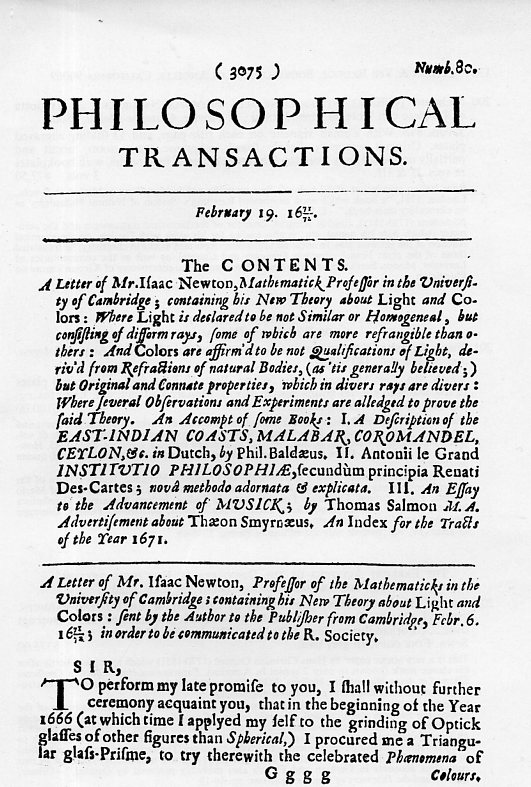
    There were four main contributors to the 19 February 1672 issue of the yet-young Philosophical Transactions of the Royal Society, (No. 80,  pp. 3075-3087). One original papers and three reviews of recently published books:  the first book was a description of the coast of eastern India by Phil. Baldeus; the second, a work on the philosophy of “Renati Des Cartes”; and third, “an essay on the advancement of MUSICK, by Thomas Salmon1.  These three have a common trait in that they are mostly entirely forgotten though the works seem interesting to me.  The scientific paper was written by Isasac Newton:  “New Theory about Light and Colors”.  Though it was his very first publication2 (coming at age 29), it was already the result of years’ worth of hard thought and experimentation3. It also among the most important things he ever published, and was a direct link to his superlative and iconic work published as Opticks in 1704.

    Newton--light809

    (It is interesting to note that the date on the title page is given as “February 19, 1671/72”. This refers to a bubble int he calendar system at the time, where in some quarters the old first day of the year was celebrated on March 25, a practice which didn’t firmly disappear until 1752.  So th e”1671/72″ bit refers to the year being 1671 according to the Old System and 1672 according to the New.)

    Newton was simply the most important person in the history of science.  Aside from all of his many iconic and revolutionary accomplishments, one thing that sands out over the collective of greatness is that he applied a sameness in investigation of different fields, a constant standard of scientific method across the disciplines, which was not necessarily the case with science folks, even extending back into the dimness of the great ancient philosophers.  This in itself was a most major accomplishment.


  • Reference Tool: a Short and Handy Timeline of Quantum Mechanics, 1900-1962

    A Short Timeline of Quantum Mechanics, 1900-1962

    1900 Johannes Rydberg refines the expression for observed hydrogen line wavelengths.

    1900 Max Planck states his quantum hypothesis and blackbody radiation law1902 Philipp Lenard observes that maximum photoelectron energies are independent of illuminating intensity but depend on frequency.

    1902 Theodor Svedberg suggests that fluctuations in molecular bombardment cause the Brownian motion.

    1905 Albert Einstein explains the photoelectric effect.

    ·Posted by :

    ·in:

    —

  • Reference Tool: Handy List of Nobel Prizes Awarded in Physics

    (For some reason I couldn’t find a simple listing of Nobel Prize winners listed alphabetically–so here one is. This is linked to the Nobel site which of course has an exhaustive listing of winners and reasons for the award; this list is a simple thumbnail of the winners.)

    Note: about halfway down is a descending list of recipients with the Nobel Foundation’s reasons for the awards.  All text in the descrption for the award is from the Nobel Foundation site.  (This ends/begins in 1997–I’ll get this up to date shortly.) 

    For videos of the recipients’ Nobel lectures, see here.

    Abrikosov, Alexei A. 2003
    Alferov, Zhores I. 2000
    Alfven, Hannes 1970
    Alvarez, Luis W. 1968
    Anderson, Carl David 1936
    Anderson, Philip W. 1977

    ·Posted by :

    ·in:

    —

  • Inside Looking Out: Ernst Mach vs. the Hudson River

    JF Ptak Science Books  Post 1913
    Machbook

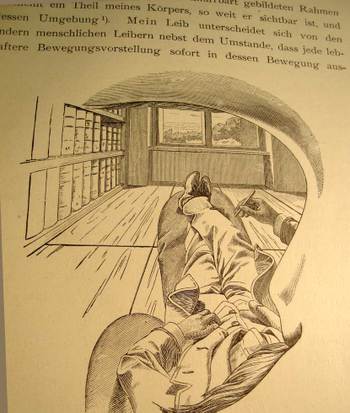
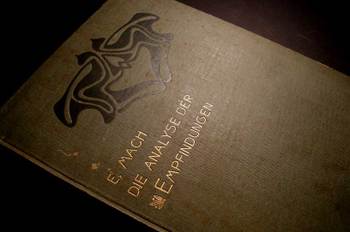
    I cannot think of another illustration by a scientist or philosopher who attempts to explain their own, literal, view of the world and then offer what this looks like to the reader from inside his own head, looking out through his own eye.  That’s exactly what Ernst Mach is doing right here on page 15 of his influential book Die Analyse der Empfindungen,  the fourth German edition (“The Analysis of Sensations and the Relation of the Physical to the Pyschical”, published in Jena in 1903).

    There is nothing in this world for Mach that is not admissible to the human brain that is not empirically verifiable–that is, the world is nothing but awash in sensation and that sensation itself forms part of the experience of, well, experience. I’ve actually never been interested in the philosophy of science, and this is one of the reasons why.  Nevertheless I boldly break through my own prejudices to enjoy this phenomenally original image, drawn from the inside of Mach’s working mind, looking out through his eye socket, over his mustache, under his eyebrow, around his nose, out across his body and then leaping into the rest of the world.  I think he does make his point about the essentialSteinberg_352
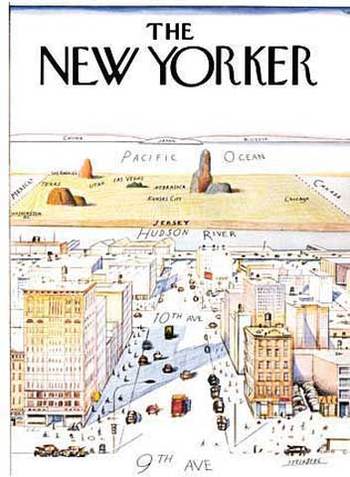
    nature of the observer. And much like the classic Steinberg New Yorker cartoon of the world view of the New Yorker (of course this includes only Manhattan), I know some number of people who have transposed their bodies much like Herr Mach into the Steinberg map–except that their worldview ends basically at the Hudson River (Mach’s feet) with the rest of the world being the sliver out there beyond the river (Mach’s window) until you go 359 degrees around the world to get back to the East River (and back inside Mach’s noggin).  It is an unusual world view to have, but someone has to have it so that we can at least identify it so. 

    I just like the picture.   

    (Section 10, describing this image,  with translation by C M Williams and Sydney Waterlow from the blessed Dover people in 1959):

    “The considerations just advanced, expressed as they have been in an abstract form, will gain in strength and vividness if we consider the concrete facts from which they flow. Thus, I lie upon my sofa. If I close my right eye, the picture represented in the accompanying cut is presented to my left eye In a frame formed by the ridge of my eyebrow, by my nose, and by my moustache, appears a part of my body, so far as visible, with Mach2_3
    its environment. My body differs from other human bodies – beyond the fact that every intense motor idea is immediately expressed by a movement of it, and that, if it is touched, more striking changes are determined than if other bodies are touched – by the circumstance, that it is only seen piecemeal, and, especially, is seen without a head. If I observe an element A within my field of vision, and investigate its connexion with another element B within the same field, I step out of the domain of physics into that of physiology or psychology, provided B, to use the apposite expression of a friend of mine made upon seeing this drawing, passes through my skin. Reflexions like that for the field of vision may be made with regard to the province of touch and the perceptual domains of the other senses.”

  • Index of the Scientific Papers of Erwin Schroedinger, 1914-1955


    Schrondinger3
    1914 ANNALEN DER PHYSIK 44 (14): 916-934
    Schrodinger E
    The dynamics of elastically coupled point systems

    1914 PHYSIKALISCHE ZEITSCHRIFT 15: 79-86
    Schrodinger E
    Acidity which produces interference patterns with x-rays.

    ·Posted by :

    ·in:

    —

  • Index of the Scientific Papers of Niels Bohr, 1909-1955

    Bohr

    Niels Bohr Works, 1909-1955.  This list is assembled from the data from the HistCite of the Garfield Library of the University of Pennsylvania. 

    1909 PHILOSOPHICAL TRANSACTIONS OF THE ROYAL SOCIETY OF LONDON SERIES A-CONTAINING PAPERS OF A MATHEMATICAL OR PHYSICAL CHARACTER 209: 281-317
    Bohr N
    Determination of the surface-tension of water by the method of jet vibration

    1910 PROCEEDINGS OF THE ROYAL SOCIETY OF LONDON SERIES A-CONTAINING PAPERS OF A MATHEMATICAL AND PHYSICAL CHARACTER 89 (572): 395-403
    Bohr N
    On the determination of the tension of a recently formed water-surface.

    ·Posted by :

    ·in:

    —

  • Einstein at 10: School Photograph

    JF Ptak Science Books   Quick Post
    Follow Me on Pinterest


    There is a reminder on our refrigerator for class pictures being made for our younger daughter’s elementary school this Friday.  It never fails to remind me of simpler times for not-so-simple people, time that would soon be overtaken by the complex time of the rest-of-their-lives.  One of my favorite images of this impending wave of life is this:

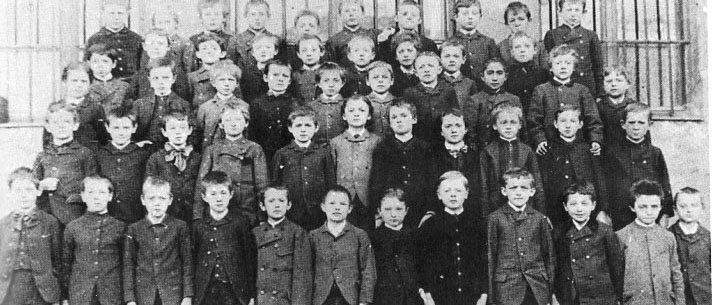
    Instein class photo763
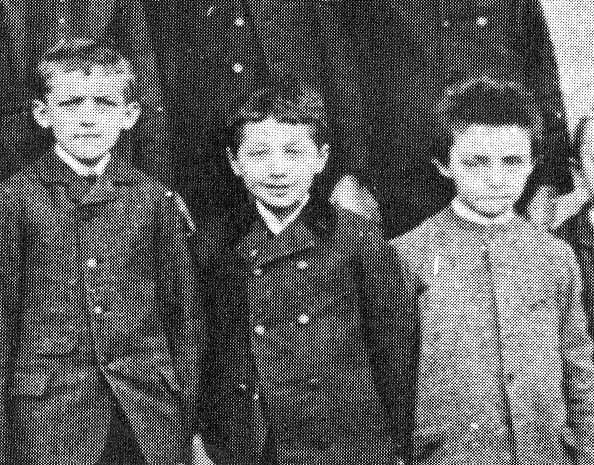
    This shows Albert Einstein in Munich at the Luitpold Gymnasium in 1889, when he was 10. (The source for his image, Ronald Clark’s illustrated biography of Einstein, says that it is from the 1890’s, which is just wrong. Einstein is third from right, front row. In many reproductions of this photographs the boy on the far right of the front row is usually lopped off–I’ve imagiend a rich life for him from time to time, excised as he was from one of the most famous schoolboy photographs of the last 125 years.)

    It was a fiction or fairy tale that Einstein was an average student when he was young–he was in fact a prodigy, and tested out so long as he was somewhat interested, tested out in all areas save one:  French.  Latin and Greek were good.  French, not so.  It was a main stumbling block for him throughout his young academic career.  And that’s a pity.  More so, really, when you consider the amount of interest French scientific publications gave to Einstein in the early years, 1905-1908; and conversely, how much time and effort Einstein gave to the French, which was very little, and almost no attention at all when the greatest mathematician of the day, Henri Poincare, especially whe the great man died (in 1911). It has little to do with the actual language part–but that’s another story.)

    Instein class photo764

     It was a time of big discovery for the little man, though not so much of that discovery took place in school, and the school itself was a trial. But at least right at this point, when this photo was made, he looked happy.

    ·Posted by :

    ·in:

    —

  • New Page Announcement: Contemporary Abstracts of Einstein, 1905-1920

    I’ve established a new page (column at left) to accompany the other Einstein pages, this on abstracts and reviews of Einstein’s work (1905-1920) appearing in Science Abstracts (London, Institute for Electrical Engineers).


    ·Posted by :

    ·in: