A Daily History of Holes, Dots, Lines, Science, History, Math, Physics, Art, the Unintentional Absurd, Architecture, Maps, Data Visualization, Blank and Missing Things, and so on. |1.6 million words, 7500 images, 4.9 million hits| Press & appearances in The Times, Le Figaro, Mensa, The Economist, The Guardian, Discovery News, Slate, Le Monde, Sci American Blogs, Le Pont, and many other places… 5000+ total posts since 2008.

Category: Physics

  • A Short Note on Clerk Maxwell’s Reading

    JF Ptak Science Books  Quick Post

    We shall find that it is the peculiar function of physical science to lead  us . . . to the confines of the incomprehensible. —J. C. M., 1860

    What is done by what I call myself is, I feel, done by something greater than myself in me.—Comment made by Maxwell to the Reverend Professor F.J.E. Hort in 1879 when terminally ill.

    [Both quotes found in Fred Seitz’s article in  the Proceedings of the American Philosophical Society,  March 2001, “James Clerk Maxwell, (1833-1879), Member APS 1875”.

    Placeholder  Image

    This note may restrict itself to a small population of readers of this blog, but I’m always fascinated to come upon notices of the reading habits and library book-borrowing practices of significant people.  For example Herman Melville’s reading has been particularly studied, with scholars hunting books that had once belonged to him and then dispersed at auction (some going to the Brooklyn Public Library), and there are records of his borrowing practices at the library as well.  Thomas Jefferson’s reading habits is a well-known and fascinating study (though he did little borrowing, per se, what with there being few borrowing  libraries for him to visit, and then of course his library was much larger than anything else remotely close to him).

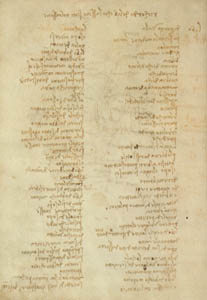
    Leonardo libraryThe library of Leonard is also well known–over the years via my bookstore I’ve had a number of people (usually involved in a classical study program, or St. John’s folks, etc) looking to try to reproduce Leonardo’s library.   In general, though, the full classification of the library of working scientists is not in general a known thing. (An interesting tour of some of the 116 books that comprise the library as described in the Codex Atlanticus and written around 1509 [left].  can be found at Museo Galileo, here.)

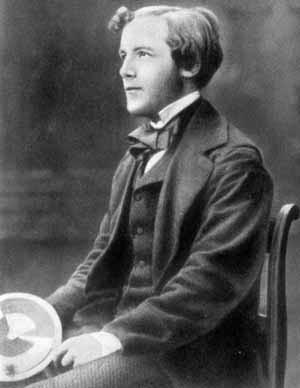
    This is the main reason why my interest was piqued when I read this biographical treatment of James Clerk Maxwell (1831-1879)  in the 27 October 1881 issue of Nature magazine. It mentions the while the great Maxwell was not-yet-great, studying at the University of Edinburgh (which he attended from 1847-1850, when he was just sixteen), that he used the library there extensive, and that the library has “records” of that reading.  The article quotes P.G.Tait from an 1879 article in that same journal (Nature, volume XXI, p 317)  that during the years at Edinburgh “without keeping the regular course for a degree”, Maxwell “carried home for study..such books as Fourier’s Theorie de la Chaleur, Monge’s Geometrque Descriptive, Newton’s Optiks, Willis’ Principles of Mechanisms, Cauchy’s Calcul Differentiel, Taylor’s Scientific Memoirs, and others of a very high order.  These were read through, not merely consulted.” 

    I’d like to see the whole list, though as yet I’ve not been able to find it, and I’ve not yet been able to find the right person to speak with at Edinburgh to determine whether there is a full list of Maxwell’s borrowing habits, or not.  It would be an interesting thing to see.  After all, the man did basically invent modern physics, and it was his portrait among the very few that were displayed in Einstein’s house at 112 Mercer Street.

    The original article on Maxwell along with a very fine steel engraved portrait is offered for sale in our blog bookstore, here.]


    ·Posted by :

    ·in:


  • Foucault’s Pendulum, 1851

    JF Ptak Science Books   [Quick Post in the History of Lines series]

    “That was when I saw the Pendulum. The sphere, hanging from a long wire set into the ceiling of the choir, swayed back and forth with isochronal majesty.. .The time it took the sphere to swing from end to end was determined by an arcane conspiracy between the most timeless of measures: the singularity of the point of suspension, the duality of the plane’s dimensions, the triadic beginning ofn, the secret quadratic nature of the root, and the unnumbered perfection of the circle itself… Were its tip to graze, as it had in the past, a layer of damp sand spread on the floor of the choir, each swing would make a light furrow…”–Umberto Eco, Foucault’s Pendulum.

    I’ve uploaded an interesting recrod to the books for sale section of this blog on the great experiment of Leon Foucault (1819-1868), who was the first to actually demonstrate the rotation of the Earth, doing so with a very simple, extraordinarily elegant experiment involving a heavy brass bob suspended from a long cable–a pendulum that was unencumbered and free to swing along any plane.  It is the curvature of the Earth that allows the tip of the bob to make its pattern, and it is the fact that the Earth is rotating under the moving pendulum that allows it to be tracing this path at all–it is also tells the difference between living on a sphere and living on a plane. 

    ·Posted by :

    ·in:

    —

  • Motion and Change in Natural Sculpture–The Galileos of Clouds and Snowflakes

    JF Ptak Science Books   Post 1692

    (I wrote this post two years ago in the bookstore section of this blog but never put it in the blog. Here’s an addition to the Howard material in a new listing in the bookstore section.)

    It is odd to think among the great classifiers of nature, including even the lofty-namer Aristotle, that clouds were not scientifically classified until the early 19th century.   Here they are, just about the biggest thing we have as earthlings that are gigantic and close to us, and nobody offered a good classifications scheme until 200-odd years ago—a pretty slim margin of time  in the terms of recorded human history.
    Blogcloud_howard

    Clouds are of course problematic, what with floating around and all—but if you didn’t already know the relative newness of their recognizable names isn’t it shocking to learn this bit of history? For the most part I think clouds must have been thought as being too transient, changeable, whimsical, wispy, to be given proper names.   The great scientist and classifier Lamarck tried to do so in his  Annuaire Méteorologique of 1802, and really is the first to try this, but his ideas weren’t terribly good (especially compared to the rest of his work), and it seems as though he left his best thinking effort on clouds at home.  For example, he gave us Hazy, dappled, massed, broom-like and grouped clouds as classifications (in French, respectively, en forme de voile, pommelés, attroupés,  en balayeurs and groupés).  They seem quite “French” to me, but largely outside the scope of being useful. 

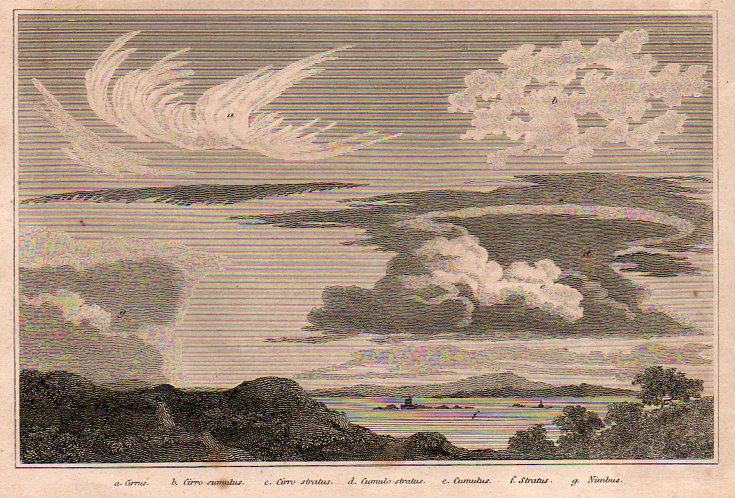
    It was the English pharmacist and chemist Luke Howard who in 1803 gave a greater bit of thought to structuring cloud names, classifying them according to size and shape and giving them Latin names—and this forms the basis of our naming clouds to this day.  Howard was perhaps the first, greatest, meteorologist, producing On the Modification of Clouds, (in which he describes his naming system, the “modification” part actually meaning classifying rather than changing),  The Climate of London, and the first textbook on weather,  Seven Lectures on Meteorology.  Howard’s system was expanded in 1887 by Abercromby and Hildebrandsson, who further classified clouds by height above ground as well as by appearance (and utilizing Howard’s naming system). 

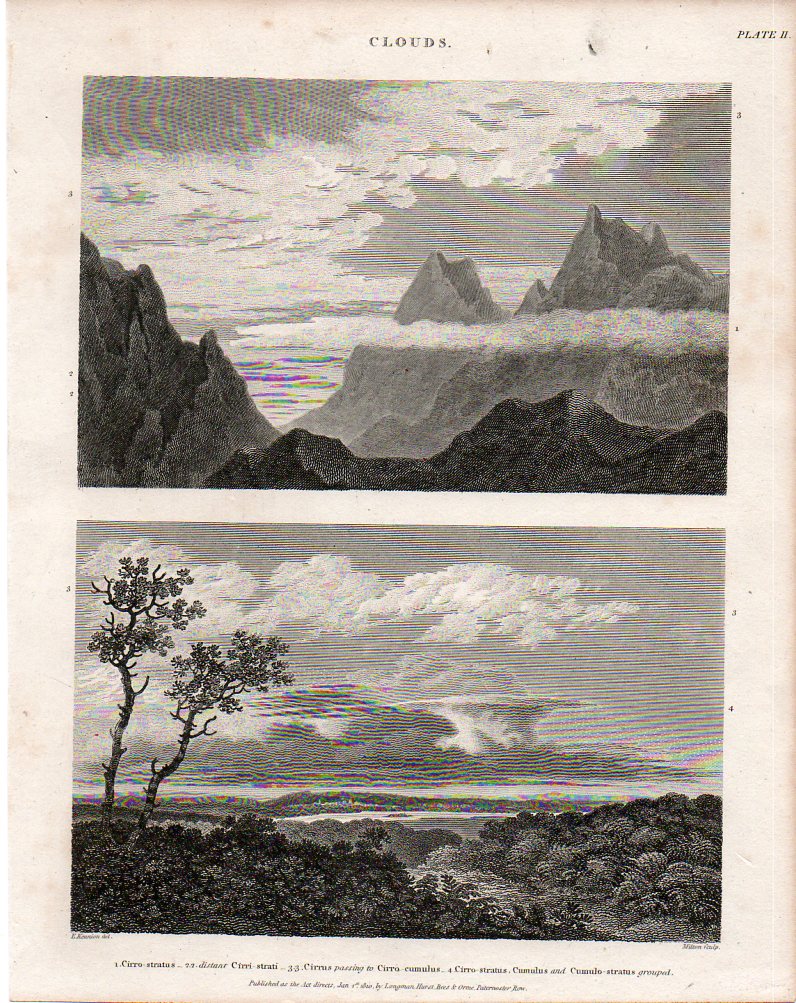
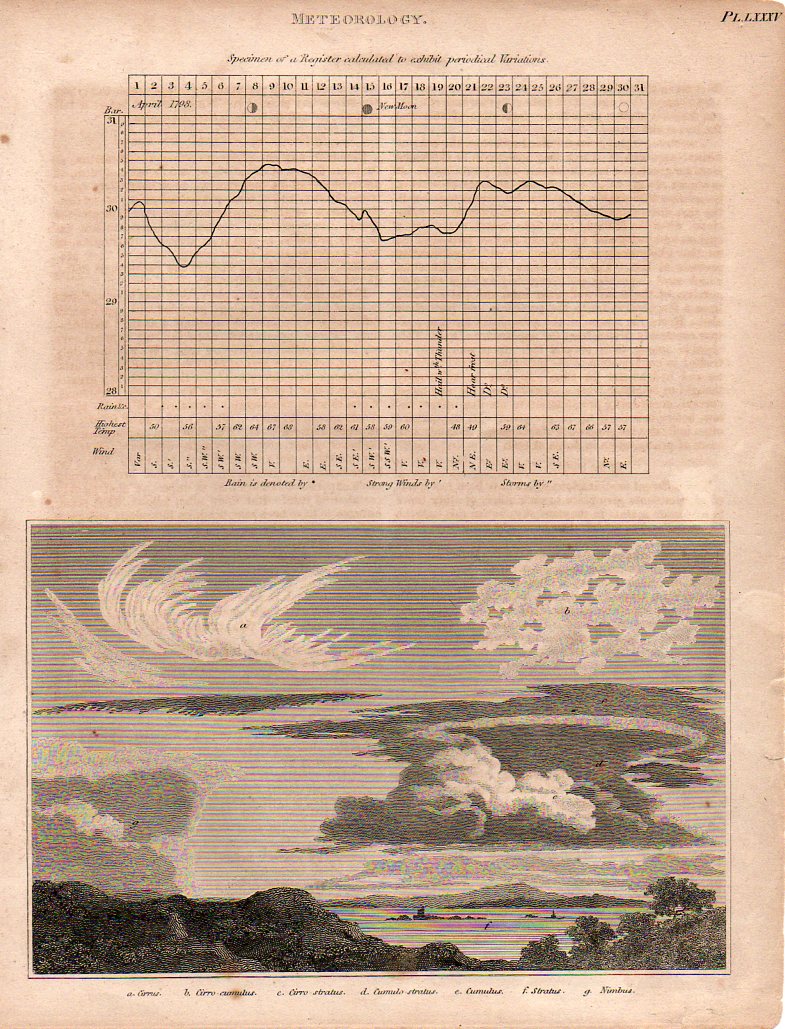
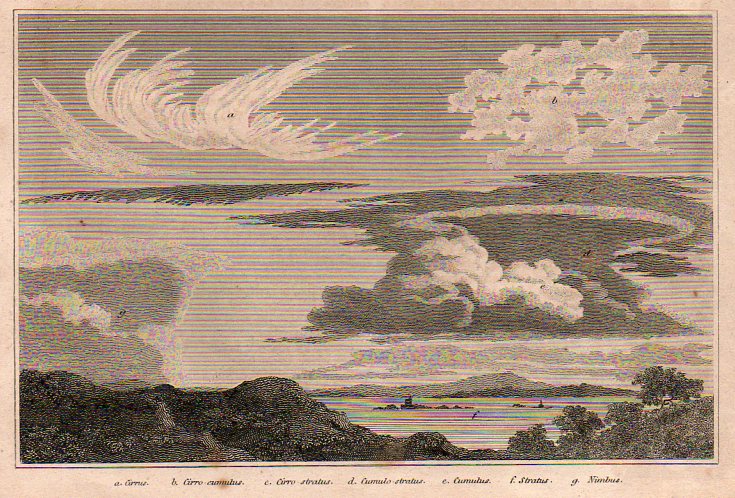
    Here (below) are two fine, early examples of cloud-naming for the scientifically-minded of the British elite, finding their way into print in the fabulous, ingenious and  mammoth (45-volume) Cyclopædia, or The New Cyclopaedia, or, Universal Dictionary of the Arts and Sciences, edited by Abraham Rees (1743-1825).  The work was published between 1802 and 1820, and was the resulting effort of 100 contributors who generally wrote monograph-length entries, contributing to a final tally of close to 40 million words.  I’ve particularly enjoyed the illustrations like those below—some of which have become iconic—and especially the fine and deep engraving of Wilson Lowry.
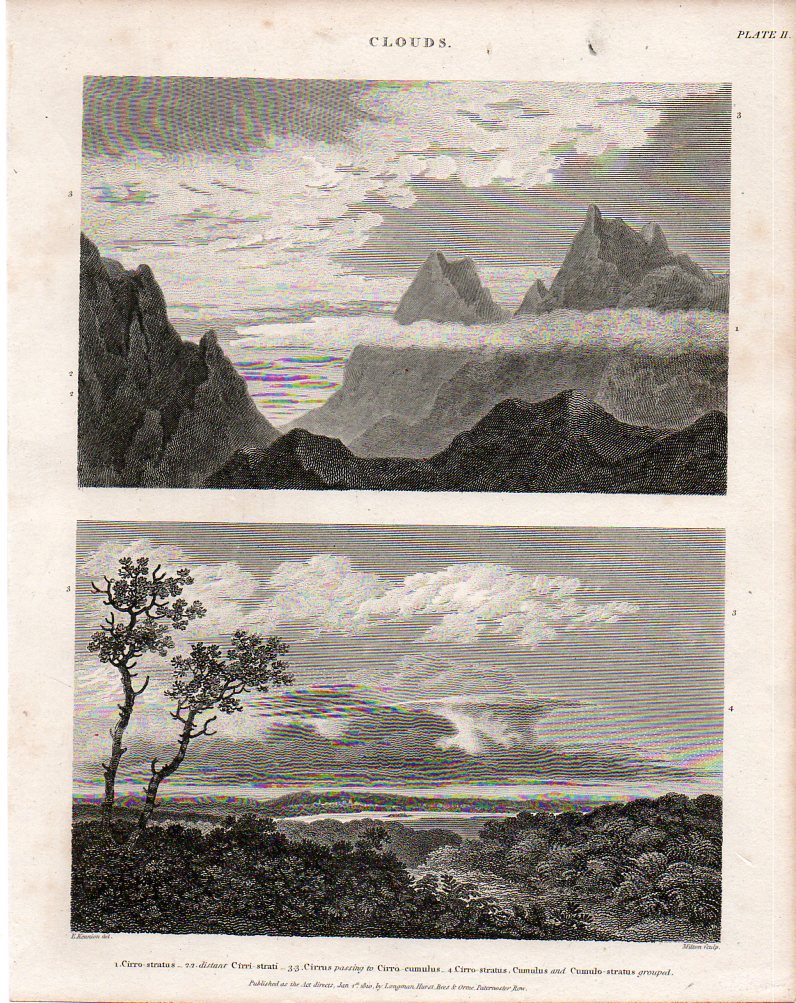
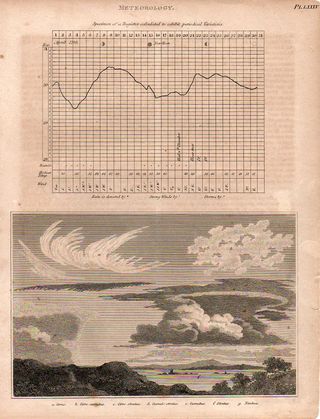
    Clouds875

    Cloudsb876Howard began his system by identifying three basic shapes to clouds: heaps, layers, and curls.  Heaps of separated cloud  masses with flat bottoms and bulbous, splayed, tops, which he called cumulus, which is Latin for heap; the Latin stratus was applied to clouds in layers which were much wider than they were thick; and again to Latin for cirrus, which called out the wispy curls of clouds.  (Rain clouds were given the Latin nimbus, for rain, and so on.) 
      Cloudsbdet877

    It is interesting and romantic to think of Howard being moved in his love of clouds as many Brits and Europeans were in the Volcanic Year of 1783 by the enormous eruptions of the Eldeyjar (Iceland) and Asama Yama (Japan) volcanoes—the force of their eruptions caused enormous changes in the skies (especially in Europe), creating vast sky-borne tapestries (the “Great Fogg” in England) and for such extended periods of time that it would have been impossible for the scientifically-minded Howard not to see them. 
    Blogsnowflake_bentley

    Similar, in a way, to clouds is the snow crystal (snowflake)—they change forms in their lives from sky to ground, and may well disappear on contact with a warm surface.  Of course unlike clouds they may fall and be captured, kept even, though the ability to actually perform some sort of scientific something with them didn’t occur until 400 years ago, which means that snowflakes passed in and out of human existence being very simply named (in most languages) as a mass group, and not classified at all.
    Blogsnowflake_hooke

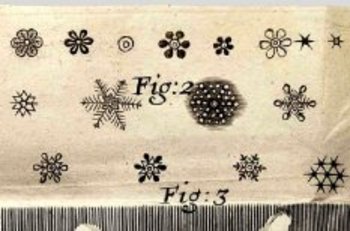
    Johannes Kepler thought very deeply in In 1611 publishing a short treatise called On the Six-Cornered Snowflake, thinking that perhaps their (mistaken) six-cornered symmetry revealed something much deeper about the basis of nature and the universe. The 26-year-old  Robert Hooke seems to be recognized as the first to throw the snowflake under a microscope, publishing drawings of them and just about everything else that he saw in his monumental (and tall, being 13-inches tall) Micrographia (1665)–the first truly scientific book of modern times.  The largest of the large images was saved for the flea, showing the unsuspecting public the great and beautiful nature of what seemed like a fantastical beast (under magnification).  Snowflakes appeared in the book, revealed in their intricate and seemingly-symmetrical nature.  Fantastic, unimagined images. This aside, he seems to have, um, borrowed these images from an earlier work, Thomas Bartholin’s  De Nivus usu Medico Observationes Varieae, 1661.  But so it goes. 
     

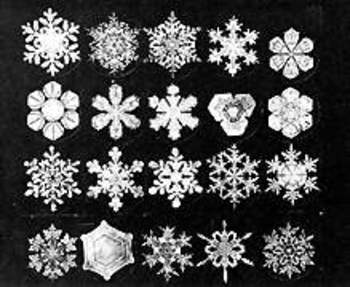
    The Galileo of the snowflake was Wilson Bentley (1865-1931), an autodidact Vermont farmer, seen by fellow hamlet-dwellers as odd and off, who figured out how to photographically and beautifully record the intricacies of the snow crystal world—no one had ever done this so dramatically, with such gorgeous results.  It really was as though he was able to record the heights of the mountains of the moon with a slender telescope in Pisa, 350 years earlier. The results of his decades of experience were published  in 1931 his book Snow Crystals, containing more than 2400 snow crystal images.  On the heals of Bentley’s accomplishments came the classically trained nuclear physicist Ukichiro Nakaya, who was truly the first person to apply a scientific classification to snowflakes, and who published his intrepidly-beautiful work in a 1954 book entitled Snow Crystals: Natural and Artificial.  His classification system of the various types of snowflakes would prove vastly more useful, interesting and appealing than that published by the 1951 the International Commission on Snow and Ice, and forms the basis of the discussion of snow crystals today—a classification system of a massively-occurring phenomenon that is younger than me. 
    ·Posted by :

    ·in:

    —

  • History of Dots Series: How Much Does the Earth Weigh? (1798)

    JF Ptak Science Books     Post 1690 [Part of the History of Dots series: Weighing Earth’s Biggest Dot–Itself.]

    Archimedes said that given certain conditions and equipment that he could lift the Earth with a lever; he did not, however, have the necessaries to actually determine how much the whole thing “weighed”, and would have to wait for  20 centuries  in the work of Henry Cavendish to have an answer. (Archimedes was a very busy man with an enormous list of contributions, and was perhaps the greatest physicist and mathematician of his age in the third century BCE, but he did not invent the lever–he did however  provide the mathematical understanding and formalization of how the thing worked in his “On the Equilibrium of Plane Figures”.)


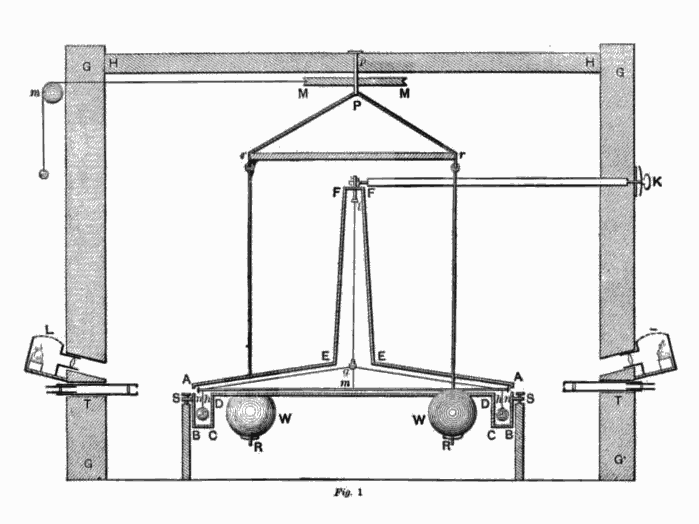
    In this experiment,  “Experiments to determine the Density of the Earth”, the results of which appeared in the Philosophical Transactions in 17981, the great and somewhat mysterious (and odd) Henry Cavendish determined to, of all things, weigh the Earth. (Well, really it was measuring the force of gravity and finding the gravitation constant G, which Cavendish referred to as the specific weight of the Earth.)  Now there are certain remarkable things to be achieved in the 18th century (like for example the discovery of oxygen by Scheele/Priestly), and of course the idea of measuring the weight of the Earth was a high intellectual achievement.  Cavendish set off to measure the force of attraction between large and small lead balls using as a basis for research parts of his dead friend John Michell’s designs for a torsion balance (which he had created in 1783), and using of course Newton’s laws showing that the force of gravity between two objects depends on their masses as well as the distance between them.  Michell had thought of the experiment years before but died before he could present; Cavendish carried on and up, and out. Mind he wasn’t the first on the spot (Coloumb was there too slightly before Michell), or the first with the idea–he was the first to complete it, though, taking the difference in the measures on the very sensitive balance from a distance using a telescope so as to not disturb the readings. As a matter of fact this was the only method employed to conduct this experiment for nearly another hundred years, the results being confirmed by a number of scientists2 over the coming decades.   It was a lovely idea, and  a fantastic piece of work. 

    In his paper in the Philosophical Transactions, Cavendish described Michell and the instrumentation int he opening two paragraphs:

    The instrument:

    File:Cavendish Experiment.png

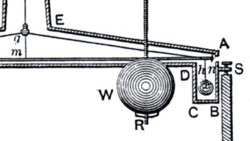
    This is the test apparatus that Cavendish constructed following the original Michell plans–it was a big, solid instrument, as that horizontal piece suspended fro the rod (K) is six feet long, and those two spheres (W) attached to its ends are 350-pounds apiece.  The smaller sphere is located in the box to the side of the large sphere, as so:

    File:CavendishSchematic111.jpg


    “Henry Cavendish had fitful habits of publication that did not at all reveal the universal scope of his natural philosophy. He wrote no books and fewer than twenty articles in a career of nearly fifty years. Only one major paper was theoretical, a study of electricity in 1771; the remainder of his major papers were carefully delimited experimental inquiries, the most important of which were those on pneumatic chemistry in 1766 and 1783–1788, on freezing temperatures in 1783–1788, and on the density of the earth in 1798.” (D.S.B. III:155).


    ________

    Notes:

    1.  A copy of the first German edition of this work is available at our blog’s bookstore:  “Versuche über die Dichtigkeit der Erde zu Bestimmen.” Halle, Rengerschen Buchhandlung, 1799, and published  in Annalen der Physik, herausgegeben von Ludwig Wilhelm Gilbert, band. 2, erstes stück.  120pp in this section, 488pp overall in in the entire volume, with 9 plates.  Cavendish’s paper occupies pp 1-62, with two plates  (the torsion balance of Michell shown on the plates).

    The entire Cavendish paper can be found here:  Cavendish, Henry (1798). “Experiments to Determine the Density of the Earth”. In MacKenzie, A. S.. Scientific Memoirs Vol.9: The Laws of Gravitation. American Book Co.. 1900. pp. 59–105 Online copy of Cavendish’s 1798 paper, and other early measurements of gravitational constant.

    2.  The experiment was in fact repeated numerous times, including that by Reich (1838), Baily (1843), Cornu & Baille (1878), among others, and it wasn’t until 1895–the year of Roentgen’s epochal discovery–that Cavenidsh’s accuracy was exceeded by the work of C.V. Boys. 

    ·Posted by :

    ·in:

    —

  • History of Blank, Empty, and Missing Things: Fission. 1934

    JF Ptak Science Books   Post 1689

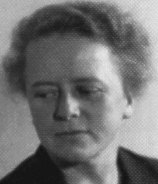
    Ida Noddack (1896 - 1978)

    “it is conceivable that the nucleus breaks up into several large fragments, which would of course be isotopes of known elements but would not be neighbors of the irradiated element.“–Ida Noddack, 1934

    Sometimes events and conspire to almost come together, to be very-nearly-there but not so, just this shy of complete, just a little short of being whole–save for inspiration, or insight, or genius.  Such I think is the case of Ida Noddack (and just about everyone else) in the non-discovery of fission in 1934.

    Just for the record, fission is properly discovered by Hahn/Strassmann/Meitner and announced in Naturwissenschaften beginning in 1935 (with “Ueber die kuensrtliche Umwandlunbg des Urans durch Neutronen” in 1935 and culminating in the epochal papers of 1939)–and this the result of a long series of necessary discoveries made by Becquerel, Einstein, Curie, Joliot, Bohr, Chadwick, Compton, Fermi, Frisch, Rosbaud, Wheeler, Alvarez and others. 

    Noddack published her paper–“Uber das Element 93” in Angewandte Chemie (vol 47, pp 653-655) in 1934 (and published in Berlin) which correctly pointed out errors in Fermi’s important two-page 1934 paper on neutron bombardment experiments “Possible Production of Elements of Atomic Number Higher than 92”,  published in Nature 133 (3372), pp 898-899.  She identified as inconclusive Fermi’s identification of transuranic products of neutron bombardment, and stated that the presence of all of the lower elements needed to eliminated along with the heavy radioactive elements.  Noddack (1896-1978) was nominated three times for the Nobel (chemistry) but was passed by–she received recognition for her work, of course, but at the time- (1934) her paper was generally ignored, as it ran counter to some of the basic ideas of physics  Noddack didn’t offer any theoretical help in her observations, and the paper slid almost instantly into obscurity. The breakthrough work on this issue would begin int he next year and ultimately the unthought-of concept of fission would be announced five years later. 


  • Videos of Scientists & Mathematicians: Feynman, von Neumann, Dirac et al

    JF Ptak Science Books   Quick Post

    Richard Feynman on being “stupid”:

    John von Neumann inerview:


    ·Posted by :

    ·in:


  • Did Galileo Know That He Was Galileo?

    JF Ptak Science Books     Post 1610

    Here’s an interesting lead sentence I found in 3QuarksDaily via Salon:

      “Karl Marx did not know what we know: he did not know that he was Karl Marx.”

    The author suggested that Marx would’ve had a better time in his life had he known what influence he wielded in what he was writing–basically, Karl Marx didn’t know that he was KARL MARX.  It is an interesting–and frightening–idea to think of someone laboring like that laboring (as it were) away in relative obscurity, or at least relative to the monumental influence it would come to have.

    The real question is not how many people might be in this category of not knowing who we know them to be, but if everyone is in this category at one point or another, and how long it took for them to understand the lasting significance of their work.  But for right now I’m interested to know what people think of the following ten science personalities, and to answer (in a simple survey), if they knew the significance of their work.

    The survey is simple and fairly straightforward, and asks questions regarding Copernicus, Harvey, Galileo, Einstein, Maxwell, Newton, Turing, Darwin, Lucretius and John Von Neumann. 

    You’ll have a chance to view the survey results at the end.  Thanks!

    Follow this link to the survey.


  • History of Lines–The Mathematics of Euclidean Love & Maxwell’s Demon, 1879

    JF Ptak Science Books   Post 1603  {The History of Lines series.]

    If you give them a chance, physics and the maths will provide their own fairy tales.

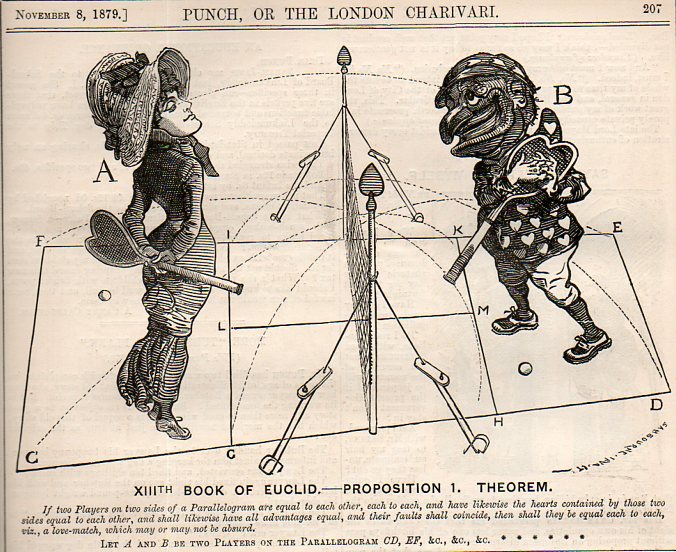
    This lovely trompe l’oeil of Euclid calls into play the play of love, in hard angles and parabolas, between Mr. Punch of Punch or the London Charivari  and the object of his affection.  The  image was published on 8 November 1879–just three days after the death of one of the greatest line-makers of the 19th century, James Clerk Maxwell.  (There is no mention of JCM anywhere in Punch, and I guess probably that there needn’t be, even if he was one of the greatest thinkers of the nineteenth (or any other) century.)

    Euclid733

              “XIIITH BOOK OF EUCLID.—PROPOSITION 1. THEOREM.

    If two Players on two sides of a Parallelogram are equal to each other, each to each, and have likewise the hearts contained by those two side» equal to each other, and shall likewise have all advantages equal, and their faulty shall coincide, then shall they be equal each to each, viz., a love-match, which may or may not be absurd.”

    Maxwell‘s really big lines come in a series of four papers called “On the Lines of Force”1, and were published in 1861 and 1862. It is in these papers that Maxwell’s famous equations are all found, and it is also the place where we’ll find the basis not only for the foundation of classical electrodynamics, but the forms for the structure of what would become the epochal/modern communication/electrical technologies. 

    File:On Physical Lines of Force.pdf
    MaxwellPhys1-10.png
    [Source:  here.]
    Maxwell’s Demon came into being as a gedankenexperiment in a series of letters–it was Maxwell not only playing devil’s advocate in trying to propose a circumstance in which the 2nd Law of Thermodynamics could be violated, but also providing the Demon, in the experiment, which he proposed as being a finite being, the contradictor.  JCM didn’t actually name this thing on his own–that appelation came via William Thomson in an article in Nature magazine3 in 1874. 
    We’ll continue this later with Faraday’s lines of force.
    2.   Maxwell stated it so:  “… if we conceive of a being whose faculties are so sharpened that he can follow every molecule in its course, such a being, whose attributes are as essentially finite as our own, would be able to do what is impossible to us. For we have seen that molecules in a vessel full of air at uniform temperature are moving with velocities by no means uniform, though the mean velocity of any great number of them, arbitrarily selected, is almost exactly uniform. Now let us suppose that such a vessel is divided into two portions, A and B, by a division in which there is a small hole, and that a being, who can see the individual molecules, opens and closes this hole, so as to allow only the swifter molecules to pass from A to B, and only the slower molecules to pass from B to A. He will thus, without expenditure of work, raise the temperature of B and lower that of A, in contradiction to the second law of thermodynamics….”
    3.  William Thomson (Lord Kelvin), “Kinetic Theory of the Dissipation of Energy,” Nature, 9 April 1874, pp. 441-444, and “The Sorting Demon Of Maxwell” (1879), Proceedings of the Royal Institution, vol. ix, p. 113.

    ·Posted by :

    ·in:

    —

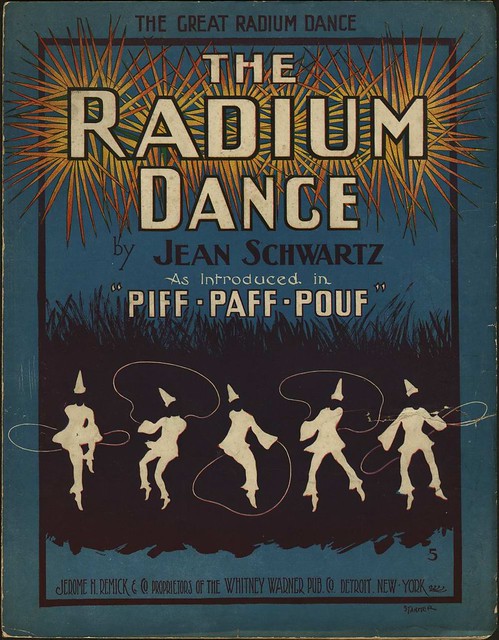
  • The Radium Dance, 1898 and 1904

    JF Ptak Science Books   Post 1595

    photo
    Jean Schwartz (b. 1878) , composed this number for his (with the collaboration of William Jerome) Broadway (hit!) musical comedy Piff! Paff! Poof!  in 1904,  which sounded like this.
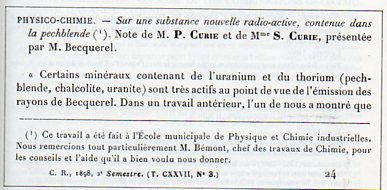
    But the real story–that we’ll deal with later–occurs a few years earlier, in 1898, with a married couple of scientists who made an epochal discovery:
    Curie712
    What was easier for folks to understand was the application of the discovery, just six years after the Curie effort–though it did take a little longer to take hold in the public creative imagination than, say, the discovery of the X-ray, which entered the public mind almost instantly following its discovery in 1895. 

    72dpi JPEG image of: The radium dance; Piff-paff-pouf

    [Source:  Duke University]

    [Source]

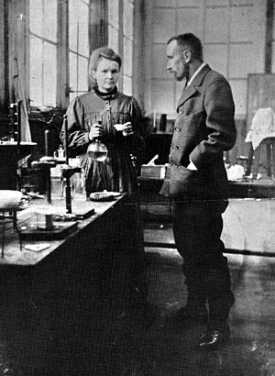
    Perhaps the real Radium Dance occurred for the first time by the people who found the thing, radium, back there in 1898–Marie Sklodowska Curie and Pierre Curie.  They were a happily married couple, beginning their joined life in 1895, vacationing on wedding present money on bikes through the French countryside.  They were soon back to their primary love in physics and chemistry, and inspired by the work of Henri Becquerel, began their assault on radioactivity in the next year.  After several years of effort and laboriously extracting a gram of  pure radium (by 1902) from a ton of pitchblende, they published their efforts in the volume of the great French scientific journal, Comptes rendus…Academie des Sciences (volume 127, in three short articles), announcing their discovery of polonium (after Marie’s country of origin) and radium. 

    The really big Radium Dance would occur the year before the Broadway hit, in 1903, when the Curies and Henri Becquerel were awarded the Nobel Prize in physics1. 

    Notes:

    1. The Nobel Prize in Physics 1903 was divided, one half awarded to Antoine Henri Becquerel “in recognition of the extraordinary services he has rendered by his discovery of spontaneous radioactivity”,the other half jointly to Pierre Curie and Marie Curie, née Sklodowska “in recognition of the extraordinary services they have rendered by their joint researches on the radiation phenomena discovered by Professor Henri Becquerel”.


  • Present at the Creation–“Physics Today”, 1948

    JF Ptak Science Books   Post 1579

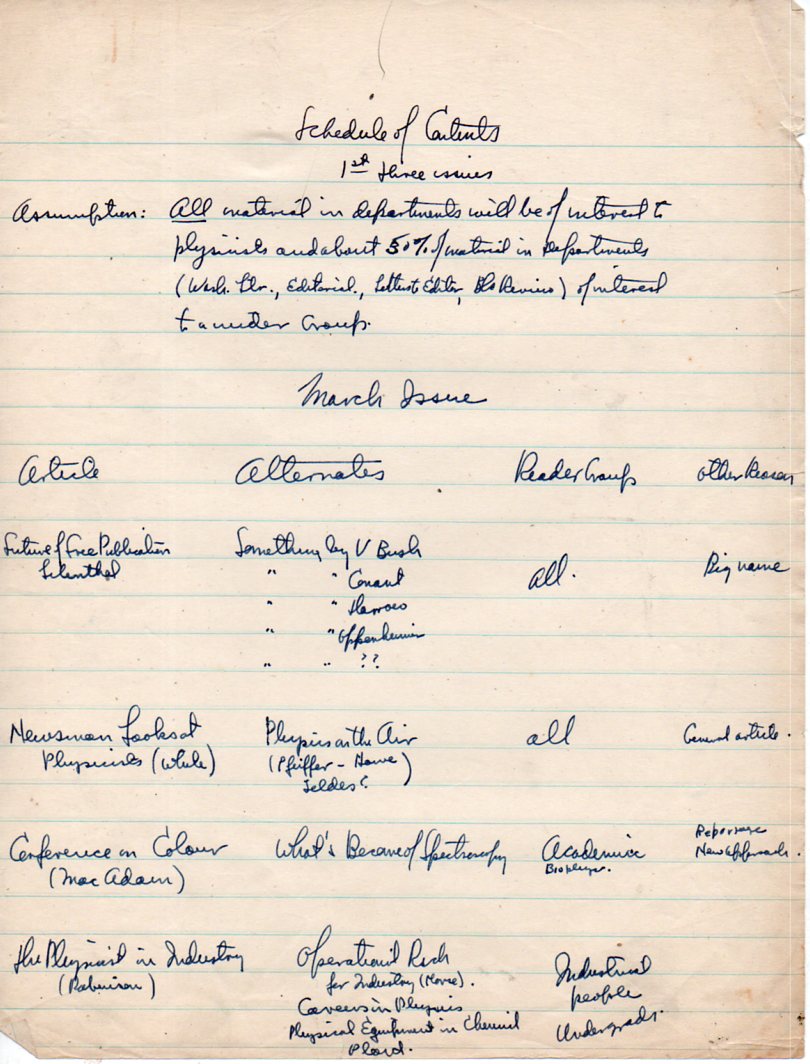
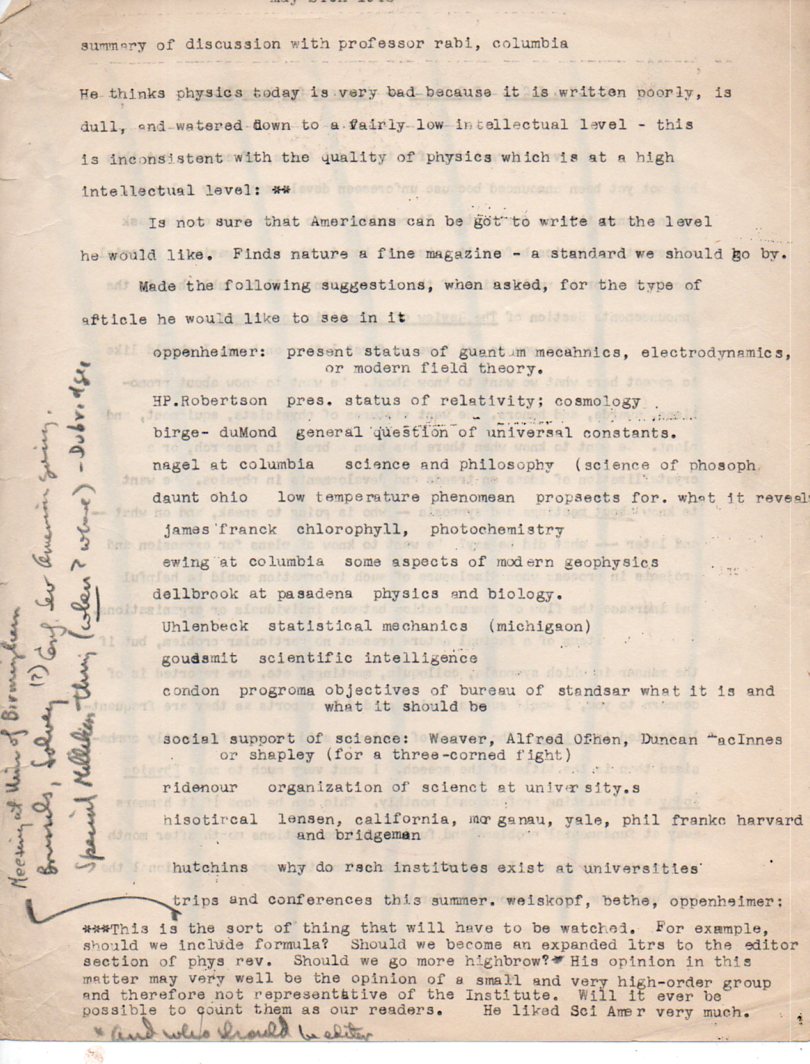
    One of the real pleasures of being a bookseller is the discovery of the unexpected source–in this case it was a small group of papers that at one time belonged to David Katcher, who–among many other things–was the first editor of the American Institute of Physics’ magazine, Physics Today.  It was started in 1948 to help bridge the gap between good science writ bad and hard science writ even worse for the world of the general reader. These are a few of the fragments from the editor’s desk, as Katcher was organizing his thoughts about what the magazine would be about, who would write for it, and how the ideas would be presented. 

    For example, this worksheet for the first issues of the magazine outlined articles by some of the heaviest names in physics, with “something” by Bush, Conant, Oppenheimer; as well as who would be the target audience (“all”);  and who the contributors would be (‘big name”).  Quite a different world and pace, then, and one in which a forceful man like Katcher could do a lot in, and quickly. 

    Physics today646
    Then there’s this interesting page of notes of a conversation between Katcher and the great I.I. Rabi, who offered some suggestions and insights about what might appear in the new magazine:

    Physics today649 And this, Katcher’s very clear statement on editorial policy (for 28 July 1948):

    ·Posted by :

    ·in:

    —