A Daily History of Holes, Dots, Lines, Science, History, Math, Physics, Art, the Unintentional Absurd, Architecture, Maps, Data Visualization, Blank and Missing Things, and so on. |1.6 million words, 7500 images, 4.9 million hits| Press & appearances in The Times, Le Figaro, Mensa, The Economist, The Guardian, Discovery News, Slate, Le Monde, Sci American Blogs, Le Pont, and many other places… 5000+ total posts since 2008.

Category: Physics

  • Bad Ideas Department: First Image of a Hypnotized Chicken

    JF Ptak Sciene Books LLC  Post 380
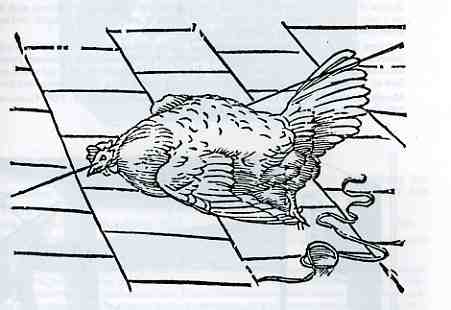
    0-blog---Nov 19 kircher chicken080This non-metaphorical, truth-be-told image is the responsibility of the irrepressible everyone’s-favorite-18th-century-Jesuit, Athanasius Kircher.  Fr. Kircher was extremely learned and had a superb memory and a great scientific bent; and for the stuff that he didn’t know or hadn’t read about or couldn’t prove by experimentation or produce by logical means, well, he just made the stuff up and pressed on.  But there is *so* much that he got correct and he published such a terrific amount of material that we’ll forgive these forays into The Twilight Zone  His detractors and critics  couldn’t keep up with the man; almost nobody could–the bit about the hypnotized chicken that appears in his incredible Physiologia Kircheriana Experimentalis...(Amsterdam, 1680, edited and compiled by Kircher’s pupil Johann Stephan Kestler), which is packed with so much diverse material that the chicken pretty much gets lost in the intellectual sauce.  Kircher’s reach was deep, formalizing bunches of natural science expositions by physical and mathematical experimentation and proof, not the least of which was proving the lunar influence on the tides and the construction of a magic lantern (below) .

    The hypno-chicken comes into the picture via Kircher’s interests in the magnetic art and electricity, dabbling away at the edges of science in a precursor to Mesmerism.  He also came up a little short with his experimental proof that insects were born of animal dung, but, as I said, he got much more right than he did wrong, and forgive him his rush to publication on some things that he may not have been happy with.
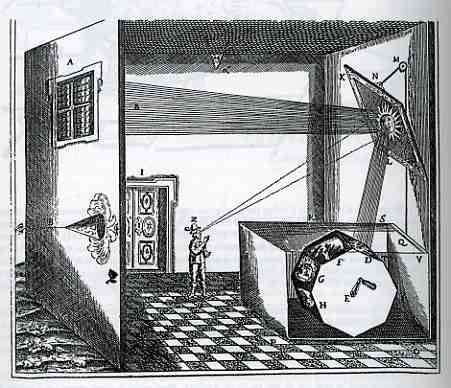
    0-blog---Nov 19 kircher movie081

    To press the point only slightly (the list and breadth of his accomplishments is just too much for this prankish little post about the chicken), have a look at the partial list of his publications:

    A partial list of Kircher’s works include:

        * 1631 Ars Magnesia
        * 1635 Primitiae gnomoniciae catroptricae
        * 1636 Prodromus coptus sive aegyptiacus
        * 1637 Specula Melitensis encyclica, hoc est syntagma novum instrumentorum physico- mathematicorum
        * 1641 Magnes sive de arte magnetica
        * 1643 Lingua aegyptiaca restituta
        * 1645–1646 Ars Magna Lucis et umbrae in mundo
        * 1650 Obeliscus Pamphilius
        * 1650 Musurgia universalis, sive ars magna consoni et dissoni
        * 1652–1655 Oedipus Aegyptiacus
        * 1654 Magnes sive (third, expanded edition)
        * 1656 Itinerarium extaticum s. opificium coeleste
        * 1657 Iter extaticum secundum, mundi subterranei prodromus
        * 1658 Scrutinium Physico-Medicum Contagiosae Luis, quae dicitur Pestis
        * 1660 Pantometrum Kircherianum … explicatum a G. Schotto
        * 1661 Diatribe de prodigiosis crucibus
        * 1663 Polygraphia, seu artificium linguarium quo cum omnibus mundi populis poterit quis respondere
        * 1664–1678 Mundus subterraneus, quo universae denique naturae divitiae
        * 1665 Historia Eustachio-Mariana
        * 1665 Arithmologia
        * 1666 Obelisci Aegyptiaci … interpretatio hieroglyphica
        * 1667 China Monumentis, qua sacris qua profanis
        * 1667 Magneticum naturae regnum sive disceptatio physiologica
        * 1668 Organum mathematicum
        * 1669 Principis Cristiani archetypon politicum
        * 1669 Latium
        * 1669 Ars magna sciendi sive combinatorica
        * 1673 Phonurgia nova, sive conjugium mechanico-physicum artis & natvrae paranympha phonosophia concinnatum
        * 1675 Arca Noe
        * 1676 Sphinx mystagoga
        * 1676 Obelisci Aegyptiaci
        * 1679 Musaeum Collegii Romani Societatis Jesu
        * 1679 Turris Babel, Sive Archontologia Qua Primo Priscorum post diluvium hominum vita, mores rerumque gestarum magnitudo, Secundo Turris fabrica civitatumque exstructio, confusio linguarum, & inde gentium transmigrationis, cum principalium inde enatorum idiomatum historia, multiplici eruditione describuntur & explicantur. Amsterdam, Jansson-Waesberge 1679.
        * 1679 Tariffa Kircheriana sive mensa Pathagorica expansa
        * 1680 Physiologia Kicheriana experimentalis

    ·Posted by :

    ·in:

    — — —

  • Wordle Word Art–Vocabulary from our Atomic Bomb Chronology

    JF Ptak Science Books LLC

    This is the newest installment of Found Word Art engineered by the good folks at WORDLE.:  this iteration uses the text block from my page on the chronology of the creation of the atomic bomb, with the entire thing dumped into the Wordle wonder-engine which produced this piece of art.  I should point out that the size of the word refers to relative appearances of the word in the post. 

    If you click on the image it will get larger and clearer.
    Wordleatomic_bomb_cchronology

    ·Posted by :

    ·in:

    — —

  • Wordle Word Art–Vocabulary from our Nobel Prize in Physics Chronology

    JF Ptak Science Books LLC

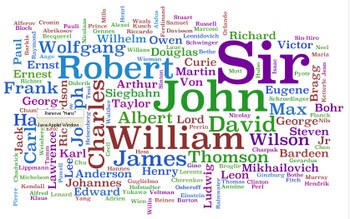
    This is the newest piece of sub-art that was produced via the good folks at WORDLE :  namely, it represents the dominant occurrence of a word in a text block on my page of winners of the Nobel Prise in physics via the its size in the one-page WORDLE summary, producing a pretty enjoyable and wholesome (!) bit of art.  It also reveals some interesting pieces of info, like, the most common first names of all of the physicists awarded the Nobel prize (for physics).  There are some little surprises here and there; mainly though its a nice thing to look at. 

    If you click on the image it gets bigger and sharper. 

    Wordlenobel_physics

    ·Posted by :

    ·in:

    —

  • Wordle Word Art: Einstein 1920 and Poincare 1905, Side by Side–Looking at Two Disparate Approaches to Relativity

    JF Ptak Science Books LLC  Post 254

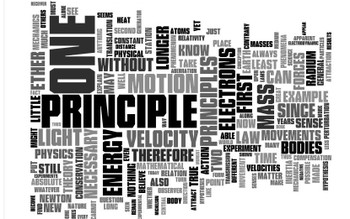
    Okay, okay–this is definitely apples and oranges here, but it is interesting nevertheless, even if I can’t reference the apple and the orange to something that would make sense for both, for something that has shared grounds of commonality.   What we have here is the Wordle version of Henri Poincare’s The Principles of Mathematical Physics (1905,and which I wrote about a little here accompanied by the paper’s full text), which was his quai-popular attempt at explaining a modified version of what some people call his “relativity” paper of 1904 (On the Dynamics of the Electron, which appeared in the Comptes rednus):

    Wordle_poincare

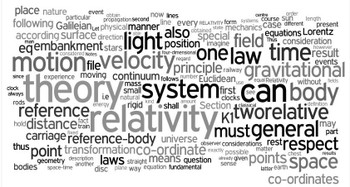
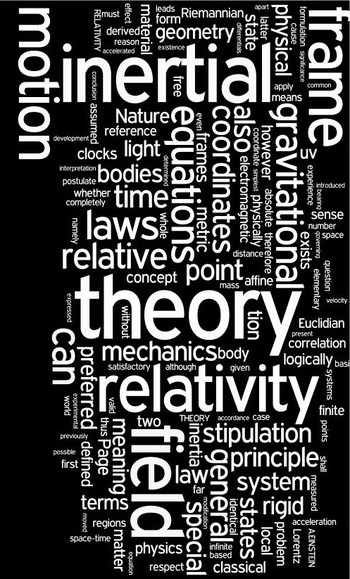
    View this (“contrast” being too hard, too unwieldy, too problematic) along with Einstein’s 1920 Relativity:  the Special and theGeneral Theory, the book in which he makes a full frontal assault of a popular explanation of his special (1905) and general 1915/16) theories of relativity:

    Wordle_einstein_relativity_1920

    Very little in common, no?  It really is just an interesting set of images, really; I’d hate to think of this as anything approaching content analysis or anything besides this that might look like a “serious” attempt at comparing the two.  I think of them in very simple terms, these two Wordscapes–like looking at two rivers, the one meanderingly serene, while the other looks more contentious, robust, challenging.  At the end of it all the robust Einstein river, unlike the beautiful if not sanguine Poincare river, rushes towards a Niagra; the Poincare, not. 

    ·Posted by :

    ·in:

    —

  • Wordle Word Art: 200 Einstein Quotations

    JF Ptak Science Books LLC   Post 251

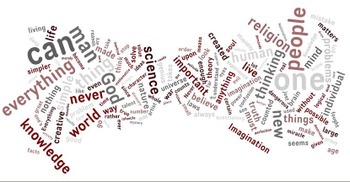
    My thanks to Jeff De Cagna for the suggestion of Wordle-ing a favorite Einstein quotation–its a fine idea.  What I’ve done is take 200 or so quotes and made one large file of them and fed it into the Wordle-izer with the following results (below)  Again Wordle weights words in size according to the number of times it appears in a document, so the resulting image is a wort of word map, a lay of the land if you will of this collection of quotes, showing the words most often used by Einstein (at least in the quotes that I have selected).  The longish quote list is below in the continue reading section(unfortunately without source attribution). 
    Clicking on the image will enlarge it and make it clearer.

    It is interesting to note that the largest word here seems to be “can”, followed closely by “one”, which I think is really another way of his saying “you” or “us” or “we”–so, we get “you can” or “we can” or “one can”, speaking to the possibility of possibility, of effort, of moving forward, of trying.  Imagination, effort, thought, creation–that’s what the man was all about, and I think that’s what we see in this word map. 

    Wordleeinstein_190

    ·Posted by :

    ·in:

    —

  • Wordle Word Art–Vocabulary from Einstein’s Nobel Prize Acceptance Speech

    JF Ptak Science Books LLC

    Einstein_1923_nobel
    Einstein’s delayed 1923 acceptance speech for his hideously delayed
    Nobel prize–finally offered to him in 1921 for his “work on the
    photoelectric effect” of 1905–is generated here into a piece of Found
    Word Art, fashioned by the language-generator residing in the WORDLE site.
    As in the other cases of word art generated by Wordle, the work is the
    product of the vocabulary-digester at Wordle, which in this case
    consumed the entire text of the speech and displayed it according to
    the appearance of the most popularly-used words.  The results of these
    jaunts into Wordle have been fascinating to me, as I hope they are to
    you. 

    The full text of the Einstein speech (which is tricky to find in full
    text versions) is below.  I’m sorry to say that I’ve messed up the
    equations, trying to fit them into typepad. 

    Also you can click on the Wordle display to make it not only larger but clearer. 

    ·Posted by :

    ·in:

    —

  • Wordle Word Art–Vocabulary from Einstein’s Complete List of Publications

    JF Ptak Science Books LLC  Post 248

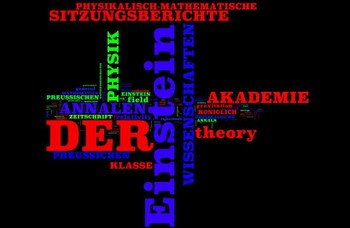
    This piece of Found Word Art is generated by the word-synthesizer at the lovely Wordle site which crunched and counted the occurrence of words in the titles and attributions of Albert Einstein’s complete opus. (See our page on the Einstein publications which we used to generate this art here.)

    If you click on the image it will become larger and clearer. 
    Wordle_einstein_annalen

    ·Posted by :

    ·in:

    —

  • Wordle Word Art–Vocabulary from our Particle Physics Chronology, 1895-1995

    JF Ptak Science Books LLC

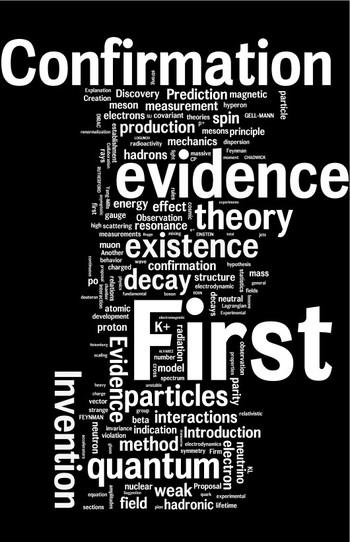
    Up next in the expanding WORDLErama of creating FOUND WORD ART by dumping text blocks into the glorious WORDLE wonder-engine is my page devoted to the chronology of modern particle physics (1895-1995).  The most often recurring words are the largest, which produces some interesting and unexpected affects and results. 

    If you click on the image it will be larger and clearer.

    Wordleparticle_physics

    ·Posted by :

    ·in:

    —

  • Henri Poincare, Relativity and the full text of “The Principles of Mathematical Physics” (1905)

    JF Ptak  Science Books LLC   Post 177

    Poincare
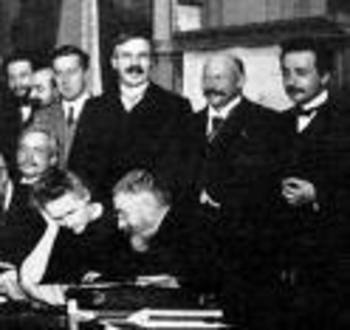
    I really don’t want to make a post here on the pre-history of the special theory of relativity (SR)—I really just want to post the English translation of a paper that came late in the career of the polymathic Henri Poincare (1854-1911) and in the same year as Einstein’s epochal paper (1905). (Poincare would republish this paper in a more technical form in 1906 as  “Sur la dynamique de l’electron”, published in the Comptes Rendus volume 140, 1905 Lecat Bibliographie de la Relativite # 2269, and which can be found in a fine translation here by an old friend of our store, Scott Walter).    (This photo shows Poincare seated next to Mme Curie at the first Solvay Conference in 1911.)   

    It has been resident here on the computer for a long time and thought to publish it here.  This is not by any means the only effort by Poincare in this area—in addition to technical papers Poincare had earlier published his “Science and Hypothesis” in 1902 which included some basic philosophical investigations on the relativity of space and time, the questioning of the existence of the aerther, and some other pertinent SR-related topics—again, addressed to an advanced general audience. 
    There were of course many others who made important contributions to to development of SR:  Joseph LArmor, Wilhelm Wien, Heinrich Hertz, HA Lorentz, W. Voigt, Michelson Morely, Walter Kaufman, Max Abraham, GF FitzGerlad, Herman Minkowski, and many others.  (A nice place to start on the history of this topic is  The Genesis of General Relativity Vol. 3: Theories of Gravitation in the Twilight of Classical Physics; Part I (Boston Studies in the Philosophy of Science 250), 253-271, Springer, 2007.

    Although a strong case can be made for Poincare being one of the last of a breed that “knew everything”(like Arnold Sommerfeld, Herman von Helmholtz, JC Maxwell, Goethe, and so on) he really didn’t get to SR before Einstein, in my opinion.  At the very least it was Einstein who correctly reinterpreted Lorentzian electrodynamics and finally did away with the ether, not Poincare.

    Also see a fine physics blog dealing with Poincare here.

    And so the paper:

    THE PRINCIPLES OF MATHEMATICAL PHYSICS.
    by Henri Poincare

    Reprinted from The Monist, volume 15, Number 1, 1905.

    WHAT is the actual state of mathematical physics? What are the problems
    it is led to set itself? What is its future? Is its orientation on the
    point of modifying itself ? Will the aim and the methods of this science
    appear in ten years to our immediate successors in the same light as to
    ourselves; or, on the contrary, are we about to witness a profound transformation?
    Such are the questions we are forced to raise in entering today upon our
    investigation.

    If it is easy to propound them, to answer is difficult.

    If we feel ourselves tempted to risk a prognostication, we have, to
    resist this temptation, only to think of all the stupidities the most eminent
    savants of a hundred years ago would have uttered, if one had asked them
    what the science of the nineteenth century would be. They would have believed
    themselves bold in their predictions, and after the event, how very timid
    we should have found them. Do not, therefore, expect of me any prophecy;
    if I had known what one will discover tomorrow, I would long ago have published
    it to secure me the priority. But if, like all prudent physicians, I shun
    giving a prognosis, nevertheless I cannot dispense with a little diagnostic;
    well, yes, there are indications of a serious crisis, as if we should expect
    an approaching transformation.

    We are assured that the patient will not die of it, and even can hope
    that this crisis will be salutary, that it was even necessary for his development.
    This the history of the past seems to guarantee us.

    This crisis in fact is not the first, and for its comprehension is important
    to recall those which have preceded it.

    Mathematical physics, we know, was born of celestial mechanics, which
    engendered it at the end of the eighteenth century at the moment when it
    itself attained its complete development. During its first years especially,
    the infant resembled in a striking way its mother.

    ·Posted by :

    ·in:


  • Three Great First F’s: Forks, Forts, Fission, (and one plain non-first F (Nobel))

    JF Ptak Science Books LLC  Post #139
    Blogfsfork210

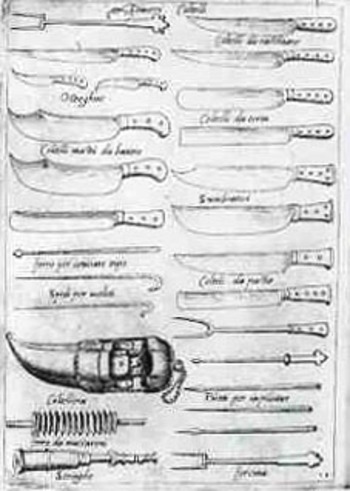
    Apropos of nothing whatsoever, I’d like to look at four “first” F’s.  the first is the first known published image of a fork , or forcina in Italian.  This was a prickish utensil (seen in the image at the bottom-right), hiding none of its stabbing qualities with a middle tine, and shows for us all its direct decent from Mother Knife.  It appears in the Opera dell’arte del cucinare by the great Renaissance chef  and cook to Pope Pius V Bartolomeo Scappi (c. 1500 – 13 April 1577, buried in the church of SS. Vincenzo ad Anastasio alla Regola, dedicated to cooks and bakers) was published in 1573. In the book he lists approximately 1000 recipes of the Renaissance cuisine (some of which, for Renaissance salads, appear at bottom) includes many images of kitchenware, the fork being perhaps the most famous.  (I used to know the first time that a fork appeared in a painting–of the Last Supper of course, but I’ve forgotten, though it does come right on the heals of Scappi.)

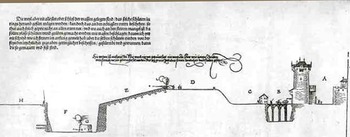
    The second unrelated but interesting first “F” is perhaps the first image of a modern, canon-proofed fort, by none other than Albrecht Durer.  This image appears in 1527 in his Etliche underricht zu bestestigung der Stat, Schloss und Flecken, and although his designs were impracticable (massive and massively expensive forts and fortified cities;
    Blogfsfort211_2

    pretty but very costly), there were certain elements of the work that were very useful—namely, the new face of some of te walls that he offered to the modern canons of the 1520’s.  These weapons were vast improvements over their earlier brethren, and Durer responded to the extra and more accurate firepower by lowering and thickening the walls and giving them greater slope—this would aid in deflecting many of the shots that were not directly spot-on, and also would improve the chances of the fort’s survival against those hits by having thicker walls. 

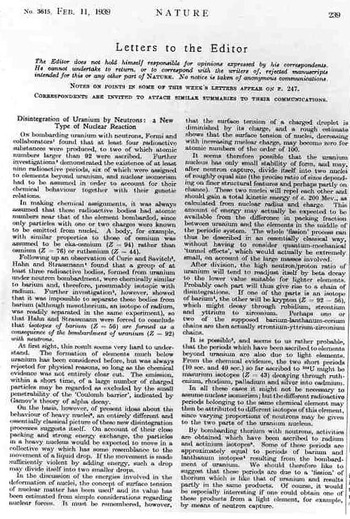
    The third F is slightly related to Durer’s fort walls—this is the first appearance of the word “fission”.  It appeared as so many of these sorts of 20th century announcements appeared with great sotto voce--this one, in a “Letter to the Editor” of the journal Nature (11 February 1939), by Lise Meitner and Otto Frisch.
    Blogfsfission212

    The communication, “Disintegration of Uranium by Neutrons:  a New Type of Nuclear Reaction”  wasn’t a letter to the editor in the conventional sense of course but was meant to be the quickest line of communication of an important result and thus appeared somewhat truncated though the great stuff of the announcement was made known and understood.     Niels Bohr’s “The Mechanism of Nuclear Fission” in the Physical Review (1 September 1939) may I think be the first use of “fission” in the title of a paper.) 

    There is a very big story here with Meitner and fission and Nazis and the Nobel.  This leads to our fourth F:  and that would be “F” as in “Failure” to the Nobel committee who in 1944 awarded the Nobel Prize to (German, non-Jewish) Otto Hahn for the discovery of nuclear fission while completely ignoring (purposefully, I would say) Meitner, who really, by all  rights, should’ve gotten the award, and probably by herself.  This is a more complex tale than I would care to deal with now, but I think that it is beyond doubt that the Nobel committee again (think Einstein and others) severely screwed this up in favor of maintaining their dislike for people with Meitner’s heritage.  (And yes, she was Jewish; Einstein suffered too at the hands of the committee, not receiving his award, unbelievably, until 1921, *16 years* following what was probably the best single year  that anyone ever had in the history of physics, ever, and then 14 years following his great year of 1907 and five years following 1916’s paper.  And so on.)   Yes, Meitner hung on in a not-good way in Germany for six bad years 1933-1938) until she finally get the hell out, but that really doesn’t tell the story very much.  The fission bit with Hahn and Strassmann is a little bedeviling, but it really was Meitner who recognized the whole thing as being the process of fission.  Period.  And shame again on the Nobel people for getting it wrong, again, on purpose. 

    ·Posted by :

    ·in:

    —