JF Ptak Science Books LLC Post 177
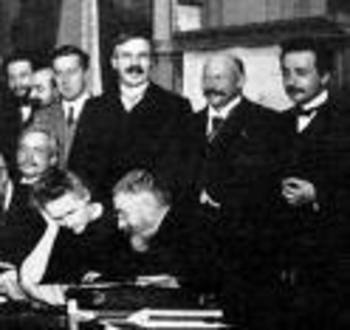
I really don’t want to make a post here on the pre-history of the special theory of relativity (SR)—I really just want to post the English translation of a paper that came late in the career of the polymathic Henri Poincare (1854-1911) and in the same year as Einstein’s epochal paper (1905). (Poincare would republish this paper in a more technical form in 1906 as “Sur la dynamique de l’electron”, published in the Comptes Rendus volume 140, 1905 Lecat Bibliographie de la Relativite # 2269, and which can be found in a fine translation here by an old friend of our store, Scott Walter). (This photo shows Poincare seated next to Mme Curie at the first Solvay Conference in 1911.)It has been resident here on the computer for a long time and thought to publish it here. This is not by any means the only effort by Poincare in this area—in addition to technical papers Poincare had earlier published his “Science and Hypothesis” in 1902 which included some basic philosophical investigations on the relativity of space and time, the questioning of the existence of the aerther, and some other pertinent SR-related topics—again, addressed to an advanced general audience.
There were of course many others who made important contributions to to development of SR: Joseph LArmor, Wilhelm Wien, Heinrich Hertz, HA Lorentz, W. Voigt, Michelson Morely, Walter Kaufman, Max Abraham, GF FitzGerlad, Herman Minkowski, and many others. (A nice place to start on the history of this topic is The Genesis of General Relativity Vol. 3: Theories of Gravitation in the Twilight of Classical Physics; Part I (Boston Studies in the Philosophy of Science 250), 253-271, Springer, 2007.Although a strong case can be made for Poincare being one of the last of a breed that “knew everything”(like Arnold Sommerfeld, Herman von Helmholtz, JC Maxwell, Goethe, and so on) he really didn’t get to SR before Einstein, in my opinion. At the very least it was Einstein who correctly reinterpreted Lorentzian electrodynamics and finally did away with the ether, not Poincare.
Also see a fine physics blog dealing with Poincare here.
And so the paper:
THE PRINCIPLES OF MATHEMATICAL PHYSICS.
by Henri PoincareReprinted from The Monist, volume 15, Number 1, 1905.
WHAT is the actual state of mathematical physics? What are the problems
it is led to set itself? What is its future? Is its orientation on the
point of modifying itself ? Will the aim and the methods of this science
appear in ten years to our immediate successors in the same light as to
ourselves; or, on the contrary, are we about to witness a profound transformation?
Such are the questions we are forced to raise in entering today upon our
investigation.If it is easy to propound them, to answer is difficult.
If we feel ourselves tempted to risk a prognostication, we have, to
resist this temptation, only to think of all the stupidities the most eminent
savants of a hundred years ago would have uttered, if one had asked them
what the science of the nineteenth century would be. They would have believed
themselves bold in their predictions, and after the event, how very timid
we should have found them. Do not, therefore, expect of me any prophecy;
if I had known what one will discover tomorrow, I would long ago have published
it to secure me the priority. But if, like all prudent physicians, I shun
giving a prognosis, nevertheless I cannot dispense with a little diagnostic;
well, yes, there are indications of a serious crisis, as if we should expect
an approaching transformation.We are assured that the patient will not die of it, and even can hope
that this crisis will be salutary, that it was even necessary for his development.
This the history of the past seems to guarantee us.This crisis in fact is not the first, and for its comprehension is important
to recall those which have preceded it.Mathematical physics, we know, was born of celestial mechanics, which
engendered it at the end of the eighteenth century at the moment when it
itself attained its complete development. During its first years especially,
the infant resembled in a striking way its mother.
Henri Poincare, Relativity and the full text of “The Principles of Mathematical Physics” (1905)
Recent Posts
Archives
Categories
- Absurdist, Unintentional (1,452)
- Alphabets (136)
- American History: Western Exploration & Native Americans (120)
- Anticipation, History of (812)
- Architecture and Building (478)
- Art (108)
- Art History (684)
- Astronomy (324)
- Atlas of Dead Ideas (72)
- Atomic and Nuclear weapons (362)
- Aviation & flight (294)
- Bad Ideas (1,008)
- Beautiful books (62)
- Biology (24)
- Blank and Empty Things; A History of (726)
- Books–Great Cover Art (114)
- Books–title pages, beautiful (70)
- Books: Great & Lost in the Dust (24)
- Books: Title Pages, Unusual (30)
- Boredom, History of (22)
- Brevity and Complexity (102)
- Calculating (118)
- Chemistry (1)
- Chemistry, history of (32)
- Children's Art (46)
- Circles, Geometry (12)
- Color & its advanced Abuses (62)
- Color Theory (64)
- Computer Tech/History (258)
- Contraries (22)
- Cross-Sections (50)
- Daily Dose from Dr. Odd (168)
- Economics (16)
- Electro-LUXurious (42)
- Exploration (6)
- Fantastic Beasts and Tales (18)
- Fantastic Titles (90)
- Fear, History of (42)
- Future Punk (54)
- Future, History of the (624)
- German Design (28)
- Histories of Smallness (60)
- History (4)
- History of Dots (144)
- History of Goodbye (122)
- History of Holes (67)
- History of Lines (166)
- History of Memory (64)
- History of Nothing (94)
- History of the Future (690)
- How Fast Stuff Is. (6)
- Iconography (160)
- Imaginary and Impossible, Museum of the (28)
- Impossible Books (70)
- Industrial & Technological art (342)
- Information, Quantitative Display of (1,236)
- Inventions (132)
- Lines, History of (72)
- Literature (4)
- Magnifcent Mundane (28)
- Manuscripts (12)
- Maps, Cartography, History of Mapmaking (500)
- Maps/Diagrams of Imagination & Ideas (348)
- mathematics, logic (220)
- Medicine, History of (180)
- Memory, Historry of (24)
- Militaria (950)
- Mistakes, The Importance of (14)
- Music (24)
- Mythology (28)
- Naming Things (294)
- Outsider Logic (196)
- Patents (118)
- Perception (374)
- Perspective (398)
- Photography (290)
- Photography, history (138)
- Physics (117)
- Picture Post/Image Dump (10)
- Piles, History of (2)
- Politics, American (6)
- Poster Series (10)
- Prints–looking HARD/deeply at (558)
- Propaganda (110)
- Psychology (40)
- Quantum Theory (1)
- Questionable Quidity (52)
- Reference Tools (76)
- Science (14)
- Social History (293)
- Sports (10)
- Statistics–Fossil, Found, Odd, Forgotten (58)
- Strange Things in the Sky (82)
- Tech-Quiz (30)
- Technology, History of (835)
- Title Page Art, Beautiful (64)
- Travel (6)
- Uncategorized (309)
- What is It? (28)
- Women, History of (196)
- WORD art (30)
- World War I (496)
- World War II (55)
- Writing Systems (16)
- You Are There (12)
- Zoomology (50)