A Daily History of Holes, Dots, Lines, Science, History, Math, Physics, Art, the Unintentional Absurd, Architecture, Maps, Data Visualization, Blank and Missing Things, and so on. |1.6 million words, 7500 images, 4.9 million hits| Press & appearances in The Times, Le Figaro, Mensa, The Economist, The Guardian, Discovery News, Slate, Le Monde, Sci American Blogs, Le Pont, and many other places… 5000+ total posts since 2008.

Category: Physics

  • Harvard’s Giant Brain; the ASCC Mark I Computer

    JF Ptak Science Books LLC  Post #125
    Blogharvardbrain
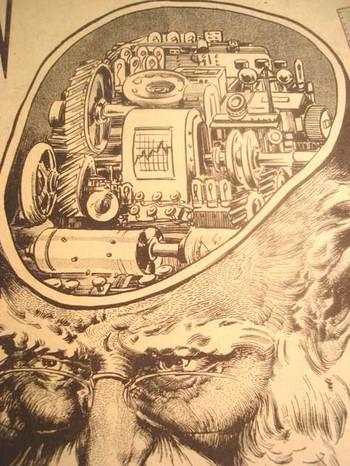
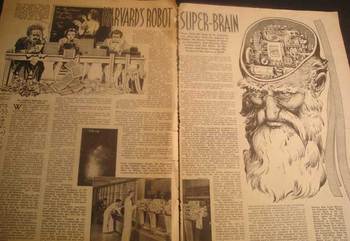
    This may well be the first public, popular, report on the Harvard Automatic Sequence Controlled Calculator (ASCC) (appearing in the American Weekly, 15 October 1944), the first automatic, general-purpose, digital calculator.  Known as the MARK 1, it was the brainchild of Howard Aiken (1900-1973), a graduate student at Harvard, who started it all in 1937 by proposing a series of coordinated Monroe calculators to function as a unified whole  that would cross the threshold of the physically-impossible calculation (though theoretically possible) to the eminently doable.  The project was immeasurably aided by the input of Harvard astronomer Harlow Shapley (who had earlier dealt with the enormously problematic aspects of the scale of the universe) who put Aiken in the hands of IBM at Endicott (NY).  From there the building of the computer came under the supervision of Clair D. Lake, with the engineering and theoretical team of Francis Hamilton, Ben Durfee and Howard Aiken. \
    Blogharvardbraindetail

    The machine was basically completed in 1943 and tested in Endicott for the better part of the year before it was shipped of to Harvard in February 1944, where it was put almost instantly to work on ballistic calculations (like its cousin ENIAC at the Moore School at U Penn), as well as naval engineering and design issues. 

    The author of this article, Gordind Bhari Lal (“noted science analyst”), actually does a pretty decent job describing the machine and its (1940’s) possibilities, noting at the end that “it may even unleash for Man’s Use the long-dreamed-of energy of the atom”.  This part did come true, especially post-war, when the machine was put to fair use by the US Atomic Energy Commission. 

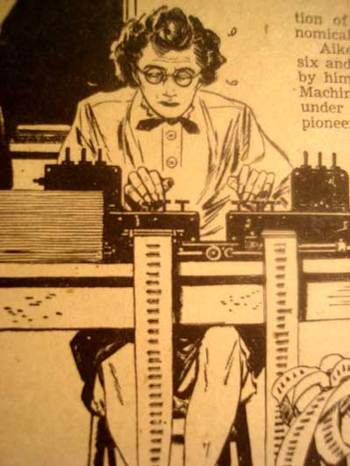
    The part I really don’t understand in this article is comparing the speed and function of the ASCC to two women working on calculators and Albert Einstein, working with a pencil, paper and pipe, none of whom look comfortable or happy.  (Actually the dresses on the women look a little hiked-up to me, just a little too high.)  Lal does make a decent comparative point (of uncertain veracity) about four generations of humans (the three above-mentioned calculators?) doing calculations that the ASCC could do in seconds.  Right or wrong, it gave the crowds in 1944 a real something to think about.
    Blogharvardbraingirl

    ·Posted by :

    ·in:

    —

  • Different Forms of Writing 1: Big Writing With Light—Nollet, Citroen, Barnum and Packard

    JF Ptak Science Books  Post #97

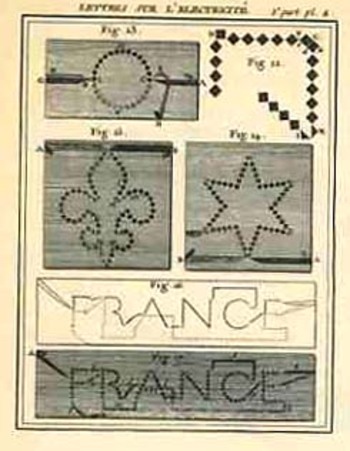
    The fabulously over-usage of light-polluting electricity in advertising finds its beginning 220 years ago with the work of a modest, family-friendly French country priest.  The image to the left is  the first example of writing via electricity—basically, the basis for the earliest electric signs, more than 110 years before Edison’s (et alia ) electric incandescent bulb, and about twenty years before the presumptive “first” electrical experiments of Sir Humphrey Davy) on the first arc/carbon filament electrical light in 1809).   \

    Bloglighting_nollet_2

    They were the product of the electrical mind of Jean-Antoine Nollet (1700-1770), a peasant boy who was educated for the priesthood (becoming Abbe), whose extensive curiosity soon led him to physics and then to electricity—he was well educated and taught at numerous prestigious schools, admitted to the Academy of Sciences as a member in 1742,  finally winding up in 1740 tutoring the dauphin at Versailles.  He published widely, was the first person to experiment with the Leyden jar in France, and made wide contributions in the conduction of electricity through different media. (He also had numerous public disagreements, some of which stood with Benjamin Franklin, whose theories Nollet referred to  as “les pretenetions de l’ecole de Philadelphie”.)  The image above was published in Lettres sur l’electricite, (part II), published in Paris in 17601 (with part I located at Gallica, here);  see the interesting Le Blog du Bibliophile, des Bibliophiles, de la Bibliophilie et des Livres Anciens, here, hosting some useful information and images relating to Nollet.  [Thanks to Jaime Day for pointing out the misattribution of the plate.]

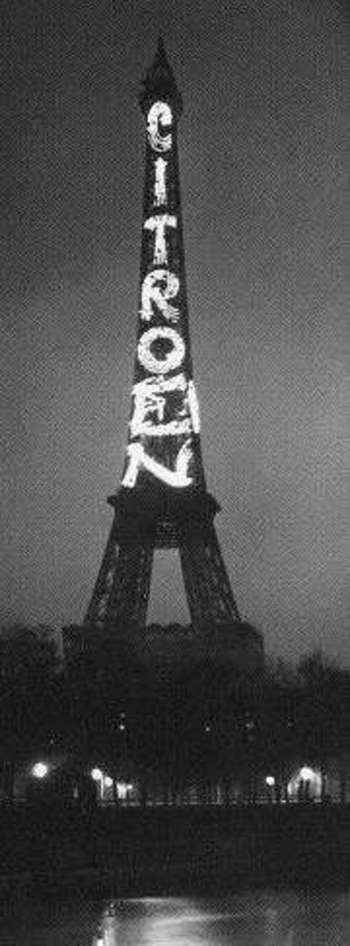
    The, um, adventurous PT Barnum contracted  the  first electric bulb writing (utilizing the Edison invention) in Manhattan in 1892 to envious attention, resulting in less than 15 years with the Great White Way.  The world’s largest electric bulb writing was on the Eiffel Tower, with Andre Citroen agreeing to light the outline of the tower if he could put his name on the rest of it.  I’m not sure how this was seen as a good idea, but the sides of the tower were used for this purposes until somebody wised up and put an end to it all in 1937.

    Bloglightingcitroen_2

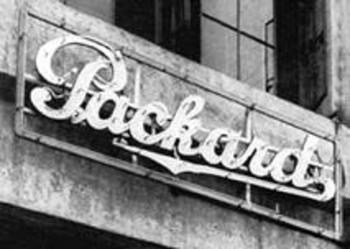
    But as white and as bright as the light bulb was in advertising, it was completely overwhelmed by the invention of the bold, brassy (and with a high potential “trashy” factor) neon sign, which was first used in the United States by Earle Anthony’s Packard dealership in Los Angeles in 1924.

    Bloglightingpackard_2
    (Mr. Anthony paid $24,000 1924 dollars for the two “Packard” signs, which in today’s dollars, employing the kindest inflation factor in the comparative CPI, would be about $3,000,000.  Mr. Anthony could afford it, and the signs were a sensation.

    Notes

    1.  The full title:   Lettres sur LÉlectricité. Dans lesquelles on examine les dernieres Découvertes qui ont été faites sur cette Matiere, & les conséquences que l’on en peut tirer (part I), 1753; and Lettre sur L’electricité; Dans laquelle en soutient le principe des Effluences & Affluences simultanées contre la doctrine de M. Franklin, & contre les nouvelles prétentions de ses partisans. Avec Figures en Taille-douce. Seconde Partie, published in 1760. 


  • First-Hand Observations of Isaac Newton–Humphrey Newton and the Principia Mathematica

    JF Ptak Science Books LLC   Post #68Newtontrinity_desk
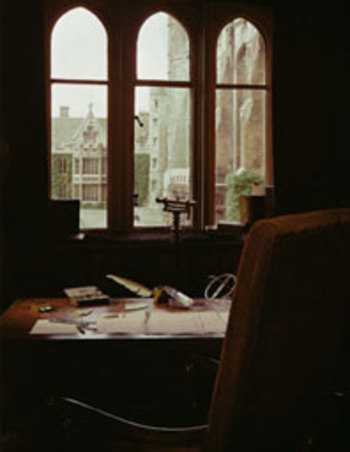
    I started to write an essay on Sir Isaac’s interest in alchemy–which was considerable, as he wrote more than a million words on the subject and fully one third of his library was devoted to it–chiefly to look at the reasons in pursuing the darker aspects of chemistry (in trying to master the ultimate secrets of the gatekeeper, finding the lost early magnificent knowledge, that sort of thing).  Newton felt that he really, truly, just didn’t know enough, and that there was something very big, and very hidden, that was escaping him. And so the background of these pursuits was to be tied to musical composition with color, and synesthesia, but I got sidetracked by two glorious letters by Newton’s assistant, Humphrey Newton, in which the personal life-style stuff of the Great Man is described.  I thought to post the two Humphrey Newton letters here, slightly annotated by me, before the thoughts left my head.  I’ll  return to the Newton/Color Music/Music of the Spheres stuff later.  (At right, Newton’s desk/study at trinity.)

    Thoughts and Recollections by Humphrey Newton, assistant and amenuensis to      Sir Isaac Newton (no relation), briefly annotated (in blue).

    Original transcription available from The Newton Project:  “King’s College, Cambridge, Keynes Ms. 135, two letters from Humphrey Newton (Newton’s amanuensis from 1683-89 and no relation) to John Conduitt, 17 January 1727/8 and 14 February 1727/8, with reminiscences of Newton”.

    We’ve followed this with the Newton’s Introduction to the Principia (1687)

    Humphrey Newton Letter 1

    (This letter also published in full in Memoirs of the Life, Writings, and Discoveries of Sir Isaac Newton,  by Sir David Brewster, 1832)

    Sir
    Receiving yours return as perfect & as faithful Account of my deceased friend’s {Newton, Sir Isaac, 1642-1727] Transactions as possibly does at this Time occur to my memory Had I had the least Thought of gratifying after this manner, Sir Isaac’s ffriend, I should have taken a much stricter view of his Life & Actions
    .
    In the last year of King Charles 2d [Charles  died 2 Nov 1685] Sir Isaac was pleas’d through the Mediation of Dr. Walker (then Schoolmaster at Grantham) [Grantham.  The King’s School, in Lincolnshire, an English educational institution,  endowed in 1528. Newton attended, and may have carved his name in the wooden walls of the library there] to send for me up to Cambridge, of whom I had the opportunity as well as Honour to wait of, for about 5Principia
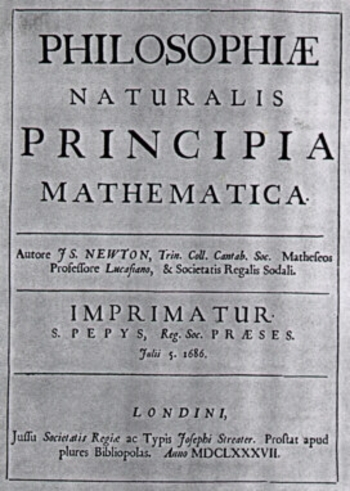
    years, in which time he wrote his Principia Mathematica, [Philosophiae Naturalis Principia Matheamtica published in 1687] which stupendous work, by his order, I copied out, before it went to the Press [of Joseph Streater].. After the Printing Sir Isaac was pleas’d to send me with several of Them, as Presents, to some of the Heads of Colledges, & others of his Acquaintance, some of which (particularly Dr. Babington of Trinity [Humphrey Babington, Fellow of Trinity, 1615-1692]) said That They might study seven years, before They understood any thing of it. His carriage then was very meek, sedate & humble, never seemingly angry, of profound Thoughts, his Countenance mild, pleasant & Comely; I cannot say, I ever saw him laugh, but once, which was at that Passage, which Dr. Stewkley mentioned in his Letter, to your Honour which put me in mind of the Ephesian Phylosopher, who laugh’d only once in his Life Time, to see an Ass, eating Thistles, when Plenty of Grass was by [not the “gathering thistles from figs” part of Eph 6:17]. He always kept Close to his Studyes, very rarely went a visiting, & had as few Visitors, excepting 2 or 3 Persons, Mr. Ellis of Keys, Mr. Lougham of Trinity [John Laughton, Fellow, d. 1712] , & Mr. Vigani, a Chymist, [John Francis Vigani was the first Professor of Chemistry at
    Cambridge University and taught at Queens’ College for three years up
    to 1705.]
    in whose Company he took much Delight and Pleasure at an Evening, when he came to wait upon Him. I never knew him take any Recreation or Pastime, either in Riding out to take the Air, Walking, bowling, or any other Exercise whatever, Thinking all Hours lost, that was not spent in his Studyes, to which he kept so close, that he seldom left his Chamber unless at Term Newtontrinity
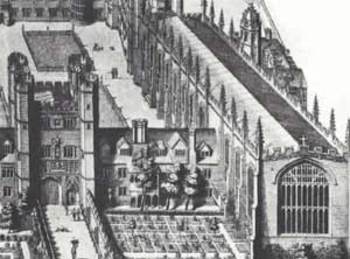
    Time, when he read in the Schoools, as being Lucasianus Professor, where so few went to hear Him, & fewer that understood him, that oftimes he did in a manner, for want of Hearers, read to the Walls. fforeigners He received with a great deal of ffreedom; Candour, & Respect. When invited to a Treat, which was very seldom us’d to return it very handsomely, freely, & with much satisfaction to Himself. So intent, so serious upon his Studies, that he eat very sparingly, nay, oftimes he has forget to eat at all, so that going into his Chamber, I have found his Mess untouch’d, of which when I have reminded him, would reply, Have I; & then making to the Table, would eat a bit or two standing, for I cannot say, I ever saw Him sit at Table by himself, At

    (Newton’s rooms at Trinity at lower right)

    some {seldom} Entertainments the Masters of Colledges were chiefly his Guests. He very rarely went to Bed, till 2 or 3 of the clock, sometimes not till 5 or 6, lying about 4 or 5 hours, especailly at spring & ffall of the Leaf, at which Times he us’d to imploy about 6 weeks in his Elaboratory, the ffire scarcely going out either Night or Day, he siting up one Night, as I did another till he had finished his Chymical Experiments, in the Performances of which he was the most accurate, strict, exact: What his Aim might be, I was not able to penetrate into but his Paine, his Diligence  at those sett times, made me think, he aim’d at somthing beyond the Reach of humane Art & Industry. I cannot say, I ever saw him drink, either wine Ale or Bear, excepting Meals, & then but very sparingly. He very rarely went to Dine in the Hall unless upon some Publick Dayes, & then if He has not been minded, would go very carelessly, with shoes down at Heels, stockins unty’d, surplice on, & his Head scarcely comb’d. As for his Opticks being burnt, IOptickstitle
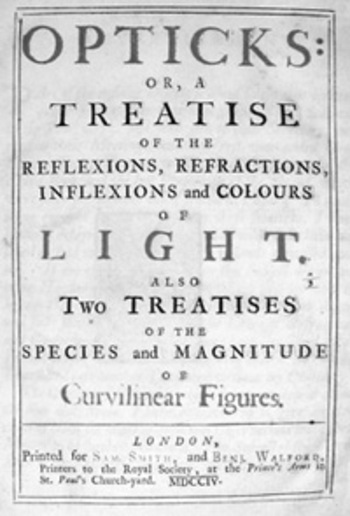
    know Nothing of it, but as I had heard from Others, That Accident happening before he writ his Principia. He was very Curious in his Garden, which was never out of Order, in which he would, at some seldom Times, take a short Walk or two, not enduring to see a weed in it; On the left end of the Garden, was his Elaboratory, near the East end of the Chappell, where he, at these sett Times, employ’d himself in, with a great deal of satisfaction & Delight. Nothing extraordinary, as I can Remember, happen’d in making his Experiments, which if there did, He was of so sedate & even Temper, that I could not in the least discern it. He very seldom went to the Chappel, that being the Time he chiefly took his Repose; And as for the Afternoons, his earnest & indefatigable Studyes
    retain’d Him, so that He scarcely knewe the Hour of Prayer. Very frequently
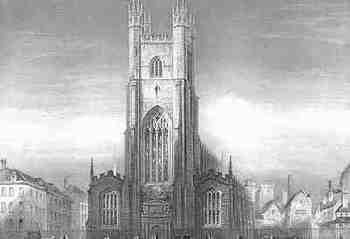
    Newtonst_marys
    on Sundays he went to St. Mary’s Church, especially in the fore Noons. I know Nothing of the Writings, which your Honour sent, only that it is his own Hand, I am very certain of, believing he might write Them at some leasure Hours, before he sett upon his more serious & weighty Matters. Sir Isaac at that Time had no Pupills, nor any Chamber ffellow, for that I presume to think, would not in the least have <4> been agreeable to his Studies. He was only once disorder’d with pains at the stomach, which confin’d Him for some days to his Bed, which he bare with a great deal of Patience & Magnanimity, seemingly indifferent either to live or dye. He seeing me much Concern’d at his Illness, bid me not trouble my self, for if, said he, I dye, I shall leave you an Estate, which he then mention’d.
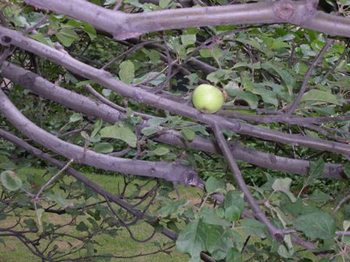
    Newtons_apple_tree_at_mit [Cutting from Newton’s “original” apple tree bearing fruit at MIT]

    Sir this is what I can at present recollect, hoping it may in some Measure satisfy your Quæries.
    My wife at this Time is brought to Bed of a son, whom I intent to Nominate after my dear deceased ffriend, would you please to honour me so far, as to substitute Dr. Stewkly to stand as witness, I should take it as a very singular ffavour, & would very much
    oblige, Sir, your most humble
    & obedient Servant.
    Humphrey Newton
    Ian.17. –27/8
    Grantham

    Humphrey Newton Letter 2

    Sir
    I return your Honour a great many Thanks for the ffavour you have done me, in deputing Dr: Stewkley to stand in your stead, as witness to my son. It is out of my Sphere to make any grateful Return, therefore doubt not but Your Goodness, will in that Point, excuse my Deficiency.
    I have bethought my self about Sir Isaac’s Life, as much as possibly I can.
    About 6 weeks at Spring & 6 at the ffall the fire in the Elaboratory scarcely went out, which was well furnished with chymical Materials, as Bodyes, Receivers, ffends, Crucibles &c, which was made very little use of, the Crucibles excepted, in which he {fused} his Metals: He would sometimes, thô very seldom,) look into an old mouldy Book, which lay in his Elaboratory, I think it was titled, – Agricola de Metallis, The transmuting of Metals, being his Chief Design, for which Purpose Antimony was a great Ingredient. Near his Elaboratory was his Garden, which was kept in Order by a Gardiner I scarcely ever saw him do any thing (as pruning &c) at it himself. When he has sometimes taken a Turn or two, has made a sudden stand, turn’d himself about, run up the stairs, like another Archimedes, with an Ε’ύρηκα, fall to write on his Desk standing, without giving himself the Leasure to draw a Chair to sit down in.
    At some seldom Times when he design’d to dine in the Hall, would turn to the left hand, & go out into the street, where making a stop, when he found his Mistake, would hastily turn back, & then sometimes instead of going into the Hall, would return to his Chamber again.
    <6>
    When he read in the Schools, he usually staid about half an hour, when he had no Auditors he Commonly return’d in a 4th part of that time or less. Mr Laughton, who was then the Library Keeper of Trinity College resorted much to his Chamber, if he commenc’d Doctor after that, I know not.
    His Telescope, which was at that Time, as near as I could guess, near 5 foot long, which he plac’d at the head of the stairs, going down into the Garden, buting towards the East, what Observations he might make, I know not, but several of his Observations about Comets & the Planets may be found scatter’d here & there in a Book intitled, The Elements of Astronomy, by Dr. David Gregory. He would with great acutness answer a Question, but would very seldom start one. Dr: Boerhaave (I think it is) Professor Lipsiae in some of his writings, speaking of Sir Isaac That man, says he, Comprehends as much as all mankind besides.
    In his Chamber he walk’d so very much, that you might have thought him to be educated at Athens among the Aristotelian sects. His Brick ffurnaces pro re natâ, he made & alter’d himself, without troubling a Brick-layer. He very seldom sat by the ffire in his Chamber, excepting that long frosty winter, which made him creep to it against his will.
    I can’t say, I ever saw him wear a Night-Gown, but his wearing Cloathes, that he put off at Night, at Night, do I say, yea rather towards the Morning, he put on again at his Rising. He never slept in the Day Time, that I ever perceived. I believe he grudg’d that short Time he spent in eating & sleeping. ’Ανέχου και ’χπεχου may very well & truly be said of him, he always <7> thinking with Bishop Sanderson, Temperance to be the best Physick. In a Morning he seem’d to be as much refresh’d with his few hours sleep, as though he had taken a whole Night’s rest. He kept neither Dog nor Cat in his Chamber, which made well for the old woman, his Bed-maker, she faring much the better for it, for in a Morning, she has sometimes found both Dinner & Supper scarcely tasted of, which the old woman has very pleasantly & mumpingly gone away with. As for his private Prayers, I can say nothing of them, I am apt to believe his intense Studying depriv’d him of the better Part. His Behaviour was mild & meek, without Anger, Peevishness or Passion, so free from that, That you might take him for a Stoick. I have seen a smal pasteboard Box in his study set against the open window, no less as one might suppose, then a 1000 Guineas in it crowded Edgewayes, whether this was suspicion or Carelessness I cannot say, perhaps to try the ffidelity of those about him. In Winter Time, he was a Lover of Apples, & sometimes at a Night would eat a smal roasted Quince. His thoughts were his Books, thô he had a large study, seldom Consulted with them. When he was about 30 years of Age, his gray Hairs was very Comely, & his smiling Countenance made him so much the more graceful. He was very Charitable, few went empty handed from him. Mr. Pilkinton, who liv’d at Market-Orton, died in a mean Condition (thô formerly he had a plentiful Estate) whose Widow with 5 or 6 Children Sir Isaac maintain’d several years together. He commonly gave his poor Relations (for no ffamilies so rich, but there is some Poor among them) when they apply’d themselves to him, no less then 5. Guineas <8> as they themselves have told me. He has given the Porter many a Shilling, not for leting him at the Gates at unseasonable Hours, for that he abhor’d, never knowing him out of his Chamber at such Times. No way litigious, not given to Law or vexatious suits, taking Patience to be the best Law, & a good Conscience the best Divinity.
    Says Seneca, some Body will demonstrate, which way Comets wander, why they go so far from the rest of the Celestial Bodies, how big, & what sort of Bodies they are, which had he been Contemporary with Sir Isaac he might have seen this Prophecy of his fulfill’d by that wonder of his Age.
    Could Your Honour pick some things out of this indigested Mass, worthy to be inserted into the Life of so great, so good, & so illustrious a Person, as Sir Isaac Newton! it would be of infinite Satisfaction to him, Sir
    who is Your Honours most
    humble & most obedient
    Servant
    H: Newton
    ffeb: 17. 1727/8
    Grantham
    ·Posted by :

    ·in:

    —

  • (Literal) Bits of History–the Softly Pedestrian Beginning of the Atomic Bomb

    JF Ptak Science Books LLC Dsc00015_detail
    My  rare/significant/non-existent scientific bookstore was in Georgetown for many years.  It was a few doors down from Alger Hiss’ house, a few less from Warren Christopher’s house, a few more further from Alex G. Bell’s house, diagonally away from a George Washington ____ here tavern,  just across the street from a children’s park built on top of a Revolutionary War cemetery, and just generally in the misty mist of interesting stuff. It was by virtue of my location (it took 15 years for me to actually get a sign for the store, and only then because my glorious wife, Patti Digh, bought it for me) that I was able to met a wide range of interesting folks–and this is how I came to meet Robert L. Walker.  Dr. Walker was retired and living in the desert near Santa Fe at that point, and had just happened to pop into the store because he was visiting a neighbor who shared his hobby of harpsichord building. 
    Blogwalkerfermi

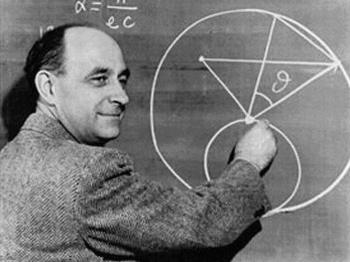
    Since he was a physicist and of a certain age, it was my custom to find out what this class of human was doing, oh, 55 years earlier.  Dr. Walker, as it turned out, was a graduate student at Cornell who was recruited to work at the Metallurgical Lab at U Chicago, beginning in 1941. 
    Dsc00015

    This of course was an incredibly interesting time to be where he was. Steps towards the realization of nuclear energy were being taken under the grandstands of Soldier’s Field (the “West Stands Laboratory”), with Enrico Fermi in charge–the atomic pile (code for a nuclear reactor) being constructed during the months of October and November 1942 and then becoming “operational” (becoming a self sustaining chain reaction initiating the controlled release of nuclear energy, as they say) for the first time (in human history) on December 2, 1942.

    Now what really captured me in all of this was Dr. Walker’s story of how he came to go from Chicago to Los Alamos—it is to me a magnificent story of collected smallnesses in a very, decidedly, not-small environment.

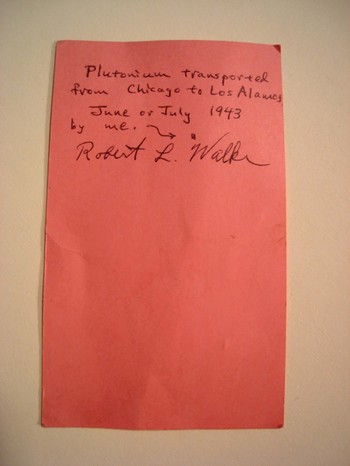
    Listen:  Dr. Walker said that he was tasked “in June or July 1943” with taking a bit of plutonium from the Chicago reactor to Los Alamos. Los Alamos was just being completed at the time.  The production of plutonium was very slow and produced minute amounts. It could well be that this was the first plutonium that was received at Los Alamos.

    Dr. Walker had the plutonium in a small glass vial in his pocket.  He traveled alone.

    He got on a commercial flight and had  several stops en route to the desert.

    Once he reached Santa Fe he waited for a JEEP; once it arrived, he hopped in and he and the driver trundled off to the brand new top secret facility in Oppenheimer’s nowhere.

    The plutonium was delivered.

    The story is just so incredibly sotto voce, so offhand and chance-filled, to transport such an incredibly rare and valuable commodity in someone’s pocket, without a guard, as to be unimaginable, at least in my mind.

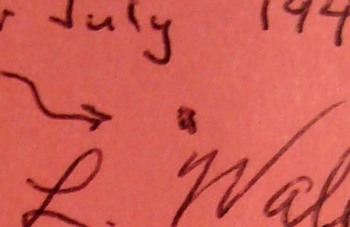
    I asked Dr. Walker to draw on a 3×5 card the size of the plutonium bit—the results are above.  The speck was a research speck to be used to determine fission quality and other preparatory tests—this was all pre –Hanford, when plutonium production really kicked in in 1944/5.  But in 1943, the speck was pretty much what we had.  And it was in Walker’s pants.

    I misplaced this card for years, and it surfaced again just today.  So, before I could send it off again to its Secret Place, I decided to write a bit about it and post its image here, just so that there is some record of this first momentous and bumpy trip.

    Earlier today I called the Los Alamos National Lab and talked history with Gordon McDonough just to make sure I wasn’t overlooking something big in the story, something that would make it more understandable for this plutonium speck to make the trip in someone’s pants.

    McDonough supported the rare nature of this trip, saying that the plutonium was very seldom transported, and that although Dr. Walker was noted in the official LANL history, there was no mention of this trip, nor it seemed was there any mention of the first plutonium received by the lab.

    I knew that there was no danger in carrying the plutonium in a glass vial in your pants, and Gordon—an animated and charming speaker—perked up further, mentioning that Glenn Seaborg quite often carried his plutonium around in an envelope in his pocket.  I really don’t know what to say.

    Seems to me that the first bits of the bomb would be moved around with a little more élan—though I am proven wrong.  Now I’m forced to try and think about a category of essay in a new and perhaps untouched genre:  great things of enormous importance that people carried in their pockets.

    Dr. Walker went on to a brilliant career and was a much-loved and highly respected, and generous, teacher and colleague.  The way in which he told his story of transporting what may have been the first plutonium to reach Los Alamos for the build of the atomic bomb will never leave me—the quiet, ultimate understatement of a man completing a task. 

    ·Posted by :

    ·in:

    —

  • “It’s ALIVE!” Scientists in Motion Pictures—Einstein, Godel & Dirac vs. Buck Rogers and the Bride of Frankenstein

    JF Ptak Science Books 

     [Via Youtube]

    (This snipet is from The Bride of Frankenstein, 1935–there are actually some excellent vignettes here, mostly the noirish grotesques, with bitter, stark black-and-white contrasts of faces at odd angles.  Parts of this are pretty good, in spite of the fact that it is what it is–the director just couldn’t help himself, it seems, and added some high-end cinematic nuggets before crying himself to sleep at the end of a long day, lamenting the thing he had made.)

    The search for early moving images of scientists started simply enough as a result of looking for something else.   I was looking for some you-tube “footage” of Richard Feynman’s O-ring-in-ice water performance before the Challenger Commission; and once I determined that it wasn’t around, I looked at other offers of the great physicist/magician, and found plenty.  From there I tried finding moving images of the earlier titans, and found a little more…

    Part I, Scientists in Movies:  Imagined, 1926-1939.

    Rotwang seems to be the first scientist/inventor in a feature-length film—he was also the first to produce  what might be the first robot in films, all wrapped into one futurist/expressionist magnum opus: Fritz Lang’s “Metropolis”. Rotwang’s problem with his robot is that it has no soul, and so he comes to transfer the soul of a woman named Maria, somehow causing the like-named robot to become evil.  Its all about souls and being lost in this movie—the future is heavily indebted to not having a soul, humanity an interior-featureless mass, the machines around them the same as they—and then along comes Rotwang to construct a souled-robot but then things go wrong.  This was the second decade of mass production of goods, as well as the second decade of Taylorism and other such humano-industrial ideas for exploiting the working class to suck out its frivolous extra breathing time.  Lang certainly saw the evil, soulless business of business, and exploited his insight. 

    1931 saw the first appearance of (Dr.) Victor Frankenstein in film, loosely based of course on the (originally anonymous) 1818 work by Mary Shelley.  It is allied with Lang’s along the lines of modern technology run amok.  Shelley’s work was sub-titled “The Modern Prometheus”; the Promethean  Titan in the 1931 film being Dr. Victor, who when he steals fire (but not from Zeus), induces tragedy to befall the human race, unlike the Greek original, where Prometheus’ wily intelligence was a benefit to early humankind…admittedly though he wasn’t encumbered by mad-scientistiana back then.

    In 1935 the evil Queen Tika—a herald of science and technology–of the lost city of Murania did battle with (of all people) Gene Autry in “Phantom Empire”  after the Singing Cowboy discovers her world 20K feet underneath his ranch.  Bela Lugosi creeps into the public eye in 1939 as a mad (no!) scientist in the robot-entwined The Phantom Creeps”;  Buck Rogers and Flash Gordon (beginning in 1936 and 1939) have their fair share of run-ins with scientists good and bad (but not indifferent) 

    Things heat up quite a bit for mad scientists in the 1940’s and ‘50’s, what with several real shooting global wars going on as well as a long bi-polar proxy Cold War raging as well.  Doctor Satan, The Perfect Woman, The Day the Earth Stood Still, Forbidden Planet, Plan 9 From Outer Space (!?), and a whole slew of others in the A+B movie genres offered scientists galore, though they were  mostly hi-calorie, low-substance, mostly-mad wild-haired mono-characters.   

    Scientists in Movies, Part II:  Real,  1927-

    One of the great tragedies in my book selling career was arriving too late to purchase an estate of a professional engineer who was charged with using and exhibiting the RCA Photophone—the world’s first successful simultaneously recording sound-on-film motion picture camera.  According to the heirs and some of the remaining archives, there should have been cans and cans of motion picture films made by this gentleman in England in 1926 of the leading scientists of the day.  Realizing instantly what this meant, I asked after the seemingly-missing films.  They weren’t “missing” at all—they were just “gone”, thrown away several days earlier, busted in the dumpster, because they were “nitrate”, and the heirs were afraid that I’d blow myself up;  so they threw away hundreds(!!) of old metal containers, and with them, probably the earliest and ONLY recordings of some of England’s leading scientific lights of the late 19th century.  Terrible but true story.

    Returning to my Feynman quest, I decided to expand my search and try to assemble as much of a list of motion picture images of older scientists that I could find on the web.  Seeing how much extraordinary material there was for classical music on youtube I thought that perhaps there might be something similar for the sciences—so far I’m wrong, overall, but I have found some very interesting stuff.   

    The Solvay Conference 1927–fantastic silent movie taken by Irving Lamgmuir, showing Schroedinger, Bohr, Picard, Brillouin, Kramers, Born, de Broglie, A.H. Compton, Plnack, Debye, Curie and Einstein.

    Richard Feynman on Teaching, Bedtime Stories and How to Find Stuff Out

    Hans Bethe, Haakon Chevalier and JRO

    Alamogardo + Oppenheimer

    Edward Teller

    ·Posted by :

    ·in:


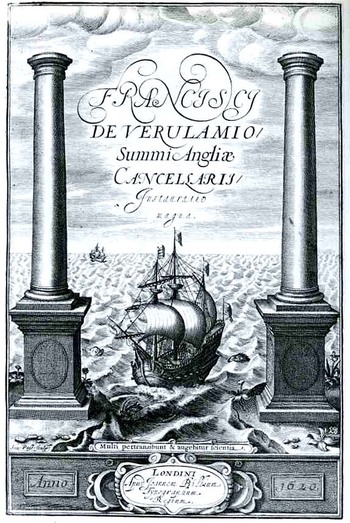
  • Beautiful Title Pages 3–Roger Bacon’s “Novum Organum” and the Voyage of Discovery, 1620

    Blogbacon038JF Ptak Science Books LLC

    This sweepingly metaphorical title page belongs to Francis Bacon’s (1561-1626) superb Instauratio Magna, printed in 1620.  Bacon, the privileged and brilliant son of Nicolas Bacon, the Lord Keeper of the Seal of Elisabeth, entered Cambridge at the age of 12 and never looked back, becoming one of the leading thinkers of the English Renaissance. 

    The Instauratio contains his Novum Organum  (The New Oganon [New Instrument], or true Directions Concerning the Interpretation of Nature) a monumental pronouncement and a new way of looking at scientific thought, looking to break away from the established Aristotlean methods that had been in place in England and Europe for centuries. The “new instrument” part directly relates to Aristotle’s own work called Organon, which in short was a work of inquiry and a treatise on logic and syllogism—Bacon would present his own new instrument of logic base upon a simpler process of reduction. (Bacon famously begins this work “Those who have taken upon them to lay down the law of nature as a thing already searched out and understood, whether they have spoken in simple assurance or professional affectation, have therein done philosophy and the sciences great injury. For as they have been successful in inducing belief, so they have been effective in quenching and stopping inquiry; and have done more harm by spoiling and putting an end to other men’s efforts than good by their own.”  He continues in this vein, getting to the real crux of the biscuit, and broadly states in the second paragraph “Now my method, though hard to practice, is easy to explain; and it is this. I propose to establish progressive stages of certainty. The evidence of the sense, helped and guarded by a certain process of correction, I retain. But the mental operation
    which follows the act of sense I for the most part reject; and instead of it I open and lay out a new and certain path for the mind to proceed in, starting directly from the simple sensuous perception…”  And how!) This new approach to knowledge was foremost in the mind of the designer and artist who produced this title page, which is deeply indebted to the analogy between the (very deeply ingrained and mature) age of exploration and that of intellectual discovery.
    Blogbacon_bits

    The ship in this scene is passing through the Pillars of Hercules, exiting the relatively safe waters of the western Mediterranean and heading out to sea—-to accent this point we see two sea monsters at either side of the ship right at the beginning of this new-world trip, just feet beyond the established safe perimeter.  The pillars had long since been recognized as the western end of the world, as recognized by Dante in the Inferno, observing the voyage of Ulysses past the pillars, endangering the lives of his sailors in the justifiable

    Blogbaconplus_ultra
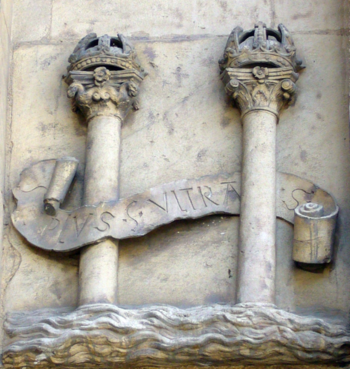
    search for knowledge of the unknown.  The Pillars appear in the coat of arms of Spain, originating with Charles V (the Holy Roman Emperor and also the King of Spain), with motto plus ultra (“further, beyond”) The plus
    ultra part fits nicely with the Bacon, even though the words are not there in the image, they really should be, emblazoned across the stern of the ship of Bacon’s imagination and intellectual enterprise.(The great voyage of discovery analogy and the  great new discovery in thought is probably painfully clear already.)

    Blogbacon_bits_latinThe image is captioned and summarized with the Latin phrase “Multi pertransibunt et augebitur scientia”, wrenched from the triumphantly problematic and slightly insane Book of Daniel (chapter 12, verse 4).  It is translated loosely as “many shall run to and fro, and knowledge shall be increased” or more elegantly “many will pass through and knowledge will be increased”—either way, whether by direct adventure and exploration or frenetic activity, the act of a new effort will be rewarded with a new knowledge.
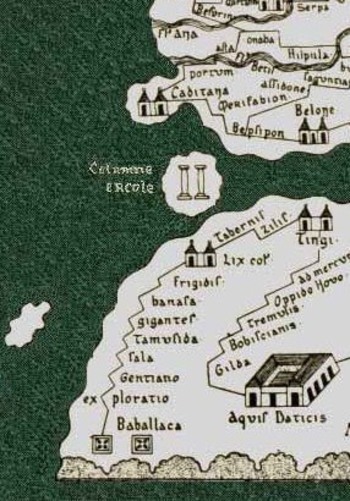
    The image below is from the Tabula Peutinger–basically a roman-era road map of the extent of Empire–and shows the location of the pillars.  They were mountainous metaphors existing at Gibraltar and Morocco, but folks were only too happy to relieve them in marble.

    Blogbaconpillars_2

    ·Posted by :

    ·in:


  • Bean-counting in 4-space–a Census of Articles relating to Quantum Theory and Relativity

    JF Ptak Science Books LLC Post 3

    A census of articles relating to quantum theory and relativity.

    We offer for a casual amusement this search that we did on
    the FANTASTIC American Physical Society website section PROLA (Physical Review
    Online Archive) http://prola.aps.org/  We simply searched all years of the Physical
    Review for the appearance of the words “relativity” or “quantum” in the
    published titles and/or abstracts. It is
    curious to see how long it actually took for these articles to appear in this
    journal.  The PROLA page is endlessly interesting and a big help to whatever it is that we’re doing  here.

    RELATIVITY
    Physical Review articles with the word “relativity” in the
    title or abstract:

    2007
    (1,012)
    2006
    (971)
    2005
    (968)

    ·Posted by :

    ·in: