A Daily History of Holes, Dots, Lines, Science, History, Math, Physics, Art, the Unintentional Absurd, Architecture, Maps, Data Visualization, Blank and Missing Things, and so on. |1.6 million words, 7500 images, 4.9 million hits| Press & appearances in The Times, Le Figaro, Mensa, The Economist, The Guardian, Discovery News, Slate, Le Monde, Sci American Blogs, Le Pont, and many other places… 5000+ total posts since 2008.

History of Lines–The Mathematics of Euclidean Love & Maxwell’s Demon, 1879

JF Ptak Science Books   Post 1603  {The History of Lines series.]

If you give them a chance, physics and the maths will provide their own fairy tales.

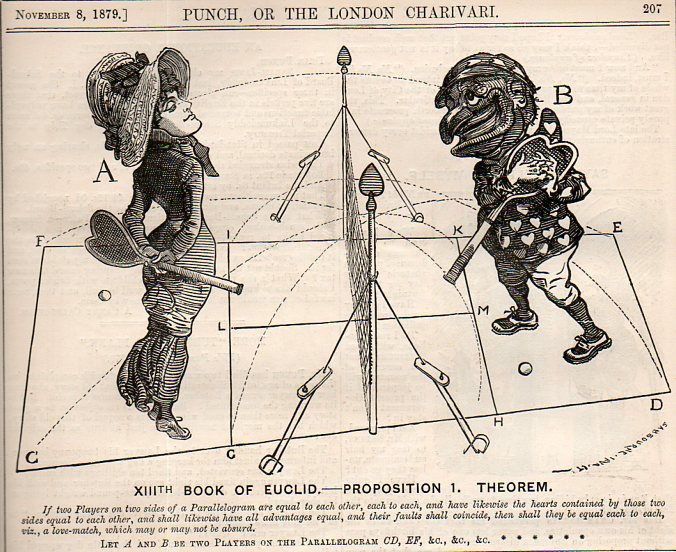
This lovely trompe l’oeil of Euclid calls into play the play of love, in hard angles and parabolas, between Mr. Punch of Punch or the London Charivari  and the object of his affection.  The  image was published on 8 November 1879–just three days after the death of one of the greatest line-makers of the 19th century, James Clerk Maxwell.  (There is no mention of JCM anywhere in Punch, and I guess probably that there needn’t be, even if he was one of the greatest thinkers of the nineteenth (or any other) century.)
Euclid733

          “XIIITH BOOK OF EUCLID.—PROPOSITION 1. THEOREM.

If two Players on two sides of a Parallelogram are equal to each other, each to each, and have likewise the hearts contained by those two side» equal to each other, and shall likewise have all advantages equal, and their faulty shall coincide, then shall they be equal each to each, viz., a love-match, which may or may not be absurd.”

Maxwell‘s really big lines come in a series of four papers called “On the Lines of Force”1, and were published in 1861 and 1862. It is in these papers that Maxwell’s famous equations are all found, and it is also the place where we’ll find the basis not only for the foundation of classical electrodynamics, but the forms for the structure of what would become the epochal/modern communication/electrical technologies. 

File:On Physical Lines of Force.pdf
MaxwellPhys1-10.png
[Source:  here.]
Maxwell’s Demon came into being as a gedankenexperiment in a series of letters–it was Maxwell not only playing devil’s advocate in trying to propose a circumstance in which the 2nd Law of Thermodynamics could be violated, but also providing the Demon, in the experiment, which he proposed as being a finite being, the contradictor.  JCM didn’t actually name this thing on his own–that appelation came via William Thomson in an article in Nature magazine3 in 1874. 
We’ll continue this later with Faraday’s lines of force.
2.   Maxwell stated it so:  “… if we conceive of a being whose faculties are so sharpened that he can follow every molecule in its course, such a being, whose attributes are as essentially finite as our own, would be able to do what is impossible to us. For we have seen that molecules in a vessel full of air at uniform temperature are moving with velocities by no means uniform, though the mean velocity of any great number of them, arbitrarily selected, is almost exactly uniform. Now let us suppose that such a vessel is divided into two portions, A and B, by a division in which there is a small hole, and that a being, who can see the individual molecules, opens and closes this hole, so as to allow only the swifter molecules to pass from A to B, and only the slower molecules to pass from B to A. He will thus, without expenditure of work, raise the temperature of B and lower that of A, in contradiction to the second law of thermodynamics….”
3.  William Thomson (Lord Kelvin), “Kinetic Theory of the Dissipation of Energy,” Nature, 9 April 1874, pp. 441-444, and “The Sorting Demon Of Maxwell” (1879), Proceedings of the Royal Institution, vol. ix, p. 113.

·Posted by :

·in:

—

Recent Posts

Archives

Categories