A Daily History of Holes, Dots, Lines, Science, History, Math, Physics, Art, the Unintentional Absurd, Architecture, Maps, Data Visualization, Blank and Missing Things, and so on. |1.6 million words, 7500 images, 4.9 million hits| Press & appearances in The Times, Le Figaro, Mensa, The Economist, The Guardian, Discovery News, Slate, Le Monde, Sci American Blogs, Le Pont, and many other places… 5000+ total posts since 2008.

Category: Physics

  • Space-Time, 1885

    JF Ptak Science Books  Quick Post

    This remarkable letter, by an anonymous correspondent to Nature in 1885, simply signed “S”, is perhaps the first serious attempt to establish time as the fourth dimension.  That is, the first serious attempt in English, in an English scientific journal; the idea (according to A.M. Bork in his  “The fourth dimension in nineteenth-century physics.” Isis 55, 326, 1964) was already known in the late 18th century in the works of d’Alembert and Lagrance. (This is also pointed out by Paul J. Nahin in Time Machines, Springer Verlag (2nd edition), 1999.) Here it is:

    “Four-Dimensional Space”

    S.

    POSSIBLY the question, What is the fourth dimension? may admit of an indefinite number of answers. I prefer, therefore, in proposing to consider Time as a fourth dimension of our existence, to speak of it as a fourth dimension rather than the fourth dimension. Since this fourth dimension cannot be introduced into space, as commonly understood, we require a new kind of space for its existence, which we may call time-space. There is then no difficulty in conceiving the analogues in this new kind of space, of the things in ordinary space which are known as lines, areas, and solids. A straight line, by moving in any direction not in its own length, generates an area; if this area moves in any direction not in its own plane it generates a solid; but if this solid moves in any direction, it still generates a solid, and nothing more. The reason of this is that we have not supposed it to move in the fourth dimension. If the straight line moves in its own direction, it describes only a straight line; if the area moves in its own plane, it describes only an area; in each case, motion in the dimensions in which the thing exists, gives us only a thing of the same dimensions; and, in order to get a thing of higher dimensions, we must have motion in a new dimension. But, as the idea of motion is only applicable in space of three dimensions, we must replace it by another which is applicable in our fourth dimension of time. Such an idea is that of successive existence. We must, therefore, conceive that there is a new three-dimensional space for each successive instant of time; and, by picturing to ourselves the aggregate formed by the successive positions in time-space of a given solid during a given time, we shall get the idea of a four-dimensional solid, which may be called a sur-solid. It will assist us to get a clearer idea, if we consider a solid which is in a constant state of change, both of magnitude and position; and an example of a solid which satisfies this condition sufficiently well, is afforded by the body of each of us. Let any man picture to himself the aggregate of his own bodily forms from birth to the present time, and he will have a clear idea of a sur-solid in time-space.

    ·Posted by :

    ·in:


  • Chronology of Milestone Events in Particle Physics, 1896-1958

    JF Ptak Science Books   Post 1838

    The data and research and linkage below are taken entirely from the Chronology of Milestone Events of Particle Physics, streamlined and adapted and made a little more accessible (for me) for a fast browse–I’ve had no hand in assembling this data, just re-arranging it. 

    The links are quite valuable–the scientist’s biography is clickable on the name, and the article is reproduced from the original in the pdf. 

    BECQUEREL 1896B 
    Evidence for spontaneous radioactivity effect.  PDF  

    BECQUEREL 1896C 
    Confirmation of the effect of spontaneous radioactivity.   PDF

    BECQUEREL 1896F 
    Uranium radioactivity established.   PDF  

    THOMSON 1897 
    Discovery of the electron, the first elementary particle.   PDF  

    ·Posted by :

    ·in:


  • Quantum Mechanics: Chronological and Not-Critical Bibliography

    JF Ptak Science Books    Post 1837

    Chronological Bibliography of Quantum Mechanics

    This is a handy and interesting 329-entry timeline of QM placed in chronological order from the article noted below.  I guess it would be easy to start the list with Planck if you wanted to give it a firm footing somewhere, though the history of quantum mechanics goes into development stages long before the 1900 Planck paper.  Be that as it may, this is just a quick exercise, and if an idea was formed or a lost memory found via a quick look at this list, then it is good enough for me.

    References used in “From the origin of quantum concepts to the establishment of quantum mechanics”, by M A El’yashevich, in Soviet Physics USPEKHI, 1977, 20 (8), 656–682.

    SOURCE:  http://www.turpion.org/php/reference.phtml?journal_id=pu&paper_id=5456&volume=20&issue=8&type=xrf


    REFERENCES

    [1] M. Planck, Über irreversible Strahlungsvorgänge, Ann. d. Phys., 1 (1900), 60–122, M. Planck, Trudy 191–233)

    ·Posted by :

    ·in:

    —

  • Contemporary Abstracts of Einstein, 1905-1920

    JF Ptak Science Books  Quick Post

    I’ve been piecing together the bits that I’ve been able to find strewn around the Intertubes for the very interesting Science Abstracts, Physics (London); my main goal was to retrieve the epochal 1905 and 1916 years for Albert Einstein (below) and then put together the rest of what I could find online.  For this morning’s effort I’ve found the 1905 and 1916 plus six other years.  I’ll be adding to this list shortly. 

    1904 (volume 7),  1905  (volume 8),  1907 (volume 10) 1909 (volume 12) 1913 (volume 16)  1916 (volume 19)  1919 (volume 22) , 1920 (volume 23)

    [Note:  I’ve collected the Einstein papers in the Annalen der Physik on a page inthis blog, here.]

    1905 a

     A. Einstein, AdP 17, 132 (1905) [17 pp.]  “Über einen die Erzeugung und Verwandlung des Lichtes betreffenden  heuristischen Gesichtspunkt”.

    ·Posted by :

    ·in:


  • Annalen der Physik (1799–Present): Useful, Searchable, Full-Text Sites.

    JF Ptak Science Books   Quick Post

    I just  posted this as a “page” (in the left-hand column) and thought to distribute the move by carrying it as a quick post on the daily side of this blog.  It seems to me that between these four links that there is some very good, easily-governable access now to the Great and Fabulous Annalen der Physik, one of the great physics journals in the history of science.  There are some full-text sites available with good search engines, as well as a link to a site that smooths out the occasionally cumbersome way in which Annalen volumes have been referenced. 

    I can safely say–after having staggered my way through hundreds of volumes of the Annalen–that these links represent to me the easiest ways thus far of navigating the massive journal. It makes using the Annalen a pleasure far more than a challenge, which it always seemed to be to me, even working at it with the (scarce!) index volumes. 

    http://de.wikisource.org/wiki/Annalen_der_Physik//at Wikisource, via ANNALEN DER PHYSIK

    http://upload.wikimedia.org/wikipedia/de/4/4f/Annalen_der_physik_Titelblatt_1900_Drude_Band_306.gif

    Annalen der Physik Annalen der Physik (Wiley-VCH) [Journal Page]
    Annalen der Physik Annalen der Physik [Wikisource Page]This offers a key for corresponding overall volume numbers with series/folge volume numbers. AND has a full text hyperlink set.
    Annalen der Physik Annalen der Physik [Gallica Page]
    Annalen der Physik Annalen der Physik [Welt der Physik Page]

    And just for the heck of it, Einstein in the Annalen, available on this blog here.

    For my history of physics readers who work with the Annalen der Physik I reproduce a useful little key to the two-tier numbering system for the Annalen‘s first and second series.  The tables come from Sachregister zu den Annalen der Physik und Chemie Poggendorr’sche Folge… published in Leipzig in 1888.  Up to this point the physics journal had been published since 1799 in two series for a total of 160 volumes (plus a Jubelband and eight volumes of Erganzungsbaende); some people reference the appearance of articles via the total volume number, while others (myself included) reference the series (as  series “I volume whatever” or series “II, volume _____”.  There is a handy table at the very end of the Sachregister that correlates the two “systems”. 

    ·Posted by :

    ·in:


  • History of Holes: Making 1=2 or 3, or More (ca. 1700)

    JF Ptak Science Books   Post 1830  Part of the series on the History of Holes. (Apologies for no-para spacing–Typepad is buggy again.)

    A beautiful and inventive way of addressing issues of perspective and un-reality in the centuries before the introduction of electricity was more able to suspend belief in the existing/obvious was via the catopticum1. This object (an example of which is pictured below, taken from the oddball/genius/problematic polymath Athanasius Kircher in his book Ars Magna Lucis et Umbrae…2 printed in 1676), and the name of which is taken from the Greek katoptron, mirror) was an advanced parlor toy and artwork, a sort-of primitive free-standing theatre of multiplied objects, a box that contained things that were seemingly larger than their container. 

    The catoptric theater. From Ars Magna Lucis et Umbrae (1671 ed.), p. 776

    Source:  Kircher at Stanford University, here.

    This image makes the “image engine” a little clearer:

    Primeira PáginaPágina AnteriorDiminuir imagemImagem a 100%Aumentar imagemPróxima PáginaÚltima Página
    desd [757 KB]
    Source:  Tratado da Catoptrica, (manuscript, 1716);  from the Biblioteca Nacional Digital, here.
    It’s a romance of images machine,  a box of antique wonder, a peepshow of centuries before, putting more things into a space than could exist.  It was a relatively simple machine of great ingenuity:  the interior of the free-standing box with rows of holes along its top edge perpendicular to the ground, and was lined with mirrors (as shown above in the Spanish document), with some mirrors set of at 45% angles; when objects were placed within the imaging-area of the angled mirrors, the object was multiplied, and then multiplied over and over as a result of the surrounding mirrors, creating in effect a “hall of mirrors”, leaving the observer with a sense impression of many dozens of objects that were contained within a container that was impossibly too small for what was being seen. 
    This of course is a property of some holes–they tend to make things larger than they could previously possibly “be”. 
    In this case, the viewer would look through a hole into a Borgesian box which would contain a multitude of its possible interiors.  Looking through a hole in the end of a glass and mirror-ended tube and pointing it at the sky at night would reveal an enormous multiplication of a small part of that sky.  In the early case of Galileo, what  was first seen with the telescope was the multiplication of what was believed to be a finite and god-granted sky of perfection–he was seeing into some other sky, into a new vault of heaven, something never before seen, above-and-beyond what was known to exist.  Hooke and Louwenhoeck had a similar experience with their (second generation) microscopes, seeing details and life never before encountered, entire worlds in a place no bigger than the head of a pin. 
    Sometimes a hole is just a dark thing; but more often than not, it isn’t. 
    Notes:

    1.  From the Greek, katoptron, mirror  or pertaining to a reflected image or reflected light, such as from a mirror.  There is another sort of catoptric that has been sort of widely used in antiquarian painting and parlor entertainments, which involves a canonical mirror reflecting a wide-field and distorted image into its proper perspective, which is known as catoptric anamorphosis.  Another version of this sort of optic imaging is optical anamorphosis, which requires the viewer to stand at a particular (usually sharp) angle to a painting containing a semi-hidden image whose proper perspective is revealed only at a particular angle of viewing.

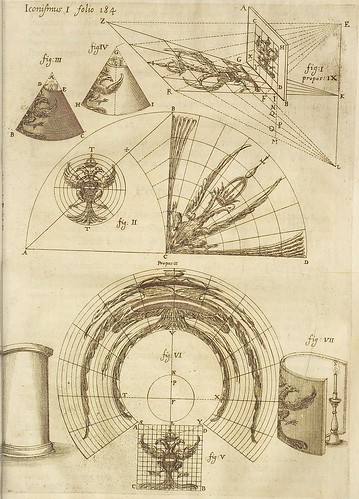
    An example of catoptric anamorphosis, from the Kircher mentioned above:
    anamorphosis - eagle

    See here:  http://hyperphysics.phy-astr.gsu.edu/hbase/geoopt/catoptric.html
    2.  Ars Magna Lucis Et Umbrae In X. Libros digesta. Quibus Admirandae Lucis & Umbrae in mundo, atque adeo universa natura, vires effectusque uti nova, ita varia novorum reconditiorumque speciminum exhibitione, ad varios mortalium usus, panduntur. Editio altera priori multo auctior. The work is presented at Bibliodyssey, here.
    Mr. P.K.hauls out a great quote and summarization of the work of Kircher by Robert Moray in his letter to the great guiding post of the Royal Society, Henry Cavendish, which really captures the spirit of the very busy/very curious and curious old man:
    “Whatsoever Mr. Huygens & others say of Kircher, I assure you I am one of those that think the Commonwealth of learning is much beholding to him, though there wants not chaff in his heap of stuff composted in his severall peaces, yet there is wheat to be found almost every where in them. And though he doth not handle most things fully, nor accurately, yet yt furnishes matter to others to do it. I reckon him as usefull Quarries in philosophy and good literature. Curious workmen may finish what hee but blocks and rough hewes. Hee meddles with too many things to do any exquisitely, yet in some that I can name I know none goes beyond him, at least as to grasping of variety: and even that is not onely often pleasure but usefull.”  (My bold.)
    [Sir Robert Moray in a letter to Henry Oldenburg, 1665]  

  • A Picture of the Speed of Light

    JF Ptak Science Books    Post 1787     History of Dots Series

    Ring the bells that still can ring
    Forget your perfect offering
    There is a crack, a crack in everything
    That’s how the light gets in.
    –Leonard Cohen

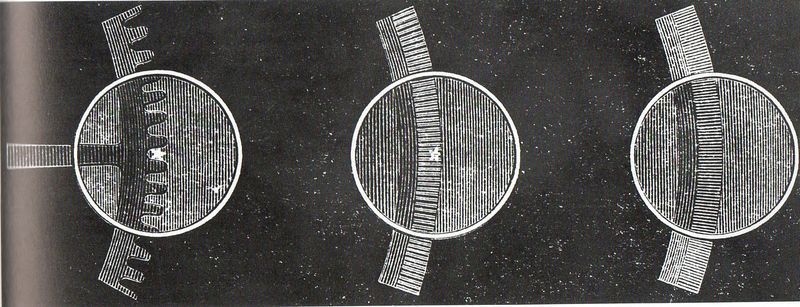
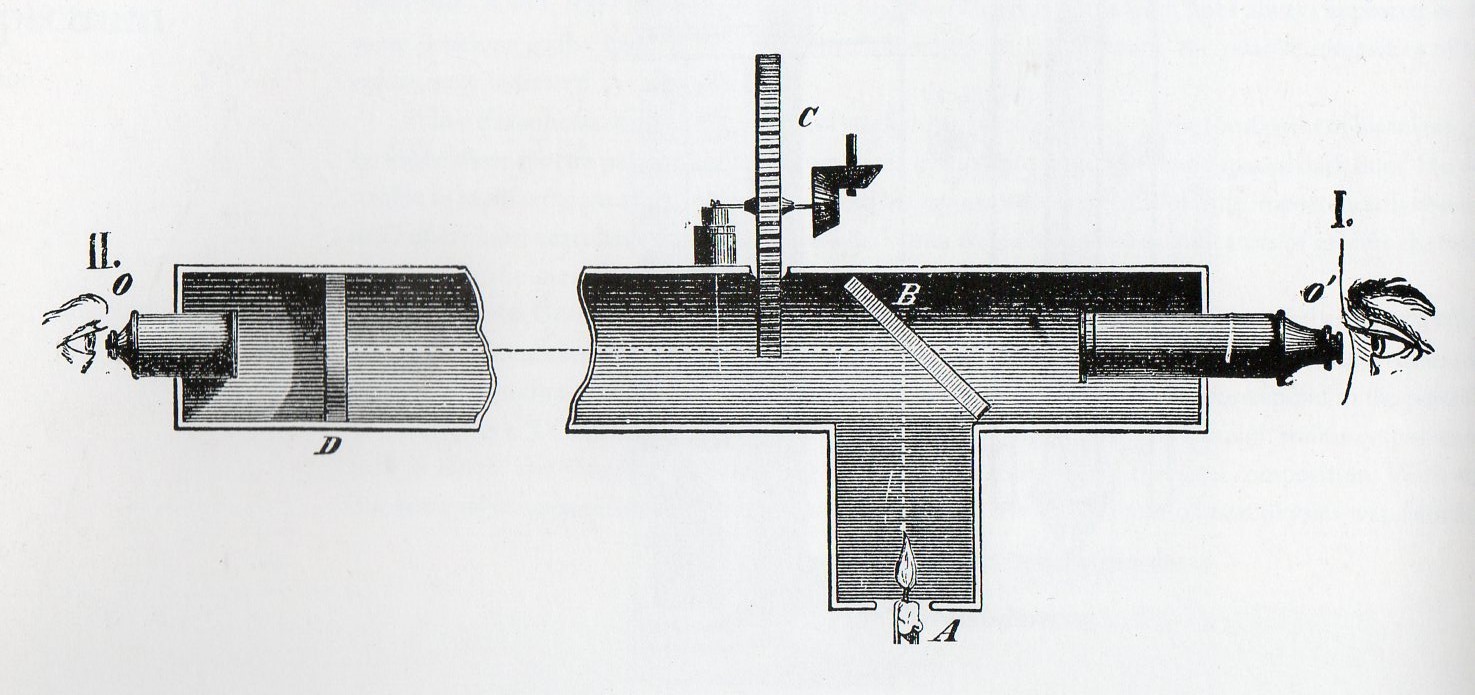
    I meant this title toAaa-light fiz gears det159 this post quite literally—among the earliest mostly-accurate estimation for the speed of light (“c”) was made by Fizeau in 1849, and he not-literally made an image of what the speed of light “looked like”, the last dot in a crack that let the light in. It followed several hundred years of thinking on the speed of light including experiments employing lanterns (Galileo),  the Moons of Jupiter (Ole Roemer), rain and starlight (James Bradley), and which in turn followed thought experiments by Empedocles, Aristotle and Descartes, who reckoned the speed of light to be instantaneous.  The Parisian physicist Armand Hippolyte Louis Fizeau (September 23, 1819 – September 18, 1896) acted on a beautiful idea and constructed an elegant apparatus (again using lanterns) to make the first modern estimate of c.  And, basically, as soon as he was finished and published the results in the Comptes Rendus in 1849, Leon Foucault—with whom Fizeau worked on many occasions—improved the apparatus and made an even closer approximation.

    Aaa-light fiz gears158

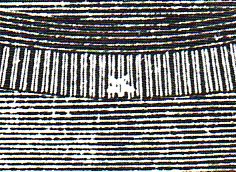
     The way the apparatus worked was simple and powerful:  Fizeau observed a light through an optical apparatus with a rotating toothed gear between observer and the entry of the light source; a mirror that was more than 5 miles away reflected that beam back through those same geared teeth of the disk.  The disk could be made to rotate at specific speeds, the object being to calibrate the disk to prevent the light from going through the teeth of the gear to the mirror and then back again through the same gap.  The point at which the dot o flight disappeared could be easily calculated and the speed of light extrapolated from there–which Fizeau estimated to be 313,300 Km/s or 194,410 miles/second. (In 1850 Foucault replaced the toothed gear with a mirror and produced a more accurate estimate of 185,093 miles/second, which in fact turns out to be very close to c. 

    Aaa-light fiz apparatus160

    Historical Estimates of c in Km/s


  • Awards and Problems of Recognition: Helmholtz, Mayer, Stillman, Alpher, Herman and Beringer

    JF Ptak Science Books   Post 1785

    Cases of High Recognition, Removal of Recognition, Failed Recognition and Imaginary, Never-Should’ve-Been-There Recognition

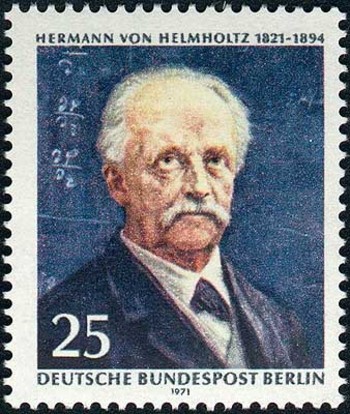
    Helmholtz2 The laws of thermodynamics have a somewhat complex parenthood, but it is the relationship of Helmholtz and Mayer in the First Law that we’re interested in here.  In short, the great three laws (in short) state: Energy can neither be created or destroyed (First Law); All spontaneous events act to increase total entropy (Second Law); Absolute zero is removal of all thermal molecular motion (Third Law).  Carnot (in a brilliant 124-page paper Reflections on the Motive Power of Fire), Joule and Helmholtz are generally associated with creating the First Law (with Clausius, Gibbs and Boltzmann for the Second and Nernst for the Third).

    It was Helmholtz who provided the mathematical proof (in 1847, in his “Ueber die Erhaltung der Kraft” “On the Conservation of Energy,” ), the basis of the law of the conservation of energy.  But even though he was the first in this particular part of the thermodynamics universe (which he later famously and incredibly declared in 1856 to be “dying”), he recognized the previous related work—which he evidently did not use or perhaps even know about—of Robert Mayer (1814 -1878) (1841, “Remarks on the Forces of Nature”), who basically stated that energy can be neither created nor destroyed, which is the sharp tooth of the law.  The paper just showed up where it shouldn’t’ve.  Helmholtz recognized its importance and later insisted on Mayer having priority in discovery—there was plenty to go around, really, and especially since it was Helmholtz who gave the law its mathematical foundation.  It is just a very fine showing of intellectual appreciation and scientific ability that Helmholtz recognized the contribution of Mayer in such a fashion. (Helmholtz, a great experimenter, theoretician and teacher, makes frequent appearances in my wife Patti’s blog–have a look!)

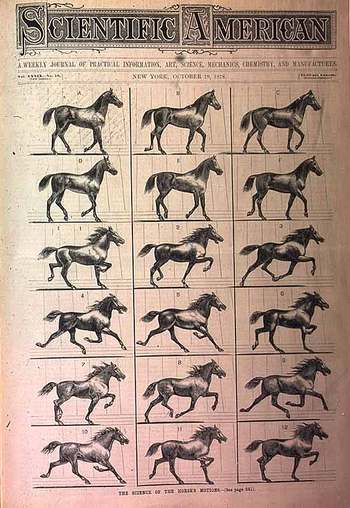
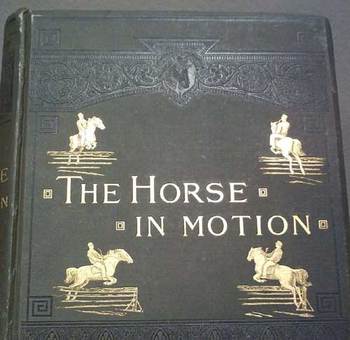
    Creditmarey Etienne Marey, who we have seen before in this blog, was inspired by Eadweard Muybridge’s photographs of motion—whom he credited of course—and who I think expanded upon and exceeded those achievements.  Marey had a multi-field career and didn’t really want for much, professionally speaking, but there is a pretty significant slight in that career that bears.  His photographs of horses in motion were stunning and shocking—being among the best photographs ever made showing the horse in all stages of motion.  But when they were expansively included (used from sources like Marey’s  “The Science of the Horse’s Motions” Scientific American, October 19, 1878)  in J.B.D. Stillman’s The Horse in Motion in 1882, they were done without attribution, which is not a nice thing, as it would have been impossible for Stillman not to have known the origin of the source of his images—impossible.  He just decided not to include Marey’s name.

    Creditstillman

    On the other hand, coming back to the non-recongition of Ralph Alpher and Robert Herman in the discovery of the background radiation of the universe—“discovered” by Penzias and Wilson at Bell Labs in Holmdel—even though their earlier papers in 1939, 1946, 1947, 1949 and 1950 pointed the way, Penzias and Wilson didn’t know of them, didn’t use them, and found the thing on their own.  By  accident.  Still, though, it would’ve been nice for them to mention Alpher and Herman in their Nobel speech.  But they didn’t.  They should’ve.

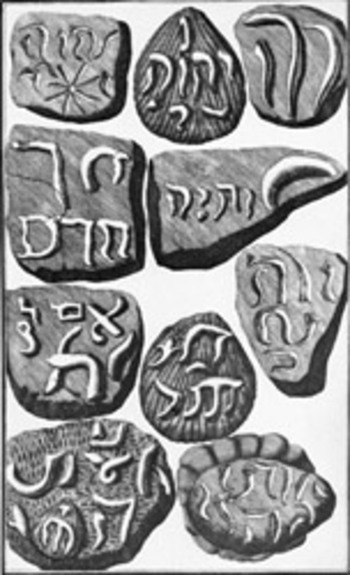
    Lastly, the Imaginary Recognition bit—this is more accurately called a “hoax”.  Perhaps one of the most famous cases—and perhaps the meanest—was in the case of Dr. Johann Bartholomew Adam Beringer (1667-1740) the Dean of the Faculty of Medicine at the University of Würzburg in Germany.  Beringer was himself a mean man, proud, ill-spirited, boasting and ponderous, and of little patience to those who disagreed with him.  So he was a public man with many enemies—a vocal, unrepenting man with enemies—and his enemies decided to have a go at him, salting a field in Beringer which he collected geological specimens with incredible, spectacular, impossible samples.  The samples spoke to his own geological-theological beliefs—in which god is never ever wrong—and the overly-excited Beringer ravenously collected/found them, and then, after a while, decided to publish a book on them.  But before the book became a reality the fossil-planter s attempted a change of heart, trying to divert Beringer’s attention away from the possibility that the stones were real, going so far as planting fossils with shooting stars, Hebrew characters, and the like.  Beringer proceeded on with publication (and his “lying stones”), and then after publication, all became revealed, basically ruining everyone.  It was a mean escapade, al the way around, and a huge waste of time.  Perhaps everyone got what they deserved. 


  • Visualizing the Normally-Unseen: Roentgen, Marey, Malevich

    JF Ptak Science Books  Post 1775

    Pleasant_1bertha The 1895/1896 issues of Nature magazine are compliantly normal until the first weeks of 1896 when the first of a flood of articles is published about the astonishing discovery of 50-year-old Wilhelm Conrad Röntgen. The English-language popular science journal announcement of his December 28, 1895  “Ueber eine neue Art von Strahlen” (“On a New Type of Ray”), appearing 16 January 1896, began the introduction of a new state of human experience.  His experiments—built upon the work of J. Plucker (1801-1868), J. W. Hittorf (1824-1914), C. F. Varley (1828-1883), E. Goldstein (1850-1931), Sir William Crookes (1832-1919), H. Hertz (1857-1894) and the odious Phil Lenard (1862-1947 and who didn’t die soon enough)—revealed as much to humans as did the experiments and inventions of Hooke and Leeuwenhoek on the invisible worlds revealed by the microscope.  There are more than 150 articles on the Roentgen (and soon to be “X-“) Ray, all published within 12 months of the original announcement, almost all excitedly, trying to comprehend, elucidate, expand, verify, this new world. 
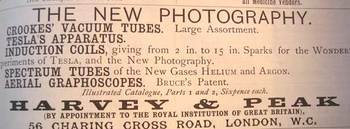
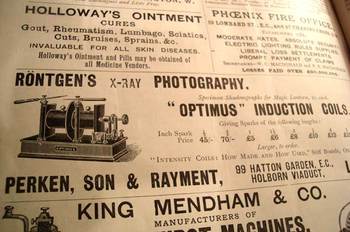
    Blogxraybigads_2 [The news of the discovery is first and most popularly reported in the January 6, 1896 London Standard:  “The noise of war’s alarm should not distract attention from the marvelous triumph of science which is reported from Vienna. It is announced that Professor Routgen (sic) of the Wurzburg University has discovered a light which for the purposeBlogxrayad of photography will penetrate wood, flesh, cloth, and most other organic substances. The Professor has succeeded in photographing metal weights which were in a closed wooden case, also a man’s hand which showed only the bones, the flesh being invisible”. By the end of the month the news was completely absorbed, worldwide.]

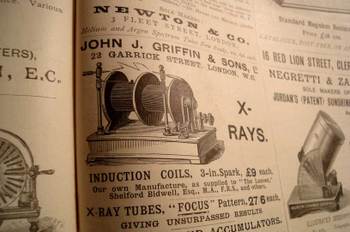
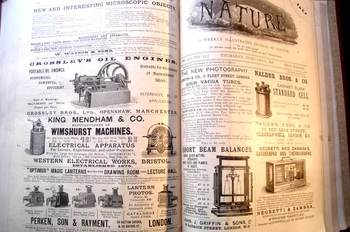
    I looked at the advertising in these issues (my copies of Nature for these decades generally have the original paper wrappers for the weeklies, complete with ad copy), looking for the first time that a Roentgen machine was offered for sale to the general public.  As it turns out, they popped up 12 March 1896 (once), 19 March (twice), and then about once a week for the rest of the year.  A little surprising, I think, a little light to my Monday-morning quarterback’s eye—I expected more; bigger, more, splashier.  But the ads are small and sedate, hardly similar to the discovery they represent. 
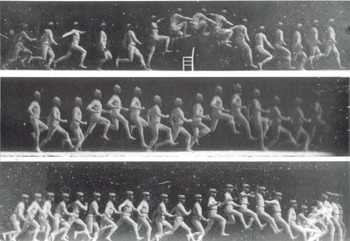
    Blogfeb_22marey The rest of the world, the rest of the advertising world, stayed the same–the Roentgen discovery and the enormous possibilities and promises of his “new photography” lived in their own unique sphere, unencumbered by their sassy new brother.   This mild response seems dimmer still when you compare it to that which greeted other (relatively) simple but still major advancements in the world of photography.  Take for example Etienne Marey, who was a technoid and physician who was able to capture motion of all sorts–he was able to develop a picture so to speak of the movement of blood in the body via his instrument to calculate blood pressure, and he also created a shotgun-style camera that made the Blog_feb_22_nude world’s first high-speed photographs of movement.  And so it cane to pass that in the late 1870’s and early 1880’s people were instantly able to see what a horse looked like when it galloped or what the body did *exactly* when jumping over a chair.  When you couple this with fourth-dimension material one wonders why it took several more decades to bump into these images in the art of 1907+. 
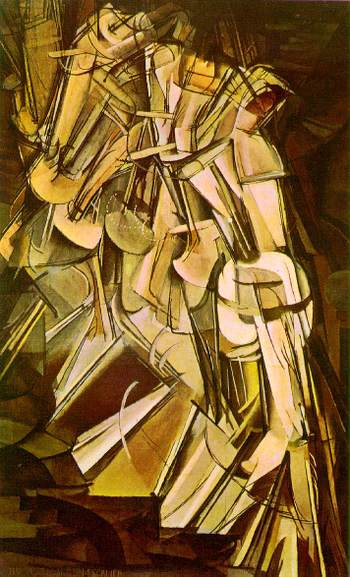
    (Duchamp Nude Descending series, 1915; above, Marey, 1881)

    And what indeed was normal in these pages?  Magic lanterns
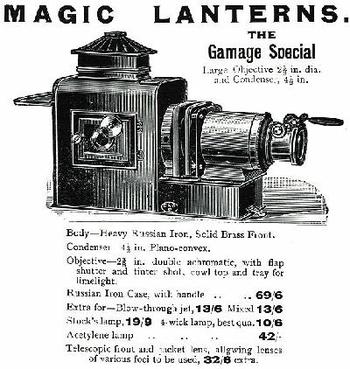
    and magi lantern slides appearMagiclantern at all levels; the gorgeous Wimshurst machine gets heavily advertised; the redoubtable Negretti & Zambra advertised all manner of excellent scientific instruments (biographs, thermogrphs.  Nadeer Bros. advertised a pretty standard cell, and the ancient Crossley displayed their “new” oil engines, “suitable for all classes of agricultural work”.  J.H. Stewart was selling their semi-automatic electric arc lamp, while across the page was Newton & Company’s “Newtonian” arc lamps for lanterns (“self feeding and focus keeping”).  Microscopes and prepared slides abound, and Thomas Bolton advertises discretely and effectively for their “living specimens for the microscope”. 
    The Physical Review, the American upstart in the science world advertises that its third volume was available, while its distant cousin, the Psychological Review, advertised its own third volume.  Booksellers seem to take the most space, thank goodness. 

    Blogxrayepps There are a few medical throwbacks:  Epp’s Cocaine takes out occasional tenth-page ads for their “cocoa-nib extract, tea-like” selling its ‘gentile nerve stimulant”.  Right underneath is “Holloway’s Pills”, promising to cure biliousness, sick headache, indigestion, and all (?!) internal complaints.   These are brilliant simple samples of the skeleton of science in world-dominant Great Britain, in a world dominated at that time by H.A, Lorentz, Ernst Mach , Roentgen, Korteweg, de Vries, Bateson, Jean-Baptiste Perrin, Pierre Curie, Zeeman, Becquerel, Joseph Thomson,  Ernest Rutherford, Marconi, Ramsay, Fitzgerald.  And so on. 

    Nothing offered for sale here offered any significant clue to the pregnant world of modernity that was nearlyBlogxray3 there—the world would become ‘modern” almost immediately following Roentgen, with revolutionary, epochal changes in art (in non-representational form more so than Impressionism), theater, literature, music.  Just about everything changed (except politics).  But there is no hint to paradigm shift hidden in the ads, just as they were with the machines selling the promise of Roentgen’s “new photography.  There’s something about the fine glass, superb turning of the screw, and a perfectly oiled gear though that makes this sort of perfection seem so lonely in the world of larger change.  Bertha, Roentgen’s wife, sat for 15 minutes while her husband passed his rays through her hand; she ran from the room once she saw the results, revealing her very bones and no doubt a strong sense of the Blog_feb_22_malevich

    fragility of life, and the strong presence of death.  Many had the same reaction to the Kandinsky’sBlogxrayad2 shapes and Malevich’s white circles and red rectangles and Ibsen’s drama and Einstein’s dancing dust and the rogue syncopation of jazz.  It is probably a very natural reaction to try and protect established memory—but memory should be more flexible than that, I think, to keep a healthy mind.

  • On Eclipses of Io and the Speed of Light: Ole Romer, 1676

    JF Ptak Science Books   Post 1730

    “When the father and creator saw the creature which he has made moving and living…, he rejoiced, and in his joy determined to…make the universe eternal, so far as might be. …Wherefore he resolved to have a moving image of eternity, and when he set in order the heaven, he made this image eternal but moving according to number, while eternity itself rests in unity; and this image we call time… Such was the mind and thought of God in the creation of time. The sun and moon and five other stars, which are called the planets, were created by him in order to distinguish and preserve the numbers of time… And for this reason the fixed stars were created, to be divine and eternal animals, ever-abiding and\ revolving after the same manner and on the same spot…” Plato, in which he wrote about the formation of the universe, among many other things, (Jowett. v. 2. Timaeus, p. 19), and spotted at the Linda Hall [Science] Library here

    Well, not exactly, but this was some pretty good thinking by Plato for his time, and beyond that–actually, the thinking was held for centuries.  But it was some very nice thinking by (Danish) Ole Rømer that pieced this part of Plato out, turning it around, and coming to terms with the use of “the order of heaven” to “preserve the numbers” of the speed of light, all through the observation of eclipses of Jupiter’s moon Io. 

    Horrebow249
    I should first say that today’s post came about via Peter Horrebow’s (1679-1764) Operum Mathematico-Physicorum… , a three-volume work published in Copenhagen in 1740-41.   Horrebow was a very accomplished astronomer in his own right (we’ll get to that in a moment), but what is of interest for me right now is the third volume of his book, as it (the Basis Astronomiae…) contains very detailed descriptions of the astronomical instruments and observatory of his fellow Danish astronomer Rømer (1644-1710).  Horrebow must have been a very gifted machinist and man-about-the-“lab”, as he was able to make his way through the educational system and then to the highest levels of academia even though beginning his life as a fish-seller’s son–an extraordinary accomplishment, really, as there were not many opportunities for people without some sort of privilege to succeed on this level.  And succeed Horrebow did, serving as the great Rømer ‘s assistant and charge, living in the man’s house for some time. (He didn’t stay for very long, as Horrebow was a father of twenty.)

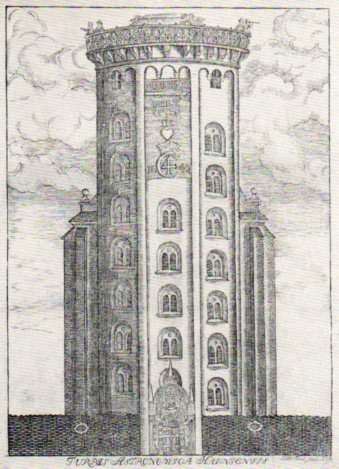
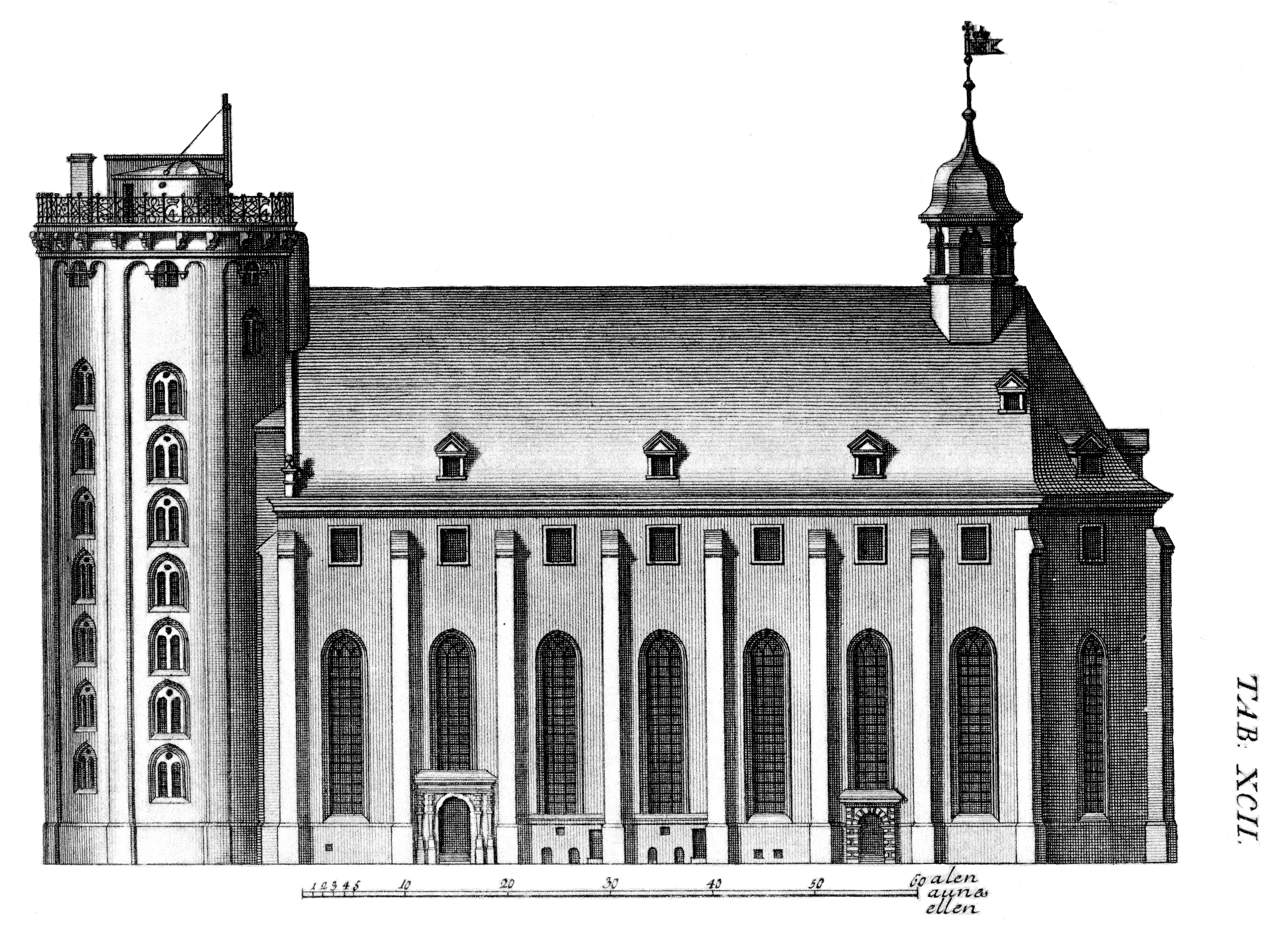
    There are some famous illustrations in this book–not the least of which is the depiction of Rømer at work on a transit in his observatory–but the image I like most of all is not one of the instruments, but a beautiful engraving of the observatory built by Charles IV.  The massive structure–called the Rundetam–was begun in 1637and finished in 1642; it is as its name suggests a “round tower” that rises 34 meters; it has no stairs using a 7.5-turn walkway instead. (It is a confusing thing, walking ’round to go up, and seems to me to have been much more than just seven turns; in a weird way by the top of the walk it felt as though one was going “down” somehow. Maybe I  just got dizzy.)  In any event the tower would be an observatory, with Rømer (and then, later, Horrebow) working from the roof as well as from some high windows, and was meant to replace the great Tycho Brahe’s demolished Stjeneborg

    File:Hafnia Hodierna Tab XCII Trinitatis Kirke.jpg

    [Cross-section of the observatory.}

    Rømer’s career was remarkable, but what I find particularly beautiful was his determination of the speed of light, and all from basically sitting there with his instruments in a window of a massive stone structure in the middle of a city, figuring out minute differentiations, making detailed observations of eclipses of the moons of a planet that had only been observed telescopically less than 67 years earlier (with the newly-invented instrument, the telescope). 

    The moons of Jupiter had been observed in 1666-1668 by Cassini and were a subject of intense study by him and Rømer, among others; Rømer in fact would travel to the Paris observatory and be an assistant to Cassini as the two worked together on the moons and eclipse observations. In this Rømer noticed a particular peculiarity in the changes of the times of these eclipses, becoming shorter when the Earth was closer to Jupiter and longer when farther away.  From this Rømer concluded that light was taking different times to reach the Earth, and from their calculated its speed.  He reported to the Royal Academy of Science on 22 August 1676:

    This second inequality appears to be due to light taking some time to reach us from the satellite; light seems to take about ten to eleven minutes [to cross] a distance equal to the half-diameter of the terrestrial orbit.

    What a jewel that was to give to the world!  It is difficult to imagine the impact of this sort of announcement in the first three-quarters of a century of the telescope, to be able to calculate something as elusive as the idea of the speed of light, and that coming from the observation of moons of another planet.  This was the first true quantitative measurement of the speed of light–there were earlier attempts (by Isaac Beekman  and Galileo), but while their ideas for measuring  were interesting and theoretically workable the instrumentation for recording minute differences in light flashes were not.  (For example in the Galileo experiment (measuring the differences in the light of exposed lanterns a  mile apart, the time was not measurable.  If it could have been measured the answer would’ve been 10 microseconds; at that time the idea of the “second hand” a clock had not yet come to be.)  Rømer established that the speed of light was finite, and gave a value that was within about 25% of the modern standard, or at least 220,000 km/sec. Galileo’s earlier best estimate was that light was at least ten times that the speed of sound. (HE was right, of course, light is at least 10x sound, but the capacity for more accurate observation and instrumentation were just beyond his age.)  This was a truly remarkable accomplishment.

    The observatory had a relatively short shelf-life, what with light pollution and the rumble and vibration of city traffic doing it in by the mid-18th century; so for its size and heavy fullness, the building lasted a little more than a century as a useful observatory. 


    ·Posted by :

    ·in:

    — —