JF Ptak Science Books Post 1787 History of Dots Series
Ring the bells that still can ring
Forget your perfect offering
There is a crack, a crack in everything
That’s how the light gets in.–Leonard Cohen
I meant this title to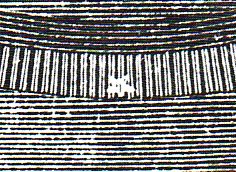 this post quite literally—among the earliest mostly-accurate estimation for the speed of light (“c”) was made by Fizeau in 1849, and he not-literally made an image of what the speed of light “looked like”, the last dot in a crack that let the light in. It followed several hundred years of thinking on the speed of light including experiments employing lanterns (Galileo), the Moons of Jupiter (Ole Roemer), rain and starlight (James Bradley), and which in turn followed thought experiments by Empedocles, Aristotle and Descartes, who reckoned the speed of light to be instantaneous. The Parisian physicist Armand Hippolyte Louis Fizeau (September 23, 1819 – September 18, 1896) acted on a beautiful idea and constructed an elegant apparatus (again using lanterns) to make the first modern estimate of c. And, basically, as soon as he was finished and published the results in the Comptes Rendus in 1849, Leon Foucault—with whom Fizeau worked on many occasions—improved the apparatus and made an even closer approximation.
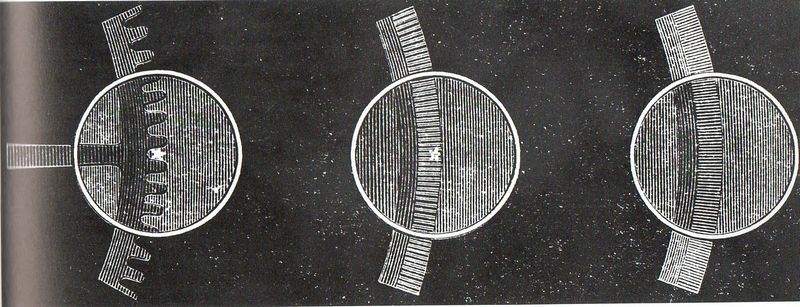
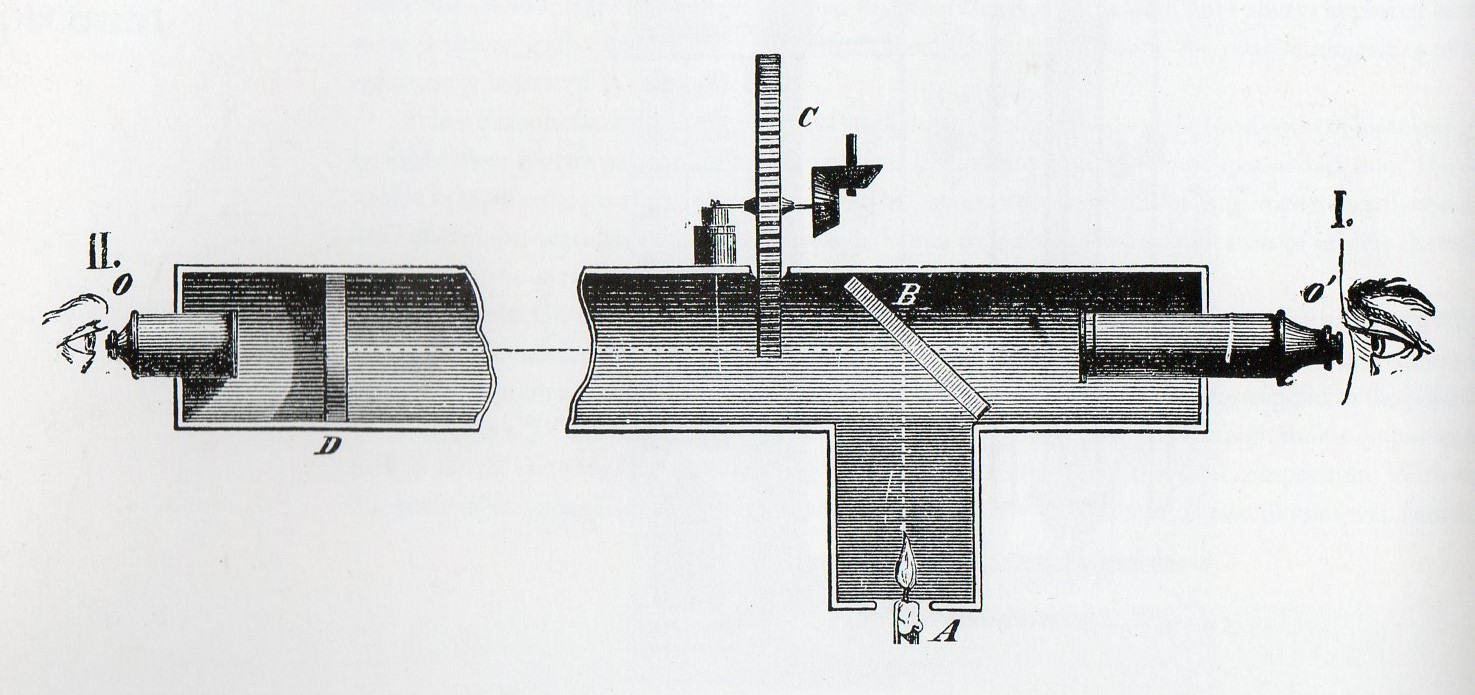
The way the apparatus worked was simple and powerful: Fizeau observed a light through an optical apparatus with a rotating toothed gear between observer and the entry of the light source; a mirror that was more than 5 miles away reflected that beam back through those same geared teeth of the disk. The disk could be made to rotate at specific speeds, the object being to calibrate the disk to prevent the light from going through the teeth of the gear to the mirror and then back again through the same gap. The point at which the dot o flight disappeared could be easily calculated and the speed of light extrapolated from there–which Fizeau estimated to be 313,300 Km/s or 194,410 miles/second. (In 1850 Foucault replaced the toothed gear with a mirror and produced a more accurate estimate of 185,093 miles/second, which in fact turns out to be very close to c.
Historical Estimates of c in Km/s