JF Ptak Science Books Post 1786
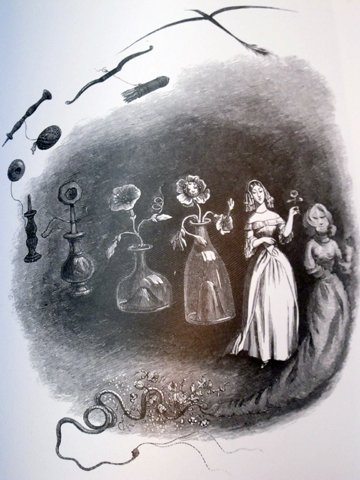
It is intriguing to see ideas are communicated when drawn as a series of events on a single piece of paper–a single-panel, progressive illustration showing the sequential development of an idea. This thought struck me while looking at some of the work of J.J. Grandville (above, “Les Metamorphoses du sommeil”, from his book Un Autre Monde, a proto-surrealist work printed in 1844) ) and caused me to think about how old this idea might be, how far back it stretched into the sciences and literature. And right now, I really don’t have the answer.
Again, what I’m thinking about is a single-sheet describing an action or thought–not like what might be the earliest example of the “comic book” the Histoire de M. Vieux Bois (1827) by Rodolphe Toepffer (Geneva, 1799–1846) but more like Little Nemo in Slumberland, by Winsor McKay (the following example from 1905). The difference between the two in composition is simply that McKay in his Sunday comics efforts would develop the story on a single sheet of paper, so that you are in a way watching the story unfold as a motion picture would; and in the case of Toepffer, the story is told more in a conventional graphic novel way–in a book over dozens or hundreds of pages, with one illustration per page. (I wonder about including Egyptian and Mixtec hieroglyphics, but I don’t think that they apply.)

What seems like an early ready-made example of the sequential imaging of an idea on one piece of paper might be from the great William Harvey’s De Motu Cordis et Sanguinis in Animalibus (On the Movement of the Heart and Blood in Animals), which was printed in 1628, and which in an iconic display shows Harvey’s demonstration of blood operating in a closed system, and circulated by the heart, and undergoing a “a motion in a circle”.

[Source: this image from Exercitationes Anatomicae, De Motu Cordis & Sanguinis Circulatione.. Rotterdam: Arnoldus Leers, 1660..]