JF Ptak Science Books Post 1907
Next: on Intitutionalized Nonthinking: the “Negro Pencil” 1938
“…Where Light is declared to be not Similar…”–from the “abstract” of Newton’s experimentum crucis
There were four main contributors to the 19 February 1672 issue of the yet-young Philosophical Transactions of the Royal Society, (No. 80, pp. 3075-3087). One original papers and three reviews of recently published books: the first book was a description of the coast of eastern India by Phil. Baldeus; the second, a work on the philosophy of “Renati Des Cartes”; and third, “an essay on the advancement of MUSICK, by Thomas Salmon1. These three have a common trait in that they are mostly entirely forgotten though the works seem interesting to me. The scientific paper was written by Isasac Newton: “New Theory about Light and Colors”. Though it was his very first publication2 (coming at age 29), it was already the result of years’ worth of hard thought and experimentation3. It also among the most important things he ever published, and was a direct link to his superlative and iconic work published as Opticks in 1704.
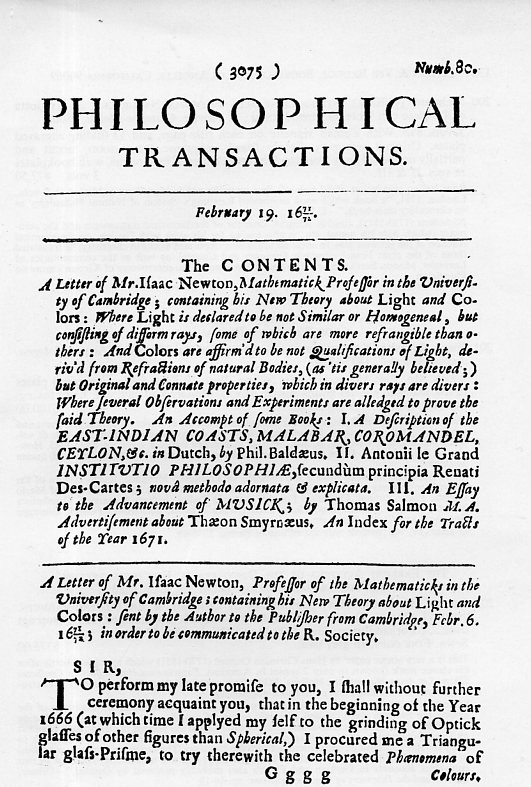
(It is interesting to note that the date on the title page is given as “February 19, 1671/72”. This refers to a bubble int he calendar system at the time, where in some quarters the old first day of the year was celebrated on March 25, a practice which didn’t firmly disappear until 1752. So th e”1671/72″ bit refers to the year being 1671 according to the Old System and 1672 according to the New.)
Newton was simply the most important person in the history of science. Aside from all of his many iconic and revolutionary accomplishments, one thing that sands out over the collective of greatness is that he applied a sameness in investigation of different fields, a constant standard of scientific method across the disciplines, which was not necessarily the case with science folks, even extending back into the dimness of the great ancient philosophers. This in itself was a most major accomplishment.