JF Ptak Science Books Quick Post
Not only is this a very early article approaching the subject of space-time, appearing in Nature in 1885 (volume 31, issue 804, page 481), but it is also the most probable source for H.G. Wells’ earliest inspirational source for thinking that would result in such classics as The Time Machine. (See here for an earlier post in this blog for a review of Well’s book in Nature.) I bumped into it recently on a graze through the endlessly interesting early-ish volumes of this great journal.
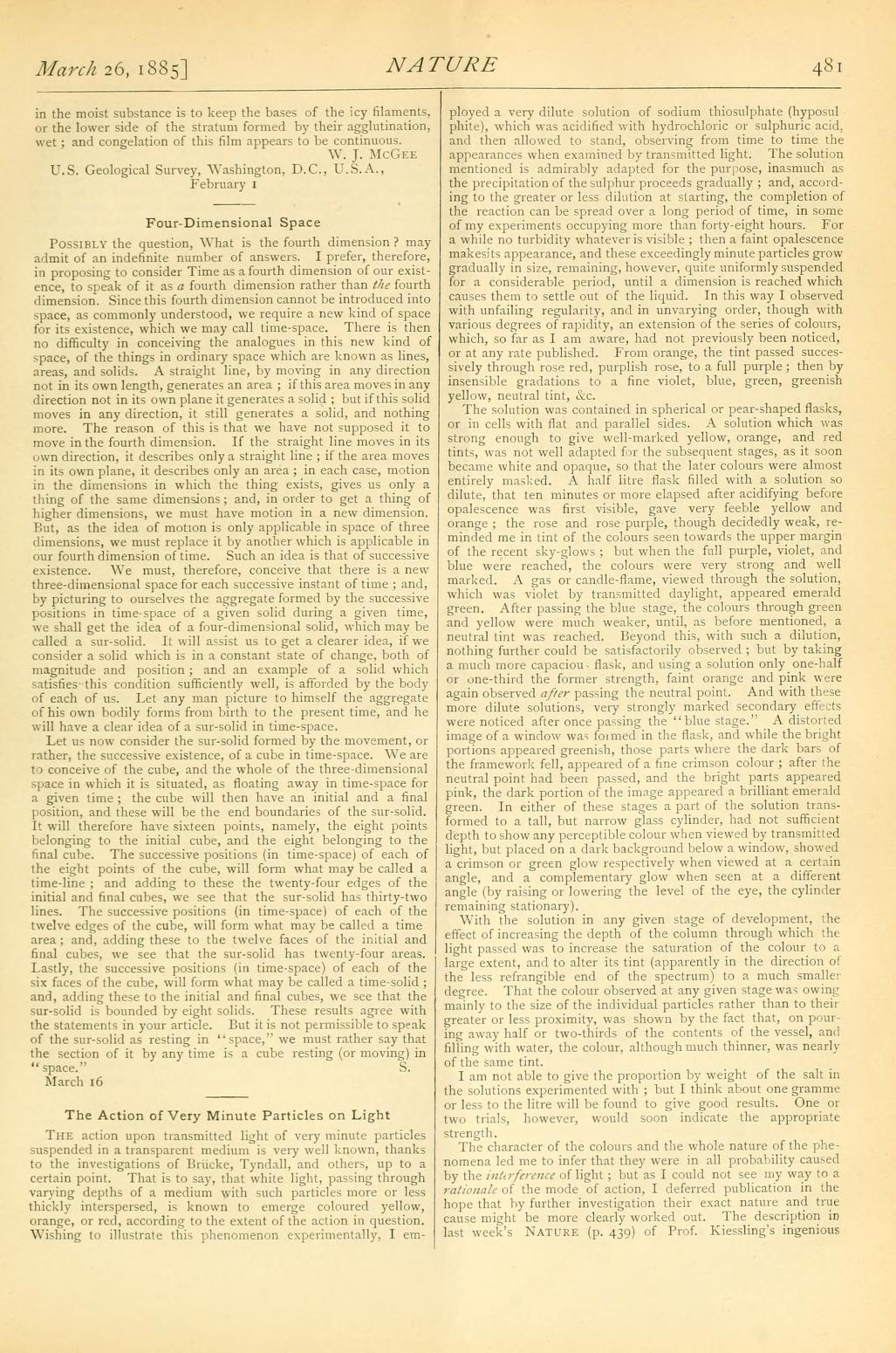
And there were certainly many who came before Wells on the subject of the fourth dimension (though not many on the subject of time as the fourth dimension): R.C. Archibald wrote on d’Alembert’s (1754) use of time as a fourth dimension (in the Bulletin of the American Mathematical Society for May 1914); Cayley’s “Analytical Geometry of n-Dimensions (Cambridge Mathematical Journal, 1843); Grassmann’s Die Lineale aus Dehnungslehre (1844); Riemann’s 1854 effort on curved space (translated in 1873 for Nature by W. Kingdom Clifford); Beltrami’s introduction of the pseudosphere in 1868; J.J. Sylvester (again in Nature for 30 December 1869); Hermann von Helmholtz and his curvature for three-dimensional spaces, and others. Also, according to Linda Dalrymple Henderson in her The Fourth Dimension and Non-Euclidean Geometry in Modern Art (Princeton, 1983) in Appendix B there were only a few other efforts before this Nature article. (Some of these include Halsted, “The New Ideas about Space”, in Popular Science Monthly, July 1877; Hinton’s “What is the Fourth Dimension?”, Dublin University Magazine, 1880; Lane “Transcendental Geometry” Popular Science Monthly, August 1882; and Fullerton, “On Space of Four Dimensions” the Journal of Speculative Philosophy, April 1894.)
Text version:
Four-Dimensional Space, by Anonymous.
From: Nature, volume 31, issue 804, page 481.