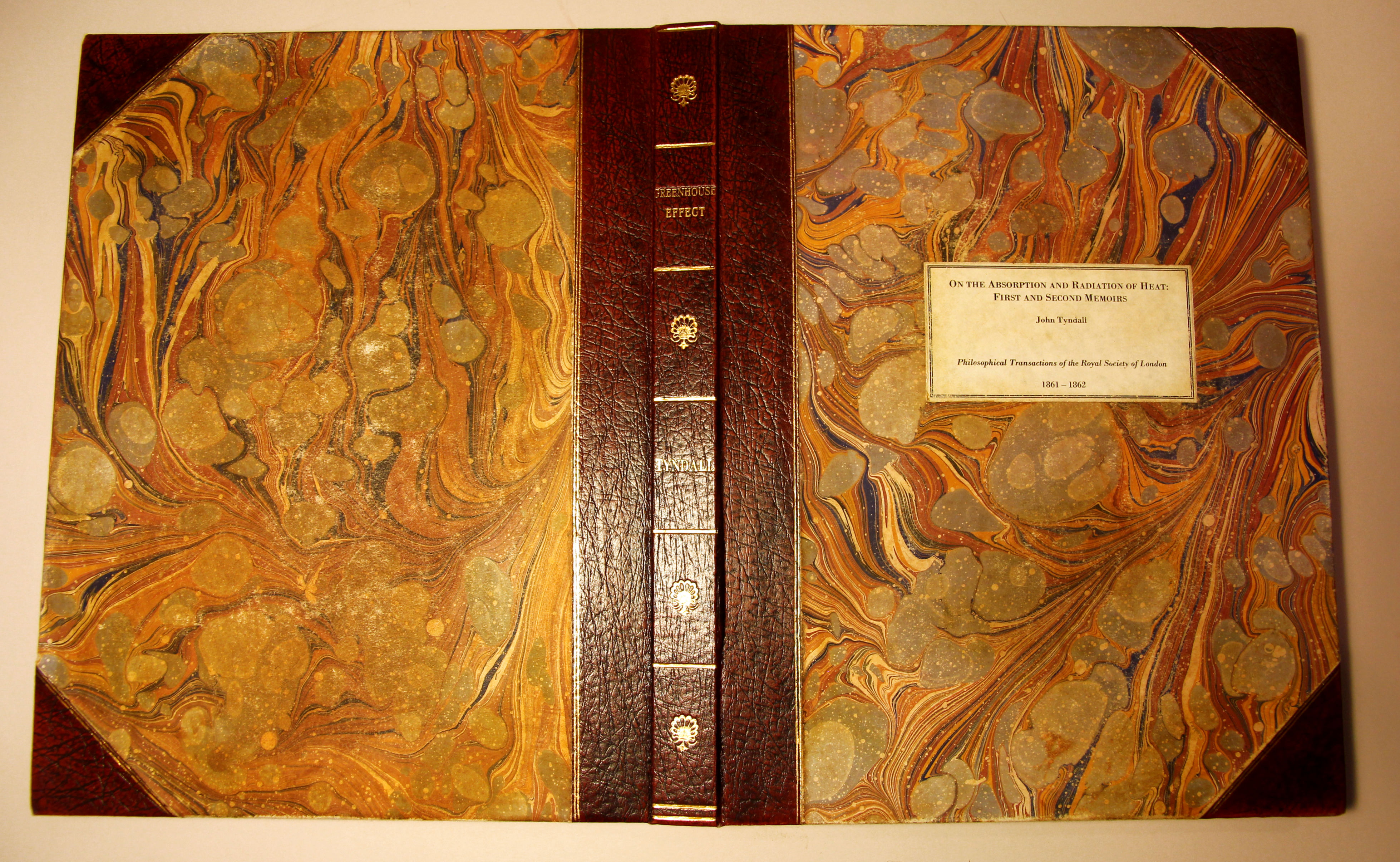
John Tyndall. Two papers, as follows:
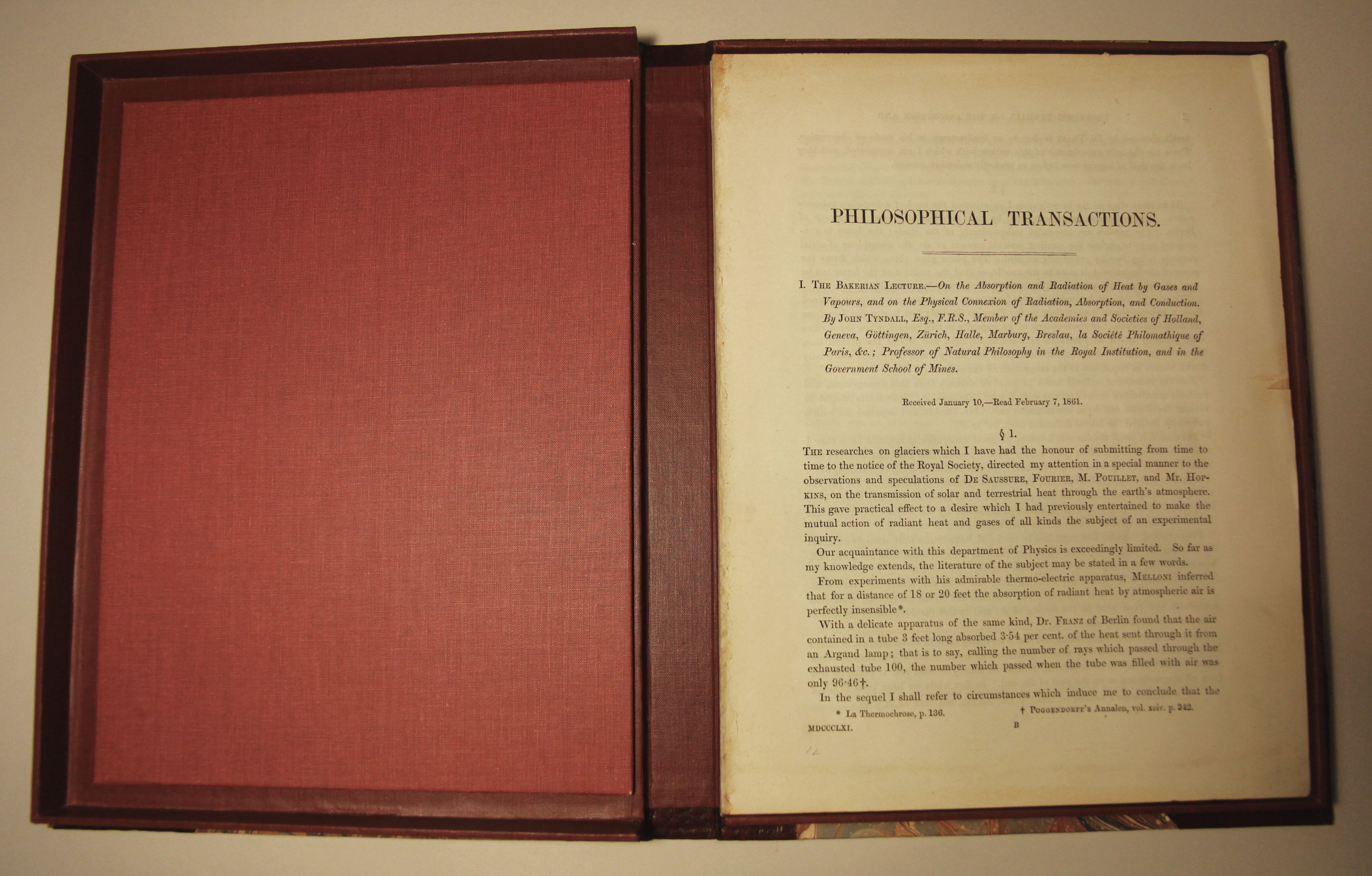
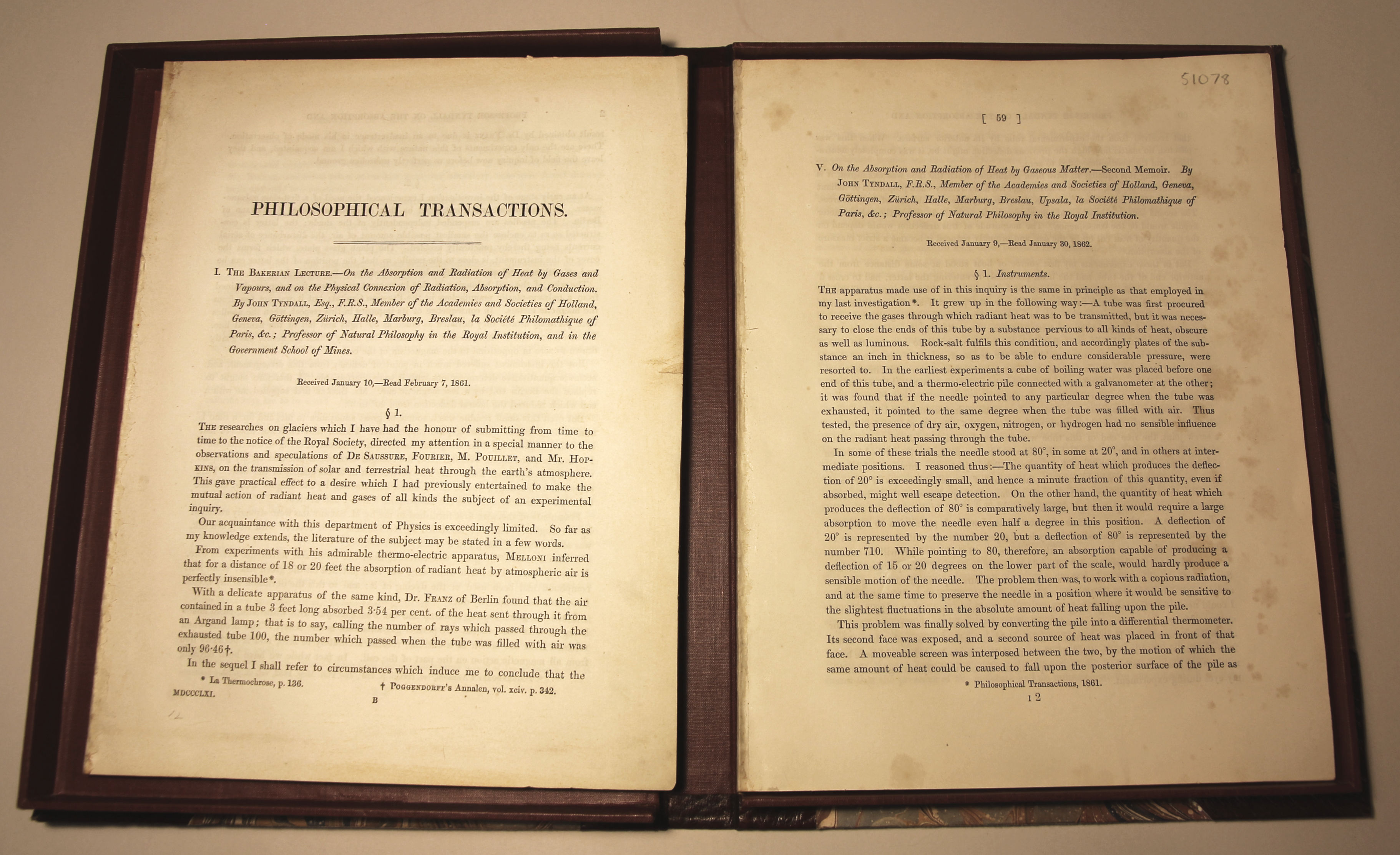
“The Bakerian Lecture: On the Absorption and Radiation of Heat by Gases and Vapours, and on the Physical Connexion of Radiation, Absorption and Conduction” , in Philosophical Transactions of the Royal Society 151, pp 1-36, 1861.
- And with:
“On the Absorption and Radiation of Heat by Gases and Vapours—Second Memoir”, Philosophical Transactions of the Royal Society of London 152 pp. 59-97, 1862.
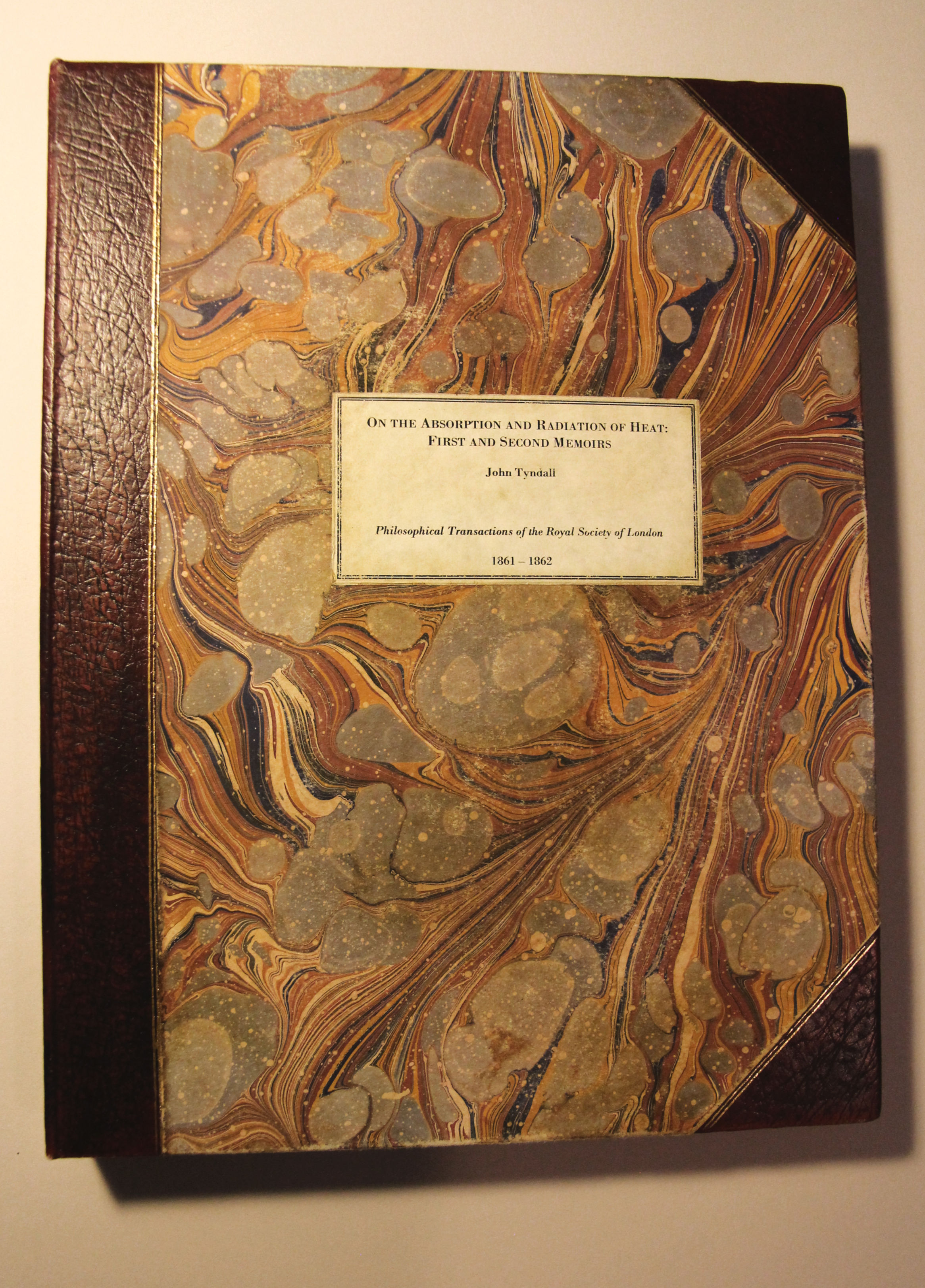
Both papers, extracted from the bound volume, and housed in a luxurious clamshell box, bound in calf-backed paper covered boards, leather corners. Lovely, and in Very Fine condition. $1100
“Tyndall described the most important findings and conclusions from his greenhouse gas experiments in [these two] papers…John Tyndall was an English physicist best known for his study of thermal radiation. In 1852, Tyndall developed the first “ratio spectrophotometer” and used it to test the heat absorption of gases. He found that only a few gases, water vapor and a few trace gases (CO2 and hydrocarbon vapors like methane and ozone), absorb infrared radiation to any measurable degree. He also found that these gases also re-emit this heat, creating the reflection/absorption/re-reflection cycle that causes the greenhouse effect.”–David Wenner, History of Physics Collection
“The enormous range of Tyndall’s inquiries reflected many different intellectual influences. An explicit discussion of these influences in their context has yet to be undertaken. We lack any comprehensive review of Tyndall’s work on optical and crystalline structure; on magnetism, radiation, and mountaineering; and on the relationship between his several research programs. Tyndall is remembered chiefly for his efforts to verify the high absorptive and radiative power of aqueous vapor; to measure the absorption and transmission of heat by many different gases and liquids; to explain the selective influence of the atmosphere on different sounds; and to establish the principle of “discontinuous heating”–Complete Dictionary of Scientific Biography, online
“His work suggested the possibility that by altering concentrations of these gases in the atmosphere, human activities could alter the temperature regulation of the planet. Tyndall could forsee such a possibility already in 1861. Changes in the amount of any of the radiatively active constituents of the atmosphere may have produced all the mutations of climate which the researches of geologists reveal (Tyndall, 1861), although he was a long way from developing a coherent account of how human actions could induce significant changes in climate on much shorter timescales.”–Mike Hulme, “On the origin of ‘the greenhouse effect’: John Tyndall’s 1859 interrogation of nature”, in Royal Meteorological Society, 27 April 2009.