A Daily History of Holes, Dots, Lines, Science, History, Math, Physics, Art, the Unintentional Absurd, Architecture, Maps, Data Visualization, Blank and Missing Things, and so on. |1.6 million words, 7500 images, 4.9 million hits| Press & appearances in The Times, Le Figaro, Mensa, The Economist, The Guardian, Discovery News, Slate, Le Monde, Sci American Blogs, Le Pont, and many other places… 5000+ total posts since 2008.

Book Category: Computing History

  • A Seminal Game Theory Theoretical Concept and “the basis for evolutionary game theory.”–British Library blog

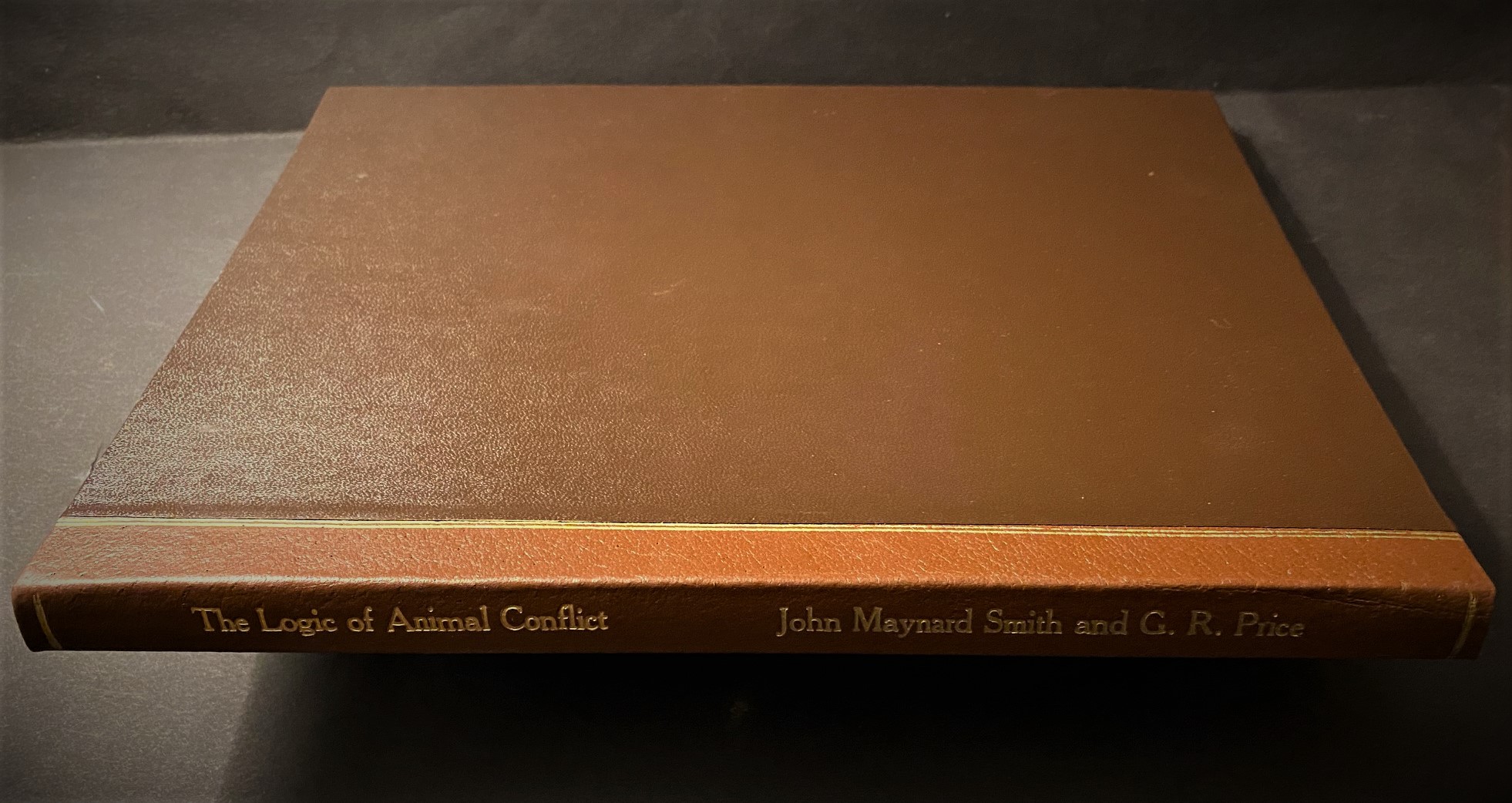
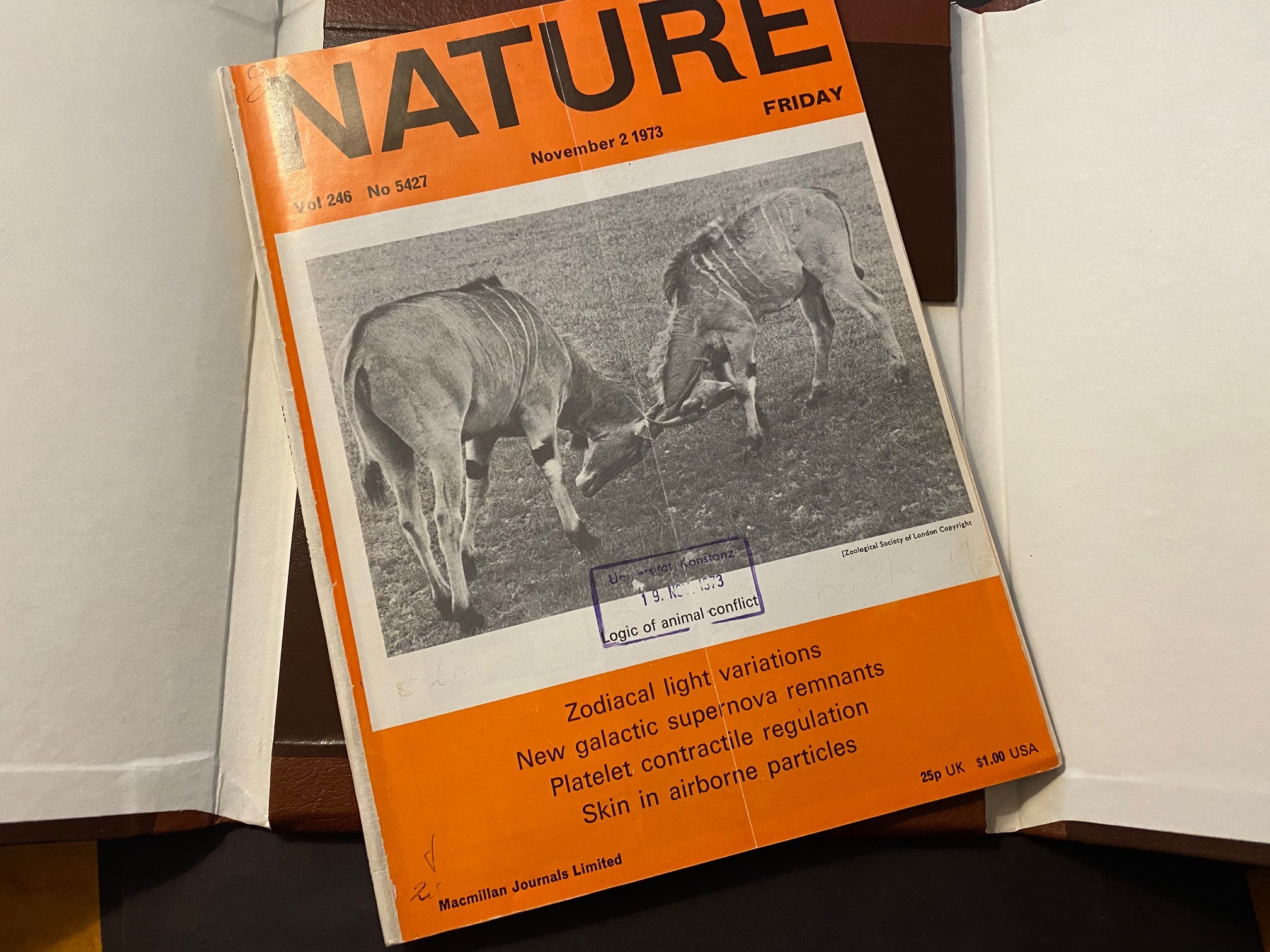
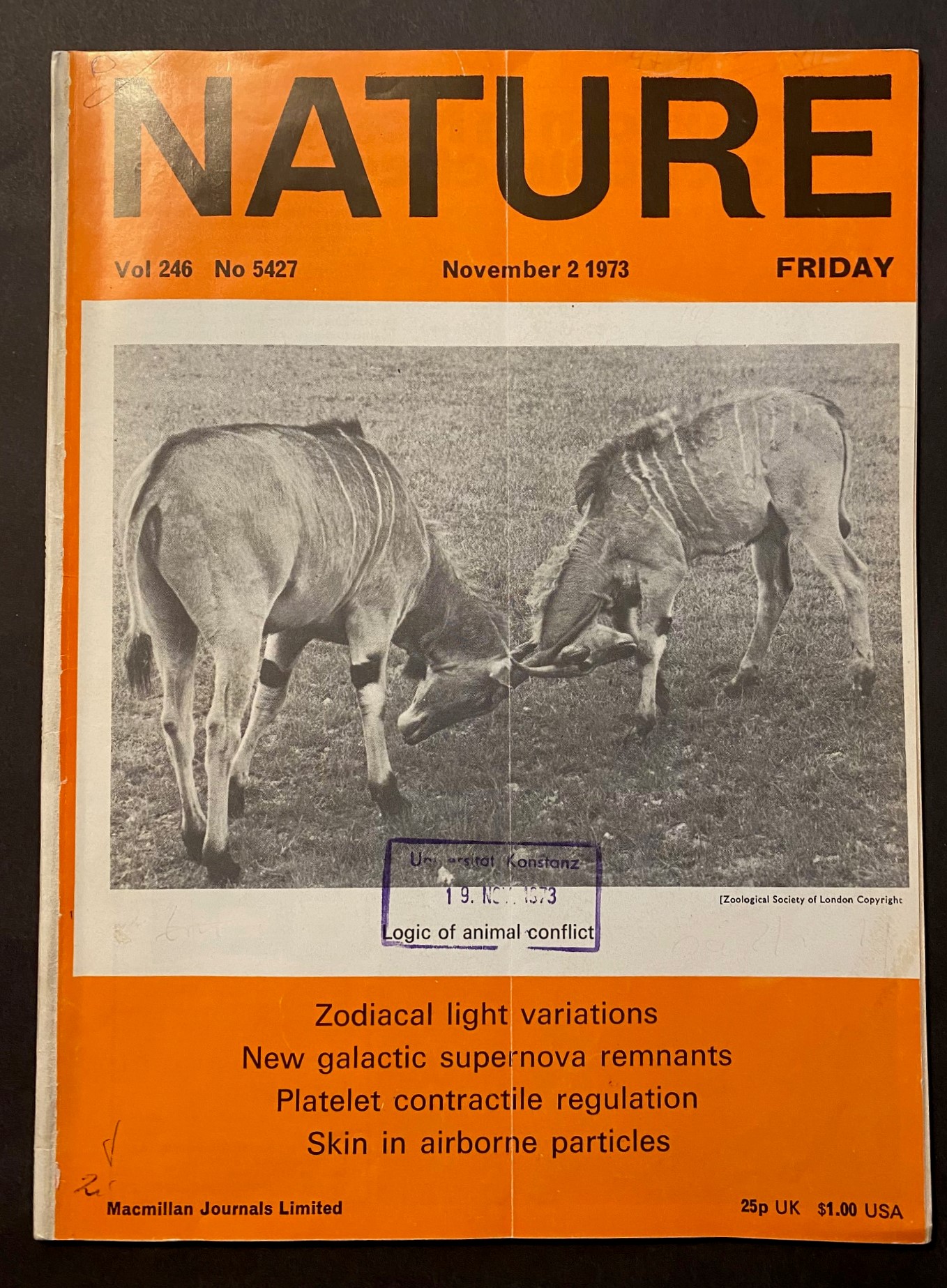
    John Maynard Smith and G. R. Price. “The Logic of Animal Conflict” in Nature vol 246  No. 5427, pp. 15-18, in the issue for November 2 1973). In the original front wrapper, with a blank rear wrapper expertly added. There is one old vertical fold that runs through the issue, and one rubber stamp on the front cover. Other than these notes, a VG copy. Housed in a lovely leather-backed pamphlet case (in Very Fine condition). $500

    This is the influential (6,000+ citations) paper about the “hawk-dove game,”  the introduction of the concept of “Evolutionarily stable strategies.”
    IMG_4108
    “Evolutionary game theory (EGT) is the application of game theory to evolving populations in biology. It defines a framework of contests, strategies, and analytics into which Darwinian competition can be modeled. It originated in 1973 with John Maynard Smith and George R. Price’s formalisation of contests, analysed as strategies, and the mathematical criteria that can be used to predict the results of competing strategies [the paper offered]. The first game that Maynard Smith analysed is the classic hawk dove[a] game. It was conceived to analyse Lorenz and Tinbergen’s problem, a contest over a shareable resource. The contestants can be either a hawk or a dove. These are two subtypes or morphs of one species with different strategies. The hawk first displays aggression, then escalates into a fight until it either wins or is injured (loses). The dove first displays aggression, but if faced with major escalation runs for safety. If not faced with such escalation, the dove attempts to share the resource.”
    IMG_4106
    IMG_4106

    “…John Maynard Smith brought about the realization of the fallacy of the good of the species idea. This brought back the focus to individual selection and forced biologists to re-think evolutionary explanations for many apparently altruistic behaviours seen in animals. Maynard Smith took up the challenge of providing an explanation for animal conflicts from the individual rather than the species point of view. Along with George R Price he used game theory, originally developed by economists, to formulate the concept of Evolutionarily Stable Strategies (ESS). ESS is a strategy that is evolutionarily stable because it is unbeatable by any other strategy. Game Theory and the concept of ESS have since been applied with success to a variety of situations including foraging, cooperation, communication, sex ratios, parent-offspring conflict, predator-prey interactions and so on.” –Indian Academy of Science, Resonance, November 2005

    Richard Dawkins, in his The Selfish Gene, credits Maynard Smith’s work as a ‘major stimulus that led me to […] write the whole book.’  “It is in chapter 5, ‘Aggression: stability and the selfish machine’ where you can read Dawkins’ description of evolutionary game theory – without any of the maths that was in the original paper of Maynard Smith and Price.”–Encyclopedia Britannica
    ·Posted by :

    ·in:


  • Grant’s Massive Calculating Engine, 1874.

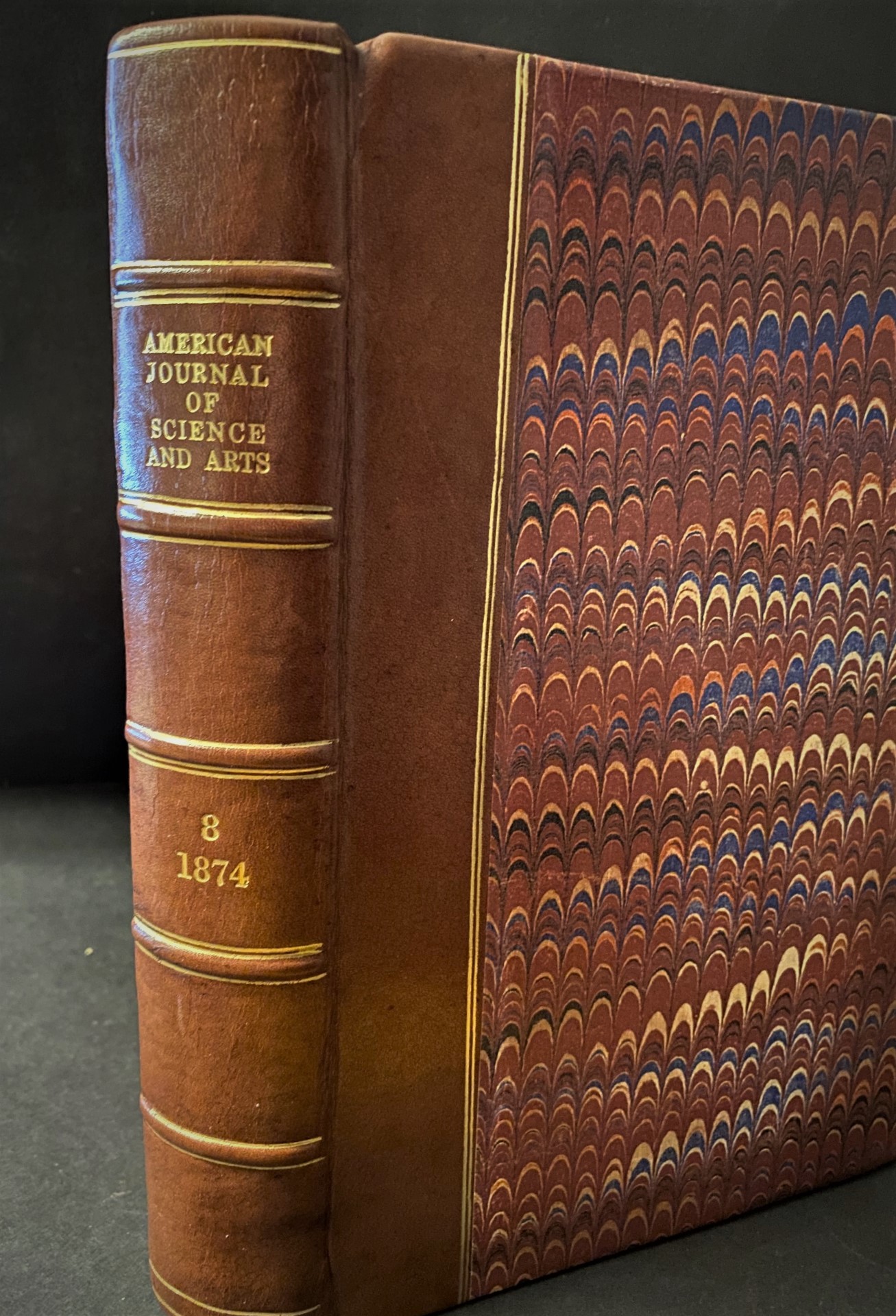
    IMG_4072GRANT, George (1849-1917) Computer Pioneer. “A New Calculating Machine”, pp 277-284, in American Journal of Science and Arts, edited by James Dana and Benjamin Silliman, third series, vol VIII (whole number 108) nos. 43-48, July-December 1874. New Haven, 1874. viii, 484pp, 7 plates. Beautifully rebound in half-leather with marbled boards, with raised bands stamped on their horizontals. VG copy. The first three pages are a review of the history of calculating machines while the last four are a description of how Grant’s machine functions. $600

    Condition—there are a few old bumps in the text at the Grant article, otherwise this volume is in excellent condition.

    “While a student at Harvard, Grant worked on the problem of inventing a mechanical calculator. With the encouragement of his professor, Oliver Wolcott Gibbs, he set about improving on the work of Babbage and Per Georg Scheutz. He published this work in the American Journal of Science and Arts (see below), and was awarded two patents as a student. Shortly after college, Grant designed and built two calculating machines that were displayed at the Centennial Exposition held in Philadelphia in 1876. One of them, known as a difference engine, was eight feet long and five feet high, and weighed 2,000 pounds. It may have been the largest calculator ever built (pictured below). The other, known as the “Centennial Model”, is among the Smithsonian collection of Grant’s inventions. The Smithsonian Institution has nine of Grant’s inventions in its collection in Washington, D.C. Grant’s calculating machine business was known as “Grant Calculating Machine Company of Lexington, Mass”.

    Although Grant’s sales of calculating machines were modest (125 of the “Rack and Pinion Model” were sold commercially), his machines were considered sturdy and reliable. Grant’s calculators won a number of awards: the Centennial Medal, the Scott Medal of The Franklin Institute, and the Gold Medal of the Massachusetts Mechanics Association.”–Wikipedia

    “Grant is reported to have invented this machine (so called Centennial Model) while a student at the Lawrence Scientific School of Harvard University (between 1870 and 1872). This machine was reported to be intended for us in counting houses, insurance offices, etc., and was described as a smaller instrument for common operations in multiplication, division, etc. It is a foot in length by half as much in height and width, weighs twenty pounds, and contains less than 400 pieces, less than 75 of which are working parts. It takes numbers up to nine decimal places. According to an exhibition report, this machine, or arithmometer, successfully rivals the well-known one of Colmar.” History Computer site/the History of Computers.

    “The American engineer and entrepreneur George Barnard Grant (1849-1917) is a notable figure in the world of mechanical calculator. He was the creator of several all-purpose calculators, but also of a magnificent Difference Engine. As a whole, Grant devised four different calculating machines: three all-purpose calculators, and a sophisticated machine for computing tables. While in Lawrence Scientific School of Harvard University, in 1869, George Grant got interested in calculating machines while he was computing a table for excavations and embankments, but he soon became discouraged with his initial efforts when he realized the subject was more difficult than he had anticipated. Thus between 1870 and 1872 he devised firstly a simple calculator, and later continued with several more complex calculating machines. All his devices were well designed and workable machines, and although none of them achieved market success, they fully deserve our attention.” Computer Timeline online

    ·Posted by :

    ·in:


  • Babbage Difference Engine, 1823

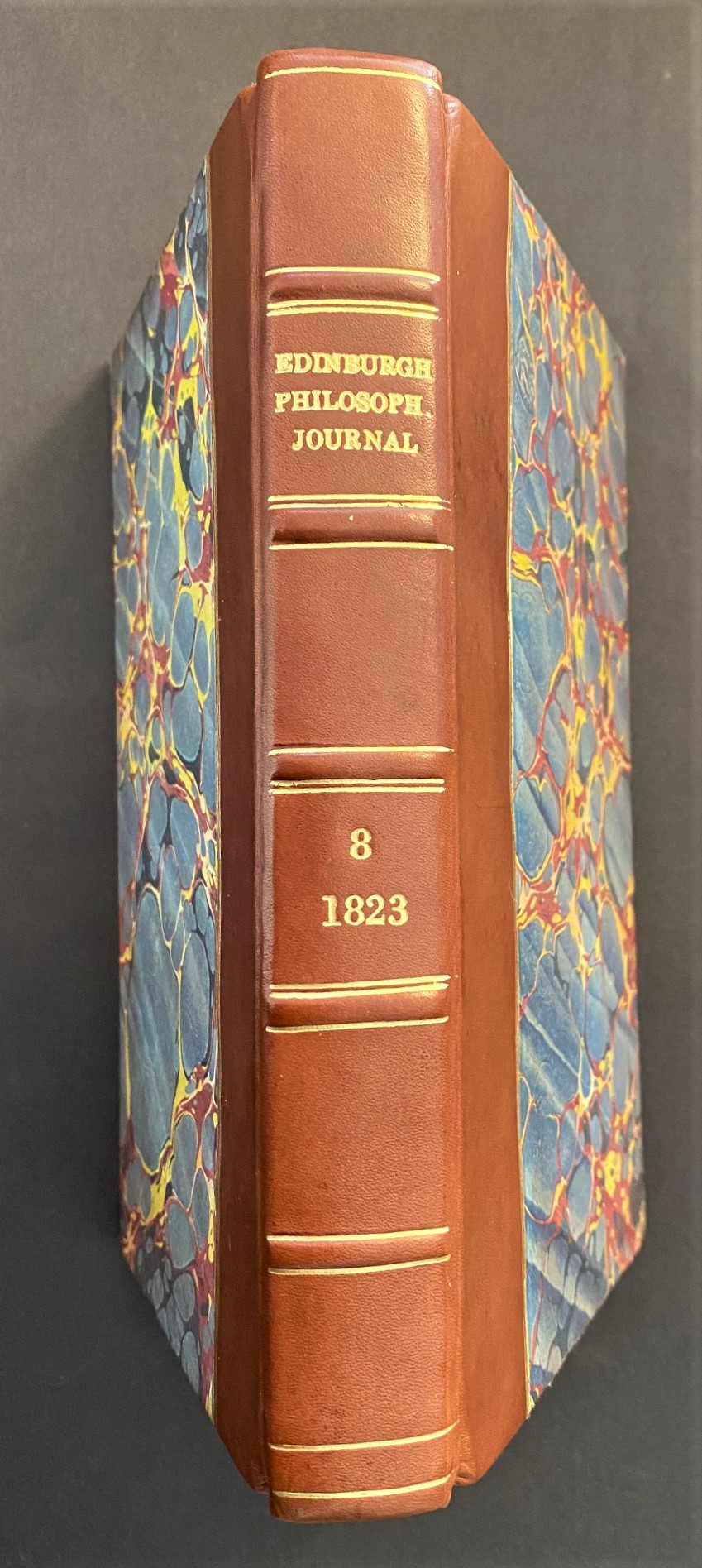
    IMG_4118BABBAGE, Charles. “On the Theoretical Principles of the Machinery for Calculating Tables. In a letter from Charles Babbage. Esq. F.R.S. Lond. & Edin. To Dr. Brewster”. In the Edinburgh Philosophical Journal, October 1, 1822 to April 1, 1823, volume VIII. Edinburgh, printed for Archibald Constable and Co. 1823. The Babbage occupies pp 122-128 in the volume of iv,iv,428pp, with 7 plates (one folding). Newly rebound in half-calf and marbled boards, with gilt decorated raised bands, new (heavy) endpapers—a lovely job by the binder. The text is clean and fresh, and the binding is new. FINE copy.  $750

    “As a founding member of the Royal Astronomical Society, Babbage had seen a clear need to design and build a mechanical device that could automate long, tedious astronomical calculations. He began by writing a letter in 1822 to Sir Humphry Davy, president of the Royal Society, about the possibility of automating the construction of mathematical tables—specifically, logarithm tables for use in navigation. He then wrote a paper, “On the Theoretical Principles of the Machinery for Calculating Tables,” which he read to the society later that year. (It won the Royal Society’s first Gold Medal in 1823.) Tables then in use often contained errors, which could be a life-and-death matter for sailors at sea, and Babbage argued that, by automating the production of the tables, he could assure their accuracy. Having gained support in the society for his Difference Engine, as he called it, Babbage next turned to the British government to fund development, obtaining one of the world’s first government grants for research and technological development.”–Encyclopedia Britannica entry for CB


    ·Posted by :

    ·in:


  • Fantastic Work on IBM Processing Machines 1936

    [IBM]   Machine Methods of Accounting. A Manual of the Basic Principles of Operation and Use of International Electric Bookkeeping and Accounting Machines. IBM, 1936-1940.  23 separately paginated sections, approximately 340pp, with illustrations throughout of machines and components, all gathered in a spring-loaded IBM binder of the same name.   A fine illustrated reconnaissance of the IBM company.   Fine condition, all 29 issues: $850

    00. Foreword
    01. Historical (in later editions, Development of International Business Machines Corporation (revised))
    02. Principles of the Electronic Accounting Machine Method 
    03. The Tabulating Card   3a. The Electric Accounting Machine Card. 
    04. The Design of Tabulating Cards 
    05. The Preparation and Use of Codes 
    06. Organization and Supervision of the Tabulation Department
    07. Selection and Training of Key Punch Operators
    08. Accounting Control
    09. Punches
    10. Alphabetic Printing Punches 
    11. Facts to Know about Key Punches 
    12. Verifiers 
    13. Gang Punches
    14. Card Operated Sorting Machines 
    15. Electric Tabulating Machines
    16. Electric Accounting Machines (Type 285 and Type 297)
    17. Alphabetic Direct Subtraction Accounting Machine
    18. Interpreters   18a. Electric Punched Card Interpreter Type 552
    19. Reproducing Punches (and supplement 19a)  AND Reproducing Punches Type 512.

    20. Automatic Summary Punches (Type 285-297; 20a – Type 405)  AND:  Automatic Summary Punches, for Use with the Numerical Accounting Machines Type 285-297. 

    21. Multiplying Punches

    22. Applications of Machines to Accounting Functions
    23. Other International Products

    24. The International Automatic Carriage (Type 921)

    [IBM]   Machine Methods of Accounting. A Manual of the Basic Principles of Operation and Use of International Electric Bookkeeping and Accounting Machines. IBM, 1936.  10 separately paginated sections, massively illustrated throughout with images of machines and components.   A fine illustrated reconnaissance of the IBM company and its early tabulating machines. Superb!  Fine condition.__+__ Includes 03. the Electric Accounting Machine Card, 20pp; 04, The Design of Tabulating Cards, 16pp; 05. The Preparation and Use of Codes, 28pp; 06. Organization and Supervision of the Tabulation Department, 16pp; 07. Selection and Training of Key Punch Operators, 12pp; 08. Accounting Control, 8pp; 13, Gang Punches, 8pp; 14. Card Operated Sorting Machines, 14pp; 20. Automatic Summary Punches (Type 285-297; 20a – Type 405) , 16pp; 22. Applications of Machines to Accounting Functions, 24pp.$220

    ·Posted by :

    ·in:


  • The Library of the Future (1960)

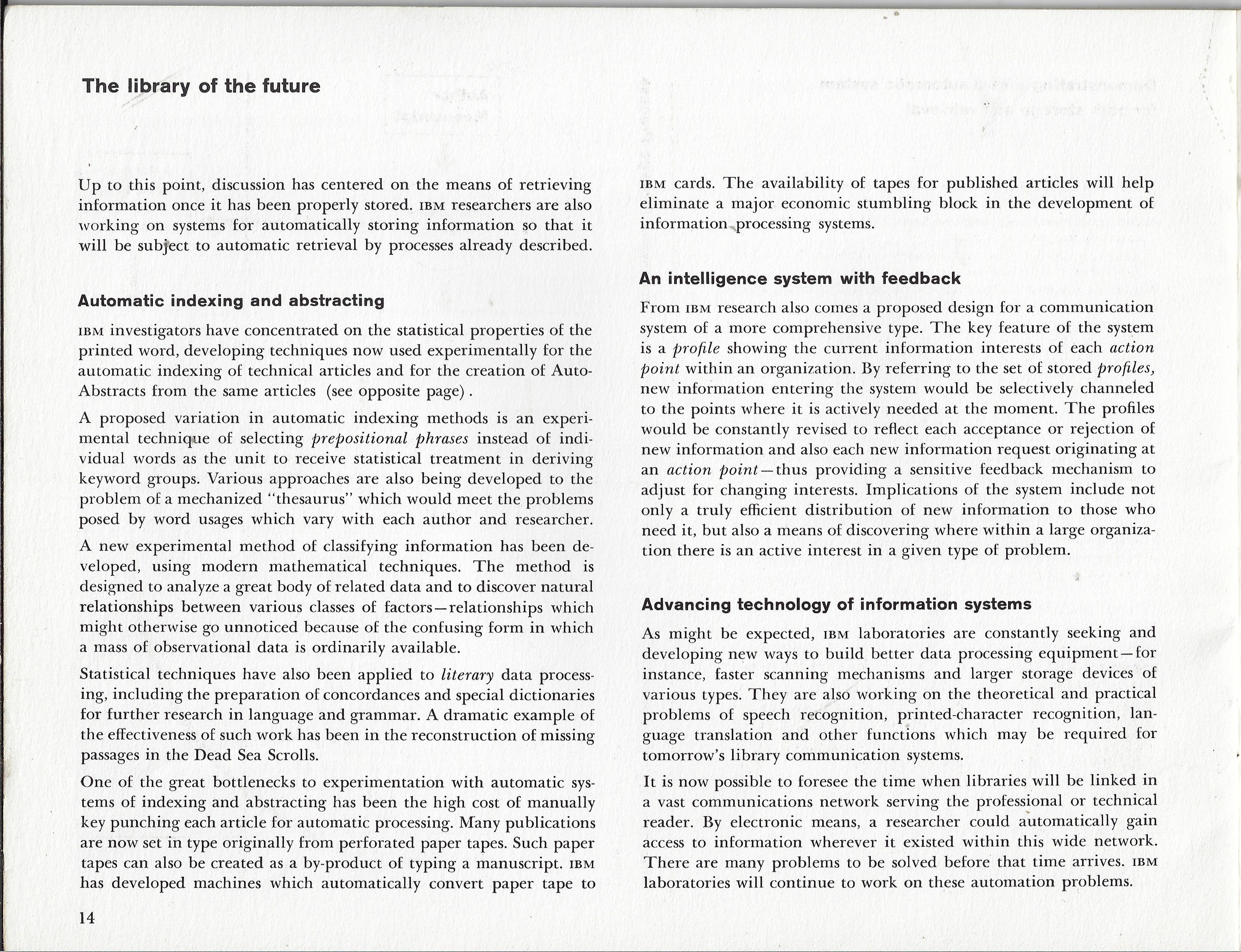
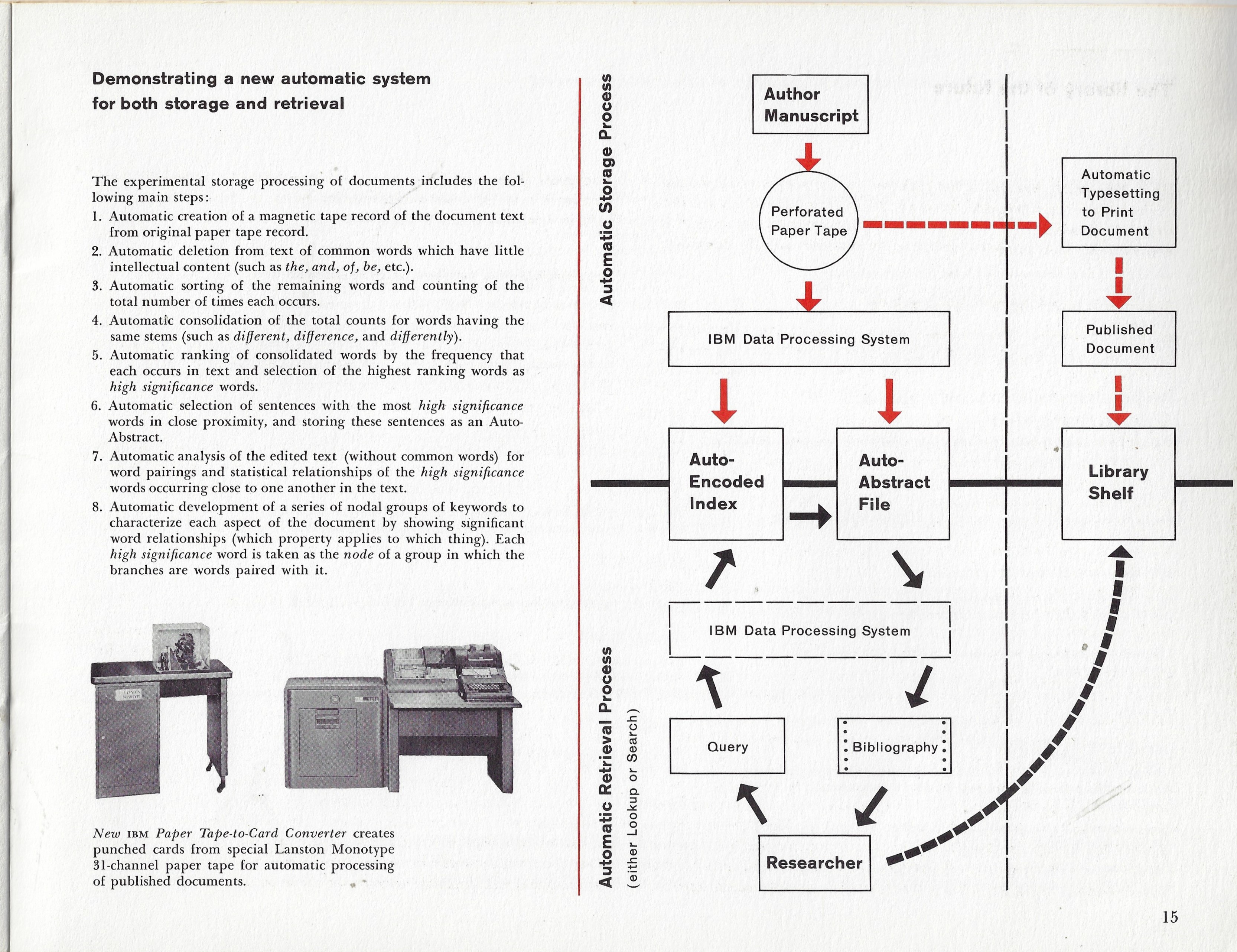
    IBM Information Retrieval. IBM, NYC, ca. 1959. (No date but the bibliography cites only 1957 and 1958 “recent” works, and the IBM machine quoted here for this particular use is the RAMAC which was sold beginning 1956. I guess it is possible that this was 1960-1962, though I’d also guess there would be more recent entries in the bibliog.) 8.5”x 11”, 16 pp, illustrated. FINE condition.  $125
    This is summation of the current state of affairs in info storage and retrieval delivered in a how-to schematic step-by-step presentation, concentrating on library applications, and including a tail piece on “the library of the future”, with that schematic reproduced here.

    IBM Info retrieval _2_

    IBM Info retrieval _2_

    ·Posted by :

    ·in:


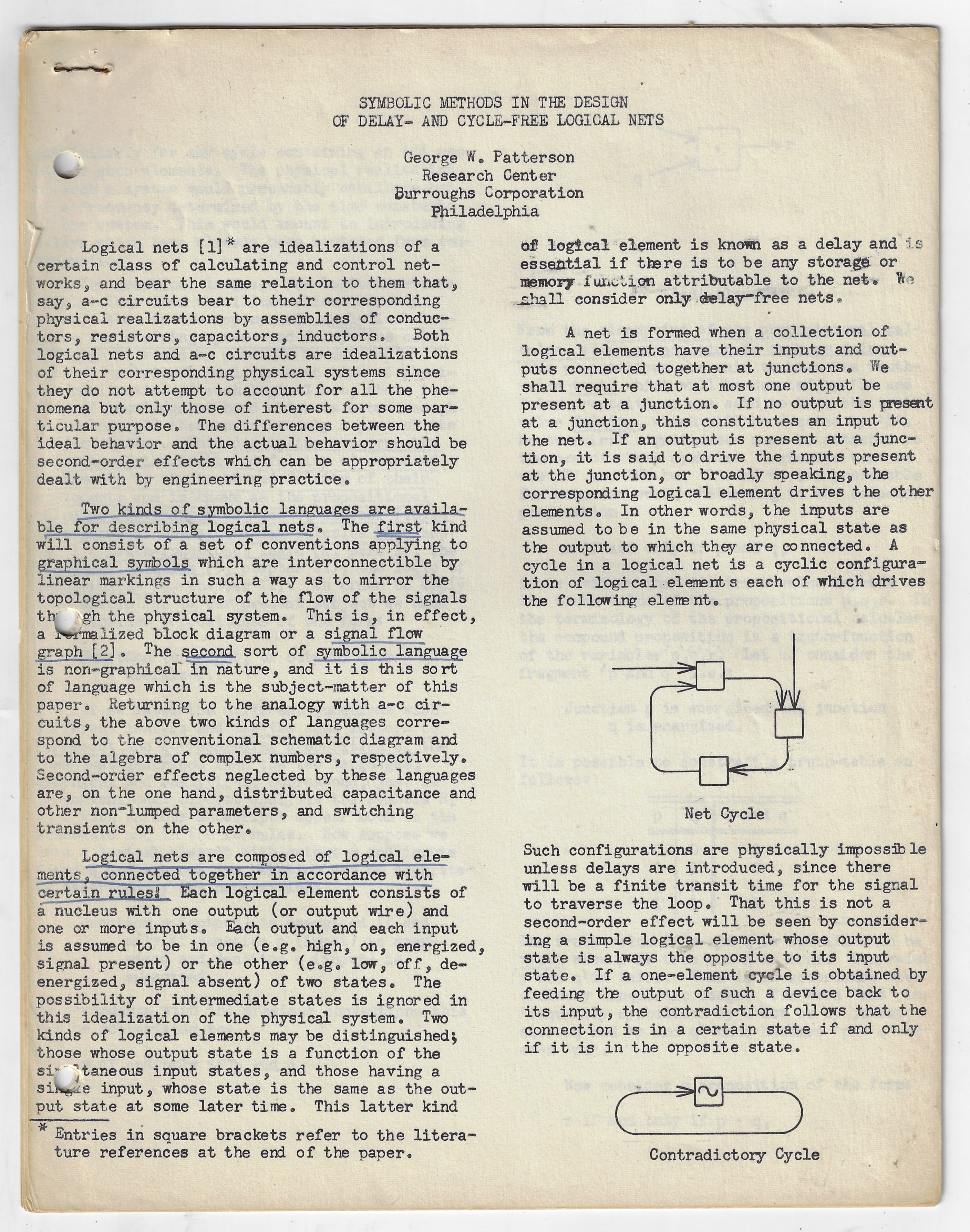
  • Patterson George Symbolic Methods In The Design Of Delay And Cycle Free Logical Nets Research Center Burroughs C


    Patterson GeorgePatterson, George. “Symbolic methods in the design of delay- and cycle-free logical nets.”

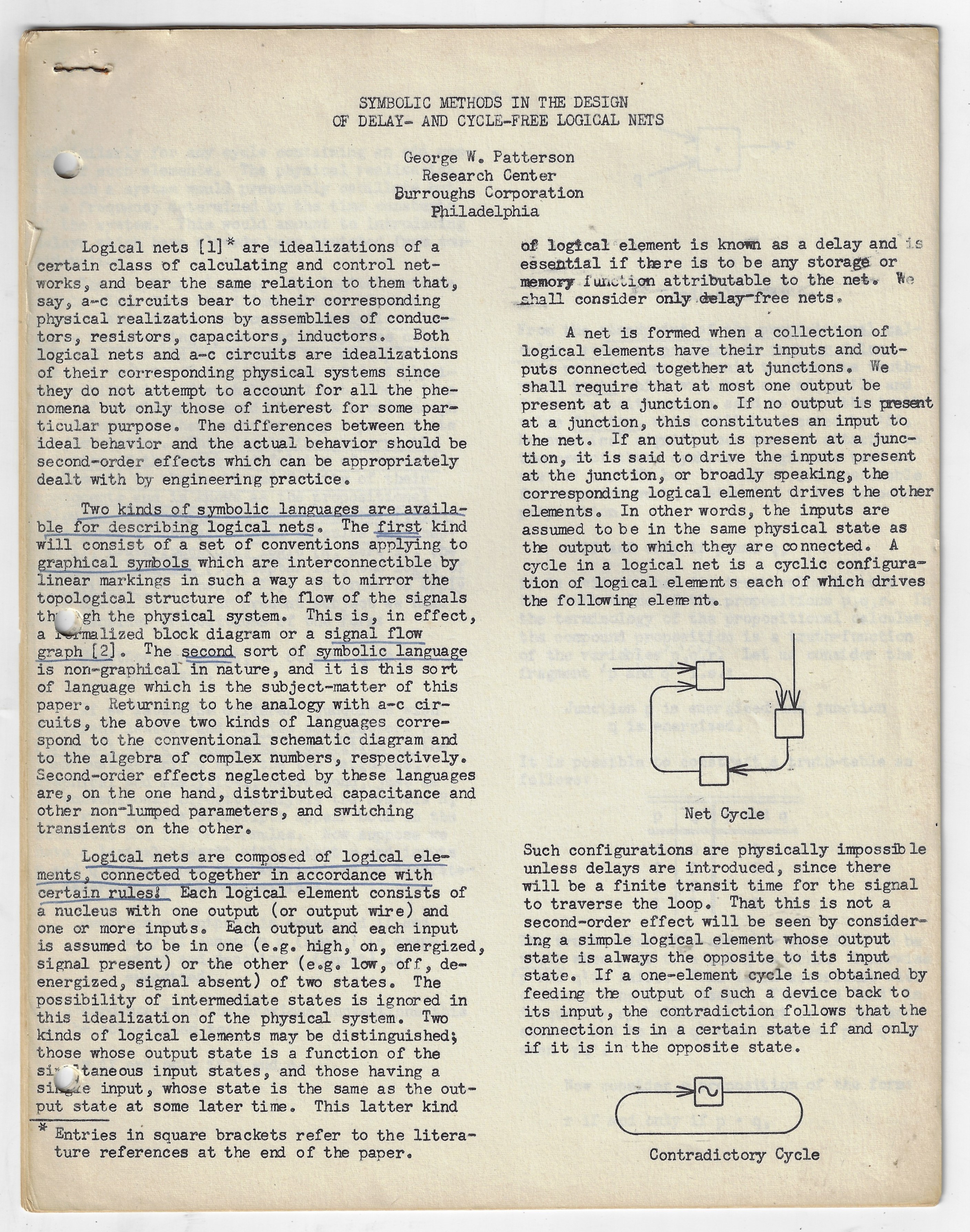
    Research Center, Burroughs Corporation, Philadelphia (1954). 11”x 8.5”. 9 leaves. Punch-bound for three-hole binder. Stapled. There is some underlining in ink in the first three pages, otherwise this is a very nice copy. $300

    “George W. Patterson (IRE J, 1931; Associate, 1949; Senior Member, 1954; and Fellow, 1959) was born in Rochester, New York, on 6 May 1912. He received the B.S.E.E. degree from the University of Vermont in Burlington, in 1934; the M.A. degree in physics from Columbia University in New York City, in 1936; and the Ph.D. degree in mathematics from the University of Pennsylvania, in Philadelphia, in 1958.”

    “In 1946, Patterson joined the staff of the Moore School of Electrical Engineering of the University of Pennsylvania, where he designed the logic for EDVAC arithmetic circuits and coordinated the logic design for the entire machine. From 1950 to 1955, Patterson was with the Research Center of the Burroughs Corporation, Paoli, Pennsylvania. Then he rejoined the faculty of the Moore School. In 1962, he was Associate Professor and Section Head for the systems logic research at the Moore School.

    “In addition to teaching and directing research on switching theory, Patterson was active in computer standardization, as a member of the Electronic Computers Committee beginning in 1949, and serving as Vice Chairman in 1962. He was also a member of the ACM committee that wrote the first programming glossary, and a member of the ASA Y32-14 task group that developed standards for computer logic systems”–Wikipedia, Engineering and Technology

    ·Posted by :

    ·in:


  • Mendeleev on the Discovery of Gallium (1876)

    MENDELEEV (MENDELEJEFF), Dmitri. "Remarks on the Discovery of Gallium" in The London, Edinburgh, and 
    Dublin Philosophical Magazine and Journal of Science,
    London, 1876. Supplement to vol I, fifth series, 1876,
    pp 542-546.
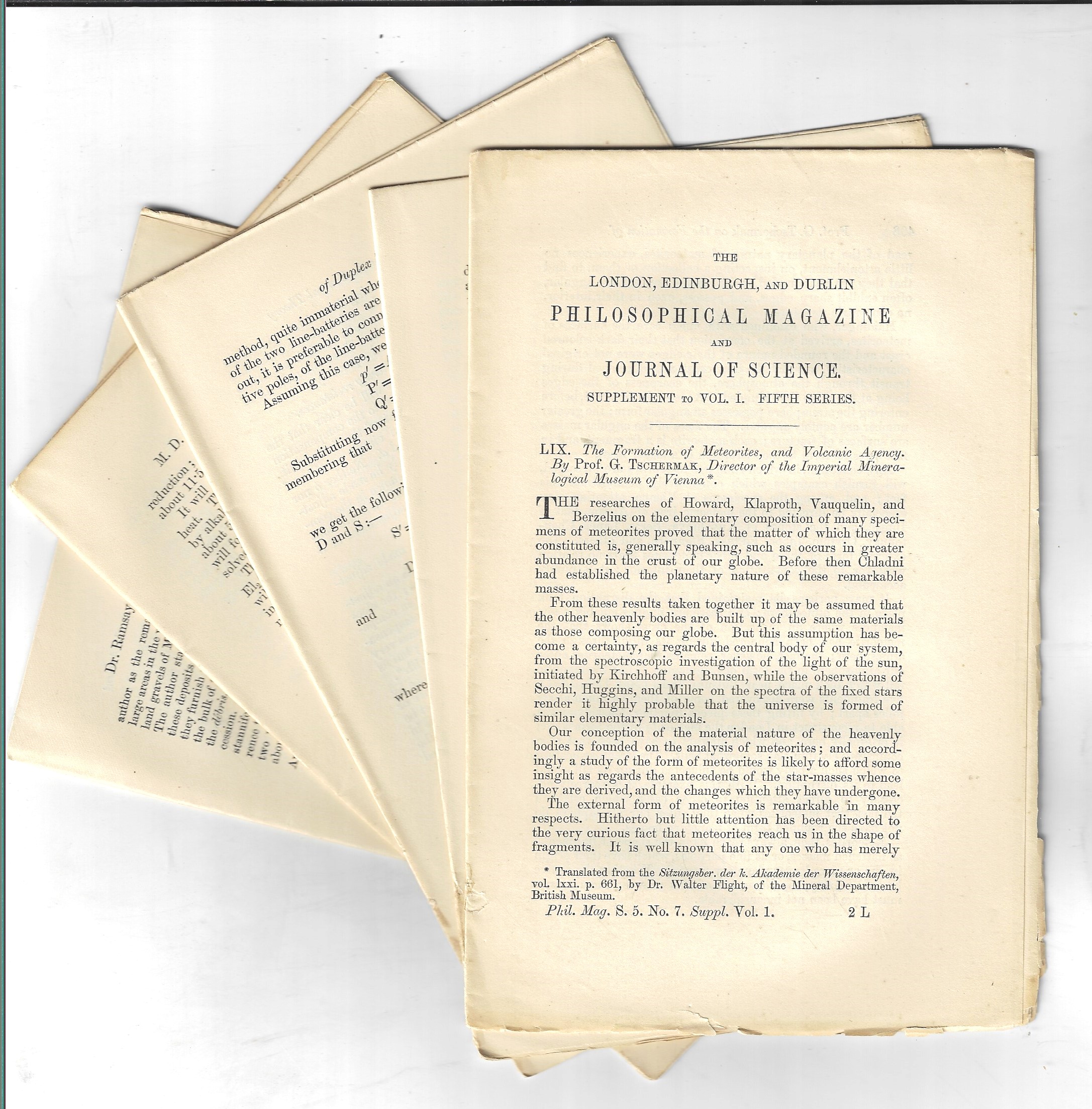
    Offered in the original unbound parts, pp (497)-576, in the five original quires, plus a sixth being the table of contents
    for the entire 576pp volume. Very unusual to my experience. Unopened and uncut. Fine condition. $450
    This is the first appearance in English of this work, translated from the French by Pattison Muir from “Remarques
    a propos de la devouverte du gallium; par M.D. Mendeleeff” and published in the
    Comptes Rendus. de l'Academie
    des Sciences,
    22 Novembre 1875.

    Mendeleev Gallium
    “The discovery of gallium has great significance to Mendeleev’s development of the periodic table as it was the first new element discovered since Mendeleev’s 1869 table. In 1871 Mendeleyev had prepared a table of known elements leaving gaps for those “elements yet to be discovered”, one of these being eka-aluminium. Four years later, a Frenchman Paul Emile François Lecoq de Boisbaudran discovered this element spectroscopically (two violet lines) during an examination of a zinc blende from the Pyrenees. Lecoq’s newly discovered element was found to have an atomic weight of 69 and appeared to have the properties that Mendeleev had predicted for eka-aluminium…gallium’s most important modern day use is in electronic devices. Semiconductor use is now almost the entire world market for gallium. However, new uses in alloys and fuel cells continue to be discovered…”–Luke McGuiness, Royal Australian Chemical Institute, “Gallium”.

    Mendeleev writes on the prediction of “gallium” and the verification of the periodic table:
    “In 1869 I announced the following periodic law:  "The  properties of the simple bodies, as also the properties and 
    constitution of their combinations, are periodic functions of the atomic weights of the elements....Among the
    different applications of that law I shall cite only the following :
    “1. This law constitutes the basis of a complete systematic classification of the elements...It ought to be remarked
    that, previous to the discovery of the periodic law, it was not possible to predict the existence or to foretell the
    properties of undiscovered elements...”
    “M. Lecoq de Boisbaudran has discovered, by means of spectral analysis, the existence of a new element in the
    blende of Pierrefitte (Pyrenees) ; to this element he has given the name of gallium. The manner of its discovery,
    the process for its separation (precipitation by sulphuretted hydrogen before zinc), and certain of its properties
    (precipitation by barium carbonate, solubility of the hydrate in ammonia, degree of volatility, &c), make it
    probable that the new metal is no other than eka alu-minium...If subsequent researches confirm the identity
    of the pro- perties of gallium with those which I have pointed out as belonging to eka aluminium, the discovery
    of this element will furnish an interesting example of the utility of the periodic law. Let us hope that the
    discovery of eka silicium, Es = 72, Es0 2 , the probable properties of which I have detailed in Liebig's
    Annalen, vol. viii. (Suppl.) p. 171, will not be long delayed.”--from this paper.

    “The discovery of gallium has great significance to Mendeleev’s development of the periodic table as it was the first new element discovered since Mendeleev’s 1869 table. In 1871 Mendeleyev had prepared a table of known elements leaving gaps for those “elements yet to be discovered”, one of these being eka-aluminium. Four years later, a Frenchman Paul Emile François Lecoq de Boisbaudran discovered this element spectroscopically (two violet lines) during an examination of a zinc blende from the Pyrenees. Lecoq’s newly discovered element was found to have an atomic weight of 69 and appeared to have the properties that Mendeleev had predicted for eka-aluminium…gallium’s most important modern day use is in electronic devices. Semiconductor use is now almost the entire world market for gallium. However, new uses in alloys and fuel cells continue to be discovered…”–Luke McGuiness, Royal Australian Chemical Institute, “Gallium”.

    See also: Early Responses to the Periodic System, edited by Masanori Kaji, Helge Kragh, Gabor Pallo.

    ·Posted by :

    ·in:


  • Correlation Coefficient Calculator (1926)

    Stuart C. Dodd. “The Applications and Mechanical Calculation of Correlation Coefficients”, in Journal of the Franklin Institute, vol 201, no. 3, March 1926, pp 337-350 in the volume of 886pp, with several illustrations, including a photo of the preliminary model of the correlation machine.  Library cloth binding, with call number on spine and a library bookplate and a few stamps on the title page, otherwise a very nice, solid copy.  $250

    • “Around 1925 Stuart C. Dodd, a psychologist at Princeton University, made a simpler correlation calculator. This machine (Figure 6) contained drums on which square numbers where represented by pins of different lengths (separate pins for units and tens). These drums are the square number equivalent of the multiplication bodies as used in the Millionaire calculator. Dodd designed different versions of this device. Later development was continued by the Cambridge Instrument Co. Inc., New York, who sold these correlation machines to the universities of Harvard, Berkeley, and Chicago.”–“Correlation Machine” article in “The contribution of psychologists to mechanical computing” via google sites.  

    ·Posted by :

    ·in:


  • With Views from the Surface of the Moon (1868)

    Henry Morton, “Sunlight and Moonlight”, an 11-part article over two volumes in Journal of the Franklin Institute, vol 56 (third series) vol 76 (overall), 1868, 426pp overall. Bound in half calf and marbled boards. Ex-library with a few stamps on title page. The binding has a set of problems, mainly with the front board being nearly detached, and the first two pages are detached. Fair/Good condition. Two volumes, $225

    The Morton occupies is located on pp 59-64 (with a lovely plate showing a view across the crater Copernicus), 131-136 (with folding photographic map of the Moon), 201-203 (with a plate of lovely lunar shadows), 274-277 (with a beautiful plate of a lunar vista on the surface of the Moon), 349-351 (with a plate of Mars), and continued in the next volume.

    C.S. Lyman, “A New Form of Wave Apparatus”, pp 187-194.

    Octave Chanute, Pneumatic Bridge Foundations, continued from a previous vol and here occupying pp 17-28 (with three plates), 89-99; Chanute is mainly remembered for his work in aeronautics and his influence on the Wright brothers, though some of his technical work wound up being incorrect, something the Wright’s discovered on their own but were loathe to publish on it.

    John Mayer, “Nitro-Glycerine: its Claims as a New Industrial Agent”, pp 40-45, 119-123.

    And many others.

    Morton, Henry. Sunlight and Moonlight”, in the Journal of the Franklin Institute, vol 57 (third series) vol 77 (whole series), 1869, 424pp complete.  Half calf and marbled boards; nice condition, ex-library with a few stamps on the title page. G-VG condition.  The Morton article is continued from p. 418 vol 56, and occupies pp 65-69 (with a plate), 133-135, 204-208 (with a plate), 274-275, 344-347 (and a plate), 414–420 (concluded).

    De Volson Wood, “History of the Investigation on the Resistance of SOlid Bodies, pp 100-110;

    Charles Emery, The Best Modes of Testing the Power and Economy of the Steam Engine, pp 110-120, 177-184;

    Lewis Leeds, Lectures on Ventilation,  continued from vol 56, pp 65-69, 135-139, 199-204, 276-280,

    J. Norman Lockyer, “Spectroscopic Observations of the Sun”, pp 266-267;

    Total Eclipse of the Sun *August 18, 1868), with a plate, pp 268- 273

    Clemens Herschel, Gauging the Flow of Rivers, pp 305-315, with a plate of the device.


    ·Posted by :

    ·in:


  • IBM Scientific Computation Forum 1948

    COMPUTERS. Grosch, H.R.J., editor. Proceedings Scientific Computation Forum, 1948. Published by IBM, NYC, 1950. 11″x8.5″, 126.  Cloth, in the original plain brown dj. FINE copy in an excellent dust jacket.  $200

    Contributors include: Frank Verzuh, H.R.J. Grosch, Cuthbert Hurd, Francis J. Murray, L.H. Thomas, and numerous others. There is also an unusual paper by George Gamow, Jack Belzer, and Geoffrey Keller, “Dynamics of Elliptical Galaxies”, on pp 67-69.  Much of the content is on the application of computers–as in the use of computers at Naval Proving Ground, Aberdeen, Nautical Almanac Office, Beech Aircraft Corp., GE, Census, and others.

    ·Posted by :

    ·in: