A Daily History of Holes, Dots, Lines, Science, History, Math, Physics, Art, the Unintentional Absurd, Architecture, Maps, Data Visualization, Blank and Missing Things, and so on. |1.6 million words, 7500 images, 4.9 million hits| Press & appearances in The Times, Le Figaro, Mensa, The Economist, The Guardian, Discovery News, Slate, Le Monde, Sci American Blogs, Le Pont, and many other places… 5000+ total posts since 2008.

Book Category: Computing History

  • Computers Nuclear Warfare And Afterwards 1964

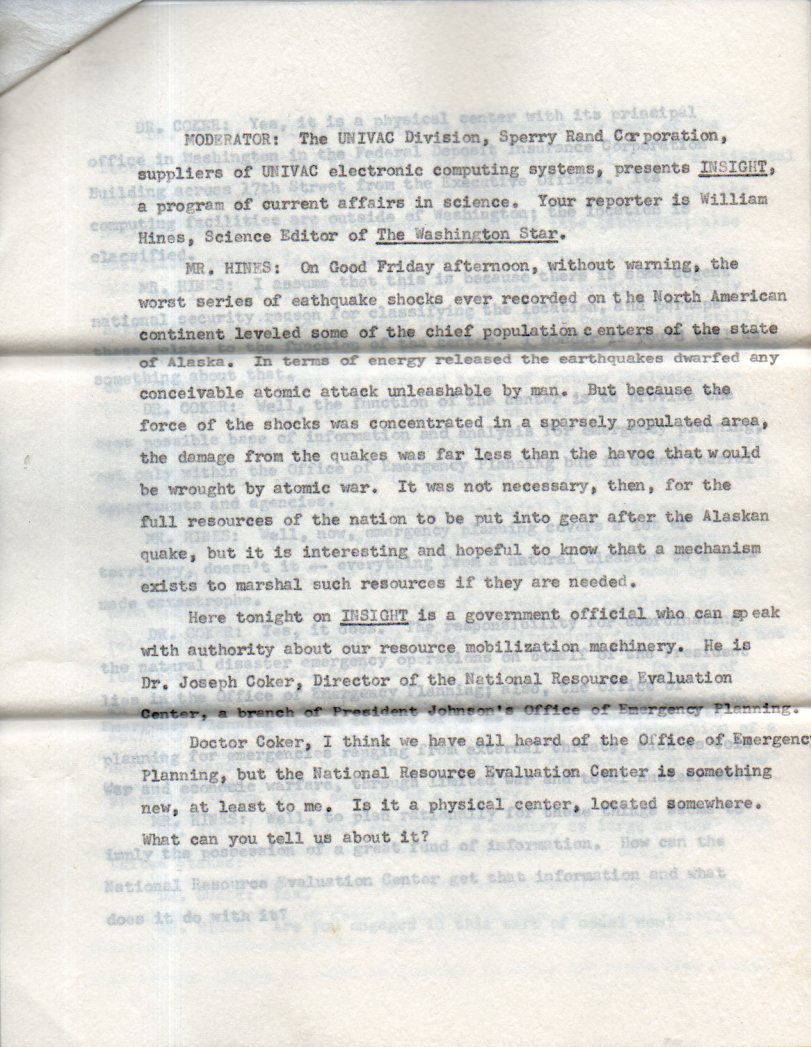
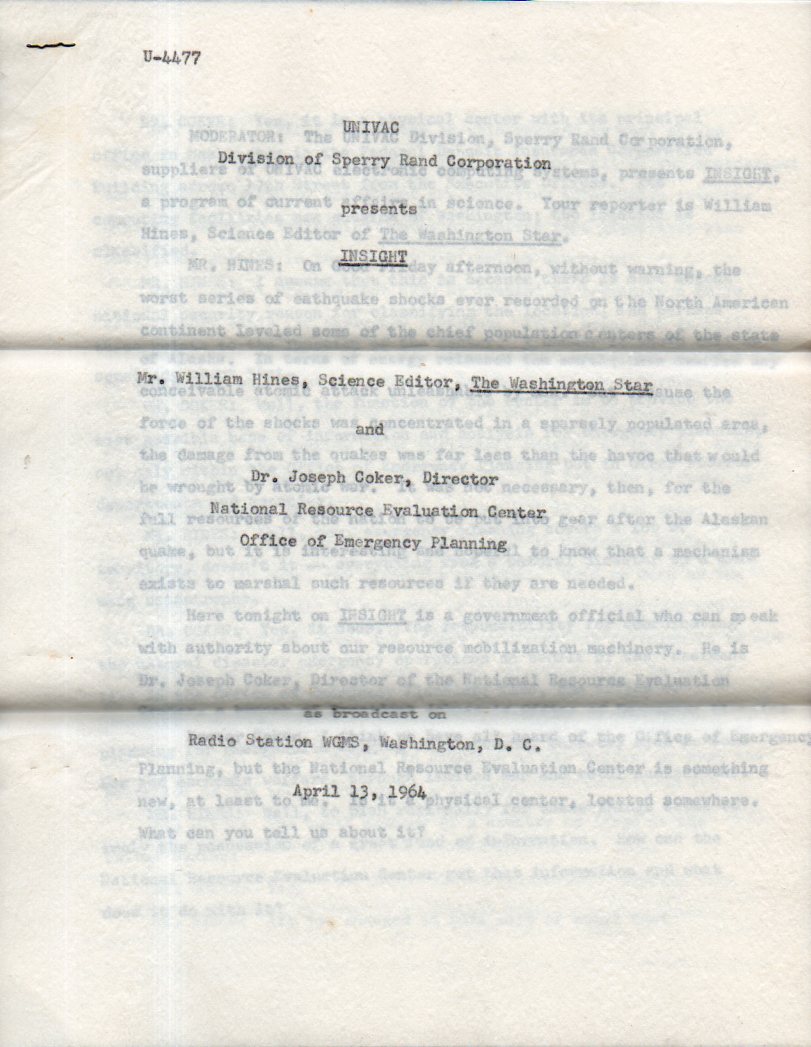
    UNIVAC, Division of Sperry Rand Corporation, presents INSIGHT.  Carbon copy transcript of a broadcast on Radio Station WGMS, Washington D.C., April 13, 1964.  8 leaves on onionskin paper. Fine copy. Two horizontal folds. SOLD

    This title may sound overly dramatic, but it really isn’t. As part of the Mutually Assured Destruction game plan there was an absolute necessity for calculating the leftovers from a nuclear exchange in order to convince the aggressor nation (which of course in 1964 would be the Soviet Union) that in spite of massive destruction the U.S. would be situated to carry out acting as a government/society/military in the post-war world. Part of figuring all of that out would entail a massive amount of bean counting for personnel, materiel, natural resources, and so on in a nearly endless list of stuff that runs the U.S., and then figuring out where it all was, and how it would/could be affected by a nuclear strike at XX locations, and that with different yields, and weather patterns, and so on, on into the night, of how a nuclear attack of x-capacity would affect the tactical and strategic and social base of the U.S.  So you’d have to gather all of that data, and then lay it all on in XX scenarios that would all be played out in computer simulations.  

    And that is what this interview is all about–explained on the radio to a general listening audience by Joseph Coker, who was at the time chief of the NREC (the National Resource Evaluation Center). All of this made its own crazy sense, and all of it had to be done, running both towards and away from the black hole that did and didn’t exist.  
    UNIVAC Coker544

    UNIVAC Coker545


    ·Posted by :

    ·in:


  • “Hand it Over to the Machine” (1878)


    SPOTTISWOODE, William. (William Spottiswoode, 1825-1883, an English mathematician and physicist, president of the Royal Society from 1878 to 1883, and of the British (Science) Association in 1878 as well.) “British Association”, address on the state of the British Association by the president, in Nature, vol 18, no. 459, occupying most of the weekly issue, pp 403-425 in the issue of pp 401-428. Detached from larger bound volume, but offered with the original wrappers (including 11 pages of advertising, some of which is fantastic). Good/VG condition. $300.00

    There’s a lot of interest in this review and state of affairs of the sciences and technology, including sections on Mathematics, Literature and Art, Physics Measurements, Manifold Space, Imaginaries, a full page on Non-Euclidean Geometry, and more.

    Of particular interest to me is the half-column entry for “Mechanical Methods” (on page 413), which turns out to be “mechanical appliances”, or calculating machines/engines. It starts with an unusual assertion:

    “Mr Babbage, when speaking of the difficulty of insuring accuracy in the long numerical calculations of theoretical astronomy, remarked that that “most accurate science” had become “inaccurate and uncertain in some of its results”.

    Spottiswoode continues with an explanation and a dig: “It is doubtless, some such consideration as this, coupled with his dislike of employing skilled labour when unskilled labour would suffice, which led him to his invention o the calculating machine”.

    The author then makes another—again, to my experience—unusual observation, referring to the replacement of human thinking capacity by a machine:

    “The idea of substituting mechanized for intellectual power has not lain dormant…”

    It is a very short comment, but I think makes a strong if understated point.

    The author then moves onto the “recent” machine of James Thomson (“by its aid it seems an unskilled laborer may, in a given time, perform the work of ten skilled arithmeticians…reduced to the simple process of turning a handle”.

    Spottiswoode finishes with a flourish, though it is easy to read through. In telling the story of Michael Faraday, who after muscling through some concept and determining that the next step wopuld be to hammer it all out mathematically, would “irreverently “ say “hand it over to the calculators”, which at that point was a team of human calculators, arithmeticians.

    And the finish:

    “But truth is stranger than fiction; and if he had lived until our day, he might with perfect propriety have said, ‘Hand it over to the machine’ ”.

    It is a small statement with a lot of possibility. Even though this comes seven years after Babbage gave up the ghost in Marleybone, it still seems remarkably early to be talking about this sort of major impact in the conduct of the sciences, lending part of the process over to machines. The Industrial Revolution is well into it second century by this point, and human effort in all manner of manufacturing has been replaced by machines—except here the active part of the human experience in the creation of ideas is the thing that is becoming “machinized”.

    ·Posted by :

    ·in:


  • Maxwell and the Human Calculating Machine (1870)

    MAXWELL,  James Clerk.  Mathematical and Physical Sciences–address to Section A of the British Association.  London:  1870.  1st edition.  Nature, vol 2, Sept 22, 1870  8vo.  Original printed wrappers.  Very good condition.  Maxwell addresses the British Science Association meeting in a long (for Nature) entry of about 4,000 words, over 4 pages. We offer the entire issue of 20pp, with their very scarce original wrappers, detached from a larger bound volume.      $225

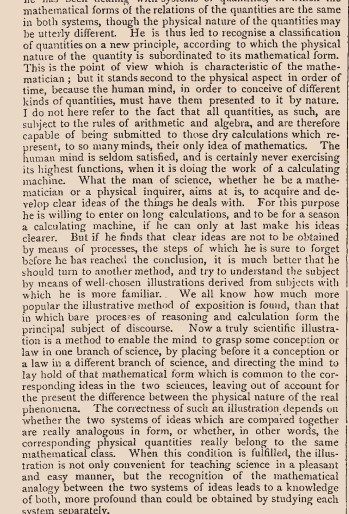
    What I find to be most interesting here is Maxwell pulling back the reins and directing the idea of clear scientific discourse by means of analogy. He does speak of “calculating” and “calculating machine”, which is referring to human calculators and not mechanical ones–the issue being that “spending a season” doing this stubborn and consuming work could turn the person occupied with in into a “machine”. He writes: 

    “What the man of science, whether he be a mathematician or a physical inquirer, aims to do, to acquire and develop clear ideas of the things he deals with. For this purpose he is willing to enter on long calculations, and to be for a season a calculating machine., if he can only at last make his ideas clearer.”

    “But if he finds that clear ideas are not obtained by the means of processes,  the steps of which he is sure to forget before he has reached the conclusion, it is much better that he should turn to another method, and try to understand the subject by well chosen illustrations derived from subjects with which he is more familiar.”

    “We all know how much more popular the illustrative method of exposition is found, than that in which bare processes of reasoning and calculation form the principal subject of discourse…”

    Calculators Maxwell NAture 1870


    ·Posted by :

    ·in:


  • Georges Meslin Calculating Machine, 1900

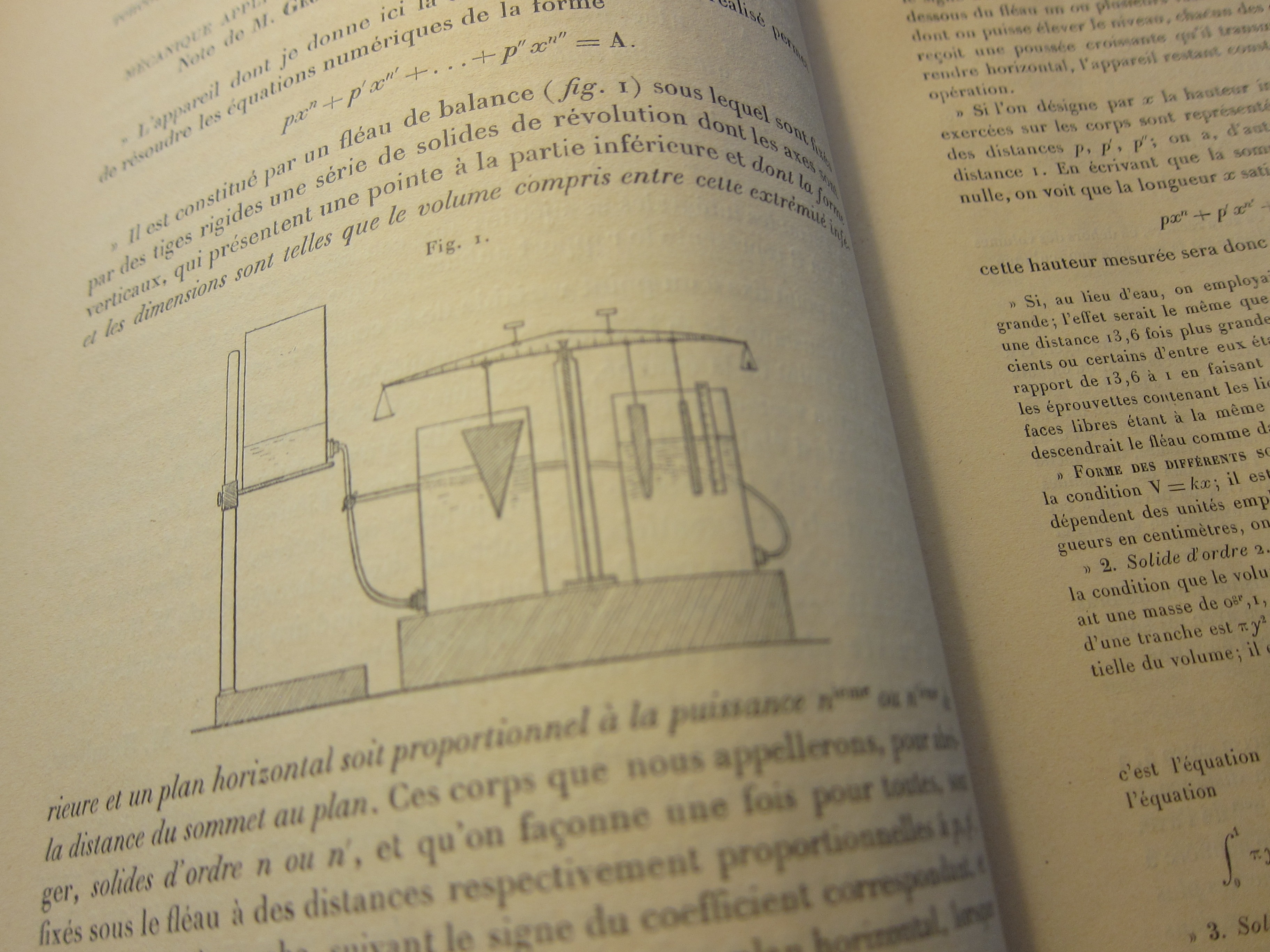
    Georges Meslin (1862-1918), “Sur une machine a resoudre les equations”, in Comptes Rendus des Seances de l’Academie des Sciences, 2 April 1900, the weekly issue comprising pp 865-960, with the Meslin article on pp 888-891.

    This issue is removed from a larger bound volume. VERY GOOD condition. $145

    ” ‘On a machine for solving equations’, by M. Georges Meslin. The machine consists of a balance carrying upon its beams at  varying distances from the point of support a series of solids of revolution, partially immersed in a liquid….”–Nature, June 14, 1900, p 579. (Interesting to note here that two thermo papers by Meslin are reviewed by Einstein in his big year of 1905.)

    CR 1900 Meslin computer

    ·Posted by :

    ·in:


  • A Hand Held Slide Calculator, 1903

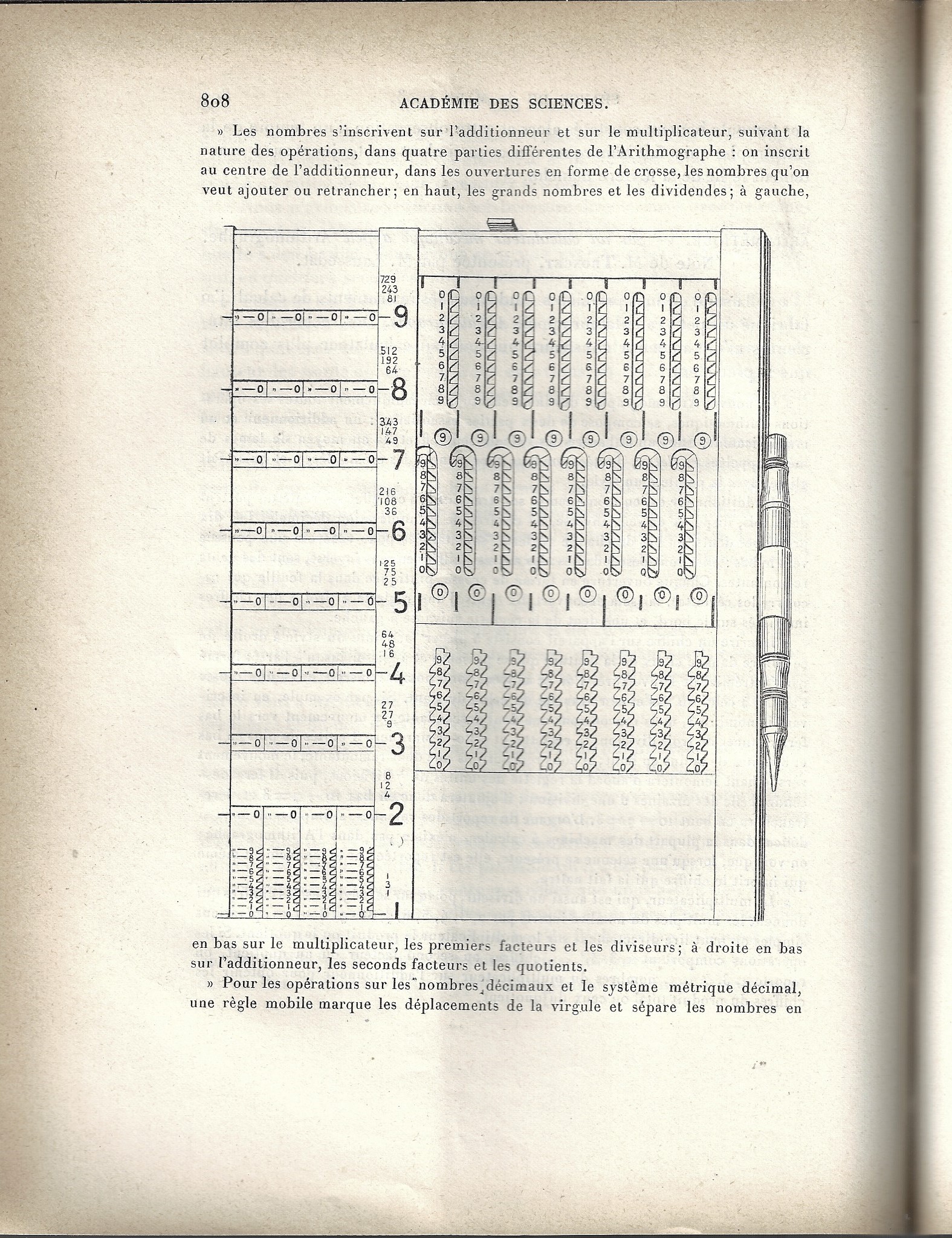
    Calculator Troncet 1903Louis-J. Troncet (b. 1850), “Sur un Calculateur mecanique appele Arithmographe“, an article in Comptes rendus, March 30, 1903, volume 136 #13, pp 785-840, the paper occupying pp 807-809, with a nearly full-page image of the calculating machine. This is the entire weekly issue, offered without the outer wrappers, and removed/detached from a larger bound volume. VG copy. $145

    It is hard to tell the dimensions of this instrument, but I’m guessing it was perhaps 8″ tall, judging by the stylus attached to the eight of the calculator.  Troncet developed a very popular instrument in his “Arithmographe”, which evidently first appeared in the late 1870’s, with versions of the machine manufactured for decades, with millions sold. This device comes relatively late in the series, though it also seems to be the first offering multiplication and division.  

    [Note: the scan of the device makes it seem as though there is vertical discoloration or an old fold–neither is there. This is just a shadow from not pressing down hard enough on the paper.]


    ·Posted by :

    ·in:


  • Bollee’s Calculating Machine

    BOLLEE< Leon. “Sur une nouvelle machine a calculer”, in  Comptes Rendus, Paris, Gauthier-Villars, November 11, 1889, volume 109, #20, pp 737-739 in the weekly issue of pp 723-774. Removed from a larger bound volume.  Good condition.  SOLD


    Bollee
    [Source: http://www.rechnerlexikon.de/artikel/Bild:Bollee-mit-Maschine-CNAM1990.jpg]

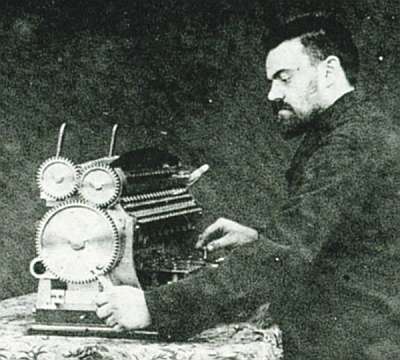
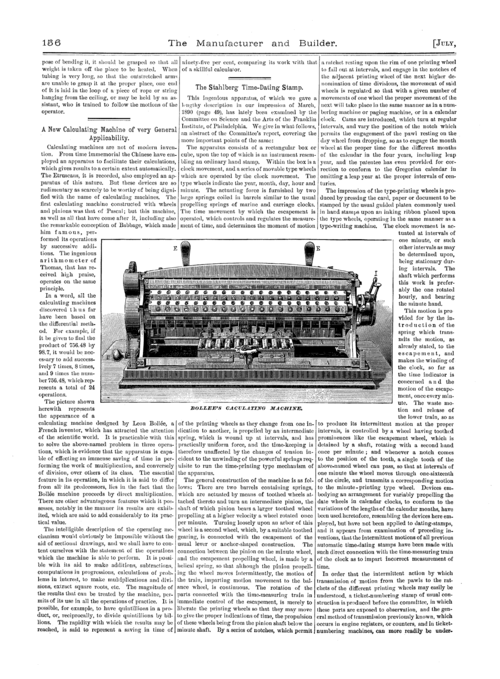
    This was a surprise, finding M. Bollee’s article (Sur une nouvelle machine a calculer) in this 1889 Comptes Rendus, pecking around in that big 10-pound volume looking for something else.  It was very easy to miss if you weren’t looking for it, just a few pages long in a 1000-page book.  But there it was, nestled comfortably in pp 737-739.  It these few pages Bollee describes his machine and with particular reference to his innovative approach to direct multipilication–a fine addition (ha!) to the long line of contributions by Babbage and Clement, Scheutz, Wiberg and Grant and Hamann. Bollee’s device would be more popularly remembered in its incarnation in the 1890’s as the relatively popular device named “The Millionaire”.  


    An image of the machine from The Manufacturer and Builder:

    Bollee

    See:  the Making of America, http://digital.library.cornell.edu/cgi/t/text/pageviewer-idx?c=manu;cc=manu;rgn=full%20text;idno=manu0022-7;didno=manu0022-7;view=image;seq=0162;node=manu0022-7%3A21


    ·Posted by :

    ·in:


  • The Abdank-Abakanowicz Integrator, 1881-2

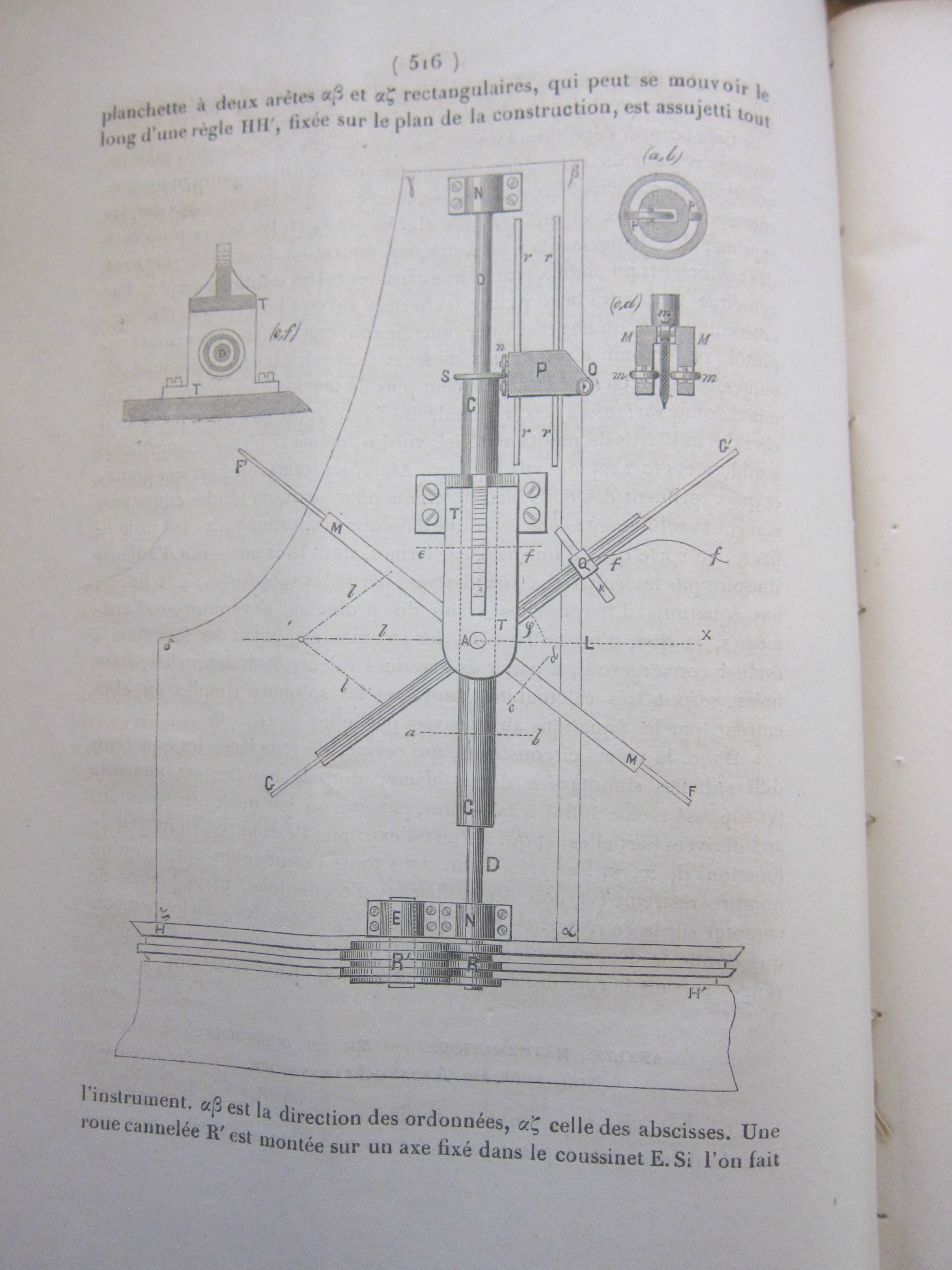
    Bruno Abdank-Abakanowicz, “Sur un integrateur. instrument servant a l’integration graphique”, vol 92, no. 8, 21 February 1881, pp 402-405 in the issue of pp 373-428;Four papers developing his analytical calculating and graphing instrument in three different numbers of the Comptes Rendus (vols 92, 94, and 95), as follows, with the three papers from volumes 92 and 95 offered with their original wrappers.  All four papers are disbound from a larger bound volume. GOOD-VERY GOOD condition.   SOLD

    _____. “Sur un integrateur. instrument servant a l’integration graphique”, vol 92, no. 10, 7 March 1881, pp 515-519 in the issue of pp 482-538;

    _____. “Sur l’integration mechanique”, vol 94, no. 12, 20 March 1882, pp 783-785 in the issue of 753-816;

    _____. “Sur un nouvel integrometre”, vol 95, no. 22, 27 November 1882,  pp 1047-1048 in the issue of pp 1017-1076.

    “Integraph, mathematical instrument for plotting the integral of a graphically defined function. Two such instruments were invented independently about 1880 by the British physicist Sir Charles Vernon Boys and the Lithuanian mathematician Bruno Abdank Abakanowicz and were later modified and improved by others. The integraph draws the graph of the integral as the user traces the graph of the given function.”–Encyclopedia Britannica

    “William Thomson. Lord Kelvin, had the powerful idea of using analog computing mechanisms tied together to solve a differential equatioms. Ten years later, AbdankAbakanowicz built an “integraph.” which had the purpose of solving one particular differential equation. Thomson’s idea was the conception of differential analyzers. which. however. did not become a practical reality until the 1930s with the work of V. Bush.’ Lord Kelvin also invented a pulley device for solving simultaneous equatioms Larger versions were built by MIT professor Wilbur in 1934 and 1935.–AB Clymer, “The mechanical analog computers of Hannibal Ford and William Newell”, IEEE Annals of the History of Computers, 15/2

    “The mechanical integraph is a noteworthy development in the history of calculating instruments, for it represents an early, albeit limited, analog approach to the solution of differential equations. It is worth noting that it was the need to solve partial differential equations with rapidity and accuracy that ultimately led to the development of the ENIAC…The integraph is an elaboration and extension of the planimeter, an earlier, simpler instrument used to measure area. It is a mechanical instrument capable of deriving the integral curve corresponding to a given curve. Hence, it is able to solve elementary differential equations graphically. Abdank-Abakanowicz concentrated on developing his integraph for several years. However, it was not until 1878 that he succeeded in developing a practical working model.”–from the Erwin Tomash Library site

    Also see H. Morin, Les appareils d’intégration: intégrateurs simples et composés; planimètres; intégromètres; intégraphes et courbes intégrales; analyse harmonique et analyseurs,pp 136-141, for descriptions of the Abdnak-Abakanowicz machines (as referred by Tomash). The full text of the Morin is found on the Cornell University classic maths books site.  


    Abdank intergrator _1_

    ·Posted by :

    ·in:


  • A Great Classic in the History of Superconductivity–the BCS THeory

    Bardeen, J.L., L.N. Cooper, and J.R. Schrieffer. “Theory of Superconductivity” in the Physical Review, volume 108, Number 5, 1957, p.1175-1204 in the issue of pp 1357-1682, in the bound volume for #108, pp 913-1696, for November-December 1957. In a sturdy and attractive red cloth. Provenance: National Bureau of Standards Library, with their name gilt stamped on the spine bottom. save for some remnants of the paper spine label, this is a lovely, fresh copy. Offered with the issues # 4, 5, and 6 bound together, with their original wrappers bound in at the end. Each wrapper cover has a somewhat faded and small rubber stamp of the NBS $750 . 

    The Nobel Prize in Physics 1972 was awarded jointly to John Bardeen, Leon Neil Cooper and John Robert Schrieffer “for their jointly developed theory of superconductivity, usually called the BCS-theory”, a classic foundation paper of superconductivity and referenced some 13,000+ times.

    “The Bardeen-Cooper-Schrieffer theory (BCS), published in July 1957, proved to be the triumphant solution of the problem which for four and a half decades had stumped all the best theorists in the world.”–Dictionary of Scientific Biography

    “BCS theory or Bardeen–Cooper–Schrieffer theory (named after John Bardeen, Leon Cooper, and John Robert Schrieffer) is the first microscopic theory of superconductivity since Heike Kamerlingh Onnes’s 1911 discovery. The theory describes superconductivity as a microscopic effect caused by a condensation of Cooper pairs into a boson-like state. The theory is also used in nuclear physics to describe the pairing interaction between nucleons in an atomic nucleus.”–Wikipedia

    “BCS theory, in physics, a comprehensive theory developed in 1957 by the American physicists John Bardeen, Leon N. Cooper, and John R. Schrieffer (their surname initials providing the designation BCS) to explain the behaviour of superconducting materials. Superconductors abruptly lose all resistance to the flow of an electric current when they are cooled to temperatures near absolute zero.” Encyclopedia Britannica

    “The turn in the team’s work on superconductivity came in the last days of January 1957, soon after Bardeen returned from Stockholm. While riding on a subway in New Jersey, Schrieffer wrote down a promising expression for the superconducting ground state wave function. Recognizing the implications, Bardeen moved the team into an intense period of work in which the three feverishly computed all the relevant experimental quantities, including the energy gap and the second-order phase transition. The Bardeen-Cooper-Schrieffer theory (BCS), published in July 1957, proved to be the triumphant solution of the problem which for four and a half decades had stumped all the best theorists in the world.”–Dictionary of Scientific Biography

    See also the very extensive BCS 50 Years by Leon Cooper and D. Feldman, from World Scientific. (Cooper recalls, for example, that when John Bardeen was looking for a post doc to work with him on superconductivity in 1955, that he had never heard of superconductivity before.)

    Also: Lillian Hoddeson, “John Bardeen and the Theory of Superconductivity: A Study of Insight, Confidence, Perseverance, and Collaboration”,  October 2008, Volume 21, Issue 6, pp 319–327|  Journal of Superconductivity and Novel Magnetism.

    ·Posted by :

    ·in:


  • Part of a Busy Year for John Bardeen

    BARDEEN, J. “Electron-Vibration Interactions and Superconductivity.” APS, 1951. 1st edition. Reviews of Modern Physics 23/3, July 1951.

    Original printed wrappers. Fine condition. $150

    This was a busy year for Bardeen, publishing a number of papers on this topic, though almost entirely in the Phys Rev. Other contributors here include Walter Brattain (Copper Oxide Rectifier), George Breit (Topics in Scattering Theory) and JH Van Vleck (Angular Momentum). 

    ·Posted by :

    ·in:


  • “The earliest paper that seems to have a direct bearing on the development of the transistor…” 1947

    Bardeen, John. “Surface States and Rectification at a Metal Semi-Conductor Contact”, in the Physical Review, volume 71, number 10, 717-735 in the issue of pp 649-743 (1947). Original wrappers, original owner’s surname on the front wrapper at upper left. Fine copy.  $500

    • “The earliest paper that seems to have a direct bearing on the development of the transistor…which was followed by the two letters reporting verification of the predictions of the theory…” [these located in Physical Review, 72, 845 (1947)].–George L. Trigg, Landmark Experiments in Twentieth Century Physics, p 153, bibliography for the chapter on the transistor.

    ·Posted by :

    ·in: