A Daily History of Holes, Dots, Lines, Science, History, Math, Physics, Art, the Unintentional Absurd, Architecture, Maps, Data Visualization, Blank and Missing Things, and so on. |1.6 million words, 7500 images, 4.9 million hits| Press & appearances in The Times, Le Figaro, Mensa, The Economist, The Guardian, Discovery News, Slate, Le Monde, Sci American Blogs, Le Pont, and many other places… 5000+ total posts since 2008.

Book Category: Computing History

  • Computer History: Five Papers by Gordon K. Teal, Transistor Pioneer

    Five Papers by Gordon K. Teal (the extent of his publications in the Physical Review)

    • “[Teal] is best known for the results of his research in germanium and silicon and in particular for the preparation of the first high-purity, high-perfection, single-crystalline germanium for transistor use. He was a co-developer of the first junction transistor. As stated by W. Shockley…’There was probably no more important scientific development in the semiconductor field in the early days following the announcement of the transistor than the development of high-quality single crystals of germanium at Bell Telephone Laboratories’.” “Best known developments under his direction are the first commercial silicon transistor (1954) and a chemical reduction process for ultra-pure silicon (1957). According to opinions summarized in Fortune (November 1961), “The silicon transistor was a turning point in TI’s [Texas Instruments’] history. . . . TI sales rose almost vertically; the company was suddenly in the big leagues.” –Engineering and Technology Wiki (Gordon Teal)
    • “He invented a method of applying the Czochralski method to produce extremely pure germanium single crystals used in making greatly improved transistors. He, together with Morgan Sparks invented a modification of the process that produced the configuration necessary for the fabrication of bipolar junction transistors. He is most remembered for developing the first silicon transistor while at Texas Instruments.”–Wikipedia
    (1) W. Shockley, M. Sparks, and G. K. Teal. “p−n Junction Transistors”. Physical Review, 83, 151 (1951), 1 July 1951. Offered in the full volume 83, July-September 1951. Each issue with their original wrappers bound in at rear. Fine copy.

    ABSTRACT: “The effects of diffusion of electrons through a thin p-type layer of germanium have been studied in specimens consisting of two n-type regions with the p-type region interposed. It is found that potentials applied to one n-type region are transmitted by diffusing electrons through the p-type layer although the latter is grounded through an ohmic contact. When one of the p−n junctions is biased to saturation, power gain can be obtained through the device. Used as “n−p−n transistors” these units will operate on currents as low as 10 microamperes and voltages as low as 0.1 volt, have power gains of 50 db, and noise figures of about 10 db at 1000 cps. Their current-voltage characteristics are in good agreement with the diffusion th

    This volume also contains:

    (2) H. J. McSkimin, W. L. Bond, E. Buehler, and G. K. Teal,. “Measurement of the Elastic Constants of Silicon Single Crystals and Their Thermal Coefficients”, in Physical Review.  83, 1080 (1951), 1 September 1951

    (3) F. S. Goucher, G. L. Pearson, M. Sparks, G. K. Teal, and W. Shockley, “Theory and Experiment for a Germanium p−n Junction”, Phys. Rev. 81, 637 (1951), 15 February 1951

    This issue also contains:
    (4) G. K. Teal, M. Sparks, and E. Buehler, “Growth of Germanium Single Crystals Containing p−nJunctions”. Offered in the full volume 81, January-March 1951, 1096pp. Each issue with their original wrappers bound in at rear. Fine copy. 
    (5) W. L. Bond, W. P. Mason, H. J. McSkimin, K. M. Olsen, and G. K. Teal, “The Elastic Constants of Germanium Single Crystals”, Physical Review,  78, 176 (1950), 15 April 1950. Offered in the original green wrappers. Very Good copy.

    The set of papers: $500
    ·Posted by :

    ·in:


  • An Early and Full Computing Bibliography by a Computing Pioneer, 1954

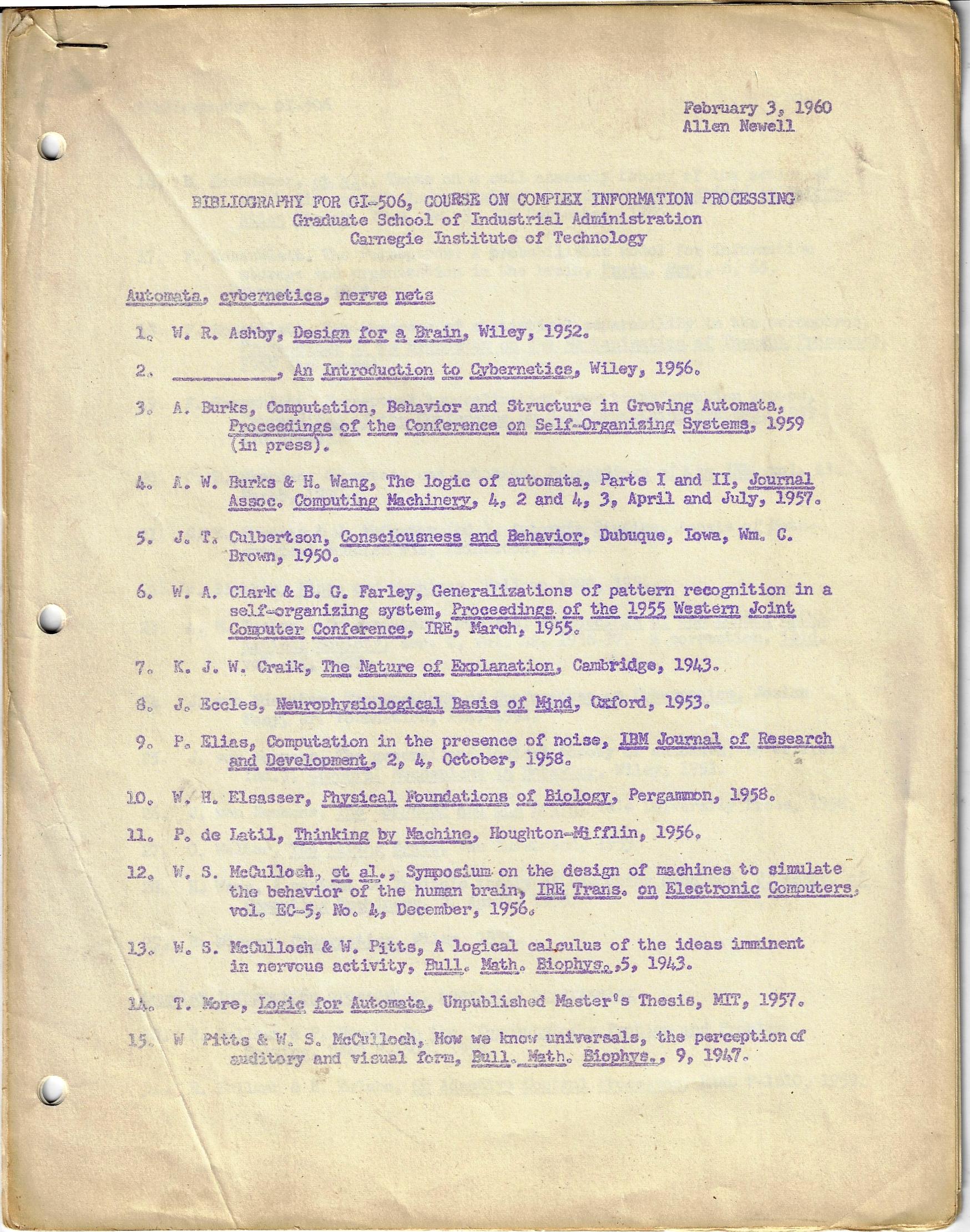
    (Allen Newell) “Bibliography for GI-506, Course on Complex Information Processing, Graduate School of Industrial Administration, Carnegie Institute of Technology”, February 3, 1960. 11×8.5″, mimeographic product, 12pp, This document is a rather full bibliography of 191 items, which for my reading through this period is pretty impressive.  Staple-bound, three-ring punched. Scarce.  SOLD


    Newell

    “Allen Newell (1927 – 1992) was a researcher in computer science and cognitive psychology at the RAND Corporation and at Carnegie Mellon University’s School of Computer Science, Tepper School of Business, and Department of Psychology. He contributed to the Information Processing Language (1956) and two of the earliest AI programs, the Logic Theory Machine (1956) and the General Problem Solver (1957) (with Herbert A. Simon)…[He founded] the artificial intelligence laboratory at Carnegie Mellon University and produced a series of important programs and theoretical insights throughout the late fifties and sixties.” –Wiki

    Some of the awards bestowed on Allen Newell include:

    • 1975 — A. M. Turing Award (with Herbert A. Simon), Association for Computing Machinery for their basic contributions to artificial intelligence and the psychology of human cognition

    • 1976-77 — Guggenheim Fellowship, John Simon Guggenheim Memorial Foundation

    • 1980 — First President, American Association for Artificial Intelligence

    • 1981 — Charter recipient of the Computer Pioneer Award from the IEEE Computer Society


    ·Posted by :

    ·in:


  • A Great Second Volume of the First “Popularly-Published Computer Magazine (1953)

    Computers and Automation, published by Edmund C. Berkeley & Associates, NYC. 10.75×8.25″, 8 issues for 1953, complete. 338pp, illustrations, advertisements.  Bound in cloth. Provenance: U.S. Air Force AEDC Library, and then the Library of Congress. Tight copy, with a few internal stamps from the USAF and a LC surplus/duplicate rubber stamp/ VG copy. Includes significant contributions by G.M. Hopper, E. Berkeley, George Boehm, Fletcher Pratt, and many others.  Scarce.  SOLD

    Computers and Automation, the brainchild of Edmund Berkeley, was the first popularly-published  magazine published regarding the computer, its applications, it programming, and really just about everything else.  (It appeared seven years after the Mathematical Tables and Aids to Computation  was published in 1943, almost entirely to the mathematics and engineering communities.) CAC was published by Edmund Berkeley & Associates in NYC, beginning its publishing journey as The Computing Machinery Field, its name changing to Computers and Automation in February 1953 (in volume 2, number 2).   All issues have some fair space devoted to advertising, even though the issues generally ran between 32 and 40pp. Berkeley was a  mathematician, engineer and computer pioneer, but he also had a pretty large taste for making these interests pay–which was essential, as the original prxcint runs were not very large, though his advertisers were impressive. (According to the first issue, approximately 1200 people were on the mailing list for the journal, with around 2000 issues being printed each number. All told, this is not a large print run, and thus not many of the early issues have survived.)  He was not averse to being somewhat outre with his journal—in addition to having contributors like Grace Hopper and Alton Householder, he also had Fletcher Pratt and Isaac Asimov writing some pretty arresting pieces from the SciFi/Futurama point of view.    

    Computer history083

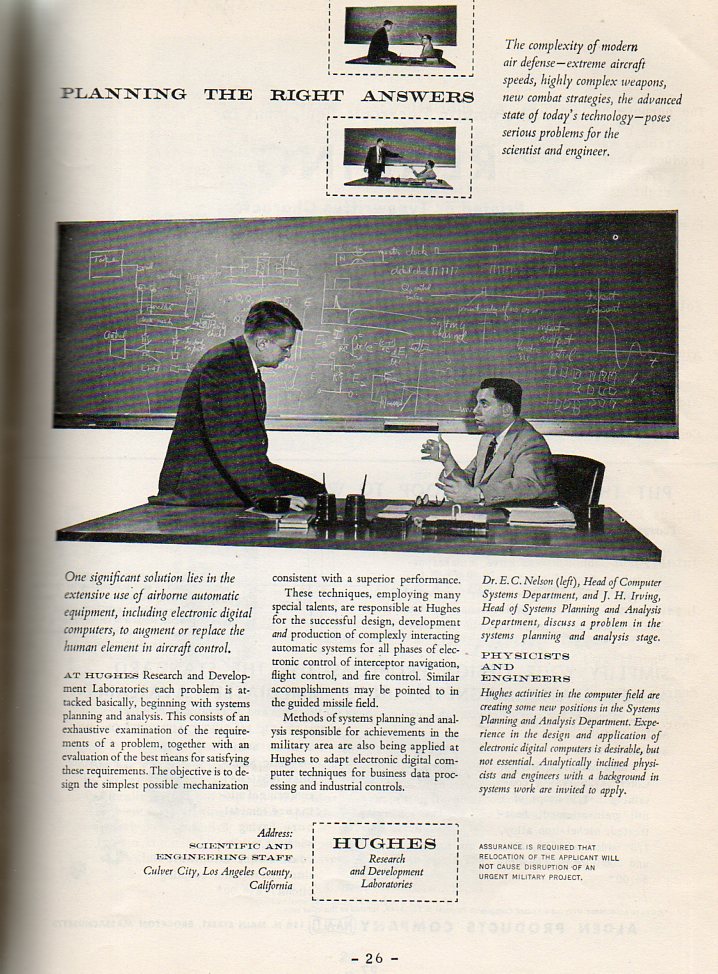
    A Note on the Advertisements: in short, they’re wonderful. For example, on the back cover of vol2/1 is Edmund Berkeley & Associates “SMALL ROBOTS”, advertising “Simon, the Mechanical Brains”, “Squee, the Robot Squirrel”, and other gadgets. To give you an example the other ads in this issue alone are for “The Circle Computer”, “General Ceramics Ferramic Cores”, “Magnetic Metals Co. Amplifier Cores”, Ross Ashby’s “Design for a Brain”, Consolidated Engineering’s SADIC System, Monroe Calculator’s Monrobot Electronic Calculator, George Philbrick’s “Computor (sic) products”, and a lovely two-page spread for Remington Rand. Further into the year are ads for Burroughs, IBM (604 ands 607), Electronic Associates Inc, Prokar capacitors, and many others.

    Some of the subjects include: The ERA 1103 computer, NIMWIT, Applications of the Computer, what the computer *is*, Admiral Grace Murray Hopper’s compiler, mechanical translation, Harper’s subroutines, the cost of coding, computer “self-repair”, automation at Ford, and so on.  Also includes perhaps the earliest announcement of the first all-transistor computer (October 1954, IBM’s “new experimental transistorized computer” , the earliest (?) printing of Asimov’s Three Laws of Robotics in a scientific journal, and more.

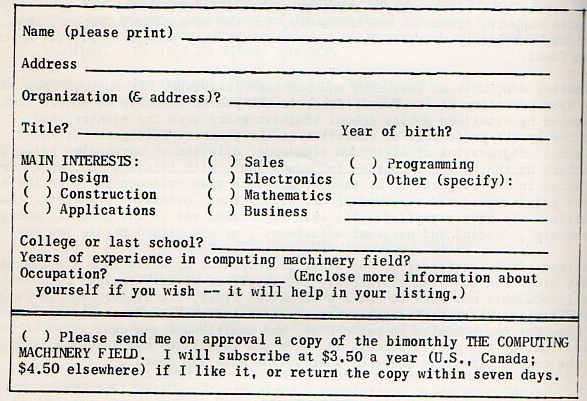
    Each section generally has three of the following categories (per issue) : computer glossary, roster of member organizations, who’s who, an annotated books and journal section, and other aligned concerns.  For example, there’s this bit, an application (cut-out) card for “Who’s Who in the Computing Field for December 1952”–utterly simple, it seems as though anyone who filled out the card was in, the “who’s who” part of this that we normally celebrate with fame or achievement really was just telling the rest of the people in the field who was exactly who.

    Computer history084

    The contents:

    Volume 2/1, January 1953. 45pp.

    Householder, A.S. Brains, Electronic and Otherwise; Williams, S.B. (President, ACM) What Computers Do; Murphy, E.F. and E.C. Berkeley. Automatic Computers on Election Night.

    Volume 2/2 , March 1953. 37pp.

    Boehm, George A.W. Gypsy, Model VI, Claude Shannon, Nimwit and the Mouse; Paynter, Henry. Water and Computers; and the editor Berkeley, The Concept of Automation, and Berkeley (with Neil Macdonald, Berkeley’s other name). The ERA 1003 Automatic Computer

    Volume 2/3, April 1953. 40pp.

    Fletcher Pratt, The Art of Solving Secret Ciphers and the Digital Computer; Berkeley, Avenues for Future Development in Computing Machinery;  Gene Hegedus, Hungarian Prelude to Automation..

    Volume 2/4. May 1953. 33pp.

    Grace Murray Hopper,  Compiling Routines; A.D. Booth, Mechanical Translation; Marshall Stone,  Medical Diagnosis.

    Volume 2/5. July 1953.

    Yehosuha Bar-Hillel (the great logician),  Machine Translation; George Boehm, Robot Traffic Policemen; Rudolf Flesch,  How to Talk to Computers.

    Volume 2/6. September 1953.

    Tommaso Fortuna,  The Soviet Union: Automatic Digital Computer Research.; Wainwright, Lawrence Wainwright,  Digital Computer Questionnaire; and a general DISCUSSION: “How to Talk About Computers”, with GG Hawley, Samuel Scharff, C.B. Crumb, and EC Berkeley.

    Volume 2/7. October 1953. 36pp.

    Brown, David W. Brown Computers in the Factory; Neil (Berkeley) Macdonald,  The Flood of Automatic Computers. 

    Volume 2/8. November 1953. 40pp.

    John W.Carr  III. Who Will Man the New Digital Computers?; E.F. Cooley,  Electronic Equipment Applied to Periodic Billing; Glenn.Hagen,  Air-Floating: a New Principle in Magnetic Recording of Information.

    Volume 2/9 December 1953. 36pp.

    Clippinger, Richard Clippinger, How a Central Computing Laboratory can Help Industry; R.T. Wiseman, “Combined” Operations in a Life Insurance Company instead of “fractured operations”.

    These are the contents for 1953; the volume for 1954 bulks up a little, but is still under an inch thick.   The MTAC journal stays quite slender throughout its pre-1960 life (it has virtually no advertisement and is entirely academic), and there are more and more computer articles appearing in old stand-by associated journals like the Proceedings of the Institute of  Radio Engineers (which by 1959 will published a massive supplemental volume called “the Computer Issue” which I’ll talk about soon.  For the time being, I just wanted to make an inroad into this journal–I’ll expand on he articles in just a bit. 

    ·Posted by :

    ·in:


  • On the Mechanical Handling of Statistics, 1926

    Victor Johns, “On the Mechanical Handling of Statistics”, an article in The American Mathematical Monthly, volume XXXIII, Number 10, December 1926.  Published by the Mathematical Association of America. 

    • The article occupies pp 494-502, with 10 small text photo illustrations of tabulating machines, and appears in the issue of pp 485-544.  Offered in the original printed wrappers. There is a small previous owner’s name rubber stamp on the top of eh front wrapper (F.A. Brandner”). A reference to this paper appears (with a short abstract) in B. Randall’s The Origins of Digital Computers: Selected Papers, as “an illustrated account of punched card machinery”. Also noted on pg 313 of James W. Cortada’s Before the Computer: IBM, NCR, Burroughs, and Remington Rand…

    Very Good condition.SOLD

    ·Posted by :

    ·in:


  • Soem Work by the Discipline-Bending Nicholas Rashevsky

    RASHEVSKY, Nicholas.  “Mathematical Biology of Learning to Drive and Automobile”, in the Bulletin of Mathematical Biophysics, March, 1963, volume 25/1, pp 51-9, offered in the monthly issue of pp 1-123. Original wrappers. VG copy. SOLD

    _____.  “The Geometrization of Biology”,  in the Bulletin of Mathematical Biophysics, volume 18/1, pp 31-57.  In the full monthly issue of 87pp.  Formerly from the library of the Committee on Mathematical Biology, University of Chicago,(mostly blacked-out with magic marker on the front wrapper) the publishers of the Bulletin. This was H.D. Landahl’s copy, with his name at top front wrapper.  SOLD

    _____.  “Mathematical Biophysics of Growth”, in The Bulletin of Mathematical Biophysics, volume 1, number 3, September 1939, pp 119-128 in the monthly issue of pp 119-149. Original wrappers. Very nice copy; there’s a tear in the upper third wrapper spine. This is a scarce copy of the publication in the original (white) wrappers.  SOLD

    ·Posted by :

    ·in:


  • Early Paper on the Use of Commercial Calculators to Scientific Computing (1946)

    COMRIE,  Leslie.  “The Application of Commercial Calculating Machines to Scientific Computing”.  Washington DC:  National Research Council,  1946.  1st edition.  Mathematical Tables and other Aids to Computation, II/16  Pp 149-196  8vo.  Original printed wrappers.  Very good condition.  Original owner’s name has been rubber stamped twice on the cover.  $250

    Comrie MTAC449

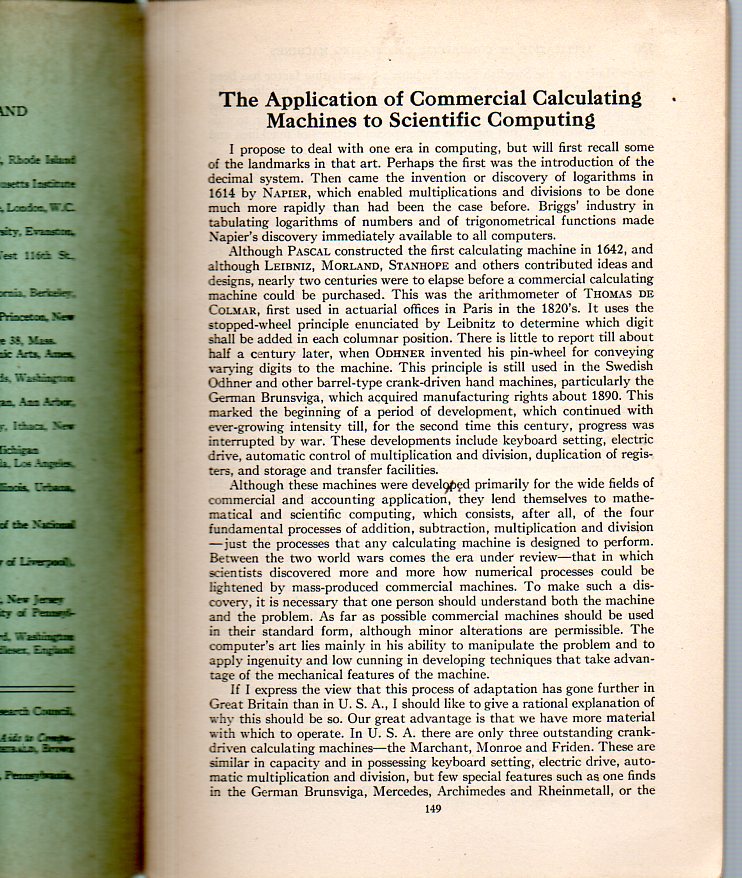
    This pamphlet is offered in its original green wrappers for the month of October 1946.  “Comrie pioneered the use of commercial accounting machines in scientific applications, especially in the production of mathematical tables. The above article describes the first use of a punched-card tabulating system in a purely scientific application. The following on Comrie from Columbia University: Leslie J. Comrie, Ph.D, (1893-1950): astronomer and pioneer in mechanical computation, born in Pukekohe, New Zealand, and educated at Auckland University College, University College London, and Cambridge University, where he received a Ph.D. in astronomy.  Like his American contemporary, Columbia University Astronomy Professor Wallace Eckert, Comrie was a pioneer in the application of punched-card machinery to astronomical calculations and the production of astronomical and mathematical tables: the first scientific use of these machines, which had been designed purely for business use.”

    ·Posted by :

    ·in:


  • Early paper on his educational/interactive machines (1964)

    PASK, Gordon.  “Adaptive Teaching Systems and a Minima, Cybernetic Model for Designing Them”, in Cybernetica, vol 7 #2, Namur, 1964, pp 125-143 (with numerous illustrations) in the issue of pp (73)-143. Nice sharp copy, with the original wrappers, this removed from a larger bound volume, and so there is no cover to the spine. Very good copy.  $150  Early paper on his educational/interactive machines.   

    “Dr. Pask received his M.A. in Natural Sciences at Cambridge in 1952, and his Ph.D. in Psychology from London University in 1964. He founded System Research Ltd. in Richmond, Surrey, England, an institute devoted to the study of adaptive teaching machines and self-organized learning systems. He has held a number of positions including Research Director of System Research Ltd.; Professor in the Institute of Cybernetics, Brunel University; Associate Professor: University of Illinois, University of Mexico, Georgia Institute of Technology, University of Oregon, and Open University. He has also served as Consultant, Solartron Electron Ltd.; and Member of Editorial Board, International Journal of Man-Machine Studies.”–Cybnerticians, from the George Washington University website, here.

    ·Posted by :

    ·in: