A Daily History of Holes, Dots, Lines, Science, History, Math, Physics, Art, the Unintentional Absurd, Architecture, Maps, Data Visualization, Blank and Missing Things, and so on. |1.6 million words, 7500 images, 4.9 million hits| Press & appearances in The Times, Le Figaro, Mensa, The Economist, The Guardian, Discovery News, Slate, Le Monde, Sci American Blogs, Le Pont, and many other places… 5000+ total posts since 2008.

Book Category: Computing History

  • An Early Appearance of an Applied Hexadecimal System (1863)

    John Nystrom, “A New System of Arithmetic and Metrology, called the Tonal System”, pp 263-275, 337-348, 402-407 (concluded), and illustrated, including a folding plate. In Journal of the Franklin Institute, third series vol 46 overall vol 76, July-December 1863, 432pp. Half-calf and marbled boards. The spine is rubbed, and the corners of the boards are quite worn. The text is bright and crisp—overall, this is a GOOD copy. $250
    Nystrom 1863 _3_

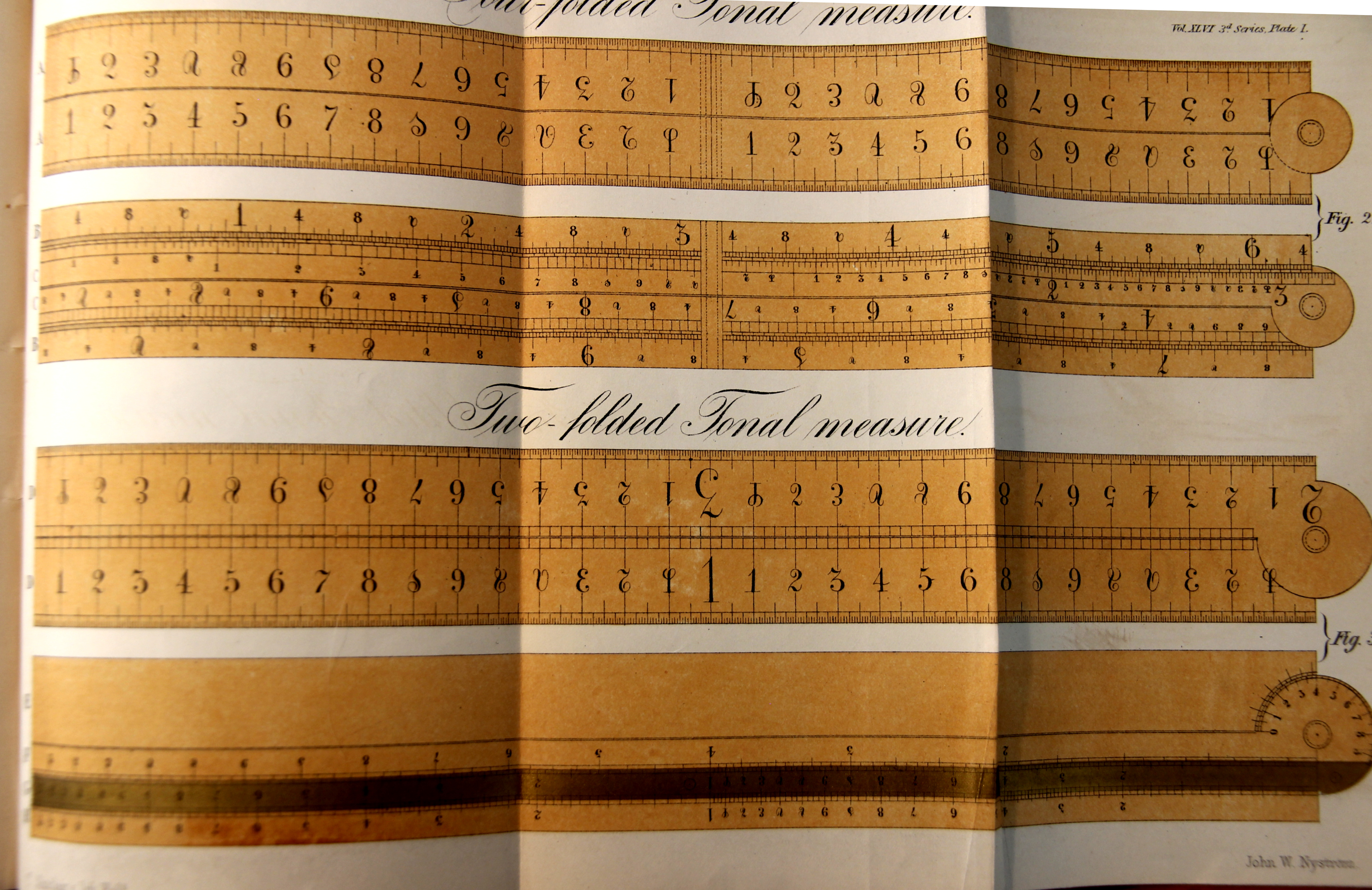
    This is a very early entry in the history of the application of the hexadecimal system. Nystrom’s plan included converting to a hex arithmetical system, and then expanded the idea to the calendar, musical notation, geography, time—an overall shift in metrology. His idea did not extend to calculators, and his name does not seem to be referenced by any of the modern compsci folks (with the major exception of Donald Knuth). Probably base-16 was not employed in programming until, I guess, around the early 1960’s. All that said, this is still a remarkable paper. ALSO: the paper is illustrated with a beautiful color-highlighted folding plate of divider-like instruments that translated hex to denary.

    “John Williams Nystrom (Swedish: Johan Vilhelm Nyström) (1825–1885) was a Swedish born, American civil engineer, inventor, and author. He served as an assistant Secretary and Chief Engineer of the United States Navy during the American Civil War. Nystrom received many patents for inventions such as a marine steam engine, a refrigerator, and calculating machines…

    Nystrom is most notable for his proposal to switch from decimal to hexadecimal as defined in his 1862 publication titled . In 1859, Nystrom proposed a hexadecimal (base 16) system of notation, arithmetic, and metrology called the Tonal system. In addition to new weights and measures, his proposal included a new calendar with sixteen months, a new system of coinage, and a hexadecimal clock with sixteen hours in a day.”–Wikipedia
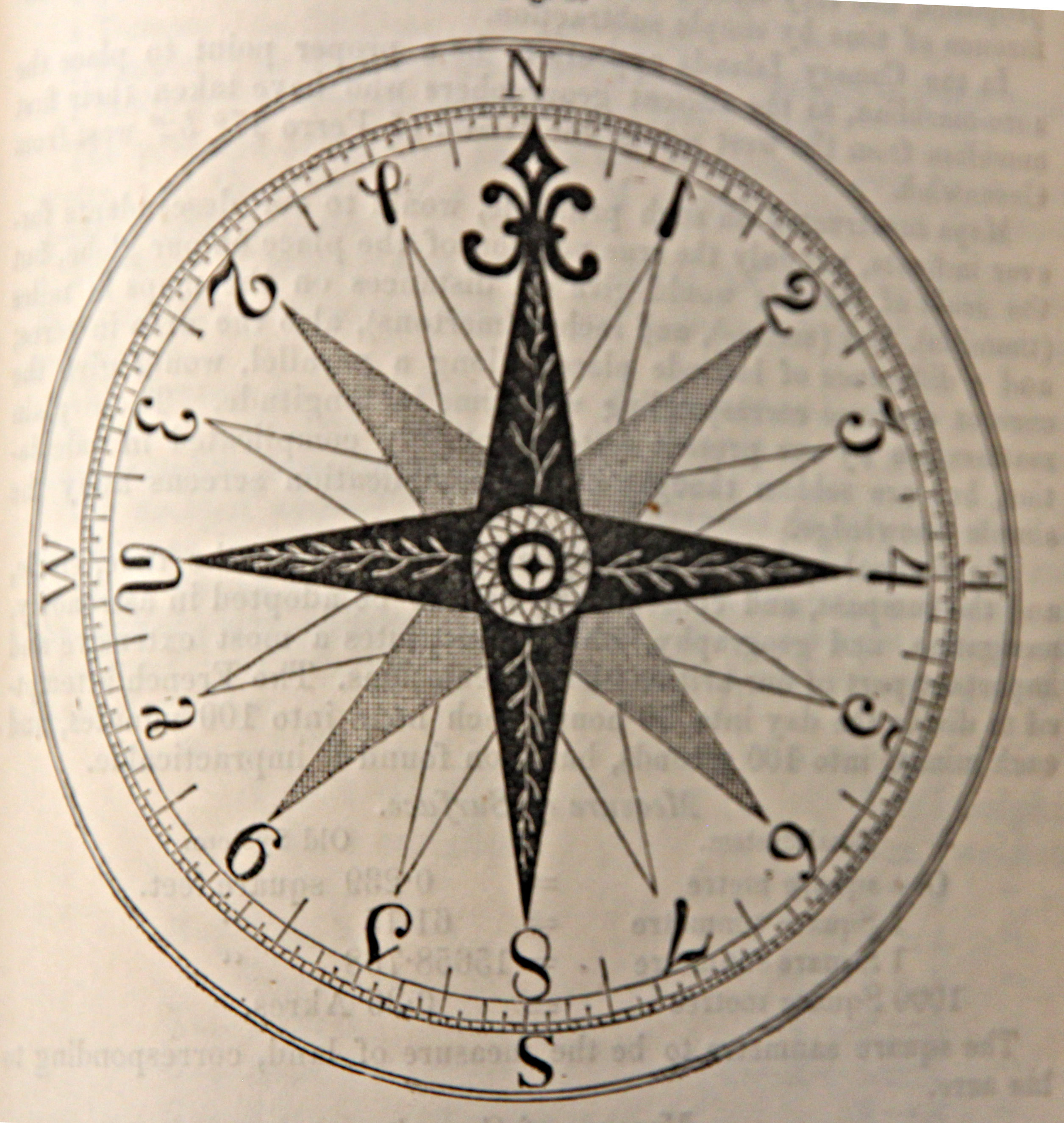
    Nystrom 1863 _3_

    (“Hexadecimal is a base/positional number system used in mathematics and computer science. … Hexadecimal is an easier way to represent binary values in computer systems because they significantly shorten the number of digits, as one hexadecimal digit is equivalent to four binary digits.”)

    “If the Arabic notation employed in our present decimal arithmetic had been suggested to Moses when he wrote the ten commandments on Mount Sinai he would surely have made similar remarks as that made on the tonal system that such curious looking characters could not be understood by his people….My manuscript on the tonal system has been sent to a great many places for publication The Franklin Institute thought it would have a very serious effect on the number of subscribers of their journal The Smithsonian Institute would not publish it because they had so much of the same kind before The US Coast Survey stated they would publish it if recommended by a member of Congress And lately the Society of Philadelphia has rejected it perhaps on the remarks herein replied to but Mr D recommended its publication.”–John William Nystrom, Project of a New System of Arithmetic, Weight, Measure and Coins: Proposed ...(1862)  (Quotation: John W. Nystrom, ca. 1863) The Art of Computer Programming section 4.1, Donald Knuth.
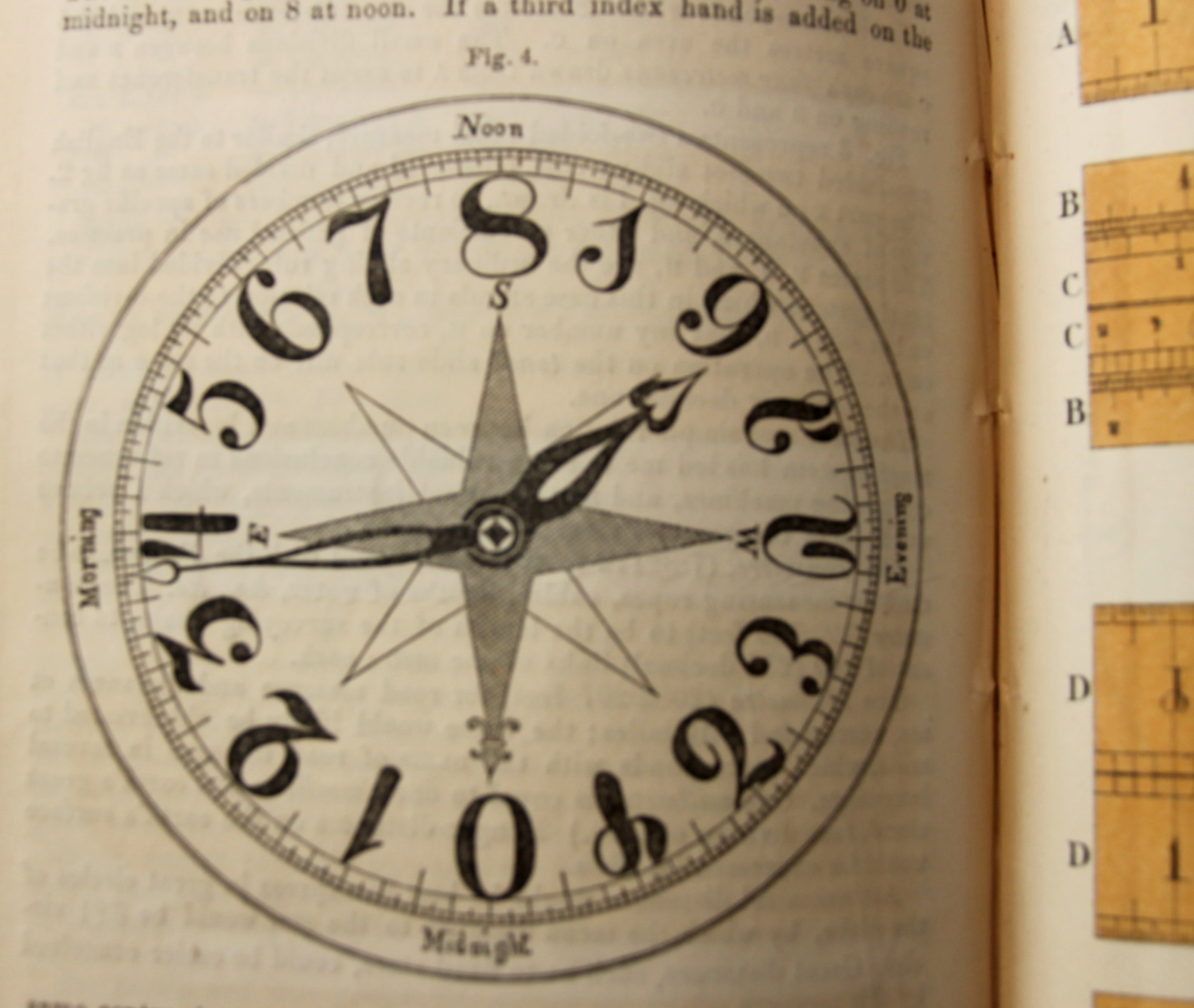
    Nystrom 1863 _3_

     “…a prominent Swedish-American civil engineer named John W. Nystrom decided to carry Charles XII’s plans [radix-8 arithmetic] a step further, by devising a complete system of numeration, weights, and measures based on radix-16 arithmetic. He wrote, “I am not afraid, or do not hesitate, to advocate a binary system of arithmetic and metrology. I know I have nature on my side; if I do not succeed to impress upon you its utility and great importance to mankind, it will reflect that much less credit upon our generation, upon our scientific men and philosophers.” Nystrom devised special means for pronouncing hexadecimal numbers; for example, (C0160)16 was to be read “vybong, bysanton.” His entire system was called the Tonal System, and it is described in J. Franklin Inst. 46 (1863), 263–275, 337–348, 402–407. A similar system, but using radix 8, was worked out by Alfred B. Taylor [Proc. Amer. Pharmaceutical Assoc. 8 (1859), 115–216; Proc. Amer. Philosophical Soc. 24 (1887), 296–366].

    On the Nystrom calculator: “In an article of Scientific American the device was hailed as the most important one ever brought before the public. Despite all of the accolades however, it was never widely accepted, and no more than 100 devices were ever produced. This may have been because the cost (there were $10, $15, and $20 models, a huge sum in 1850s), or because the instrument was never well advertised or marketed. –history-computer.com
    ·Posted by :

    ·in:


  • Marchant Calculators

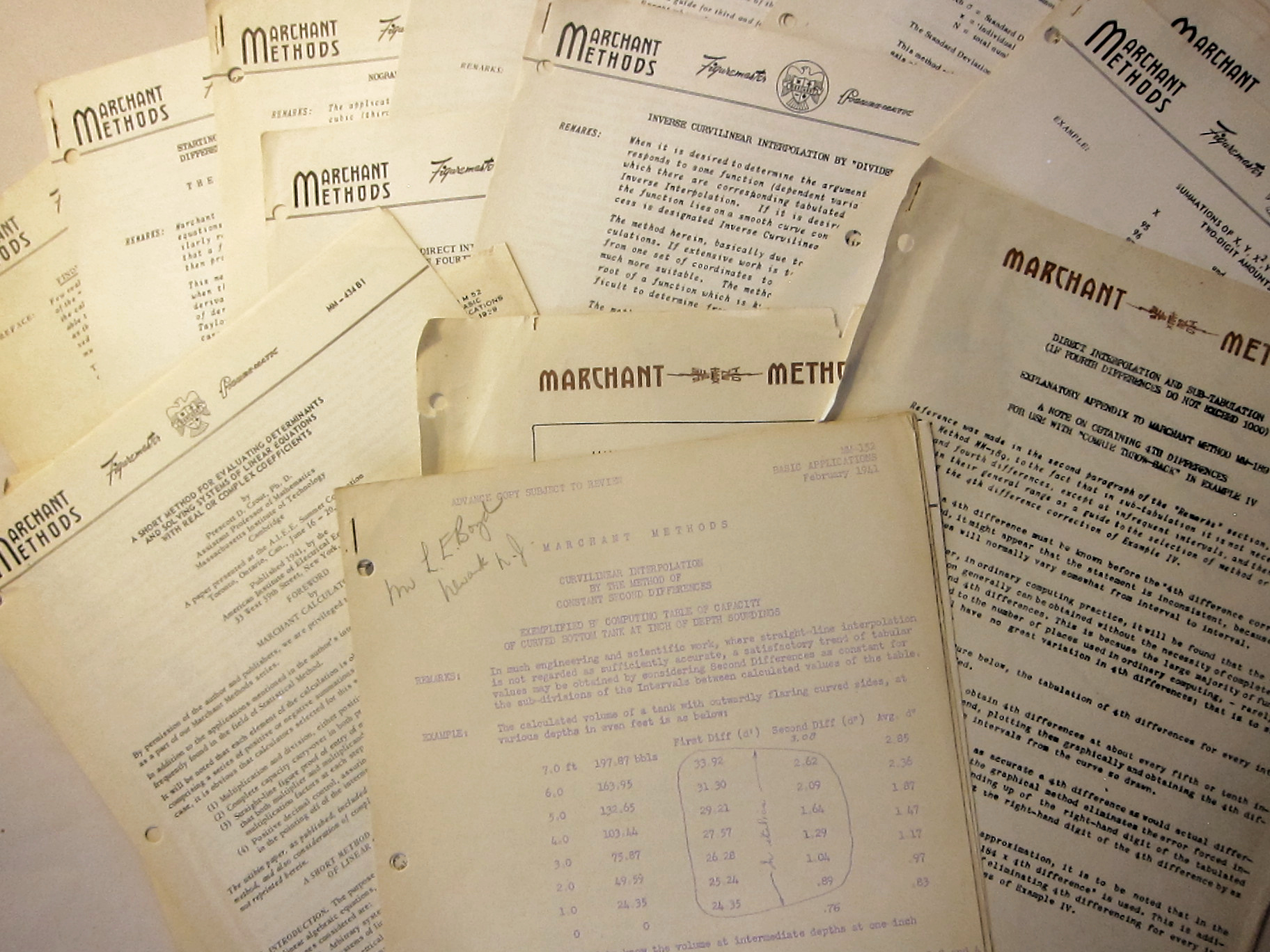
    Marchant Calculator materials. Marchant Methods. Figuremaster/Figurematic. Examples of the publication on the ins-and-outs and tricky bits, useful data, so on, for using the calculator to its fullest advantage.

    24 short publication, about 50pp all together. Only a few dates appear but they are all 1941–I suspect that the group is from this year or thereabouts.  The group:100.00

    Marchant Methods

    ·Posted by :

    ·in:


  • The Aritmometer, 1873

    THOMAS, Charles Xavier de Colmar.”The Arithmometer“, in Nature, August 21, 1873, pp 326-327, the weekly issue of pp 317-336, removed from a larger bound volume.  $150/.

    There is also a nice line drawing of the instrument, which appears here–in 1873–pretty much the way it looked when Thomas first began to make the thing back in 1820.  The big deal about the arithmometer is that it became the first mass-produced calculating machine when it entered into production in 1852–it was, basically, the birth of the calculating machine business. And not of course simply because of the mass production but because it was so reliable and dependable, and did the job. 

    Also in this issue: J. Herschel’s “The Flight of Birds” and Henry Proctor’s “The Origin of the Nerve Force”.  

    ·Posted by :

    ·in:


  • Games from 3C (ca. 1960)


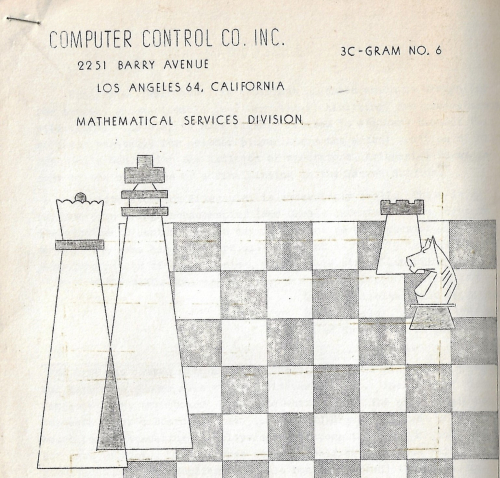
    Classic Games–Instruction manuals printed by Computer Control Co., Inc. (3C), of Los Angeles Ca., creators of the DDP series (of some fame) and in business from 1953-1966 until it was bought up and out. All are 11×8.5″, offset printed, and staple bound at top left. These publications were called “#C-Gram No. ___” . I have four of these and have no idea how many others there were, though there were at least six, as these are numbers ?, 2,3,6.  Included are: 
    “Spider”, 4pp; “NIM”, 4pp ;”Go”, 11pp; and “Kriegspiel”, 6pp. All are in about VG condition. Scarce bits of computer-related ephemera.  $75/all

    3C games


    ·Posted by :

    ·in:


  • An Electronic Simulation of Economic Systems, 1952

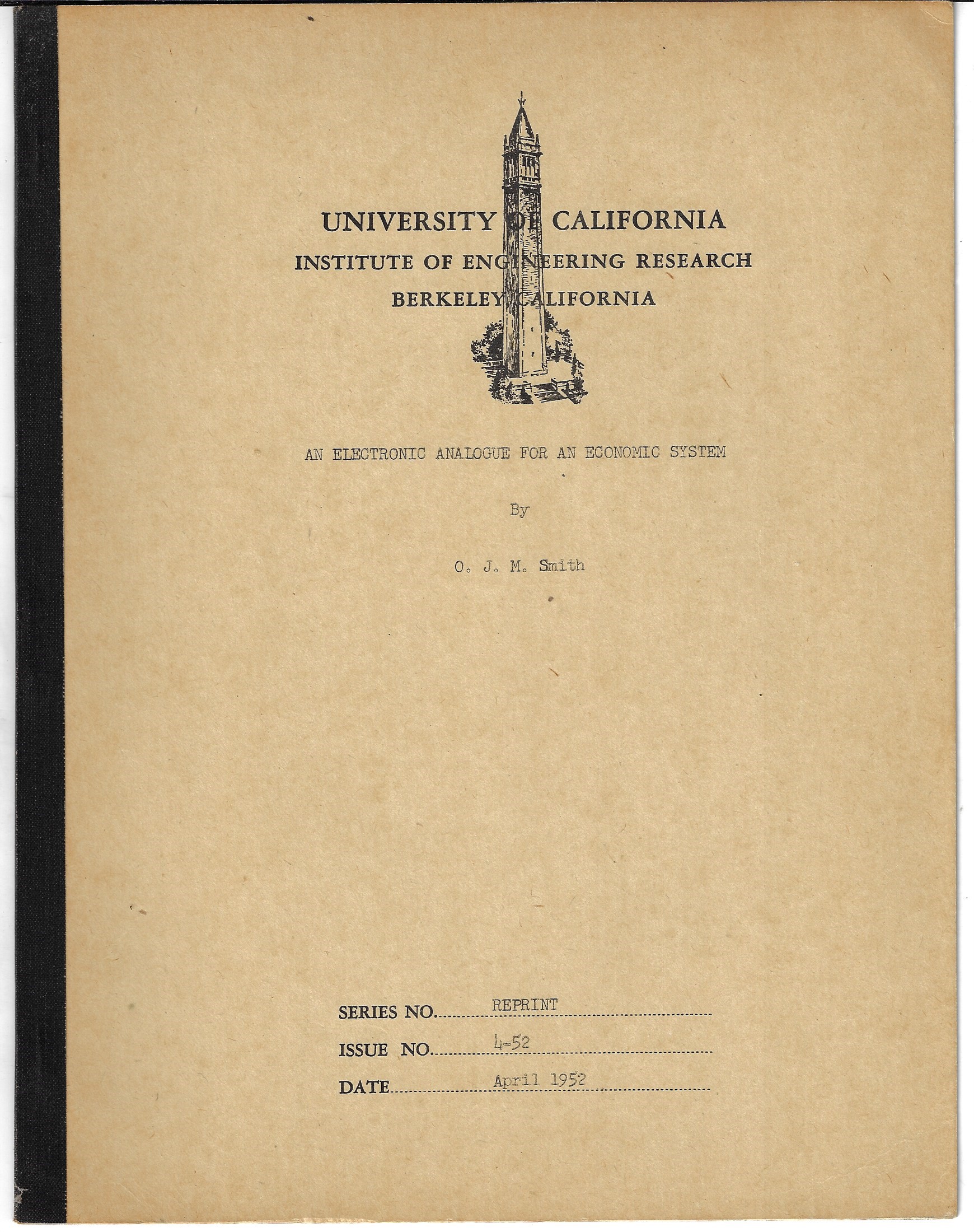
    Otto J.M. Smith, H.F. Erdley. “An Electronic Analogue for an Economic System.”  11×8″, 5pp. Stiff wrappers, with (original) cloth-adhesive spine cover. Fine copy. SOLD 

    • Reprint: Electrical Engineering ( Volume: 71 , Issue: 4 , April 1952 ) The cover reads: University of California, Institute of Engineering Research, Berkeley, California.

    Computer analogue economic “Abstract: A macrodynamical economic system is simulated with electronic circuits to study the effects of various parameters on stability. Included in the circuit are the delay between the investment of money and the production of goods, the time constant of depreciation, the distribution of manufactured goods, increase of capital goods, and national consumption.”

    “As early as 1892, Irving Fisher recommended the use of hydraulic analogies “not only to obtain a clear and analytical picture of the interdependence of the many elements in the causation of prices, but also to employ the mechanism as an instrument of investigation and by it, study some complicated variations which could scarcely be successfully followed without its aid” (1892, p. 44). It was not until 1950, however, that the first hydraulic analogues of economic systems were constructed. Phillips (1950) used machines made of transparent plastic tanks and tubes through which colored water was pumped to depict the Keynesian mechanism of income determination and to indicate how the production, consumption, stocks, and prices of a commodity interact. Electrical analogues were used to study models of inventory determination (Strotz et al. 1957) and to study the business cycle models of Kalecki (Smith & Erdley 1952), Goodwin (Strotz et al. 1953), and others.”–Encyclopedia dot com

    “Otto J.M. Smith A [long-time] professor at the University of California, Berkeley, developed the Smith Predictor in about 1957. His model-based control strategy enables a controller to predict the future effect of its present efforts and react immediately to those predictions.”–“Leaders of the Pack: From the plant to academia, InTech’s 50 most influential industry innovators”, by Jim Strothman, August 2003, ISA dot org See “Ways of Thinking, Ways of Seeing: Mathematical and other Modelling…” edited by Chris Bissell, Chris Dillon, chapter 7, “Visualizations for Understanding Complex Economic Systems”.

    ·Posted by :

    ·in:


  • The “Does-All” Computer Program, ca. 1962

    JF Ptak Science Books 

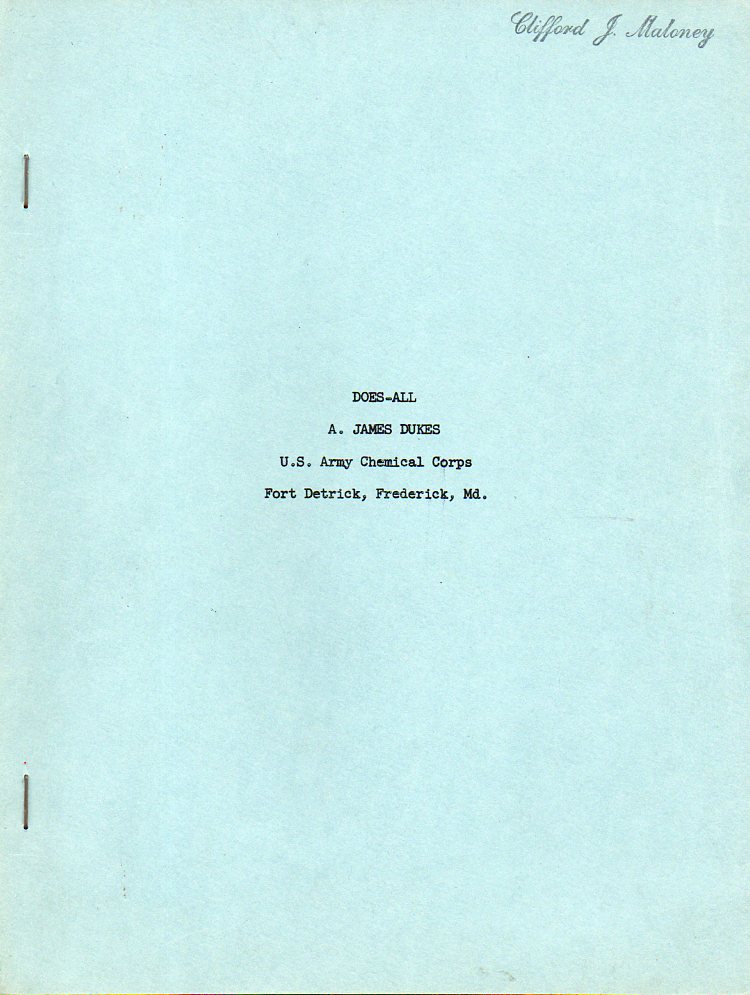
    Computer does-all916 A. James Dukes. Does-All.  U.S. Army Chemical Corps, Fort Detrick, Maryland.

    This 11×8 inch mimeographed/stapled publication does not have a date of publication, but as near as I can determine it was assembled in the early 1960’s.  It does mention several computers by name, the last of which,. the LARC, was suggested in 1960. 

    39pp(+3pp).  Fine condition. Rare. (No copies located in WorldCat.) $125

    There was no program called the “Does-All”.  This was an ironic suggestion for the name of a program to illustrate this rather lengthy introduction to computers (hardware and software) written by Mr. Dukes of the U.S. Army Chemical Corps at Fort Detrick. He has a very light pen and a good sense of humor, and writes with a great deal of clarity, and given the time period and his place of business (!) I’d say it was about the funniest intro to compsci that I’ve seen in the relatively early stuff. Dukes spends the first dozen pages or so on the hardware, with the remainder dedicated to writing programs–the writing is filled with insight and analogies.

    Charming, really.  

    Notes:

    Before it became more of a household name in popular movie culture Fort Detrick started out as Detrick Field (1931-1946), and then became Camp Detrick (1943-1956), and then on to Fort Detrick (U>S. Army Medical Command, plus dozens of other commands based there). When this pamphlet was printed Detrick was the seat of the U.S. bio-weapons program (1943-1969).  


    ·Posted by :

    ·in:


  • Computer Ephemera, M.I.T., Whirlwind, 1953


    Compsci MIT Summer Program MIT _2_Digital Computers and their Applications
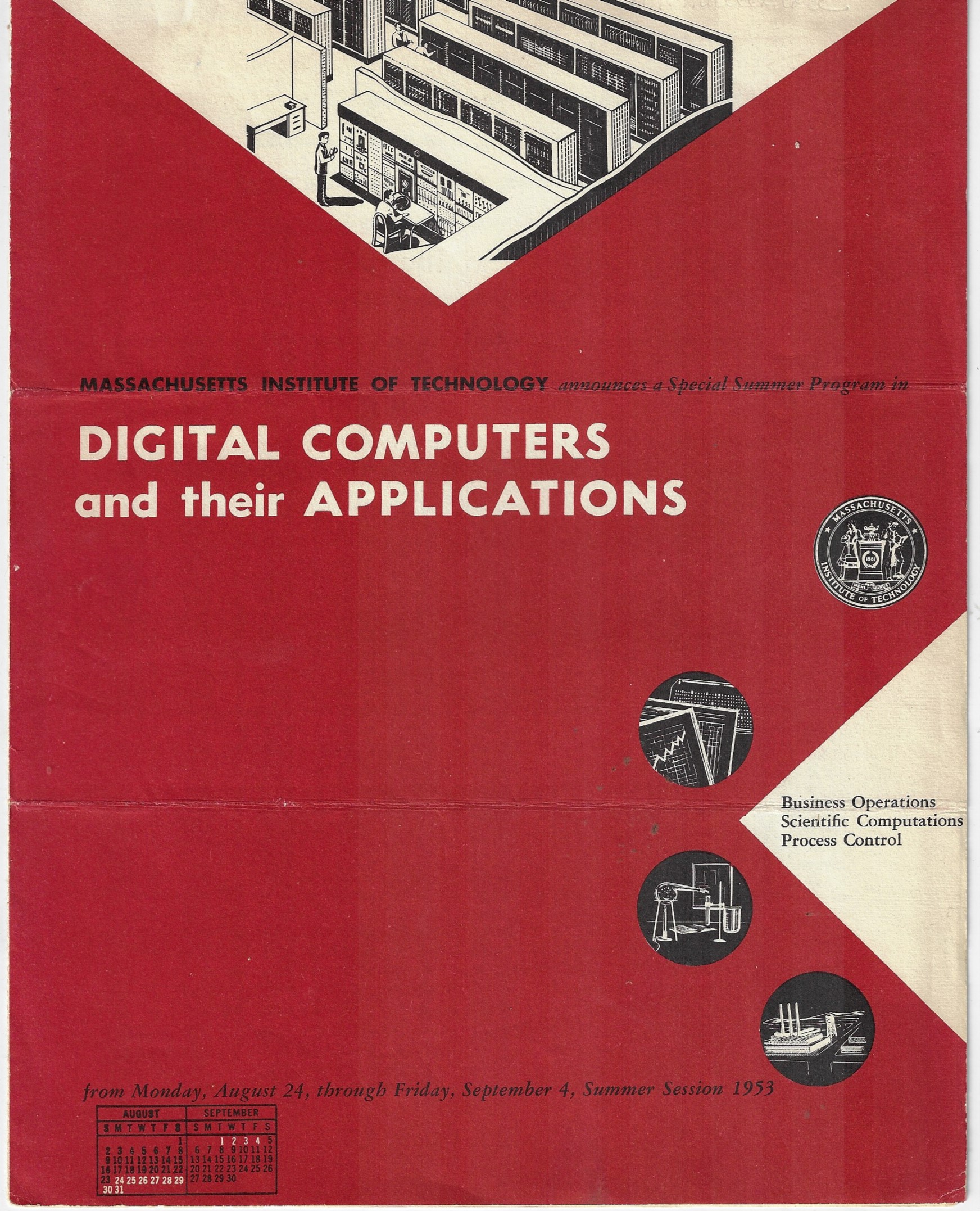
    , Special Summer Program. Massachusetts Institute of Technology. Business Operations, Scientific Computations, Business Control. August 24-September 4, 1953.

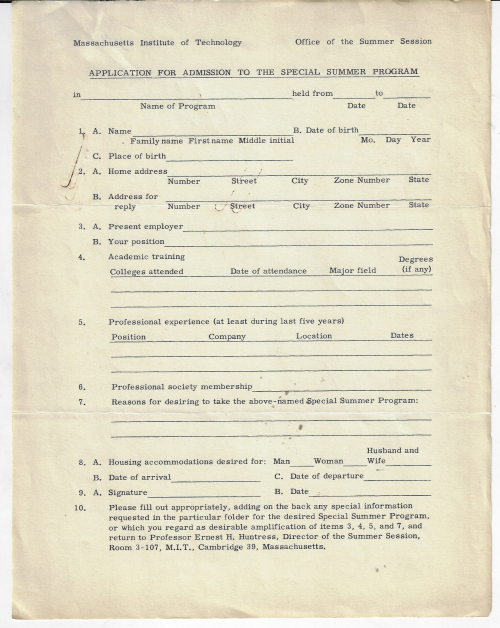
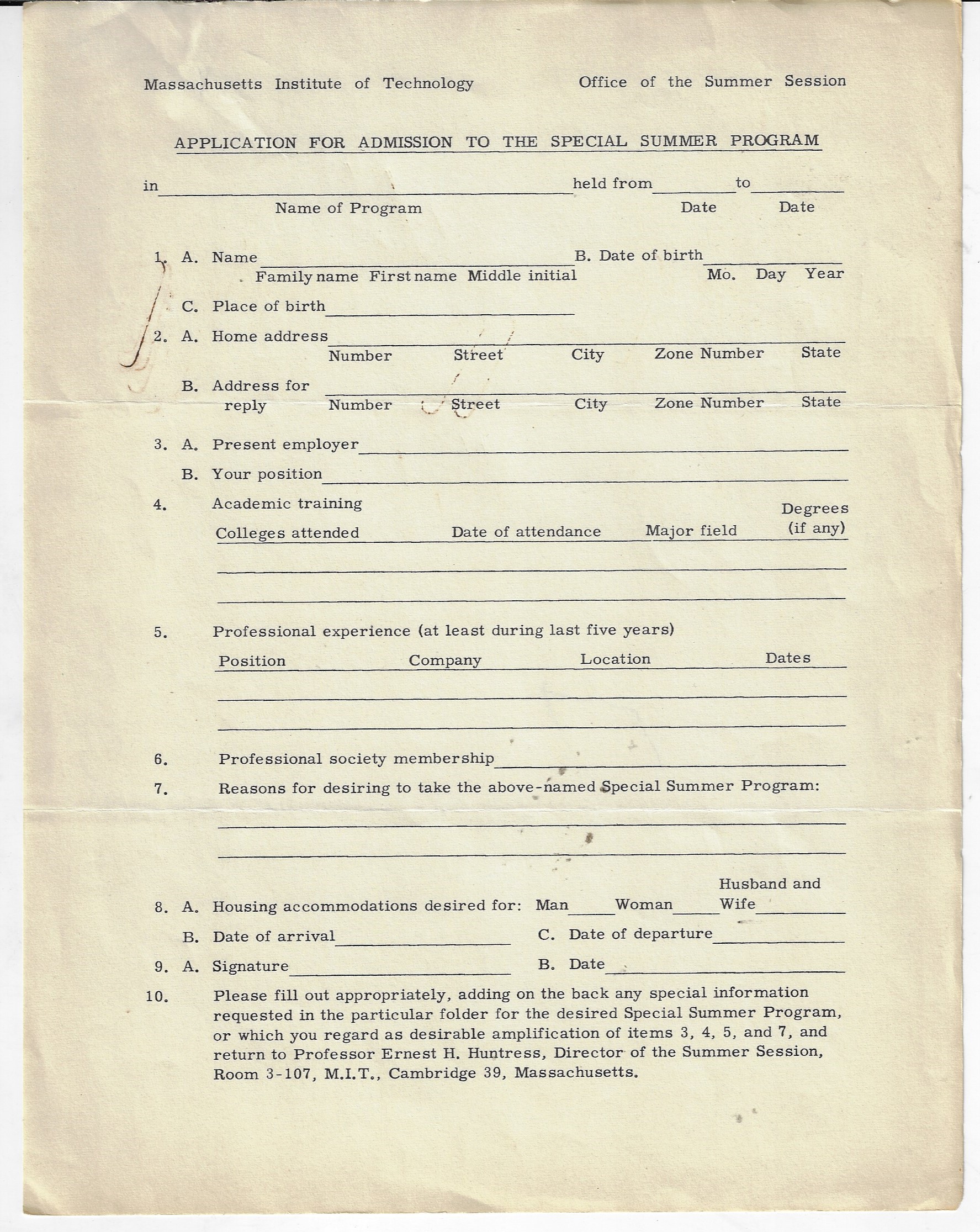
    10”x8” , 6pp, printed on one sheet, tri-folded. With: detached single sheet “Application for Admission to the Special Summer Program”. Very Good condition. Scarce piece of computer/MIT ephemera.  $125

    The staff includes the great pioneers M.V. Wilkes and Jay W. Forrester with the summer members working on the Whirlwind I. 


    Compsci MIT Summer Program MIT _1_

    ·Posted by :

    ·in:


  • Superior Single-Sheet Guide to Major Characteristics of Leading Computers, 1956

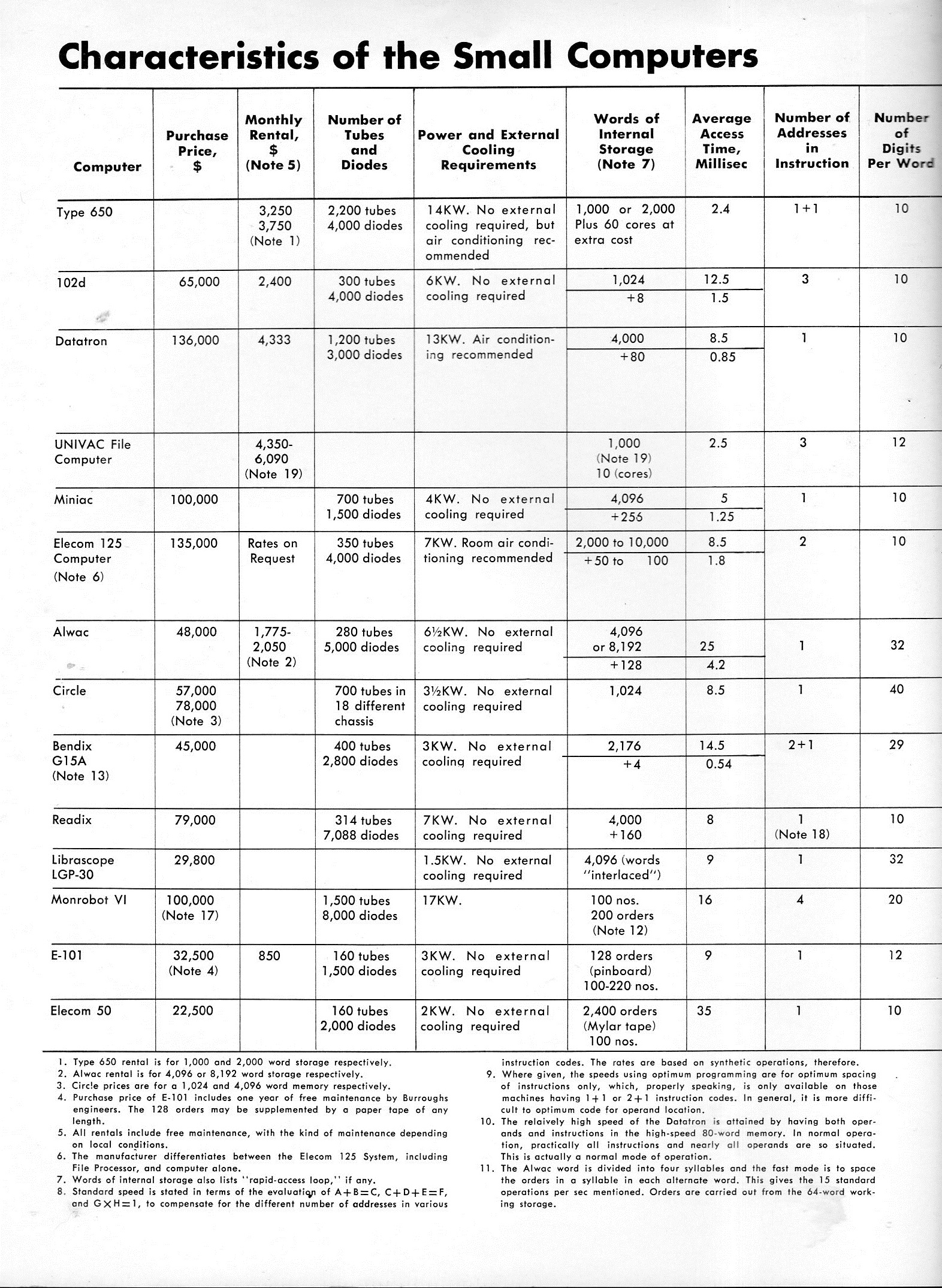
    A.J. Perlis and John Carrs  Characteristics of the Small-Scale Computers. 11×8”, 4pp. Product Engineering-Project Design Digest, offprint, “Mid-October”, 1956. The article first appeared in Control Engineering, March 1956. 

    This pamphlet looked innocent enough, 12″ tall and one folded piece of paper, and published in 1956, but there was a lot more to the simple publication than you’d expect from something so modest. The authors–John W. Carr III and Alan J. Perlis–were heavy hitters, and so I really wasn’t very surprised to see what they had done “inside”, though I was impressed and happy to see the data. Displayed on the 11″x16″ sheet of paper are 15 data points on 14 computers, many of them classic/famous:  the 650 IBM, UNIVAC, Elecom, Alawac.  (Remember that when you’re looking at purchase price and monthly rental amounts that the 1956 dollar is equal to about $8.70 in 2015 dollars, so that $3275/month for the 650 would be about $30k.  The $136k for the Datatron is about a million today.)   

       Perlis794

    ·Posted by :

    ·in:


  • An Apparatus for Calculating Efficiency (1883)

    C. Vernon Boys, “Meters for Power and Electricity”, in Nature, 14 June 1883, vol 28 #711, pp 162-5 in the weekly issue of pp 145-168.  Original self-wrappers, removed from a larger bound volume. Crisp and clean copy. $95  This is from Boys’ lecture at the Royal Institution, March 2, 1883.  

    C. Vernon Boys (1855-1944) was a British physicist and fine experimentalist and contributed this exemplary instrumentation article which appeared in the journal Nature (14 June 1883), when the no-longer new-ish journal rapid-published the breaking and thoughtful science news of the day every week.  Generally articles in the early decades would seldom range over two pages–of course, the pages were dense, and in two columns, with usually 80 lines per column and ten words per line, so each page could be filled with 1600 words, which is four times the general length of a novel.  In any event Boys’ article ran five columns, or about 5,000 words, which is a fairly meaty article.  

    From Gaston Tissandier’s Popular Scientific Recreations (1883):

    Mr. C. Vernon Boys has exhibited and described a very ingenious new 
    integrating machine of his invention, and its application as a measurer of the 
    electric energy in the circuit of an electric lamp or a dynamo-electric motor. 
    Mr. Boys' mechanical integrator belongs to the class termed tangent machines, 
    and consists essentially of a small disc or wheel running along the surface of 
    a drum or cylinder. When the wheel runs straight along the drum parallel 
    to its axis there is no rotation of the latter, but when the wheel is inclined 
    to the axis the drum rotates, and the integral is represented by the amount 
    of rotation. Continuous action is secured in giving the drum a recipro- 
    cating motion along its axis, so that when the wheel has travelled to one end 
    of the cylinder it can travel back again. The new integrator is especially 
    adapted for measuring forces which are either delicate or variable. It is 
    applied by causing the varying force to be measured to vary in a correspond- 
    ing manner the inclination of the wheel to the axis of the rotating cylinder.

    Some of Boys’ papers on calculating and measuring machines include:

    • “An integrating machine.” Proceedings of the Physical Society of London, 4:199–206, 1881.

    • “On a machine for solving equations.”Proceedings of the Physical Society of London, 7:355–360, 1885.

    • “A new analytical engine.” Nature, 81(2070):14–15, 1909

    • “Apparatus for calculating efficiency.” Proceedings of the Physical Society of London, 5: 28–35, 1882a.

    • “On integrating and other apparatus for the measurement of mechanical and electrical forces.” Proceedings of the Physical Society of London, 5:8–28, 1882b

    ·Posted by :

    ·in:


  • Rare Block Diagrams for the UNIVAC (1950)


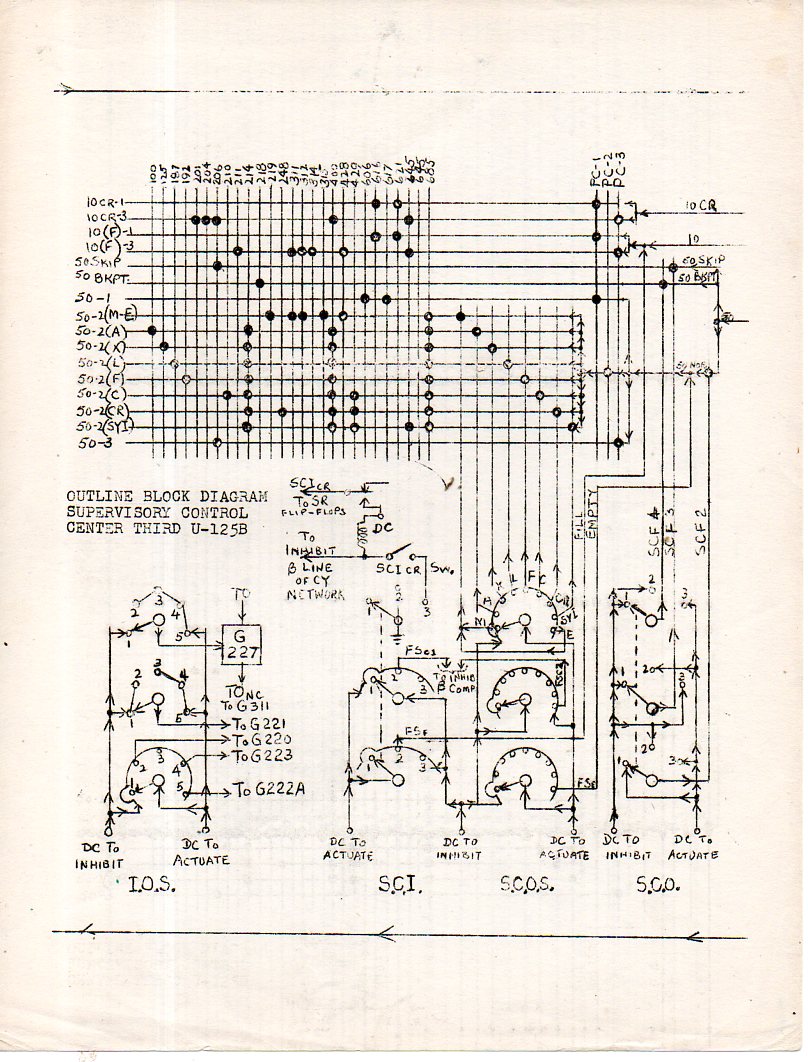
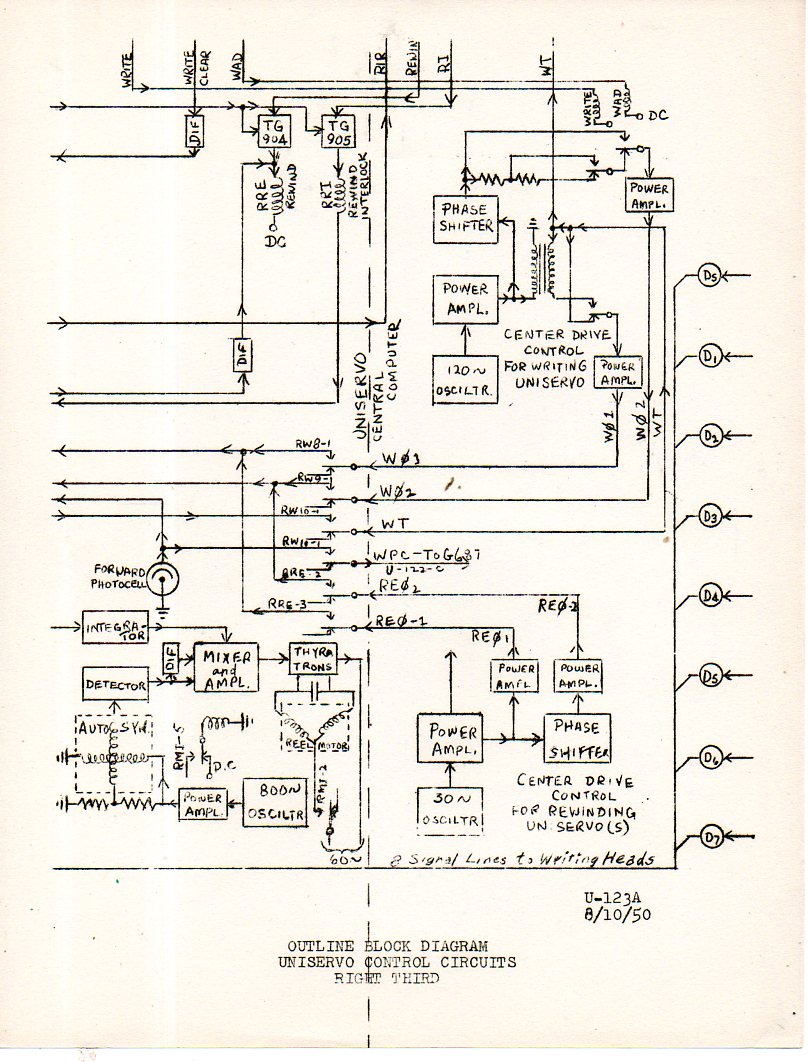
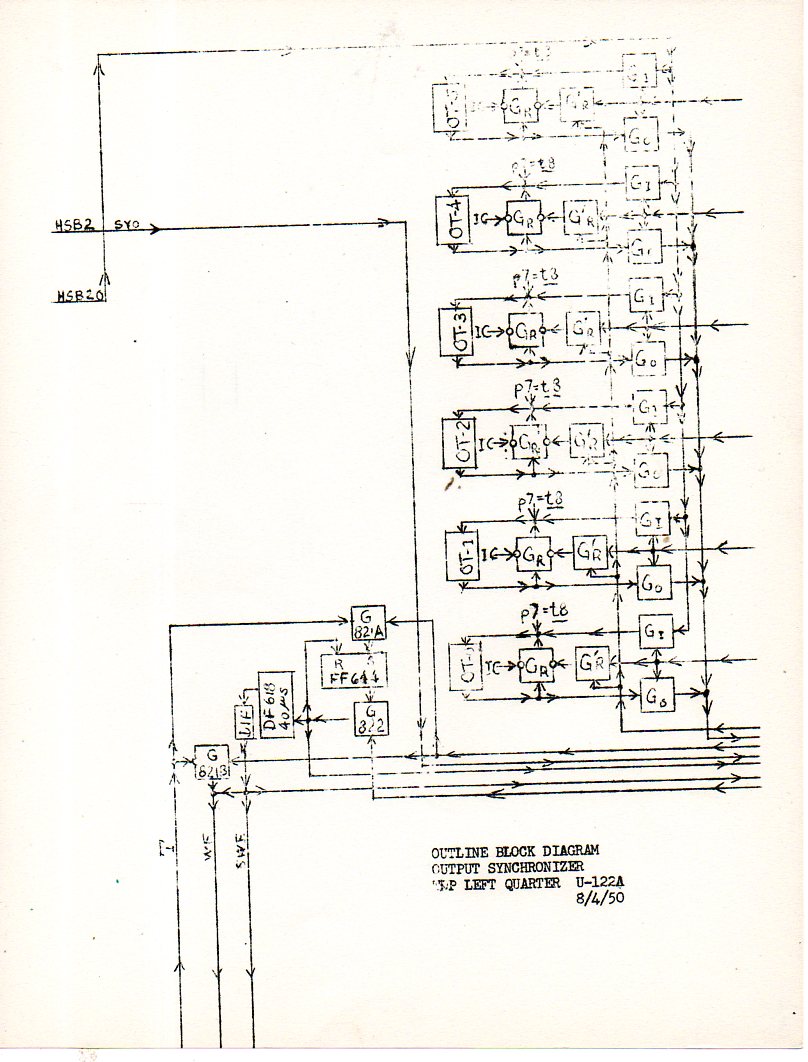
    The UNIVAC (Universal Automatic Computer) was the first commercially-available electronic computer, and the first computer to handle both numeric and alphabetic information, produced by Remington Rand, and  came into working service at the Bureau of the Census in 1951.  It was designed by John Mauchly and Pres Eckert Jr, who also worked together in the design and construction of the first digital computer, the Electronic Numerical Integrator and Computer (the famous ENIAC). The UNIVAC was a Big Boy: 25’x50′, with 5,600 tubes, and 18,000 crystal diodes–given its workhorse nature and general success, by 1957 there were 46 UNIVACs in operation. 

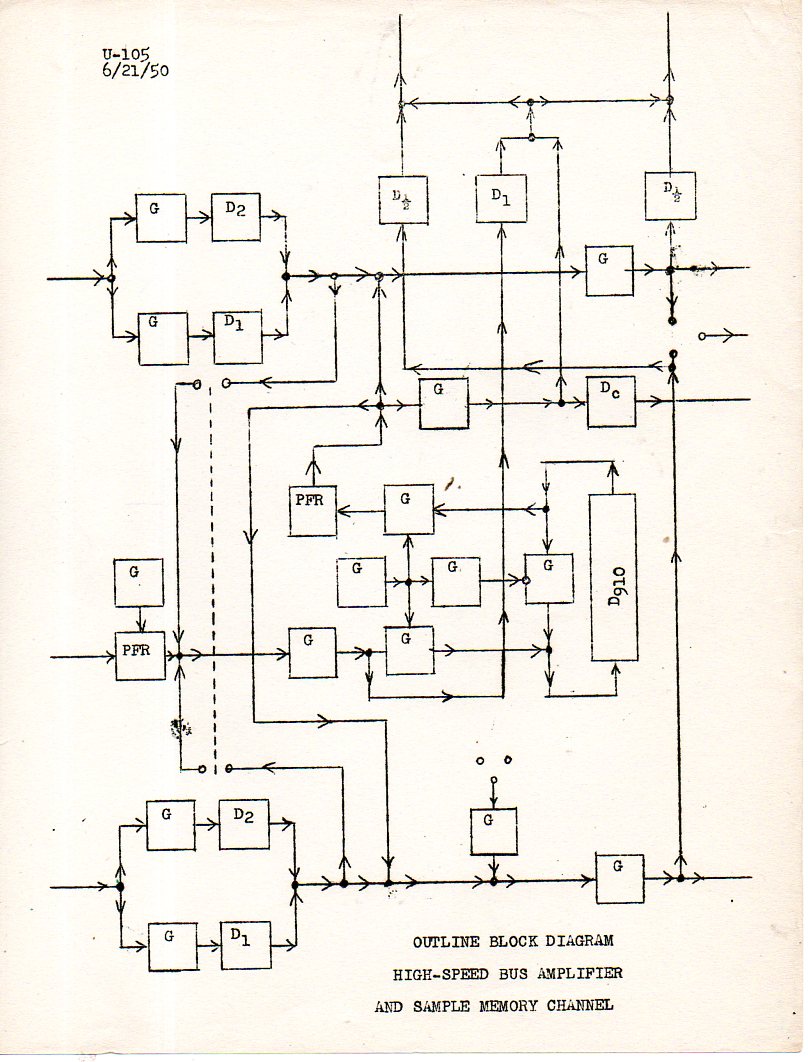
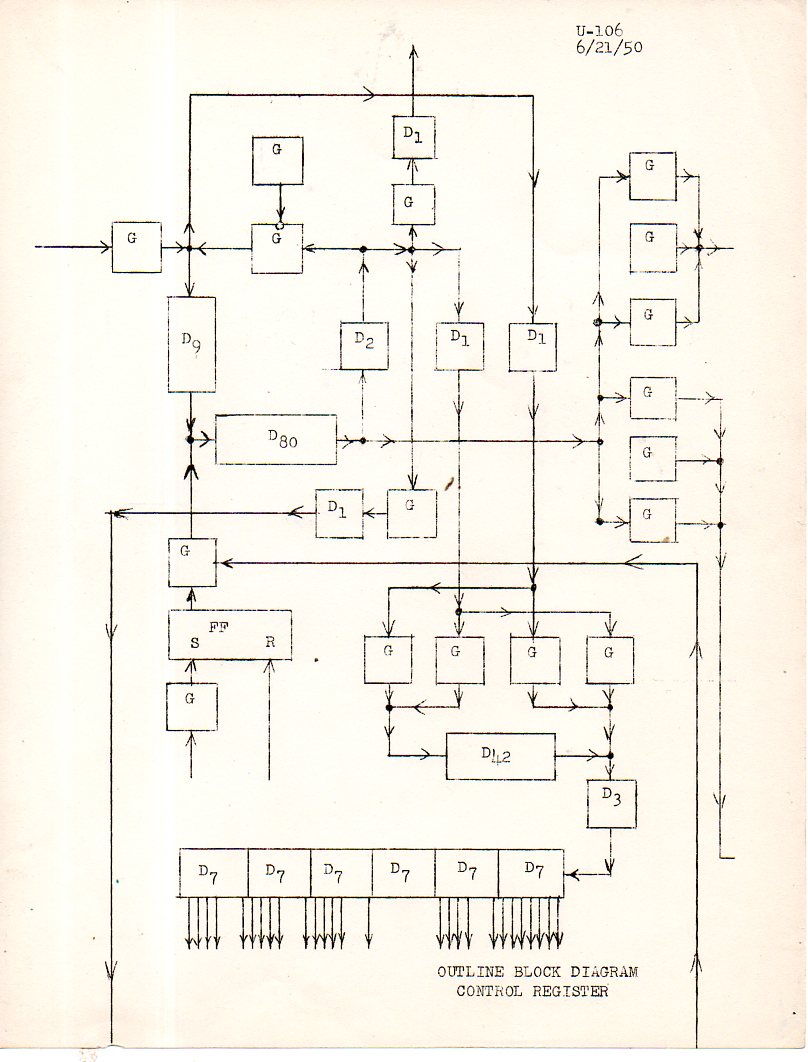
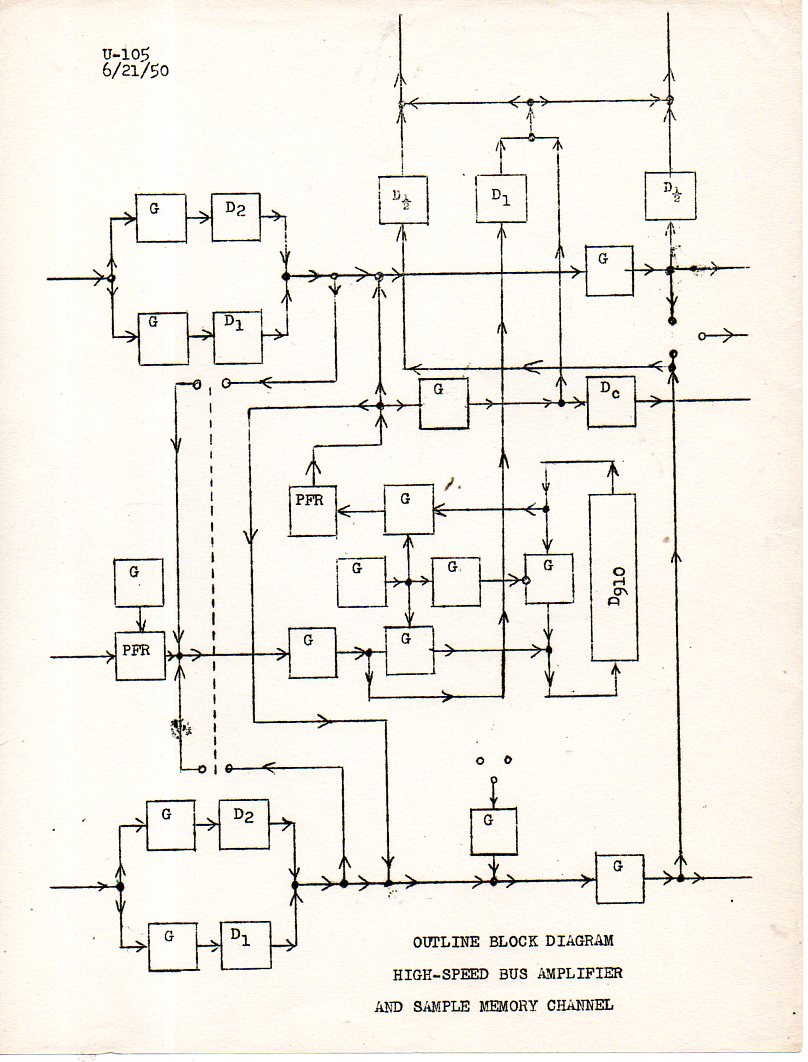
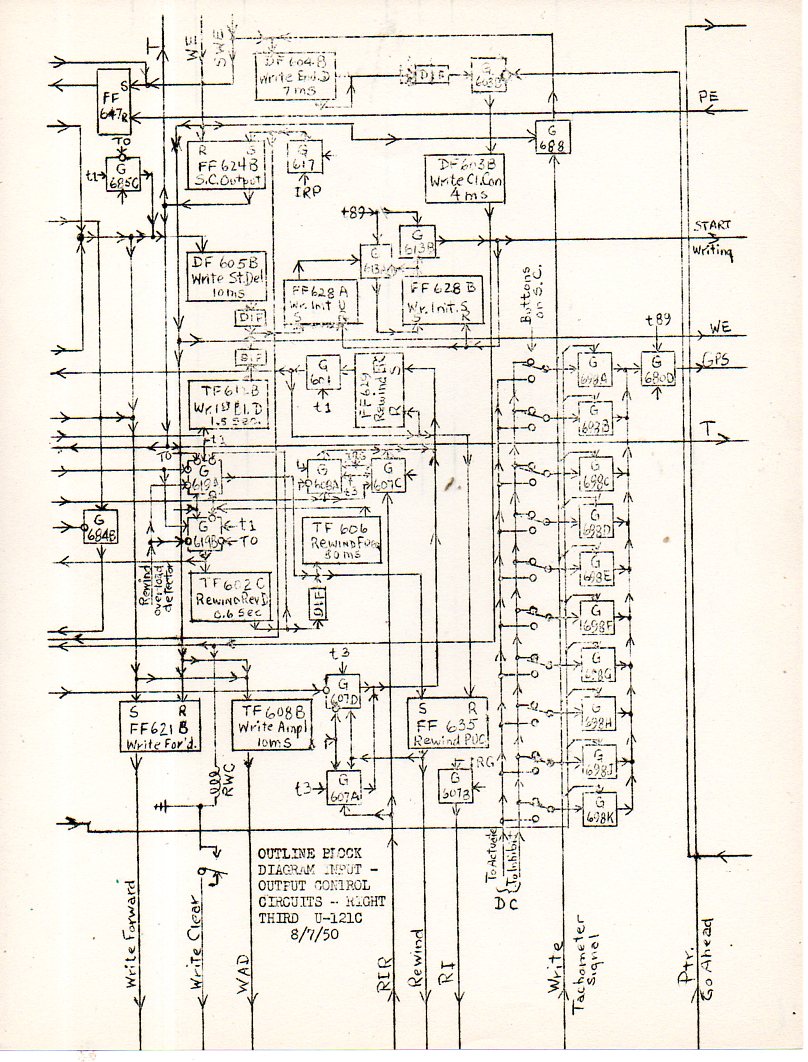
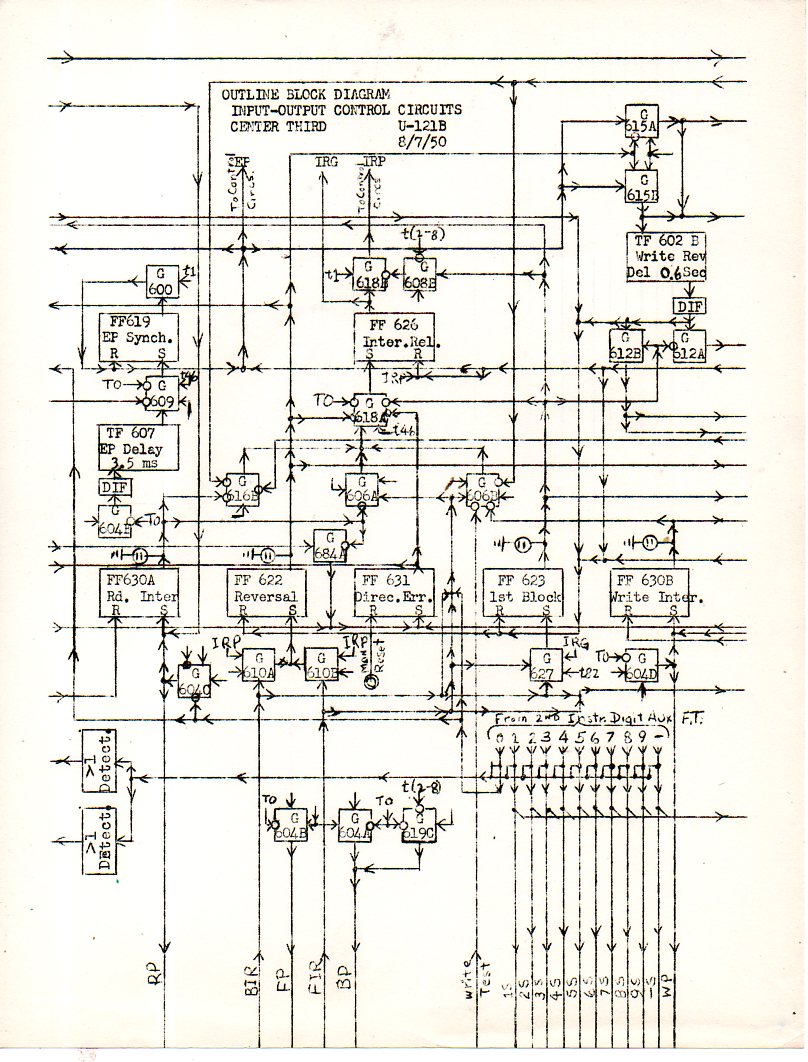
    The following are working block diagrams of sections of the UNIVAC, produced by some sort of early offset process in 1950, slightly before the computer came to its working life.  I have a number of sections of the computer represented in this way, but not the entire machine–but what is here may be of interest to historians of computer science.

    18 sheets representing seven sections of the computer: SOLD

    Including:

    MullendoreBlock diagrams497

    [Supervisory Control Panel]

    • 1.  The Supervisory Control Panel (2 sheets of 3, including center and left third, both undated but assumed to be 1950 like all of the others. [Shown above]

    • 2.  Uniservo Control Circuits. 3 sheets of 3.  All dated 8/10/50.

    MullendoreBlock diagrams503

    • 3.  Output Synchronizer. 4 sheets of 4.  Dated 8/1/50 through 8/4/50.

    MullendoreBlock diagrams502

    • 4.  Input Synchronizer.  4 sheets of 4.  Dated 8/1/50 to 11/9/50. 

    MullendoreBlock diagrams500

    • 5.  Control Register.  1 sheet of 1.  6/21/50.

    MullendoreBlock diagrams499

    • 6.  High Speed Bus Amplifier and Sample Memory Channel.  1 sheet of 1. 6/21/50

    MullendoreBlock diagrams500

    • 7.  Input-Output Control Circuits, 3 of 3 sheets,  8/7/50

     MullendoreBlock diagrams504

    ·Posted by :

    ·in: