A Daily History of Holes, Dots, Lines, Science, History, Math, Physics, Art, the Unintentional Absurd, Architecture, Maps, Data Visualization, Blank and Missing Things, and so on. |1.6 million words, 7500 images, 4.9 million hits| Press & appearances in The Times, Le Figaro, Mensa, The Economist, The Guardian, Discovery News, Slate, Le Monde, Sci American Blogs, Le Pont, and many other places… 5000+ total posts since 2008.

Book Category: Atomic Bomb

  • Nuclear Fission in 1939 from Three Major Journal Sources

    Here we three get collections of papers on nuclear fission (and more) in the 1939 volumes of three leading physics journals: The Physical Review, Revue Scientifique, and the Comptes Rendus…de l’Academie des Sciences.  

    Oppenheimer, Gamow, Feynman, Szilard, Bohr, Bethe, Rabi, and others all in the Physical Review, 1939

    “On continued gravitational contraction” and many other papers offered in one monumental year of the Physical Review for 1939.

    American Physical Society, Lancaster Pa., January-December 1939. Two volumes: x, 1294pp & x,1300pp. The two volumes, complete. Finely and sturdily rebound in cloth and marbled boards. Very stout, readable volumes. Fine condition. Few scant ownership stamps on some of the individual issues’ first page. $2250

    This is a remarkable volume for one of the most electrifying years in the history of modern phsyics, ranking alongside the great years of 1859, 1932, and 1948 for the sheer weight of highly significant papers from many sources. Included are papers by Oppenheimer, Gamow, Feynman, Szilard, Bethe, Rabi, Anderson, Tolman, Morrison, Kusch, Abelson, and many others. Astonishing, really.

    Some of the most significant papers include:

    OPPENHEIMER, Robert and Hartland Snyder, “On continued gravitational contraction”, September 1, 1939, Vol. 56, #5, pp. 426-50

    The Oppenheimer and Snyder (a graduate assistant) paper is one of the most prescient in the history of modern physics, correctly physically describing (where Chandrasekhar and Eddington in their discussions did not) what happens in a particular collapse of a neutron star, and still today reads as fresh and and brightly as it did in 1939.  Really, it is an extraordinary work, and a foundation paper in the history of gravitation, the application of RT, singularity, and astrophysics.  (The Southampton GR Explorer site nicely states it this way: “This paper has strong claims to being one of the most prophetic ever written in this field of research. Today, 60 years later, this paper needs little revision – even the terminology is undated!”)

    In an often-repeated quotation, they write, somewhat in irony and in a certain and understated manner on page 456: “The star thus tends to close itself off from any communication with a distant observer; only its gravitational field persists”. And later: “When all thermonuclear sources of energy are exhausted, a sufficiently heavy star will collapse. Unless fission due to rotation, the radiation of mass, or the blowing off of mass by radiation, reduce the star’s mass to the order of that of the sun, this contraction will continue indefinitely”, they wrote.

    BOHR, Niels and J.A. Wheeler, “The mechanism of nuclear fission”, September 1, 1939, Vol. 56, pp. 455-459. This is the experimental foundation stone (on the basis of the liquid drop model of atomic nuclei) of nuclear fission and the great leap forward in the construction of the atomic bomb.

    From the abstract: “On the basis of the liquid drop model of atomic nuclei, an account is given of the mechanism of nuclear fission. In particular, conclusions are drawn regarding the variation from nucleus to nucleus of the critical energy required for fission, and regarding the dependence of fission cross section for a given nucleus on energy of the exciting agency. A detailed discussion of the observations is presented on the basis of the theoretical considerations. Theory and experiment fit together in a reasonable way to give a satisfactory picture of nuclear fission”.

    BOHR, Niels. “Resonance in Uranium and Thorium Disintegrations and the Phenomenon of Nuclear Fission”;

    BETHE,  Hans.  “Meson Theory of Nuclear Forces.”  Lancaster, PA:  American Physical Society,  1939.  1st edition.  Physical Review, Vol 55, 2nd series, number 12; June 15, 1939.  1261-1264

    BETHE, Hans. “Energy Production in Stars” no 1. January 1, 1939 -and- Energy Production in Stars IIno. 5 March 1, 1939). Awarded the Nobel Prize (the first time the award was given for astrophysics) 1967 “for his contributions to the theory of nuclear reactions, especially his discoveries concerning the energy production in stars”)

    OPPENHEIMER, J. Robert and G.M. Volkhoff in the 15 February 1939 issue. Here (along with a preceding paper by Richard C. Tolman, issued in the same issue just above Oppenheimer, which were the analytic analysis used by O+V to base their estimates of nuclear forces) was established the Tolman-Oppenheimer-Volkhoff limit, which stated that if the state of evolution of  neutrons forming a degenerate Fermi gas of extremely dense masses in neutron stars was more  massive than .07 solar masses that it would collapse into a black hole or exotic/quark star; if the mass was below that limit, the star would not collapse due to the degeneracy pressure of neutrons and the strong force.  The black hole part was left really to a second paper of 1 September 1939 (the day that the Nazis attacked Poland and the fighting began in World War II in Europe) .

    GAMOW, George and Edward Teller, “On the Origin of Great Nebulae”, in Physical Review, volume 55, number 7, April 1, 1939, pp 654-657, in the weekly issue of pp 609-671. 

    FEYNMAN, Richard. “Forces in Molecules”, pp. 340-43. Feynman’s undergraduate thesis at MIT, know known as Feynman-Hellmann theorem – “This work treated the problem of molecular forces from a thoroughly quantum-mechanical point of view, arriving at a simple means of calculating the energy of a molecular system that continues to guide quantum chemists.” (Complete DSB online)

    SLIZARD, Leo and ZINN’s landmark “Instantaneous Emission of Fast Neutrons in the Interaction of Slow Neutrons with Uranium” confirmed ‘instantaneous’ neutron multiplication, showing that it meets the requirement for nuclear bombs. Some argue this is one of the most important papers in atomic/nuclear physic

    ANDERSON, Herbert L, Fermi, Enrico & Hanstein, H. B. “Production of Neutrons in Uranium Bombarded by Neutrons”, vol 55, pp. 415-419;

    TOLMAN, Richard, “Static Solutions of Einstein’s Field Equations for Spheres of Fluid”, vol 55, pp. 799-800;

    RABI, I, Millman, S., Kusch, P. & Zacharias J. R. “The Molecular Beam Resonance Method for Measuring Nuclear Magnetic Moments ()”, vol 55, pp 526-535, vol 55, 1939

    WEISSKOPF, Viktor. “On the Self-Energy and the Electromagnetic Field of the Electron”, 56 No. 1 pp. 72–85, July 1, 1939 . Also bound in the same issue with:   “Weisskopf demonstrates that QED diverges at all levels of perturbation theory.”  “Weisskopf was a major figure in the golden age of quantum mechanics, who made seminal contributions to the quantum theory of radiative transitions, the self-energy of the electron, the electrodynamic properties of the vacuum, and to the theory of nuclear reactions.”– “Vicktor Weisskop 1908—2002”  by J. David Jackson and Kurt Gottfried, in Memoirs of the National Academy of Sciences.

    This paper reproduced in full as paper 6 in Julian Schwinger’s Selected Papers on Quantum Electrodynamics. See also Jo Bovy (Ghent University), 

    ABELSON, Philip. “Investigation of the Products of the Disintegration of Uranium by Neutrons”, July 1, 1939, pp 1-9.

    RABI, I.I., Kellogg, J. M. B. “The magnetic moment of the proton and the deuteron. The radiofrequency spectrum of H2 in various magnetic fields” , vol. 56, No. 8., pp 728-743.


    Nuclear Fission/Atomic Bomb in the Revue Scientifique, 1939

    Revue Scientifique, January-August, 1939, volume 77, numbers 1-8, quarto, 551pp. Wrappers (front and back) bound in at the rear of the volume, with supplemental ads throughout the volume. Bound in an attractive red cloth. Tidy institutional bookplate; institutional rubber stamp on first page of each monthly issue as well as one rubber stamp on wrapper covers. Fine copy, very tight and fresh. $750.

    This volume contains a couple of original articles of interest to the development of nuclear fission as well as 16 articles that are reviewed/abstracted/somewhat reprinted from other journals (in the February, March, and April issues), and when not in French written in or translated into French, which in many cases are the first translations of some of the great papers in this period of nuclear physics. The great majority are one or two columns in length.

    Included are works by Thibaud, Savitch, Joliot, Frisch, von Halban, Meitner, Feather, Bretscher, Heyn, Strassmann, Curie and others–these are rapidly published translations/reviews, in many cases coming jsut weeks after the original paper was published.  

    • Issue for February, 1939 

    VEIL, S. “Les controls chimiques de transmutations d’atomes”, p 111-112.

    And unattributed in the “echos” section:

    “La Rupture Explosive des noyaux d’uranium et de throium dans l’Action des Neutrons”. One column article on page 133, citing Fermi/Amaldi 1934, Curie/Savitch 1938, Hahn and Strassmann (Jan 1939).

    Then:

    “Un nouveau type de reaction nucleaire”, Nature, 143, 233, 1939, translated by S. Veil—this is the “introductory” statement in Nature preceding the Meitner/Frisch paper a few pages later.

    MEITNER, Lise and O. Frisch. “Disintegration de l’uranium par les neutrons: un nouveau type de reaction nucleaire”, translated by S. Veil, pp 133-4, and which appeared in Nature, 143, 233, 1939.

    JOLIOT, F and J. Perrin. “Preuve experimentale de la rupture, explosive des noyaux d’uranium et de thorium sous l’action des neutrons”, from Comptes Rendus, vol 208, 199, 341-343, and here appearing in two columns on one full page (135).

    CURIE, I. And P. Savitch. “Sur les radioelements formes dans l’uranium et le thorium irradies par les neutrons”, from Comptes Rendus, volume 208, 1939, p 343-346, and here on one full page (136).

    • The issue for March, 1939 77/3, pp (139)-218 is very interesting:

    THIBAUD, Jean and A. Moussa. “La cassure de l’uranium, la formation d’un halogene et la liberation d’energie qui en resulte”, pp 182-185.

    And then, in the “echo et information” section, which is basically a reporting section on work that was published elsewhere (though not necessarily in French), we find abstracts and announcements of a number of very significant publications:

    THIBAUD, Jean and Andre Moussa. “Sur la rupture des noyaux d’uranium sous l’action des neutrons et la liberation d’energie qui en resulte”, from the Comptes Rendus 208, 1939, pp 744-6, p 211-212.

    SAVITCH, Paul. “Sur un radioelement gazeux forme dans l’Uraium bombarde par les neutrons”, from Comptes Rendus, 208, 1939, pp 646-647, this all on a long columns on page 212.

    JOLIOT, F. “Observation par la methode de Wilson des trajectoires de brouillard des produits de l’explosion des noyaux d’uranium”, from Comptes Rendus, vol 208, 1939, pp 647-649. one and a half columns, with photo illustration.

    FRISCH, O. “Evidence physique de rupture du noyaux lourds sous bombardement de neutrons”, in Nature, 143, 1939, p 276. This 1.25 columns.

    Von HALBAN, H. and F. Joliot. “Liberation de neutrons dans l’explosion nucleaire de l’uranium”, from Nature, 143, 1939, p 470. This pp 214-215.

    MEITNER, L. and O.R. Frisch. “Les Produits de rupture du noyaux f’uranium”, in Nature143, p 471, 1939. This is all on page 215, in two full columns.

    • The issue for April, 1939: pp 186-298

    FEATHER, N. and E. Bretscher. “La Rupture Explosive des Noyaux d’Uranium”, from Nature, 143, p 516, 1939. Here occupies 1 column.

    HEYN, F. and Aten and Bakker. “Transmutations d’uranium et de thorium par neutrons”, from Nature, 143, 516, 1939. Here occupies two full columns.

    BRETWCHER, E. and L.G. Cook. “Transmutations de noyaux d’uraniumet de thorium en moyen de neutrons”, from Nature, 143, p 559, 1939. Here the work occupies a full column.

    FEATHER, N. “La duree du processis de rupture nucleaire”, from Nature, 143, p 597, 1939. Here the work occupies two columns.

    THIBAUD, J. and A.Moussa. “La disintegration de l’uranium par l;effet des neutrons et la partition de cet element”, from Comptes Rendus, 208, 652-4, 1939. Here the artcile occupies two columns on page 293.

    DODE, M. and von Halban and Joliot. “Sur l’energies des neutrons libertes lors de la partition nucleaire de l’uranium”, (no mention of origin). This is one full column on page 294. 

    • Issue for June-July 1939, pp 371-455

    COUFFIGNAL, L. reviews/abstracts/summarizes A. Einstein and L Infeld “L’Evolution des Idees en Physique”, pp 427-8

    Also for interest in the history of computer science: Nice article on Maurice d’Ocagne (1862-1938) by Louis COUFFIGNAL and Rene Harmegnies.Fe 1939, p 70 p. 67-76 Feb 1939


    The Atomic Bomb–the French Contribution in the Comptes Rendus, 1939

    14 major papers (in 12 different weekly issues) in the history of nuclear fission, all published in Comptes Rendus hebdomadaires des Séances de l’Academie des Sciences, volume 208, January-June 1939, 2250pp, a single bound volume, thick and stout. Ex-libris, with a bookplate–also, each title-page of each weekly issue (of which there are 26 in this volume), has a small round rubber stamp of the library. Cloth binding. ca. 1950. Nice condition.  There is a faded, old vertical fold that extends through the text, no doubt from when the original owner folded the issues in half…over the years in binding, the fold is mostly gone.   $1500

    Included are the following:

    BECK, Guido and Peter Havas, “La dissymetrie de la rupture de l’uranium”, 3 April 1939, no. 14,  pp 1084-1086

    BECK, Guido and Peter Havas, “Sur le ralentissement dans l’air des fragments atomique résultant de l’explosion de l’uranium”,  22 May 1939, no. 21, pp 1643-1645;

    *CURIE, Irene and Paul Savitch. “Sur les radioelements formes dans l’uranium et le thorium irradies par les neutrons”, 30 January 1939 (one of two papers in this issue), pp 343-346; 

    DODE, Maurice, Hans von Halban, Frederic Joliot, Lew Kowarski. “Sur l’energie des neutrons liberes lors de la partion nucleairede l’uranium”, 27 March 1939,  p 995-997

    HAENNY, Charles and Albert Rosenberg. “Émission de neutrons lors de la rupture provoquée du noyau d’uranium. Possibilité de réaction par chaine” “20 March 1939, no 12, pp 898-900;  

    **JOLIOT, Frederic. “Preuve experimentale de la rupture explosive des nayaux d’uranium et de thoriumsous l’action des neutrons” 30 January 1939,  p 341-343– THE FIRST INDEPENDENT CONFIRMATION OF NUCLEAR FISSION. 

    *JOLIOT, Frederic. “Observations par la methode de Wilson des trajecoires de brouillard des produits de l’explosion des noyaux d’uranium”, 27 February 1939, p 647-649

    MAGNAN, Claude, “Sur la cassure des noyaux éléments plus légers que l’uranium, sous le bombardement des neutrons”, 6 March 1939, no. 10, pp 742-4;

    MAGNAN, Claude. “Sur les neutrons emis lors de la bipartition de l’uraniumsous l’action des neutrons”, 17 April 1939, pp 1218-1220

    *PERRIN, Francis. “Calcul relatif aux conditions éventuelles de transmutation en chaine de l’uranium”, 1 May 1939, no 18,  pp 1394-1396; 

    *PERRIN, Francis. “Calcul relatif aux conditions éventuelles de transmutation en chaine de l’uranium”, 15 May 1939, no. 20, pp 1573-1575; 

    *THIBAUD, Jean Thibaud and Andre Moussa. “Sur la rupture des noyaux d’uranium sous l’action des neutrons et la libération d’énergie qui en résulte”,  6 March 1939, no. 10 (second article of the issue) 744-6;

    von HALBAN, Hans, Lew Kowarski, Paul Savitch. ” Sur la capture simple des neutrons thermiques et des neutrons de resonance par l’uranium”, 1 May 1939, no 18 (second article in this issue) pp 1396-1398; 

    von Halban, Hans, Lew Kowarski, Michael Magot. “Sur l’intensite des neutrons dans le radiation cosmique”, 20 February 1939, pp 572-574.
     

    ·Posted by :

    ·in:


  • The Next Generation ICBM (1957, RAND)

    Cartaino, T.F.  Next Generation Weapons After the ICBM.  Project RAND, D-4665, October 21, 1957.  11×8.5″, 4 leaves. Offset (or mimeographed?) paper “not to be quoted or cited in external RAND publications or correspondence”. And: “RAND documents are available onto to persons affiliated with RAND”. VG copy. Scarce.  $125

    RAND ICBM 1957The RAND Corporation (Research And Development) is a think tank originally formed in 1946 by the US Army Air Force as part of a contract to the Douglas Aircraft Company.  After 1948 RAND Corp was funded by a number of different sources, private and governmental, and left the sphere of being a direct arm of the U.S. military. (Maybe.)  It still did enormous amounts of work on behalf of the military, and seems to have been their chief  theoreticians during this period.  It was also the time that the policy of Mutually Assured Destruction (MAD) was formulated at , partially under the direction of we’ll-see-him-again-down-the-road Robert McNamara.  And of course much else. 

    This publication is an internal RAND document, not meant for the eyes of the outside world, at least in 1957.  I own a number of these reports, and I must say that this one is odd—it is rather flippant, sometimes oddly and darkly (dare I say it?) funny.  It is also short (four pages) and gets to the very meaty part of the issue immediately.  The author(s) assume that the US and the USSR will have achieved a point of stasis such that it would make absolutely no sense for either actor to actually employ their arsenal (and excluding “the possibility of the button pusher ‘flipping his lid’ “.  The paper attempts then (“let’s jump right in and assume we find ourselves in this stalemated period”) to envision the next kind of war in which the ICBM would not be an active factor. “We therefore postulate here that the kind of war we will be engaged in…in the period of nuclear stalemate of the non-violent war, the opening phase of which has been called the cold war.”

    The tools of war in this non-violent war, the report speculates, included: (1) the State Department as a Weapon, issuing “an aggressive, imaginative foreign policy”. (2) Economic Weapons, which interestingly included “inflate USSR economy by surreptitiously flooding the country with undetectable counterfeit currency”.  (I remember that the late Sen. Patrick Moynihan suggested in the first Iraq war, televise don the floor of the U.S. Senate in the final debate on engagement, that we do this exact thing in Iraq…especially since the Iraqi dinar was being printed in London.) The third section was “Psychological Weapons”, and was very tongue-in-cheek short (?), suggesting “ideas a la Hitchcock, e.g., turn Stalin [dead in 1953] over in his grave some dark night, etc.” I’m not sure what to make of that, especially as the paper finishes on this line: “This list is open for additions and suggestion.”  Indeed.  Out of all of the internal reports that I’ve read from RAND this is the only one that approached its topic with such dark familiarity and removed humor. 

    ·Posted by :

    ·in:


  • The Euphemisms of Life and Death–Nuclear Exchange, 1964

    The NATO Conference on Damage Assessment Summary Report (May 5-6, 1964).  Printed at NATO Hadquarters, Paris, France, May 1964. 11.5″ x 8.5″, iii, 115pp., with several dozen unpaginated tables.  GVC-binding with thick paper covers.  VG copy. $300

    Nato damage _4_


    The NATO Conference on Damage Assessment Summary Report (May 5-6, 1964) was not one written for its outcome, necessarily, but the means of getting there. The outcomes were highly differentiated levels of sameness, a strategic tour of Dante’s creation cataloging the layers of deep destruction like hose of his funneling pit.

    Professionally the paper dealt with several different ways of computing nuclear exchange scenarios (given names of understated inelegance like Jumbo, Brisk, Frisky, Dart and Dusk) with lots of smokily mirrored hocus pocus, the necessary ingredient of the philosophical technology of Mutually Assured Destruction. MAD. Somehow it all worked out without any exchange ever happening. (The principal contributor here was James Coker, chief of the National Resource Evaluation Center, Office of Emergency Planning, Executive off of the President.)

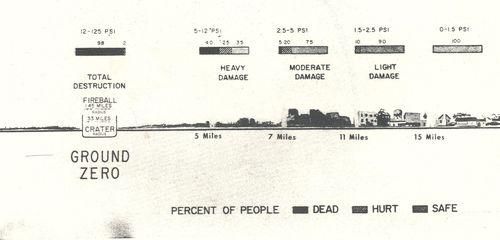
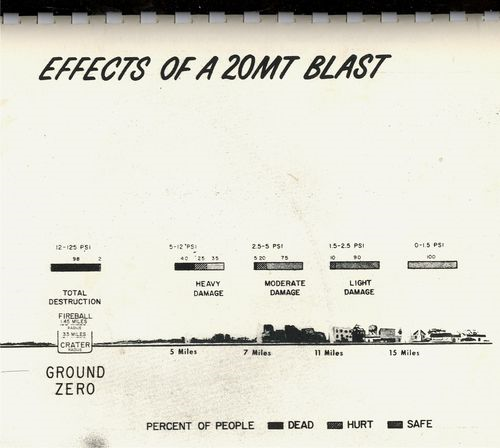
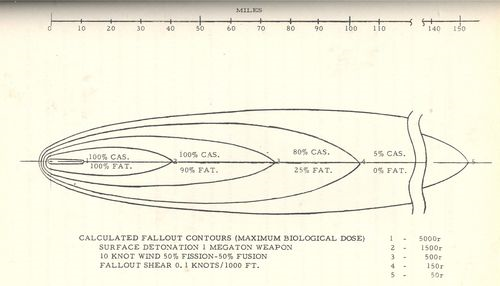
    The first image shows the effects of a 20 megaton nuclear blast detonated in in a city, presenting an incredible picture of absolute destruction, reaching out from ground zero for more than 11 miles. This doesn’t begin to measure the overall damage inflicted by radiation, which is deeply, extraordinarily, severe. This again is the effect of one weapon, the 100% fatality rate eventually reaching out 12 miles; 90% reaching over 40 miles. General casualties extend to 80% up to 70 miles from ground zero.

    Nato damage _4_

    Nato damage _4_
    Nato damage _4_
    Nato damage _4_

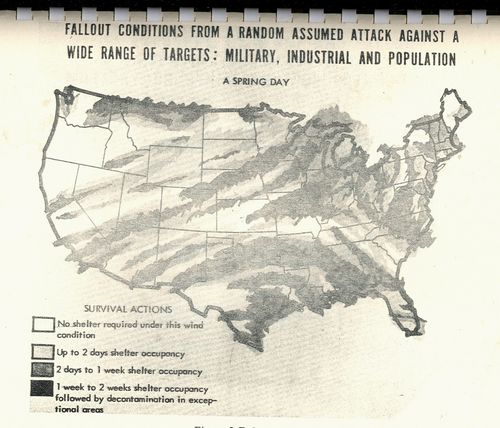
    The emergency planning end of the paper comes in at about this point. The fallout map of the U.S. shows a possible situation of an unspecified (though wide-ranging) attack (on a “spring day”) and its effects on the population as it is housed in various shelters and bunkers, suggesting the amount of time needed to “survive” the attack by staying inside the fail safe habitation.

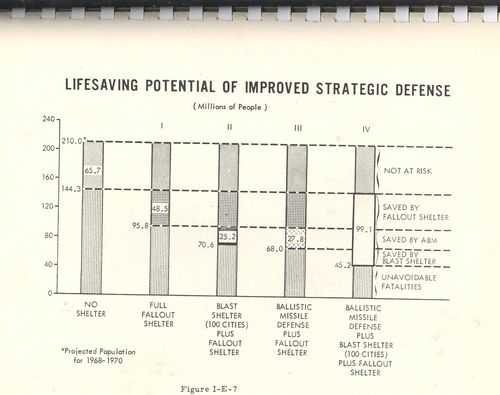
    The following chart, “Lifesaving Potential of Improved Strategic Defense” (in millions of people) shows the effect of the installation of the shelters and bunkers. In this scenario, in a massive strike, the fatality rate in the U.S. of an unprotected population was 65%, or 144 million. On the other end of the extreme was “ballistic missile defense plus blast shelters plus fallout shelters”, or a massively- protected population of fictional expanse shows that in spite of all precautions 45.2 million people would die (as “unavoidable fatalities”).

    Nato damage _6_

    This document is nothing if not a death sentence had the massive strike ever been launched. In the dozens of such reports that I’ve seen, there hasn’t been one with the Really Big One with thousands of euphemistically-named “exchanges”, which I assume would make all of these others pale by comparison

    ·Posted by :

    ·in:


  • Heisenberg’s A-Bomb History (1946)

    HEISENBERG, Werner. Uber die Arbeiten zur technischen Ausnulzung der Atomkernenergie in Deutschland. In Die Naturwissenschaften, vol 33, #11 18 December 1946 (but published in august 1947). Heisenberg on pp 325-329 of the issue. Offered in the full volume of 376pp. Bound in black library cloth, bound with the original front wrapper. The volume is printed on inferior paper, making the pages browned and brittle for their age. A good copy, only.   $250

    This is widely seen as the first German history of the Nazi atomic bomb project. One interesting thing that pops out here is what may be the not often considered meeting that the scientists had with A. Speer in 1942 in which it was decided to not pursue a bomb but rather a reactor that could power a naval vessel and then at some point be used in the making of a nuclear weapon. See Paul Lawrence Rose, Heisenberg and the Nazi Atomic Bomb Project, 1939-1945: A Study in German …,intro and the first chapter.

    ·Posted by :

    ·in:


  • An Early Document on Mutually Assured Destruction and Atomic Energy (Summer 1946)

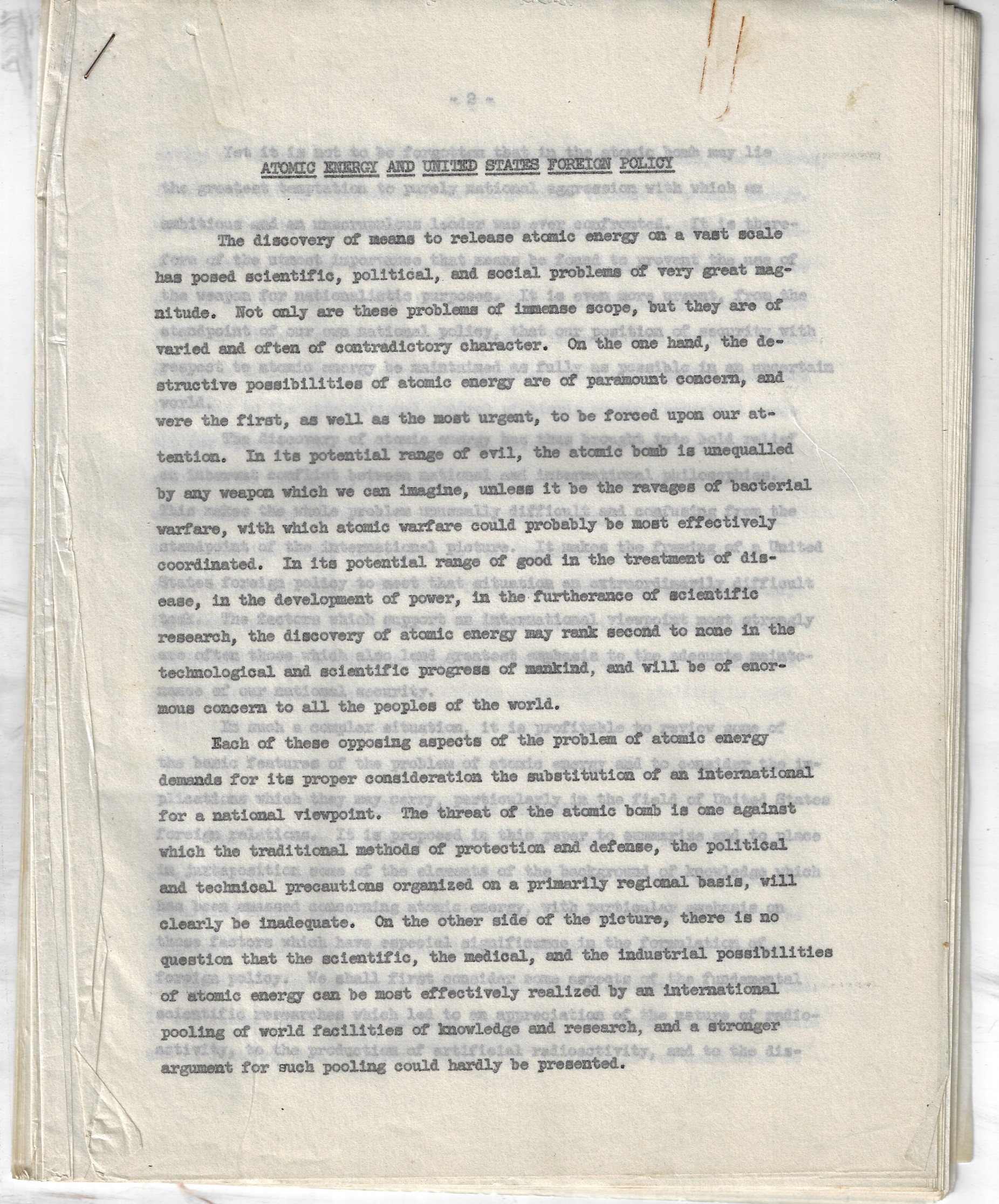
    [Atomic Bomb Control and Atomic Energy]  Haskins, Caryl P. Two drafts of “Atomic Energy and United States Foreign Policy”, published July 1946 in Foreign Affairs. Two versions, one 37pp and the other, presumably an earlier version, 28pp (pp 1-28, incomplete). Both are original carbons on tissue paper. The two documents: $500   

    • Dr. Caryl Haskins (1908-2001, Ph.D. Yale ’30 (E.E. at 22), Ph.D. Harvard 1935; LL.D. Carnegie Institute Technology 1955) was a close and long-time friend of the great Vannevar Bush with whom he throughout World War II at the OSRD,  as well as executive assistant to Bush at NSRD 1941-1945.   He was research associate at MIT 1935-1945;  he was on the Scientific Advisory Board of the Army and Navy, 1947-8; Research Consultant to the Secretary of the Army, 1950; Executive Research Consultant to the Secretary of State 1950-1972  Haskins was on the board of Scientific advisors to President’s Truman and Eisenhower, and succeeded Bush as president of the Carnegie Institution (1956-1973). 

    Haskins atomic energyWhat I find remarkable about this paper is its prescience regarding MAD, the need for international regulation and control, and the absolute belief that the U.S. could not rely on its monopoly of weapons and intelligence even in the short run. He reasons some ways in which to deal with sharing information, restricting the growth of a weapons culture, and the use of atomic energy.

    Haskins sees the delivery of atomic bombs by “long range rockets”, and that the temptation for developing an atomic arsenal would curtail expenses for military development by possibly as much as 100-1. (He mentions at one point that 10,000 atomic bombs could be used to secure world domination, at a cost of only $10 billion (or 10 Iowa-class battleships)—making this highly appealing. (He was not referring to the U.S. in this.)  He goes on to say that without guidance in atomic energy and control of atomic weapons that an exchange of two (or multiple) countries with such weapons “would be largely destructive of civilization as we know it”.

    Haskins also makes the case for the U.S. not to be isolationist in these regards, “and not count on the security of a monopoly of knowledge”.

    Haskins was certainly sounding a very considered, scientific, reasoned alarm about what may turn out to be a devastating near-future with uncontrolled atomic weapons. (This was written in 1946, three years before the Soviets exploded their first bomb. In 1946, Lee Groves thought it would take 20 years for the Soviets to develop a bomb; James Byrnes gave them 7-10 years; and Bush-Conant 3-5 years. Some scientists put it sooner than that. My impression is that Haskins was on the side of the bomb coming to the USSR much sooner rather than later, hence this urgent article in Foreign Affairs.

    Here’s an interesting notice on this article by Haskins:

    • “We therefore cannot count on maintaining our security through a monopoly of fundamental knowledge in the atomic field […]. Further, our monopoly of technical information and facilities is limited and is diminishing. At present we do have a monopoly of stockpiles of raw materials and finished atomic bombs, and we are equipped with gigantic plants for producing these materials. Within something like ten years, however, our monopoly in technology may have disappeared completely, whatever the policy we now adopt with respect to international action.”– This could almost pass as modern commentary for the U.S., but it was written 71 years ago (July 1946) by Caryl P. Haskins, then deputy executive officer of the National Defense Research Committee, who conveyed a heightened level of concern that the U.S. would lose its monopoly in nuclear science and technology for military applications. This created a direct threat to the U.S. and the world as the Soviet Union leveraged nuclear energy in its pursuit of military primacy over America and geopolitical dominance in Europe and Asia. The genie was out of the bottle and nuclear science was in the public domain. Consequently, America had a peer competitor militarily and its national security was at risk. David Gentile, Forbes, Sept 19, 2017


    ·Posted by :

    ·in:


  • Important Papers in the History of Nuclear Fission, 1939

    The Atomic Bomb–the French Contribution, first half, 1939. 

    14 major papers (in 12 different weekly issues) in the history of nuclear fission, all published in Comptes Rendus hebdomadaires des Séances de l’Academie des Sciences, volume 208, January-June 1939, 2250pp, a single bound volume, thick and stout. Ex-libris, with a bookplate–also, each title-page of each weekly issue (of which there are 26 in this volume), has a small round rubber stamp of the library. Cloth binding. ca. 1950. Nice condition.  There is a faded, old vertical fold that extends through the text, no doubt from when the original owner folded the issues in half…over the years in binding, the fold is mostly gone.   $1000

    Included are the following:

    BECK, Guido and Peter Havas, “La dissymetrie de la rupture de l’uranium”, 3 April 1939, no. 14,  pp 1084-1086

    BECK, Guido and Peter Havas, “Sur le ralentissement dans l’air des fragments atomique résultant de l’explosion de l’uranium”,  22 May 1939, no. 21, pp 1643-1645;

    *CURIE, Irene and Paul Savitch. “Sur les radioelements formes dans l’uranium et le thorium irradies par les neutrons”, 30 January 1939 (one of two papers in this issue), pp 343-346; 

    DODE, Maurice, Hans von Halban, Frederic Joliot, Lew Kowarski. “Sur l’energie des neutrons liberes lors de la partion nucleairede l’uranium”, 27 March 1939,  p 995-997

    HAENNY, Charles and Albert Rosenberg. “Émission de neutrons lors de la rupture provoquée du noyau d’uranium. Possibilité de réaction par chaine” “20 March 1939, no 12, pp 898-900;  

    **JOLIOT, Frederic. “Preuve experimentale de la rupture explosive des nayaux d’uranium et de thoriumsous l’action des neutrons” 30 January 1939,  p 341-343– THE FIRST INDEPENDENT CONFIRMATION OF NUCLEAR FISSION. 

    *JOLIOT, Frederic. “Observations par la methode de Wilson des trajecoires de brouillard des produits de l’explosion des noyaux d’uranium”, 27 February 1939, p 647-649

    MAGNAN, Claude, “Sur la cassure des noyaux éléments plus légers que l’uranium, sous le bombardement des neutrons”, 6 March 1939, no. 10, pp 742-4;

    MAGNAN, Claude. “Sur les neutrons emis lors de la bipartition de l’uraniumsous l’action des neutrons”, 17 April 1939, pp 1218-1220

    *PERRIN, Francis. “Calcul relatif aux conditions éventuelles de transmutation en chaine de l’uranium”, 1 May 1939, no 18,  pp 1394-1396; 

    *PERRIN, Francis. “Calcul relatif aux conditions éventuelles de transmutation en chaine de l’uranium”, 15 May 1939, no. 20, pp 1573-1575; 

    *THIBAUD, Jean Thibaud and Andre Moussa. “Sur la rupture des noyaux d’uranium sous l’action des neutrons et la libération d’énergie qui en résulte”,  6 March 1939, no. 10 (second article of the issue) 744-6;

    von HALBAN, Hans, Lew Kowarski, Paul Savitch. ” Sur la capture simple des neutrons thermiques et des neutrons de resonance par l’uranium”, 1 May 1939, no 18 (second article in this issue) pp 1396-1398; 

    von Halban, Hans, Lew Kowarski, Michael Magot. “Sur l’intensite des neutrons dans le radiation cosmique”, 20 February 1939, pp 572-574.


    ·Posted by :

    ·in:


  • Philip Abelson Investigation Of The Products Of The Disintegration Of Uranium By Neutrons In The Physical Review Volume 5

    Philip Abelson, “Investigation of the Products of the Disintegration of Uranium by Neutrons”. In: The Physical Review, volume 56, number 1, July 1, 1939. In the original wrappers, the weekly issue, on pp 1-10 (in the issue of pp 1-124).  Nice copy, with a tiny indentation on the front cover right-middle. This is #30 in Louis Turner’s bibliography, “Nuclear Fission”, 1940, in Reviews of Modern Physics, vol 12/1, January 1940, pp 1-30. SOLD

    ·Posted by :

    ·in:


  • Important Publications in the History of the Development of Nuclear Physics and the Atomic Bomb, 1938

    8 Important Publications in the History of the Development of Nuclear Physics and the Atomic Bomb, with papers by Irene Curie, Paul Savitch, Frederic Joliot, Louis Goldstein, Andre Moussa, and others.  All are weekly issues from Comptes Rendus, volume 206, 1938, and are detached from a larger bound volume, though they do each come supplied with their original front wrapper.  Each issue has an old vertical fold (now mostly faded) through the center of the text.  Good, sound copies.  8 issues: $450:

    CURIE, Irene  and Paul Savitch. “Sur le radioelement de periode 3.5 heures forme dans l’uraniumirradie par les neutrons” 21 March 1938, no. 12,  p 906-908;

    CURIE, Irene  and Paul Savitch.  “Sur le radioelement de periode 3.5 heures forme dans l’uraniumirradie par les neutrons” continued 30 May 1938, no. 22,  on pp 1643-5;

    JOLIOT, Frederic and Ignace Zlotowski, “SUr l’energie des groupes de protons emis lors de la transmutation du bore par les rayons X” 7 March 1938, vol 206 no. 10,   p 750-752 pp 705-792 

    JOLIOT, Frederic and Ignace Zlotowski, “Sur la formation d’un isotope cinq de l’helium lors des collisions entre helions et Deutrons”, 35 April 1938, no 17,   pp 1256-1259 pp 1229-1272, 

    And also with:

    MOUSSA, Andre and Mlle Helene Laurent, “”Sur les periodes desintegration des radioargents”, 1015

    GOLDSTEIN, Louis. “Sur la theorie des reactions nucleaires”, p 42

    _____. Sur la theorie des gerbes de prtons et de neutrons”, p 488

    _____. “Sur le mecanisme de l’activation des noyeaux atomiques”, p 1880

    ·Posted by :

    ·in:


  • Nuclear Fission in “Revue Scientifique”, 1939


    Revue Scientifique, January-August, 1939, volume 77, numbers 1-8, quarto, 551pp. Wrappers (front and back) bound in at the rear of the volume, with supplemental ads throughout the volume. Bound in an attractive red cloth. Tidy institutional bookplate; institutional rubber stamp on first page of each monthly issue as well as one rubber stamp on wrapper covers. Fine copy, very tight and fresh. $500

    This volume contains a couple of original articles of interest to the development of nuclear fission as well as 16 articles that are reviewed/abstracted/somewhat reprinted from other journals (in the February, March, and April issues), and when not in French written in or translated into French, which in many cases are the first translations of some of the great papers in this period of nuclear physics. The great majority are one or two columns in length.

    Included are works by Thibaud, Savitch, Joliot, Frisch, von Halban, Meitner, Feather, Bretscher, Heyn, Strassmann, Curie and others–these are rapidly published translations/reviews, in many cases coming jsut weeks after the original paper was published.  

    • Issue for February, 1939 

    VEIL, S. “Les controls chimiques de transmutations d’atomes”, p 111-112.

    And unattributed in the “echos” section:

    “La Rupture Explosive des noyaux d’uranium et de throium dans l’Action des Neutrons”. One column article on page 133, citing Fermi/Amaldi 1934, Curie/Savitch 1938, Hahn and Strassmann (Jan 1939).

    Then:

    “Un nouveau type de reaction nucleaire”, Nature, 143, 233, 1939, translated by S. Veil—this is the “introductory” statement in Nature preceding the Meitner/Frisch paper a few pages later.

    MEITNER, Lise and O. Frisch. “Disintegration de l’uranium par les neutrons: un nouveau type de reaction nucleaire”, translated by S. Veil, pp 133-4, and which appeared in Nature, 143, 233, 1939.

    JOLIOT, F and J. Perrin. “Preuve experimentale de la rupture, explosive des noyaux d’uranium et de thorium sous l’action des neutrons”, from Comptes Rendus, vol 208, 199, 341-343, and here appearing in two columns on one full page (135).

    CURIE, I. And P. Savitch. “Sur les radioelements formes dans l’uranium et le thorium irradies par les neutrons”, from Comptes Rendus, volume 208, 1939, p 343-346, and here on one full page (136).

    • The issue for March, 1939 77/3, pp (139)-218 is very interesting:

    THIBAUD, Jean and A. Moussa. “La cassure de l’uranium, la formation d’un halogene et la liberation d’energie qui en resulte”, pp 182-185.

    And then, in the “echo et information” section, which is basically a reporting section on work that was published elsewhere (though not necessarily in French), we find abstracts and announcements of a number of very significant publications:

    THIBAUD, Jean and Andre Moussa. “Sur la rupture des noyaux d’uranium sous l’action des neutrons et la liberation d’energie qui en resulte”, from the Comptes Rendus 208, 1939, pp 744-6, p 211-212.

    SAVITCH, Paul. “Sur un radioelement gazeux forme dans l’Uraium bombarde par les neutrons”, from Comptes Rendus, 208, 1939, pp 646-647, this all on a long columns on page 212.

    JOLIOT, F. “Observation par la methode de Wilson des trajectoires de brouillard des produits de l’explosion des noyaux d’uranium”, from Comptes Rendus, vol 208, 1939, pp 647-649. one and a half columns, with photo illustration.

    FRISCH, O. “Evidence physique de rupture du noyaux lourds sous bombardement de neutrons”, in Nature, 143, 1939, p 276. This 1.25 columns.

    Von HALBAN, H. and F. Joliot. “Liberation de neutrons dans l’explosion nucleaire de l’uranium”, from Nature, 143, 1939, p 470. This pp 214-215.

    MEITNER, L. and O.R. Frisch. “Les Produits de rupture du noyaux f’uranium”, in Nature143, p 471, 1939. This is all on page 215, in two full columns.

    • The issue for April, 1939: pp 186-298

    FEATHER, N. and E. Bretscher. “La Rupture Explosive des Noyaux d’Uranium”, from Nature, 143, p 516, 1939. Here occupies 1 column.

    HEYN, F. and Aten and Bakker. “Transmutations d’uranium et de thorium par neutrons”, from Nature, 143, 516, 1939. Here occupies two full columns.

    BRETWCHER, E. and L.G. Cook. “Transmutations de noyaux d’uraniumet de thorium en moyen de neutrons”, from Nature, 143, p 559, 1939. Here the work occupies a full column.

    FEATHER, N. “La duree du processis de rupture nucleaire”, from Nature, 143, p 597, 1939. Here the work occupies two columns.

    THIBAUD, J. and A.Moussa. “La disintegration de l’uranium par l;effet des neutrons et la partition de cet element”, from Comptes Rendus, 208, 652-4, 1939. Here the artcile occupies two columns on page 293.

    DODE, M. and von Halban and Joliot. “Sur l’energies des neutrons libertes lors de la partition nucleaire de l’uranium”, (no mention of origin). This is one full column on page 294. 

    • Issue for June-July 1939, pp 371-455

    COUFFIGNAL, L. reviews/abstracts/summarizes A. Einstein and L Infeld “L’Evolution des Idees en Physique”, pp 427-8

    Also for interest in the history of computer science: Nice article on Maurice d’Ocagne (1862-1938) by Louis COUFFIGNAL and Rene Harmegnies.Fe 1939, p 70 p. 67-76 Feb 1939

    ·Posted by :

    ·in:


  • Uranium- and Nuclear-Laced Volume (1939)

    [ATOMIC BOMB]  Uranium- and Nuclear-Laced Volume (1939) 

    Revue Scientifique, January-August, 1939, volume 77, numbers 1-8, quarto, 551pp. Wrappers (front and back) bound in at the rear of the volume, with supplemental ads throughout the volume. Bound in an attractive red cloth. Tidy institutional bookplate; institutional rubber stamp on first page of each monthly issue as well as one rubber stamp on wrapper covers. Fine copy, very tight and fresh. $750.

    This volume contains a couple of original articles of interest to the development of nuclear fission as well as 16 articles that are reviewed/abstracted/somewhat reprinted from other journals (in the February, March, and April issues), and when not in French written in or translated into French, which in many cases are the first translations of some of the great papers in this period of nuclear physics. The great majority are one or two columns in length.

    Included are works by Thibaud, Savitch, Joliot, Frisch, von Halban, Meitner, Feather, Bretscher, Heyn, Strassmann, Curie and others–these are rapidly published translations/reviews, in many cases coming jsut weeks after the original paper was published.  

    • Issue for February, 1939 

    VEIL, S. “Les controls chimiques de transmutations d’atomes”, p 111-112.

    And unattributed in the “echos” section:

    “La Rupture Explosive des noyaux d’uranium et de throium dans l’Action des Neutrons”. One column article on page 133, citing Fermi/Amaldi 1934, Curie/Savitch 1938, Hahn and Strassmann (Jan 1939).

    Then:

    “Un nouveau type de reaction nucleaire”, Nature, 143, 233, 1939, translated by S. Veil—this is the “introductory” statement in Nature preceding the Meitner/Frisch paper a few pages later.

    MEITNER, Lise and O. Frisch. “Disintegration de l’uranium par les neutrons: un nouveau type de reaction nucleaire”, translated by S. Veil, pp 133-4, and which appeared in Nature, 143, 233, 1939.

    JOLIOT, F and J. Perrin. “Preuve experimentale de la rupture, explosive des noyaux d’uranium et de thorium sous l’action des neutrons”, from Comptes Rendus, vol 208, 199, 341-343, and here appearing in two columns on one full page (135).

    CURIE, I. And P. Savitch. “Sur les radioelements formes dans l’uranium et le thorium irradies par les neutrons”, from Comptes Rendus, volume 208, 1939, p 343-346, and here on one full page (136).

    • The issue for March, 1939 77/3, pp (139)-218 is very interesting:

    THIBAUD, Jean and A. Moussa. “La cassure de l’uranium, la formation d’un halogene et la liberation d’energie qui en resulte”, pp 182-185.

    And then, in the “echo et information” section, which is basically a reporting section on work that was published elsewhere (though not necessarily in French), we find abstracts and announcements of a number of very significant publications:

    THIBAUD, Jean and Andre Moussa. “Sur la rupture des noyaux d’uranium sous l’action des neutrons et la liberation d’energie qui en resulte”, from the Comptes Rendus 208, 1939, pp 744-6, p 211-212.

    SAVITCH, Paul. “Sur un radioelement gazeux forme dans l’Uraium bombarde par les neutrons”, from Comptes Rendus, 208, 1939, pp 646-647, this all on a long columns on page 212.

    JOLIOT, F. “Observation par la methode de Wilson des trajectoires de brouillard des produits de l’explosion des noyaux d’uranium”, from Comptes Rendus, vol 208, 1939, pp 647-649. one and a half columns, with photo illustration.

    FRISCH, O. “Evidence physique de rupture du noyaux lourds sous bombardement de neutrons”, in Nature, 143, 1939, p 276. This 1.25 columns.

    Von HALBAN, H. and F. Joliot. “Liberation de neutrons dans l’explosion nucleaire de l’uranium”, from Nature, 143, 1939, p 470. This pp 214-215.

    MEITNER, L. and O.R. Frisch. “Les Produits de rupture du noyaux f’uranium”, in Nature143, p 471, 1939. This is all on page 215, in two full columns.

    • The issue for April, 1939: pp 186-298

    FEATHER, N. and E. Bretscher. “La Rupture Explosive des Noyaux d’Uranium”, from Nature, 143, p 516, 1939. Here occupies 1 column.

    HEYN, F. and Aten and Bakker. “Transmutations d’uranium et de thorium par neutrons”, from Nature, 143, 516, 1939. Here occupies two full columns.

    BRETWCHER, E. and L.G. Cook. “Transmutations de noyaux d’uraniumet de thorium en moyen de neutrons”, from Nature, 143, p 559, 1939. Here the work occupies a full column.

    FEATHER, N. “La duree du processis de rupture nucleaire”, from Nature, 143, p 597, 1939. Here the work occupies two columns.

    THIBAUD, J. and A.Moussa. “La disintegration de l’uranium par l;effet des neutrons et la partition de cet element”, from Comptes Rendus, 208, 652-4, 1939. Here the artcile occupies two columns on page 293.

    DODE, M. and von Halban and Joliot. “Sur l’energies des neutrons libertes lors de la partition nucleaire de l’uranium”, (no mention of origin). This is one full column on page 294. 

    • Issue for June-July 1939, pp 371-455

    COUFFIGNAL, L. reviews/abstracts/summarizes A. Einstein and L Infeld “L’Evolution des Idees en Physique”, pp 427-8

    Also for interest in the history of computer science: Nice article on Maurice d’Ocagne (1862-1938) by Louis COUFFIGNAL and Rene Harmegnies.Fe 1939, p 70 p. 67-76 Feb 1939

    ·Posted by :

    ·in: