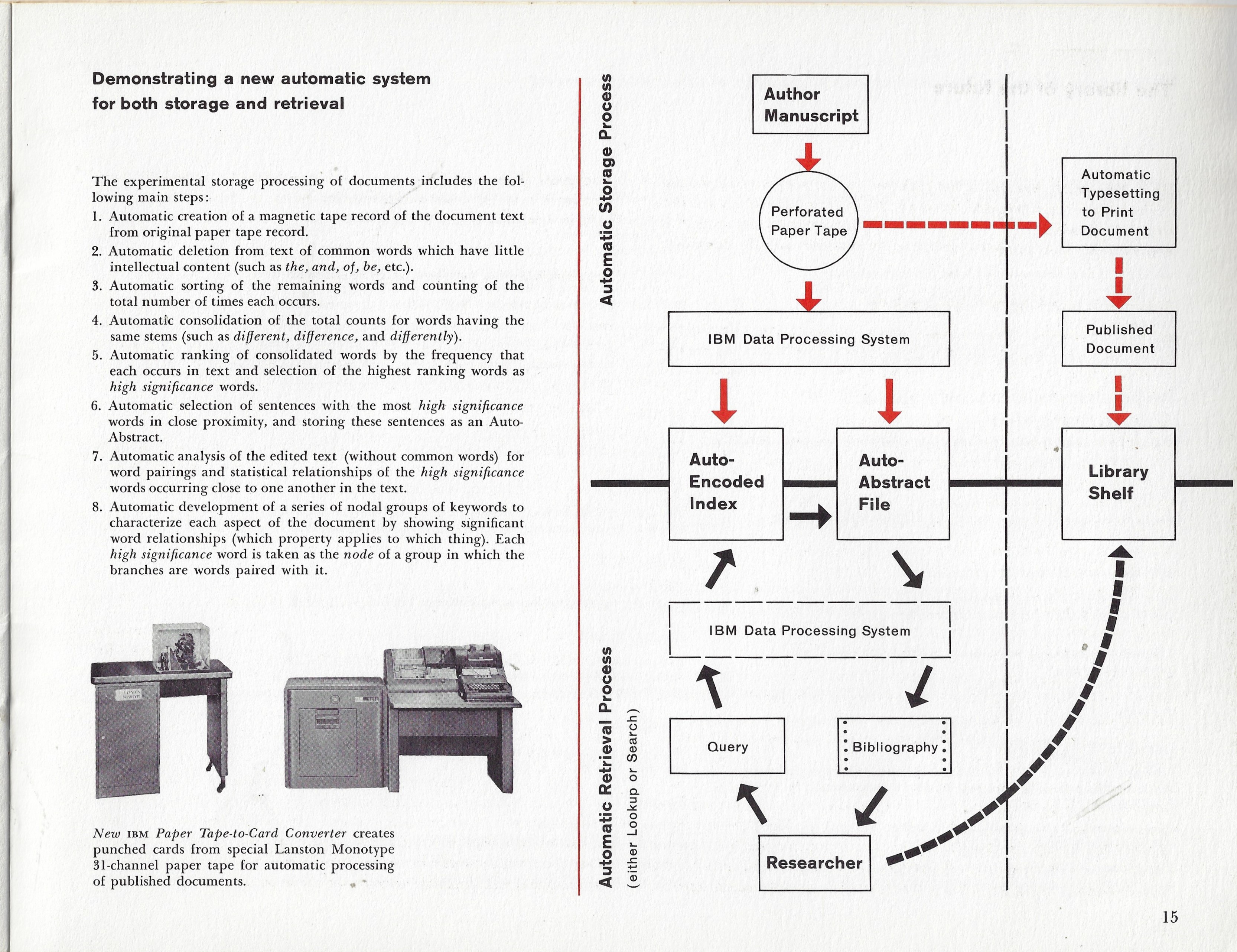
IBM Information Retrieval. IBM, NYC, ca. 1959. (No date but the bibliography cites only 1957 and 1958 “recent” works, and the IBM machine quoted here for this particular use is the RAMAC which was sold beginning 1956. I guess it is possible that this was 1960-1962, though I’d also guess there would be more recent entries in the bibliog.) 8.5”x 11”, 16 pp, illustrated. FINE condition. $125
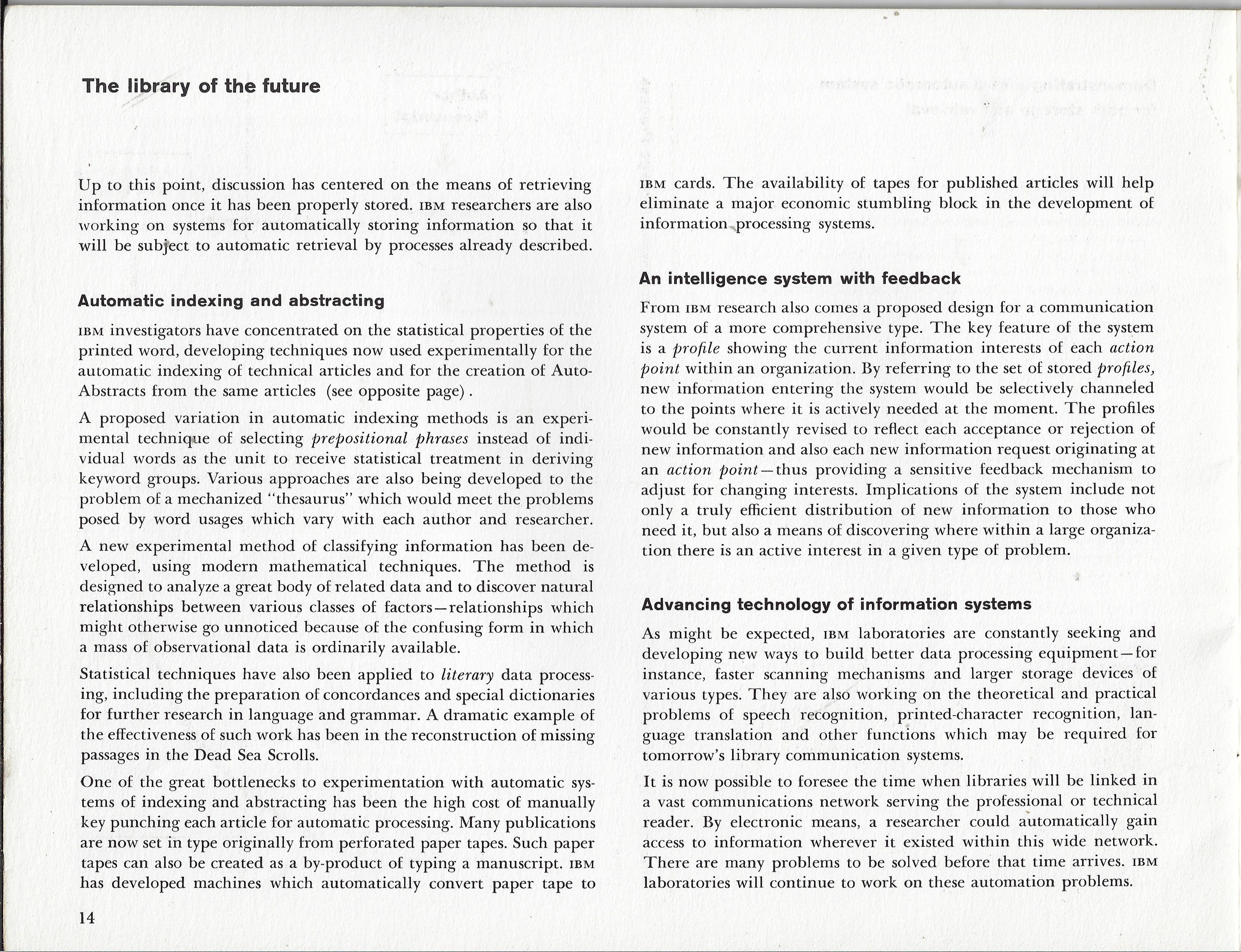
This is summation of the current state of affairs in info storage and retrieval delivered in a how-to schematic step-by-step presentation, concentrating on library applications, and including a tail piece on “the library of the future”, with that schematic reproduced here.
Book Category: Communication
-
The Library of the Future (1960)
·Posted by :
·in:
-
Early Papers on the Hughes Microphone, 1878
Early appearances of David Hughes’s microphone (invented in 1878), in Nature: (1) “The Microphone”, pp 57-8, May 16, 1878. (2) AND WITH Hughes, “Hughes’s Microphone”, in July 11, 1878 Nature, on pp 277-8. (3) AND WITH: “On the Physical Action of the Microphone”, in Nature, June 27, 1878, pp 239-240, by David Hughes. This is offered with the original wrappers. All offered in the weekly issues, removed from a larger bound volume.”Hughes’s microphone, invented in 1878, was the forerunner of the various carbon microphones that were used in most telephones produced in the 20th century. From 1879 to 1886 Hughes performed a series of experiments in which his equipment transmitted wireless signals up to 500 yards.”–Britannica dot com The three issues: $95.00
·Posted by :
·in:
-
A Map of the Slender Aspects of Transoceanic Broadcasting (1935)
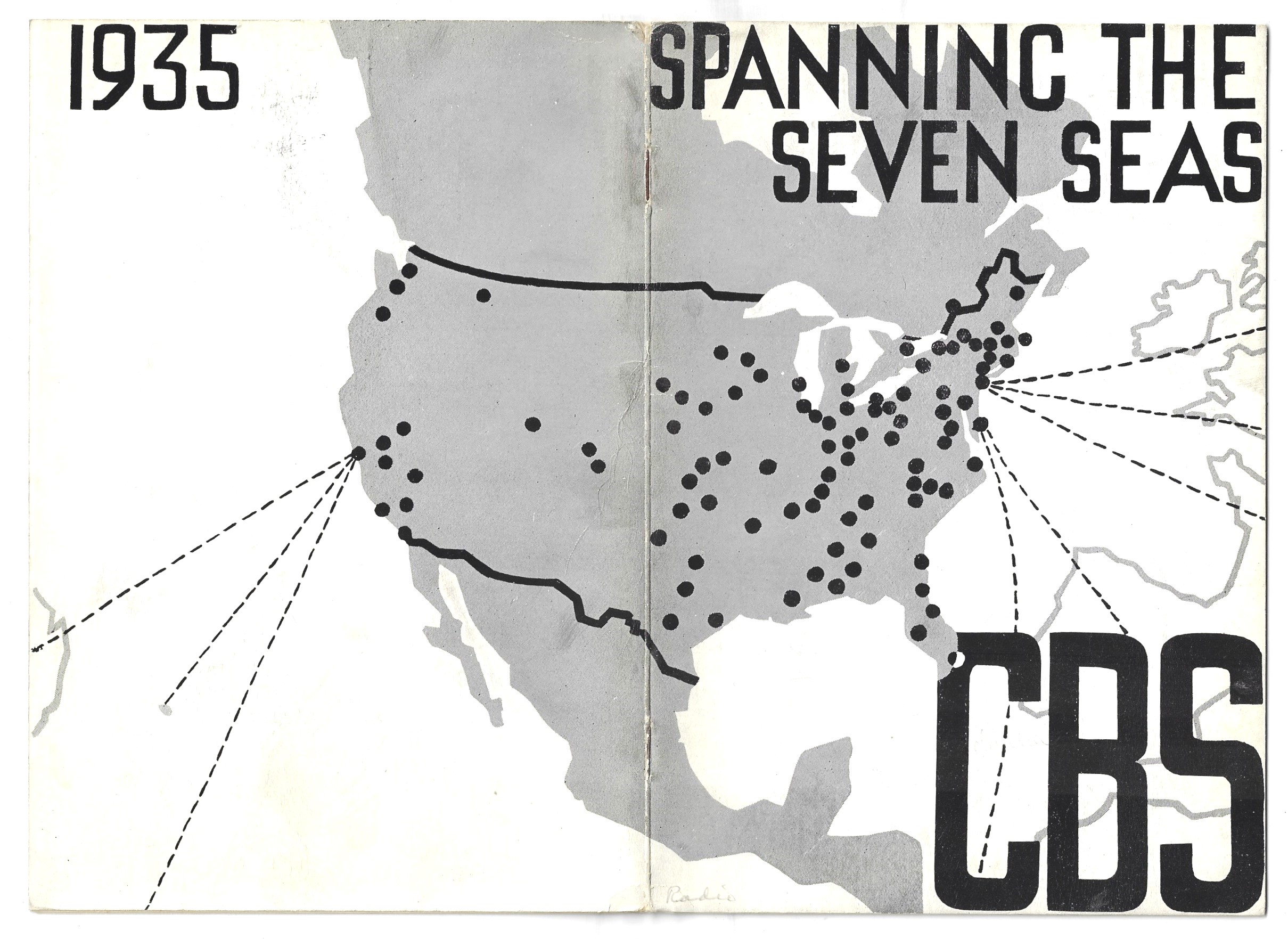
RADIO, Intercontinental. CBS. Spanning the Seven Seas, a resume of Inter-Continental Broadcasting in 1935. Published by the Central Broadcasting System, London, 1935. 8” x 5”, 11pp. Original decorated wrappers. VG condition. Provenance: Library of Congress with their stamp. $75
Curiously there is only ONE copy located by WorldCat (Bibliothek der Stiftung Deutsches Technikmuseum,Berlin).
This pamphlet discusses the CBS (at that time the world’s largest radio network)”affiliates and partners, and the new increase in transoceanic relays (with the “result that all five [sic] of the continents have at various times been linked to each other”). At this point CBS was only about eight years old, starting with 22 station in 1928 and then going over the 100 mark by the late 1930’s.
The cover (front and back) is a revealing insight into the early days of transoceanic radio communication.
·Posted by :
·in:
-
Radio Studio Acoustics (1948)
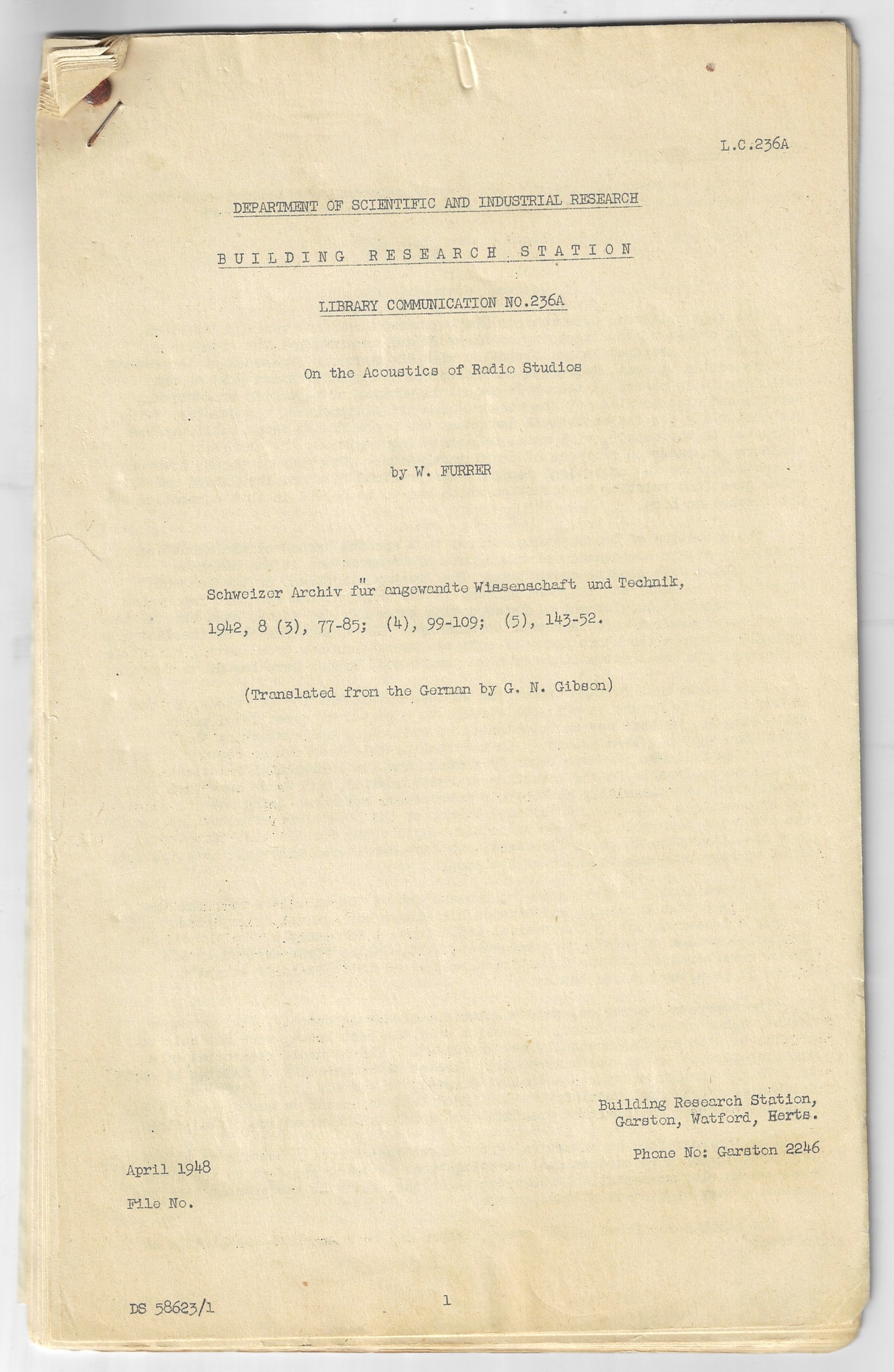
W. Furrer, On the Acoustics of Radio Studios. Department of Scientific and Industrial Research, Building Research Station, Library Communication No. 236A. Printed at BRS, April 1948. 13” x 8” 35 VERY full pages of text and tech discussion, plus 4 large photographic sheets, and one sheet with 4 pasted-on photos. Staple and brass-punch bound. Very Good condition. Scarce, relatively early technical discussion on the subject.Translated from the German by G.N. Gibson from “Schweizer Archiv fuer angewandte Wissenschaft und Tecnik 1942, vol 8 # 3,4,5.
NO copies located in WorldCat for a stand-alone English translation of the original.
·Posted by :
·in:
-
Iron Lighthouses, Aluminum, Engineering and Farm Implements, Non-photographic Photographs, and more (1856)
Journal of the Franklin Institute, Philadelphia, Vol 31 (third series), volume 61 (overall), January-June 1856, 443 pp.,with text illustrations, and three plates, including one folding.. Half-calf, with raised bands. Ex-library, with some scuffing on the spine; also a few stamps on the title page. Nice copy. $225 Contains many articles of interest, including an early report on industrialized aluminum, “nature printing”, the McCormack reaper patent case, lighthouses, the Suez Canal, and a lot more, including:
“Aluminum, the So-Called New Metal”, pp 27-31 and “History and Properties of Aluminium”, pp 65-7. I’d like to point out that I rarely see the hyphenated word “so-called” in the JFI. That said, aluminum had been around for 100+ years at this point, and then first truly described by Wohler, though it wasn’t until the period of this vol of the JFI that aluminum was produced in such a way as to be industrially useful.
Henry Bradbury, “On Nature Printing”, pp 37-39. This was a style of printing in which a sample was impressed on a sheet of soft lead and then electroplated and use as a printing block, the result being some very defined imagery. Bradbury perfects a style of this printing and found it very useful even in the early age of mass-produced photo images.
“The Canal through the Isthmus of Suez”, pp 150-155, with a lovely litho view of the canal;
G. Herbert, “On the Construction of Buoys, Beacons, and other stationary floating bodies”, pp79-84;
J. Vaughan Merrick, “On the History and Construction of Iron Lighthouses, with a description of Coffin’s Patches Light”, pp 145-150, with a lovely lithographic plate.
George Simmons, “Method of Calculating Excavation and Embankment”, pp 1-4;
Edward Allen, “Mechanical Engineering as applied to Farm Implements”, pp 41-45, 138-142 (with text illustrations), 186-190, 258-260, 334-338, 397-406 (to be concluded in the next volume)
C.H. McCormick vs. J.H. Manny, “Law Reports of Patent Cases: the Reaper Case”, pp 176-186;
David Stevenson, “Remarks on Floating and Fixed Lighthouses”, pp 221-227; John W. Nystrom, “Experiments on Sound for the Application of Ringing Bells”, pp 260-266; R.D. Thomson, “On the Condition of the Atmosphere during Cholera”, pp 202-204.
Also:
Erastus W. Smith, “United States Steam Mailer Fulton”, pp 339-340, with a beautiful folding plate of the ship.
·Posted by :
·in:
-
Embroidery by Machinery, Hughes’ Typewriting Telegraph, Submarine Cables, and more (1859)
Journal of the Franklin Institute, Philadelphia, Vol 38 (third series), July-December 1859, with text illustrations, and one (movable) plate, 430 pp. Half-calf, with raised bands. Ex-library, with some scuffing on the spine; also a few stamps on the title page. Nice copy. $150 The volume has many dozens of articles, including the following:
“Supply of Coal”, an interesting approximation of the life of the coal supply, though the common denominator is badly defined. Anyway, the writer was thinking about the future supply of coal, reckoning it at 36,000 years.
Alfred Varley, “On the Physical Theory of Electricity in Submarine Telegraphy, the Electrical Difficulties in Long Circuits…” (on submarine cable communications), pp 52-61, 132-138, 199-206, 259-267;
J.P. Espy, “Joule’s Unit Verified”, pp 254-6;
James H. Warner, “Mechanical Expansion Table”, pp 4-5, with a plate exhibiting the table with a 6” long moving indicator affixed by string, in good working order. (This seems to be the only movable table in the whole of the journal.)
“Fog Signals by Sounds”, pp 61-2;
H. Hyde, “On Professor Hughes’ System of Type-printing Telegraphs and methods of Insulation, with Special Reference to Submarine Cables”, pp 44-51, with a text illustration of the instrument; continued on pp 125-131 (concluded).
George Wallace, “On Embroidery by Machinery”, pp 181-188 (3 text illustrations), 273-277, 337-340 (concluded).
·Posted by :
·in:
-
One of the First Journal Appearances of the Successful Demonstration of the Morse Telegraph and Very Possibly the First Appearance of the “Dots” of the Morse Code (February 1838)
JF Ptak Science Books
“Report on Prof. Morse’s Electro-Magnetic Telegraph“, in Journal of the Franklin Institute, pp 106-108, Philadelphia, 1838; volume 21 (new series) and volume 25 overall, with text illustrations and one folding plate, 442 pp. Half-calf, with raised bands. Ex-library, with some scuffing on the spine and with the ghost remnants of a call number label at spine bottom; also a few stamps on the title page. As a whole the book is fresh and tight. Good/Very Good condition. $750
This may well be the one of the two earliest journal appearances of the successful demonstration of the Morse/Vail electromagnetic recording telegraph (it was not the first demonstration of an electric telegraph nor an electromagnetic telegraph, priority of which belong to Gauss and Wheatstone and others), and is perhaps the very first appearance of the “dot” part of what would become known as the Morse Code.
This was a significant report. As it turns out Morse makes the first public demonstration of his and Alfred Vail’s recording electromagnetic telegraph on January 6 1838 at Speedwell Ironworks near Morristown, New Jersey, just weeks before this JFI appearance. On this success, Morse went south to Philadelphia and demonstrated his invention to the Franklin Institute on February 8, 1838 (summarized in the present report), appearing two weeks later on February 21 1838 midway between Phila and home in Washington D.C., demonstrating the apparatus to President Van Buren and members of the Congressional Committee on Commerce.
This may well be the one of the two earliest journal appearances of the successful demonstration of the Morse/Vail electromagnetic recording telegraph, and is perhaps the very first appearance of the “dot” end of the Morse Code.
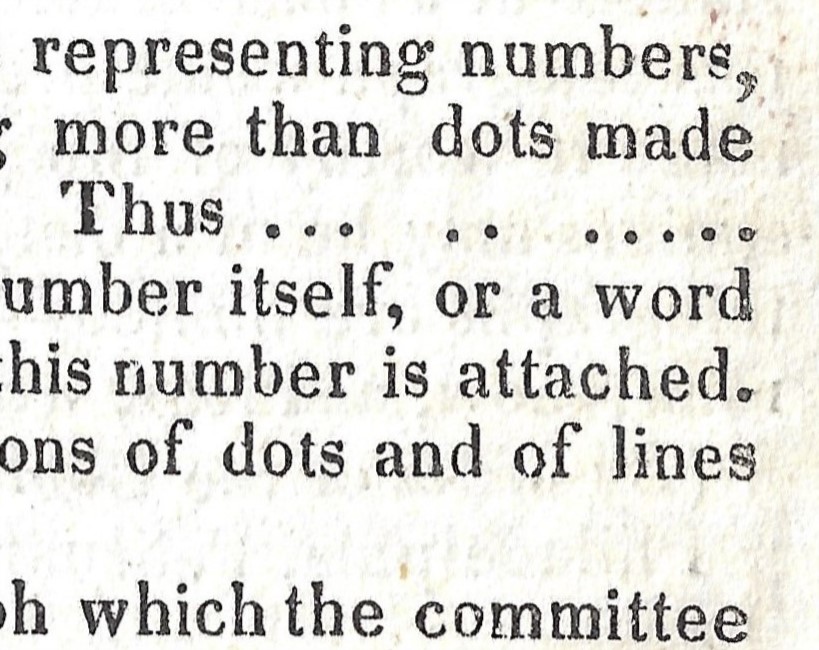
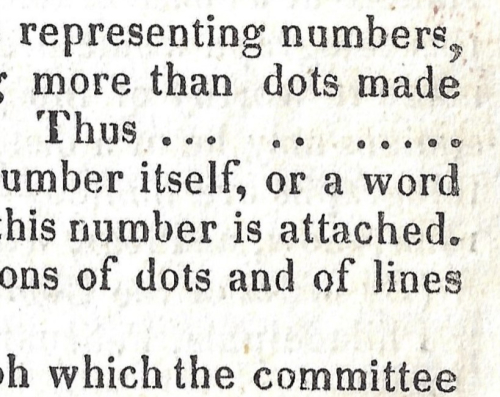
The narrative identifies two systems of signals (“…one representing numbers, the other letters”) that were displayed in the demonstration. The first “representing numbers” were a series of dots. This is perhaps the first publication in a journal of the dot method of transcribed signals of a recording electromagnetic telegraph. The dots are pictured “… .. …..” on page 107, representing the number “325” or as explained could also mean the word represented by the number “325” in Morse’s code book (“indicate…a word in a dictionary, prepared for this purpose…”). The second, “alphabetical signals are made up by a combination of dots and lines of different lengths”), an example of which is not shown.
I have only been able top locate a symbolic system of the code in published journal reports (and a newspaper article) showing a “V” system, as in the American Journal of Science and the Arts (vol 33 #1, 1838), which prints an image of the register, and shows a “specimen of telegraphic writing” using this “V”: so, “V VV VVV” governed by spaces of long and short intervals, would stand for 1,2,3 or 123, or to some word designated “123” in a code book. (I should point out that this article is about half the length of the JFI article.)
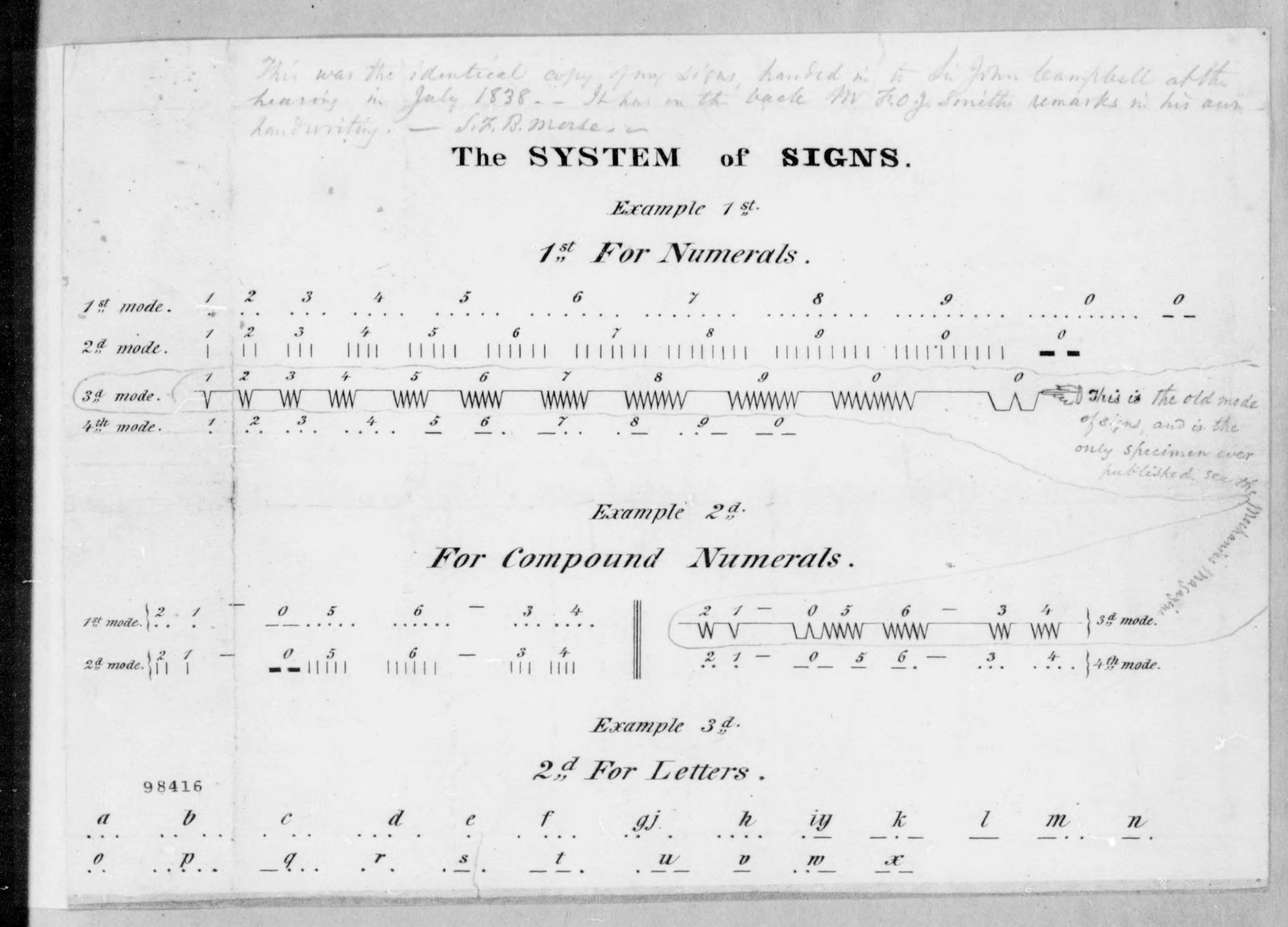
What is surprising is to see what Morse himself had to say on this issue. Here are his notes on the system of notation, from the SFB Morse papers at the Library of Congress, Manuscripts Division, bound volume 28 November 1835-18 April 1838, page 154 (“Drawings to Accompany Copy of Caveat of Oct 6 1837”). The penciled note states “this is old mode of sign and is the only specimen ever published. See the Mechanics Magazine”. It was also evidently published in the American Journal of Science and Arts at about the same time. There is no reference to the JFI report or the “dots” (or “1st Mode”). It may simply be the case that at the time of his writing this that Morse was simply unaware of the JFI report, as the three appearances were all published at about the same time (within weeks of one another).
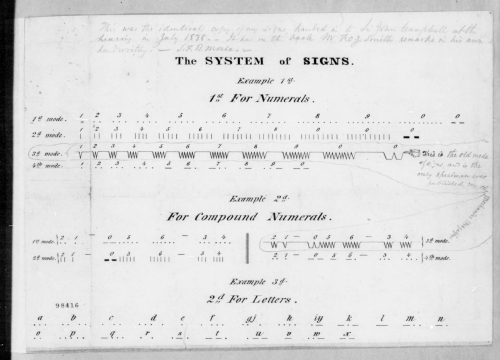
Source: LOC.gov, Manuscripts Division, Samuel F.B. Morse papers.
The famous “first” telegraph “What Hath…”1 transmission (at least seven years after the true “first”) was made of a series of raised symbols corresponding to Morse’s dictionary.
Also bound with:
Charles Goodyear, “Specification of a Patent for divesting Caoutchouc, or India Rubber, of its adhesive properties…” in the March issue, reporting on patent of June 17, 1837, pp 186-188. (Goodyear gets closer to his great and happenstance discovery and innovation the following year, 1839, in which he finally figures out how to prevent rubber from melting in the summer and cracking in the winter.)
“Of Sand, and Hydraulic Sand”, pp 89-94;
Thomas Elliot Harrison, “Specification of a Patent for an Improvement in Locomotive Engines…”, pp 122-123; Hall, “Abstract of the Specification of Mr. Samuel Hall’s Patent Paddle Wheel”, pp 124-5;
J. Reade, “Method of producing a Permanent Soap Bubble, illustrating the colors of thin plates”, pp 65-66;
“On Concrete, Circumstances in which it is advantageous to use it”, pp 145-153;
“Alexander’s Electric Telegraph”.
Notes:
- The full quote, suggested by a young girl, was from Numbers xxiii, 23:
“22…Surely there is no enchantment against Jacob, neither is there any divination against Israel: according to this time it shall be said of Jacob and of Israel, What hath God wrought!
24 Behold, the people shall rise up as a great lion, and lift up himself as a young lion: he shall not lie down until he eat of the prey, and drink the blood of the slain.”
·Posted by :
·in:
-
Earbuds, 1891
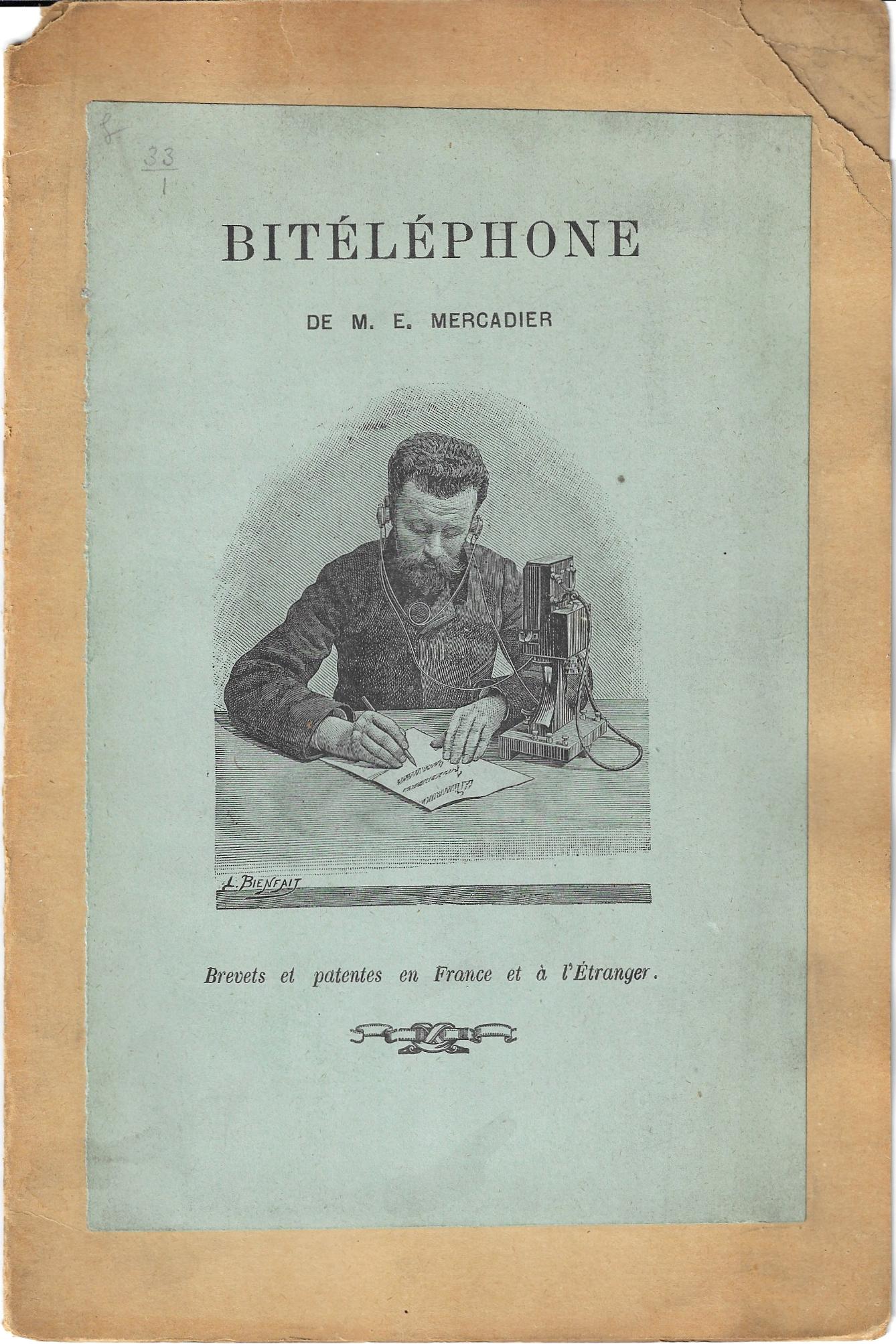
Ernest Jules Pierre Mercadier, Bitelephone. Printed by Jamin in Laval, ca. 1891-3 (though no later than 1893). 21×13.5cm, 15pp, 6 text illustrations showing the device. The author announces that there are patents for his invention at home and abroad: “Brevets et patents en France et a l’Etranger”. This is the original pamphlet in wrappers, though at some very early point the pamphlet was bound into a larger manila-folder-like paper cover measuring 25x17cm; the front wrapper of the pamphlet was removed and pasted on the front cover of the new binding. The rear cover is intact. SO, that said, this is a not-perfect copy of the pamphlet, though the much-reproduced and striking cover is present. PROVENANCE: Library of Congress Smithsonian Deposit, accessed in October 1893. Also, the LC surplus rubber stamp is on the back cover. Good copy. There are NO copies located in WorldCat/OCLC Rare. $1250
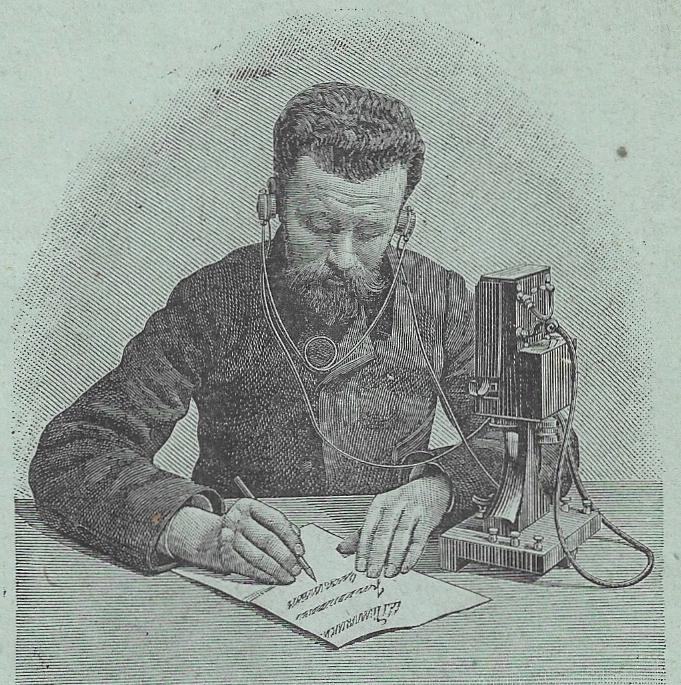
Mercadier (1836-1911, electrical engineer and director at Ecole Polytechnique) may well have introduced the first “ear buds1” into the technical world. His apparatus–small listening devices of 1.752 ounces that were padded and fit into the ear–was made for the operator of a telephone so that they could listen and speak and have free use of their hands for notes and such, as pictured on the front cover of this pamphlet. This would have been a shocking thing to see, I think, back there in 1891, only 15 years into the age of the telephone and about half of that for the time in which the still-a-luxury telephone could be accessed by relatively upper-middle-class folks. (In 1881 there were approximately 50,000 Bell telephone stations; in 1885, the year ATT was formed, there were about 150,000; in 1890, 200k and then 600k in 1900. It was in the first decade of the new century where telephone rental/ownership/accessibility really began to spread, with 2.2 million in 1905 and 5.8 million in 1910. Remember that the telephone was only one aspect of communication–all of the massive amount of infrastructure to connect thousands of telephones wasn’t yet created.) Mercadier was well acquainted with the new device (having written Etudes Sur La Theorie Du Telephone five years earlier in 1886, plus other works on the telegraph and associated beginning in 1881), though what made his instrument so softly revolutionary was that it was one of the first entries into the world of communications microminiaturization–a concept we normally associate with computer development in the middle/late 1950’s. As a “headphone” this device is also extremely early though not the first3, though to my eye it is certainly the most elegant, at least that suited to its purpose. The earbud, even though it appears here in 1891, really takes another ten decades to come into its own.
Notes:
- “Who Made that Earbud?”, NYT, May 16, 2014 https://www.nytimes.com/2014/05/18/magazine/who-made-that-earbud.html
- From the Smithsonian Magazine on Mercadier’s invnetion: “…improvements in telephone-receivers…which shall be light enough to be carried while in use on the head of the operator.” After extensive testing and optimization of telephone receivers, Mercadier was able to produce miniature receivers that weighed less than 1 3/4 ounces and were “adapted for insertion into the ear.” His design is an incredible feat of miniaturization and is remarkably similar to contemporary earbud headphones, down to the use of a rubber cover “to lessen the friction against the orifice of the ear… effectually close the ear to external sounds.” : http://www.smithsonianmag.com/arts-culture/a-partial-history-of-headphones-4693742/#4c4flaaUUVCDrfVX.99 Also a nice notice in an article by The Guardian, “10 Most Influential Headphones”.
- An interesting article in the SVG blog by Mark Schubin (http://www.sportsvideo.org/blogs/?blog=schubin-cafe&news=headphones-history-hysteria) points to the Mercadier device for being perhaps the third earliest headphone, following some others (issuing beginning in 1881) that were earlier but a lot more cumbersome. The Mercadier really were much smaller, more elegant, and a lot lighter than its 19th century companions. That said, the Mercadier device was more a candidate for the earliest earbuds more so than a straightforward headphone.
For a good timeline on the development of the telephone/telephone system, see: http://www.telephonetribute.com/timeline.html
·Posted by :
·in: