A Daily History of Holes, Dots, Lines, Science, History, Math, Physics, Art, the Unintentional Absurd, Architecture, Maps, Data Visualization, Blank and Missing Things, and so on. |1.6 million words, 7500 images, 4.9 million hits| Press & appearances in The Times, Le Figaro, Mensa, The Economist, The Guardian, Discovery News, Slate, Le Monde, Sci American Blogs, Le Pont, and many other places… 5000+ total posts since 2008.

Book Category: Aviation

  • Rare Work on Aviation and Meteorology–No Record in WorldCat


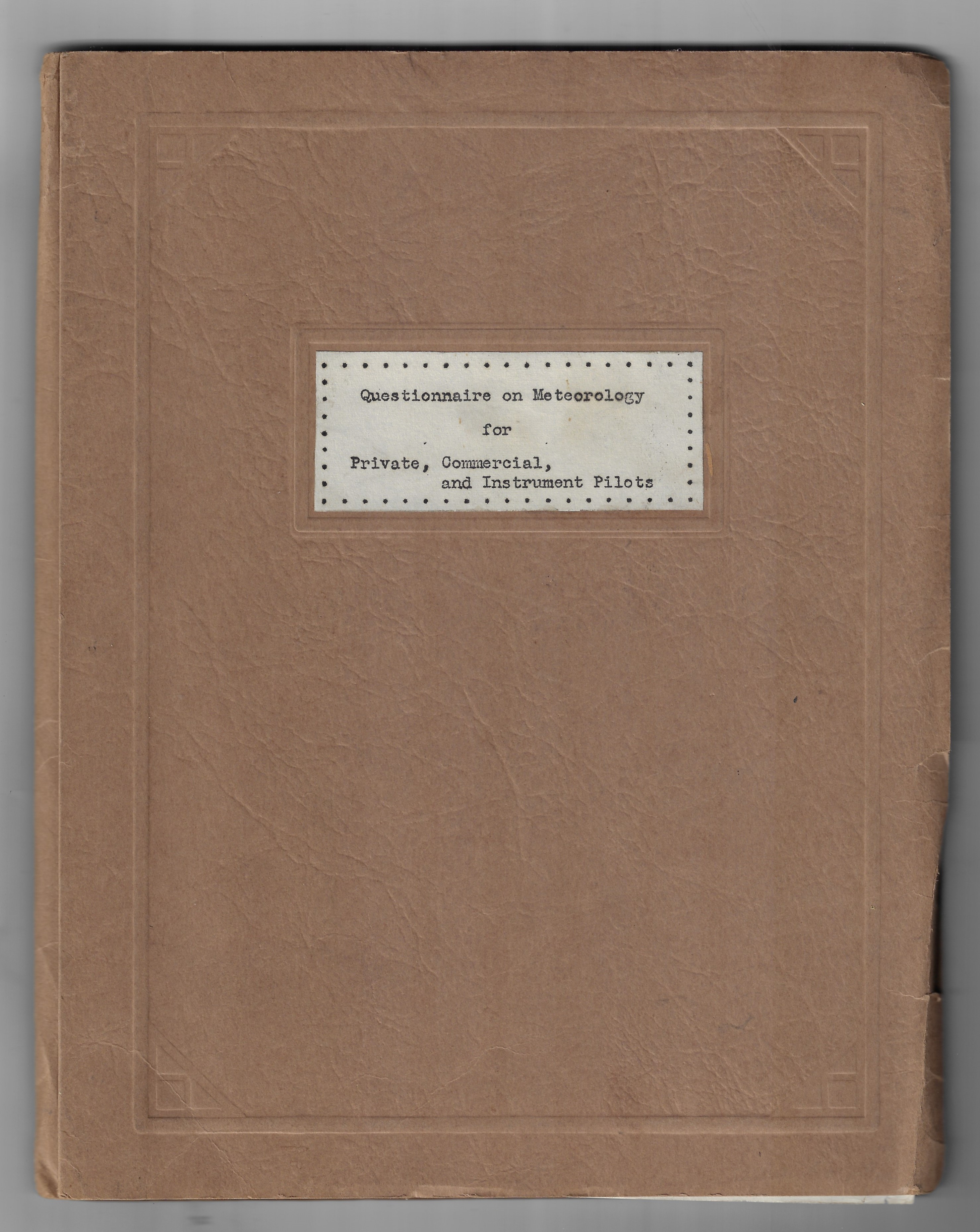
    Questionnaire meteorologyClyde H. Long, Questionnaire on Meteorology for Private, Commercial and Instrument Pilots.  Published by the Flying “L” Aero Service, Bailey, Colorado.  December 1, 1951.  11″x 8.5″, 56 leaves, printed on one side only.  Offset printed, and probably a private production.  Bound in a store-bough folder with a typed paper title.  VG copy. Provenance: Library of Congress, with their rubber stamp on inside front cover.  NO COPIES listed in WorldCat.  $150

    There are 250 multiple choice questions here for study and exam (with answers!)  These are NOT trivial questions.  

    ·Posted by :

    ·in:


  • Internal Spec Sheets for the “China Clipper”–Flying Boat Martin Model 130 (1932)

    Glenn L. Martin Company. Detail Specification for Pan American Long Range Air Mail Flying Boat Martin Model 130. GLM Spec #17, February 23,1932.

    This looks to be some sort of odd photographic reproduction from 1932, produced by GLM Co.. 11”x 8.5”, with 20pp, 2pp, and 5pp. Numerous annotations in a contemporary hand. Rare. No copies located in WorldCat. $500

    It seems as though sheet 2 is missing, though a hand-written note seems to imply (?) that the contents of page 2 is included in an appendix, though I can’t determine that.

    Bound in a metal-clasp heavier paper wrapper, in a Glenn L. Martin portfolio. I assume that this had a very limited distribution, thinking that this was circulated much beyond GLM Co and Pan American.

    This is signed by the VP and chief engineer at GLM, Lessiter C. Milburn (who was one of the first 23 Fellows of the Institute Aeronautical Sciences, 1932, along with such headliners as Lymann Briggs, W. Diehl, Donalf Douglas, Glenn Martin, John Northrup, I. Sikorsky, T. van Karman, and others. He was later president of Balanca Aircraft Corp.)

    “The Martin M-130 was a commercial flying boat designed and built in 1935 by the Glenn L. Martin Company in Baltimore, Maryland, for Pan American Airways. Three were built: the China Clipper, the Philippine Clipper and the Hawaii Clipper…Martin named them the Martin Ocean Transports, but to the public they were the “China Clippers”, a name that became a generic term for Pan Am’s large flying boats – the Martin M-130, Sikorsky S-42, and Boeing 314.”–Wikipedia

    The contents of the work includes a (1) general section (pp 1-19); pg 20 is a list of appendices numbered I, II, and III, though only (2) appendix III (2pp) is bound here. There is a third section (3) “Supplement ‘A’ ”, 5pp., that is not listed as part of the introduction.

    ·Posted by :

    ·in:


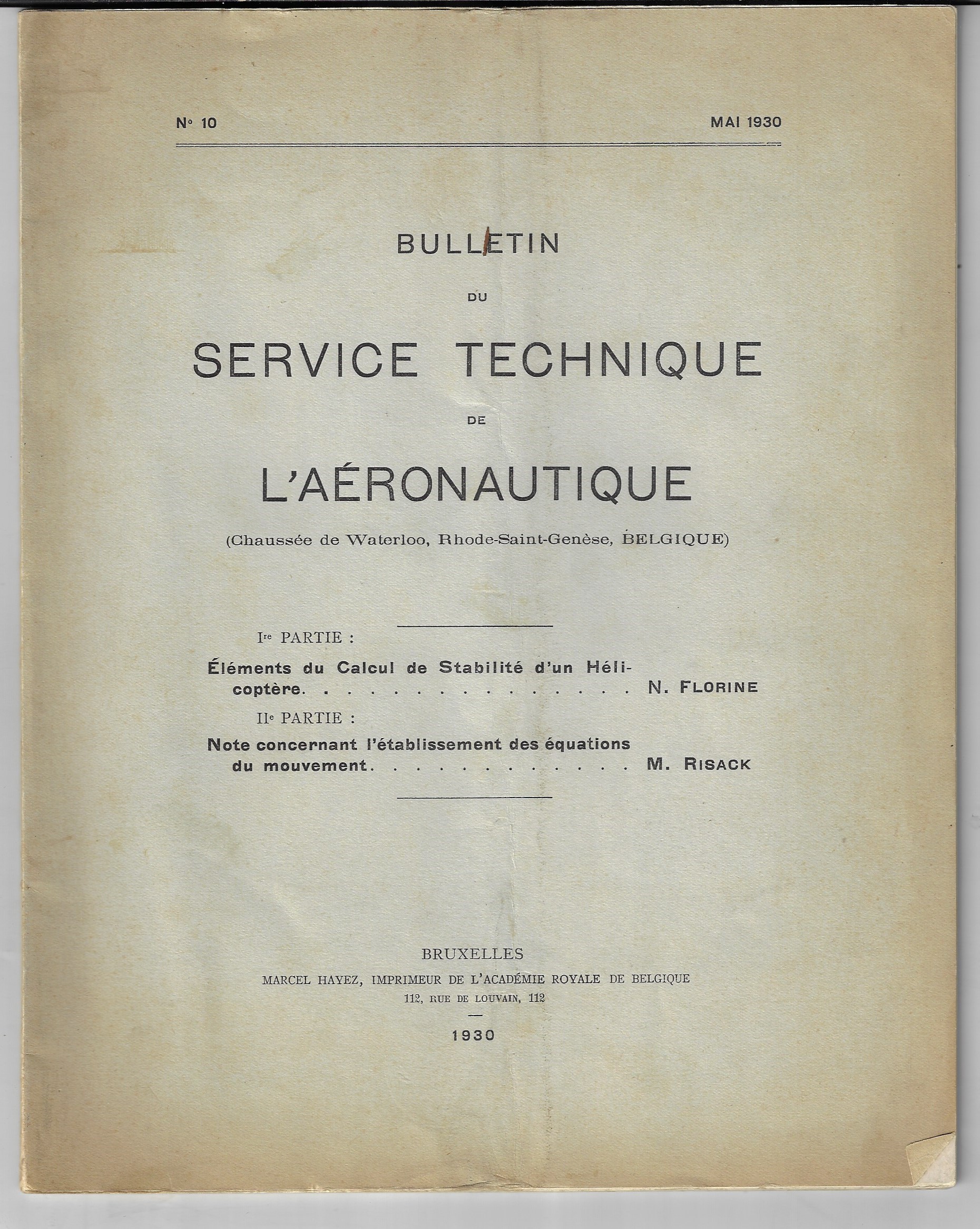
  • Classic and Significant Paper in the History of Helicopters

    Florine, N. “Elements du Calcul de Stabilite d’un Helicoptre” in Bulletin du Service de l’Aeronautique. No. 10, May 1930, pp 1-50. Also with M. Risack, “Note Concernant de l’Etablissement des Equations du Mouvement” on pp 51-55. Original wrappers. There’s an old fold going through the center vertically through the publication, otherwise the publication is a solid VG. Scarce. $200

    • “Nicolas Florine worked at l’Administration de l’aéronautique, based in the buildings of the Hotel des Monnaies in Saint-Gilles (Brussels). In 1926 he was responsible for initiating the Centre d’aérodynamisme …He was involved in the creation of Belgium’s first wind tunnel…The studies Florine performed…in 1926 led to patents related to helicopter control and in particular how to counteract the torque resulting from using two rotors. The results of the studies were published in the article “Eléments du calcul de stabilité d’un hélicoptère”. Herein, the principle was described of a helicopter with two rotors. These rotors turned in the same direction, in contrast to the current tandem helicopters…This publication formed the basis of all his designs that would follow.”—Wikipedia

    Helicopter florine stability 1930


    ·Posted by :

    ·in:


  • Spaceflight and Rocketry Material

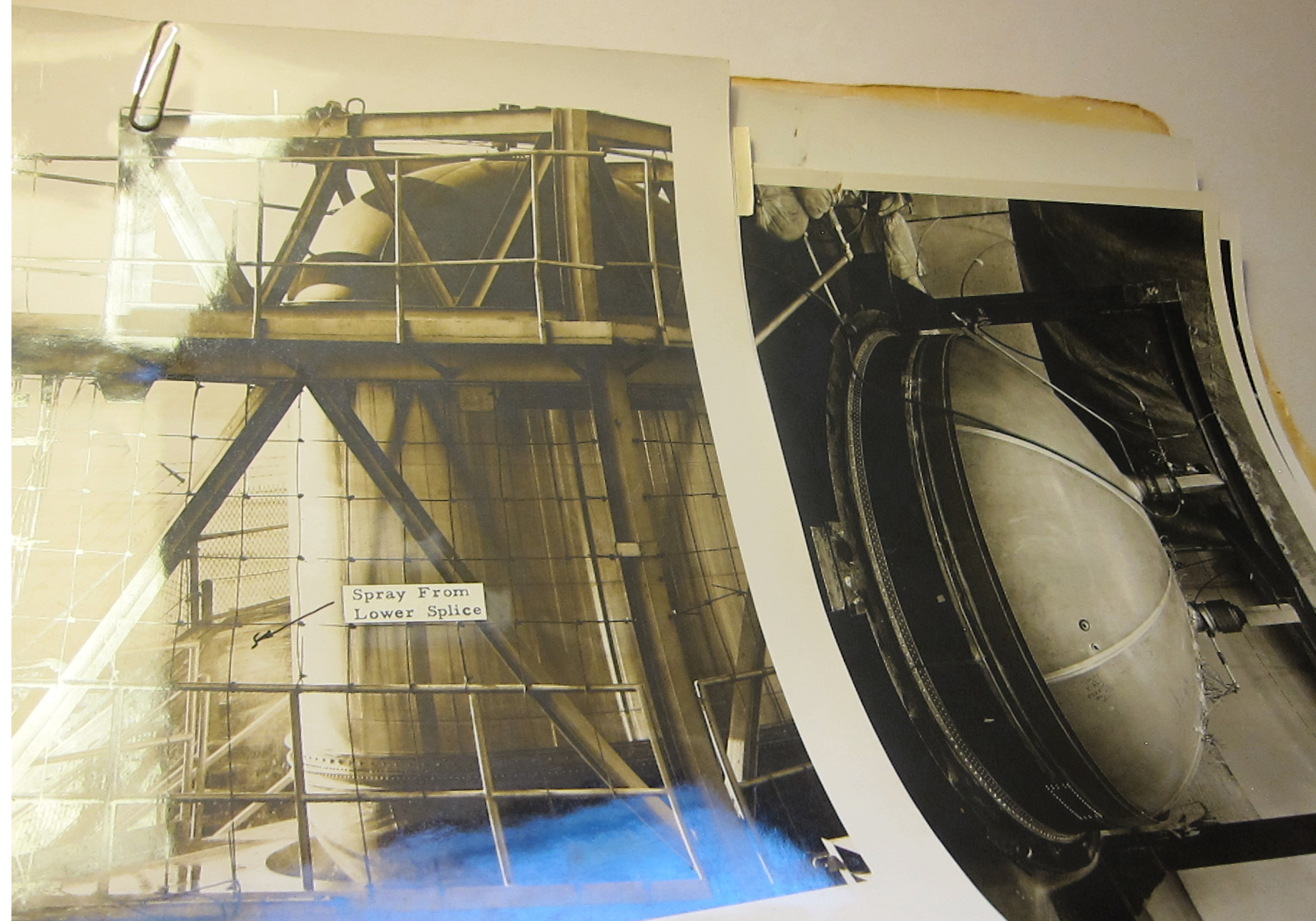
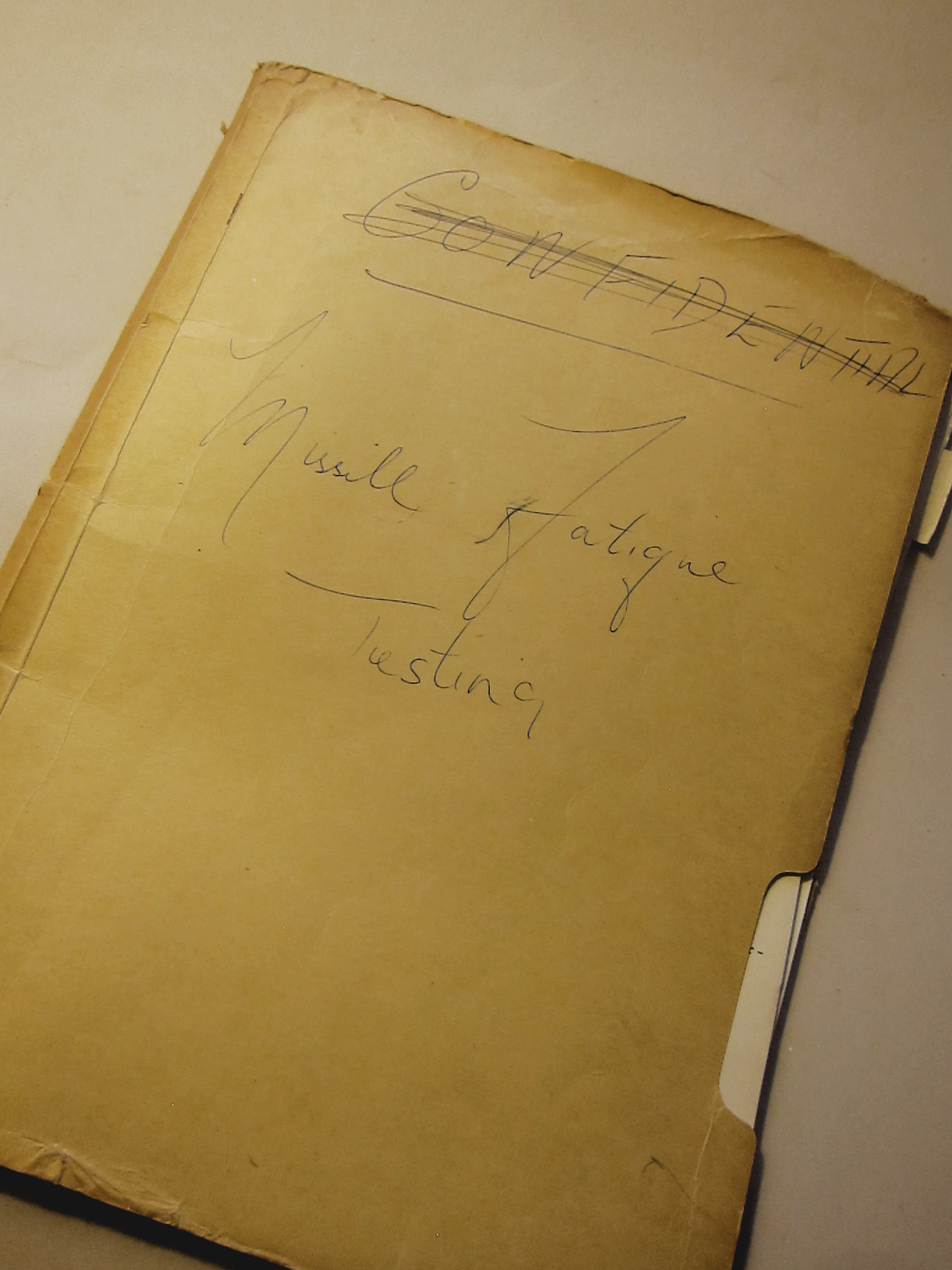
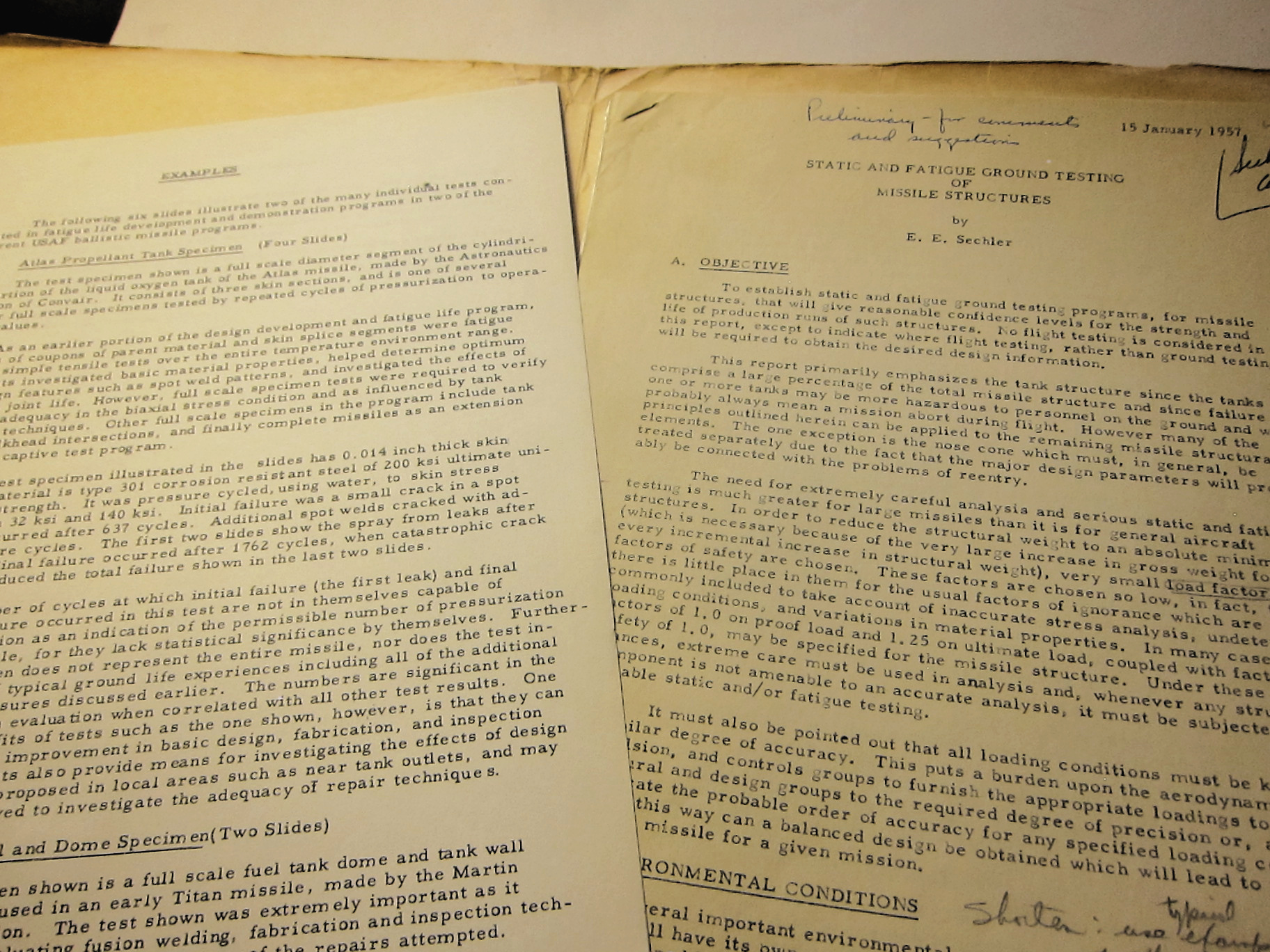
    Sechler, E.E.  Static and Fatigue Ground Testing of Missile Structures.  (“Preliminary–for comments and suggestions” written in ink at top of cover page. Also: “Sechler copy”.) 15 January 1957, 11″x 8.5″, 18 leaves. This is some sort of photomechanical reproduction, I think, with many additions and corrections in manuscript. With six original glossy photos, each 11″x 8″.  Housed in an old manila folder, with “CONFIDENTIAL” crossed out in pen. Very good condition.  $125

    “Ernest Edwin Sechler (1905-1975) was an aerospace engineer and scientist who specialized in thin-shell structures. He earned his doctorate in 1934 at Caltech as one of the early students of Theodore von Kármán with a dissertation on the mechanics of thin-plate compression. ‘A graduate student named Ernest E. Sechler (now a professor of aeronautics at Caltech) was reviewing research in the strength of thin metal plates which had been carried out by the National Bureau of Standards. Sechler reported that the engineers didn’t think that sheet metal could be used to make structural elements in an airplane because the metal would give way…Sechler’s report intrigued me.’—T von Karman, ‘The Wind Beyond’.  Von Kármán showed that by stiffening with re-enforcing strips the “effective width” of metal sheets could be increased to withstand the load aloft. In 1934 Sechler wrote his thesis, The ultimate compressive strength of thin sheet metal panels, under von Karman’s supervision. Development of light, fail-safe structure became the main theme of his professional life.”[1] His thin-wall structures included missiles, booster rockets, and a movable dome for Palomar Observatory. This work was performed as consultant to NASA and industry.”—Wikipedia

    Missile fatigue _3_
    Missile fatigue _3_
    Missile fatigue _3_


    Lewis H. Abraham (in collaboration with the NASA Research Advisory Committee on Missile and Space Vehicle Structures). Important structural research problems for the support of future space missions, prepared by Lewis H. Abraham in collaboration with the NASA Research Advisory Committee on Missile and Space Vehicle Structures. NASA, August 1963. NASA TN D-2059

    10”x 8”, 16pp. Original wrappers. Fine. $50


    M.V. Barton, Important research problems in missile and spacecraft structural dynamics. NASA, TN D-1298, May 1962.  10″ x 8″, 57pp.  Original wrappers. Fine condition.  $50


    J.D. Wood, Factors Affecting the Response of Missiles Excited by Rigid Shock. Space Technology Laboratories, 1960.  STL/TN-60-0000-09031. 11″ x 8.5″, 16pp. Original wrappers. Fine. $25


    John H. Boeckel, The Purposes of Environmental Testing for Scientific Satellites. NASA, Technical Note D-1900, TN D-1900. 1963. 11″ x 8″, 24pp.  Original wrappers. Fine.. $25


    ·Posted by :

    ·in:


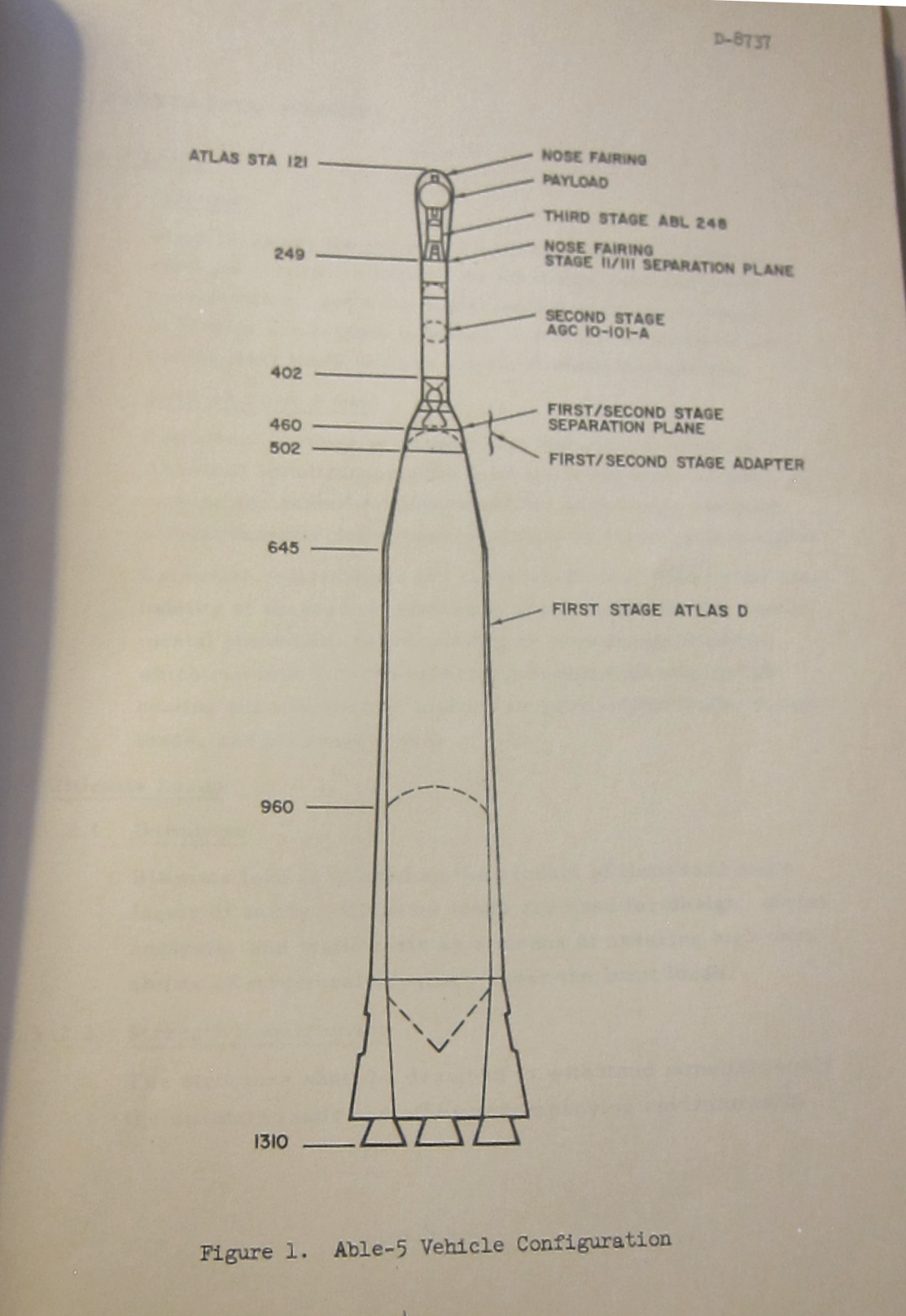
  • An Early U.S. Effort on Lunar Exploration: the Able-5 Rocket (1960)

    Selected Specs _4_Selected Structural Design Criteria Able-5.  Space Technologies Laboratories, Los Angeles, 1960. 

    Printed on 11″x8.5″ sheets (on one side only), (2), 65pp, folding table. This is seems not to be published but distributed internally to Space Technology Laboratories (Ramo-Wooldridge Corp subsidiary), bound in a two-hole punch STL binding. Very Good condition.  $175

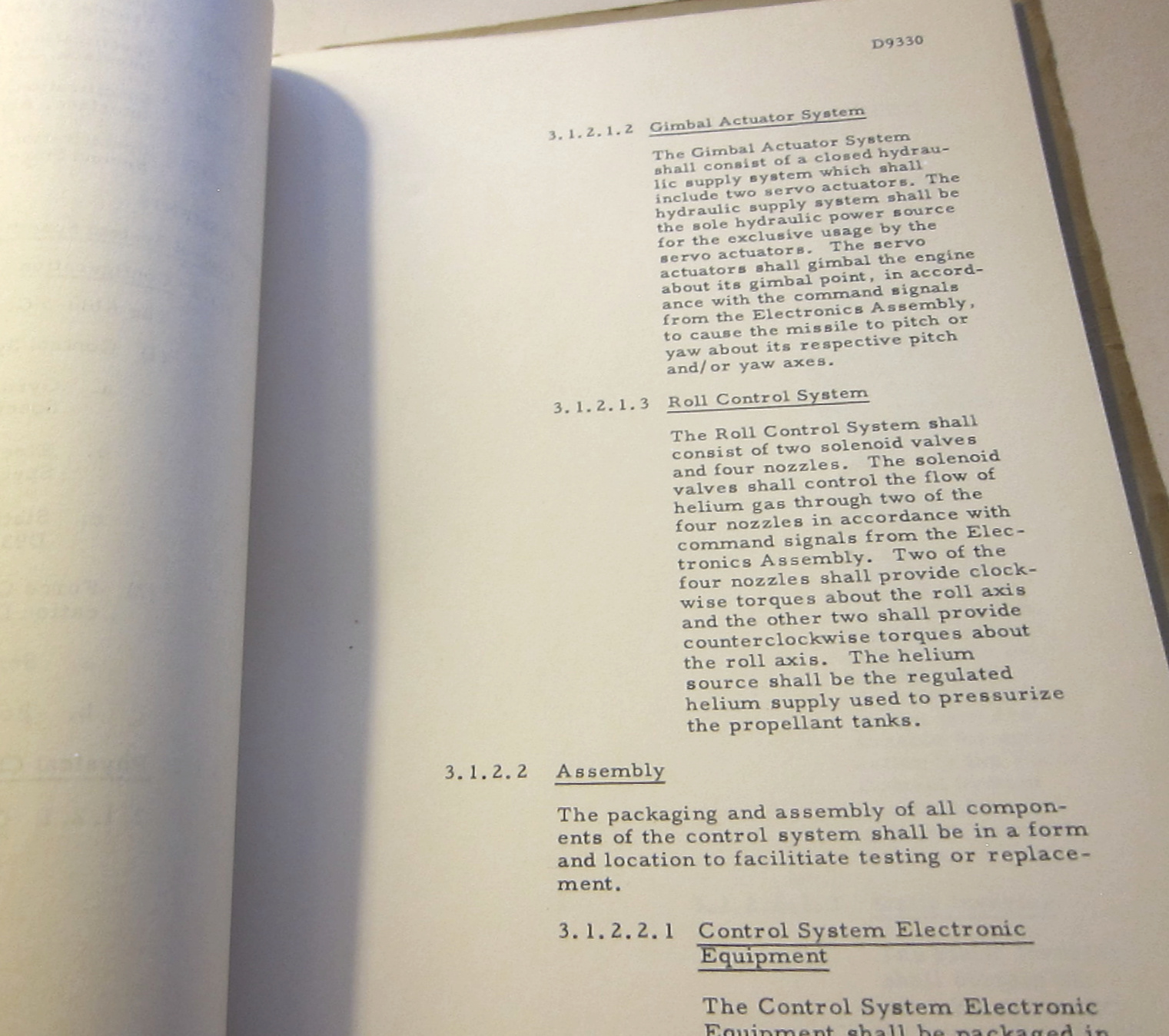
    Includes the following sections: Specifications on Structural Design Criteria (35pp); Specifications for Control System Second Stages  (16pp); Specification for Force Control System, Second Stage Vehicle (16pp); Specifications for Third Stage ((5pp); Specifications for Temperature Control, Payload (3pp). 

    “The first step beyond Earth orbit for the USAF, called Project Able-1, was a series of attempts to place a small spacecraft into orbit around the Moon. These orbiters, along with a pair of small US Army-JPL lunar flyby probes, were part of the ARPA-sponsored Operation Mona, which was approved by President Dwight Eisenhower on March 27, 1958. Three launch attempts made by the USAF between August and November of 1958, now called Pioneers 0, 1, and 2, all failed to reach the …But even before these missions flew, the USAF, in conjunction with the builders of their first lunar orbiters, STL (Space Technology Laboratory, a division of TRW), began to study follow-on missions not only to lunar orbit but also to Venus to be launched during the 1959 launch window…”—Andrew LePage, from his Drew Ex Machina site, “NASA’s Forgotten Lunar Project”

    Selected Specs _2_

    ·Posted by :

    ·in:


  • A Trafalgar of the Air—the Flying Battleship of the Future (1907)

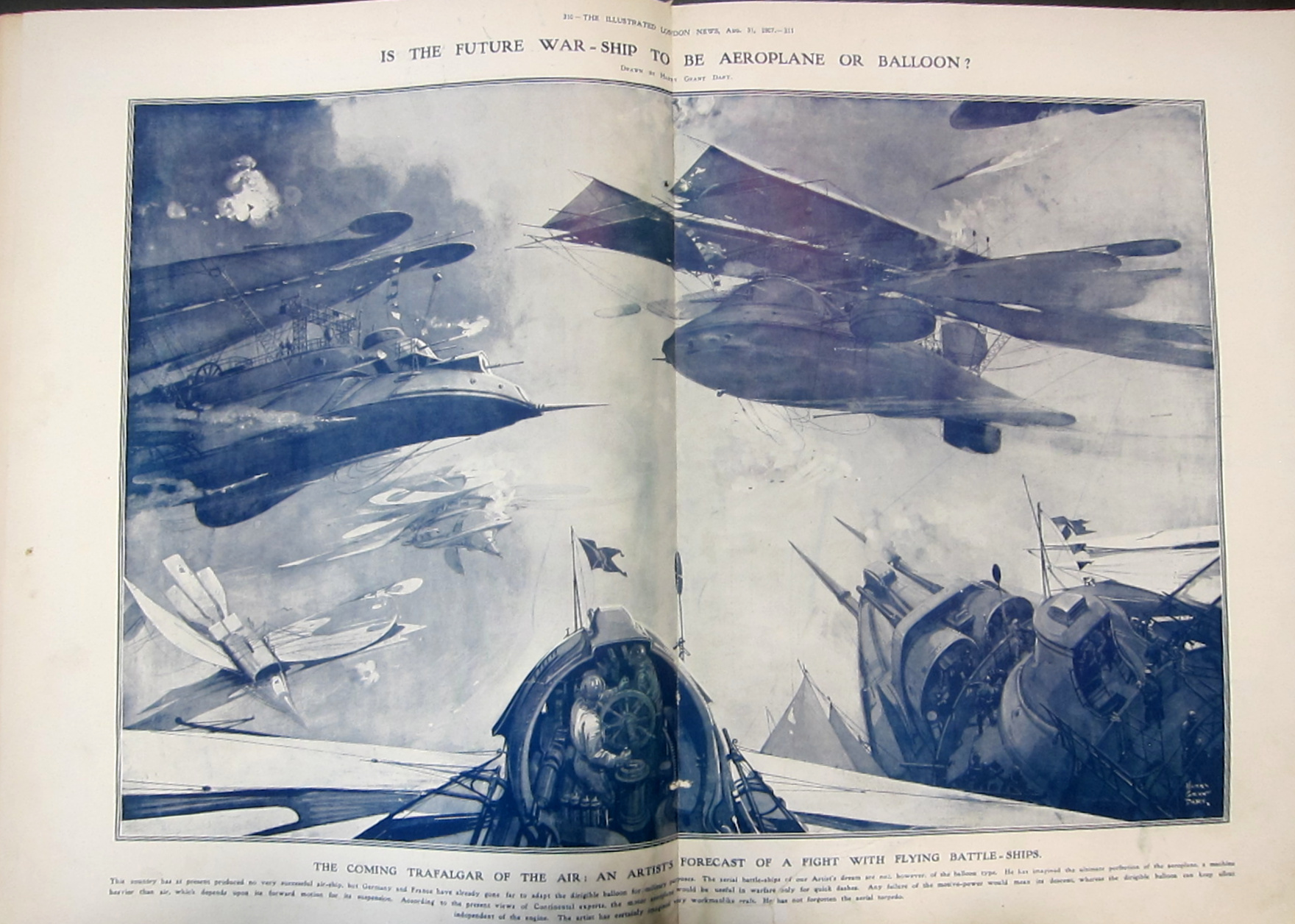
    “Is t he Future War-Ship to be Aeroplane or Balloon?”, a glorious 2pp (16” x 23”) illustration in the Illustrated London News, August 31, 1907, pp 293-328. 16” x 11.5”. Original wrappers, removed from a larger bound volume Good condition. $100

    This image was drawn by Harry Grant Dart only four years after the wrights’ powered flight at Kill Devil. It features four images of enormous aircraft as well as two smaller images, none of these seem to be the balloons in question in the title of the artwork, the artist seeming to have come down on the side of the aeroplane. That said, these aircraft are massive—iterating by the figures on deck the plane was close to 50’ tall with wings that must’ve been 100’ wide. Everything seems to be massively heavy, looking more like steam-fired ships (“flying battle-ships”) than anything else…except for their resemblance to birds and dragonflies.  Also of note in the upper right corner is a missile—an “aerial torpedo—fired at one of the aircraft.

    Harry Grant Dart (1869-1938) was a correspondent, artist, and cartoonist who worked for the New York World, Life, and Judge, whose specialties seem to involve techno-future-vision. 

    ILN Ap 31 1907


    ·Posted by :

    ·in:


  • The First U.S. Woman to Fly as a Passenger in a Plane (1908)

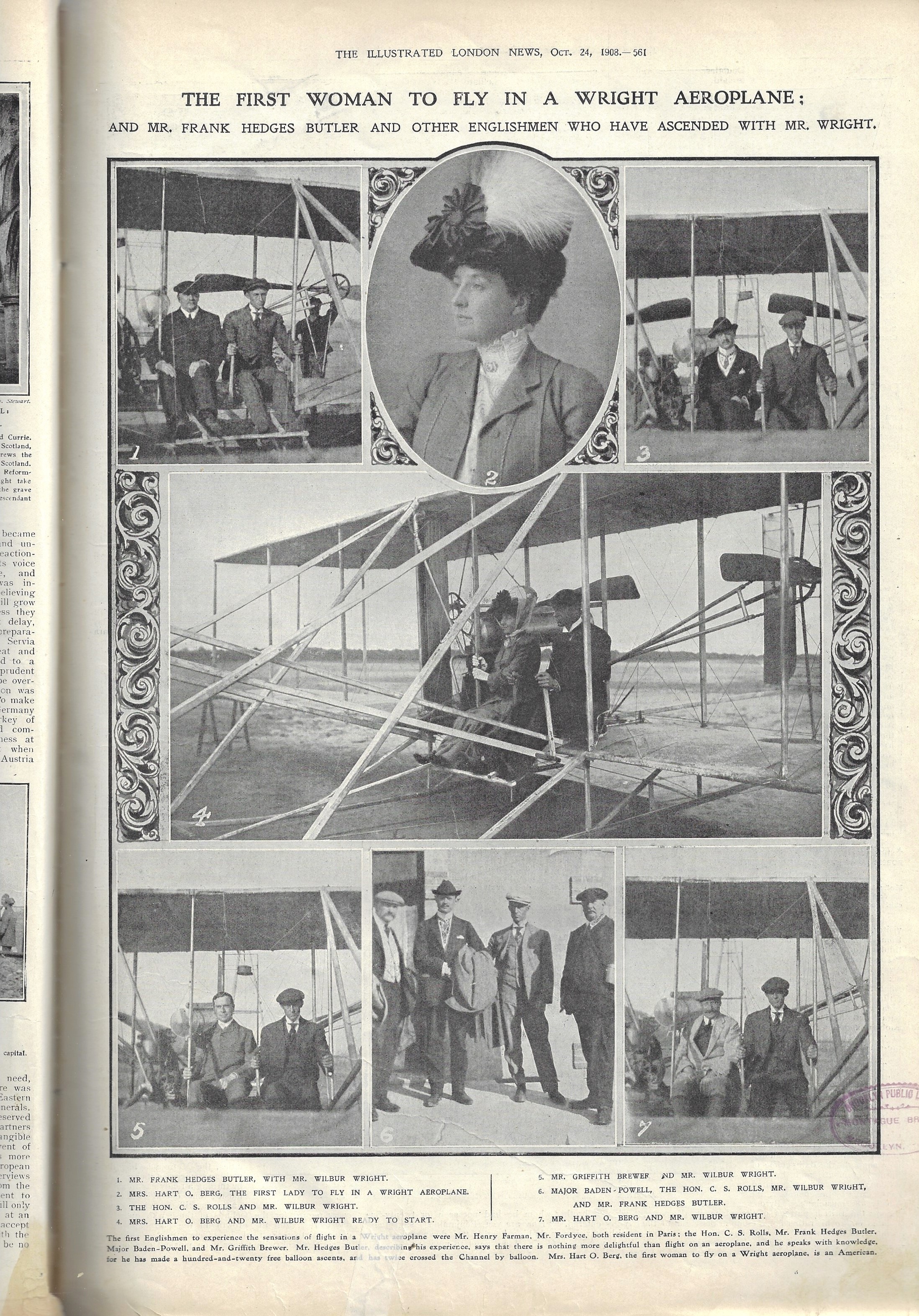
    “The First Woman to Fly in a Wright Aeroplane”

    ILN 1908 wright flyer Mrs bergFull-page picture article “The First Woman to Fly in a Wright Aeroplane: and Mr Frank Hedges Butler and other Englishmen who have Ascended with Mr. Wright”, in Illustrated London News, October 24, 1908 issue (No. 3627 vol 133). The weekly issue of 30 pp printed on a heavier, semi-gloss paper, removed from a larger bound yearly volume, with the spine showing signs of the removal; also a small oval rubber stamp on page bottom right corner from previous owner. G-VG copy, otherwise.  $125

    The main subject here is Edith Berg, wife of Hart O. Berg, the European rep of the Wright’s  business interests  (and who helped Wilbur personally through his long stay on the continent). She was the first American woman to fly as a passenger in an airplane, and the first woman in Europe to fly in a Wright airplane. Lovely 6-photo full-page story on pg 561.

    “When Mrs. Hart O. Berg watched Wilbur Wright demonstrate the Wright Flyer at Le Mans, France, she was so thrilled by the performance that she asked Wilbur for a ride. Thus, in September 1908, she became the first American woman to fly as a passenger in an airplane, soaring for two minutes and seven seconds.”—National Air and Space Museum

    ·Posted by :

    ·in:


  • Scarce Aviation Atlas (1938)

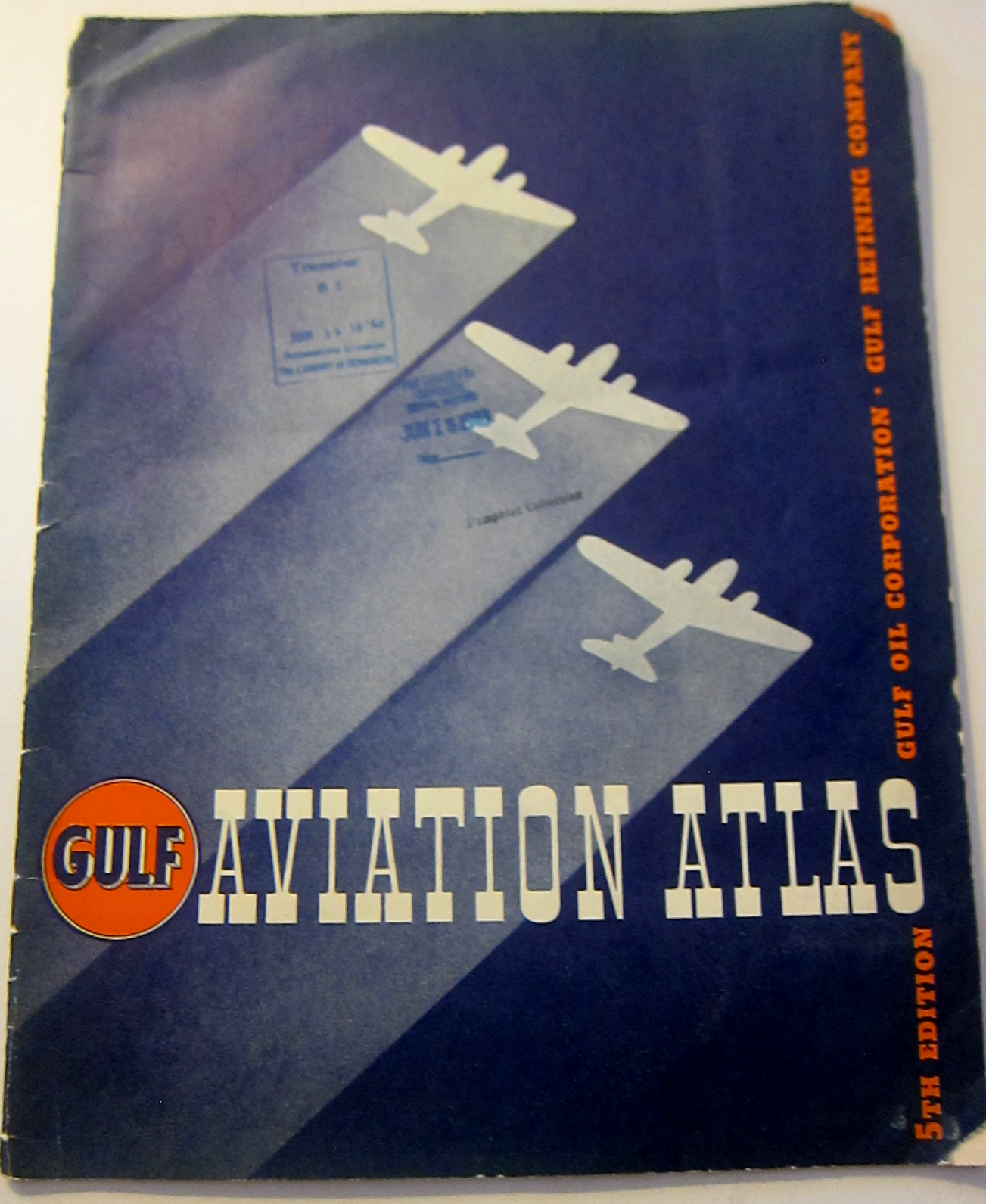
    Aviation Atlas _4_ cvrGulf Aviation Atlas. Gulf Oil Corporation, Gulf Refining Company. 5th edition, 1938. 12.25″ x 9.25″, 32pp, illustrations and maps. Heavy printed wrappers with some few chips here and there. Provenance: Library of Congress, with three of its stamps on the front cover. It turns out that this is a scarce item, little located. Good copy.  $75

    • The nice thing here is that  in addition to the 5 pp of maps of various sorts of air service, there’s a lot of data–for example, there’s a chronology section (in small print) that is really rather good; there are also graphs of bits of aviation history, as well as an illustrated sheet on different varieties of airplane maneuvers.  Quite nice, really.  

    ·Posted by :

    ·in:


  • Early Aviation, 1843

    Cayley, George and William Henson, and others: papers in Journal of the Franklin Institute, Philadelphia, volume VI (third series) and vol 36 (overall). 429pp.  Half calf. Ex-library, with evidence of a call number slip on spine bottom and a large bookplate on front pastedown, The front joint is a bit sprung, and there’s scuffing on the spine. Good copy. $225  

    Cayley, George. “Retrospect of the Progress of Aerial Navigation, and demonstration of the Principles by Which it must be governed”,  in Journal of the Franklin Institute, August, 1843; pp 132-134.  

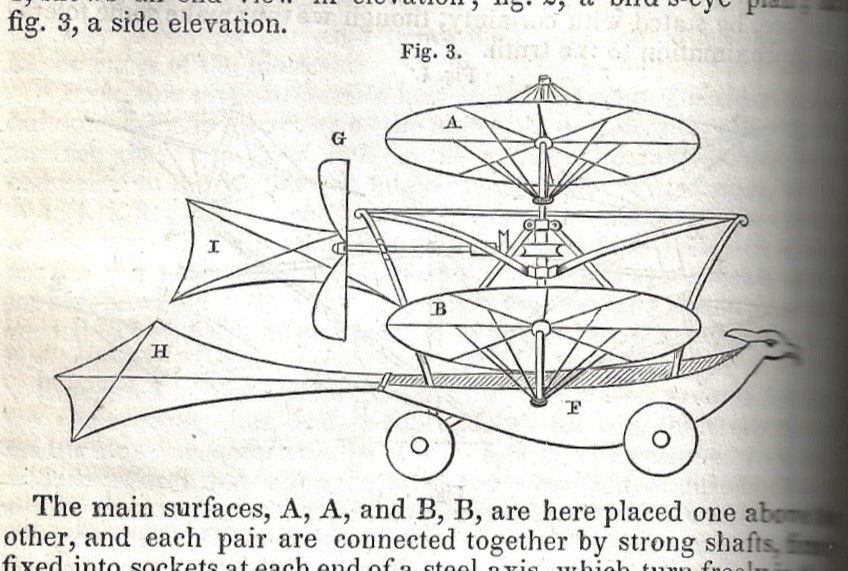
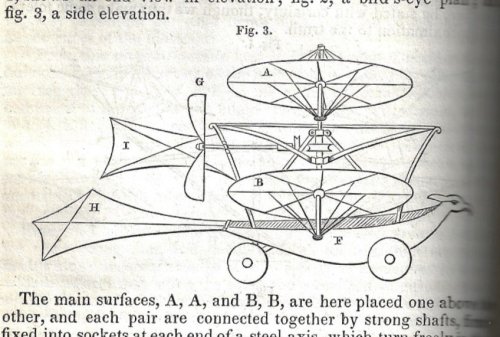
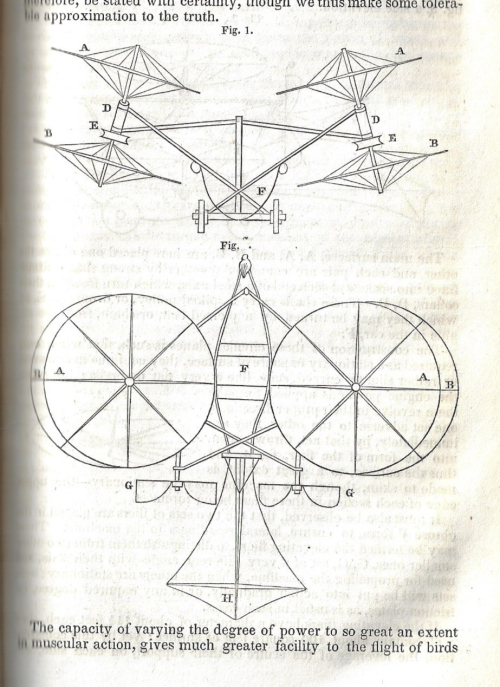
    _____.  “On the Principles of Aerial Navigation” September 1843,  volume 6 (third series) vol 36 overall; pp 203-209, 4 charming figures in text. (Original appearing in the London Mechanic’s Magazine April 2, 1842.)

    “Now widely regarded as ‘The Father of Aeronautics’, Sir George Cayley (1773-1857) evolved the idea of an aircraft with fixed wings, in which the principle of lift was separated from the propulsion system, and in which inherent stability, as well as tail-unit control-surfaces, must be incorporated.”–Royal Aeronautical Society website intro to Cayley.
    JFI 1843 Cayley _2_
    JFI 1843 Cayley _2_

    AND:

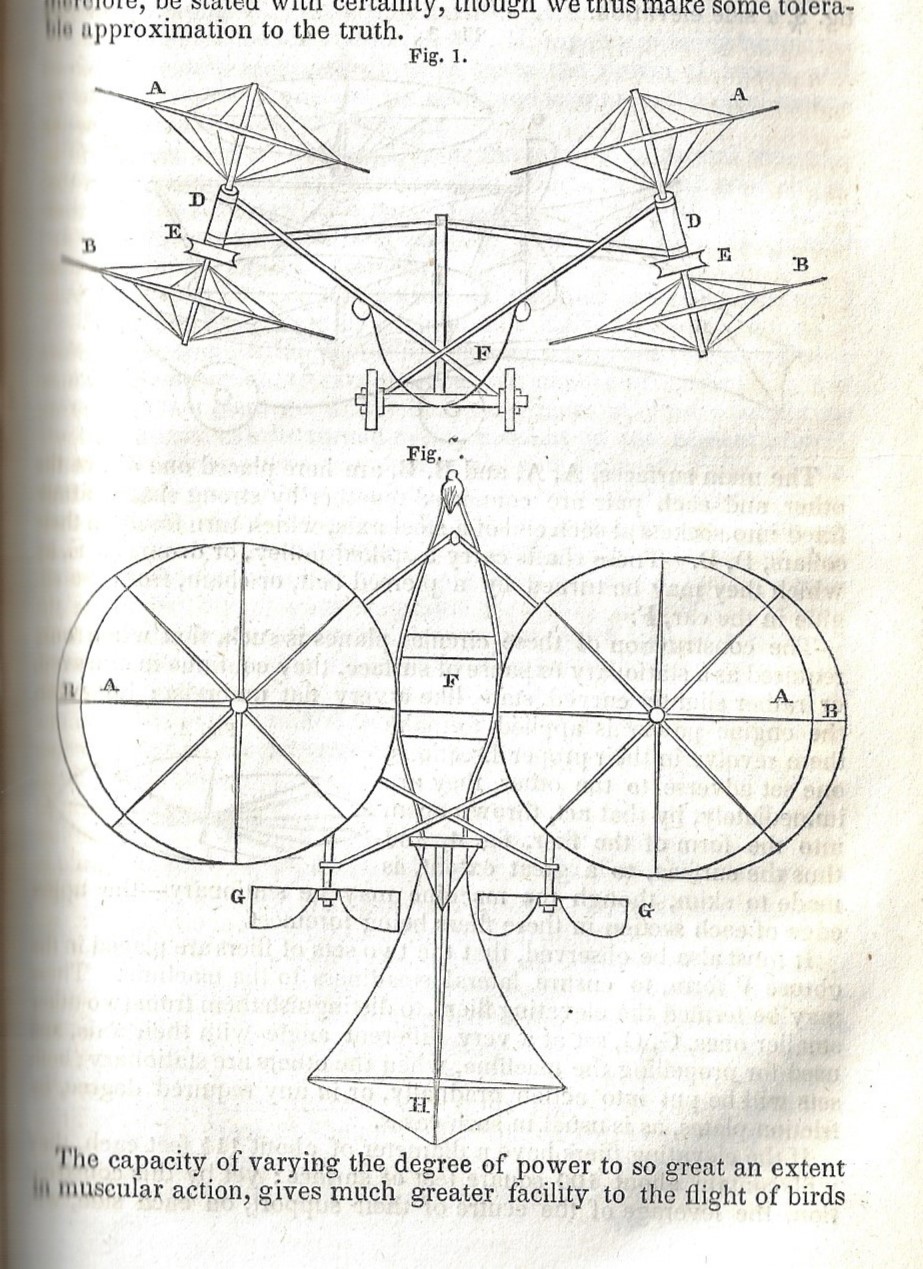
    [William S. Henson,  1812-1888]  “On the Steam Power of Mr. Henson’s Flying Machine”, pp 281-2, with 4 text illustrations.  “The aerial steam carriage, also named Ariel, was a flying machine patented in 1842 that was supposed to carry passengers into the air. It was, in practice, incapable of flight since it had insufficient power from its heavy steam engine to fly. A more successful model was built in 1848 which was able to fly for small distances within a hangar. The aerial steam carriage was significant because it was a transition from glider experimentation to powered flight experimentation.”–Wikipedia

    Michael Faraday, “Ont he Electricity evolved by the Friction of Water and Steam Against Other Bodies”, p. 283

    Also bound in this volume: J.F.W. Herschel, “On certain improvements on Photographic Processes described in a former Communication, and on the Oarathermic Rays of the Solar Spectrum”, pp 187-190. “Report on the best Modes of Paving Highways”, pp 145-168, 

    And:

    J.C. Loudon, “The Principles of Landscape-Gardening and Landscape-Architecture applied to the Laying out of Public Cemeteries  and the Improvement of Churchyards…”, a paper in four parts, on  pp 46-54, 89-98, 182-190, 265-269. 
    ·Posted by :

    ·in:


  • Floating Transoceanic Airport Network, 1936–from the White House Library

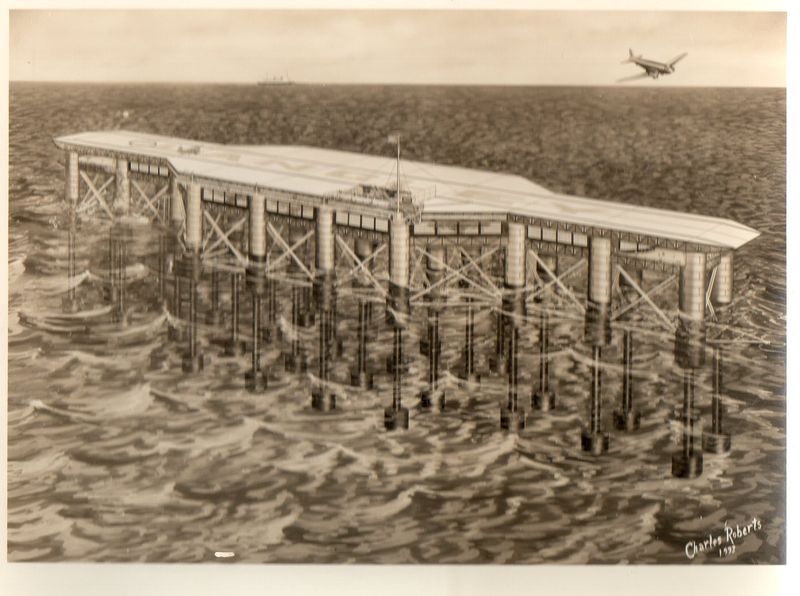
    DocFile (5)Edward R. Armstrong (1880-1955). Application of Seadrome Ocean Dock Corporation (a private corporation) for a Loan Under the Provisions of the National Industrial Recovery Act, printed ca. 1933.  11×8 inches, 34pp.  With two original photographs one of the floating airports, and a map.  This copy comes from the White House Library, transferred to the Library of Congress in 1933. Printed wrappers. There is a Library of Congress surplus stamp on the rear cover, ans a tiny “LC” perforated stamp at the bottom of page one. Very nice copy.  $500 

    The outline for this plan asks the federal government for a loan of $30 million (Depression) dollars to undertake the construction of a five floating airports transoceanic network.  “It will require the work of approximately 10,000 men per month for a period of twenty-four to thirty months”.  The labor figures did not include was what necessary to produce all of the material necessary for the project ( for reasons unknown).  Once finished the network would enable aircraft  to make it across the ocean in 18 to 36 hours.

    The members of the Seadrome Corporation estimated that the entire 30 million would be paid back by 1945,  and that the corporation would be completely debt-free.  Perhaps all of  this made sense when Armstrong first developed the plan in 1913, just ten years after the Wright brothers’ successful first in North Carolina. The idea of the floating airport girding the Atlantic was a pretty interesting idea, seeing as how the world record for sustained non-stop flight in 1913 was 11 hours (in a Maurice Farman MF-2), and that was under more-or-less optimal conditions; the speed record was 120mph, and again, optimal conditions and not sustained for hours on end.  By 1933 it seems to me that it had become obvious that non-stop transoceanic flight was coming, and coming soon.  That would of course make an investment in the Seadrome project superfluous, like building an antique, though an unnecessary one. The first transatlantic non-stop flight was made by John Alcock and Arthur W. Brown in 1919, averaging about 100mph; Lindbergh would come later to accomplish the first solo non-stop in 1927–by the early 1950’s jet aircraft would be making the trip with regularity, which means that  for most of the life of the completed Seadrome it would have been unnecessary.  I feel certain that the Seadrome–which was supposed to be paid off by 1945, though in 1933 there was no inkling on the part of the Corporation members who wrote the request for the money that a war was looming and that there would have been almost no way for them to have been made at any time between 1939 and 1945–would never have been paid for.Armstrong’s idea would get major play in the popular press from time-to-time, and discussed as a series of floating islands.  Armstrong himself would organize the Seadrome Ocean Dock Corp. in the late 1930’s, his pretty but  impractical idea (reported by Time Magazine1 in 1933 as little more than “a perennial gift to Sunday feature editors”)  finally grinding to a salty end with greater fuel capacity and efficiency in transatlantic aircraft. 
    Seadrome152

    Notes:
     

    ·Posted by :

    ·in: