Cayley, George and William Henson, and others: papers in Journal of the Franklin Institute, Philadelphia, volume VI (third series) and vol 36 (overall). 429pp. Half calf. Ex-library, with evidence of a call number slip on spine bottom and a large bookplate on front pastedown, The front joint is a bit sprung, and there’s scuffing on the spine. Good copy. $225
Cayley, George. “Retrospect of the Progress of Aerial Navigation, and demonstration of the Principles by Which it must be governed”, in Journal of the Franklin Institute, August, 1843; pp 132-134.
_____. “On the Principles of Aerial Navigation” September 1843, volume 6 (third series) vol 36 overall; pp 203-209, 4 charming figures in text. (Original appearing in the London Mechanic’s Magazine April 2, 1842.)
“Now widely regarded as ‘The Father of Aeronautics’, Sir George Cayley (1773-1857) evolved the idea of an aircraft with fixed wings, in which the principle of lift was separated from the propulsion system, and in which inherent stability, as well as tail-unit control-surfaces, must be incorporated.”–Royal Aeronautical Society website intro to Cayley.
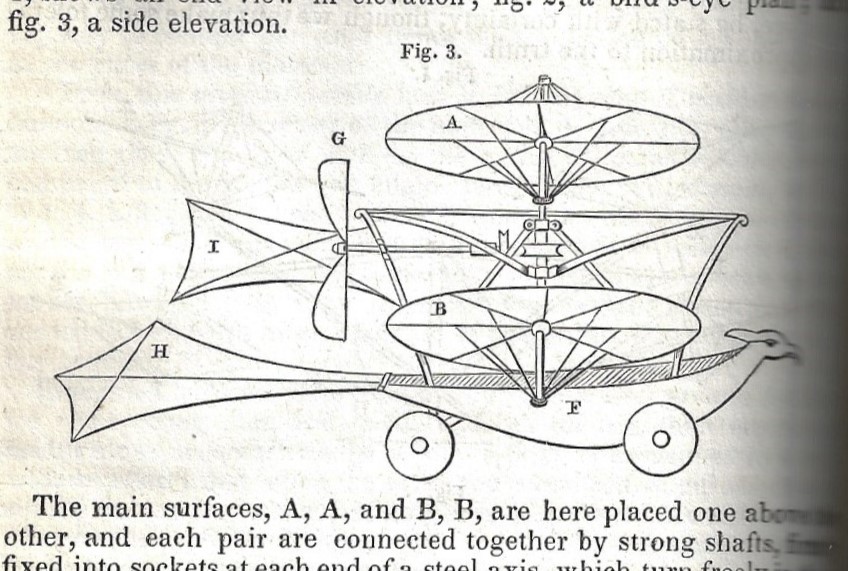
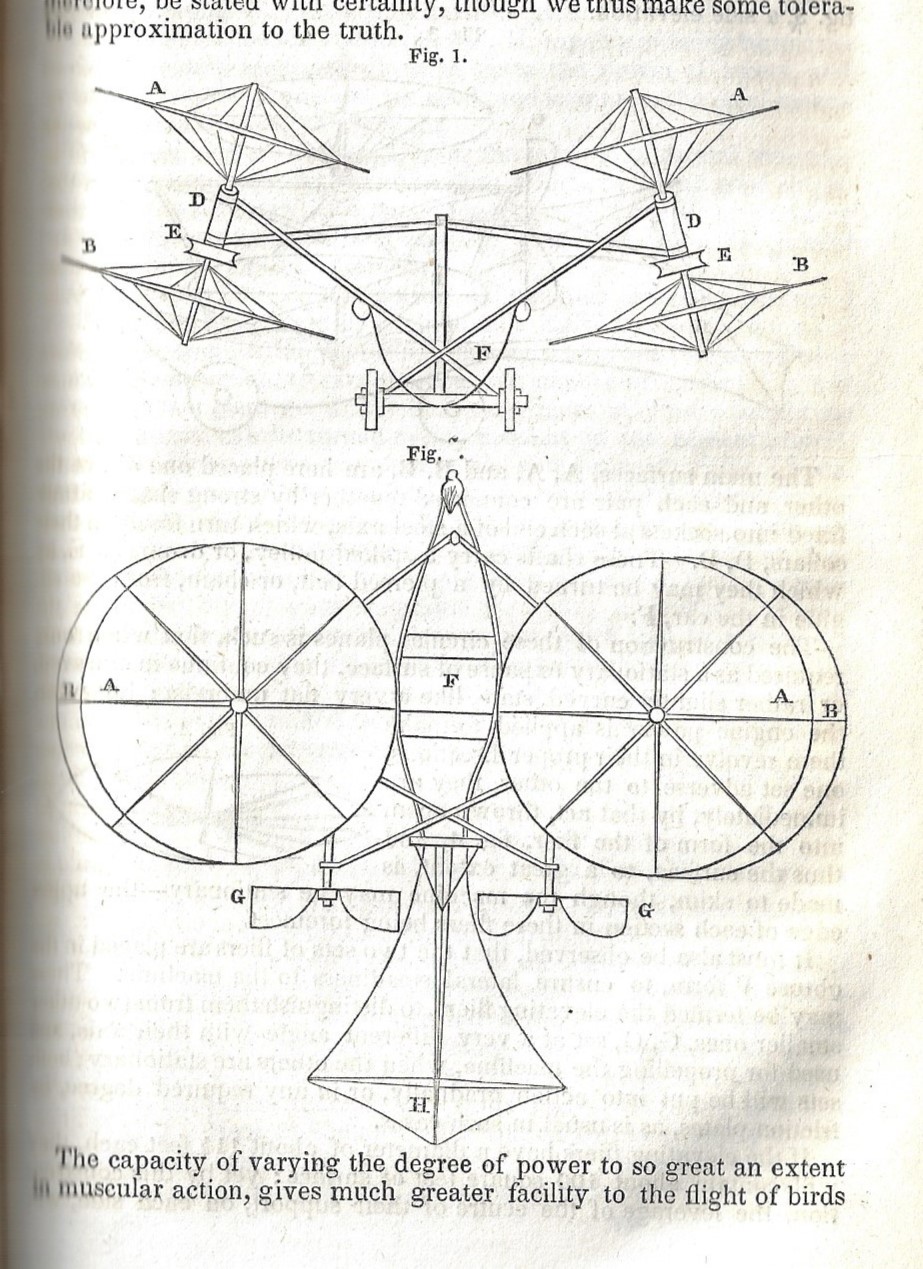
AND:
[William S. Henson, 1812-1888] “On the Steam Power of Mr. Henson’s Flying Machine”, pp 281-2, with 4 text illustrations. “The aerial steam carriage, also named Ariel, was a flying machine patented in 1842 that was supposed to carry passengers into the air. It was, in practice, incapable of flight since it had insufficient power from its heavy steam engine to fly. A more successful model was built in 1848 which was able to fly for small distances within a hangar. The aerial steam carriage was significant because it was a transition from glider experimentation to powered flight experimentation.”–Wikipedia
Michael Faraday, “Ont he Electricity evolved by the Friction of Water and Steam Against Other Bodies”, p. 283
Also bound in this volume: J.F.W. Herschel, “On certain improvements on Photographic Processes described in a former Communication, and on the Oarathermic Rays of the Solar Spectrum”, pp 187-190. “Report on the best Modes of Paving Highways”, pp 145-168,
And:
J.C. Loudon, “The Principles of Landscape-Gardening and Landscape-Architecture applied to the Laying out of Public Cemeteries and the Improvement of Churchyards…”, a paper in four parts, on pp 46-54, 89-98, 182-190, 265-269.