A Daily History of Holes, Dots, Lines, Science, History, Math, Physics, Art, the Unintentional Absurd, Architecture, Maps, Data Visualization, Blank and Missing Things, and so on. |1.6 million words, 7500 images, 4.9 million hits| Press & appearances in The Times, Le Figaro, Mensa, The Economist, The Guardian, Discovery News, Slate, Le Monde, Sci American Blogs, Le Pont, and many other places… 5000+ total posts since 2008.

Book Category: Particle Physics

  • Oppenheimer, Gamow, Feynman, Szilard, Bohr, Bethe, Rabi, and others in the Monumental “Physical Review” for 1939


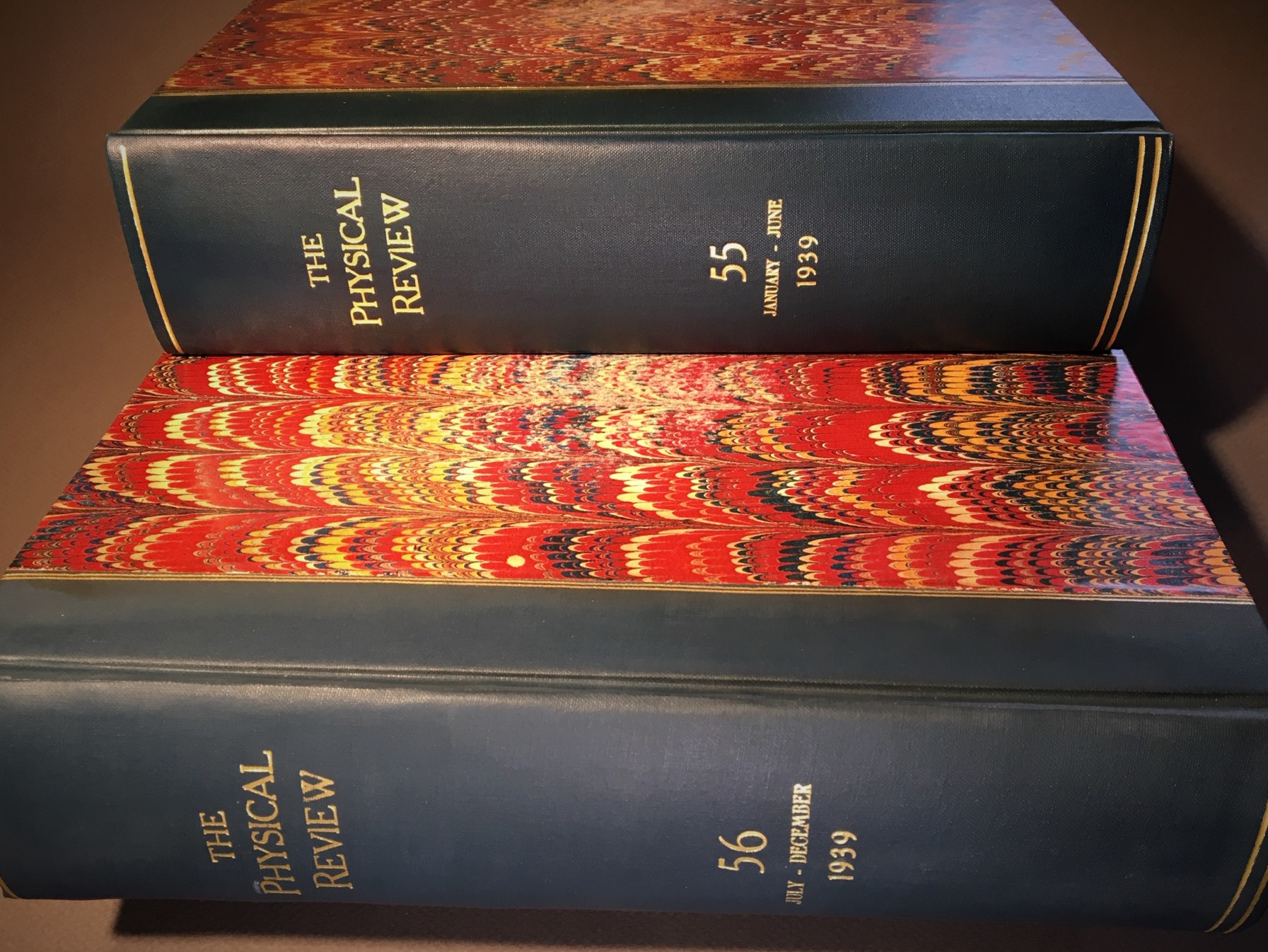
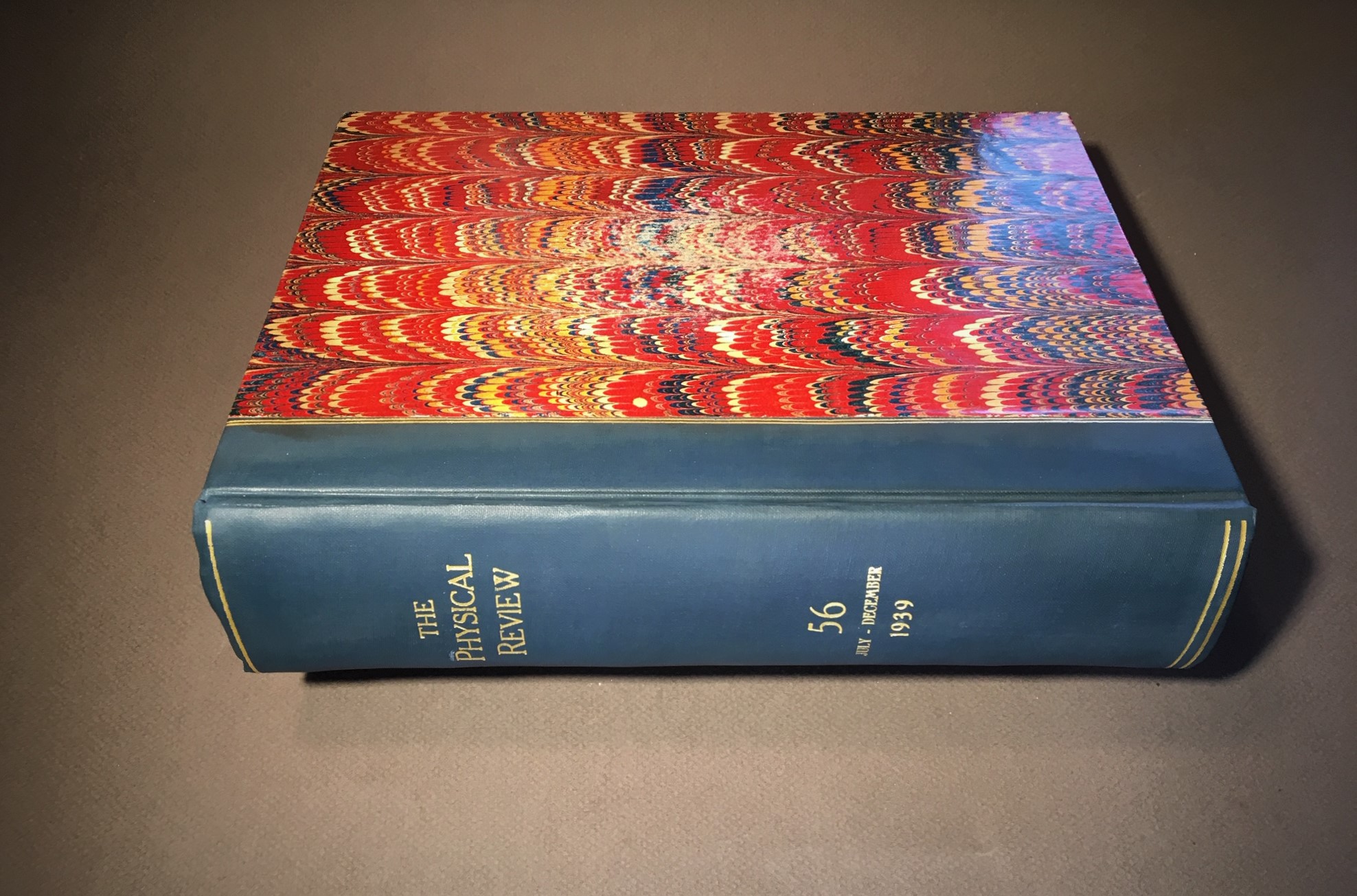
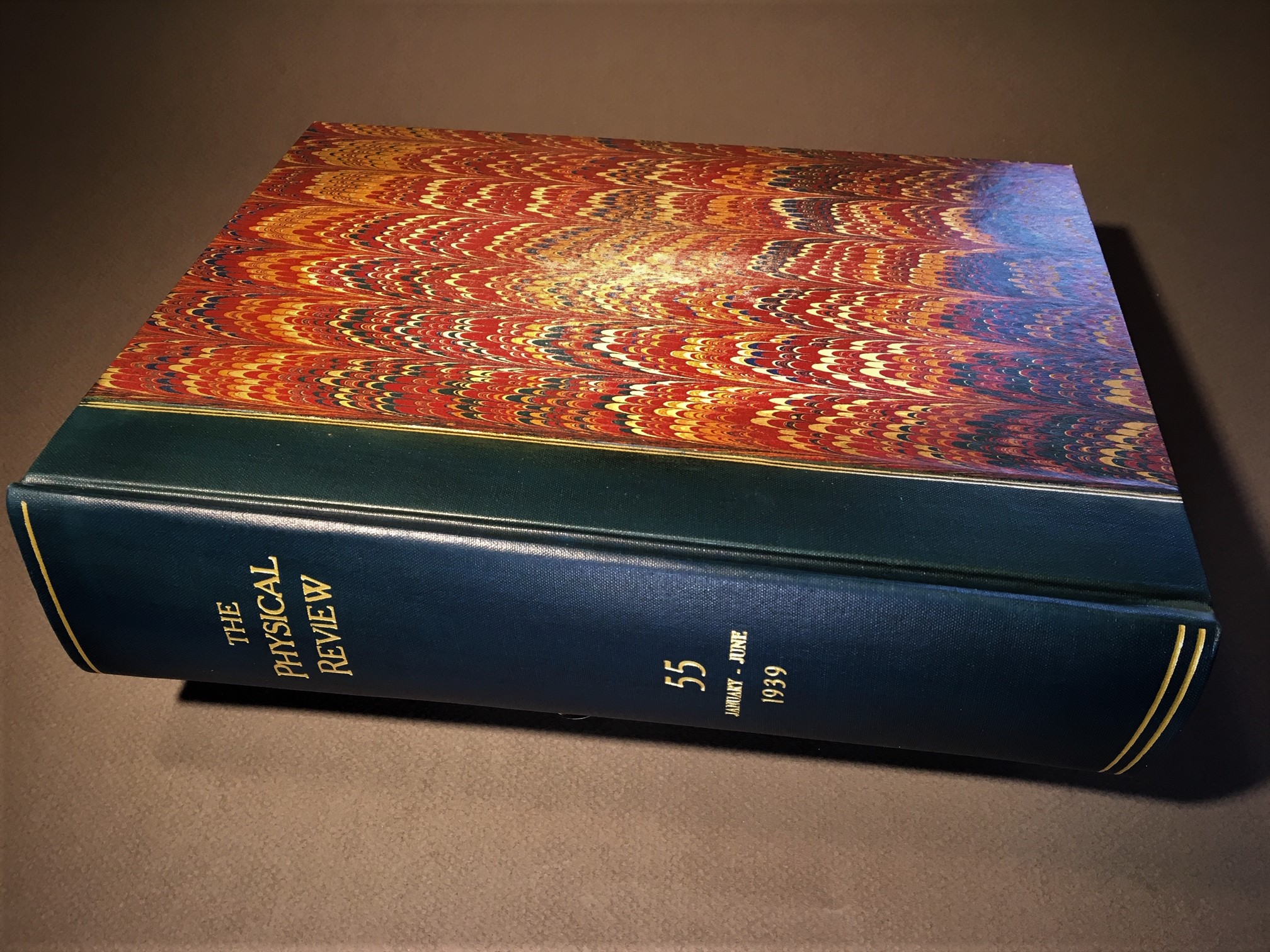
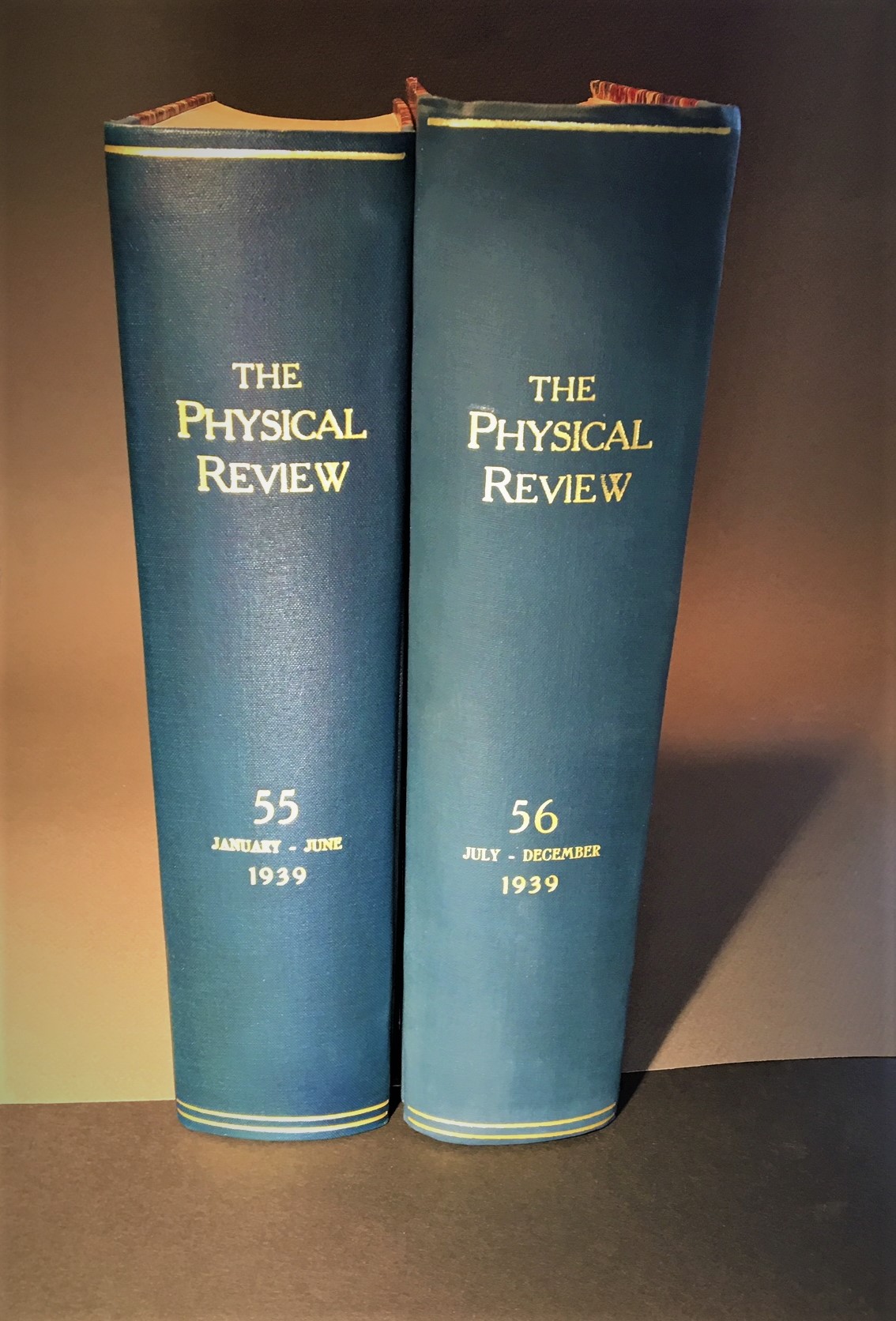
    OPPENHEIMER, J. Robert. “On continued gravitational contraction” and many other papers offered in one monumental year of the Physical Review for 1939.

    American Physical Society, Lancaster Pa., January-December 1939. Two volumes: x, 1294pp & x,1300pp. The two volumes, complete. Finely and sturdily rebound in cloth and marbled boards. Very stout, readable volumes. Fine condition. Few scant ownership stamps on some of the individual issues’ first page. $2250

    This is a remarkable volume for one of the most electrifying years in the history of modern phsyics, ranking alongside the great years of 1859, 1932, and 1948 for the sheer weight of highly significant papers from many sources. Included are papers by Oppenheimer, Gamow, Feynman, Szilard, Bethe, Rabi, Anderson, Tolman, Morrison, Kusch, Abelson, and many others. Astonishing, really.

    Some of the most significant papers include:

    OPPENHEIMER, Robert and Hartland Snyder, “On continued gravitational contraction”, September 1, 1939, Vol. 56, #5, pp. 426-50  The Oppenheimer and Snyder (a graduate assistant) paper is one of the most prescient in the history of modern physics, correctly physically describing (where Chandrasekhar and Eddington in their discussions did not) what happens in a particular collapse of a neutron star, and still today reads as fresh and and brightly as it did in 1939.  Really, it is an extraordinary work, and a foundation paper in the history of gravitation, the application of RT, singularity, and astrophysics.  (The Southampton GR Explorer site nicely states it this way: “This paper has strong claims to being one of the most prophetic ever written in this field of research. Today, 60 years later, this paper needs little revision – even the terminology is undated!”)

    In an often-repeated quotation, they write, somewhat in irony and in a certain and understated manner on page 456: “The star thus tends to close itself off from any communication with a distant observer; only its gravitational field persists”. And later: “When all thermonuclear sources of energy are exhausted, a sufficiently heavy star will collapse. Unless fission due to rotation, the radiation of mass, or the blowing off of mass by radiation, reduce the star’s mass to the order of that of the sun, this contraction will continue indefinitely”, they wrote.

    Phys Rev Wenner _1_

    BOHR, Niels and J.A. Wheeler, “The mechanism of nuclear fission”, September 1, 1939, Vol. 56, pp. 455-459. This is the experimental foundation stone (on the basis of the liquid drop model of atomic nuclei) of nuclear fission and the great leap forward in the construction of the atomic bomb.

    From the abstract: “On the basis of the liquid drop model of atomic nuclei, an account is given of the mechanism of nuclear fission. In particular, conclusions are drawn regarding the variation from nucleus to nucleus of the critical energy required for fission, and regarding the dependence of fission cross section for a given nucleus on energy of the exciting agency. A detailed discussion of the observations is presented on the basis of the theoretical considerations. Theory and experiment fit together in a reasonable way to give a satisfactory picture of nuclear fission”.

    BOHR, Niels. “Resonance in Uranium and Thorium Disintegrations and the Phenomenon of Nuclear Fission”;

    BETHE,  Hans.  “Meson Theory of Nuclear Forces.”  Vol 55, 2nd series, number 12; June 15, 1939, 1261-1264

    BETHE, Hans. “Energy Production in Stars” no 1. January 1, 1939 -and- “Energy Production in Stars II”, no. 5 March 1, 1939). Awarded the Nobel Prize (the first time the award was given for astrophysics) 1967 “for his contributions to the theory of nuclear reactions, especially his discoveries concerning the energy production in stars”)

    OPPENHEIMER, J. Robert and G.M. Volkhoff in the 15 February 1939 issue. Here (along with a preceding paper by Richard C. Tolman, issued in the same issue just above Oppenheimer, which were the analytic analysis used by O+V to base their estimates of nuclear forces) was established the Tolman-Oppenheimer-Volkhoff limit, which stated that if the state of evolution of  neutrons forming a degenerate Fermi gas of extremely dense masses in neutron stars was more  massive than .07 solar masses that it would collapse into a black hole or exotic/quark star; if the mass was below that limit, the star would not collapse due to the degeneracy pressure of neutrons and the strong force.  The black hole part was left really to a second paper of 1 September 1939 (the day that the Nazis attacked Poland and the fighting began in World War II in Europe) .

    GAMOW, George and Edward Teller, “On the Origin of Great Nebulae”, volume 55, number 7, April 1, 1939, pp 654-657, in the weekly issue of pp 609-671. 

    FEYNMAN, Richard. “Forces in Molecules”, pp. 340-43. Feynman’s undergraduate thesis at MIT, know known as Feynman-Hellmann theorem – “This work treated the problem of molecular forces from a thoroughly quantum-mechanical point of view, arriving at a simple means of calculating the energy of a molecular system that continues to guide quantum chemists.” (Complete DSB online)
    Phys Rev Wenner _1_
    Phys Rev Wenner _1_

    SLIZARD, Leo and ZINN’s landmark “Instantaneous Emission of Fast Neutrons in the Interaction of Slow Neutrons with Uranium” confirmed ‘instantaneous’ neutron multiplication, showing that it meets the requirement for nuclear bombs. Some argue this is one of the most important papers in atomic/nuclear physic

    ANDERSON, Herbert L, Fermi, Enrico & Hanstein, H. B. “Production of Neutrons in Uranium Bombarded by Neutrons”, vol 55, pp. 415-419;

    TOLMAN, Richard, “Static Solutions of Einstein’s Field Equations for Spheres of Fluid”, vol 55, pp. 799-800;

    RABI, I, Millman, S., Kusch, P. & Zacharias J. R. “The Molecular Beam Resonance Method for Measuring Nuclear Magnetic Moments ()”, vol 55, pp 526-535;

    WEISSKOPF, Viktor. “On the Self-Energy and the Electromagnetic Field of the Electron”, 56 No. 1 pp. 72–85, July 1, 1939 . Also bound in the same issue with:   “Weisskopf demonstrates that QED diverges at all levels of perturbation theory.” –This paper reproduced in full as paper 6 in Julian Schwinger’s Selected Papers on Quantum Electrodynamics. See also Jo Bovy (Ghent University), 

    ABELSON, Philip. “Investigation of the Products of the Disintegration of Uranium by Neutrons”, July 1, 1939, pp 1-9.

    RABI, I.I., Kellogg, J. M. B. “The magnetic moment of the proton and the deuteron. The radiofrequency spectrum of H2 in various magnetic fields” , vol. 56, No. 8., pp 728-743.
     

    Phys Rev Wenner _1_

    ·Posted by :

    ·in:


  • Confirming the Theory of the Antiproton (1956)

    CHAMBERLAIN, Owen. “Example of an Antiproton–Nucleon Annihilation” , in Physical Review, vol 102 No. 3 pp. 921–923, May 1, 1956. Single issue with original wrappers. Name on front cover, tiny split at bottom of spine, otherwise fine. $350

    • Offered with Robert Hofstadter, “Elastic Scattering of 188 MeV Electrons from Proton and the Alpha Particle” same issue, pp. 851–85.
    • Offered with Müller and Bahadur, “Field Ionization of Gases at a Metal Surface and the Resolution of the Field Ion Microscope” , same issue, pp.624-631.

    “Chamberlain provides definitive evidence of the annihilation of a proton, the confirmation of the discovery of the antiproton. Hofstadter calculates the size of a proton. Muller and Bahadur describe the first viewing of an atom. “ $350

    • “Owen [as he had everyone call him, “students and colleagues alike”] had first become interested in looking for antiprotons during a visit to Brookhaven National Laboratory in the summer of 1953. He thought that antiprotons must exist, but he was really turned on to the chase when he heard that Maurice Goldhaber had bet Hartland Snyder $500 that they did not exist. In an oral history completed in 2000, Owen stated, “Well, I have great respect for Maurice Goldhaber as a physicist, and I suspect he made the bet when he was a little drunk, but even when drunk, Maurice Goldhaber is a good physicist. So if someone of the stature of Maurice thought maybe antiprotons didn’t exist, then this was a real spur to showing that they did. And I think it was at that moment that I decided: ‘By Jove, this is what I want to do.’ ”

    The experiment itself was simple and elegant. Antiprotons were produced when the proton beam in the Bevatron struck an internal copper target. Since the antiprotons were negatively charged, the machine’s magnetic field bent them out of the Bevatron’s circular orbit into an external beamline where their charge, momentum, and velocity were measured.After about a month of intermittent data taking, the group was able to report in September 1955 the unambiguous observation of antiprotons. The Nobel Prize followed in 1959.”–”Physics Today”, 59/8, August 1, 2006, pg 70, obituary for Chamberlain.

    ·Posted by :

    ·in:


  • Brabent John M Terminal Observations On Antiprotons In Physical Review Vol 101 No 1 Pp 498501 January 1 1956

    BRABANT, John M. “Terminal Observations on Antiprotons”, in Physical Review, vol 101 No. 1 pp. 498–501, January 1, 1956. Original wrappers. Previous owner’s name on the front cover, otherwise fine. $250

    • First tentative sighting of a proton-antiproton annihilation, an important confirmation of the discovery of the antiproton.

    ·Posted by :

    ·in:


  • “Possible Example of the Annihilation of a Heavy Particle” (1954)

    ROSSI, Bruno  H. S. Bridge, H. Courant, H. DeStaebler, Jr. “Possible Example of the Annihilation of a Heavy Particle” in Physical Review, 95 No. 4 pp. , 1101-1103, August 15, 1954). Original wrappers. Condition: the spine has been repaired, and there’s a name on the front cover. A very nice copy. Solid VG. $250

    This is the report on first tentative sighting of an antiproton annhilation. “In 1954, a team led by Italian physicist Bruno Benedetto Rossi (1905–1993) observed an unusual cloud chamber event in which a singly charged particle decayed into three photons whose energies totaled more than the proton rest energy, the signature of an antiproton annihilation.”

    “Rossi…was an Italian experimental physicist. He made major contributions to particle physics and the study of cosmic rays. A 1927 graduate of the University of Bologna, he became interested in cosmic rays. To study them, he invented an improved electronic coincidence circuit, and traveled to Eritrea to conduct experiments that showed that cosmic ray intensity from the West was significantly larger than that from the East. During World War II, Rossi worked on radar at the MIT Radiation Laboratory, and he played a pivotal role in the Manhattan Project, heading the group at the Los Alamos Laboratory that carried out the RaLa Experiments. After the war, he was recruited by Jerrold Zacharias at MIT, where Rossi continued his pre-war research into cosmic rays. In the 1960s, he pioneered X-ray astronomy and space plasma physics. His instrumentation on Explorer 10 detected the magnetopause, and he initiated the rocket experiments that discovered Scorpius X-1, the first extra-solar source of X-rays.–Wikipedia

    ·Posted by :

    ·in:


  • The Discovery of the Pion (1947)

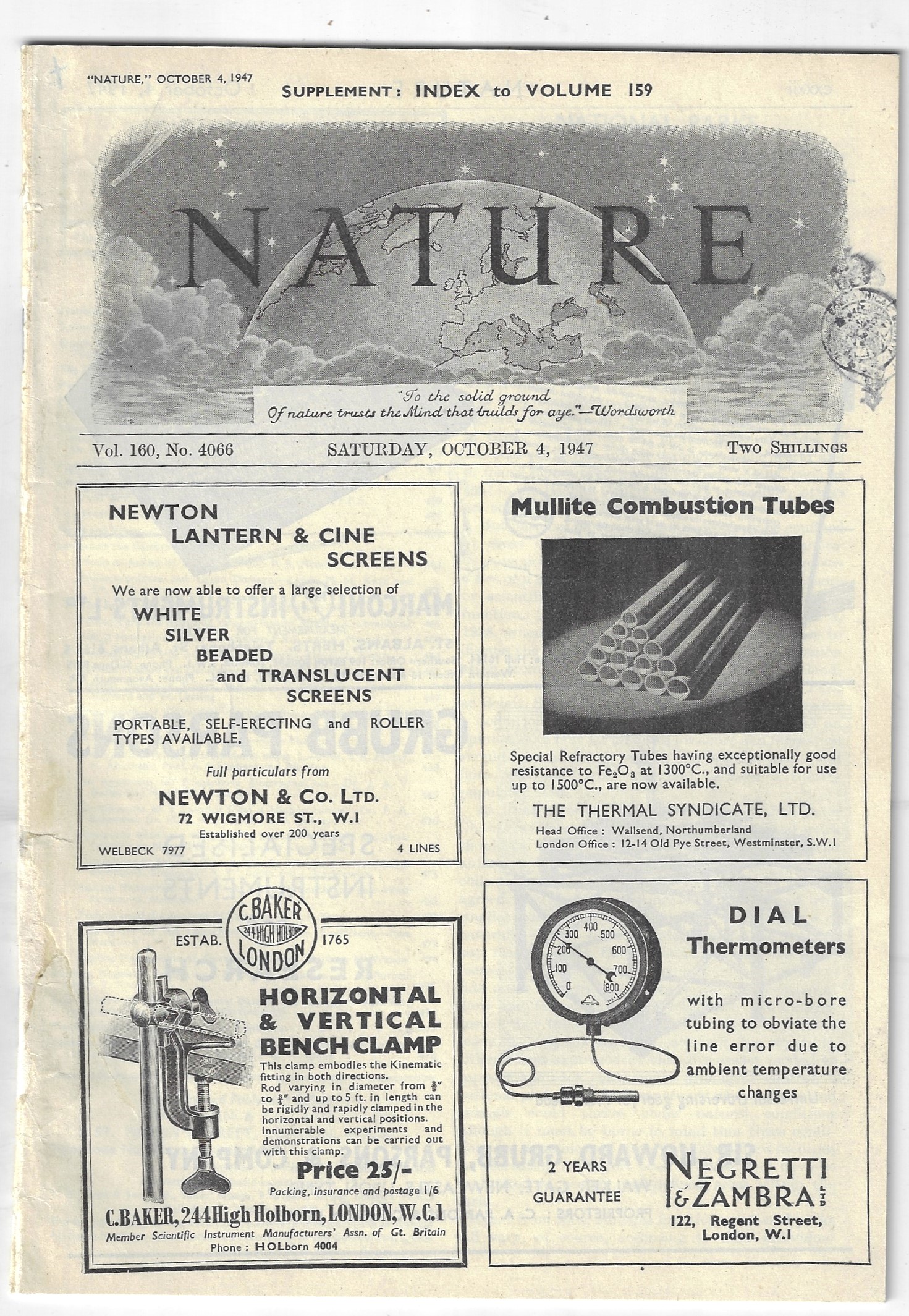
    Nature 1947 DW PionM.G. Lattes, G. P. S. Occhailini, and C. F. Powell , “Observations on the tracks of slow mesons in photographic emulsions”, in Nature, 160 No. 4066 pp. 453–456, October 4, 1947, with photos, tables, and graphs. Original wrappers. Almost invisible professional repair to front wrapper, otherwise fine. Confirmation of the discovery of the Pion. $250

    “1947 was the year of the pion…In February of that year, Cecil Powell and Giuseppe Occhialini reported[on Nature 159, 186–190] the observation of six star-like patterns in emulsions exposed to cosmic rays. Powell’s group had finally found the Yukawa particle, predicted in 1935 to be the carrier of strong force inside the atomic nucleus. In fact, Don Perkins pipped them to the post with the publication of a single, similar star-like event just two weeks earlier. Later in the year, another paper from Powell’s group [the paper offered here] announced the first observation of pion decay to a muon — the particle picture was beginning to take shape.”–From NATURE’S “Physics Portal” on the discovery of the pion.

    From the paper: “In recent experiments, it has been shown that charged mesons, brought to rest in photographic emulsions, sometimes lead to the production of secondary mesons. We have now extended these observations by examining plates exposed in the Bolivian Andes at a height of 5,500 m., and have found, in all, forty examples of the process leading to the production of secondary mesons…”

    ·Posted by :

    ·in:


  • Early Contribution to Brownian Motion 1863 (by Not-Norbert) Wiener


    WIENER, Christian (1826-1896) . “Erkldrwig des atomistischen Wesens des Jiussigen Korperzustandes und Bestatiguny desselben durch die sogennanten Molekularbetvegungen”, in the Annalen der Physik, 1863, volume 118, part 1, pg 79-94, offered in the entire volume of 644pp with 8 folding plates (1 plate split at the fold and detached). Ex-libris Deutsche Akademie der Luftfahrtforschung, then Wright Patterson Field Library (USAF), then Library of Congress.  Library markings:  small gilt-stamped “Akademie der Luftfahrtforschung”, page edges stamped “Wright Field Library/Dayton, Ohio” on top and bottom.. Contents quite nice.  $350

    “The first name which calls for reference in this respect [regarding Brownian motion] is, perhaps, that of Wiener, who declared at the conclusion of his observations, that the movement could not be due to convection currents, that it was necessary to seek for the cause of it in the liquid itself, and who, finally, almost at the commencement of the development of the kinetic theory of heat, divined that molecular movements were able to give the explanation of the phenomenon” – Perrin, Jean. Brownian Movement and Molecular Reality, 1910, pg 3.

    “…molecular -kinetic explanation of Brownian Motion (first qualitatively proposed by Christian Wiener in 1863)…”–“Error and the Growth of Experimental Knowledge”, Deborah G. Mayo, p 218.

    “In his studies on molecular physics, Wiener demonstrated by extremely careful observations that Brownian movement is an “internal motion peculiar to the liquid state…”–“Wiener, Ludwig Christian.” Complete Dictionary of Scientific Biography. Vol. 14. Detroit: Charles Scribner’s Sons, 2008. 342-344.

    “(Wiener was a) German mathematician who specialized in descriptive geometry. Wiener was also a physicist and philosopher. In 1863, he was the first person to identify qualitatively the internal molecular cause of Brownian motion.”–Wiki 

    Also bound with: KIRCHHOFF, Gustav.  “Zur Geschichte der Spectral-Analyse under der Analyse der Sonnenatmosphaere”, same volume, pp 94-111.  Kirchhoff (1824-1887) was part of the Bunsen-Kirchhoff teams that developed the spectroscope in 1859 and then detected the first chemical elements in the spectrum of a star (1859 and 1860, respectively).  This article (“On the history of spectral analysis and the analysis of the solar atmosphere”) is interesting  given that it is relatively lengthy for such a short history, though it does reach back into the early 19th century for related developments.


    ·Posted by :

    ·in: