A Daily History of Holes, Dots, Lines, Science, History, Math, Physics, Art, the Unintentional Absurd, Architecture, Maps, Data Visualization, Blank and Missing Things, and so on. |1.6 million words, 7500 images, 4.9 million hits| Press & appearances in The Times, Le Figaro, Mensa, The Economist, The Guardian, Discovery News, Slate, Le Monde, Sci American Blogs, Le Pont, and many other places… 5000+ total posts since 2008.

Book Category: World War II

  • Henry Ford, the Dearborn Independent, and anti-Semitism (1927)

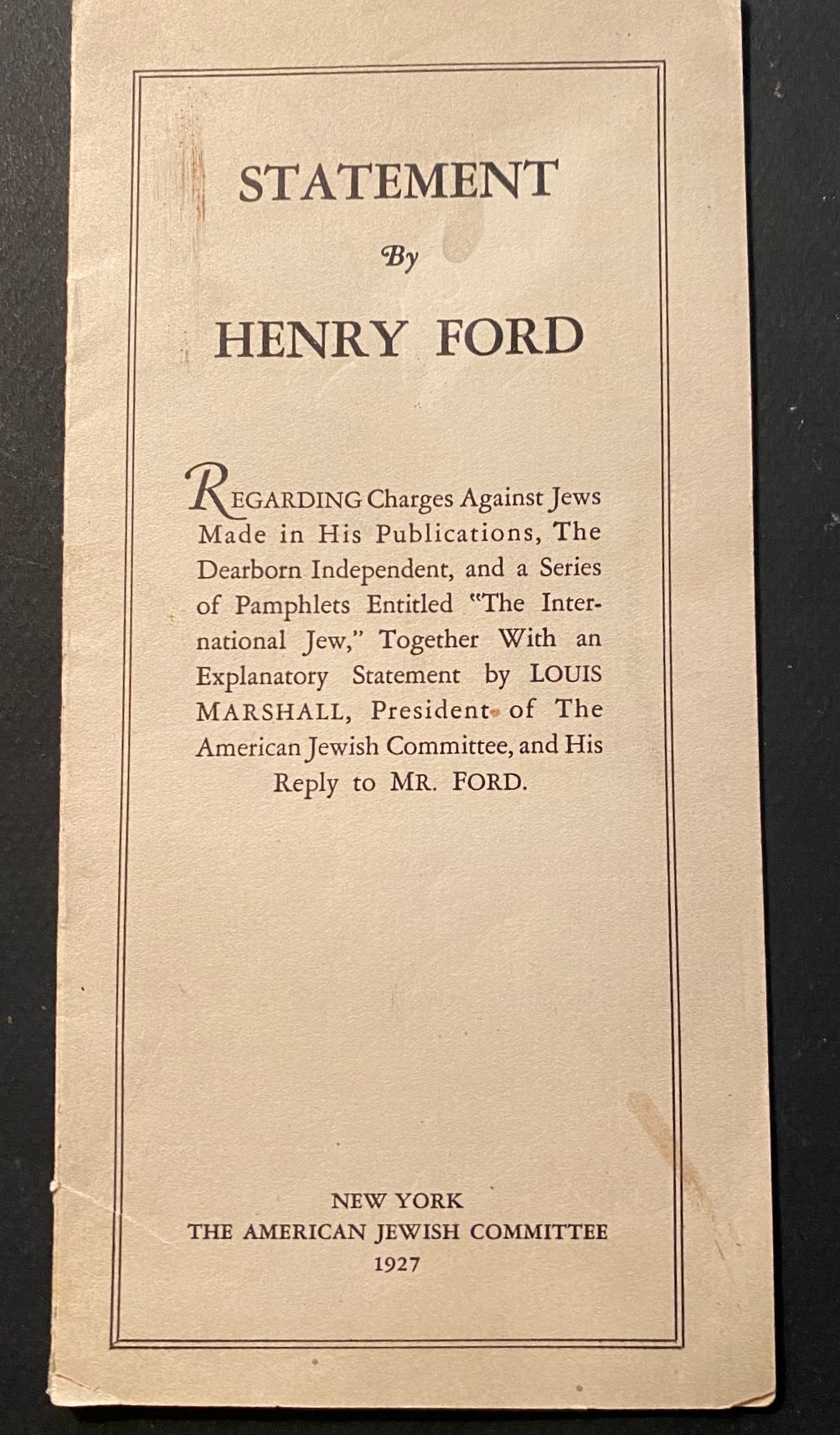
    IMG_5467(FORD, Henry) “Statement by Henry Ford Regarding Charges Against Jews Made in his Publications, The Dearborn Independent, and a Series of Pamphlets Entitled “The International Jew”, together with an Explanatory Statement by Louis Marshall, President of the American Jewish Committee and his Reply to Mr. Ford. Published by the American Jewish Committee, 1927. WorldCat locates ONE print copy, University of Michigan. (There are 5 other copies located, all overseas, Australia, NZ,2 UK, Canada) though they all seem to be only online copies.)  SOLD

    So, the Dearborn Independent was owned and published by Ford beginning in 1920 and rose to 900,000 copies/day, the second-leading circulation in the country. It was partially put over the hill via incentive quotas in every Ford dealership. There were many anti-Semitic articles appearing in the newspaper, which also published “The International Jew”. It was bad stuff. Anyway, boycotts against the Ford company were lodged and a lawsuit appeared in 1927. Ford finally responded to the accusations in June 1927 saying that he had no idea that the paper had published this sort of garbage since 1920, and that he was shocked by it, and repelled. He recanted, though it seems from historical sources that the letter wasn’t written or signed by Ford. The response by Louis Marshall, president of the American Jewish Congress, was reserved, and hoped that the paper no longer published the anti-Semitic filth. Ford closed the paper by the end of 1927. In 1938, Ford accepted the Nazi award of the Grand Cross of the German Eagle, the highest medal offered by the Nazis to a foreign. Hitler had been in power for five years by this point, and his war against the Jews was years old.
    So: actions and words…
    ·Posted by :

    ·in:


  • Equal Rights for Women, League of Nations, 1936

    [Women, Equal Rights for. ] “Annual Meeting of Women’s Consultative Committee of the League of Nations.” Information Bulletin from Committee of Representatives of Women’s International Organizations, created in accordance with a resolution of the Council of the League of Nations, Hotel de Russie, Geneva, September 29, 1936.

    • Four leaves, 13″x 8.5″. Mimeographed (?) Printed on cheap newsprint. Paper browned and brittle, and heavily chipped at top. Fair condition. 10 or so short tears are repaired on reverse with archival Japanese tissue paper. NO copies located in WorldCat. Rare. Provenance: Library of Congress, with their rubber stamp on the back of leaf 4. $500

    This is a resolution presented to the League of Nations in September 29, 1936 (addressed to the president of the Seventeenth Session of the Assembly of the League of Nations, Saavedra Lamas [Argentina, 187801959]) on the subject of adopting equal rights for women in the League’s covenants. This was a combined meeting of the International Council of Women, Louise C.A. Van Eeghan (Holland) and Renee Girod (Switzerland); Women’s International League for Peace and Freedom, Madeleine G. Doty with Lola Maverick Lloyd, (USA); Inter American Commission of Women, Abby Scott Baker and Alice Paul (USA), with Leonor Cespedes (Columbia). Also: Equal Rights International, Juanita Frances (England), Helene Granitsch (Austria), Linda P. Littlejohn (Australia), Lilian von Matsch (Austria); and the All Asian Conference of Women, Rosa Welt Straus (Palestine).

    ·Posted by :

    ·in:


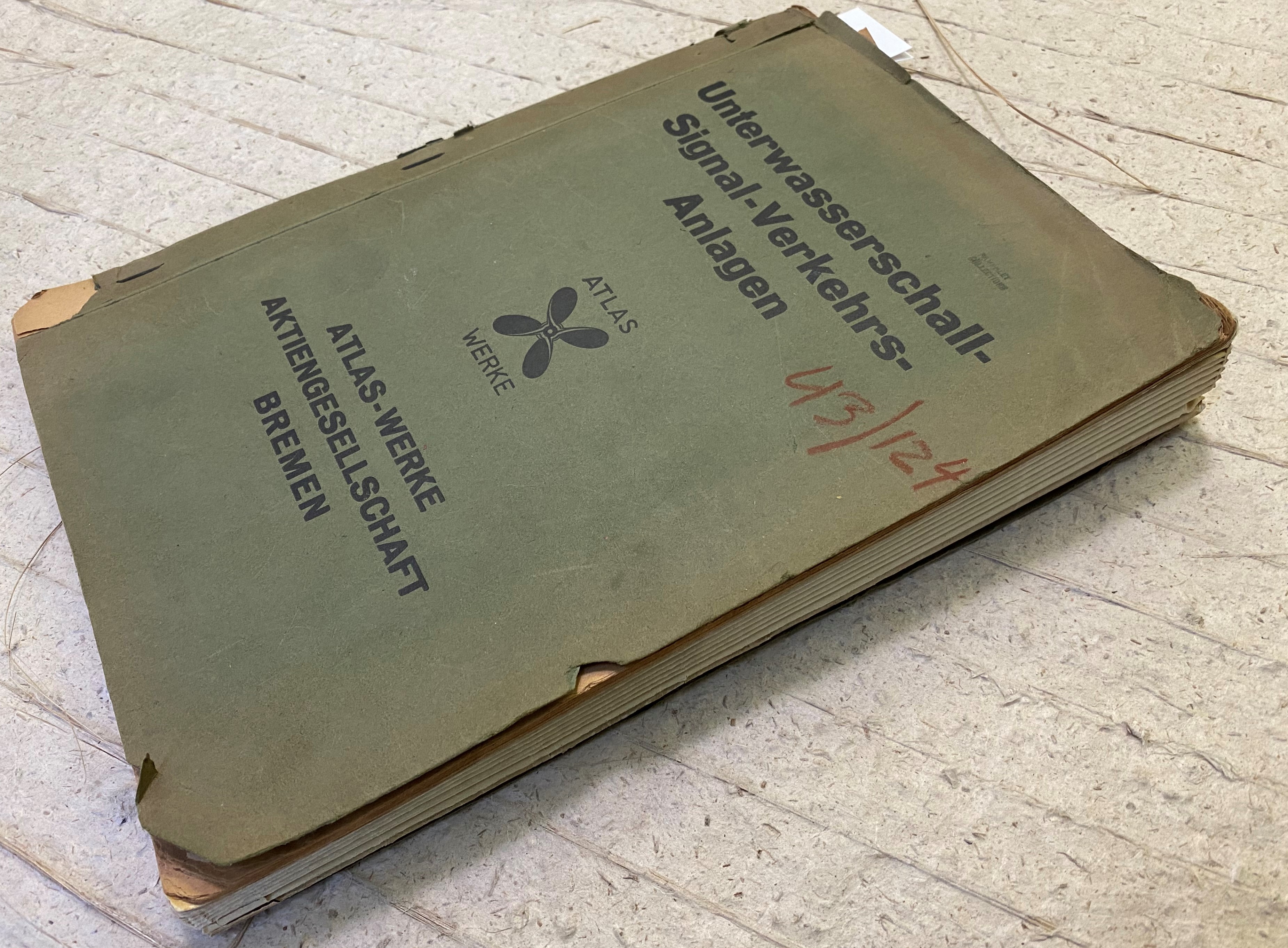
  • German WWI U-boote SONAR, November 1942. RARE work with schematics. NO Copies in WorldCat.

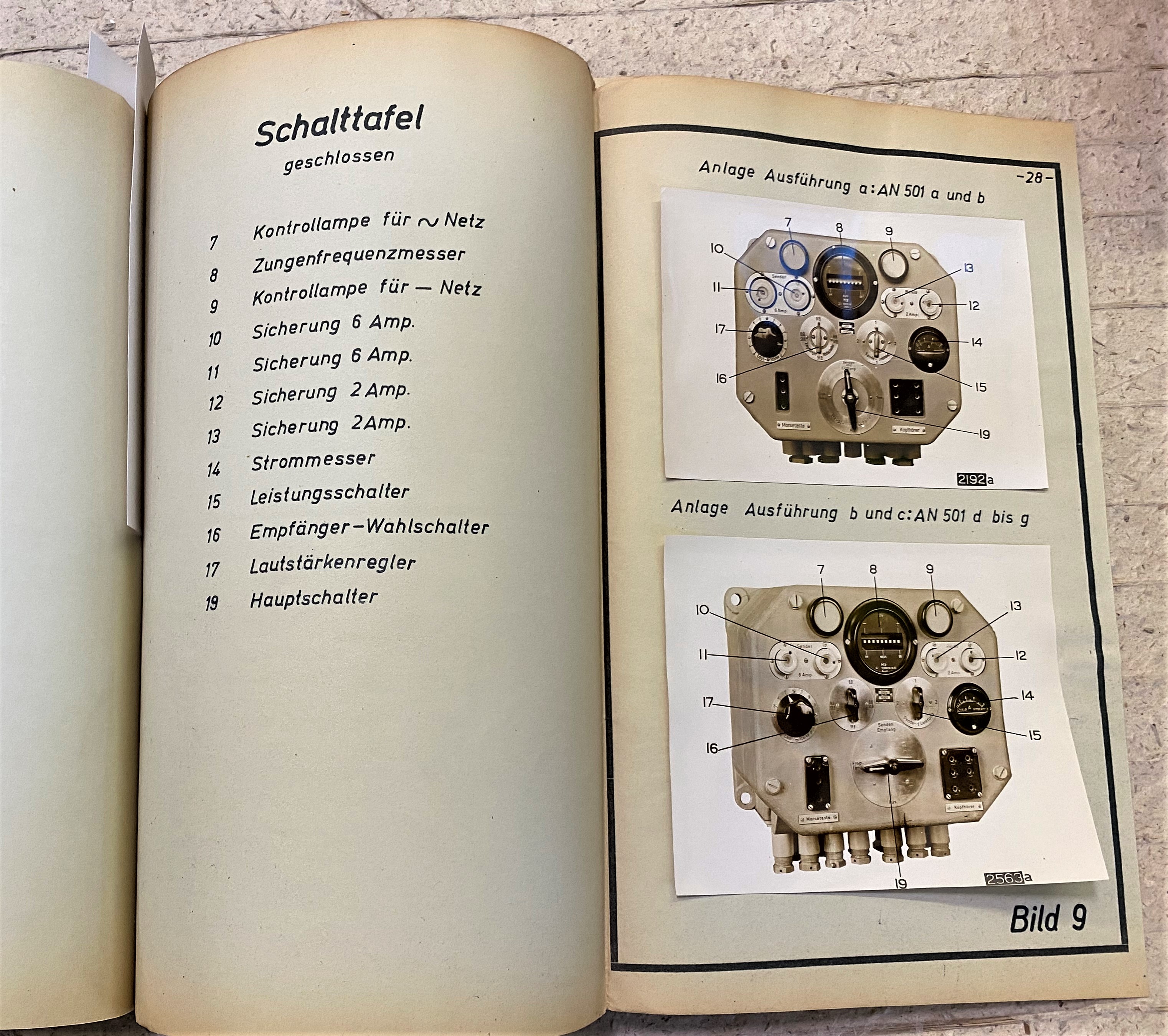
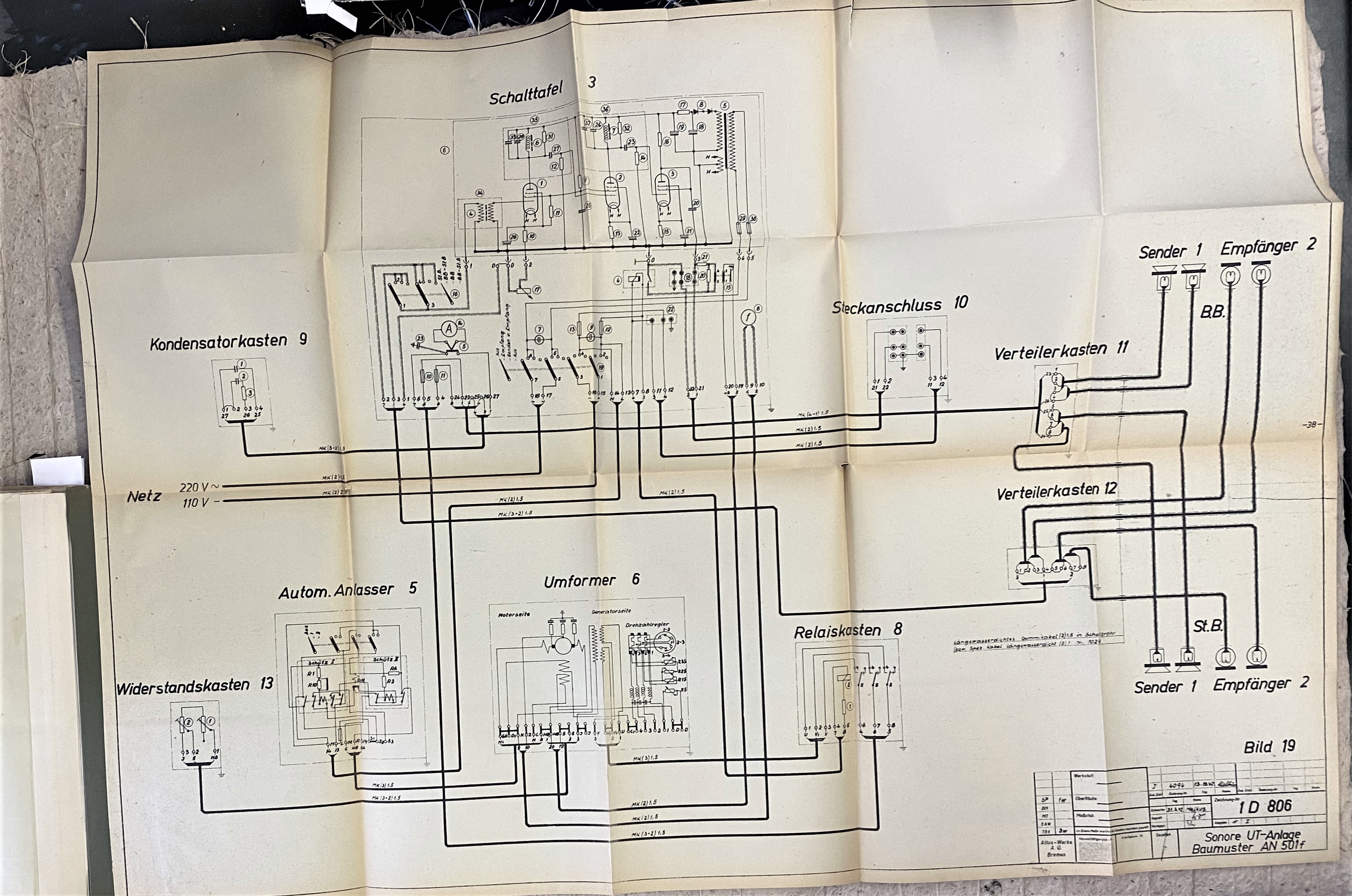
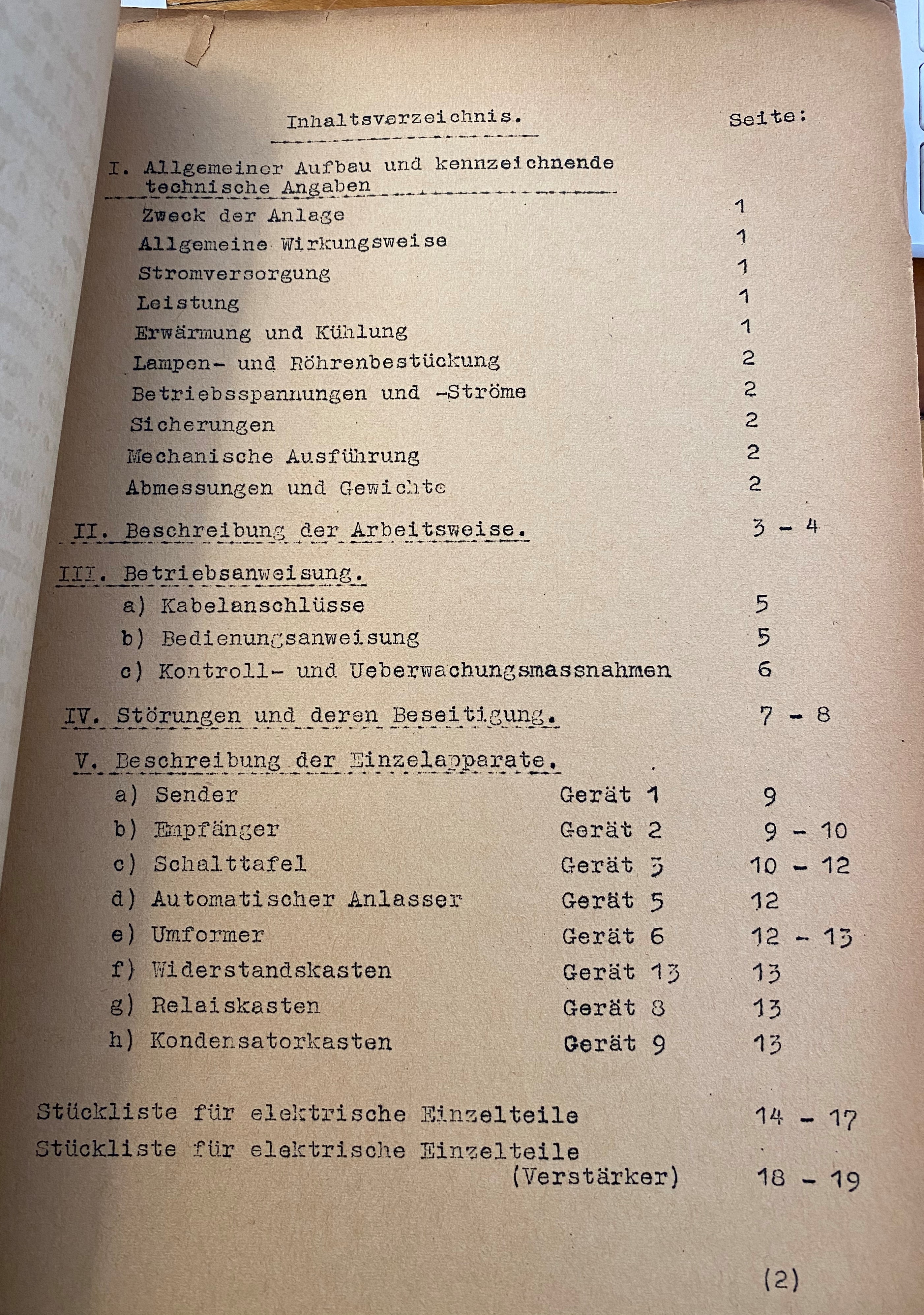
    Sonore UT-Anlgae fur U-Boote: An 501. Beschreibung durch die Prufstelle der KMW Kiel gepruft Kiel, im November 1942. (“Description checked by the test center of KMW Kiel “,)  Unterwassersdchall-Signal-Verkehrs-Anlagen. Atlas Werke. Aktiengesellschaft, Bremen. 295X208mm.  $3500

    Image-4Staple-bound in stiff boards. 35 lvs+3 unpaginated large folding schematics, including 19 plates, 17 of which are folding. The first 13 lvs (all text) were printed on an inferior stock and are browned. The plates are all printed on a better and much thinker paper and are FINE; the photos are also FINE. The covers are somewhat worn around the edges but a solid VG. The binding itself is very sturdy and the plates (which are fresh) are easily opened and closed and well-hinged to the binding. Overall: VG

    Pagination (slightly complicated): overall, 35 lvs+3 unpaginated large folding schematics, including 19 plates, 17 of which are folding. Lvs 1-13 are text/review/summary/outline; lvs 14-21 are charts and lists printed on a heavier stock. The folding plates begin at lv 20 (though lv 20 and 21 are designated Bild 1+2 are of the same style as lvs 14-21, confusingly). Folding plates begin at Bild 3-8 and Bild 16-35, which is followed by 3 further large folding plates that are not paginated. Bild 9-15 are one-fold plates (29x35cm) illustrated with original photographs of the equipment.

    Image-3 (1)

    • WorldCat describes this work (and according to their description the book seems to be complete) though it locate NO copies worldwide.

    I take it that the SONAR system described in great detail here (for boats VII c, IX c, and IX d) may related to that equipment aboard the U-boote 501 (which was a IX c, departed Kiel, and which sank 10 Sept 1941), though it may reference a particular class of U-boote…I’m not sure. I thought the cover page for the work would clarify that but it doesn, at least to me—it does point out some minutiae, for example, that the AN 501 a is used for the VII c and the AN 501 b for the IX c. That sort.


    Image (1)

    Description of the plates: (remember Bild 1 and 2 are lists of illustrations and associated and not plates in themselves, though paginated so); Bild 3, Sonore UT-Anlage, 29x53cm; Bild 4 Sonore UT-Anlage (type VIIc), 29x53cm; Bild 5 “Prinzip-Schaltbild” (Principle circuit design) 29x35cm; Bild 6 “Apparte Masskizzen 29x35cm; Bild 7 Tonsender 29x35cm; Bild 8 Tonenpfanger 29x35cm. Bild 9, Schalttafel geschlossen, w/2 photos on 29x35cm folding sheet. Bild 10-16 each are 29x35cm foldinbg sheets with one photo each (the photos all around 12x12cm to 16x12cm). Bild 17, an overall schematic, and quite large, 93x44cm. Bild 18, “Stromlaufplan”, 75x44cm. Bild 19 is another overall, 93x44cm.

    The photos are titled “automatischeranlasser”, “zumformer”, “Widersandskast”, Relaikasten”, and “Kondensatopkasten”.

    Provenance: Library of Congress, with a few of their small stamps, plus their rubberstamp “surplus”.  

    ·Posted by :

    ·in:


  • A Call to Sabotage and to Arms of French Youth by the Communist Party of France, 1944

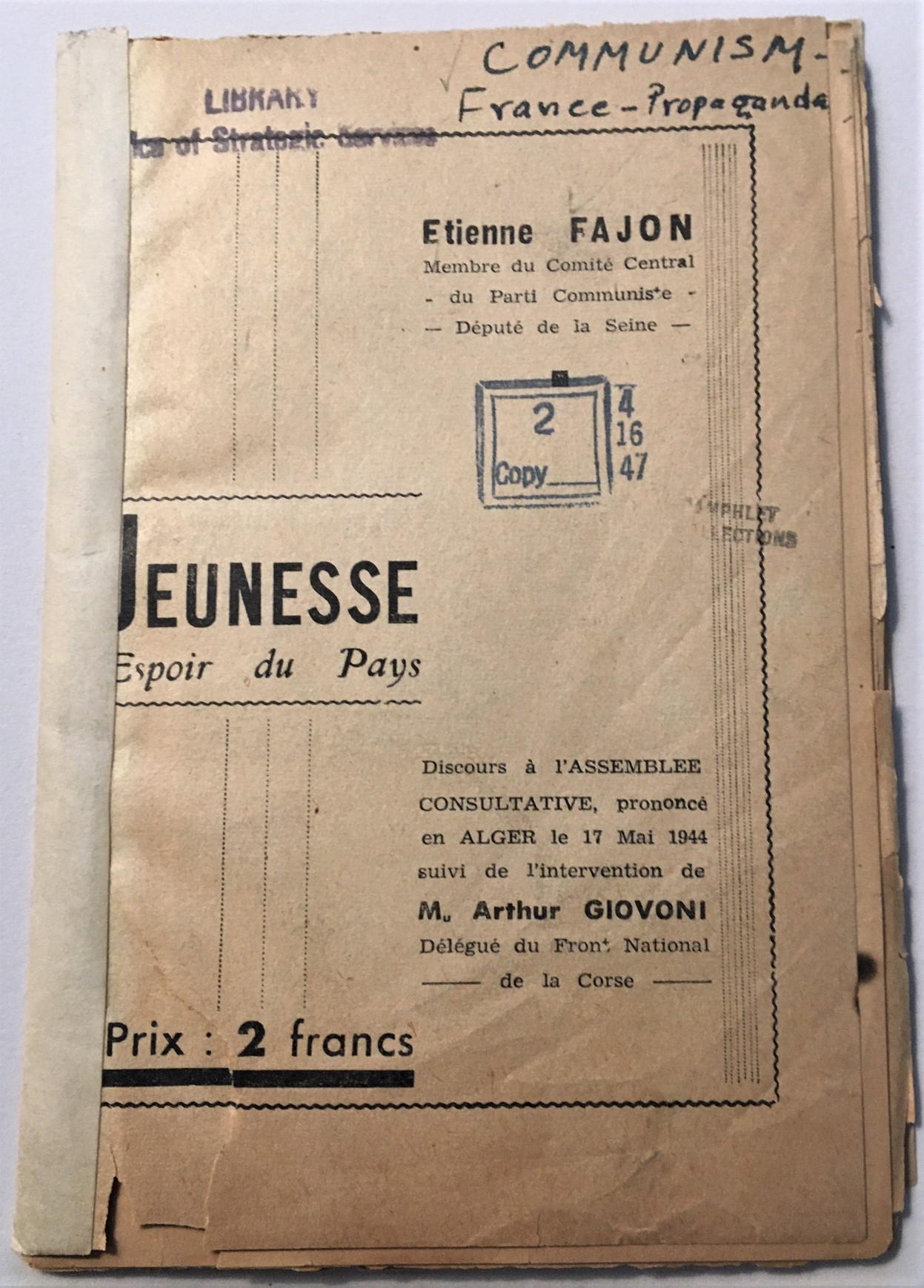
    IMG_2032FAJON, Etienne and Arthur Giovani, and others Jeunesse, Espoir du Pays. Published meeting of the French Communist “Assemblee Consultative”. Published in Algeria (?), 1944 (?) 6.5”x 4.5”, 36pp. Printed on newsprint. Original wrappers; crude but yet charming cloth repair to the spine.  Provenance: Library of the Office of Strategic Services (OSS), via the Library of Congress, each of which has contributed a rubber stamp to the pamphlet. GOOD condition, only. $250  NO Copies located in WorldCat.

    Well. Someone at the library of the OSS (the precursor to the CIA) labeled this “COMMUNISM—France-Propaganda”, which it is, though what it is first, I think, is a call to arms. And that clarion call is very directly aimed at the youth of France, which the Communist Party saw as being directly under attack by the Nazis.

    The writers here established that “combat over slow death” was the approach to take, there in 1944.

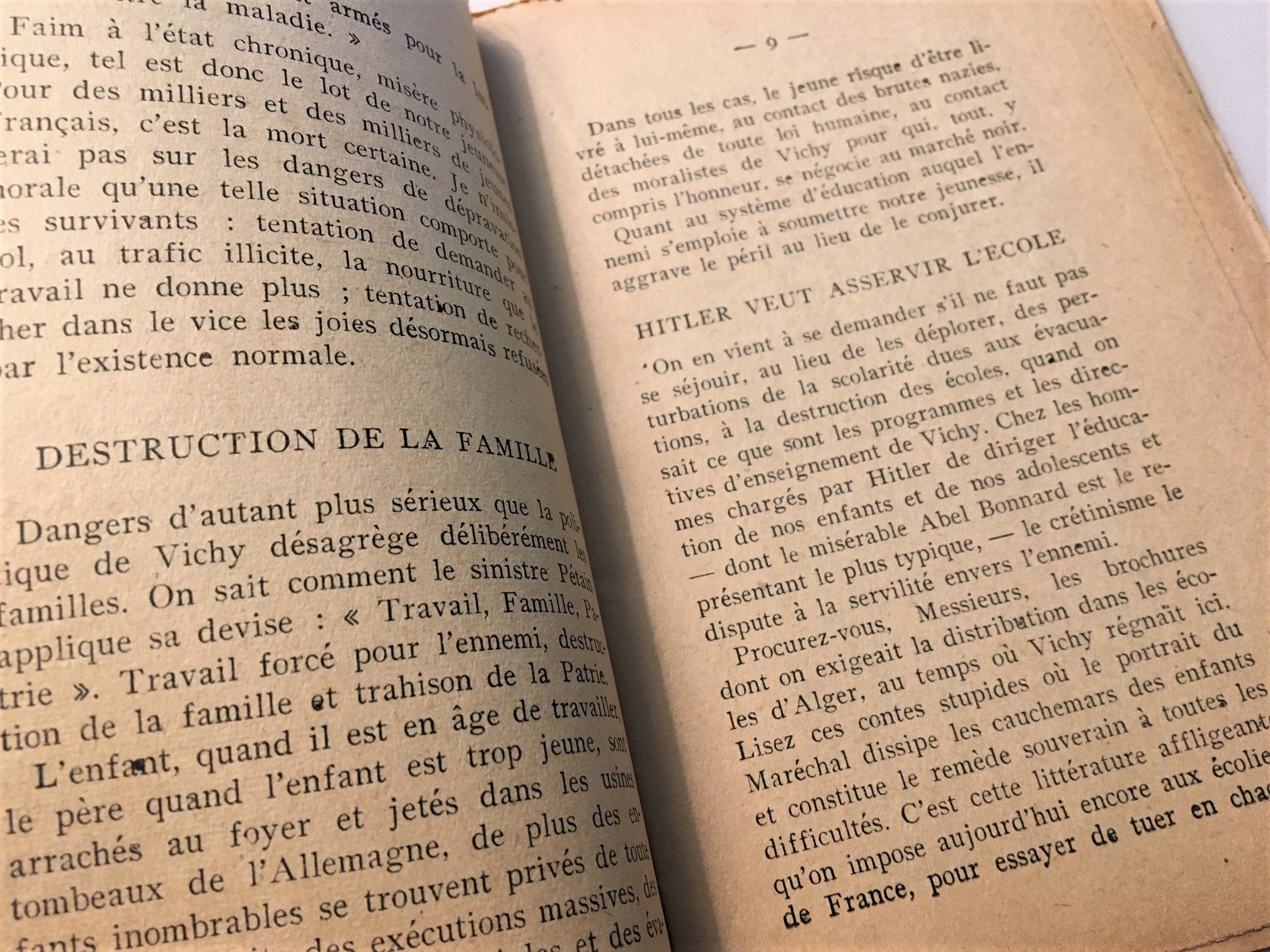
    Here’s a selection of what they were talking about:

    (Section header: Helping Youth to Fight)

    “We all want to save the French youth that the enemy is trying to destroy. All that, there is only one way: to help young people in France to defend themselves against the enemy, to strike him, to hasten his defeat.”

    “..the rations granted to the French, from January 1943, were equivalent to the death of one in five individuals. No fight could cost our young generation so dear.”

    “Helping French youth to fight that means: Replace certain wait-and-see or stupid broadcasts on our radio with specific advice to young workers to organize the sabotage of enemy production and transport with minimum risk and maximum efficiency

    “…develop the struggle of prisoners and deportees in Germany who are, in their vast majority, young people doomed to death. Our radio must give directives for escapes, for sabotage, for all forms of struggle • in enemy territory. Above all, to urgently send by all means, to young soldiers without uniform, small arms, ammunition, clothing, instructors.

    IMG_2033

    “We are concerned with restoring, upon liberation, the compromised health of millions of children and adolescents in France. In our opinion, the Government will not be able to solve this problem…”

    “We all want to save the French youth that the enemy is trying to destroy. All that, there is only one way: to help young people in France to defend themselves against the enemy, to strike him, to hasten his defeat.”


    “..the rations granted to the French, from January 1943, were equivalent to the death of one in five individuals. No fight could cost our young generation so dear.”


    “Helping French youth to fight that means: Replace certain wait-and-see or stupid broadcasts on our radio with specific advice to young workers to organize the sabotage of enemy production and transport with minimum risk and maximum efficiency


    “…develop the struggle of prisoners and deportees in Germany who are, in their vast majority, young people doomed to death. Our radio must give directives for escapes, for sabotage, for all forms of struggle • in enemy territory. Above all, to urgently send by all means, to young soldiers without uniform, small arms, ammunition, clothing, instructors.


    “We are concerned with restoring, upon liberation, the compromised health of millions of children and adolescents in France. In our opinion, the Government will not be able to solve this problem…”


    ·Posted by :

    ·in:


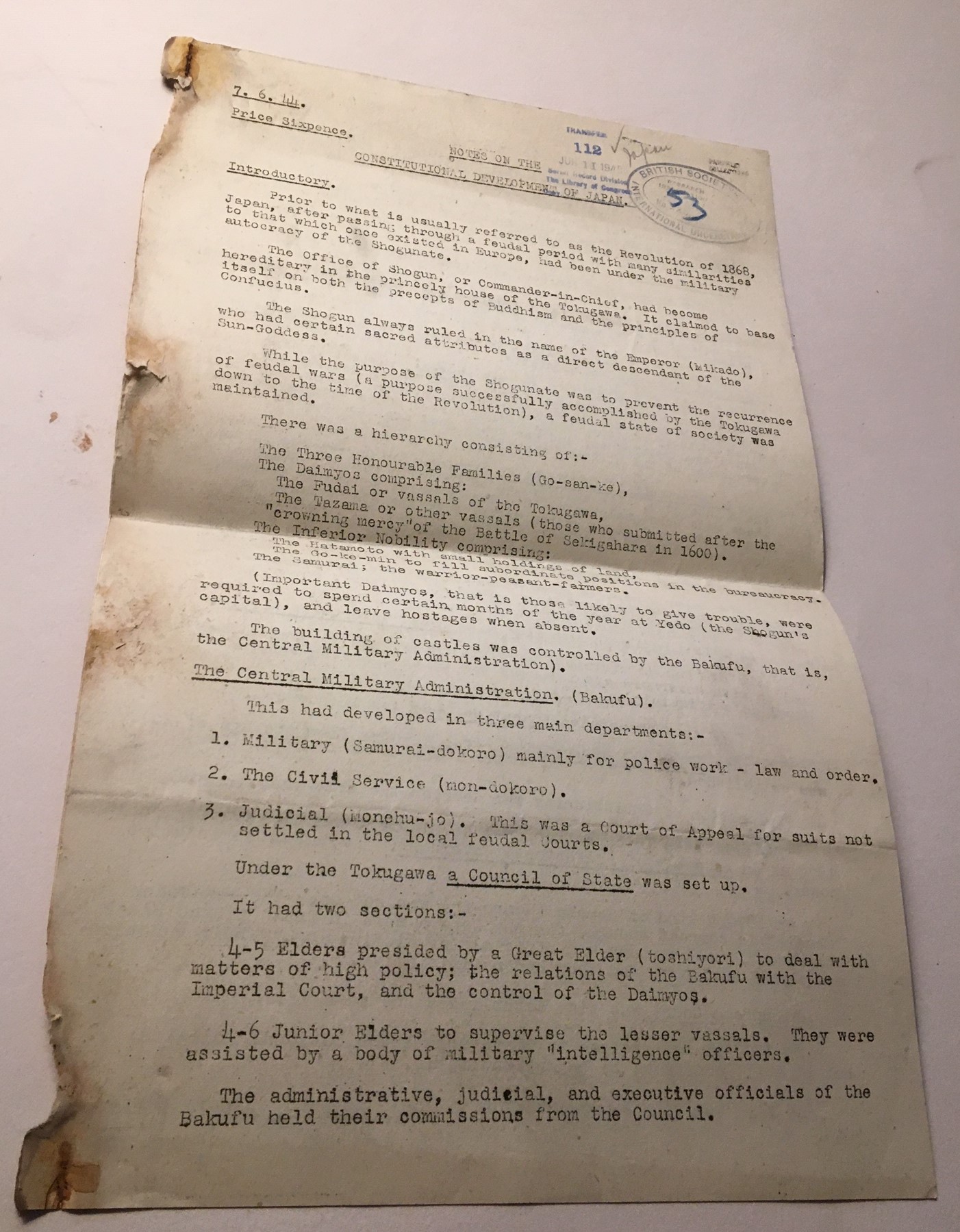
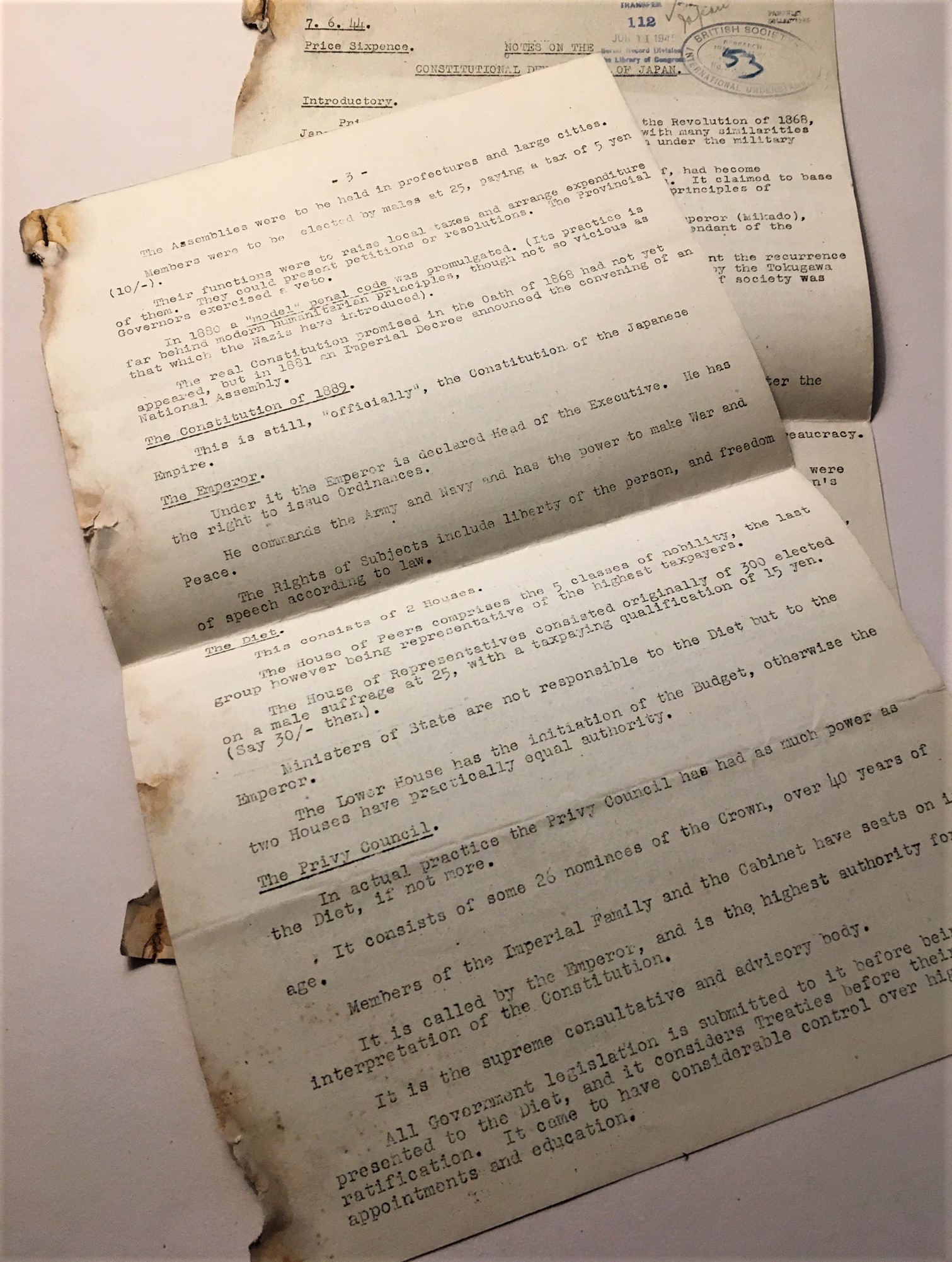
  • Rare Mimeographed Item on Japanese Constitutional History (1944)

    IMG_2021Notes on the Constitutional Development of Japan.

    Unknown publisher. Dated 7 June 1944. 13”x 8”, 7pp (4 leaves). Mimeographed.

    Provenance: British Society for International Understanding (the possible publisher?); then received 11 June 1945 by the Library of Congress. Rubber stamps from those two institutions on front, plus a LC surplus rubber stamp on the rear blank.

    GOOD copy, only. The staple holding this together is rusted and has degenerated the paper around it (see photo). There is also some edge wear on the leaf leaf.  $250

    Scarcity: NO copies located in WorldCat.

    Interesting note from page 6: “The Secret Societies and Fascist Bodies.  These are really only carrying on an old tradition, but perhaps the first of importance in modern times was the “Black Dragon”formed from extreme reactionary elements of the Sei yu-kai about 1925. It was probably responsible for the “Death Bands” which carried out a series of political assassinations from 1952 onwards. From them came the “Back-to-Asia-” ideology. They attracted fervent youth by their claim to stand for spiritual regeneration…”

    IMG_2022

    ·Posted by :

    ·in:


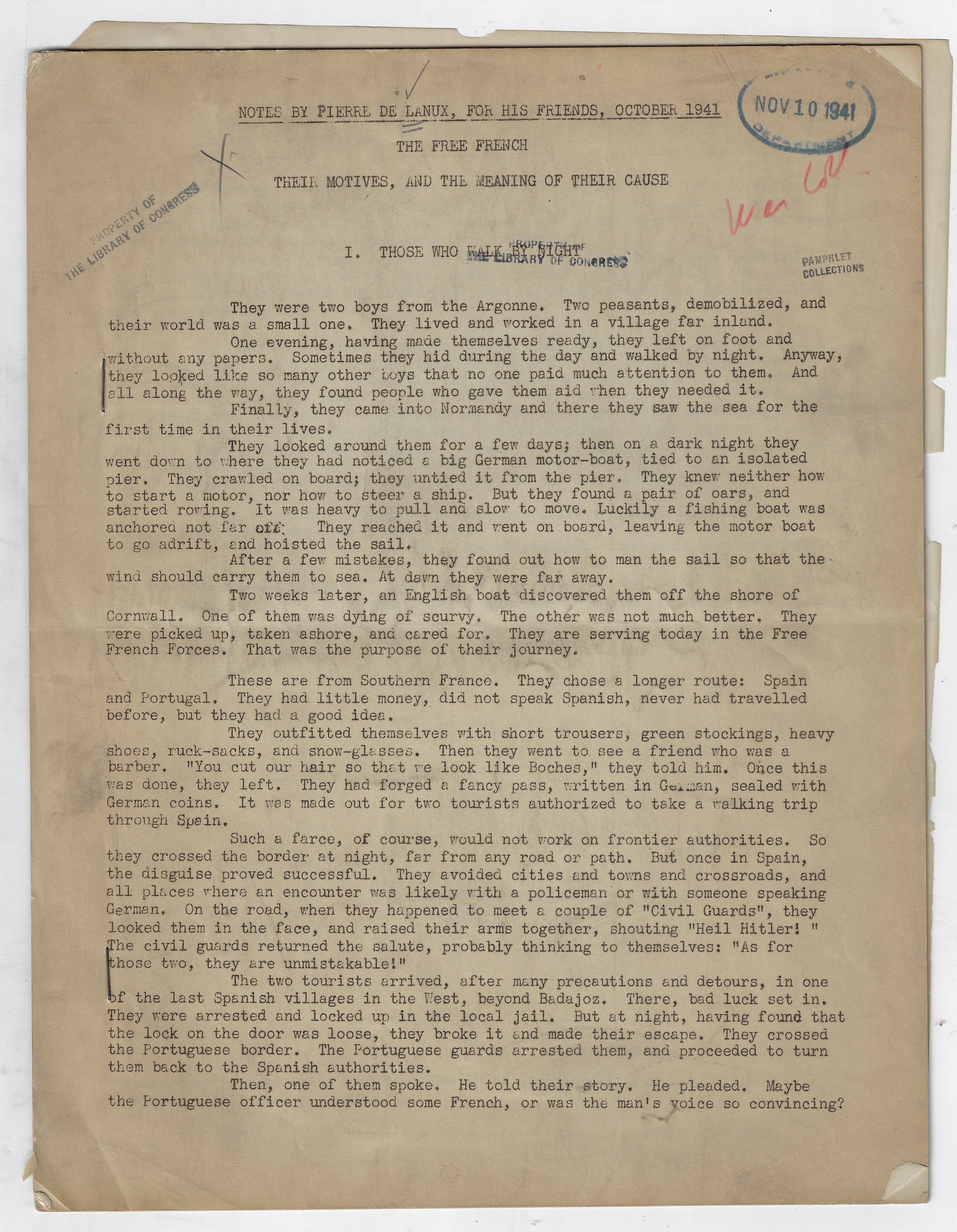
  • Rare Work on the Free French, 1941

    Free FrenchPierre de Lanux, Notes by Pierre de Lanux, for his Friends, October 1941. The Free French, their Motives, and the Meaning of their Cause. November, 1941. Received by the Library of Congress November 10, 1941. 11”x 8.5{, 11 leaves. Mimeographed. Includes he following sections: Those Who Walk by Night; A War of Independence; The F.F.F.(Free French Forces);the Invisible Army; In Terms of History.  $200

    Provenance: Library of Congress, with a small oval stamp plus three small rubber stamps on front page; LC rubber stamp on rear page. Front page a little dusty but he rest of the ext is near-fine. Stapled, with last leaf detached. Very old and nearly gone horizontal fold at center.

    NO copies located in WorldCat.

    ·Posted by :

    ·in:


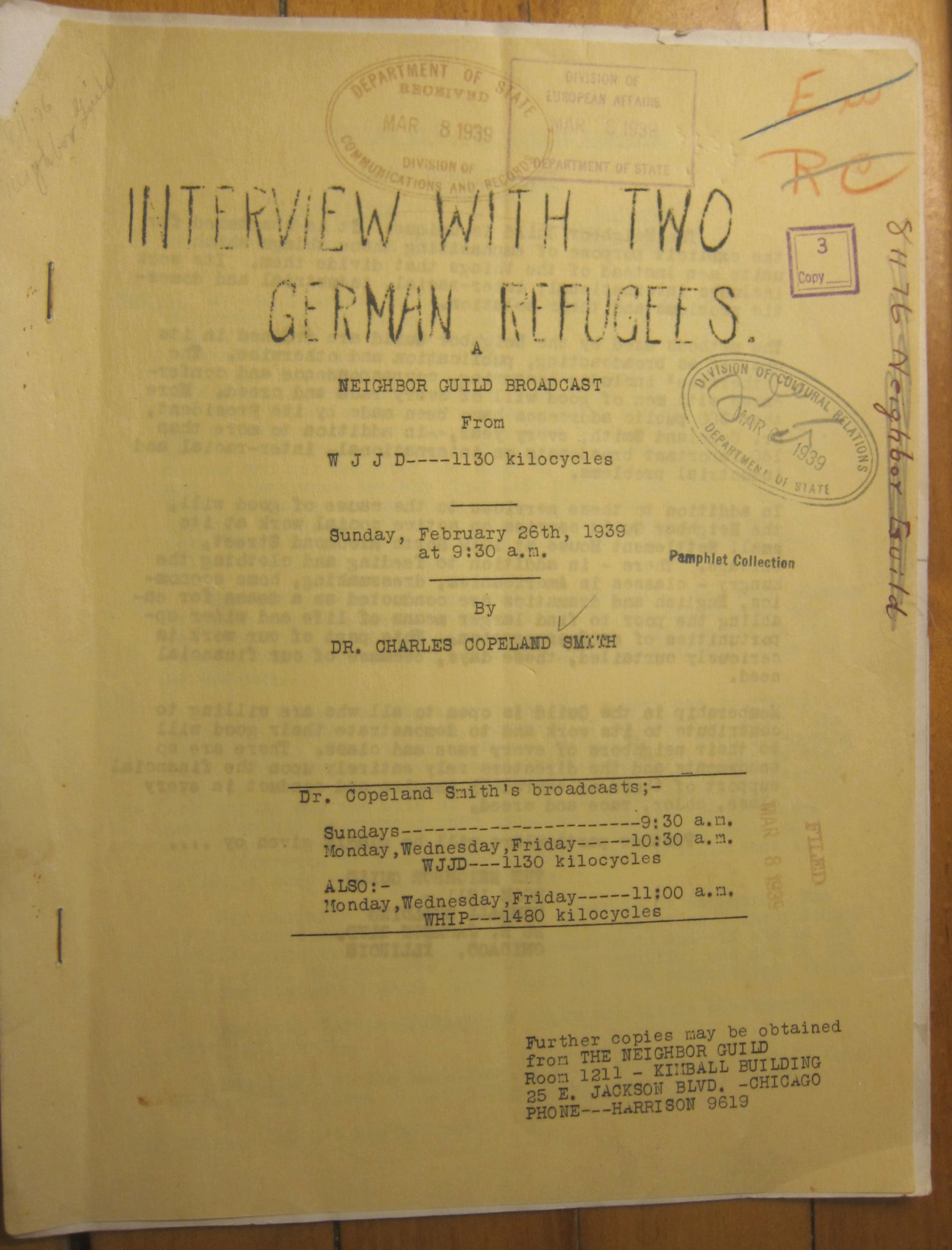
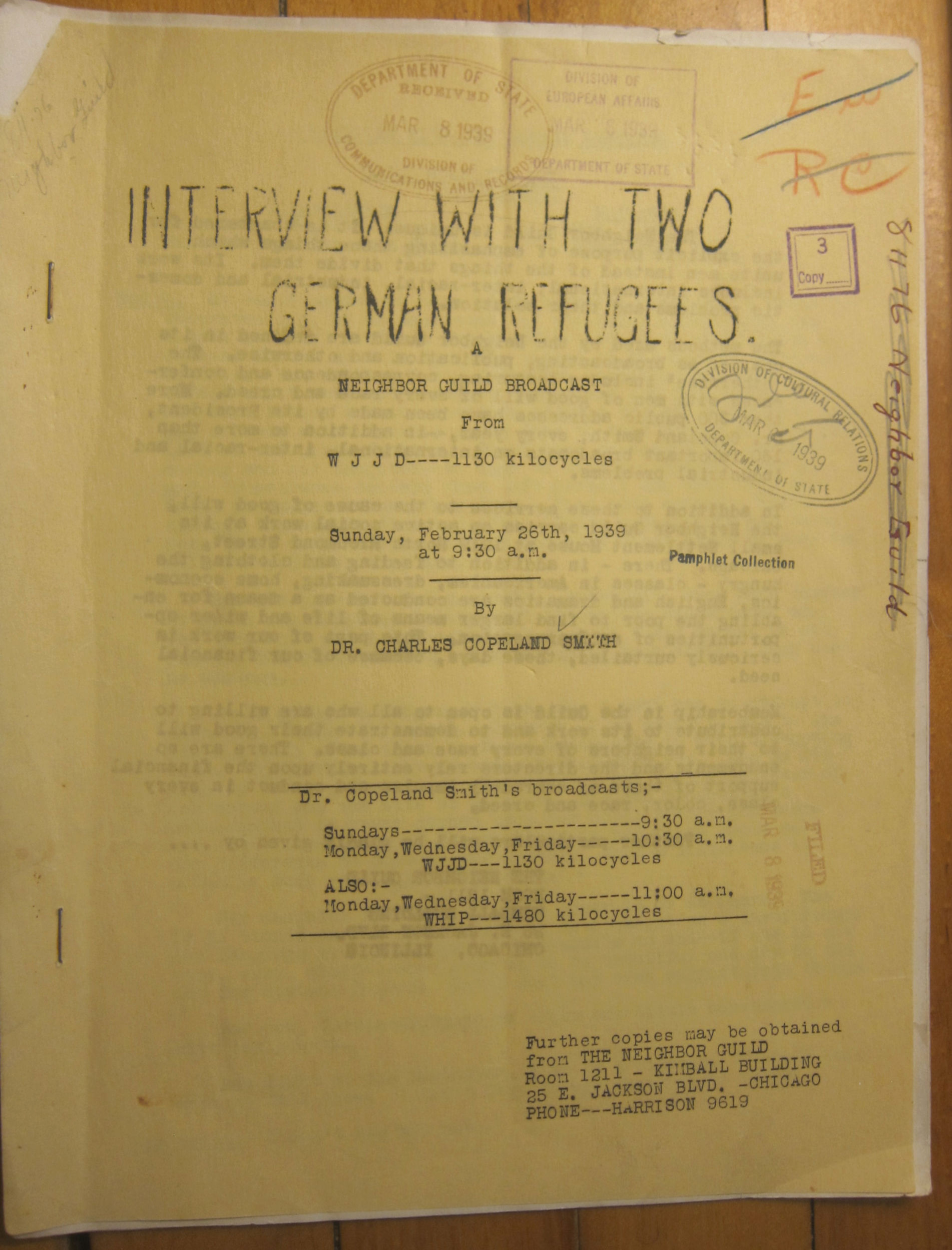
  • Wwii Jewish Refugees 1939 Interview With Two German Refugees A Neighborhood Guild Broadcast From Wjjd1130 Kilo

    German refugees _cvr_(WWII Jewish Refugees, 1939).

    “Interview with Two German Refugees.” A Neighborhood Guild Broadcast from WJJD—1130 kilocycles, Sunday February 26, 1939, conducted by Charles Copeland Smith. Chicago, Illinois.

    11”x 8.5”, cover+6 leaves of printed interview. Provenance: U.S. Department of State.

    GOOD condition.  $150

    This is a radio interview conducted by Charles Copeland Smith in 1939 of two German refugees (Mrs. King and a Miss Greta King”) shortly before the fighting war begins later in the year.

    Four rubber stamps on the cover (see image); last leaf detached from the stapled binding.

    Why did the Kings leave Germany? Because they were Jews. The husband, Dr. King, lost his practice and privilege on April 1933. They outlined what was happening to Jews in general in Germany—the stormtroopers, the loss of life, imprisonment. Reports on some anti-Semitism in the US towards them

    By 1935 determined to leave, the end was in sight for the Jews.

    The April 1 1933 law that is mentioned I this interview refers to “The “Law for the Restoration of the Professional Civil Service”, the first official banishment of the Jewish people as menials, second-class citizens,  banning the Jews from government jobs. The Jews had already been established by the Nazis as being the cause for the loss of WWI, the debacle at Versailles, the ruination of German culture and mortal enemy of the Aryan German. Many hundreds of laws like this would be instituted over the coming few years, establishing the legality of the supposed inferior nature of the Jewish people.  (Also in July 1933 came the underpinning legislation of some future nasty thinking, Ernst Rudin’s “Law for the Prevention of Hereditarily Diseased Offspring”, which established health courts and compulsory abortion and sterilization for a variety of physical and hereditary traits found to be unacceptable for the promulgation of a superior German race.) And this is all before the Nuremberg Laws of 1935/1936, (specifically the “Reich Citizenship Law” 1936)  which basically established the fate of the Jews, removing their citizenship and making them “subjects of the state”. Do I really need reiterate the case for the Nazi subjugation of the Jews, and their making the social and legal basis for the coming extermination policies which were codified at Wansee in 1942?  I think not–though it seems to me that for whatever reason the Smiths decided to not utilize this already well established (even by 1939) information. I think that at the very least they did not want to know.”

    ·Posted by :

    ·in:


  • Rare First-Hand Account of the Japanese Surrender in Tokyo and the Philippines (1945)


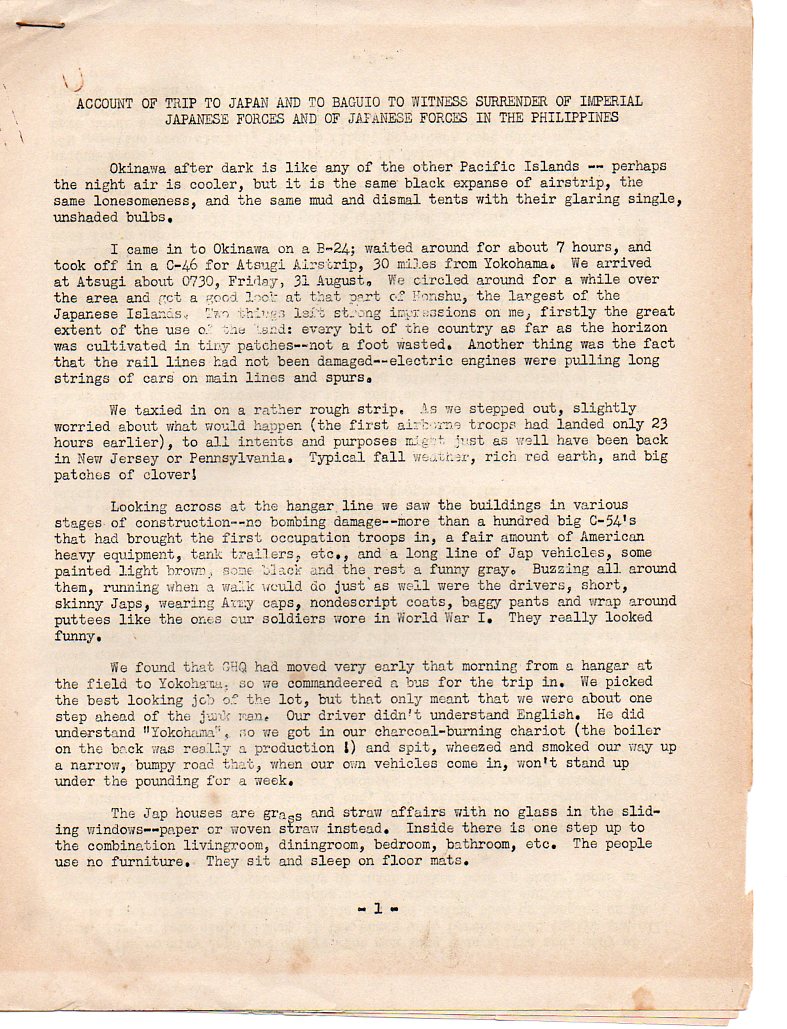
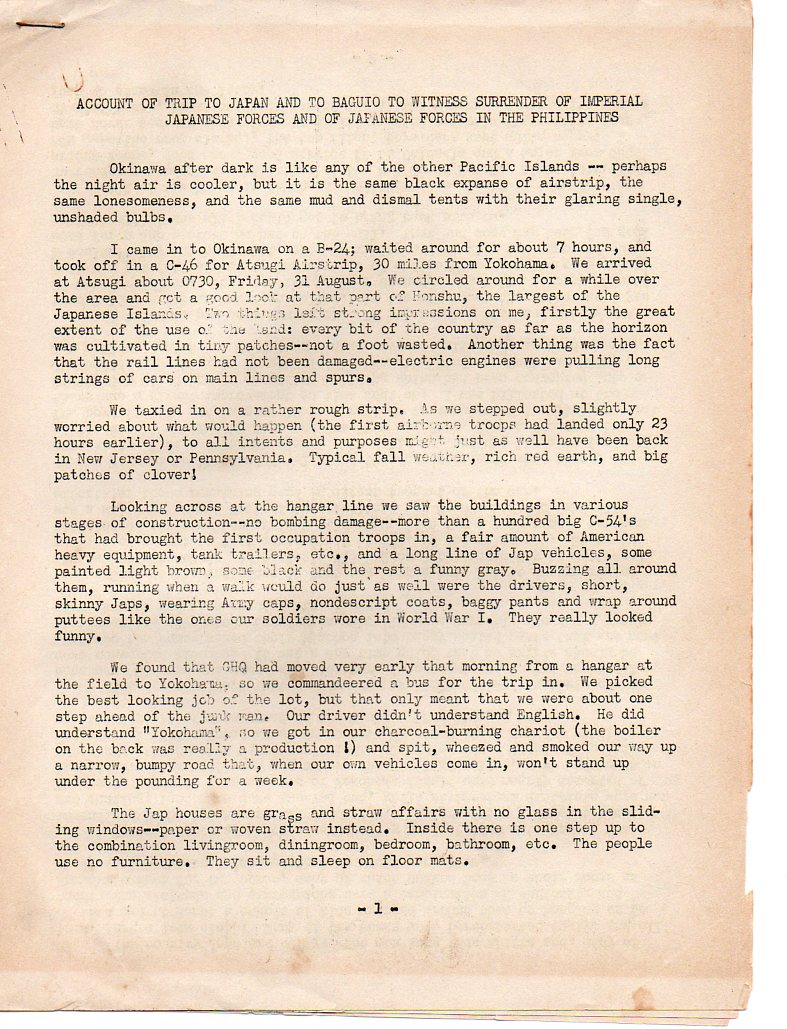
    Deglin _1_Deglin, Lt. Col T(heodore) .L.  (“PRO AFWESPAC”, Public Relations Officer, Armed Fores Western Pacific, Phillippines). Account of a Trip to Japan and to Baguio to Witness Surrender of Imperial Japanese Forces and of Japanese Forces in the Philippines. 1945  5pp.  Very good condition.  $950

    After serving as public relations director for Madison Square Garden (1935-1942), T.L. Deglin became a Lt. Col. in the U.S. Army (and later a full colonel) in a public relations capacity, finding himself a witness on 2 September 1945 to the Japanese surrender on the U.S.S. Missouri. He and his party then leaves immediately for Baguio (in the Philippines) to bear witness and report on the surrender of Japanese forces in the Philippines, including the arrest of the Beast of Manila, General Yamashita. What follows below is his five-page (1750 word) description of those events.  The report is an offset-printed production, so it did see some sort of distribution, but I can find no mention of it anywhere. 

    An example of Deglin’s reporting from the desk of the USS Missouri:

    • “General MacArthur is a terrific showman. Every move of his is dramatic and beautifully timed. He spoke briefly, then instructed the Jap foreign minister to sign for the emperor of Japan and the Japanese government. The skinny, bespectacled, top-hatted minister, Shigemitsu, limped forward, pulling his game leg after him. He sat down, facing MacArthur, and had trouble getting the leg under the table. He fiddled around, picked up a pen, put it down, looked at his watch, looked around, looked at his watch again until everyone was slightly nervous, and the general looked quite irritated. Frankly, I could think of only one thing: that a kamikaze plane was going to dive out of the clouds at this time and blow us all over Tokyo Bay. No such excitement, however; the old boy signed both copies of the surrender document and limped back to his position. Then General Umezu, chief of staff for the Imperial Japanese Army, signed quickly.”

    Here’s an example of Deglin’s reporting from Baguio:

    • “The conference room was set up with a long table. On one side were a dozen high, hand-carved chairs. On the other side were four wooden folding chairs. The newsreel cameras, still photographers, and radio broadcasters were all set up in their places. Then the Japs were brought in. They were led to the side of the table where the small chairs were and started to sit down but were instructed to remain standing. They were kept standing for nearly 10 minutes; then the top generals came in and sat down. After them came a group of 15 brigadier and major generals. Then the correspondents were herded in—about 35 of them.
      The ceremony was partially designed for the radio broadcast. The surrender document was read, Yamashita was asked if he understood the terms (an interpreter stood behind him), he answered “yes,” the documents (four copies) were signed, the generals filed out, and Yamashita was turned over to the MPs for delivery to New Bilibid Prison near Manila. Incidentally, when he left Baguio he wore a string of ribbons. Guess who has them now!

    ·Posted by :

    ·in:


  • Rare Document on Japanese Surrender in the Philippines (23 September 1945)

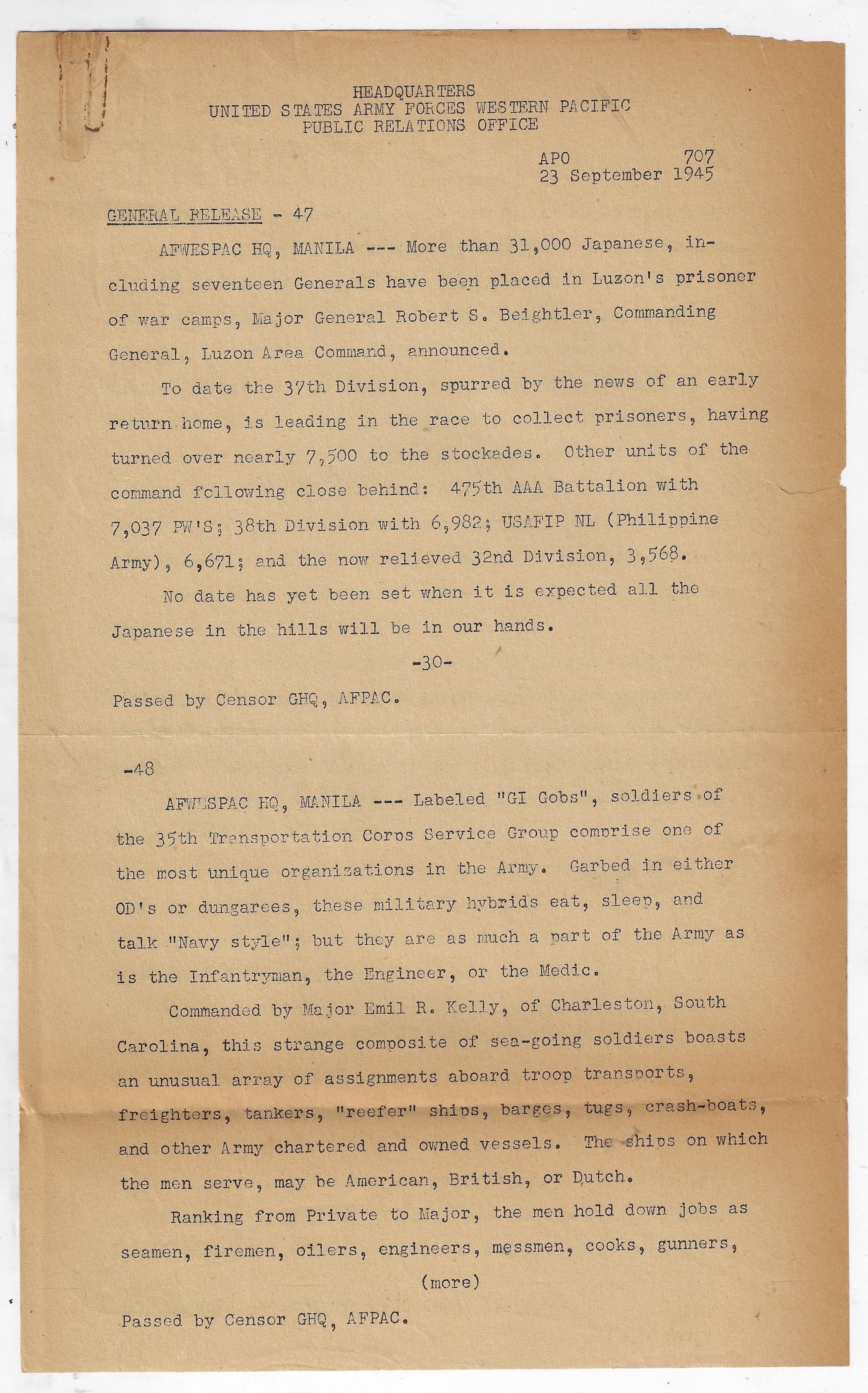
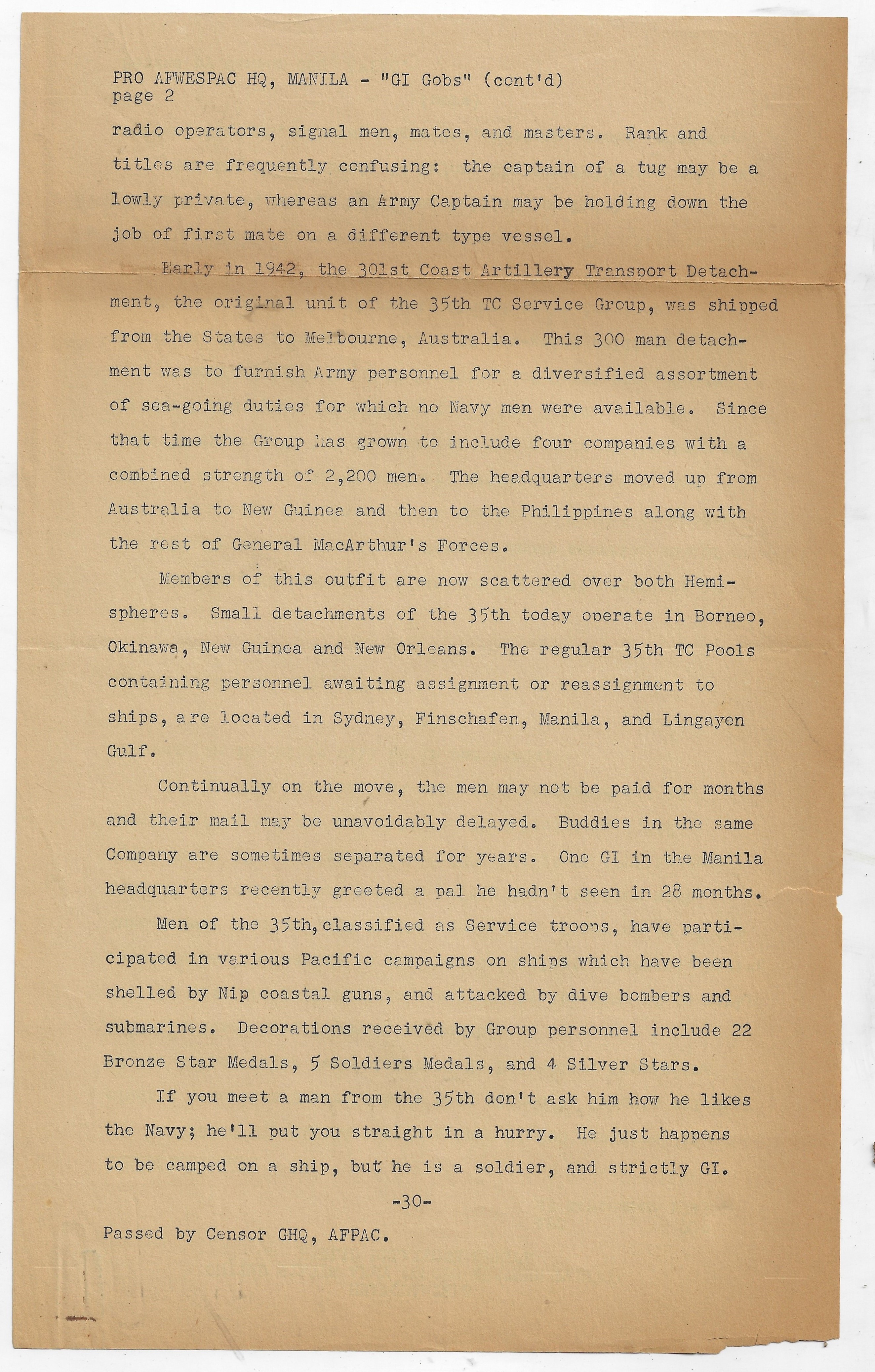
    Philippines 23 Sept 1945 “Headquarter / United States Army Forces Western Pacific / Public Relations Office / General Release – 47, APO 707, 23 September 1945”. Single sheet, offset on newspaper print. 13”x 8”, printed front and back. About 700 words. The entire document is reproduced here.

    GOOD condition, only. The document was printed on an inferior paper, which has browned and has become brittle along the edges. There is one old old (at bottom) and one short tear (at top side right). Rare. $500

    Even though WWII in the Pacific was ended on 15 August 1945 (or at least the surrender was initiated then) and the surrender papers signed aboard the USS Missouri in Tokyo Bay on 2 September 1945 (“VJ Day”), there were many elements of the Japanese Army that took weeks and in some cases months to actually lay down their weapons and submit. (There are some rare cases of individual soldiers lasting for years and decades past the surrender, refusing to give in, living their lives in remote places.)

    This document–“Headquarter / United States Army Forces Western Pacific / Public Relations Office / General Release – 47, APO 707, 23 September 1945”–released by the propaganda/public relations office of the U.S. Army Force Western Pacific, details some of the process of large forces of Japanese forces in the Philippines coming in to surrender. 

    Stating that 31,000 Japanese soldiers (and 17 generals) had already been placed under guard in Luzon’s POW camps, the three-paragraph document ends with this interesting statement:

    “No date has yet been set when it is expected all the Japanese in the hills will be in our hands.”


    Philippines 23 Sept 1945 _2_

    ·Posted by :

    ·in:


  • WWII German Bombing Report (1940)

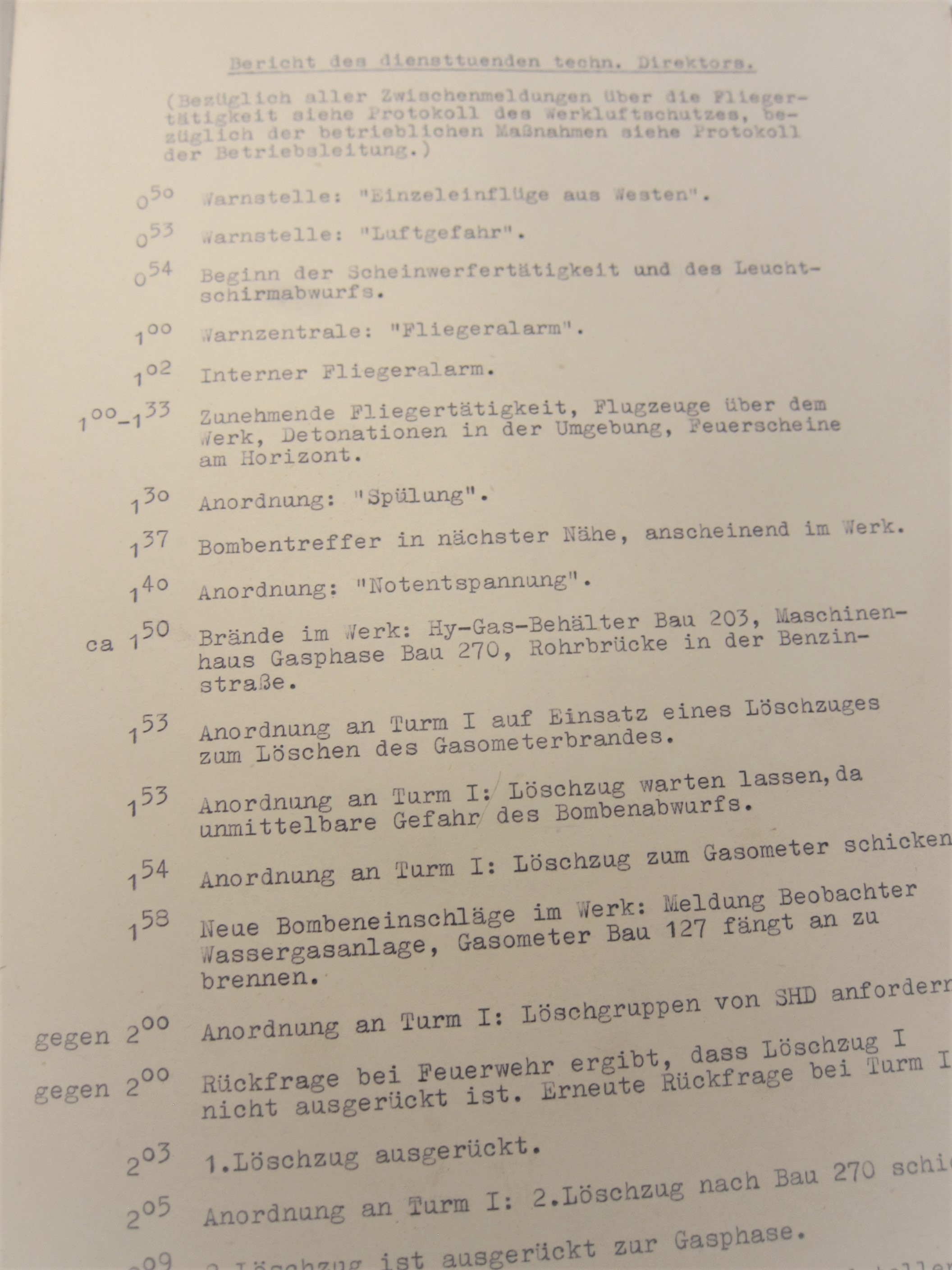
    Title: Allied Bombing and a Report on Damage to German Industry– Fliegerangriff in der Nachct vom 17./18.8.40 auf die Hydrierwerk Scholven A.G.   1940. 

    With 27 original photographs displaying bombing damage. $750

    **NOTE: Hydrierwerk Scholven A.G. was a synthetic petroleum plant and was one of the earliest targets of the British in the Ruhr Valley. It was owned by the Hibernia Mining Company, as a hydrogenation plant in 1935. Gelsenkirchen is a city in North Rhine-Westphalia, Germany. It is located in the northern part of the Ruhr area. Publication Data: no indication of author/printer or which agency/department was responsible, but this looks like (to me) to be the beginning of a standard protocol on reporting damage from British bombing raids. It seems as though the typing under the captions is first generation.
     
    Bombing report _1_

    Publication data: there is no indication of author, place of publication, or any other printing data. Given the production values here this may be a unique work, or at worst, one copy of a very restricted number, of extremely highly limited distribution. It also seems that the typed captions under the photos is first generation.

    It seems to me that this is a standard bit of reporting made after every bombing raid (?) 

    Size: 11.5 x 8.5 inches. 20 leaves with 27 original photographic images of damage caused by the bombing. Each leave is quite thick—much more stiff and heavy than a 110-lb cover stock sheet. The photos are all 3 x 4.5 inches, and are clear and bright. Condition: fine condition. Provenance: ex-library, U.S. Library of Congress.

    Provenance: this book was part of a very large collection of 90,000 pamphlets bought of the U.S. Library of Congress. Known simply as the “Pamphlet Collection” it is identified by a distinctive and tiny 3mm perforated stamp on the title page (bottom), plus a bookplate at the front pastedown with the LC surplus/duplicate rubber stamp on it.

    Binding: bound in thick cloth boards, with heavier black cloth board tips and spine.  

    Condition: there is a bit of rubbing to the extremities, though overall the book is in Very Good condition.  

    Notes:

    “Gelsenkirchen in the time of the Third Reich In the time when the Nazis held sway in Germany, Gelsenkirchen, owing to its location in the heart of the Ruhr area, was a centre of wartime industry. In no other time has Gelsenkirchen’s industry been so highly productive. This brought about, on the one hand, after the massive job cuts in the 1920s, a short-term boost in mining and heavy-industry jobs. On the other hand, the city naturally became the target of many heavy Allied bombing raids during the Second World War, which destroyed three fourths of Gelsenkirchen. Even today, many old above-ground air-raid shelters can be found in the city, and some of the city’s official buildings such as Hans-Sachs-Haus downtown and the town hall in Buer have air-raid shelters still kept more or less in their original form. Two synagogues in Gelsenkirchen were destroyed in the anti-Jewish riots of Kristallnacht in November 1938. The one in Buer was burnt down. The one in downtown Gelsenkirchen was likewise destroyed. Exactly 66 years later, the cornerstone was laid there for a new synagogue. The Institute for City History set up a documentation site: “Gelsenkirchen in National Socialist times”. Throughout the time when Hitler was in power, from 1933 to 1945, the city’s mayor was Carl Engelbert Böhmer, an NSDAP.”

    ·Posted by :

    ·in: