A Daily History of Holes, Dots, Lines, Science, History, Math, Physics, Art, the Unintentional Absurd, Architecture, Maps, Data Visualization, Blank and Missing Things, and so on. |1.6 million words, 7500 images, 4.9 million hits| Press & appearances in The Times, Le Figaro, Mensa, The Economist, The Guardian, Discovery News, Slate, Le Monde, Sci American Blogs, Le Pont, and many other places… 5000+ total posts since 2008.

Book Category: World War II

  • German Anti-Soviet Propaganda (1942)

    Sous la faucille el le marteau (“Under the Hammer and Sickle”). (No indication of place of publication, or publisher, or date of publication, though I would guess around 1942.) 18”x 28”. One separation along 10” of a fold repaired with archival Japan tape; otherwise VG. Provenance: Library of Congress, with their rubber stamp on the front cover. WorldCat locates 10 copies—none in the U.S. (Also they estimate the publication date to be 1945, which I think is too late in the war; I would guess 1942.)

    $250

    This “pamphlet” is uncut from the original sheet, meaning that in order to read it you unfold/open the object three times: one panel to start, then two, then four are revealed, and then eight. This is an effective technique, as the images become progressively more grim; when you arrive at the “poster” portion of this pamphlet, the images are very bad.
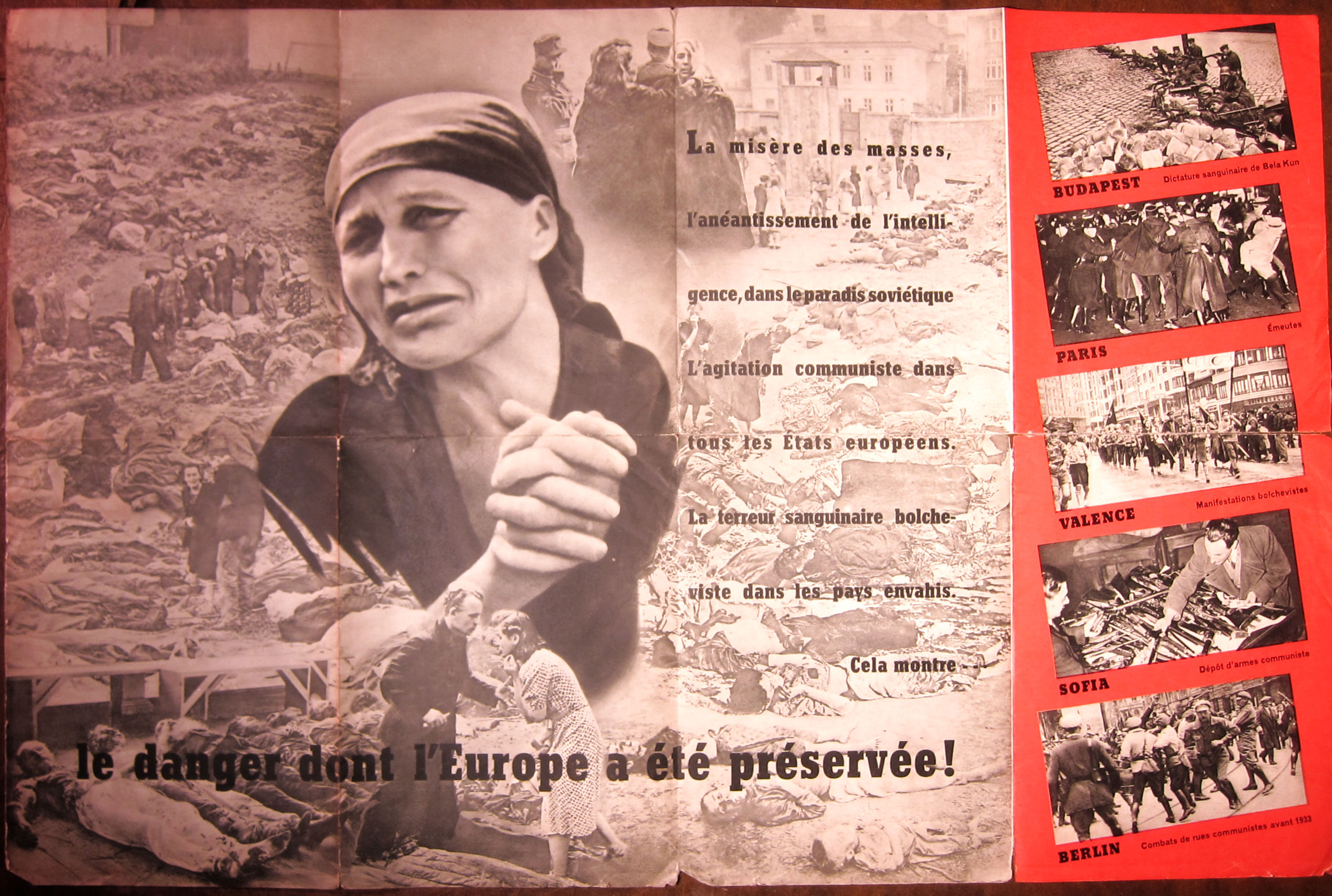
     

    German propaganda poster _2_


    This is a searing and bitter piece of German anti-Soviet propaganda printed for French readers somewhere near 1942—it seems to me to be a product of the Nazi thought engineers that was made before the turning point of Operation Barbarossa, before things started to go very badly for the Germans in mid/late 1941 and advancing into 1942 (the campaign and the VI army ending in January 1943). This is something that goes far beyond a general strafing of the Soviet Union, and on into a condemnation of the system/soldiers/people as barbaric and “deviant”.

    The opening page leads with an indicting quote from Lenin and then introduces the rest of the imagery saying, in effect, “what the domination of international communism means in reality” and reporting the first-hand accounts of what “the German troops and their allies and saw…everywhere with their own eyes” which is established as the “practice, the aspect of Bolshevism that menaces Europe”.
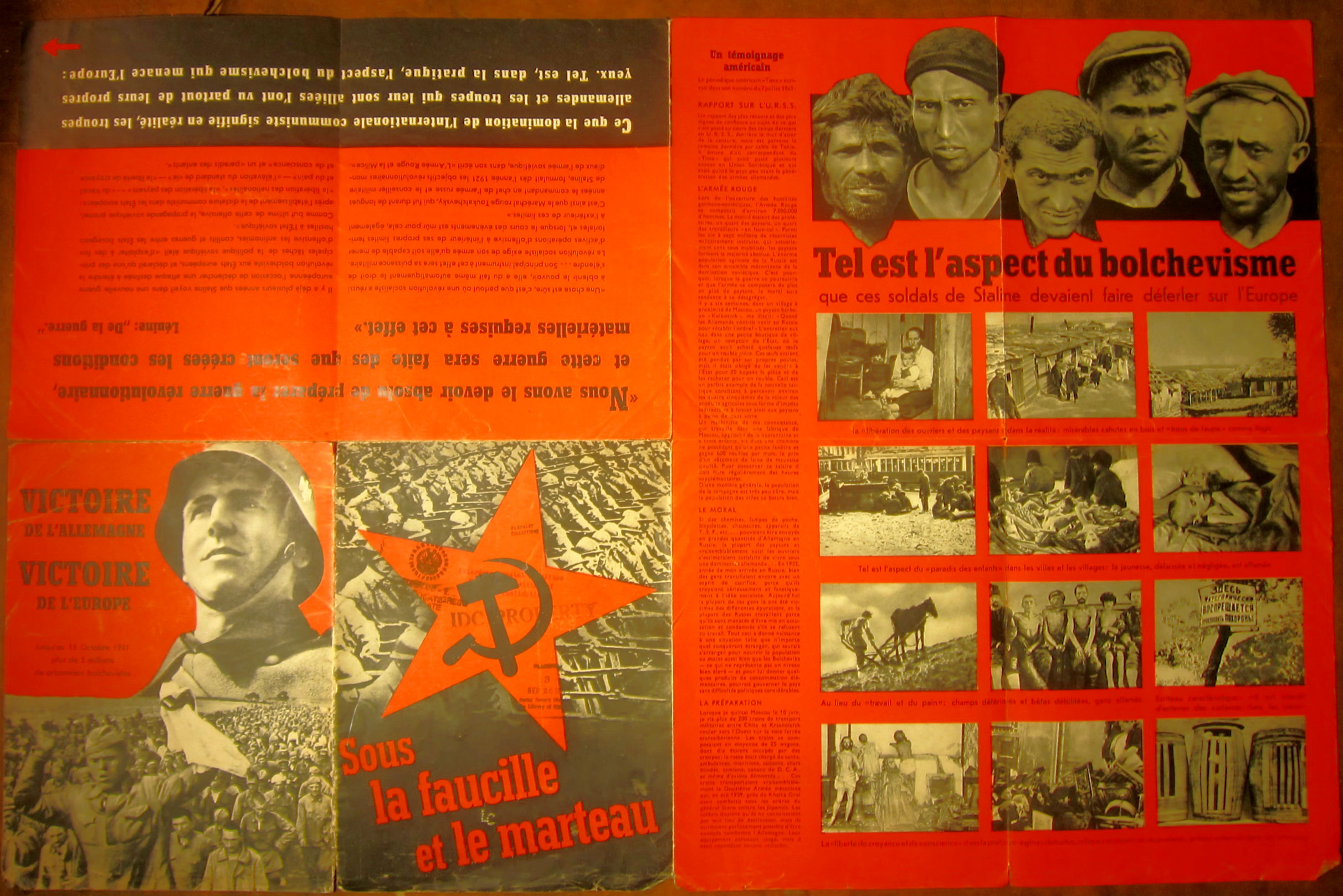
    German propaganda hammer sickle covers poster 1_


    Then comes the hard stuff, the pamphlet opening into a poster, with grainy pictures depicting terrible things: menacing-looking portraits of men said to be the ‘deviant” USSR soldiers; depictions of hardscrabble and dilapidated villages in the “worker’s paradise”; a common sight of a sign in a park prohibiting the burial of cadavers on park grounds; profanities committed against the church, including imprisoning priests in barrels as cells, and then advancing to the terrible depiction of the “children’s paradise”, showing “the youth, neglected and abandoned, starving”, with photos of piles of small bodies.

    On the other side of the “poster” is another dire set of images, again depicting the supposed hell-hole of Bolshevism, the “Soviet paradise” nothing but misery, accompanied by the “annihilation” of intelligence/intellect. Very tough stuff, especially writ large like this.
    ·Posted by :

    ·in:


  • The Situation in Poland, 1944

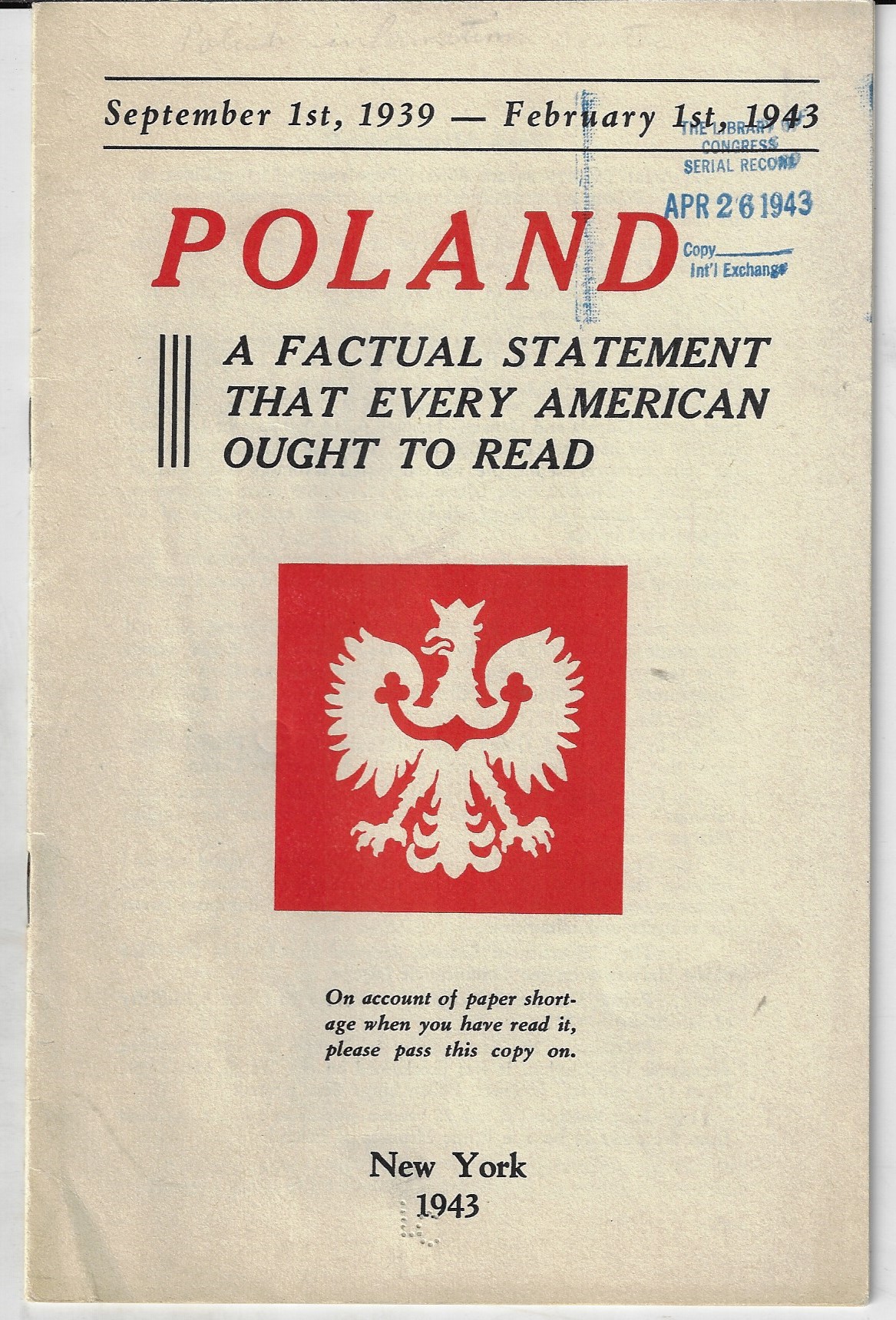
    Poland, a Factual Statement that Every American Ought to Read. New York, 1943. Polish Information Center, 151 East 67th Street, NYC; 9”x 6”, 16pp. Printed wrappers. Provenance, Library of Congress, with their rubber stamp on the front cover. VG copy. WorldCat locates only 5 copies. $350

    Of particular interest is the section “German Reign of Terror” [reproduced below] (pp 12-15), leading with these numbers of crimes committed by the Germans: To forced labor in Germany (1,000,000 Poles); to the Government General (700,000 Poles); shot and murdered (1,200,000 Poles), starved to death (about 500,000 Poles). “It staggers the imagination to think that every tenth human being in German occupied Poland had already been shot or hanged tortured to death, starved…or deported to Germany.”

    There are other stories of mass executions, as well as a short description of Auschwitz: “More than 60,000 Poles have been murdered in the concentration camps of the Government General and the Reich. Oswiecim is the most gruesome on Polish territory. It was set up in July 1940 and consists of ten barracks, each of which is supposed to contain 400 prisoners, but actually houses 1,000 men. Prisoners wear thin cotton uniforms in winter as in summer. They were only given shoes on October 15 and had no caps before December. On arrival they had to fill out answers to 32 questions about their life, family, health, wealth and political activities. Two weeks suffice to break men above 45 years. Younger men lose their vigor and youth within half a year…”

    Poland  factual statement

    This is the scan of the “German Reign of Terror” section:

    ·Posted by :

    ·in:


  • Report No 1 Confidential Eye Witness Reports From North Of The 38Th Parallel Russian Occupation Zone In Korea 13X8

    Russia North Korea

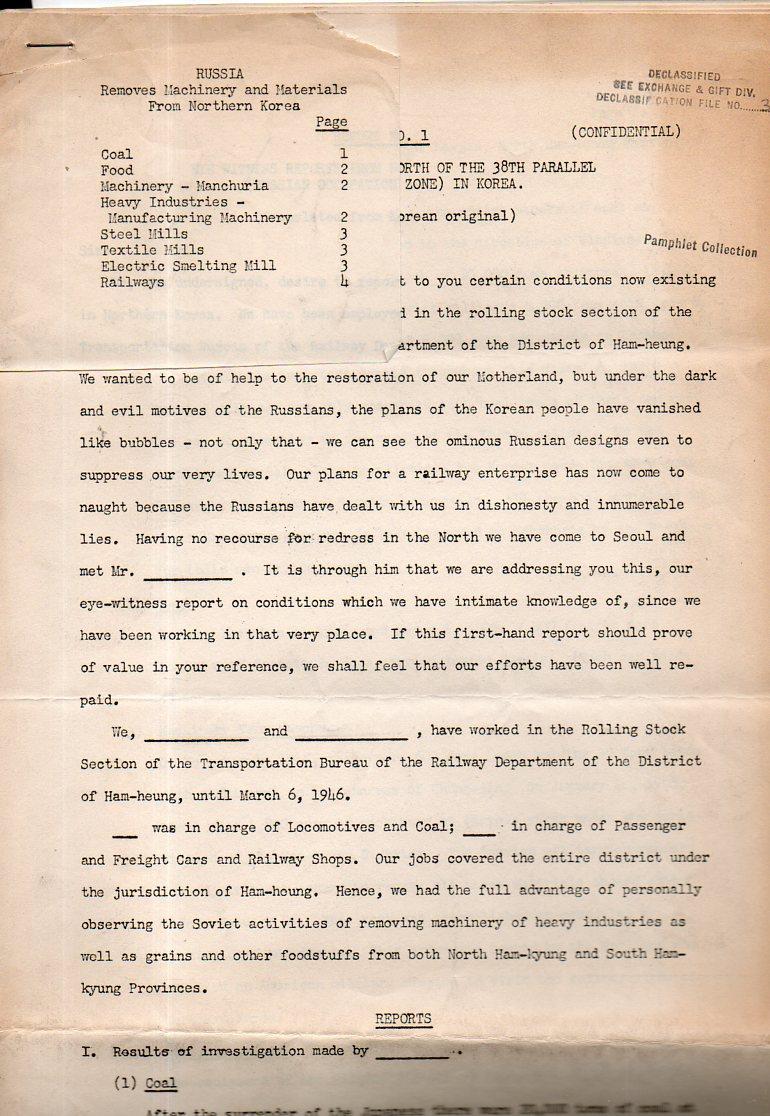
    Report No. 1. (Confidential) Eye Witness Reports from North of the 38th Parallel (Russian Occupation Zone) in Korea. 13×8″, 5 leaves, offset printed. Offset printed. WorldCat/OCLC locates NO copies. $750

    Condition: old vertical fold at the bottom quarter. Stamped “declassified” by the exchange and gift division, Library of Congress, with their surplus/duplicate stamp on the rear page.

    There are various reports with the “eyewitness” names left out, replaced by subscript lines. The materials removed are categorized so: coal, food, machinery, Manchuria, heavy industries, manufacturing machinery, steel mills, textile mills, electric smelting mill, railways, and so on.

    This document seems to offer proofs of large-scale stripping of North Korean facilities back to the Soviet Union–at just the time when it was said that there perhaps wasn’t good evidence for this. (See: The North Korean Revolution, 1945–1950 By Charles K. Armstrong, page 150, available online).

    ·Posted by :

    ·in:


  • Kilsoo K. Haan/OSS (CIA) Copy

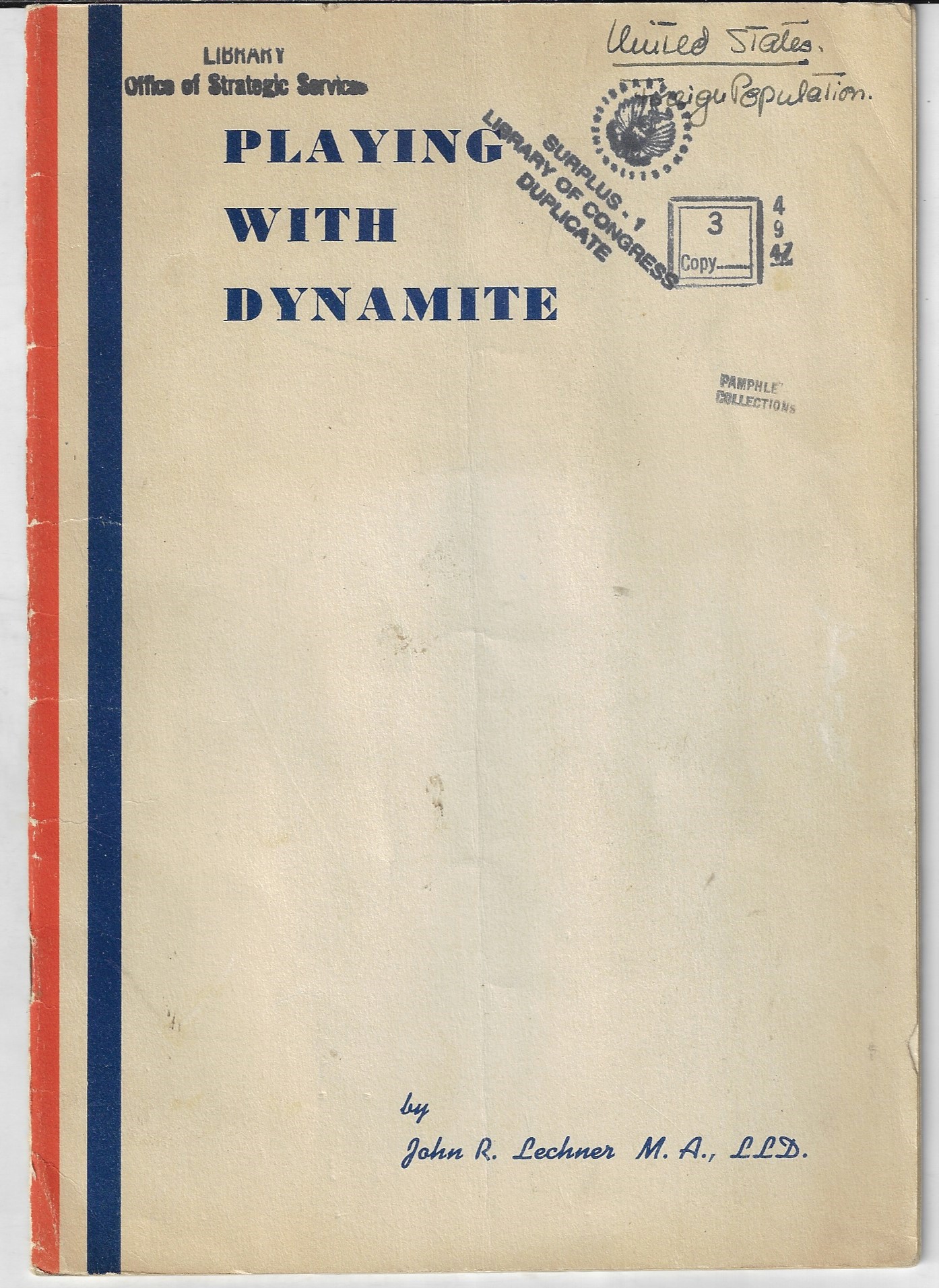
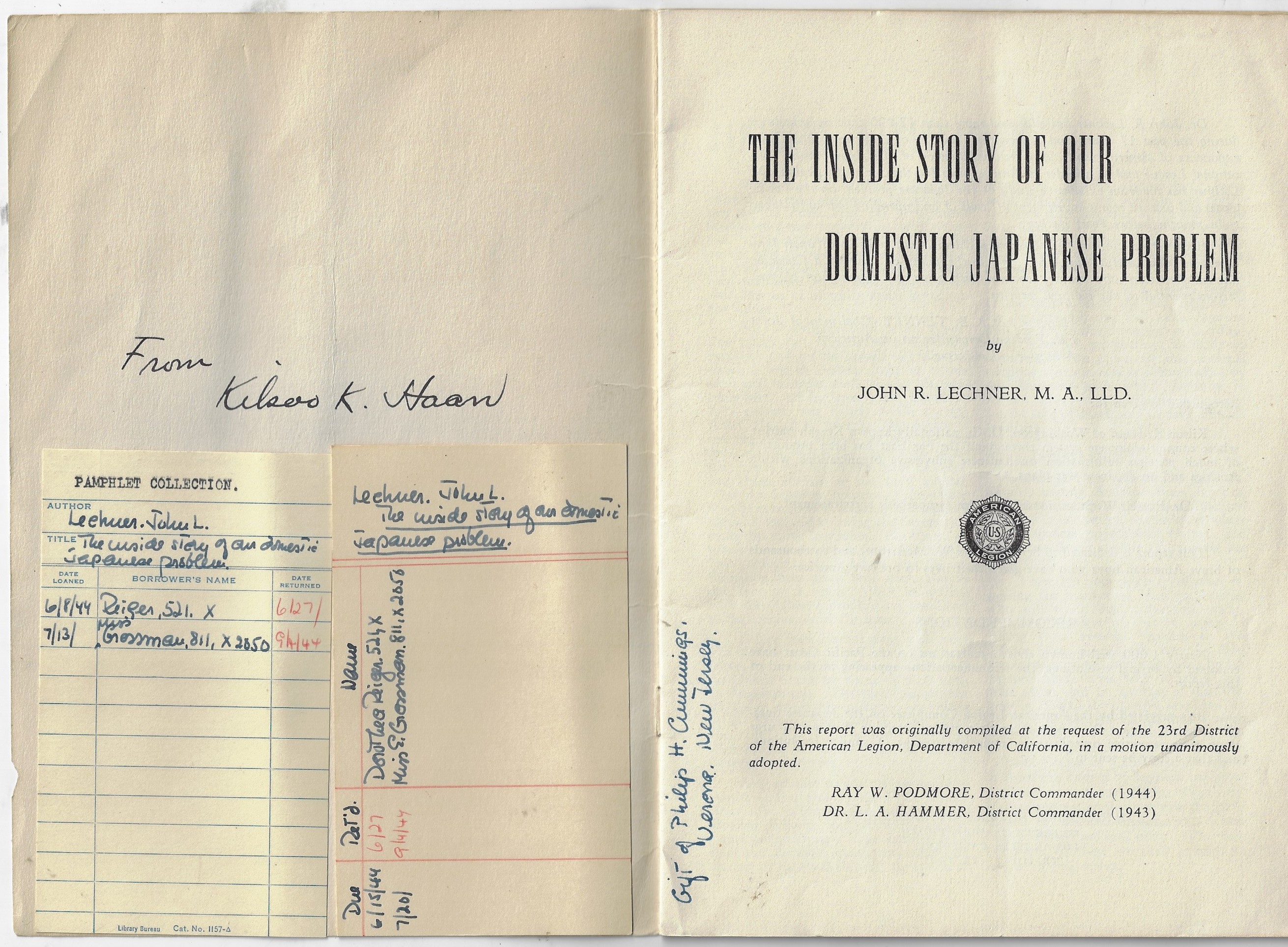
    Lechner1, John R. The Inside Story of our Domestic Japanese Problem. (1944) American Legion of California. 10”x 7”, 18pp. Provenance: Kilsoo K. Haan2, to Phillip H. Cummings, who gave this to the Library of the Office of Strategic Services (OSS, precursor of the CIA), and from there to the Library of Congress. Rubber stamps for the OSS library and for the Library of Congress.

    Only 5 copies located in WorldCat (all in the U.S.) There is also an OSS borrowing slip (with two entries) in the rear pocket of the pamphlet.

    Condition: there is an old vertical fold that runs through the pamphlet. A GOOD copy. $350

    Lechner _2_Lechner—a one-time champion of the Japanese in the U.S. Turned completely against his old allies following some extended interlude after Pearl Harbor, and became a virulent proponent for the military control and incarceration of Japanese-descent people in the U.S. He also proposed the incarceration of all people of Japanese descent in the U.S., including Hawaiians. This pamphlet outlines some of his theories about people of Japanese descent in the U.S., how they planned to sabotage the country, and how they must be removed from the areas around the U.S. and never be allowed to be part of national society again without adopting certain Japanese principles (including the renouncing of Shintoism).

    To give you some ides of the depth of Lechner’s anti-Japanese thinking, here are some of the pamphlet’s section subheads: “Japanese Language Schools” under consideration for subversive activity; “Japanese Children Attending Public School” (to “preserve the magnificent Japanese culture”; “Imperial Educational Association”, “…the control exercised by Japan…over Japanese-American youth”; “Nisei as Propaganda Agents for Japan”; “The Future Road of the Nisei”(on the role of Nisei working for the interests of Japan); “Kebei Organizations (“…brazen violation of mutual friendship …(via) an enticement of Nisei to pursue cultural training in Japan”); “Kebei Organizations” (stating that these cultural organizations are part of Japan’s “shrewd” conduct of their total war against the U.S.); “Japanese Conscription of the Nisei”; “Local Japanese Subversive Organizations”; “Imperial Comradeship Society”, (“arm of the Imperial Black Dragon Society, most powerful and most feared secret organization in the Japanese Empire…to eradicate Occidental influence in the Far East”); “Behind the Scenes at Manzanar”, (on riot and resistance at the camp); and of course “Bacteria Warfare”, (“this was to be accomplished by dropping vials containing germs, to spread bubonic plague…”). Finishing up the pamphlet is “No Time for Sentiment” (“No Christian leader can find fault with the the human treatment if the Japanese by our government”) and that there was no “race hatred” because there was a fallacious logic involved in “not understanding the meaning of race hatred”. Lastly there is a small section called “American Appeasers” listing nine U.S. Organizations working in the interest of Japanese Americans (including the (American) Civil Liberties Union

    Lechner addresses the fact that no sabotage had been committed by any Japanese-American to 1944 as an instance of them being instructed by Japan “NOT to commit sabotage in the first stage of the war”, a classic bad logic (that I’ve seen often in these documents) where something is proved to be so precisely because there was no existing evidence to show it to be the case.

    Lechner _1_

    Notes

    1. “Americanization” and anti-Communist activist. “Dr.” John Lechner (1900–67), first allied himself with Nisei patriotic efforts just prior to World War II, then became one of the most strident voices for the mass eviction of Japanese Americans from the West Coast and against their return –https://encyclopedia.densho.org/search/

    2. “Kilsoo Haan was a Korean nationalist figure who rose to prominence in Hawai’i in the 1930s and the U.S. mainland in the early 1940s, engaging in intelligence activities through the Sino-Peoples League. Claiming that Koreans in Manchuria, Siberia, China, and America could be indispensable in aiding the United States against Japanese militarism, Haan drew considerable attention from the American public as well as from U.S. government and military officials.” https://encyclopedia.densho.org/search/

    ·Posted by :

    ·in:


  • Rare Eyewitness Account of the Surrender of Japan (1945)

    Deglin, Lt. Col T.L.  Account of a Trip to Japan and to Baguio to Witness Surrender of Imperial Japanese Forces and of Japanese Forces in the Philippines. 1945  5pp.  Very good condition.  $450


    Deglin c det956
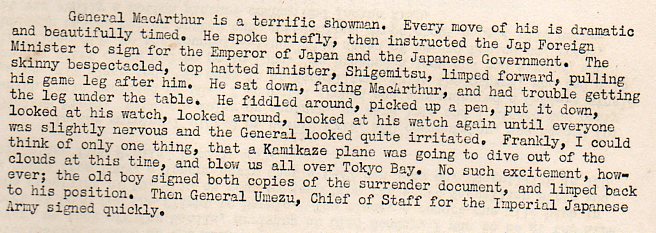
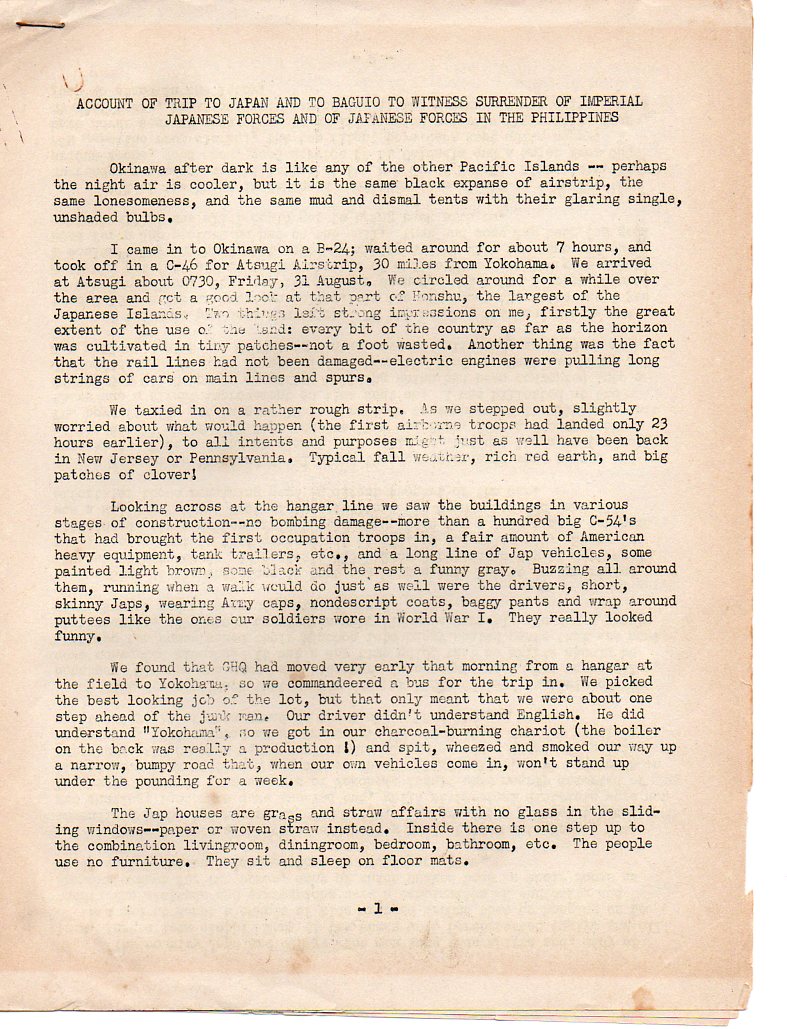
    After serving as public relations director for Madison Square Garden (1935-1942), T.L. Deglin became a Lt. Col. in the U.S. Army in a public relations capacity, finding himself a witness on 2 September 1945 to the Japanese surrender on the U.S.S. Missouri and at Baguio (in the Philippines). what follows below is his five-page (1750 word) description of those events.  The report is an offset-printed production, so it did see some sort of distribution, but I can find no mention of it anywhere. 

    My copy came as part of a large group of material (known as “The Pamphlet Collection”) that I purchased of the Library of Congress some years ago–the one cohesive factor to the collection-without-a-purpose was that the material was by and large no located in other libraries.  This may have been because of the great ephemeral nature of some of them, but the pamphlets saw very restricted play in the library circulation game. 

    [Content warning–there’s some very place/time/situation-specific derogatory language here.]

    Deglin a953

    I reproduce the document in full, below.  

    ·Posted by :

    ·in:


  • Manuscript and Rare Material on a Bombing Survey of Japan, October 1945

    This small archive—from the estate of J.D. Coker, who served in the U.S. Navy on the US Strategic Bombing Survey Ships’ Bombardment section, and who later became a leading official in the U.S. Atomic Preparedness programs (such as the President’s Committee on Emergency Preparedness)—are mimeographs and manuscripts that comprise what seems to be the summary of the Navy’s bombardment of Kamaishi, Muroran, Hitachi, Kushimoto, Shimizu, Hakodate, Nojima, Saki, and Hamamatsu.  This was about the extent of the Allied naval bombardments against Japan, as it was not possible for battleships to maneuver close enough to the Japanese homeland to fire against industrial and production centers.  (It may have also been the case that the aircraft used to protect the assaulting ships could have perhaps done as much damage to the targets as the ships themselves.) $1750

    Ships Bombardment Surveys Original, Confidential Material

    Group of 14 documents of 63 leaves concerning the bombing surveys at Hamamatsu, Hitachi, Kamaishi, Hakodate, Kushimoto, Nojima Saki (Japan) in 1945. Includes the following sections:

    (1) “Memo from the Chairman”

    Marked CONFIDENTIAL.

    “Preliminary Summary of report on Ships’ Bombardment Survey Party.”

    8vo, 7pp, carbon typescript on onion skin paper, heavily annotated and corrected in pencil.

    By N.A. Chapin, Capt., USN.

    This detailed report reviews the damage done to the areas under bombardment including Kamaishi, Hamamatsu, Hitachi, Muroran, Shimizu, Shionomisaki, Nojima Saki

    “Primary task of units attacking first four objectives was bombardment, and principal components of these Task Units in general were fast battleships and heavy cruisers. Attacks on the last three were secondary tasks during anti-shipping sweeps … .In general the mission assigned by commander Third Fleet was to bombard certain vital areas of Japanese Mainland in order to destroy vital industries and demoralize transportation, and lower will to resist of Japanese people”.

    (2) ”Ships’ Bombardment Survey Party, Order of Publication of Reports”

    8vo, 18pp, carbon typescripts on onion skin paper. Outlines this segment of the survey and provides statement on the distribution of bombing data, how reports are to be made, structure of reports. For example, for “Japan Iron Works” in Kamaishi the order of report should be the decription of target (functional and physical), followed by analysis of damage (physical, funcitonal, fall of shot and general damage plot, photos of Japan Iron Works and machinery; building and machinery layouts; tablesof production. This is the general outline and does NOT include the actual data, though it does outline about three dozen target areas. (Dated as revised in December 1945.)

    • 2a-3f are all ship-board mimeographic reports, staple bound, of the six target areas outlined above.

    (2a) ”Ships’ Bombardment Party. Field Memo No. 1. U.S.S. Haines, at Sea, 2 October 1945.”

    Marked CONFIDENTIAL. 3pp.

    Data recorded summary includes, for example:

    Kamaishi area.

    Target: Japan Iron Works. Invloving the ships USS Indiana, South Dakota, Massachusetts, using 16” guns, delivering 802 rounds on 14 July 1945.

    (2b) “Ships’ Bombardment Party/. Field Memorandum No.2 U.S.S. Haines, at Sea 7 October 1945”

    Includes data on Nihon Steel Works and Wanishi Iron Works under bombardment by USS Missouri, Iowa Wisconsin, all 16^, delivering 434 rounds. Also provides coordinates for target areas. 2pp.

    (2c) “Ships’ Bombardment Party/Confidential/ Field Memorandum No.3 U.S.S. Haines, at Sea, 16 October 1945.”

    CONFIDENTIAL.

    Objectives/bomb targets: RADAR Installation (Iso Saki), Hitachi Steel Works. Hitachi Arms Factory, and several others.

    The battleships involved include North Carolina, Alabama, Wisconsin, Missouri, Iowa (all 16”), plus Atlanta and Dayton (6”).

    (2d) ”Ships’ Bombardment Party/ Field Memorandum No.4. U.S.S. Haines, at Sea, 3 Novmber 1945”

    CONFIDENTIAL. Offset printed. 3pp.

    Kushimoto area (seaplane base, airfield, urban area, radio station). Targets distributed among the 5” and 6” guns of the USS Pasadena, Springfield, Astoria, Wilkes Barre, Wedderburn, Twining, Stockham, Uhlmann, Cushing, Colahan, Benham.

    (2e) “Ships’ Bombardment Party, Field Memo No.5 U.S.S. Haines, at Sea; 6 November, 1945”. Offset printed.2pp.

    Shimizu area (metal alumina plant, oil refinery, railroad area, urban area). Targets were bombarded by the USS McKee, Murray, Rodgers, Harrison, Ringold, Schroeder, Dashiell, with 1063 rounds.

    (2f) ”Ships’ Bombardment Party, Field Memo No. 6 U.S.S. Haines, at Sea, 6 November 1945”. 3pp. Offset printed. Hamamatsu area; (Japan Musical Company (?), railroad station, military barracks, railway, loom works, tool works, and more). Bombardment data from the USS Massachusetts, Indiana, South Dakota, all 16”; plus the Chicago, St. Paul, Boston, Quincy, all at 8”, laying in about 1200 rounds.

    ( 3) “Economic Effects of Incendiary Attack of 19 July 1945 on Hitachi Urban Area.” 16pp. Typewritten carbon sheets. Discusses damage done to the Hitachi works as wells to the civilian population (in an attack that killed 700). Including “Hitachi Economic Effects” pp 1-4; “Hitachi Mine”, 2pp; Utilities, 2pp; “Morale”, 2pp; “Effect of Attack Upon Public Health”, 1pp, plus 5pp of stats.

    ·Posted by :

    ·in:


  • On Dealing with Post-War Nazism (May, 1945)

    Algernon D. Black, Ethical Issues in the News: The Nazi Surrender. Radio announcement and delivery by Black, “Leader of the Society for Ethical Culture”, May 3rd, 1945, station WQXR. 11”x 8.5”, 5 lvs., about 2000 words. Offset printed from typed originals. Stapled, front page detached. Scarce document. $150

    Black (1900-1993) was a long-time leader of the Ethical Society (“Faith without God”) who for decades delivered radio addresses, including this one on station WQXR. The present address discuses the final weeks of the war, and the important steps that need to be taken post-war to understand who the Nazis were and how they manufactured and managed the war.

    • “…even the surrender by Nazi generals and suicides by Nazi leaders is no guarantee of a surrender of Nazi will and the defeat of Nazi ideology. In he moment of defeat, the Nazis have done things to assure the rebirth of the Nazi movement. They have hidden some of their Gestapo, SS and some o their Nazi leaders in the army and among civilians in as a complete disguise as possible.” Distractions fighting the “world’s greatest enemy”, the Bolsheviks…they would like us to believe that the mass murders in prisons and concentration camps do not matter because their victims were Jews…”
    • “When we have accepted the Nazi surrender, our real difficulties will begin.”

    Black goes on to speak about the need to separate out the Nazis from the Nazi supporters and then the anti-Nazis in order to reintroduce Germany “into civilized society”. Part of that process is to understand the propaganda and lies that were propagated to facilitate the war, and to know who and what Hitler was.

    • “Let nothing divert us from dealing…with the task of seeing to it that Nazism is really ended in this world.”


    ·Posted by :

    ·in:


  • A Call to Arms Against Hitler’s Germany (France, ca. 1935)

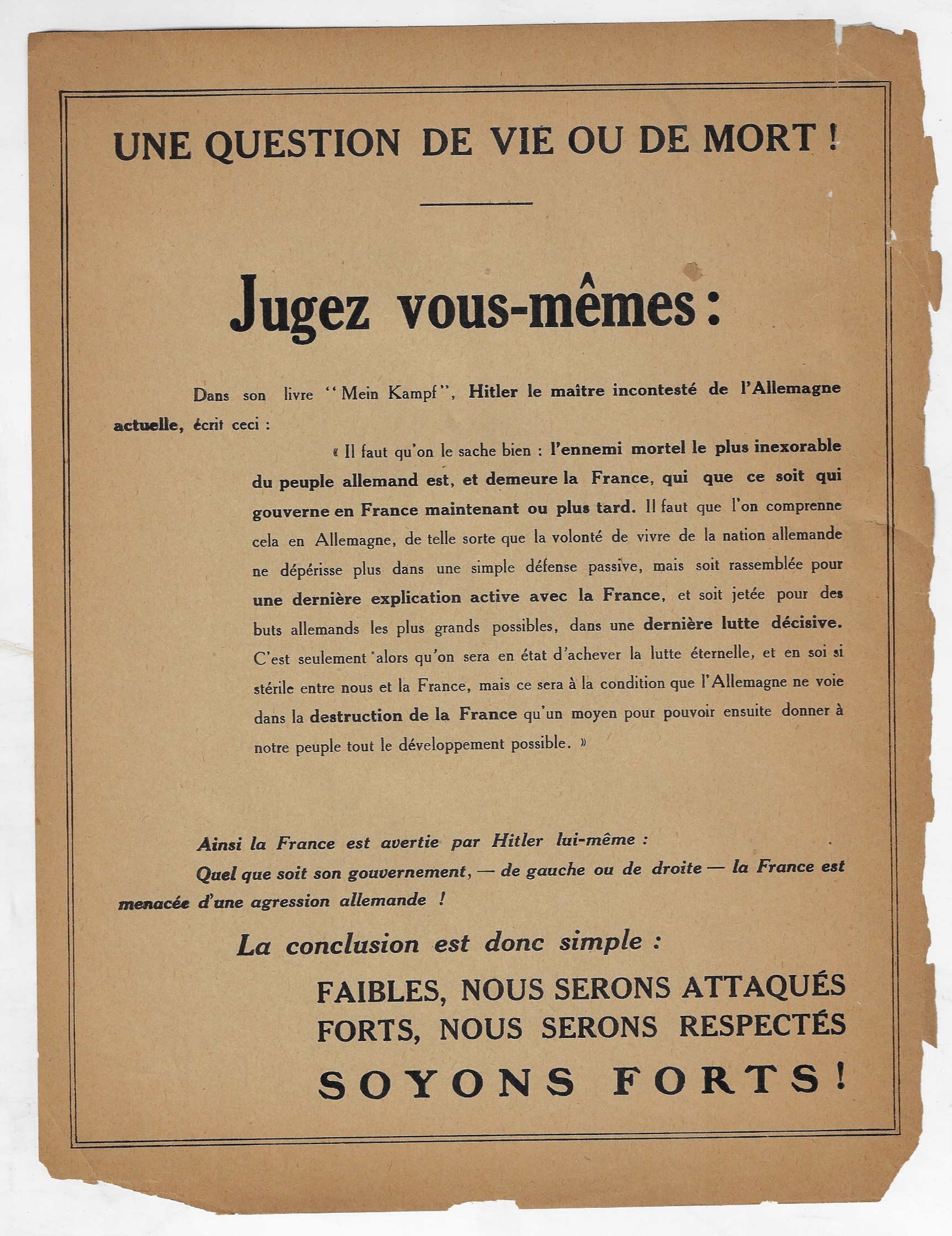
    Une questio de vie ou de mort!  Jugez vous memes. Dans son livre Mein Kampf, hitler le maitre inconteste de l’Allemangne actuelle,…

    One sheet/leaflet, printed on one side only. 10”x 8”. Ca. Mid 1930’s?   $150

    French poster Jugez vous-memesThis is a leaflet or broadsheet making the point that France and Germany are mortal enemies—it attracts attention by boldly stating in the first line that the situation/question is a matter of life and death. .(This is more of a statement than an interrogatory, as there are no questions on the sheet.) The writer makes the point clearly with a long extract from Mein Kampf:

    “Il faut qu’on le scahe bien l’ennemi mortel le plus inexorable du peuple allemand est et demeure la France …” (“We have to be clear about the most inexorable mortal enemy of the German people is and remains France…”) Not only is France the mortal enemy, but it and its people should be destroyed in the coming great decisive battle (“derniere lutte decisive”).

    And so France is warned by Hitler himself. The author of the leaflet does have a solution, and it involves solidarity and strength from all of the people of France regardless of the sort of government you support, if you are on the Left or Right. (“Ainsi la France est avwertie par Hitler lui-meme: quel que soit son gouvernement—de gauche ou de droite—la France est menacee d’une aggression allemande!”)

    The concolusion is simple: “We will make a strong attack, we will be respected, we will be strong.”

    (“Faibles, nous serons attaques forts, nous serons respectes soyons forts.”) Come 1940, though…

    ·Posted by :

    ·in:


  • Public Opnion Documents on Japan, 1943-4

    Three opinion collection documents, printed

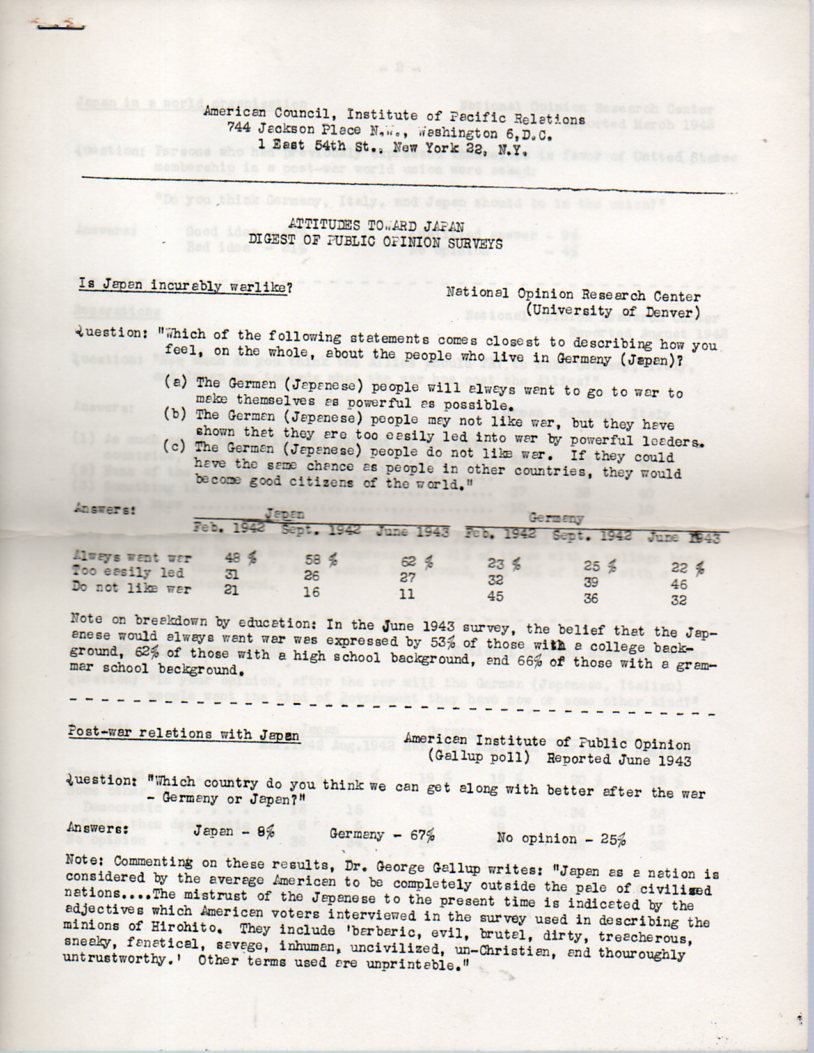
    • 1) Attitudes Toward Japan, Digest of Public Opinion Surveys.  11″x 8.5″, offset printed from typed originals. 2 lvs. Stapled. 1944.
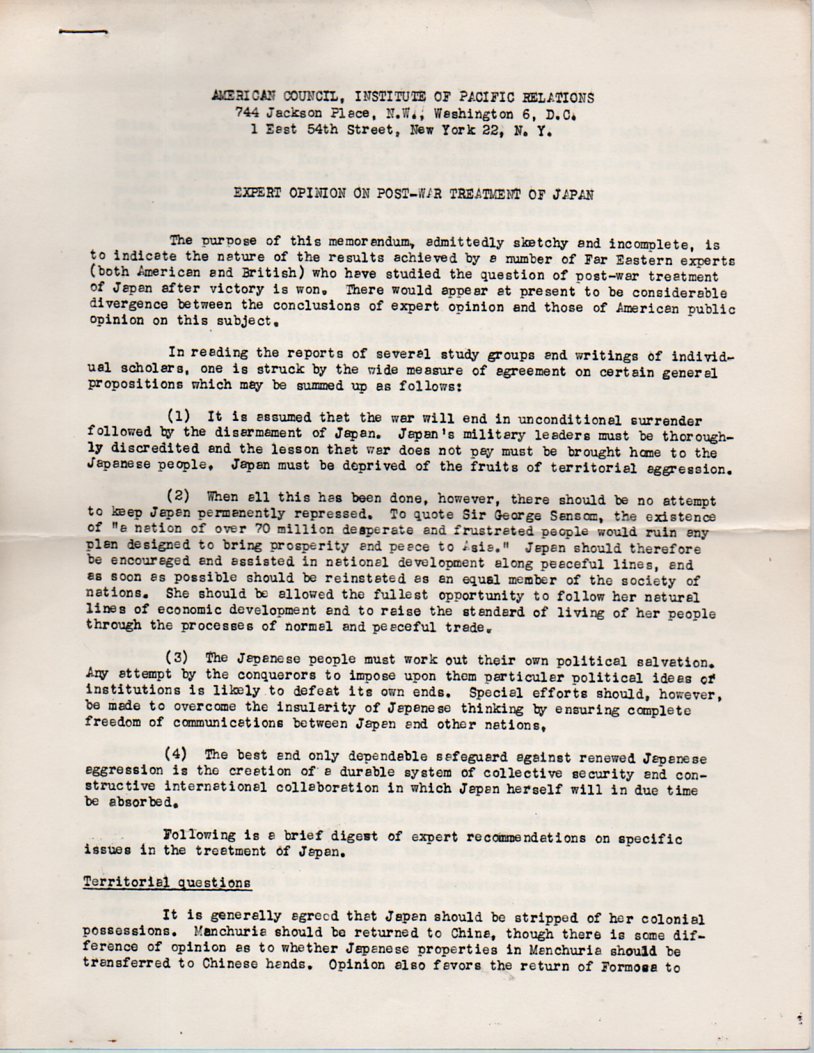
    • 2) Expert Opinion on Post-War Treatment of Japan. 11″x 8.5″, offset printed from typed originals. 4 lvs. Stapled. 1944.
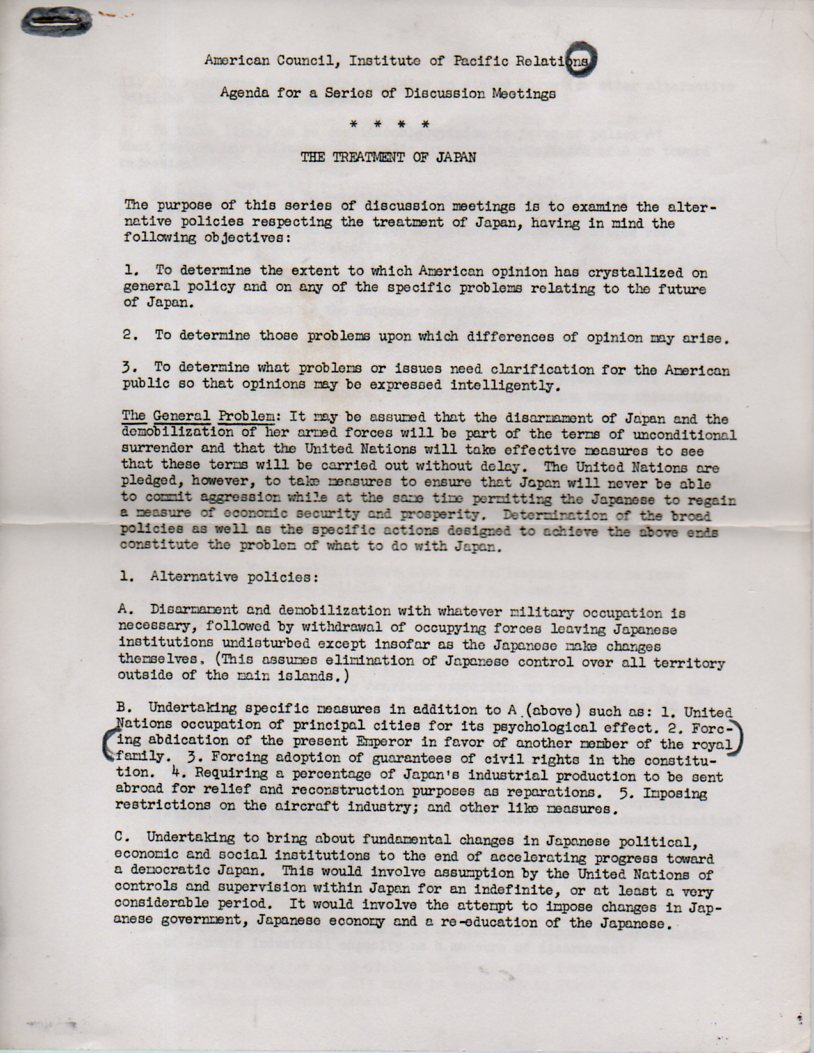
    • 3)  The Treatment of Japan.   11″x 8.5″, offset printed from typed originals. 4 lvs. Stapled. 1944.

    The three (all quite scarce): SOLD

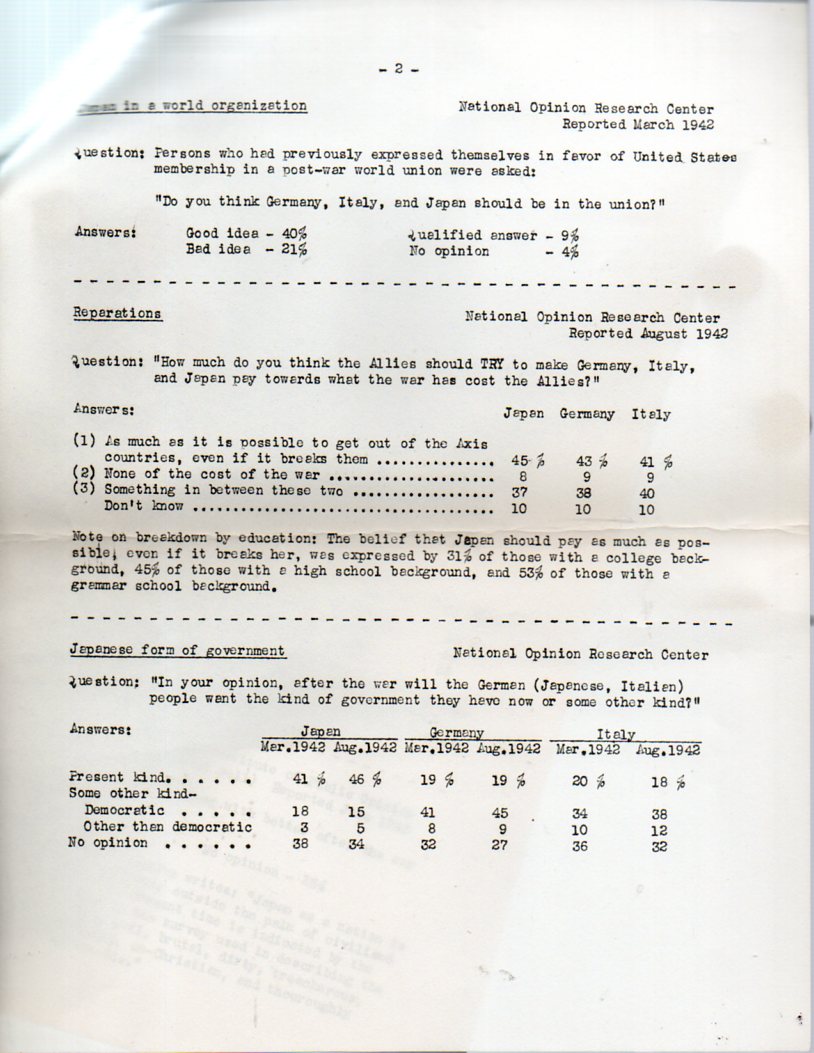
    I uncovered a few interesting documents this morning from The American Council, Institute of Pacific Relations (in 1944 at the address 744 Jackson Place, N.W., D.C.) relating to collecting opinions on Japan and the Japanese, right at the height of the war.   And this is what the American Council was doing–prep work to assess the extent of public opinion on the treatment of Japan post-war, which entailed reviewing existing polling data (from Gallup) was well as conducting their own original research.The “first” issue (so far as I can determine)  was perhaps the most aggressive:

    Is Japan incurably warlike?

    Japan Public Opinion889

    The question was asked of an undefined group over three periods of time  (February 1942 to June 1943) for both Japan and Germany, the statements the respondents having to choose from being: “always want war”, “too easily led” and “do not like war” at three different times, from February 1942 to June 1943.  From Feb ’42 to June ’43, people’s opinions that the Japanese “always want war” went up from 48% to 62%, while for the same time the same question regarding the Germans stayed about the same, 22%.  The Gallup Poll for June 1943 reported that for 75% of the respondents only 8% of the folks thought that “we can get along” with the Japanese, while 67% favored our chances with the Germans. 

    Get along with them or not, or feeling that they are war-like or not, had little to do with the opinions of people (reported by the National Opinion research Center, August 1942) who thought that reparations should be paid, and paid hard, by the Axis powers across the board, “as much as it is possible to get out of the Axis countries, even if it breaks them”.

    The following two papers came a little later, closer to the realization that victory was coming, that the war would be over, that victory would be taken–probably at the end of 1944 or the beginning of 1945, when position statements were more circumspect than the earlier public opinions.  “Expert Opinion on Post-War Treatment of Japan”  was more understanding when speaking to the post-war existence of Japan, stating in a number of different ways that “there should be no attempt to keep Japan permanently repressed” and “the Japanese people must work out their own political salvation”.  Also that there would be no “continuing burden of reparations payments…as done with Germany after the last war”. 

    Japan Public Opinion treatment after891

    The overall feeling of this and the following document (“The Treatment of Japan”) can be found in the section “Teaching Japan a Lesson”:  “United Nations effort should be directed toward demonstrating to the people of Japan the advantages of making peace rather than the penalties of losing a war”.  The issue regarding the Emperor and whether or not he should or could stay–an issue that would stay with high command right through the second week of August 1945. 

    Japan Public Opinion treatment after892

    Japan Public Opinion890

    ·Posted by :

    ·in:


  • Planning for a Postwar Germany, 1944

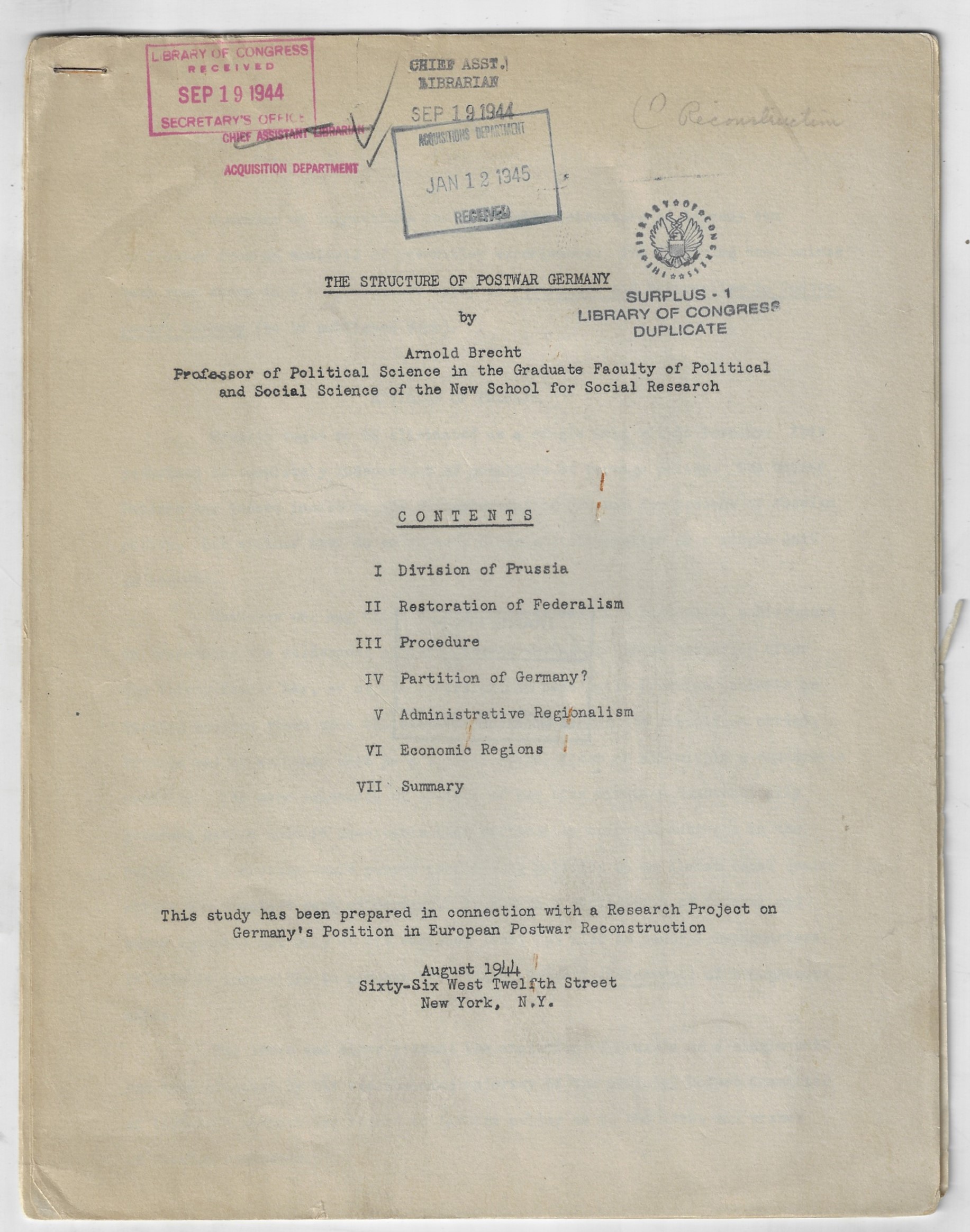
    Brecht GermanyArnold Brecht. The Structure of Postwar Germany.

    11″x 8.5″, offset printed from typed originals, 13 lvs, Provenance: Librarian’s Office, Library of Congress.  VG copy.  Scarce. $250

    • (“Arnold Brecht (January 26, 1884 – September 11, 1977) was a German jurist and one of the leading government officials in the Weimar Republic. He was one of the few democratically minded high-placed officials that opposed the Machtergreifung in 1933. An alumnus of the University of Göttingen, Brecht served as a government official from 1918 to 1933. He was dismissed from his post shortly after the Nazi seizure of power, and emigrated to the United States. He became a lecturer at The New School, and also a foreign policy adviser to the United States government. After World War II he returned to Germany and helped drafting the Basic Law for the Federal Republic of Germany. In 1959 he received the Federal Cross of Merit. Brecht also made contributions to political science. Brecht’s law is the academic basis for one of the components of the equalization payments between the states of Germany.”–Wikipedia)

    ·Posted by :

    ·in: