A Daily History of Holes, Dots, Lines, Science, History, Math, Physics, Art, the Unintentional Absurd, Architecture, Maps, Data Visualization, Blank and Missing Things, and so on. |1.6 million words, 7500 images, 4.9 million hits| Press & appearances in The Times, Le Figaro, Mensa, The Economist, The Guardian, Discovery News, Slate, Le Monde, Sci American Blogs, Le Pont, and many other places… 5000+ total posts since 2008.

Book Category: World War II

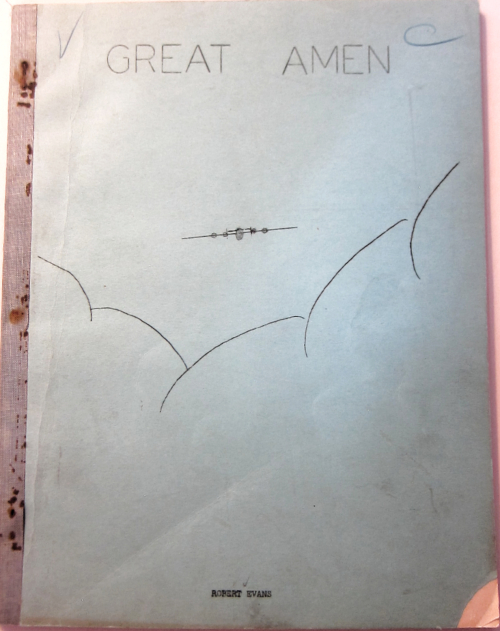
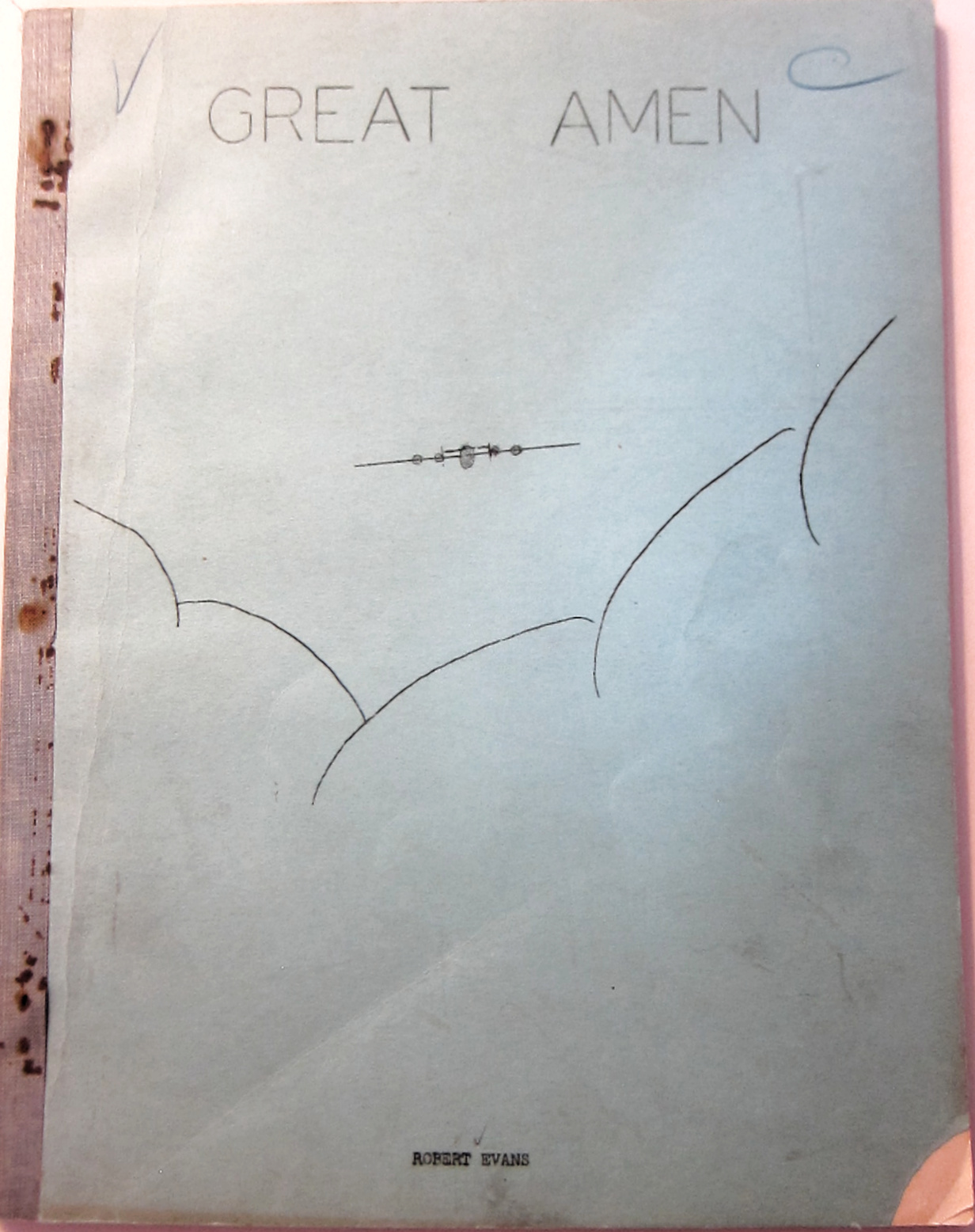
  • The Great Amen–a Scarce (unlocated in WorldCat) USAAF WWII Recollection

    Robert J. Evans, Great Amen. Self-published, printed by Bureau Mailing Service (Brooklyn), 1946.  11″x8.5″, 49pp. Offset printed. Bound in cloth-backed paper wrappers, which have chips here and there. Good condition. Approximately 35,000 words.  $400

    • NO copies located in WorldCat/OCLC. 
    • The table of contents tell part of the story of Staff Sergeant Robert J. Evans, who wrote of his adventures as a gunner on what I think must have been a B-24 (as there  are mentions of belly gunners, and also what seems to be the names of the crew of nine airmen…also a close look at the rudimentary drawing of the aircraft on the cover gives it a nose looking very much like a Liberator). Training in Texas with the USAAF and the trip abroad take the first 10pp, the combat experience beginning on p. 11, in Italy. There are almost no dates mentioned, oddly enough, and no mention of bomber group; though I suspect the action takes place in 1944, as there is a chapter dedicated t a bombing of the Moosbierbaum oil refinery in Austria–a target hit numerous times from June 1944 into March 1945.  This took place in 1944 as there is a mention of Christmas 1944 that comes later on in the story. In any event that was the only bombing action I could find, though it was lengthy; there’s plenty of daily life/color in these pages, though, which makes it an interesting read.
      Great Amen


    ·Posted by :

    ·in:


  • On aerial defense, bombs, and gas, 1936-1940.

    Five pamphlets published 1936-1940, stapled together in a manila folder. Provenance: Library of Congress.  Each 8.25” x 5.75”, original wrappers.  Of the five, only one is located at all in WorldCat (with one copy only). The pamphlets seem to rank last-to-first in terms of interest here, to me, although even the first pamphlet no doubt contains some difficult-to-find detail on civil defense uniforms. In GOOD condition, at least.  $200

    Prescriptions concernant les vetements de travail pour les troupes des organisms locaux de defense aerienne passive.  Department militaire federal, Service de la defense aerienne passive, Berne, 1936. 4pp.  NO copies located in WorldCat.

    Programme d’instruction 1938 pour les organisms de defense aerienne industrielle. (Defense aerienne Industrielle, D.A.I.) 1938. 6pp.  NO copies located in WorldCat.

    Programme d’instruction 1939 pour les organisms locaux de D.A.P. 1939. 8pp (2 copies). NO copies located in WorldCat.

    Defense aerienne, Dernieres experiences de guerre. Confederation Suisse. (April, 1940.) (“A conserber soigneusement!”). This pamphlet has sections on incendiaries, dangers of explosions, gas attacks, and “blessures de la peau par des toxiques persistants” (“skin wounds by persistent toxins”).  WorldCat locates 1 copy (Basel).

    “Instructions a la population civile concernant les sabotages et les parachutists”, 23 May 1940. 2pp.   NO copies located in WorldCat.  (This one seems particularly interesting…)


    ·Posted by :

    ·in:


  • Rare Combat Unit History: 413th Fighter Group

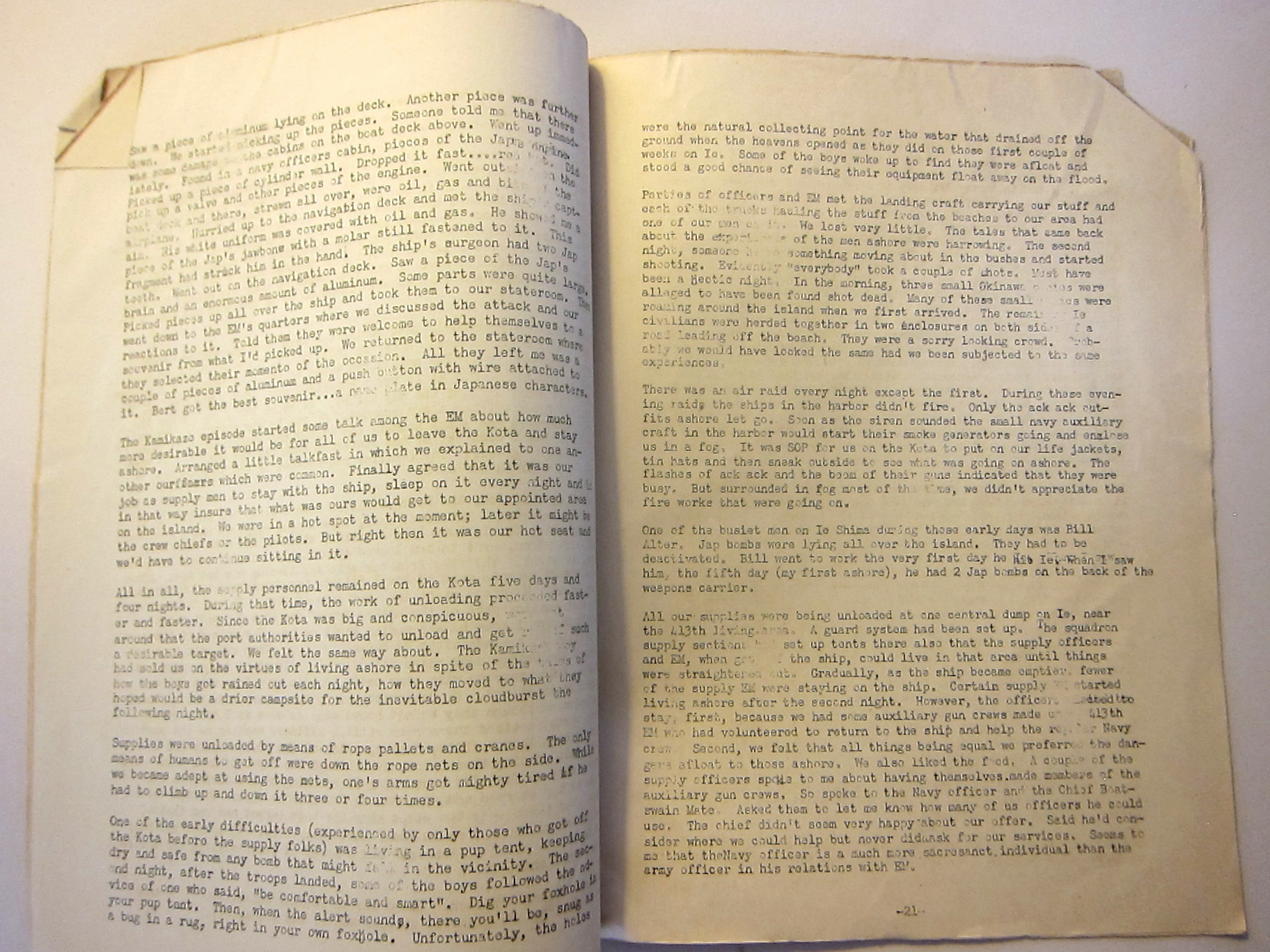
    Tyler, Parker R.: From Seattle to Ie Shima with the 413th Fighter Group, a Narrative.  Self-published, 1945. 30pp,  11×8 inches. Good condition.  Personal recollection of Capt Parker Tyler, jr.:  mimeographed, typewritten, and gathered by staples. $250  Only one copy located (US Air Force Academy) in WorldCat. 

    • “Constituted as 413th Fighter Group on 5 Oct 1944 and activated on 15 Oct. Trained for very-long-range operations with P-47’sMoved to the Asiatic- Pacific Theater, Apr-Jun 1945. Assigned to Twentieth AF; reassigned to the Eighth early in Aug 1945. Flew a few strafing missions from Saipan to the Truk Islands in May before beginning operations from Le Shima in Jun. Engaged in dive-bombing and strafing attacks on factories, radar stations, airfields, small ships, and other targets in Japan. Made several attacks on shipping and airfields in China during Jul. Flew its only escort mission on 8 Aug 1945 when it covered B29’s during a raid against Yawata, Japan. Served as a part of the air defense and occupation force for the Ryukyu Islands after the war. Inactivated on Okinawa on 15 Oct 1946. Principal aircraft was the P-47.

    Tyler 413th _2_

    ·Posted by :

    ·in:


  • An Early Document on Mutually Assured Destruction and Atomic Energy (Summer 1946)

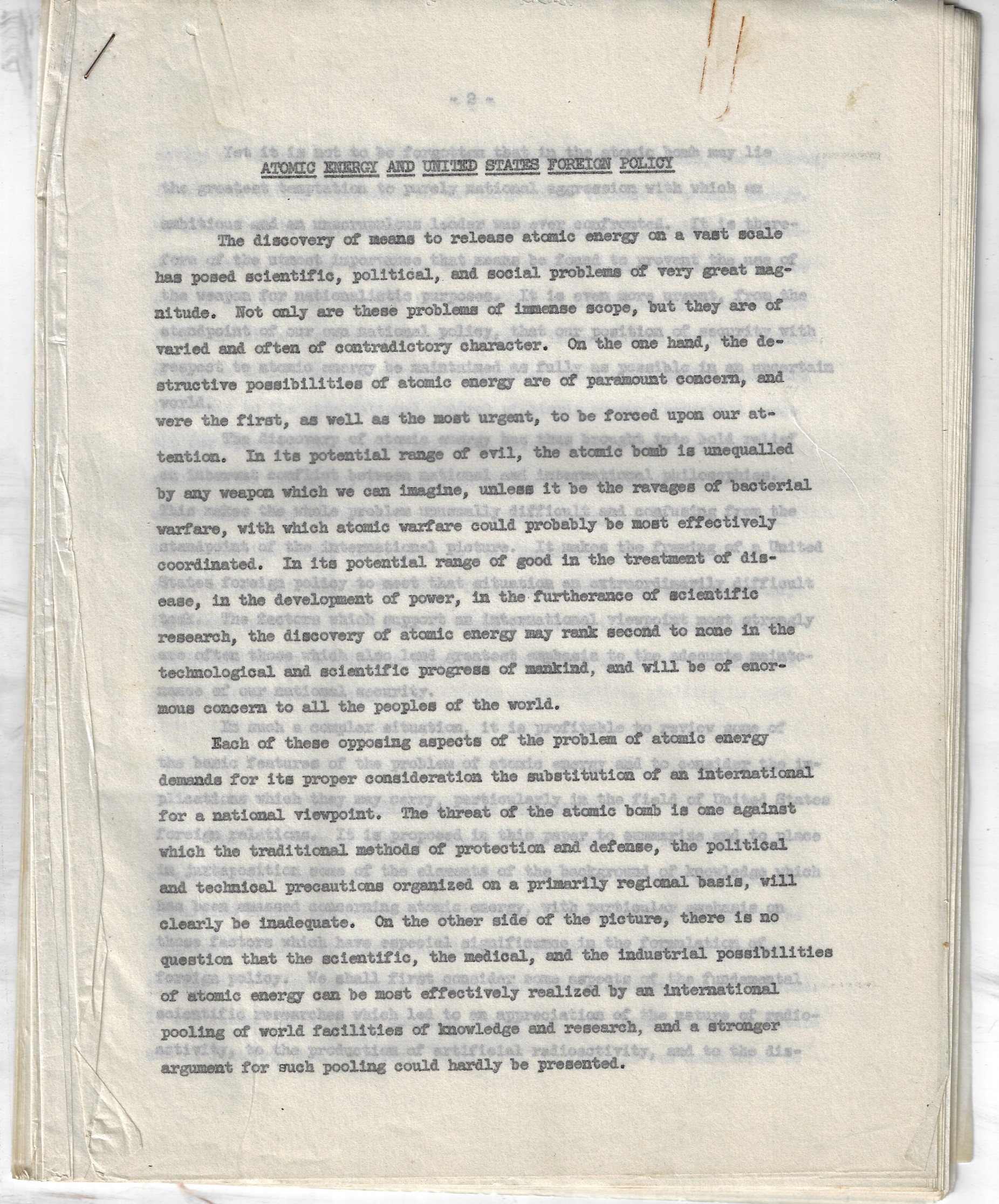
    [Atomic Bomb Control and Atomic Energy]  Haskins, Caryl P. Two drafts of “Atomic Energy and United States Foreign Policy”, published July 1946 in Foreign Affairs. Two versions, one 37pp and the other, presumably an earlier version, 28pp (pp 1-28, incomplete). Both are original carbons on tissue paper. The two documents: $500   

    • Dr. Caryl Haskins (1908-2001, Ph.D. Yale ’30 (E.E. at 22), Ph.D. Harvard 1935; LL.D. Carnegie Institute Technology 1955) was a close and long-time friend of the great Vannevar Bush with whom he throughout World War II at the OSRD,  as well as executive assistant to Bush at NSRD 1941-1945.   He was research associate at MIT 1935-1945;  he was on the Scientific Advisory Board of the Army and Navy, 1947-8; Research Consultant to the Secretary of the Army, 1950; Executive Research Consultant to the Secretary of State 1950-1972  Haskins was on the board of Scientific advisors to President’s Truman and Eisenhower, and succeeded Bush as president of the Carnegie Institution (1956-1973). 
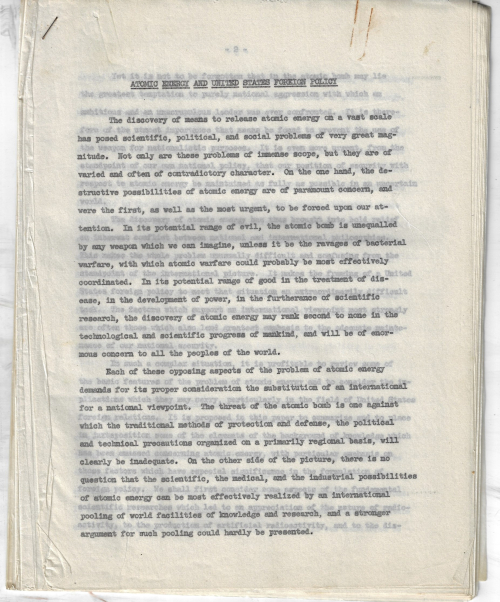
    Haskins atomic energyWhat I find remarkable about this paper is its prescience regarding MAD, the need for international regulation and control, and the absolute belief that the U.S. could not rely on its monopoly of weapons and intelligence even in the short run. He reasons some ways in which to deal with sharing information, restricting the growth of a weapons culture, and the use of atomic energy.

    Haskins sees the delivery of atomic bombs by “long range rockets”, and that the temptation for developing an atomic arsenal would curtail expenses for military development by possibly as much as 100-1. (He mentions at one point that 10,000 atomic bombs could be used to secure world domination, at a cost of only $10 billion (or 10 Iowa-class battleships)—making this highly appealing. (He was not referring to the U.S. in this.)  He goes on to say that without guidance in atomic energy and control of atomic weapons that an exchange of two (or multiple) countries with such weapons “would be largely destructive of civilization as we know it”.

    Haskins also makes the case for the U.S. not to be isolationist in these regards, “and not count on the security of a monopoly of knowledge”.

    Haskins was certainly sounding a very considered, scientific, reasoned alarm about what may turn out to be a devastating near-future with uncontrolled atomic weapons. (This was written in 1946, three years before the Soviets exploded their first bomb. In 1946, Lee Groves thought it would take 20 years for the Soviets to develop a bomb; James Byrnes gave them 7-10 years; and Bush-Conant 3-5 years. Some scientists put it sooner than that. My impression is that Haskins was on the side of the bomb coming to the USSR much sooner rather than later, hence this urgent article in Foreign Affairs.

    Here’s an interesting notice on this article by Haskins:

    • “We therefore cannot count on maintaining our security through a monopoly of fundamental knowledge in the atomic field […]. Further, our monopoly of technical information and facilities is limited and is diminishing. At present we do have a monopoly of stockpiles of raw materials and finished atomic bombs, and we are equipped with gigantic plants for producing these materials. Within something like ten years, however, our monopoly in technology may have disappeared completely, whatever the policy we now adopt with respect to international action.”– This could almost pass as modern commentary for the U.S., but it was written 71 years ago (July 1946) by Caryl P. Haskins, then deputy executive officer of the National Defense Research Committee, who conveyed a heightened level of concern that the U.S. would lose its monopoly in nuclear science and technology for military applications. This created a direct threat to the U.S. and the world as the Soviet Union leveraged nuclear energy in its pursuit of military primacy over America and geopolitical dominance in Europe and Asia. The genie was out of the bottle and nuclear science was in the public domain. Consequently, America had a peer competitor militarily and its national security was at risk. David Gentile, Forbes, Sept 19, 2017
     

    ·Posted by :

    ·in:


  • A Really, Really Good Radio Show (1938-1941)


    America’s Town Meeting of the Air. 1938-1941. 58 issues. 11×8.5″. Each issue 3 leaves, or 6pp, offset printed, stapled in upper left corner.  Provenance:  Pamphlet Collection of the Library of Congress.   $1500

    • This is an incomplete run, though I can find no other evidence of any substantial number of these publications are held in any institution, though there is an entry in WorldCat for the NYPL having a collection of “miscellaneous pamphlets”. The 102 WorldCat/OCLC listings are almost entirely for individual pamphlets. VG condition.

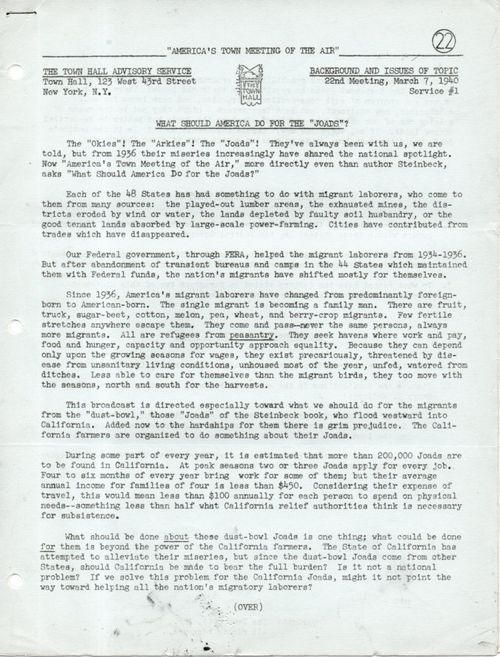
    It turns out that I own a good stack of guideline publications for what was America’s first news talk show: “America’s Town Meeting of the Air”, produced by the Town Hall Advisory board between 1935 and 1955. (“The NBC Radio Network program America’s Town Meeting of the Air was an early form of electronic “townhall” democracy–perhaps the very first such electronic forum. In May of 1935 the program began what would become a 21-year run. In later years the program would be broadcast on the ABC network.”–Social Security Administration, https://www.ssa.gov/history/1935radiodebate.html) The format of the broadcasts pitted two prominent experts in a debate of some aspect of public policy. The program was unique for its time in that it also featured questions from both the live audience and from the listening audience around the country. It was a weekly show, and in general–at least for the 90 examples I have for the 1938-1941 period)–each broadcast came with a three-sheet guideline. The first sheet was a general statement of the show’s interest–for example, “What Shall We Do With the Joads?”, for March 7, 1940 (the Joads being the family in the Steinbeck mega-epic The Grapes of Wrath). These intro pages are usually very concise, very well written, logical, and provocative.

    The second sheet is really what surprised me so–a bibliography and suggested reading for the discussion.  That means that before the radio program was broadcast the producers provided listeners a handy sheet with material to read so that they could better follow the discussion–this seems truly exceptional by today’s sub-standards of a great chunk of radio political discussion, where volume/noise dictates correctness over recognized references. I wondered before looking at the list if The Grapes of Wrath would be there, because, well, it wasn’t necessarily a popular read everywhere in spite of the book’s critical reception. It was there, along with (shockingly) Dorothea Lange and Paul Taylor’s (her husband) An American Exodus;  Carey McWilliams’ Factories in the Field the Story of Migratory Farm Labor in California; and You Have Seen Their Faces, by Erskine Caldwell and Margaret Bourke-White (described as “the Southern sharecropper in photographs and prose”).  Actually all of the books and articles are given a similarly very-short description like this, in spite of their Great Classic status of today–the photographs by Bourke-White and Lange and McWilliams and their accompanying texts are really nothing short of masterpieces, difficult and challenging exposes of a national tragedy –and here they are, suggested reading for listeners of a radio talk show.


    ·Posted by :

    ·in:


  • Two Unlocated (?)  Yugoslavian  Pamphlets on Underground Movements, 1944


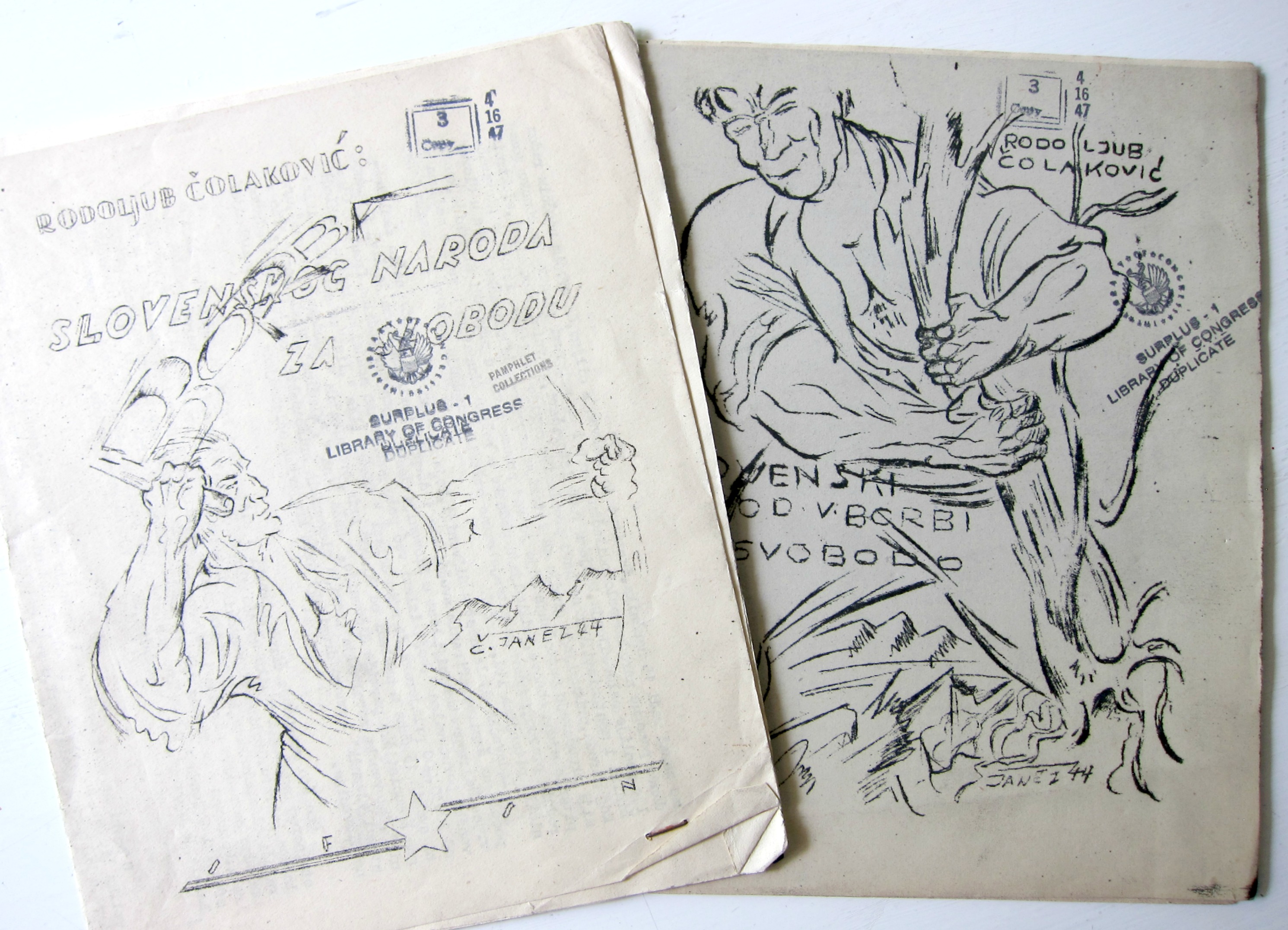
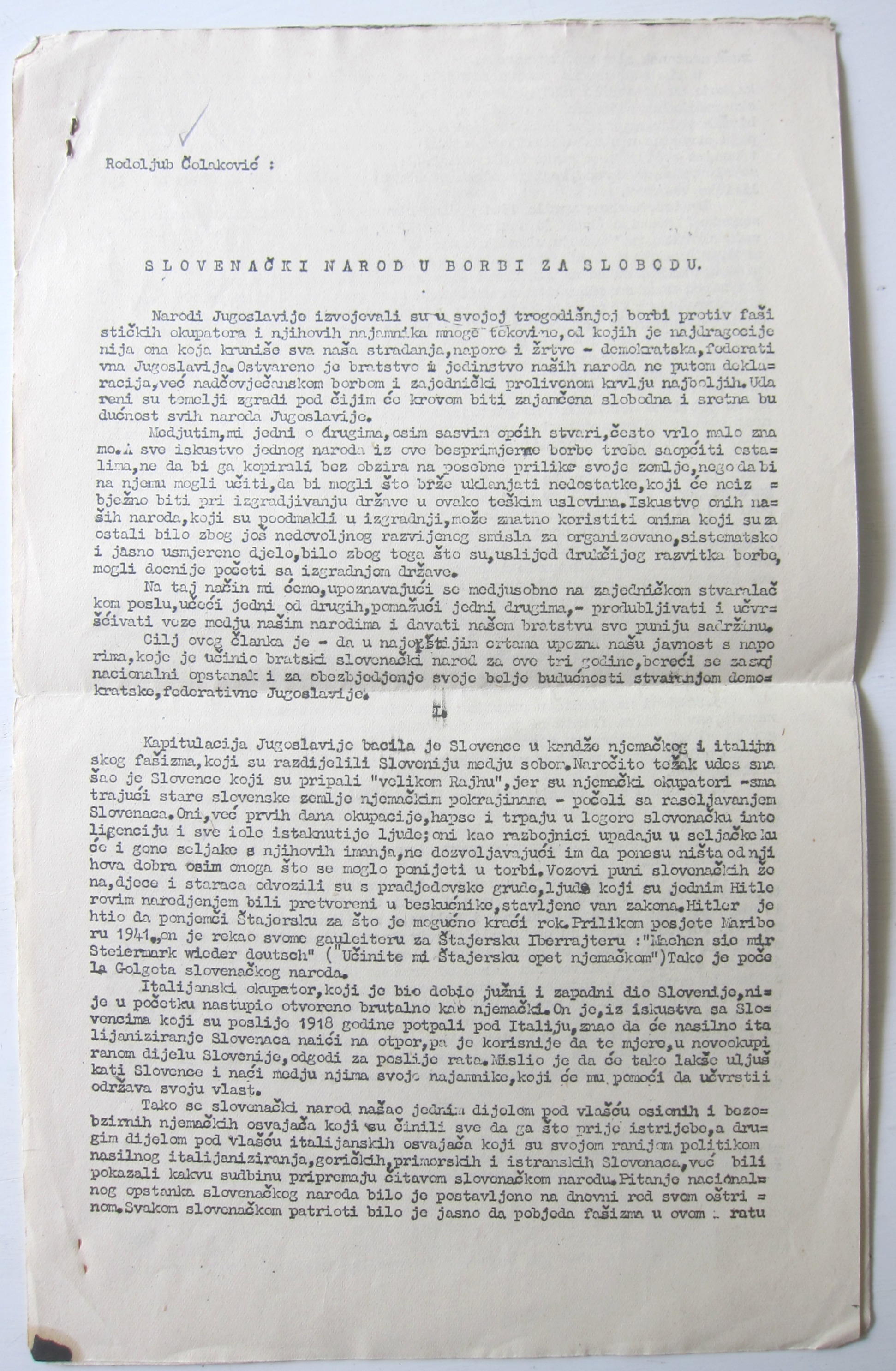
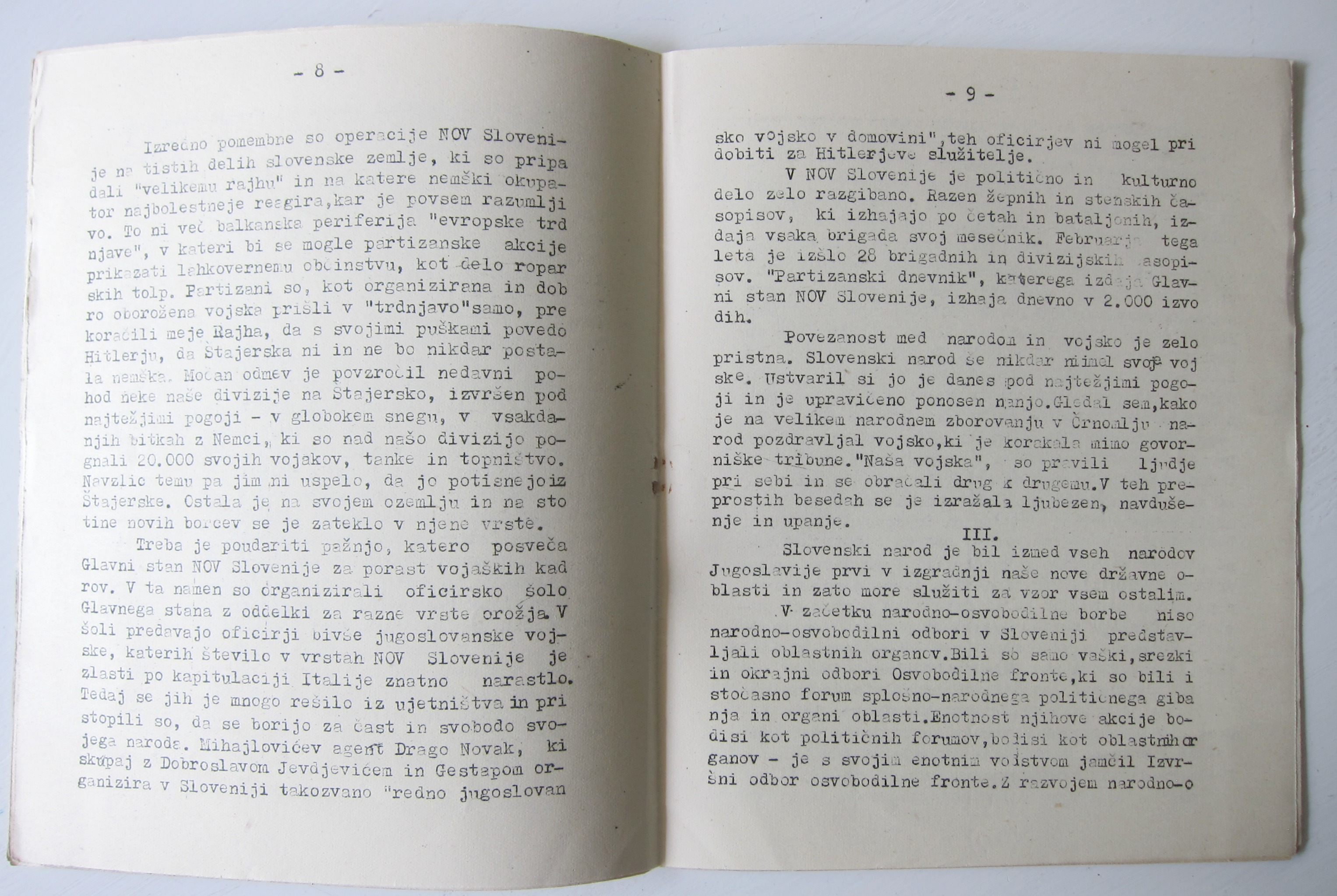
    COLAKOVIC, Rodoljub.  Slovenski Narod V Borbi za Svobodo  (“The Slovenian People in the Fight for Freedom”) (From the “Neve Jugoslaije”, St. 4-, 20 aprila 1944. 8×6″, 16pp, wrappers.  

    • offered with:

    ______, another version of the above, this with a different introduction (so far as I can determine) with the rest of the contents looking the same as the above, except in a different format. This version: folded 11×8″ sheets, and printed vertically on three sheets of paper.  

    Provenance: Library of Congress.  Neither is located in the WorldCat/OCLC.  I did find a couple of references to this title being published as part of a larger, edited work, but for 1945. Both of these pamphlets feature artwork on the cover dated 1944.  $300

    Czech freedom fighter IV

    Czech freedom fighter II


    Czech freedom fighter

    “Rodoljub “Roćko” Čolaković[1900 – 1983) was a Bosnian Serb and Yugoslav politician. A native of Bijeljina, Rodoljub Čolaković joined the Socialist Party of Bosnia-Herzegovina in March 1919 as a student. Later he joined Crvena Pravda (“Red Justice”), a left-wing terrorist organisation which assassinated Yugoslav interior minister Milorad Drašković. For his role in this event Čolaković was sentenced to 12 years in prison. While serving his sentence he made friends with many notable Yugoslav communists, including Moše Pijade with whom he translated Das Kapital and other seminal Marxist texts into Serbo-Croatian. After his release, Rodoljub Čolaković emigrated to the Soviet Union and later took part in the Spanish Civil War on the Republican side.”–Wikipedia

     Also this slightly different minute appraisal:   “… a revolutionary and writer, a participant in the Spanish Civil War and the People’s Liberation Struggle , a socio-political worker of theSFRY and SR of Bosnia and Herzegovina , the hero of socialist work and a national hero Yugoslavia .”–Wikipedia, slobodna enciklopedija


    ·Posted by :

    ·in:


  • War Production Board Home Front Propaganda Leaflets (1942)

    JF Ptak Science Books  

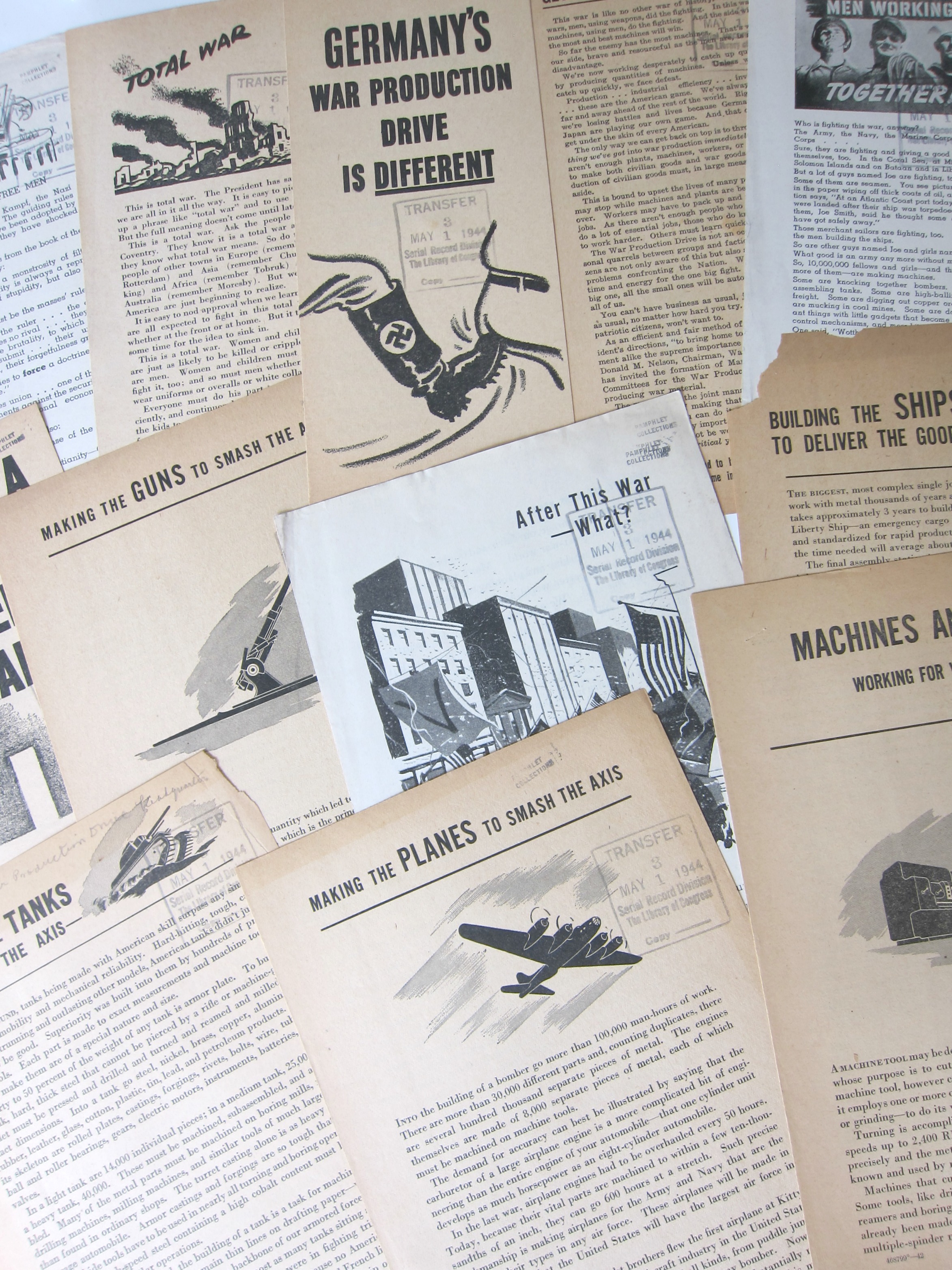
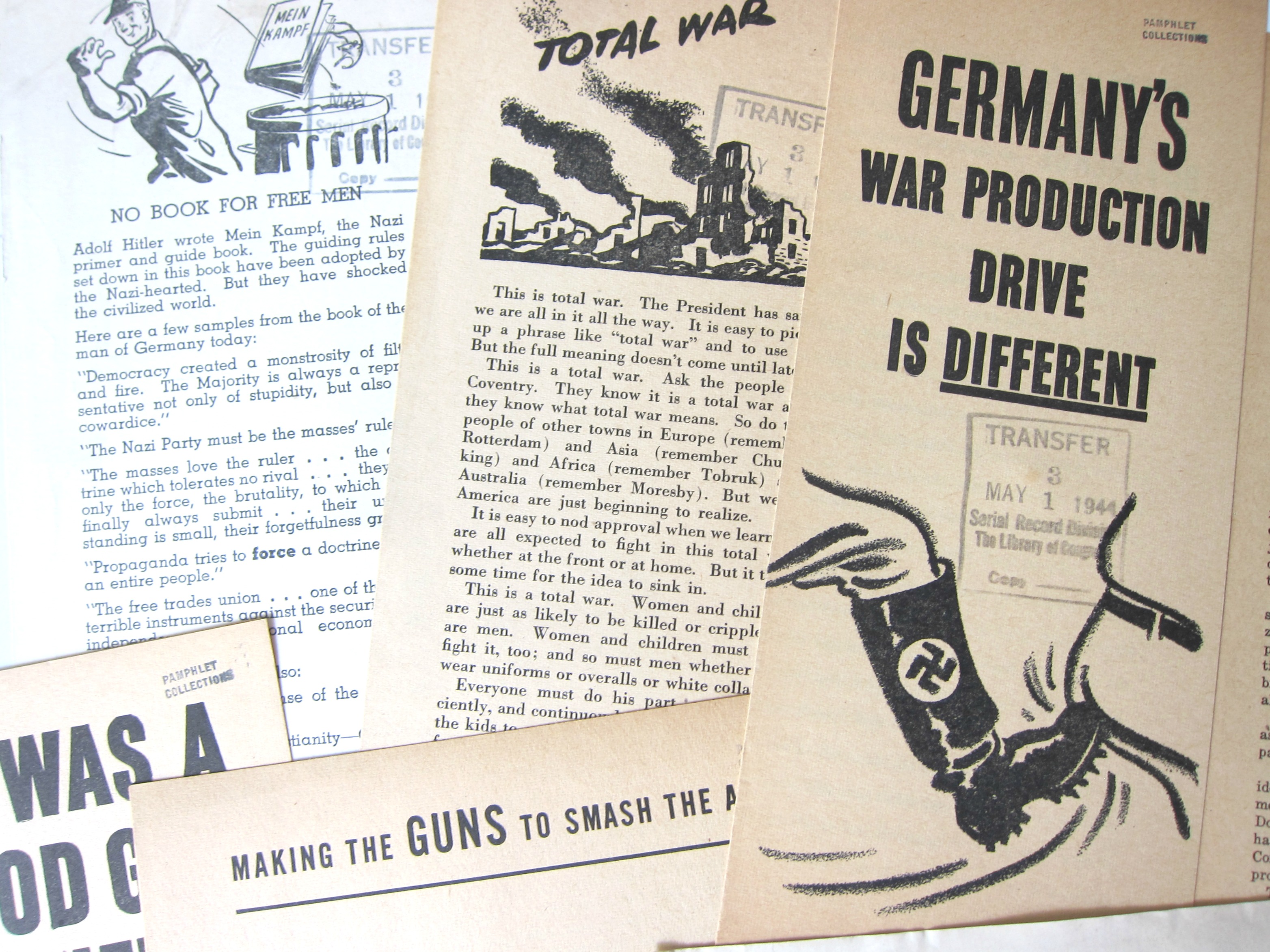
    Pamphlets and Leaflets Issued by the War Production Board Headquarters, War Production Board, U.S. Government Printing Office. 11 pieces, $200

    War Dept Production Board leaflet

    • He Was a Good Guy When He Had It. 8×3″, unfolds for a central message, which was to make sure that the guy (“Joe”) had “it”, being bullets and grenades.  16-27955-1 (Received May 3, 1944)
    • After This War–What?   1942.  9×6″, 4pp. (Received May, 1944)
    • Building the Ships to Deliver the Goods. 1942. 8×5″, single sheet. 
    • Building the Tanks to Smash the Axis. 8×5″.(undated, though received by the L.C. May 1944), single sheet. 4pp. 1942
    • Making the Guns to Smash the Axis. 8×5″,  4pp. 1942. 
    • Machines and Men, Working for Victory. 4pp. 1942
    • Men Working Together. 8×3″. Single sheet. 
    • Get Straight on this War. 8×3″. Single sheet. Undated by stamped “received” by the L.C. in May 1944.
    • Germany’s War Production Drive is Different. 8×3″. Single sheet, folded. Undated by stamped “received” by the L.C. in May 1944
    • Total War. 8×3″. Single sheet. Undated by stamped “received” by the L.C. in May 1944
    • No Book for Free Men. 8×3″. Single sheet. Undated by stamped “received” by the L.C. in May 1944

    War Dept Production Board leaflet detail


    ·Posted by :

    ·in:


  • On the Liberation of Yugoslavia (1945)

    [Marshal Tito (Josip Broz)]

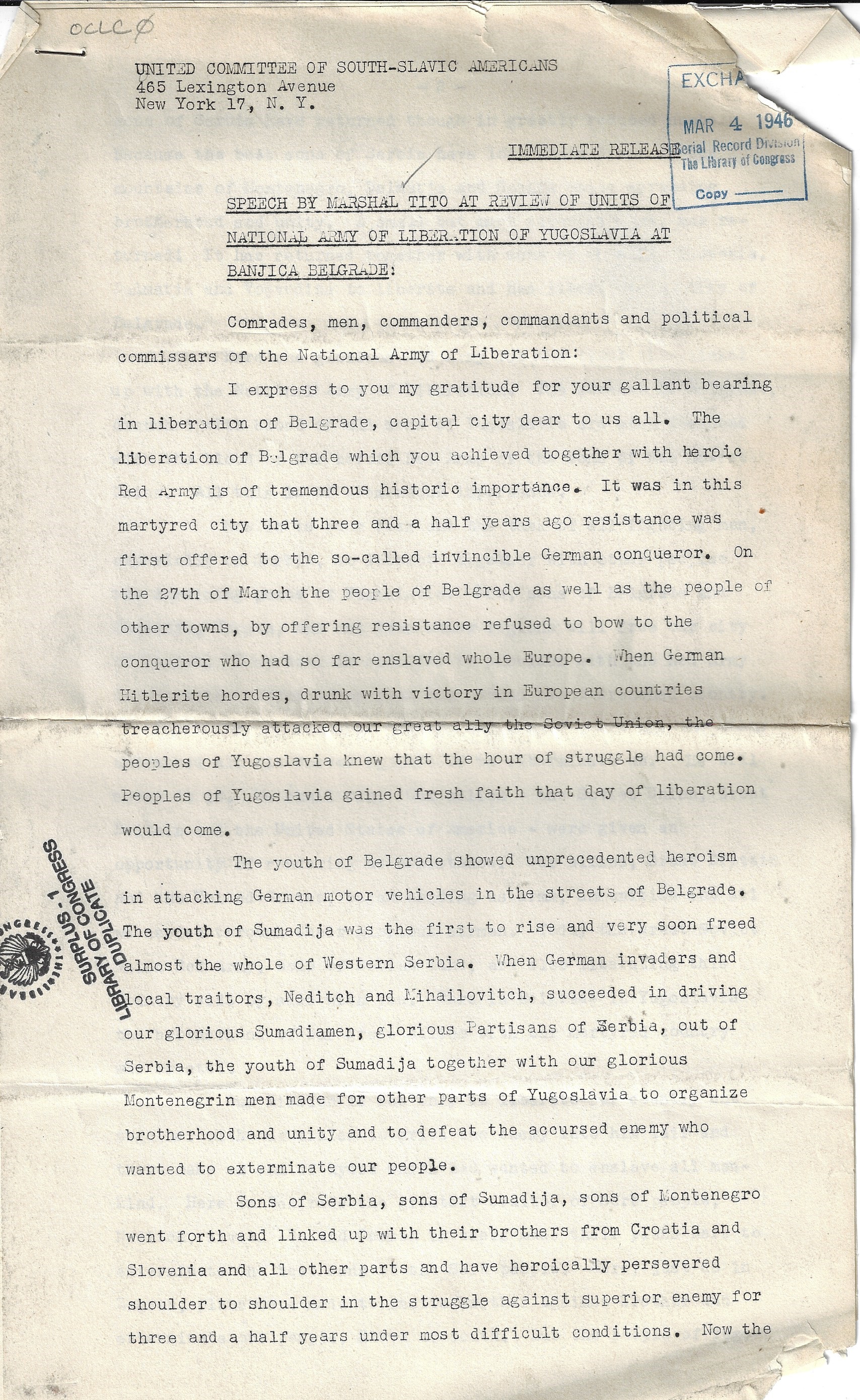
    Speech by Marshall Tito at Review of Units of National Army of Liberation of Yugoslavia at Banjica Yugoslavia.

    United committee of South-Slavic Americans, (465 Lexington Ave, NYC).  Mimeo/offset production, printed on 13″x8.5″, 5 sheets, (1945). Good condition. NO copies are located in WorldCat/OCLC.  $145

    • IMMEDIATE RELEASE

    “The liberation of Belgrade which you achieved together with heroic Red Army is of tremendous historic importance. It was in this martyred city that three and a half years ago resistance was first offered to the so-called invincible German conqueror.”

    WWII Yugoslavia mimeo


    ·Posted by :

    ·in:


  • Taking Aim at Japanese Relocation (Fortune Magazine, April 1944)

    [Anon.] “Fortune Magazine reviews the program of the War Relocation Authority and the problems created by the evacuation from the West Coast of 110,000 people of Japanese descent.” Reprint from Fortune Magazine, April 1944. 8 3/8 in x 5 3/8 in; 21.2725 cm x 13.6525 cm, 20pp.
    Provenance: Library of Congress, with their tiny “pamphlet collections” stamp on the front upper cover and a 6mm perforated “LC” on the front cover bottom. Very nice copy, with one short half-inch tear in the front wrapper (repaired with Japanese paper tape). Scarce.  $200
    From the opening of the pamphlet:
    “When the facts about Japanese brutality to the soldier prisoners from Bataan were made known, Americans were more outraged than they had been since December 7, 1941.  Instinctively they contrasted that frightfulness with our treatment of Japanese held in this country; and, without being told, Americans knew that prisoners in the U.S. were fed three meals a day and had not been clubbed or kicked or otherwise brutalized.  Too few, however, realize what persistent and effective use Japan has been able to make, throughout the entire Far East, of U.S. imprisonment of persons of Japanese descent.  This propaganda concerns itself less with how the U.S. treats the people imprisoned than who was imprisoned.  By pointing out again and again, that the U.S. put behind fences well over 100,000 people of Japanese blood, the majority of them citizens of the U.S., Japan describes to her Far Eastern radio audiences one more instance of American racial discrimination.  To convince all Orientals that the war in the Pacific is a Crusade against the white man’s racial oppression, the enemy shrewdly notes every occurrence in the U.S. that suggests injustice to racial minorities, form the Negroes to the Mexicans and Japanese.”
    And the closing paragraph, which takes a very direct stab at the “relocation program”:
    “The longer the Army permits California and the rest of Pacific Coast to be closed to everyone of Japanese descent the more time is given the Hearst papers and their allies to convince Californians that they will indeed yield to lawlessness if the unwanted minority is permitted to return.  By continuing to keep American citizens in “protective custody,” the U.S. is holding to a policy as ominous as it is new.  The American custom in the past has been to lock up the citizens who commits violence, not the victim of his threats and blows.  The doctrine of “protective custody” could prove altogether too convenient a weapon in many other situations.  In California, a state with a long history of race hatred and vigilantism, antagonism is already building against the Negroes, who have come in for war jobs.  What is to prevent their removal to jails, to “protect them” from riots? Or Negroes in Detroit, Jews in Boston, Mexicans in Texas? The possibilities of “protective custody” are endless, as the Nazis have amply proved.”
    “The reprint of Fortune Magazine’s “Issei, Nisei, Kibei”, which reviewed the war relocation program, reached a wide swathe of the United States and confronted Americans with the severe social issues taking place on the home front. Awareness of the prejudicial treatment of these specific citizens was widespread, yet, it took years until the internment system was dismantled and Japanese Americans were left to reassemble their lives.”–National Museum of American History
    “(The) article provides a contemporary description of the panic and ensuing incarceration of Japanese including the suggestions of “coddling,” politics, “registration and segregation,” “relocation,” “military necessity,” and “protective custody,” and discusses what future generations may think of the incarceration and U.S. policies.”–Calisphere, Japanese Relocation Collection, University of California

    ·Posted by :

    ·in:


  • From the Denmark Information Service, 1944

    Hasselriis, C.H.W. (Capar Heinrik Wolfson, 1881-1972)

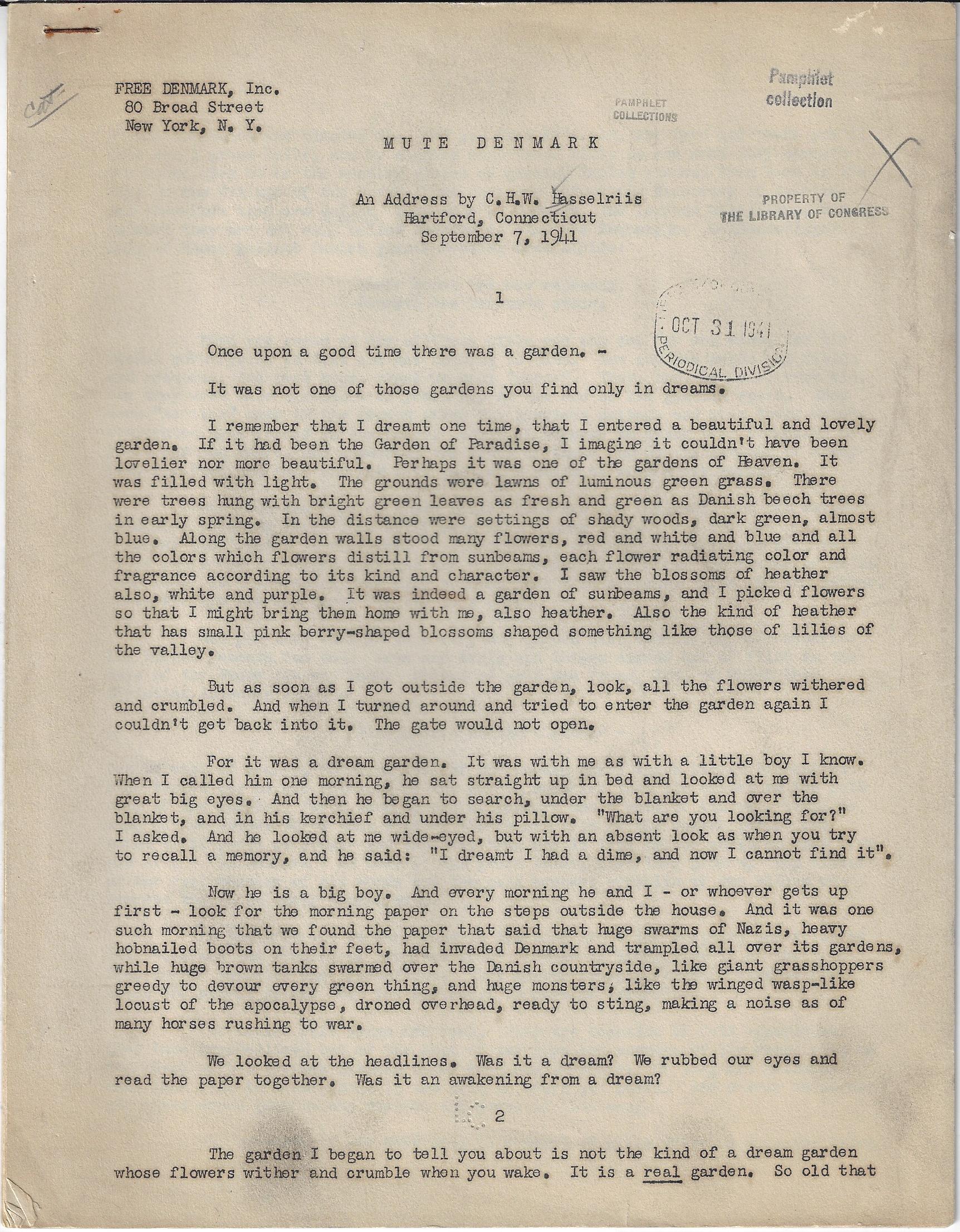
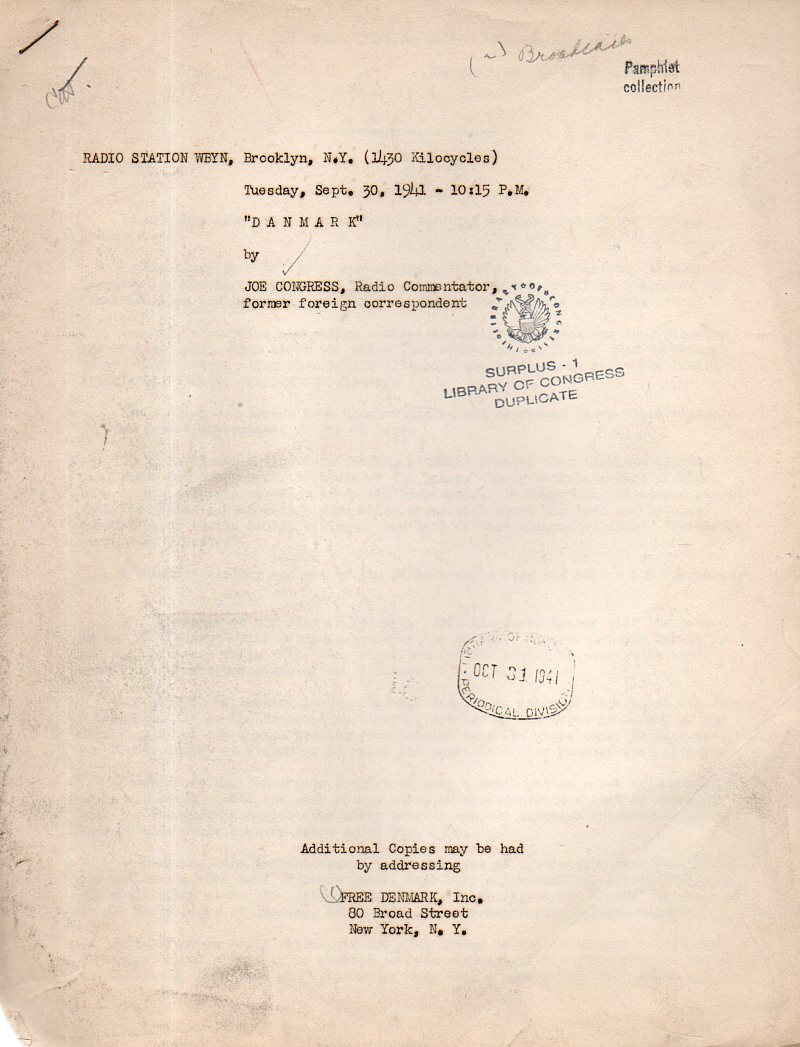
    Of the Land, the Character and the Faith of the Danes. Distributed by the Danish Information Service of the Friends of Denmark, NYC; “For release on or after Nov. 6, 1944. [1944] Offset mimeographed leaves, stapled. 11.5×8”, 5pp.

    _____. Mute Denmark. Published by Free Denmark, Inc., NYC, September 1941. Offset mimeographed leaves, stapled. 11.5×8″, 9pp. On the silencing of the voice of Denmark–a lyrical and poetic statement on the “lark no longer sing(ing)” though the spirit of Denmark remains dedicated to freedom.

    Neither publication is located in WorldCat/OCLC, $200/pair

    Denmark mute

    Denmark 1941 164

    ·Posted by :

    ·in: