A Daily History of Holes, Dots, Lines, Science, History, Math, Physics, Art, the Unintentional Absurd, Architecture, Maps, Data Visualization, Blank and Missing Things, and so on. |1.6 million words, 7500 images, 4.9 million hits| Press & appearances in The Times, Le Figaro, Mensa, The Economist, The Guardian, Discovery News, Slate, Le Monde, Sci American Blogs, Le Pont, and many other places… 5000+ total posts since 2008.

Book Category: World War II

  • Iconic WWII Propaganda Posters–the United Kingdom, 1940

    “Original WWII Poster by “Fougasse”

    Fougasse – Cyril Kenneth Bird, (1887-1965), illustrator for Punch (from 1937 to 1949, and a wounded vet of Gallipoli in the First War)” “Careless Talk Costs Lives”.

    This is one of eight posters in the very popular “Careless Talk Costs Lives” wartime propaganda series issued by the Ministry of Information and printed in the year of terrible and great struggle in Great Britain, 1940. 32x22cm, color lithograph, and printed on paper (though some were originally issued affixed to cardboard or another stiffer board).

    The series in general depicts people sharing a piece of possibly sensitive information that in the wrong hands and together with other pieces of info could reveal devastating secrets—and in each case there are figures lurking/loitering/disguised in the background waiting to collect the data, and generally a poorly disguised Hitler or Goering or both. Fougasse was able to make his message immediately memorable and understood because I think of his understated over-the-top visual humor. The images were funny, but the message was deadly serious. Also, you really didn’t even need to read the text to understand the message. (This is in the same vein as some of Thomas Nast’s finest work, conveying social content and a political message to the illiterate, making his devastating (and usually highly textual) cartoons understandable without needing to read them.) 

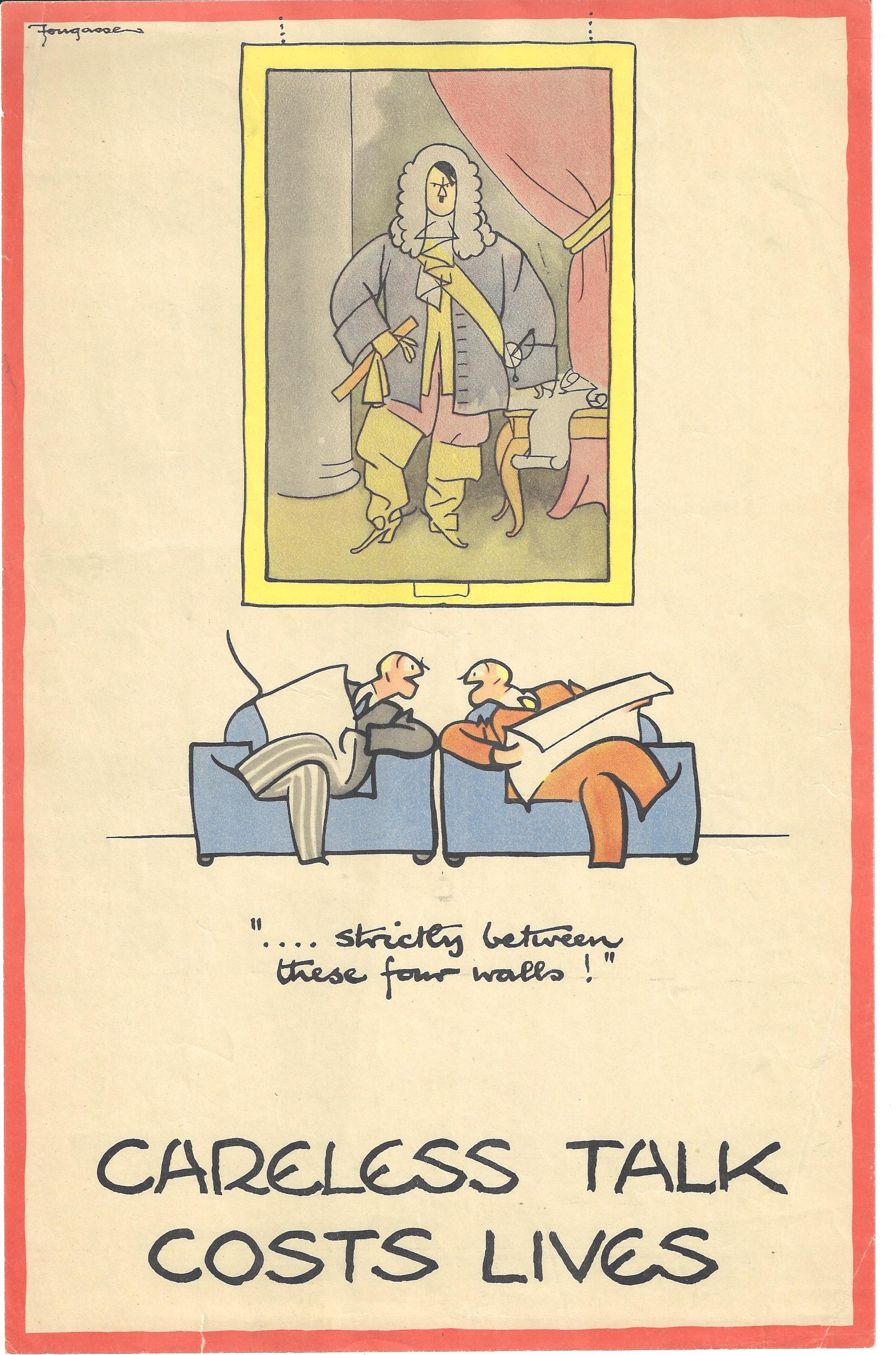
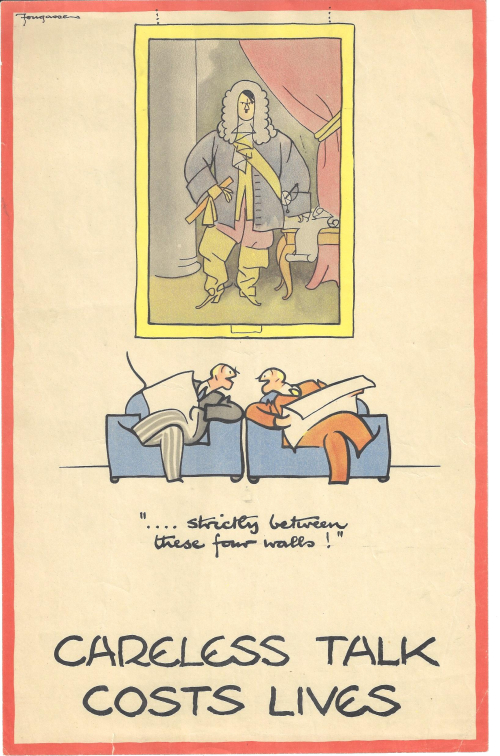
    (1) “Strictly Between Four Walls”.  In this poster (made a convenient size to be useful in virtually any small area and also abiding the wartime paper shortage) we see two men in big club chairs about to share some bit while the artwork-ensconced Hitler waits to hear the interesting parts. Fine condition. 1940. 32x22cm, color lithograph, and printed on paper $175

    Fougasse but of course it mustnt


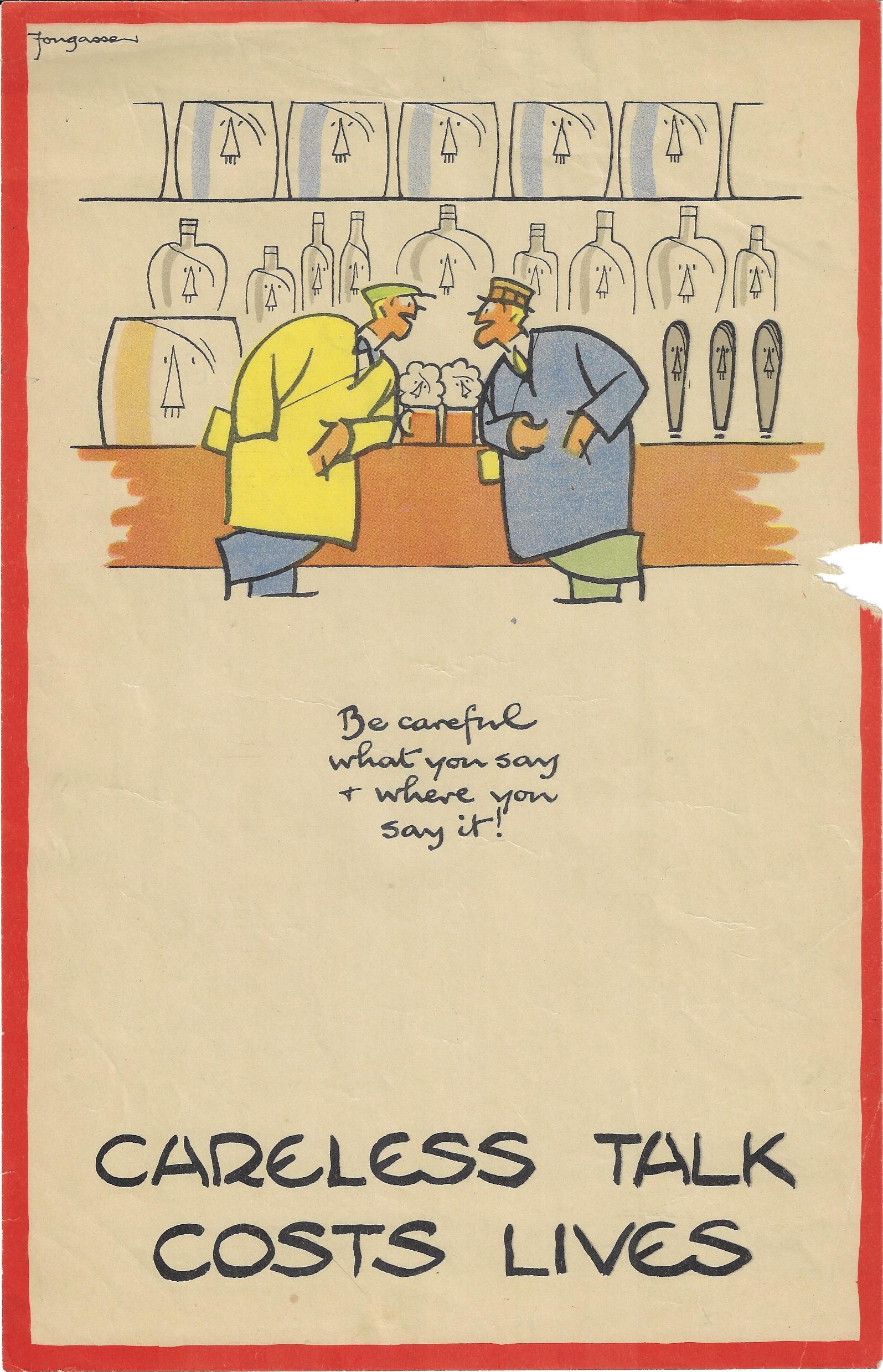
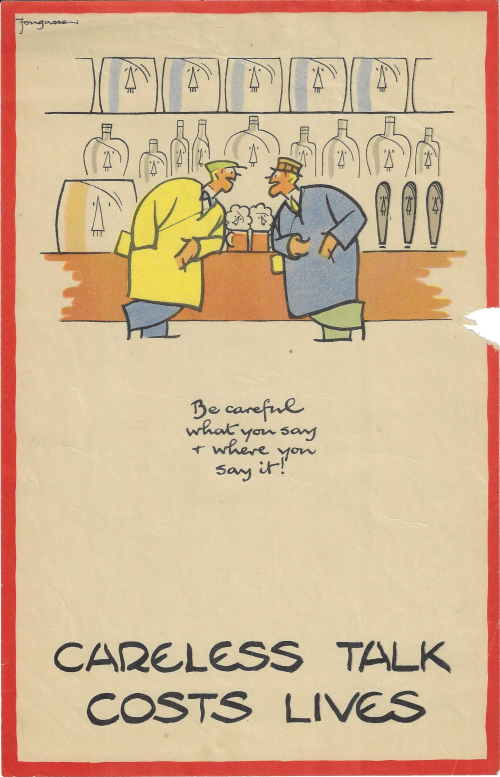
    (2) “Be Careful What You Say and Where You Say It!” 1940. 32x22cm, color lithograph, and printed on paper. Here two chaps share suds in a Hitler-infused pub. Unfortunately there is a 15x15mm chip out of the image at middle-right edge, otherwise this is a nice crisp image.  $100

    Fougasse but of course it mustnt

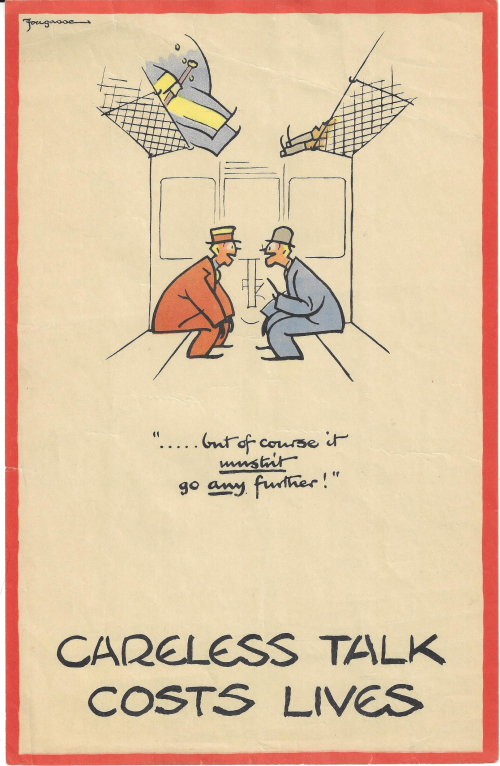
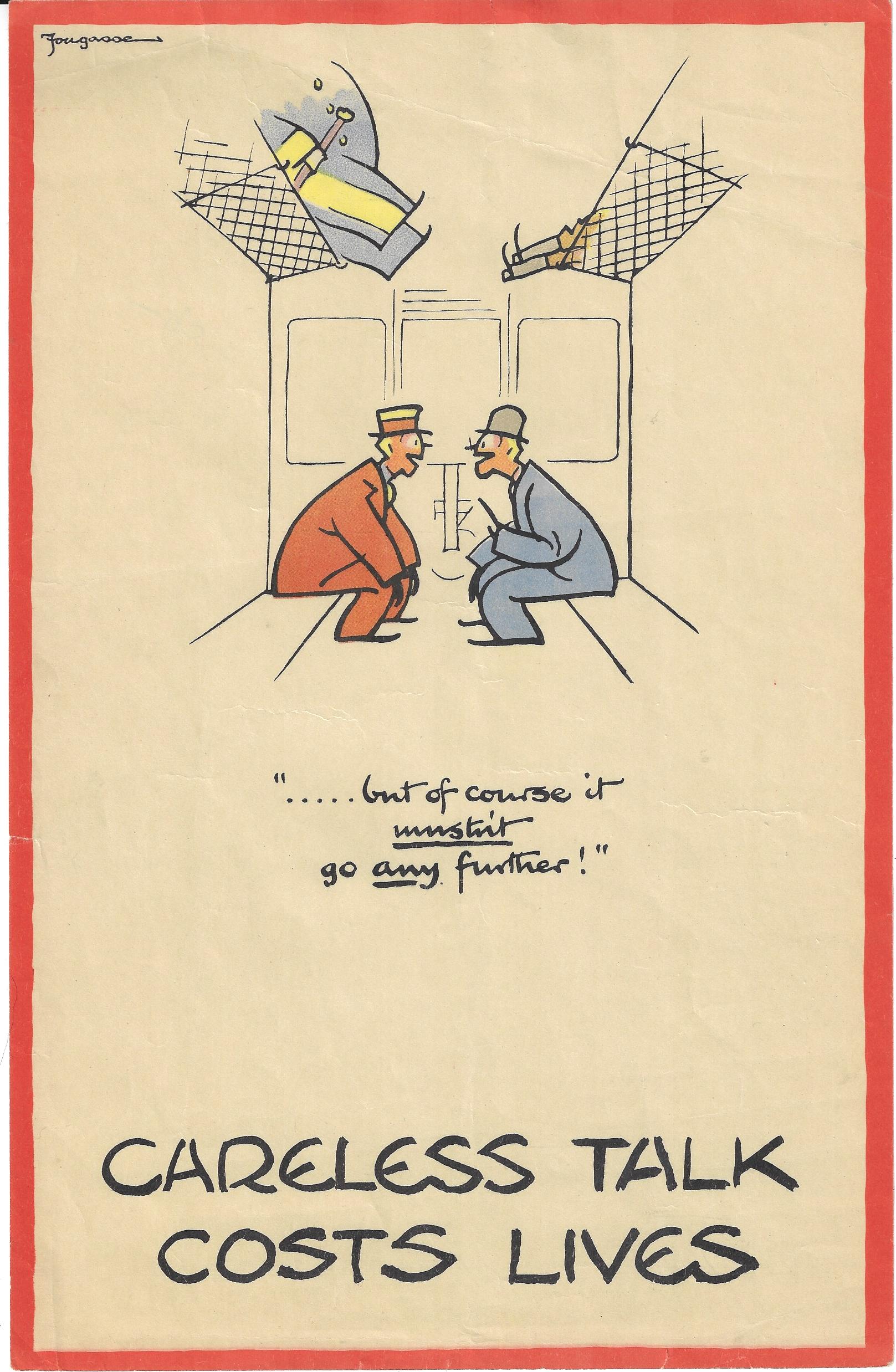
    (3) “But of Course it Mustn’t Go Any Further!”, say two blokes in a 2nd class railway cabin, the feet and legs of Goering and Hitler dangling over them as they share their unsharable war information. Fine copy.  1940. 32x22cm, color lithograph, and printed on paper.  $200

    Fougasse but of course it mustnt

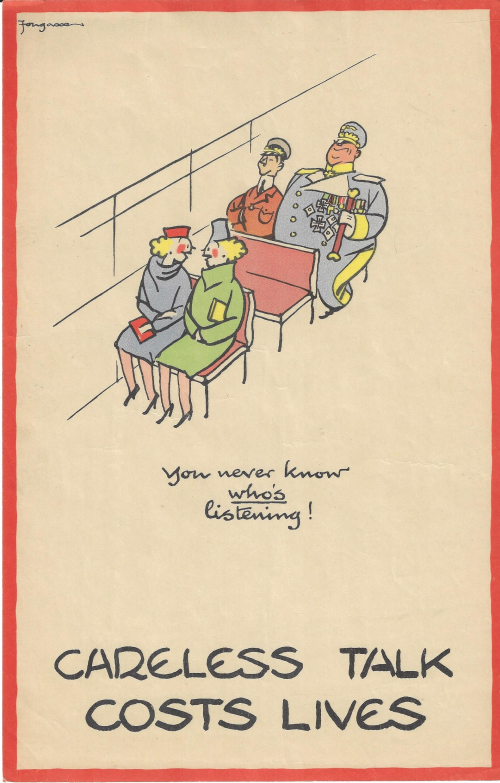
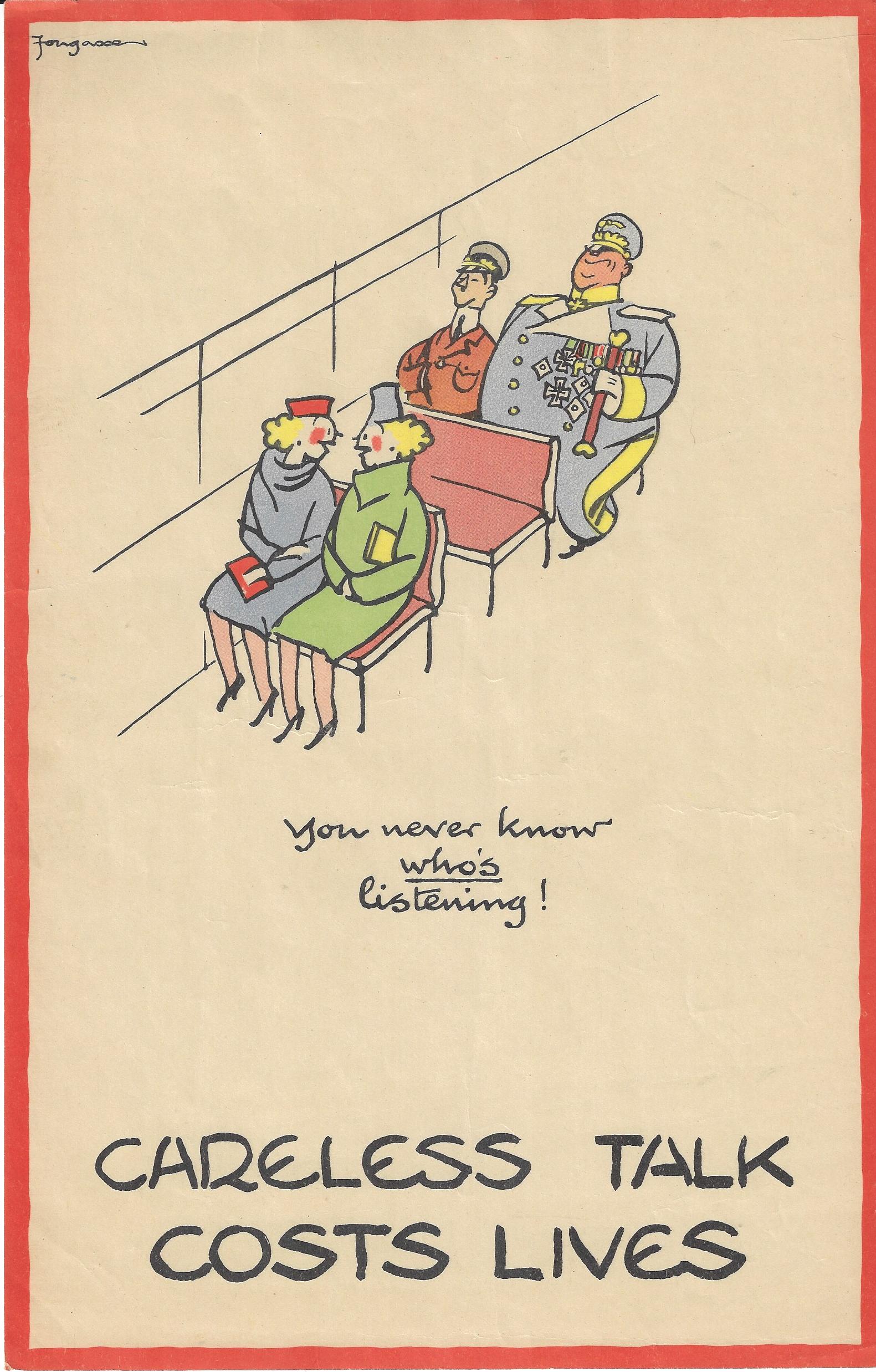
    (4) “You Never Know Who’s Listening!”. Two ladies on a bus share some wartime news while Hitler and Goering sit aloof and patient, absorbing all.  1940. 32x22cm, color lithograph, and printed on paper. Fine condition.  $200

     Fougasse but of course it mustnt

    ·Posted by :

    ·in:


  • Soviet Response to the Beginning of the Nazi Attack, July 1944

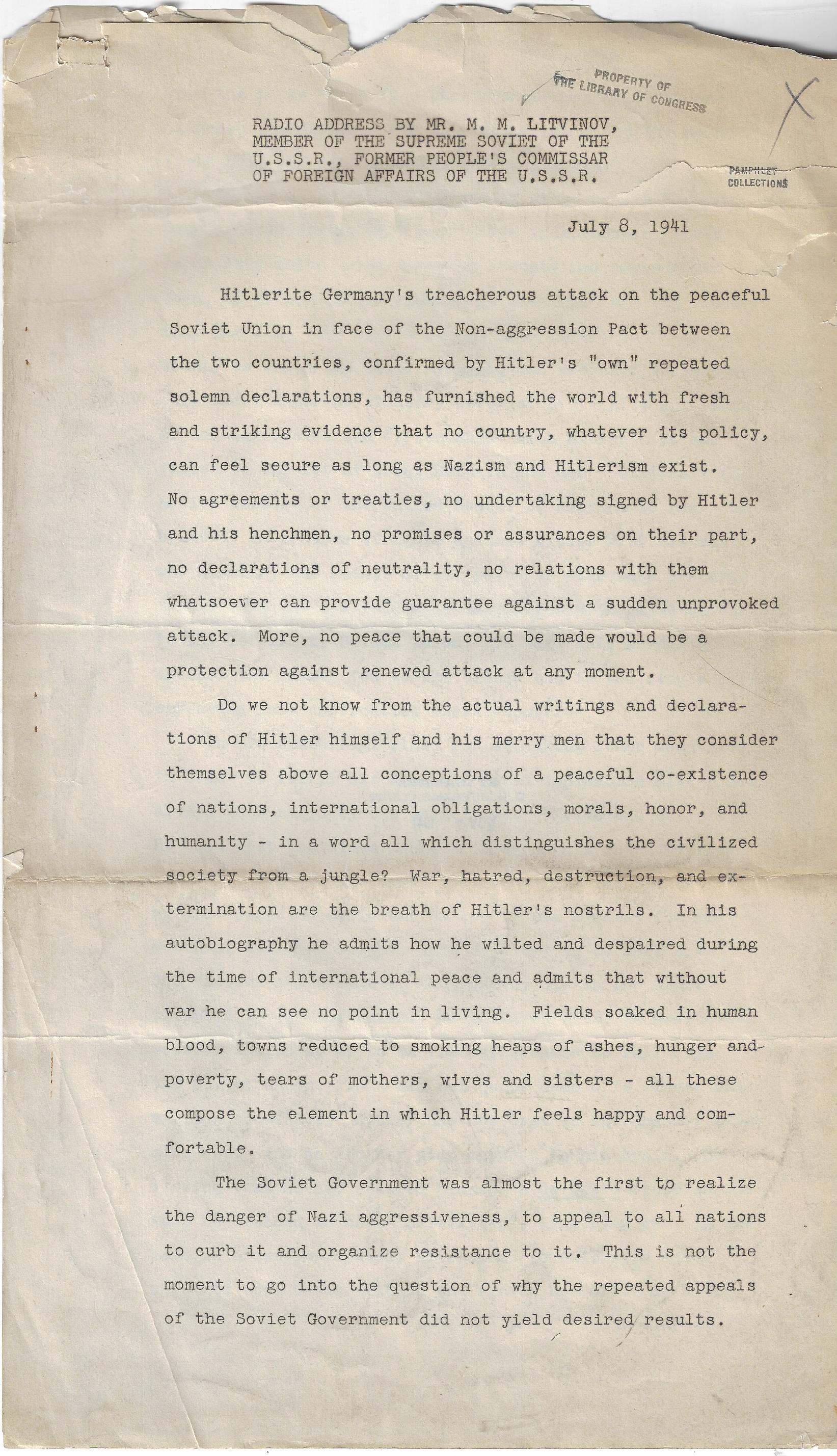
    Radio Address by Mr. M.M. Litvinov, Member of the Supreme Soviet of the U.S.S.R., Former People’s Commissar of Foreign Affairs of the U.S.S.R. July 8, 1941  12.5×8″, 4 leaves. Offset printed from typed original.  No place or date of publication.  Good copy, only. A little brittle, and also somewhat tattered along the top edges. Also there is a Library of Congress surplus/duplicate stamp on the rear wrapper. Loose leaves, formerly stapled. Mimeographed production.

    • Provenance: U.S. Supreme Court, and then the Library of Congress.    WorldCat/OCLC locates 0 copies.  $400

    Russia Litvinov _1_

    It is hard to criticize the Soviets when they were at their post WWI weakest, but I needed to point out a few, well, inconsistencies in the following statement by Maxim Litvinov. The text is that of a radio address by the mega-connected and high profile Russian revolutionary and People’s Commissar of the USSR, and it was delivered on July 8, 1941. At this point Litvinov (1876-1951)–who would in a few weeks become the Soviet Ambassador to the United States–was addressing the weeks-old attack and declaration of war made upon the U.S.S.R. by Nazi Germany.  

    It was a terrible and nearly mortal blow to the state, and Hitler’s vast overreach very nearly came to be. Still there were some bits in the address that were difficult to absorb. 

    For example Litvinov states: “Hitlerite Germany’s treacherous attack on the peaceful Soviet Union in face of the Non-aggression Pact…”  The Soviets did indeed sign a hands-off/so-no-evil Non-Aggression Pact (the Molotov-Ribbentrop Pact) with the Nazis in August 1939 and enjoyed the fruits of that special relationship, the two nations dividing conquered border states according to each other’s “sphere of influence”. So, this pact was “peaceful” only so far the U.S.S.R. is concerned, and not so peaceful for other nations.

    Then this: “The Soviet Government was almost first to realize the danger of Nazi aggressiveness…”, which seems hard to acknowledge when they shared a non-aggression pact/treaty in the early stages of WWII.

    Then the “veritable miracles of heroism” of the Red Army is “bearing the whole of Hitler’s powerful war machine and compelling him to transfer more and more forces from West to East”. I will not doubt heroism of fallen soldiers in a near lost cause effort, and it is true that the Germans would half- or mostly-exhaust themselves in the East, maybe more than that, probably, probably costing Hitler far more than he could ever have conceived. Stalin had already murdered his way through a large swath of the Soviet command structure, and was also unwilling to recognize that the Nazi attack was in fact the Real Thing. Stalin hesitated, and went incognito a little, and in general did not know what to do; he did come to his senses in short order, but a great amount of damage had already been done to Soviet defenses, and that would nearly cost him the country. But it didn’t, and the U.S.S.R. rallied, and at the cost of millions of lives killed the Germany armies in the East, and really was responsible for contributing in large part to the defeat of Nazism. 

    “Thanks to this the English people are enjoying a certain respite after twelve months of incessant bombardment…”, which was true to some degree.

    “Each blow struck now is ten times as effective and entails infinitely less expenditure and sacrifice than if it is delivered when anyone [sic] of his adversaries becomes weaker”. 

    And so on.  

    ·Posted by :

    ·in:


  • An Unusual Find of Information and an Insight into the Education and Training of Air Intelligence Officers, and how the US Military Analyzed Battle Data (1944)

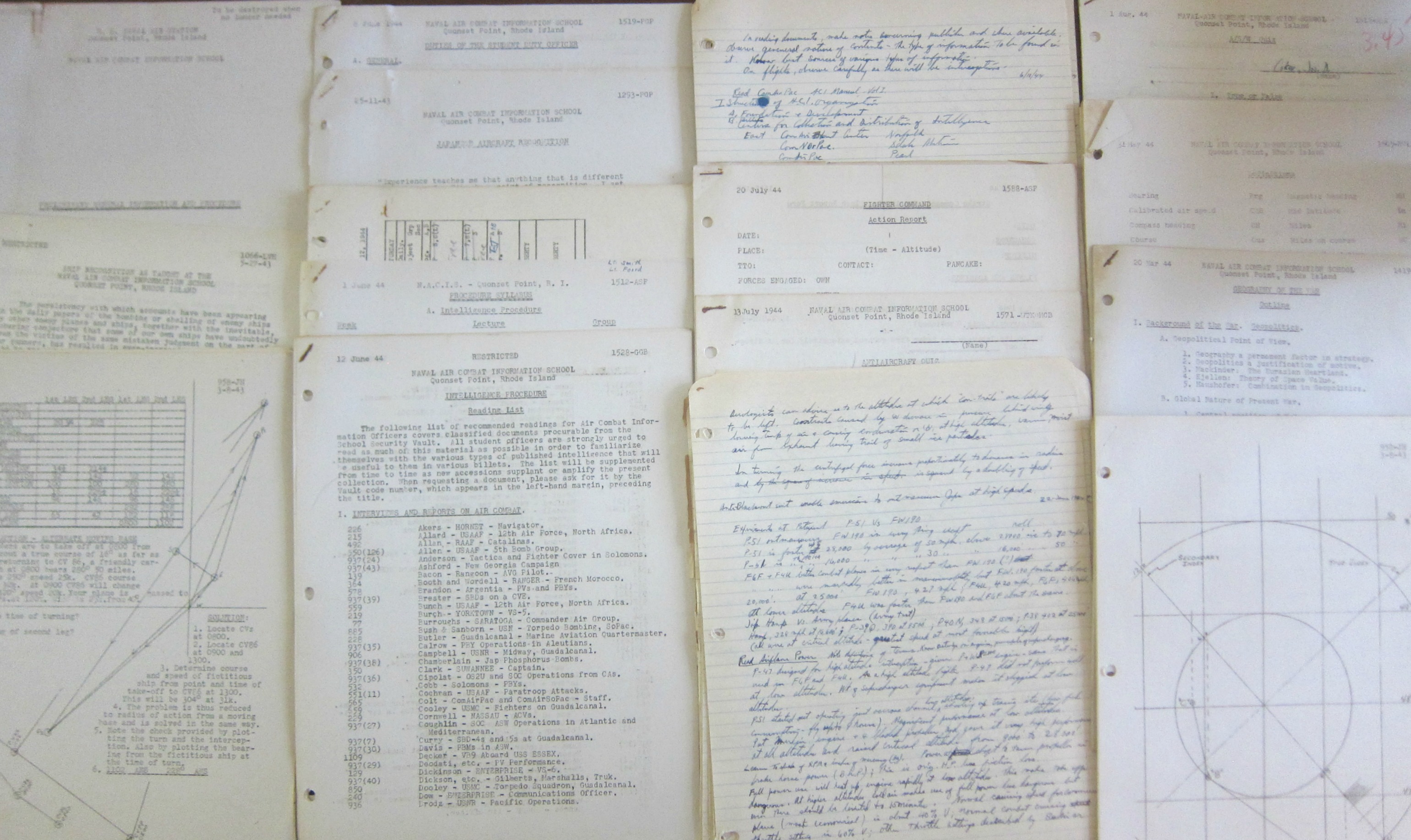
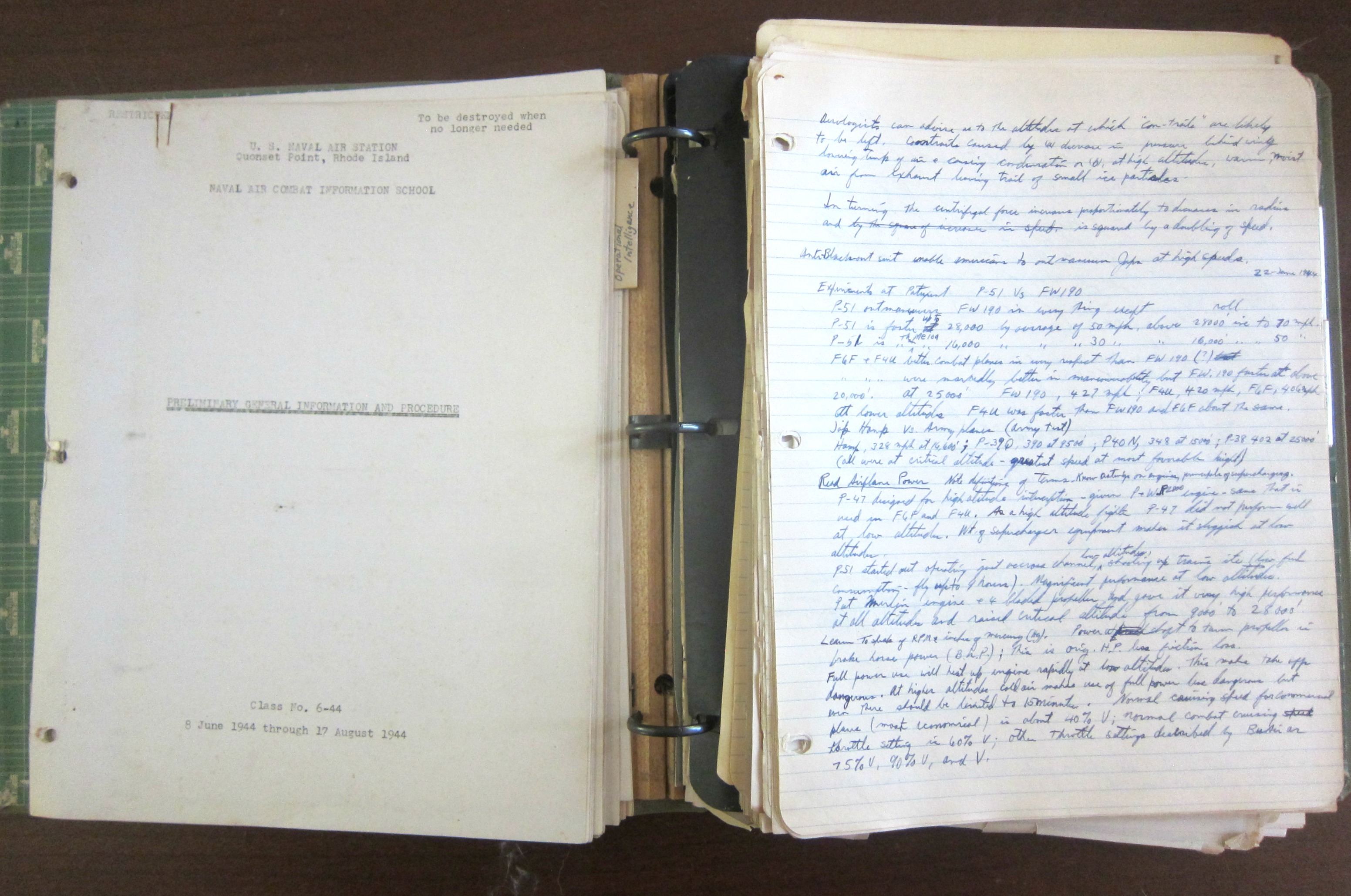
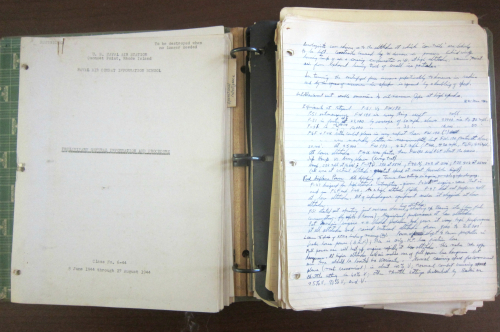
    Mixed mimeographic and manuscript notebook of an officer attending the Naval Air Combat Information School (NACIS) at Quonset Point, Rhode Island in the summer of 1944. The material is bound in the original three-ringed notebook, all of which is in Very Good condition.  The document runs 221pp, including 140pp printed documents (almost entirely mimeographed), 51pp of manuscript notes, and 30pp of mixed printed forms with manuscript additions). $1750.00

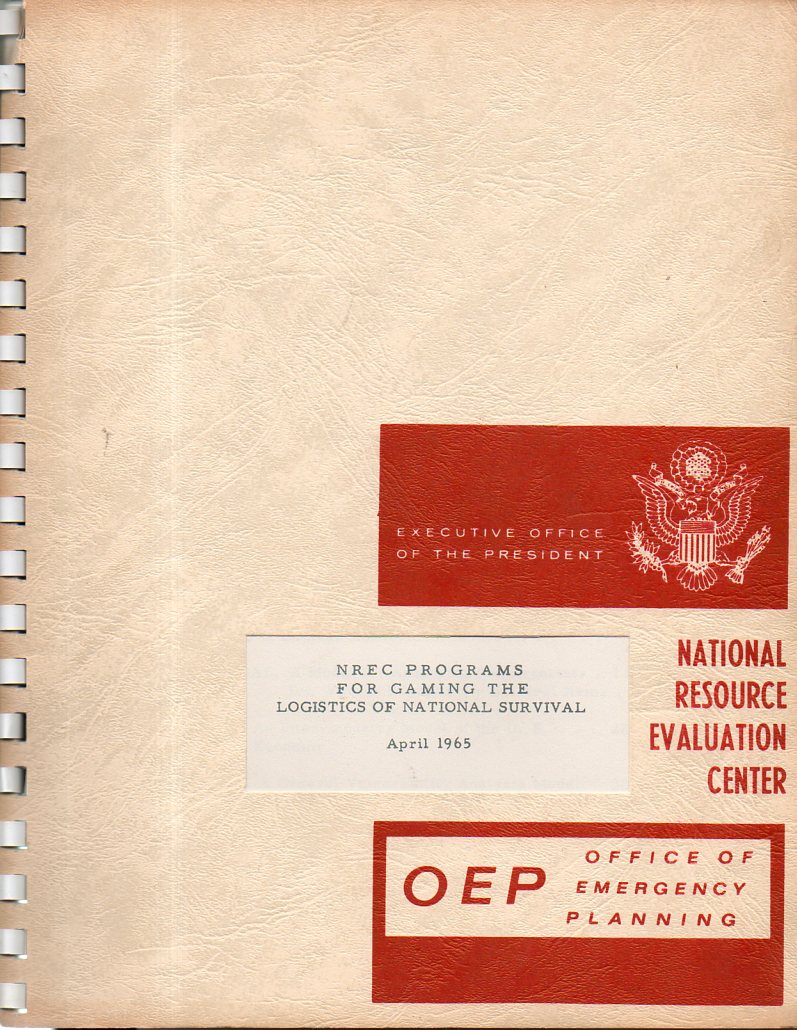
    Most of the material is mimeographed from type originals, and most of that is marked “Restricted” or “Confidential” in the original sheets.  This was the notebook of Joseph Coker, who did an excellent job of note-taking and was a superior observer, and who would continue his career post-war int eh field of defense analysis, and retire from government service as the director of the National Resource Evaluation Center in the Office of Civil and Defense Mobilization in the Executive Office of the President, which was really about preparing for nuclear attack and the world that would be left after that.
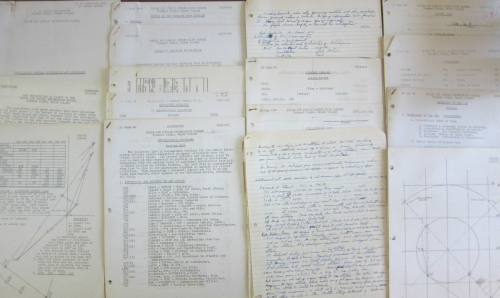


    NACIS group[Some of the notebook’s contents–the foggy bit in the upper right corner is shadow, and not a stain.]


    Contents, in order of appearance:

    –USNAS, NACIS, “Preliminary General Information and Procedure”, Class No. 6-44, 8 June 1944-17 August 1944, for the 289 hours of classwork. Marked “to be destroyed when no longer needed” and “restricted”. 2 lvs, 8pp.

    –General Notices (Daily schedule), 6pp.

    –Outlines of the Student Duty Officer”. 4pp

    –NACIS, “Japanese Aircraft Recognition” 25-11-43. 1 page. (See below for details.)

    –Ship Recognition as Taught at the NACIS. 5-27-43. 3pp. “Restricted” A full and tight 3pp on the outline of a classification scheme.

    –Course outline and schedule. 9pp of the daily regime at the school.

    –“Procedure Syllabus”, 1 June 1944. 1pp

    “Intelligence Procedure”, “Restricted”, 12 June 1944. 14pp. Includes reading list of interviews and report on air combat with about 120 named airmen; outlinnes for a course on air combat tactics, action reports, and battle notes, including amphibious warfare and ASW; airplane chracteristics; “interview and reports on air combt intelligence duties”; photographic interpretations; geographical references.

    “Sample Pilot’s Check Chart”, “Confidential” 1pp. Chart outlining altitude, RPM, max manifold pressure, mixture control,oil temp, oil pressure, cylinder head max, cowl flaps, fuel consumption, for 13 different operating conditions.

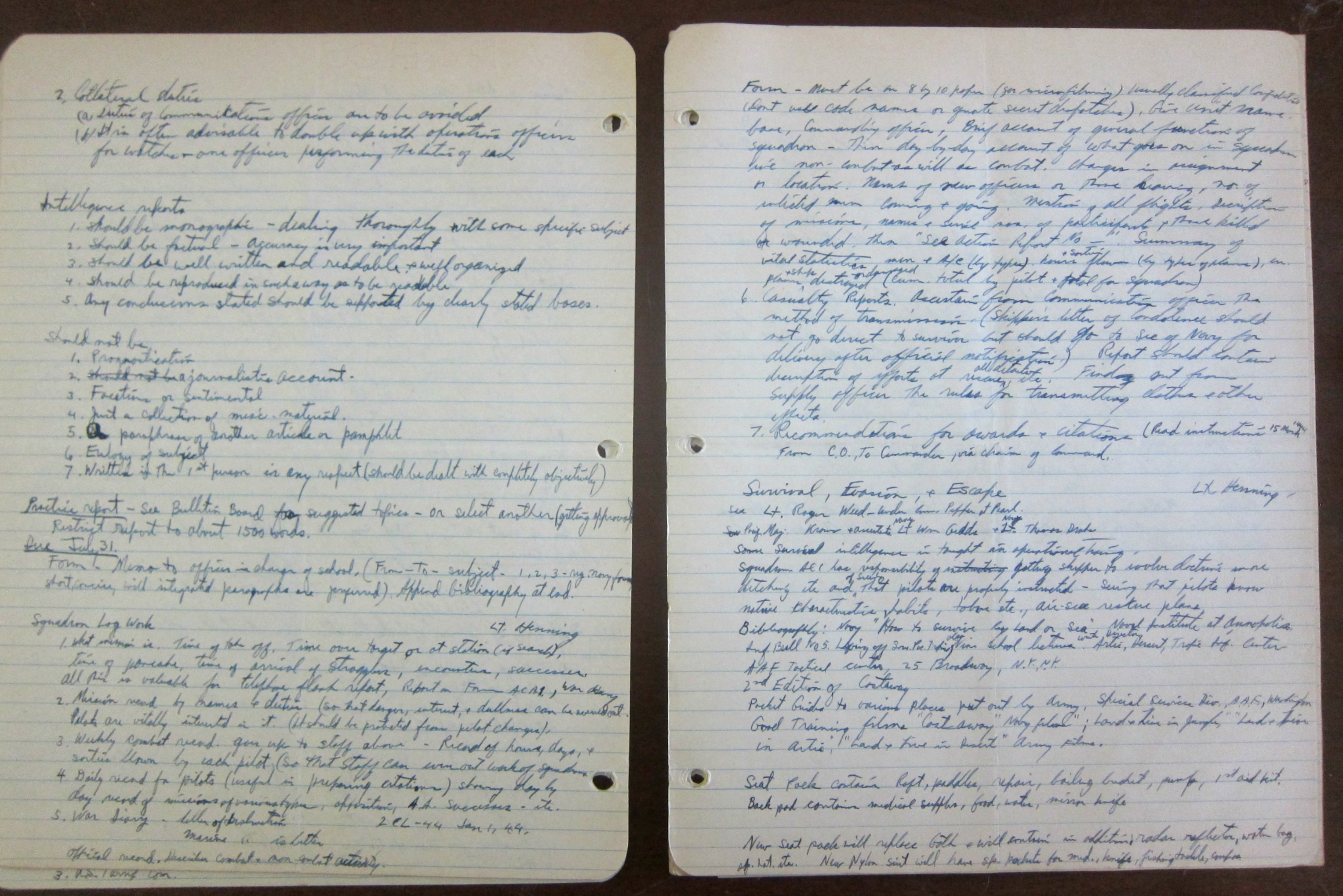
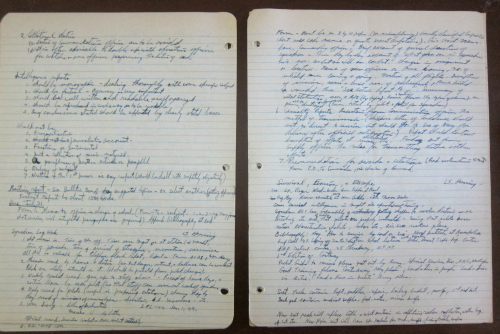
    –MANUSCRIPT: 8pp general outline of intelligence procedures.
    NACIS three ring

    –“TBF’s at Truk. Interrogatee: Pilot” 22 July 1944. Sample of a debrief after air combat over Truk Island. Second part: “F4U’s at Saipan”. 2pp.

    –“NACIS Index System”, “restricted”, 25 May 1944. 2pp

    –EXAMINATION. “Procedure Test”, 30 June 1944, with printed questions and hand-written responses. 2pp

    –EXAMINATION. “Antiaircraft Quiz”, 13 July 1944. 3pp, with printed questions and hand-written responses.

    –“Fighter Command, Action report”, 20 July 1944. Sample form, not filled in. Also includes “Mission report (Navy) FORM MIKE” with general instructions. 13pp. Also includes “Life Raft and Emergency Performance Report”, 4/1/1944, 1 sheet. Also 1 short page of ms notes.

    –“Geography of the War”, 20 March 1944. 8pp, plus 1 sheet of ms notes.

    –EXAMINATION: “Tactics Quiz”, 8 July 1944. (Sample question:“Give a reason or reasons why it would be foolish to compare the original models of the P39 and the P47 on the same basis”.) 2pp

    –MANUSCRIPT Notes: 16pp of tactics, mostly on torpedo tactics from planes, dive bombing, glider bombing (?). About 5000 words.

    –MANUSCRIPT Notes, ASW, 8pp, about 3000 words, including a printed dagram/cutaway of a U-boat.
    U.S. Depth Bombs (depth chargers), “Confidential”, 27 July 1944. 1 sheet. Table of the bomb type, weight of charge, total weight, nose, pistol, lethal radius, and impact-spacing (day and night).
    NACIS mss

    –ASW Classification, “Confidential”, 4 May 1944, NACIS. Interesting 11-point grading system for assessment of attack on sub. 1 sheet.

    –COMINCH Instructions for Briefing Squadrons on ASW Missions, “Confidential”, 29 July 1944. 1 sheet.

    –EXAMINATION: ASW Quiz. 1 Aug 1944. 3pp

    –Homework Assignments: 22 single-leaf assignments, all dated May 1944, and mostly concerned with navigation.

    –Construction of Mercator Chart, Measurement of Course and Distance, determination of longitude and latitude. March 8, 1943. 13 leaves. Also: 6pp of manuscript notes.

    –“Aerology”, by John Hamlin. Offset/mimeograph. 27pp.

    –“Performance of Fighter Command Aircraft”, 26 January 1944. Lists engine, operational ceiling, climb rates, speed, and guns in charts for 34 aircraft. Marked “Restricted”. 3pp. Wonderful data.  Accompanied by 12pp of manuscript notes outlining command structure of the Japanese, Russian, German, Italian, and British air forces. (See below for a images.) The air forces outlined in diagrams in the notebook include the U.S. Army Air Force, the Luftwaffe, the air forces of the Soviet Union, and the air force of the Imperial Army of Japan. I’m not saying that these notes are significant, just that they are from an unusual source, and so from that perspective alone they are interesting–that and the fact that the person who made the notes and took the classes became the head of the chief nuclear weapons preparedness organizations in the U.S.

    –“Performances of German Aircraft” “Restricted”. 16 February 1944. 9pp

    –“Instructions for Preparing Revised Form ACA-1 for reporting Aircraft action”, prepared by the Air Intelligence Group, Division of Naval Intelligence, June 1944. This is the only mass printed document of the lot. It is 11pp, and marked “restricted”. The document is accompanied by a printed form for the Aircraft Action Report (4pp)
    ·Posted by :

    ·in:


  • On the Starvation Conditions in Europe, 1946

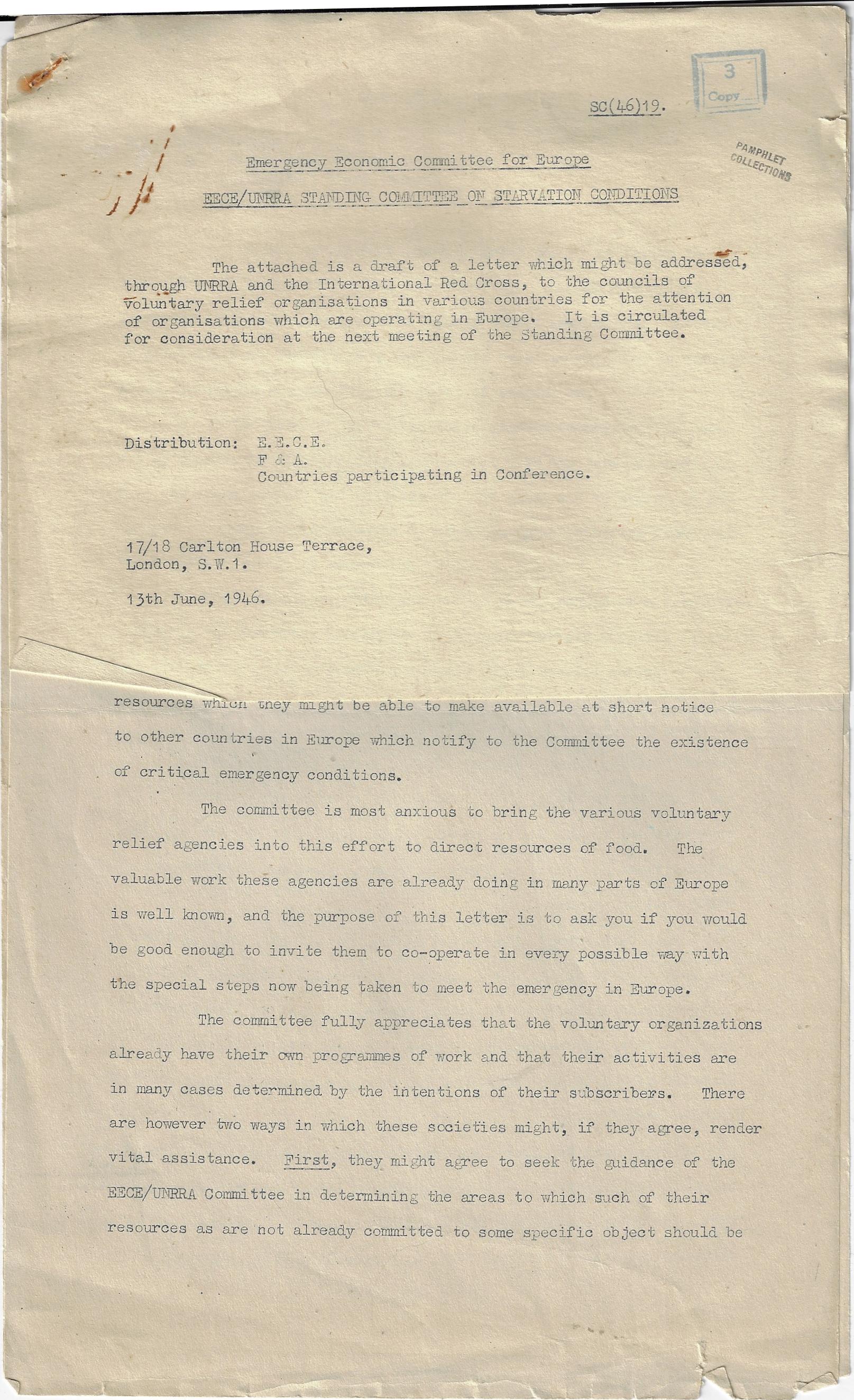
    Starvation _1_Emergency Economic Committee for Europe, EECE UNRA Standing Committee on Starvation Conditions SC(46)19  12.5×8.5″, 5pp, 3 sheets, including a truncated cover sheet. Provenance: Library of Congress, with their surplus/duplicate stamp on the rear of the last sheet. Very Good condition.  $150 

    I reproduce the entire document, below. It is interesting to note that this deals just with Europe, with no mention of, say, the Ukraine (which was suffering from famine already by 1945), or of the artificially-famine-induced Soviet Union.  

    The United Nations Relief and Rehabilitation Administration (UNRRA, 1943-1947) was established to “plan, co-ordinate, administer or arrange for the administration of measures for the relief of victims of war in any area under the control of any of the United Nations through the provision of food, fuel, clothing, shelter and other basic necessities, medical and other essential services…By 1947, UNRRA was running nearly 800 resettlement camps, housing seven million people. Forty-four nations contributed to funding, supplying, and staffing the agency, of which the United States was the leading donor. The largest recipients of UNRRA commodity aid, in millions of US dollars were China, $518; Poland – $478; Italy – $418; Yugoslavia – $416; Greece – $347; Czechoslovakia – $261; Ukraine (USSR) – $188; and Austria – $136.”–wikipedia


    ·Posted by :

    ·in:


  • Some Current Catalogs: WWII, the Soviet Union, Nuclear Weapons, WWI Photographs, and of course Large Color Lithographs of San Marco

    CONTACT:   jfptak AT thesciencebookstore DOT com    johnfptak AT gmail DOT com

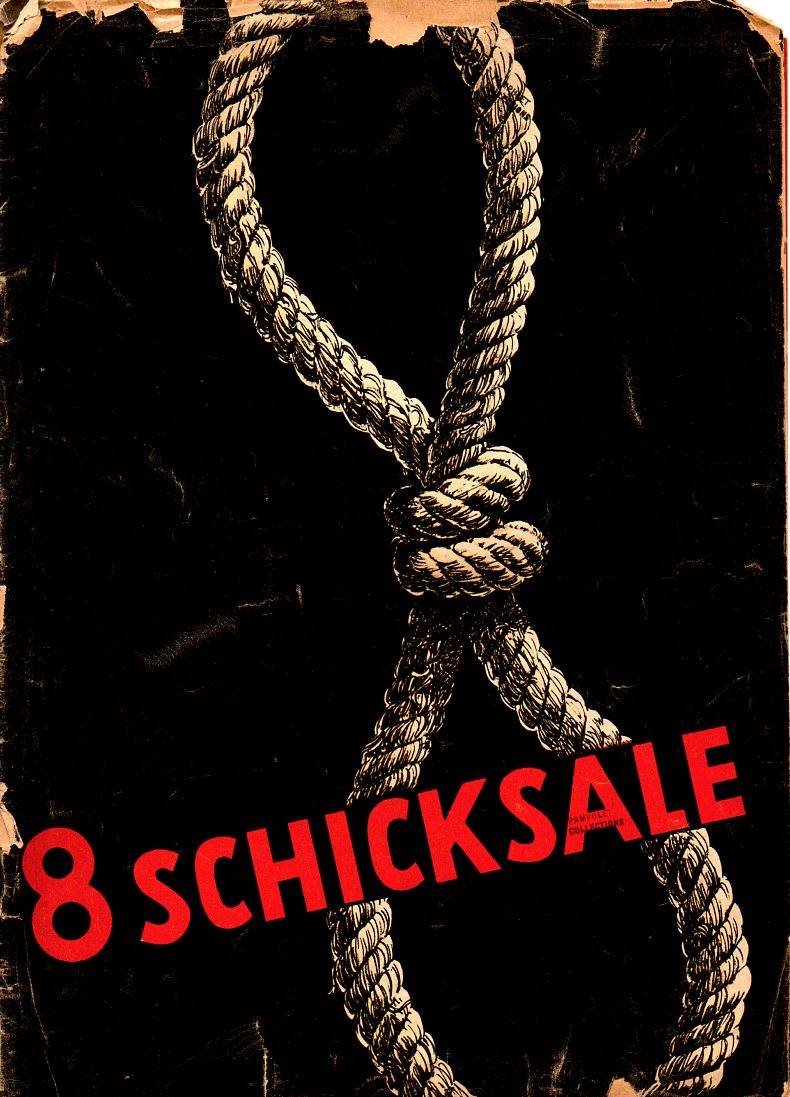
    Weimar pamphlet 8 schicksale336

    Weimar-Era to 1944 German Social, Political, and Military Pamphlets  

    Download Weimar-era to 1944 German pamphlets 

    (44pp, 5 meg. heavily illustrated)


    Nukes hoover NREC237

    Nuclear Weapons and Planning the Post-Apocalypse Society

      Download Nuclear Weapons for PDF 

    (66pp,  8 meg, heavily illustrated)


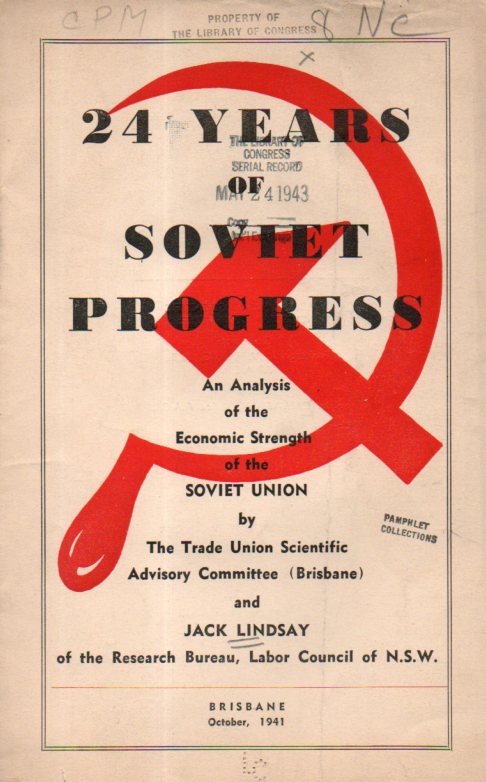
    Russian a131

    The Soviet Union and Communism (1920’s-1945)


    Download Soviet Union and Communism

     (20pp, 496k) 


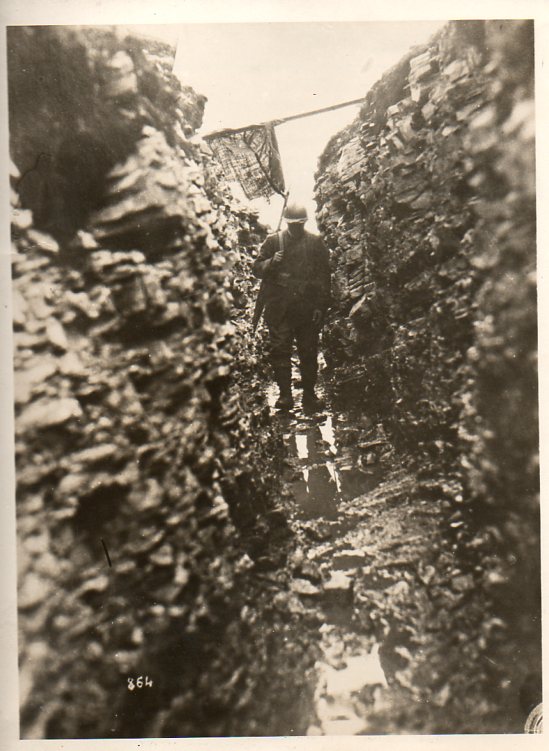
    WWI News Photo Service Archive, 1918 WWI cold ditch

    Download WWI News Photo Service Archive (41pp, 67 megs) 


    San Marco _1_

    Lavish Architectural Chromolithographs, 1886

    Download Catalog San Marco 

    23pp 4 meg pdf

    ·Posted by :

    ·in: