Title: Allied Bombing and a Report on Damage to German Industry– Fliegerangriff in der Nachct vom 17./18.8.40 auf die Hydrierwerk Scholven A.G. 1940.
With 27 original photographs displaying bombing damage. $750
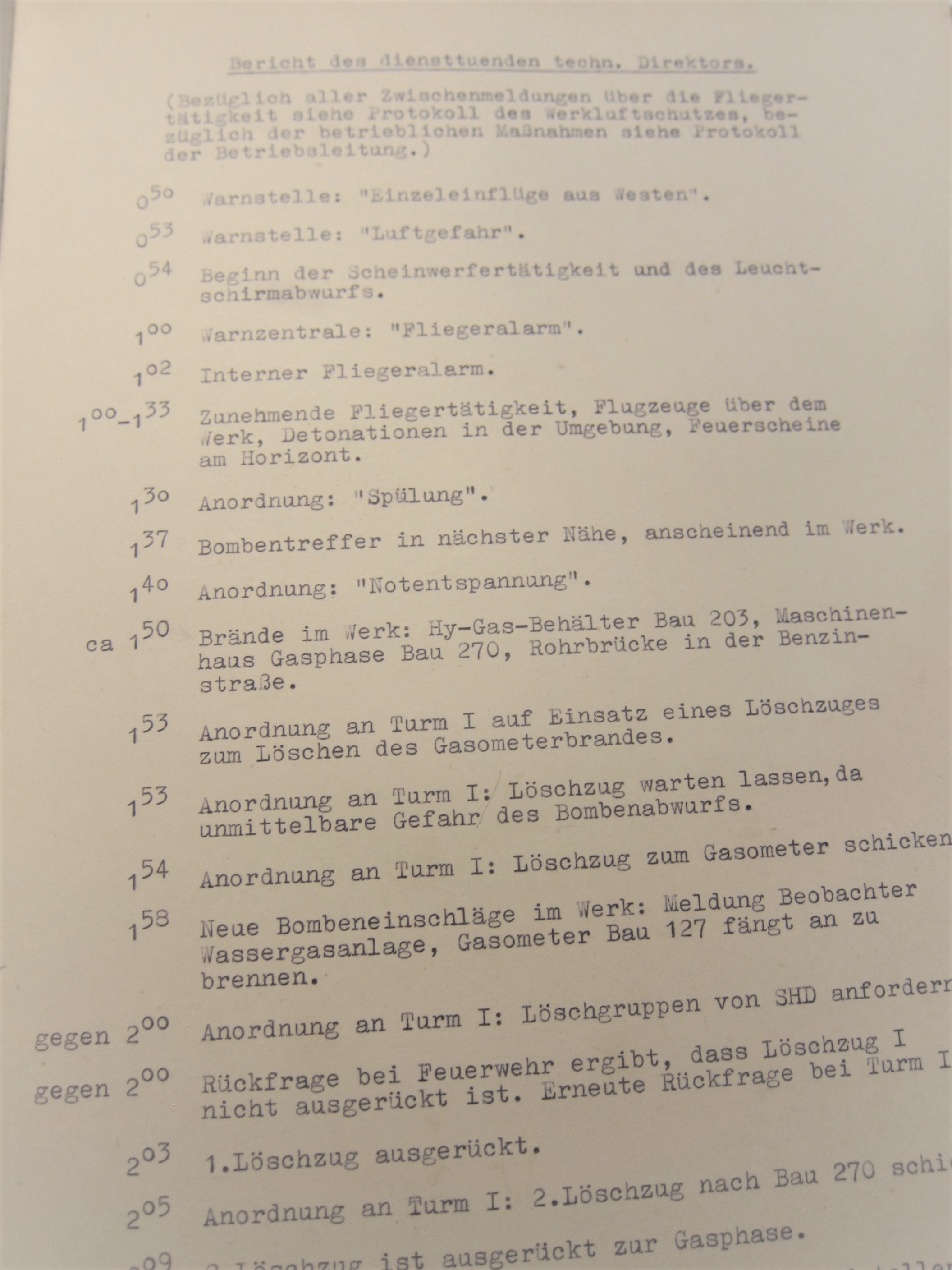
Publication data: there is no indication of author, place of publication, or any other printing data. Given the production values here this may be a unique work, or at worst, one copy of a very restricted number, of extremely highly limited distribution. It also seems that the typed captions under the photos is first generation.
It seems to me that this is a standard bit of reporting made after every bombing raid (?)
Size: 11.5 x 8.5 inches. 20 leaves with 27 original photographic images of damage caused by the bombing. Each leave is quite thick—much more stiff and heavy than a 110-lb cover stock sheet. The photos are all 3 x 4.5 inches, and are clear and bright. Condition: fine condition. Provenance: ex-library, U.S. Library of Congress.
Provenance: this book was part of a very large collection of 90,000 pamphlets bought of the U.S. Library of Congress. Known simply as the “Pamphlet Collection” it is identified by a distinctive and tiny 3mm perforated stamp on the title page (bottom), plus a bookplate at the front pastedown with the LC surplus/duplicate rubber stamp on it.
Binding: bound in thick cloth boards, with heavier black cloth board tips and spine.
Condition: there is a bit of rubbing to the extremities, though overall the book is in Very Good condition.
Notes:
“Gelsenkirchen in the time of the Third Reich In the time when the Nazis held sway in Germany, Gelsenkirchen, owing to its location in the heart of the Ruhr area, was a centre of wartime industry. In no other time has Gelsenkirchen’s industry been so highly productive. This brought about, on the one hand, after the massive job cuts in the 1920s, a short-term boost in mining and heavy-industry jobs. On the other hand, the city naturally became the target of many heavy Allied bombing raids during the Second World War, which destroyed three fourths of Gelsenkirchen. Even today, many old above-ground air-raid shelters can be found in the city, and some of the city’s official buildings such as Hans-Sachs-Haus downtown and the town hall in Buer have air-raid shelters still kept more or less in their original form. Two synagogues in Gelsenkirchen were destroyed in the anti-Jewish riots of Kristallnacht in November 1938. The one in Buer was burnt down. The one in downtown Gelsenkirchen was likewise destroyed. Exactly 66 years later, the cornerstone was laid there for a new synagogue. The Institute for City History set up a documentation site: “Gelsenkirchen in National Socialist times”. Throughout the time when Hitler was in power, from 1933 to 1945, the city’s mayor was Carl Engelbert Böhmer, an NSDAP.”