A Daily History of Holes, Dots, Lines, Science, History, Math, Physics, Art, the Unintentional Absurd, Architecture, Maps, Data Visualization, Blank and Missing Things, and so on. |1.6 million words, 7500 images, 4.9 million hits| Press & appearances in The Times, Le Figaro, Mensa, The Economist, The Guardian, Discovery News, Slate, Le Monde, Sci American Blogs, Le Pont, and many other places… 5000+ total posts since 2008.

Book Category: Medicine, History of

  • Rare Work by Abraham Maslow (1962)

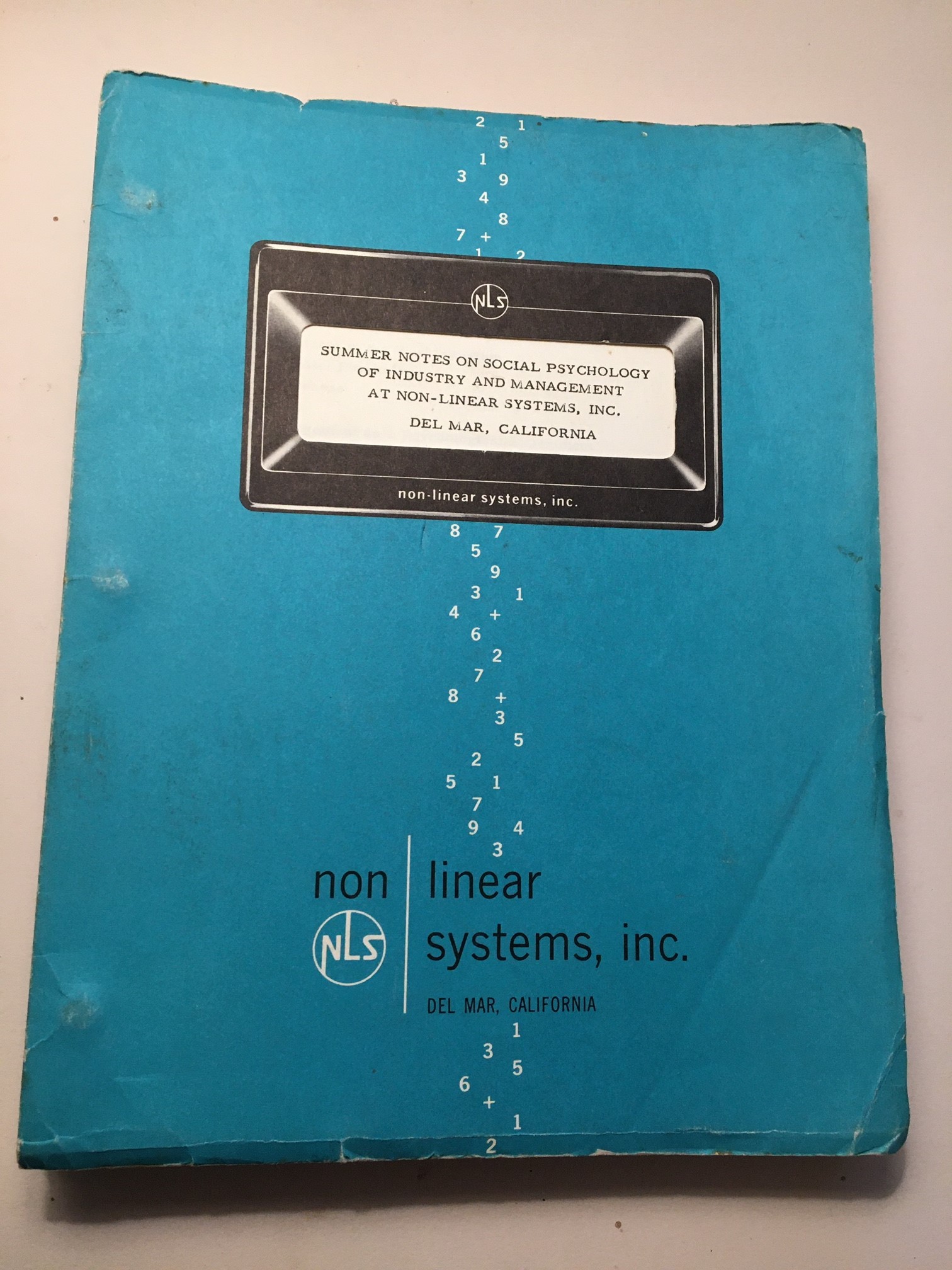
    Maslow _1_MASLOW, Abraham.  Summer Notes on Social Psychology of Industry and Management at Non-Linear Systems, Inc, Del Mar, California.  Published by Non-Linear Systems, 1962. 11.5×8″ 148 leaves.  (This is misleading: the pages are single spaced and have 50+ lines/page with 15+words/line, making this document about 100,000 words, or more along the lines of a 250pp book.) 1500.00

    Three-ring holed held together with brass holders, with thickish NLS wrappers.  Very good copy.  

    WorldCat/OCLC identifies 12 locations for the work–however, I cannot identify a paper copy, as they all may be electronic copies.  For example, St. Andrews, San Diego, and McGill (my school) identify their copies explicitly as e-books; and then the obvious ones are Google, Hathi Trust, and UC Mass Digitalization. Then there are three (like U New Mexico) where when you go to the school’s records the OCLC number is “not found” or “your OCLC number would be here” but isn’t.  The remaining three are inconclusive.  Obviously someone has an original somewhere, but I’m not sure where that is.  The OCLC 12 is therefore misleading.  At best there are three cases where maybe-but-probably-not the libraries have a paper copy. I’d say conservatively that the OCLC number is three, but it may actually be one.  

    This is an interesting document by a major psychology name poking around in a new field. I reproduce the author’s statement in (nearly) full because it tell exactly what Maslow was doing. 

    “I had never before had any contact with industrial or managerial psychology, so the possibilities for psychological theory hit me with great force as I read first the books by Drucker and McGregor that are used as “textbooks” at Non-Linear, and as I began to understand what Andrew Kay was trying to do there.I started dictating my impressions to the tape recorder. They are mimeographed here without editing, addition, subtraction, or other change, beyond correction of typographical and grammatical errors, to be passed out to my friends for discussion, because I don’t know if they will ever be published more formally.”

    “I have been told by enough people that they are interesting and useful to make me
    agree to this informal kind of communication. They should be understood as first impressions, unformed, not further worked up, of a theoretical psychologist taking his first look at a new (for him) field of knowledge and realizing that it was of great import for various of his theoretical concerns (and vice versa). I have learned in other contexts that the novice can often see things that the expert overlooks through long familiarization.”
    ·Posted by :

    ·in:


  • The Four Color Theorem

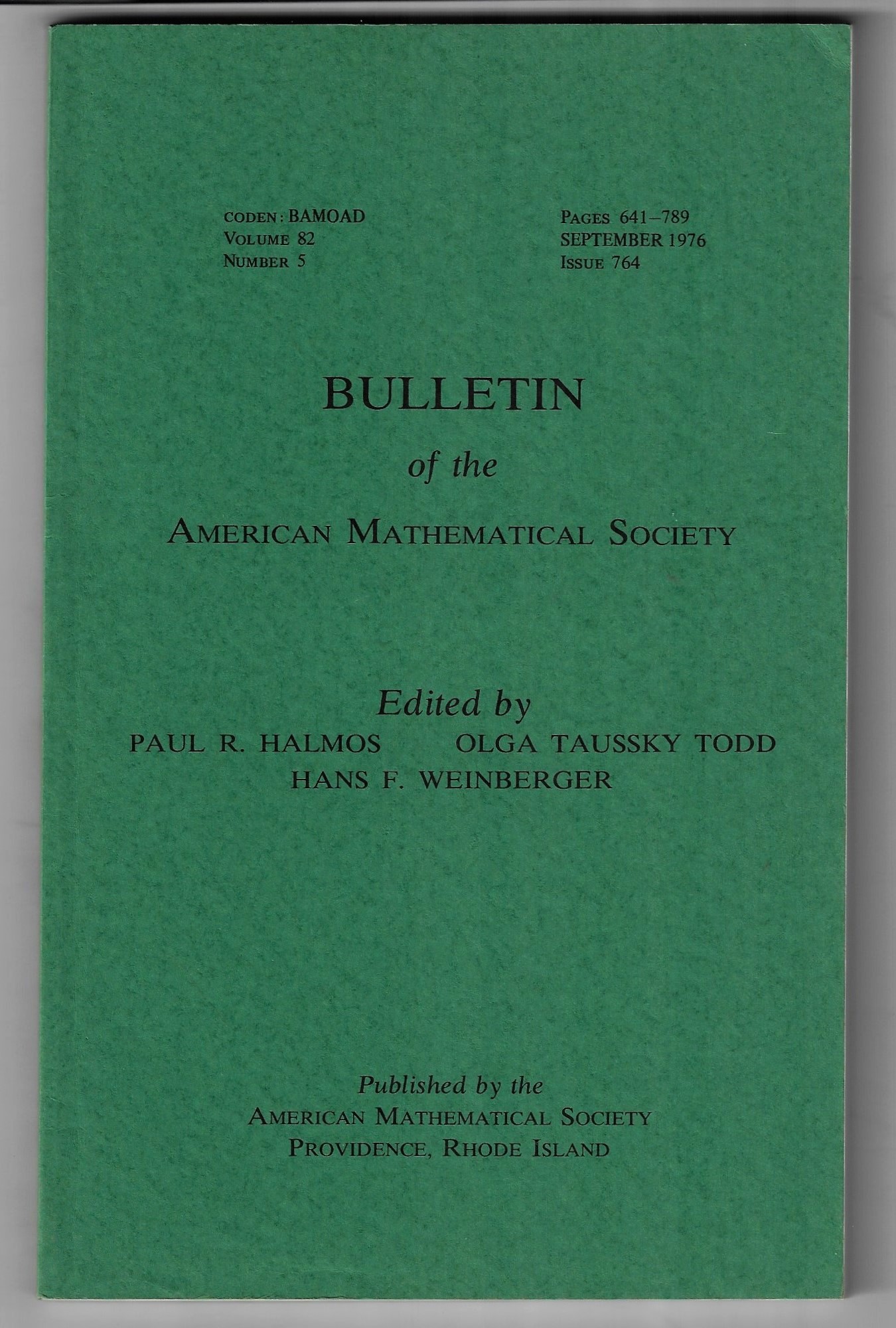
    APPEL, Kenneth and Wolfgang Haken, “Every Planar Map is Four Colorable”, in Bulletin of the American Mathematical Society, 1976, vol 82 No. 5 pp. 711-712, September 1976, in the issue of pp 641-789. Original wrappers. Very fine copy—beautiful. . $450

    4CCThis is the announcement of the proof of the four color conjecture (4CC), cited 1800+ times.

    “The four color theorem is a theorem in topology that states that no more than four colors are required to ensure than no two contiguous regions on a map have the same color. The question was first posed by Francis Guthrie in 1852 but wasn’t proven until 1976 when University of Illinois mathematicians Kenneth Appel and Wolfgang Haken proved it using a computer. This was the first major theorem proven using a computer [using 1200 hours of 1975/6 computer time].”–Wenner, History of Physics

    “The four-color theorem states that any map in a plane can be colored using four-colors in such a way that regions sharing a common boundary (other than a single point) do not share the same color. This problem is sometimes also called Guthrie’s problem after F. Guthrie, who first conjectured the theorem in 1852. The conjecture was then communicated to de Morgan and thence into the general community. In 1878, Cayley wrote the first paper on the conjectureSix colors can be proven to suffice for the  case, and this number can easily be reduced to five, but reducing the number of colors all the way to four proved very difficult. This result was finally obtained by Appel and Haken (1977), who constructed a computer-assisted proof that four colors were sufficient. However, because part of the proof consisted of an exhaustive analysis of many discrete cases by a computer, some mathematicians do not accept it. However, no flaws have yet been found, so the proof appears valid. ”–Wolfram Mathworld,
    ·Posted by :

    ·in:


  • Einthoven Willem Eine Isolationsvorrichtung Gegen Erschutterungen Der Umgebung In Annalen Der Physik Und Chemie 1895 Vol

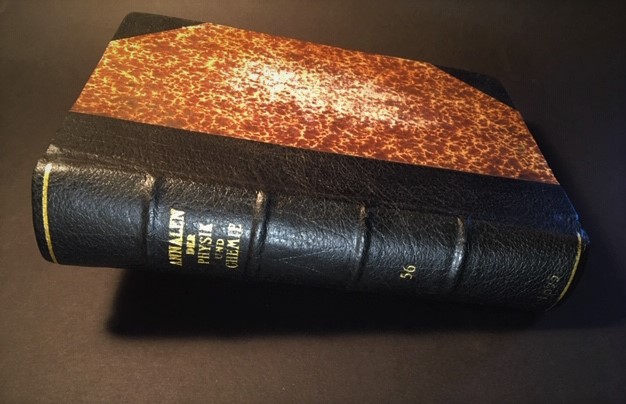
    EINTHOVEN, Willem. “Eine Isolationsvorrichtung gegen Erschutterungen der Umgebung”, in Annalen der Physik und Chemie, 1895, vol 56, pp. 161- 166. Bound in period style leather and boards. Number on title page; otherwise beautiful, fine and clean  $350.00

    “In 1895, after the London physiologist A. D. Waller had published the curve for the action current of the heart as deduced from the body surface and had announced that he was unable to calculate its true shape (as recorded with Lippmann’s capillary electometer), Einthoven repeated this experiment. He defined the physical constants of the capillary electrometer and calculated the true curve, which he called the electrocardiogram.” – DSB.

    EInthoven

    “The first accurate recording of the electrocardiogram ...Einthoven, using an improved electrometer and a correction formula developed independently of Burch, distinguishes five deflections which he names P, Q, R, S and T.”–ECG Libvrary

    “Einthoven derived a correction formula that compensated for the inertia and friction when using the mercury column of the Lippmann capillary electrometer….and…superimposed the mathematically corrected curve on the uncorrected curve. He had previously used ABCD to indicate the waves in the uncorrected tracing, and was forced to find other letters to label his corrected curve.”–Dr. Mike Cadogan, “History of the Electrocardiogram”.

    Einthoven received the Nobel Prize in 1924 “for his discovery of the mechanism of the electrocardiogram.” Nobel, the Man and his Prizes, pp. 262-265.

    Wasson, Nobel Prize Winners, pp. 294-295

    ·Posted by :

    ·in:


  • The World Dope Menace and the U.S. Contribution To It (1923)

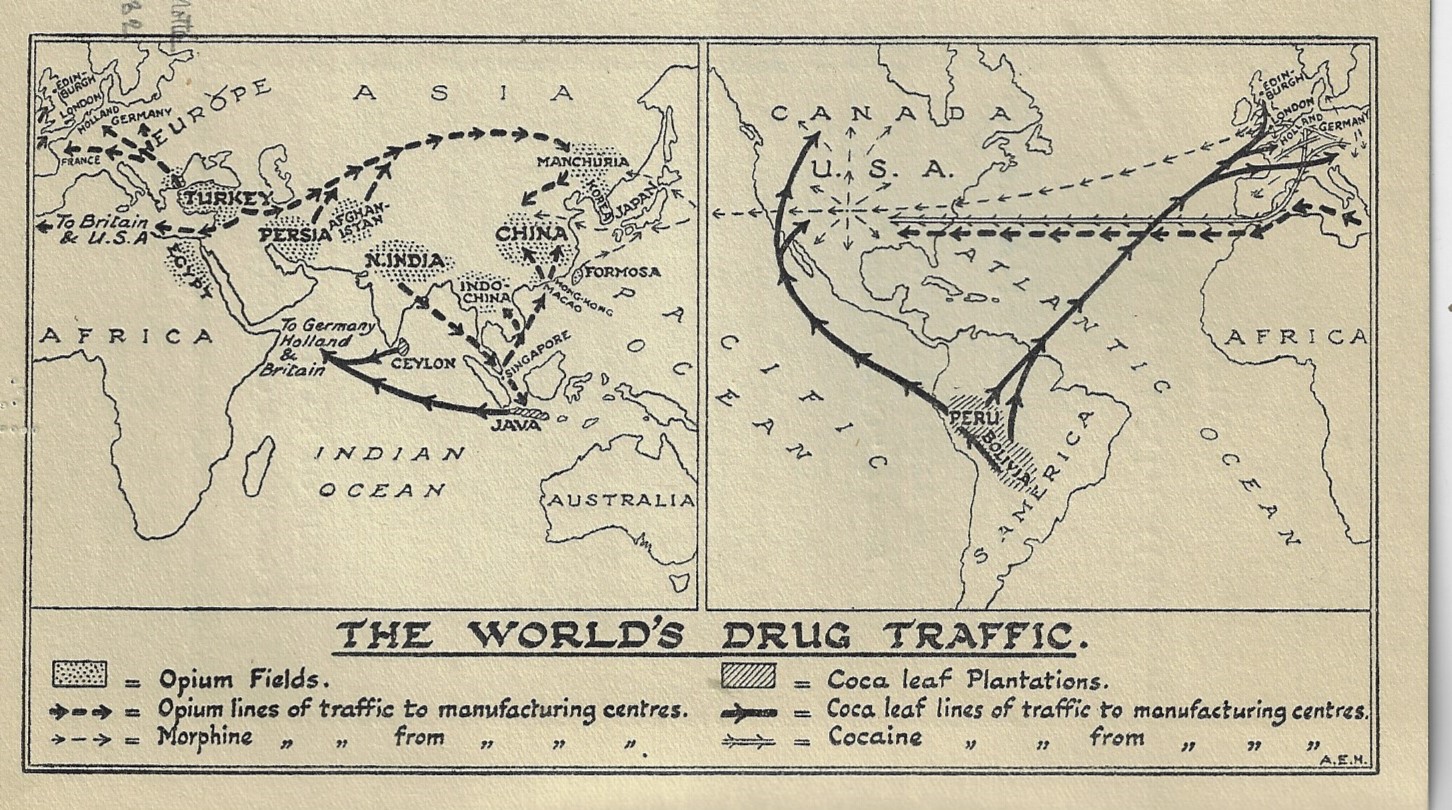
    Basil Mathews, The World “Dope” Menace and the League of Nations. London, the League of Nations Union, 1923. 7″x 5″, 24pp. Original wrappers.  VG copy. $95

    A sober and clinical appraisal of the amount of narcotics being smuggled and consumed in Hong Kong, China, Japan, french Indochina, Ceylon, Mauritius, and others.

    He also states the amounts that Western countries export to (in this case) Japan: England 10,000 lbs, France 8,000 lbs, Germany 2.800 lbs, Belgium 2800 lbs, Switzerland 4400 lbs, Holland 250 lbs, USA 18,500 lbs.

    World Dope menace map

    “In cold literal fact men in Britain and America and Japan have grown rich by debauching of China’s morphino maniacs who are now innumerable.”

    “The seriousness of morphine addiction can be understood from the opinion of an expert authority who says Morphine is not only ten times more deadly than opium but is more seductive and overwhelming in results. The addict becomes an absolute slave entirely powerless for not only are his will and moral fibre entirely rotted by the drug itself but he becomes the victim of the most dreadful tortures directly that he is robbed of his doses nervous tortures so terrible that they often drive him mad and end in death.”–from the pamphlet, p. 15.


    Basil Mathews, The World “Dope” Menace and the League of Nations. London, the League of Nations Union, 1923. 7″x 5″, 24pp. Original wrappers.  VG copy. $95

    A sober and clinical appraisal of the amount of narcotics being smuggled and consumed in Hong Kong, China, Japan, french Indochina, Ceylon, Mauritius, and others.

    He also states the amounts that Western countries export to (in this case) Japan: England 10,000 lbs, France 8,000 lbs, Germany 2.800 lbs, Belgium 2800 lbs, Switzerland 4400 lbs, Holland 250 lbs, USA 18,500 lbs.

    “In cold literal fact men in Britain and America and Japan have grown rich by debauching of China’s morphino maniacs who are now innumerable.”

    “The seriousness of morphine addiction can be understood from the opinion of an expert authority who says Morphine is not only ten times more deadly than opium but is more seductive and overwhelming in results. The addict becomes an absolute slave entirely powerless for not only are his will and moral fibre entirely rotted by the drug itself but he becomes the victim of the most dreadful tortures directly that he is robbed of his doses nervous tortures so terrible that they often drive him mad and end in death.”–from the pamphlet, p. 15.

    ·Posted by :

    ·in:


  • American Medical Association. Anti-Quackery Reports.

    American Medical Association Propaganda Department.Medical Quackery, Facts , Cures Treatments–14 pamphlets, 1916-1924. American Medical Association, Propaganda Department of the Journal of the AMA. $175

    The following 14 publications, printed by the Propaganda Department of the Journal of the American Medical Association, detailing a public interest in ferreting out charlatans, hacks, fakes, cure-alls, phony cures and treatments, and schemers of all shapes and descriptions. All are 8″ x5″, in their original wrappers. All are from the Library of Congress, with their 6mm perforated “LC” on the cover and a rubber stamp surplus stamp on the front cover as well. All are in VG save one which is missing its rear wrapper.

    Published by the Propaganda Department of he Journal of the American Medical Association

    • Medical Mail-Order Concerns, 1924,
    • Cancer Cures and Treatments, (1920), 36pp
    • Deafness Cures, 1916, 3rd ed. 48pp.
    • Some Quasi-Medical Institutions, 192387pp.
    • At the Bar of Public Opinion, 1917, 28pp.
    • Mineral Waters, (1920?), 34pp.
    • Medical Institutes, (1920?), 85pp.
    • Convictions under the Food and Drugs Act, 1917, 4th ed, 96pp.
    • Epilepsy Cures, 1916, 2nd ed, 34pp.
    • Nostrums for Kidney Diseases and Diabetes, 1923, 51pp.
    • Miscellaneous “Specialists”, (1920?), 69pp.
    • Testimonials, “A Fake’s Protest is a Testimonial”,(1920?), 16pp.
    • Some Quasi-Medical Institutions, 1916, 58pp (lacking rear wrapper, Good copy only)

    ·Posted by :

    ·in:


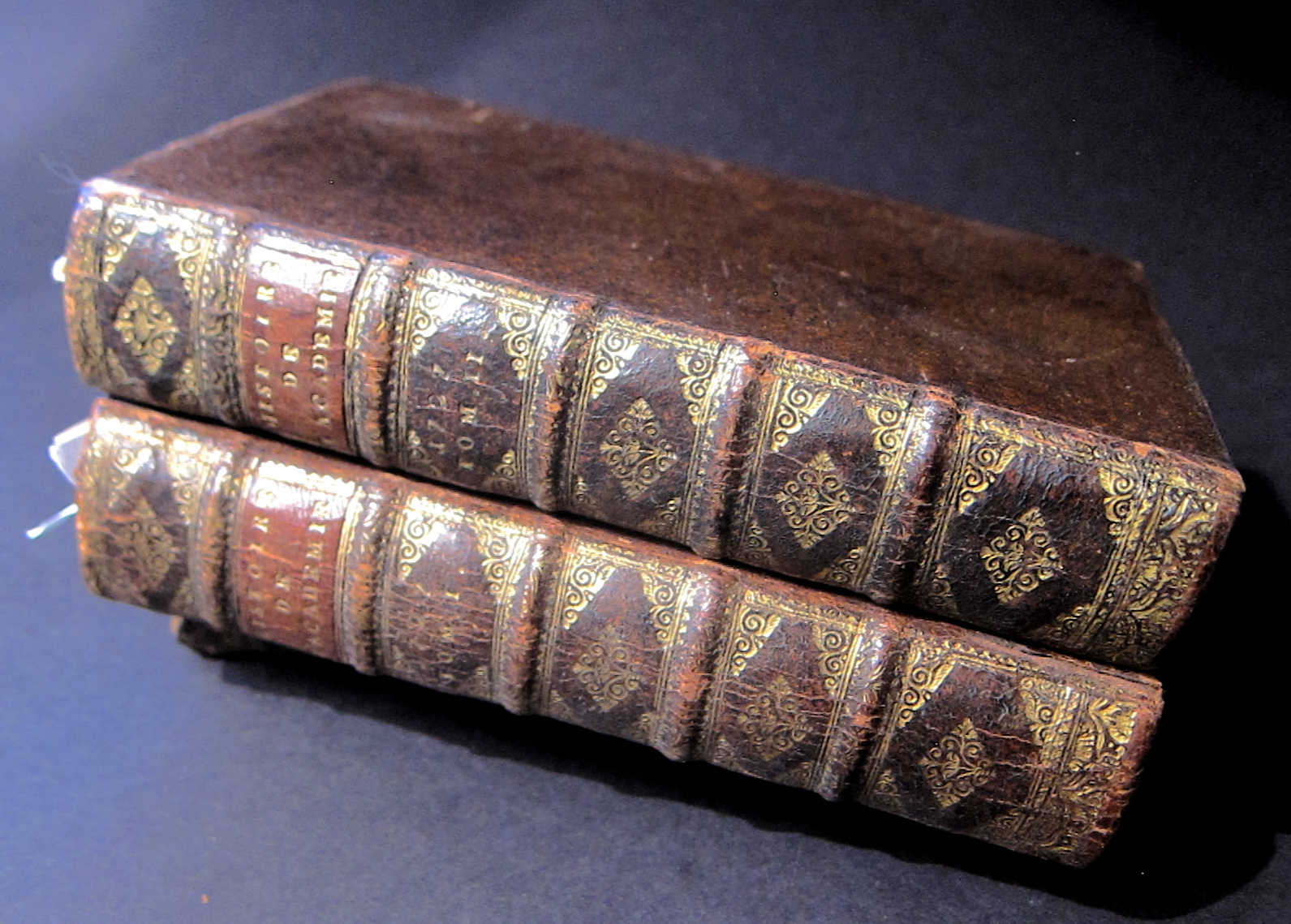
  • Histoire De L Academie Royale Des Sciences Annee M Dccxxii Avec Le Memoires De Mathematique De Physique Pour La Meme Ann

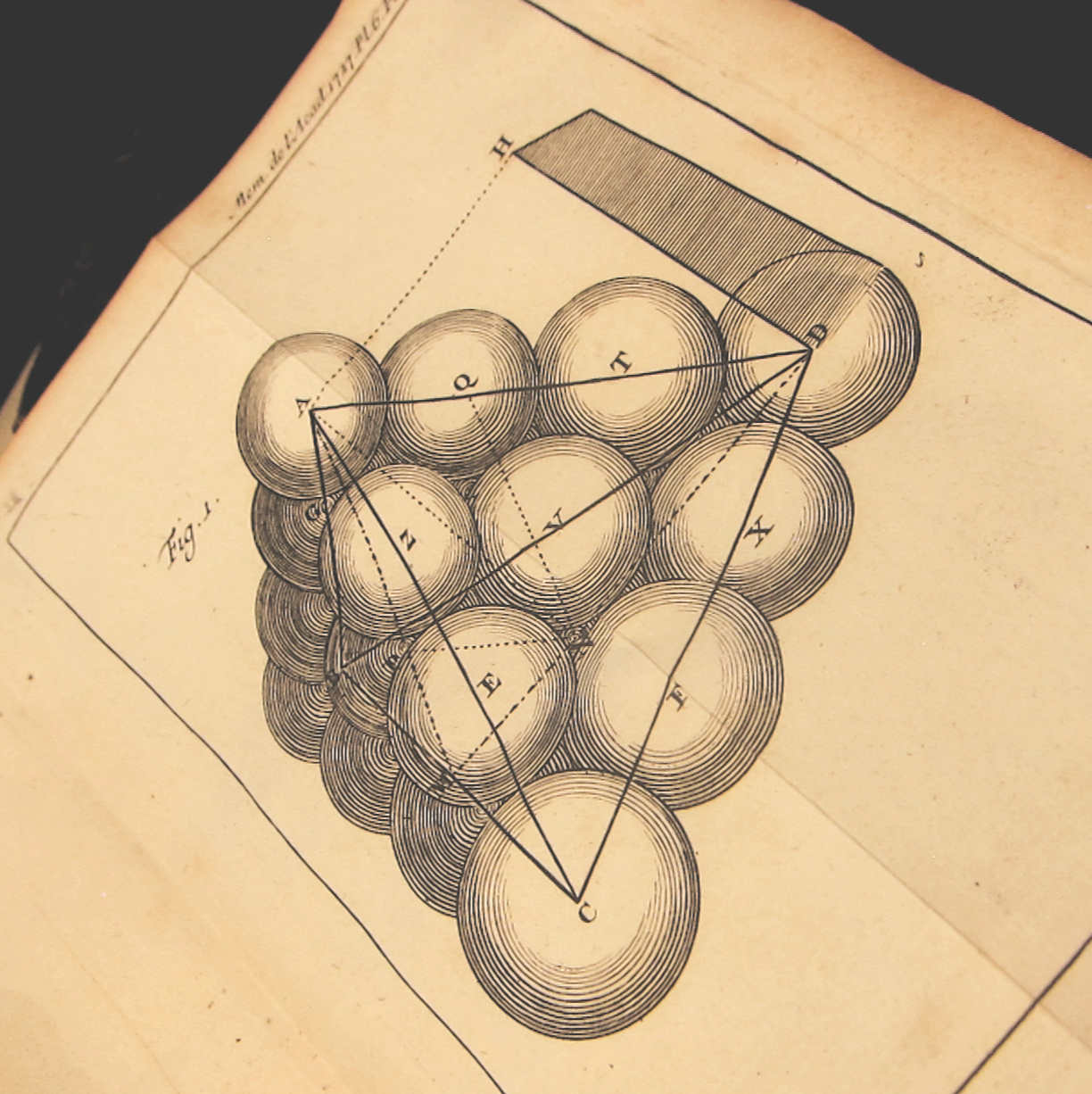
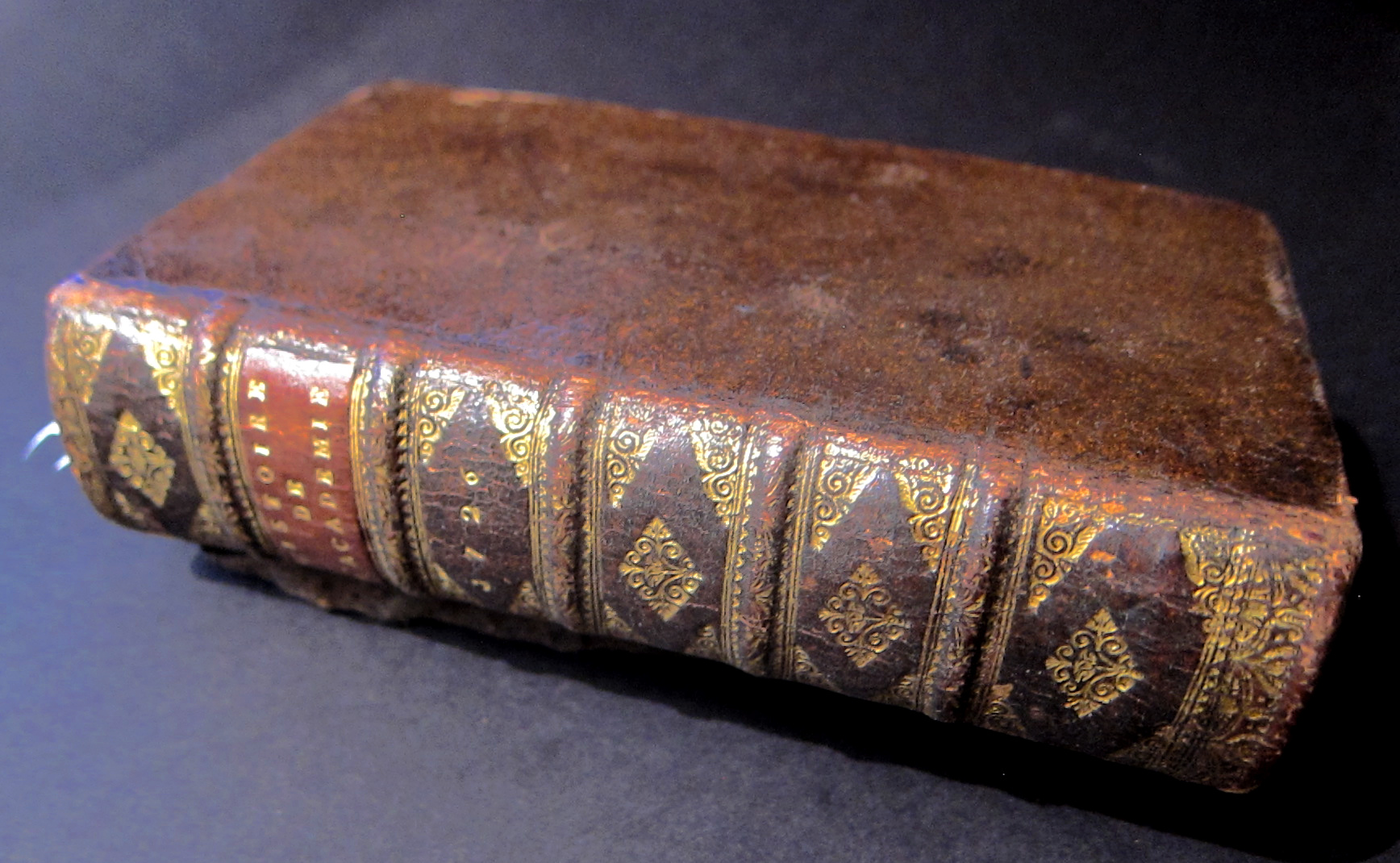
    Histoire de l’ Academie Royale des Sciences. Annee M. DCCXXII. Avec le memoires de mathematique & de physique, pour la meme annee. Tires des registres de cette academie. Printed in Amsterdam by Pierre Coup, 1727, three years after the first French edition (Paris 1724, which is 4to and 439pp compared to this 12mo and 204+526pp). [Histoire de l’ Academie Royale des Sciences] vii, 204pp; [Memoires de mathematique & de physique] 526pp, plus 18 folding engraved plates.
    Lovely copy, bound in full leather, with decorated spine and raised bands. Very Good. $300
    Includes work by Maraldi, Mairan, Cassini, Reamur, Morand, and several others:
    Giacomo Maraldi, “Observations sur differents Meteors de l’Annee 1721, pp 1-7;
    Jean-Jacques Dortous de Mairan (1678-1771,”was a mathematician and an enthusiastic experimenter whose major works were on the formation of ice and on the aurora borealis. However, he was also interested in all the important topics addressed the scientific community in the eighteenth century, among them, the shape of Earth, light, colors, sound, the composition of matter, and vis viva (the debate around the force of moving bodies and the conservation of matter).”–DSB  “Recherches Physico-Mathematiques sur la Reflexion des Corps”, pp 8-68;
    Giovanni Cassini, “Reflexions sur les Observations Astronomiques faites par le P. Feuillee, pp 68-76; 
    Saurin, “Eclaireissement sur une difficulte proposee aux Mathematiciens par M. le Cheavlier de Louville…”, pp 94-129;
    Louvlle, le Chevalier (Jacques d’Allonville, 1671-1732, mathematician and astronomer), “Eclaircissement sur une difficulte de Statitque propossee a l’Academie”, pp 174-194; 
    Morand, “Observations sur des Sacs membraneux pleins d’Hydatides sans nombre, attachés à plusieurs Visceres du bas Ventre, et découverts par l’ouverture d’un Cadavre”, pp 215-224;
    De Lagny, “Traité des progressions arithmetiques de tous les degrés à l’infinii”; 
    Maraldi and Cassini, “Observation de l’Eclipse de Soleil du 8. Decembre 1722. faite en presence du Roy”, pp 453-456; 
    Winslow, “Explication de l’enfoncement apparent d’un grand Clou dans le Cerveau par les narines. Conformation particuliere du Crane d’un Sauvage de l’Amerique Septentrionale. Observations Osteologiques. Avertissement sur un Memoire de 1720″, pp 411-453; 
    Vaillant, “Suite de l’Establissement de nouveaux caracteres de Plantes”, pp 233-293.


    ·Posted by :

    ·in:


  • Fine Scientific Volume from 1726 Including a Lovely Work on the Aurora Borealis

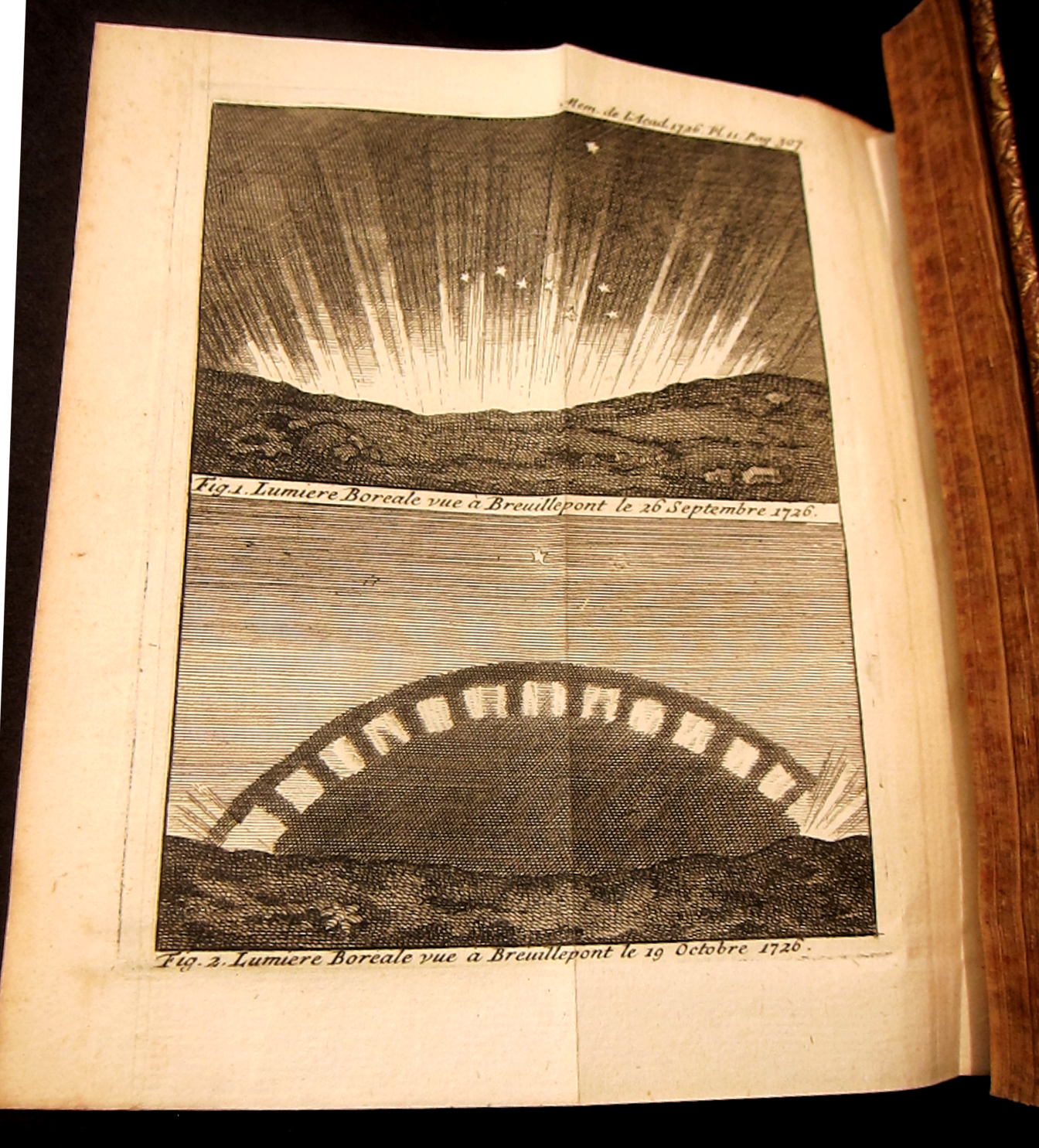
    Histoire de l’ Academie Royale des Sciences. Annee M. DCCXXVI Avec le memoires de mathematique & de physique, pour la meme annee. Tires des registres de cette academie. Printed in Amsterdam by Pierre Mortier, 1732. 6.5”x3.5” and is in two sections: Histoire de l’Academie Royale des Sciences… followed by Memoires de Mathematique et de Physique tirez des registres de l’Academie Royale des Sciences: x,116, 479pp, with 16 folding plates. Very nicely bound in full leather, with decorated six decorated spine panels.  $500

    Mairan, “description de l’Aurore Boreale du 26 Septembre, et de celle du 19 Octobre, observees au Chateau de Breuillepont…”, pp 283-308, with two glorious and (to my mind) famous images of the phenomenon.

    Memoires academie 1726 cover

    ·Posted by :

    ·in:


  • 10,000 Windows Filled with Cigarettes (1937)

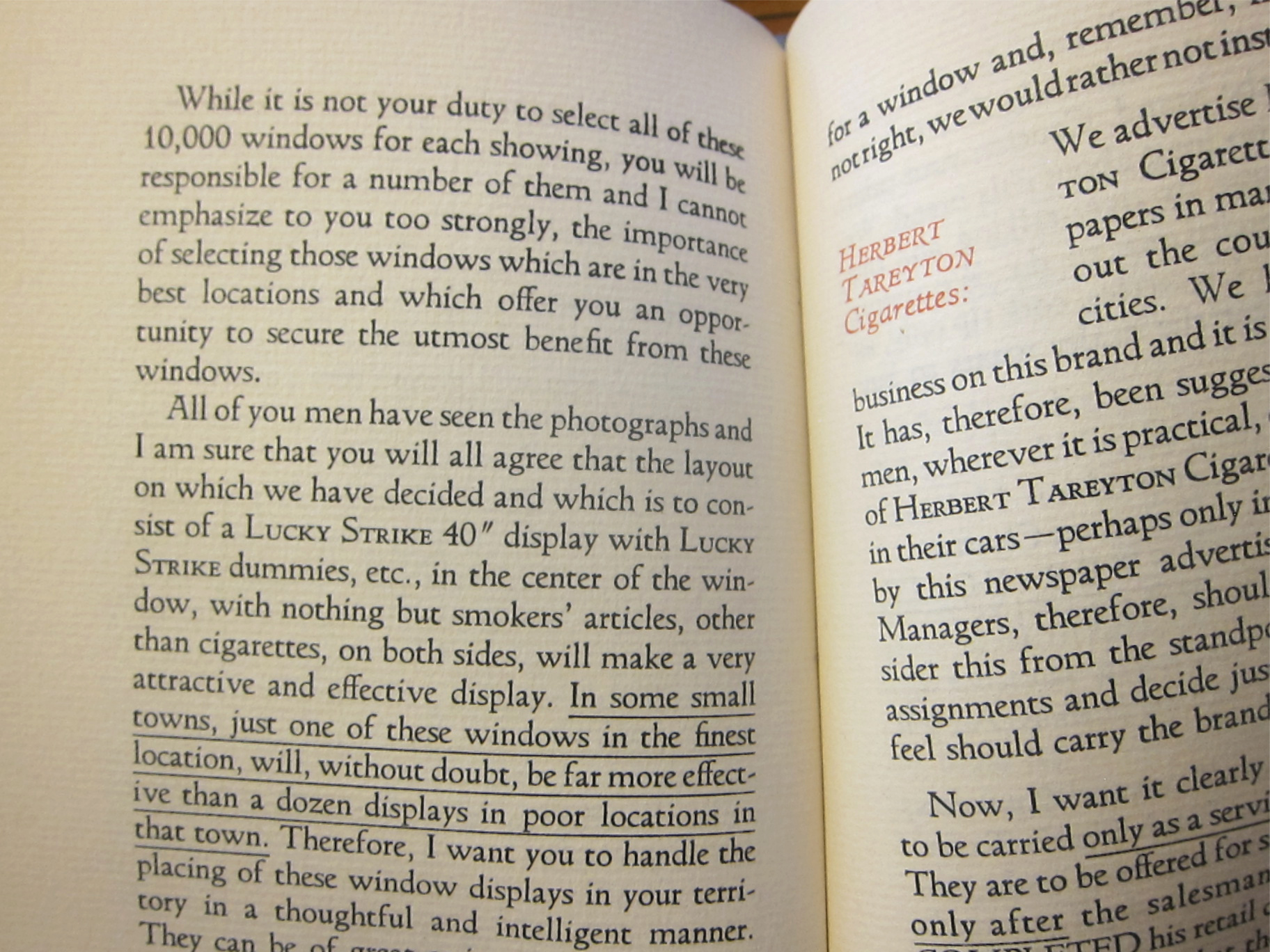
    American tobacco _3_Riggio, Vincent. American Tobacco Company, Sales Organization. Printed by ATC on fine laid paper. 7”x5”, 61pp. Embossed cloth. FINE copy. (Provenance: few scant small internal stamps from the Library of Congress.) I can’t find this in WorldCat/OCLC.  $95

    Riggio (1878-1960) was a classic rags-to-riches story: Sicilian-born, lower East Side, quit school to work, opened barber shop on 117th, etc., and by 1947 was one of the highest paid execs in the country at $484k/yr. (Its hard to translate this wealth, even after fiddling with CPI—at the time though 30 million of the 39 million families in the US Census for 1950 made less than $5k/yr.)

    Anyway Riggio’s book was boosterism and a how-to for sales. The one part that stopped me was the instruction on filling “10,000” windows in high-traffic areas with ciggie displays.  There were 93 cities in the US with 100k or more population in 1930 (105 in 1940, 50 in 1910, and 68 in 1920) so even if the windows concentrated on the big cities that’s 100 big windows (think classic giant window displays busy intersection) per each of the 100 cities. That’s in addition to massive amount of print ads and radio/sporting event sponsorships. (And remember the print ads used movie stars, doctors, lawyers, Santa, sports figures, and so on, plus the combination of the cigarette with the possibility of expressive manhood AND sexual allure.) These folks got their message across, which was too bad. 

    And for the record ATC was founded in 1890 by Buck Duke, and was one of the original 12 companies1 comprising the first index for the Dow Jones averages (1896). ATC was busted2 in 1911 as a monopoly, after which it became a simple oligopoly.

    Notes:

    1. The twelve companies included American Cotton Oil, American Sugar, American Tobacco, Chicago Gas, Distilling & Cattle Feeding, General Electric, Laclede Gas, National Lead, North American, Tennessee Coal & Iron, U.S. Leather preferred, and U.S. Rubber.

    2. United States v. American Tobacco Company, 221 U.S. 106 (1911), “…which held that the combination in this case is one in restraint of trade and an attempt to monopolize the business of tobacco in interstate commerce within the prohibitions of the Sherman Antitrust Act of 1890.”–Wikipedia

    ·Posted by :

    ·in:


  • Rare Work on Physically Addressing Color Blindness (1946)

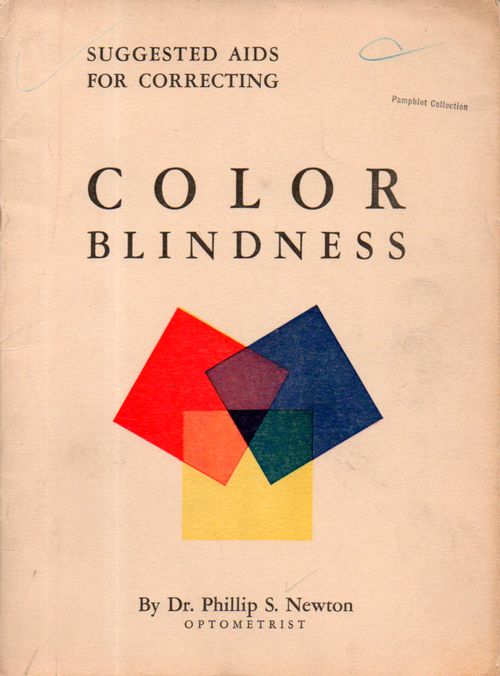
    Newton, Philips S. Suggested Aids for Correcting Color Blindness, self-published in 1946, in Oakland, California.  10.75″ x 8″, 34pp, with numerous illustrations (in color!) Heavy printed wrappers, printed on glossy paper. Provenance: Library of Congress, with their surplus stamp on the rear cover and a small stamp on the front cover. VG copy.  $125

    • Oddly enough, there are no copies of this work located in WorldCat/OCLC. 
    • “For this condition, I will prescribe, for your information, a marvelous cure, the result of my experience in such cases. Take a precious stone we call sapphire. Powder it most thoroughly in a metal mortar and store it in a golden vase. Put a little into the patient’s eye every day and he will soon be cured “– from the Medieval medical text De Oculis, by Benevenutus Grassus, Stanford University Press, 1929, page 58. 

    Admittedly I was more interested in the illustrations in this work1 than the text, mainly (and obviously) because the images are so striking. The text is in its way a pre-scientific attempt at ‘curing” color blindness, which is a genetic disorder.  The color wheels (“variable speed rotary color vision stimulator”) were intended to be rotated to produce different color senses for “color vision stimulation”–it could be used to determine whether or not color vision was being “improved”.

    Most of the work was a sales vehicle for Dr. Newton’s color blindness color regenerators, or whatever, all of which could be obtained from his office in Oakland.  I guess Dr. Newton was trying, but…

    Color blindness _5_

    ·Posted by :

    ·in:


  • Important Supplemental Paper in the Discovery of Morphine–in the Original Wrappers (1817)


    SERTUERNER, Friedrich.  “Ueber eins der fürshterlichen Gifte der Pfalnzenwelt, als ein Nachtrag zu seiner Abhandlung über die Mekonsäure und das Morphium; mit bmerkungen, den aciden Extractivstoff des Opiums und seine Verbindungen betreffend”  In Annalen der Physik, I/57, 1817; pp 183-202. Offered in the full volume of 440pp. Four full numbers (#s 9-12), each with their original front and rear wrapper, thus making this version quite scare. This is the important supplemental paper on morphine to the first paper just months earlier in of January 1817 in the same journal (vol I/55). $450

    On the discovery of morphine:

    “Rational drug discovery from plants started at the beginning of the 19th century, when the German apothecary assistant Friedrich Sertürner succeeded in isolating the analgesic and sleep-inducing agent from opium which he named morphium (morphine) after the Greek god of dreams, Morpheus. He published a comprehensive paper on its isolation, crystallization, crystal structure, and pharmacological properties, which he studied first in stray dogs and then in self-experiments…This triggered the examination of other medicinal herbs, and during the following decades of the 19th century, many bioactive natural products, primarily alkaloids (e.g., quinine, caffeine, nicotine, codeine, atropine, colchicine, cocaine, capsaicin) could be isolated from their natural sources”–Atanas G.Atanasova, et alia, “Discovery and resupply of pharmacologically active plant-derived natural products: A review”, Biotechnology Advances, Volume 33, Issue 8, December 2015, Pages 1582-1614.

    “(Serturner’s) determination now of the alkaline nature of morphine marks an important step in the beginnings of alkaloid chemistry. Its isolation is the first isolation of an alkali with a vegetable origin”–Claire Parkinson, Breakthroughs, p. 264. 

    Ex-libris Deutsche Akademie der Luftfahrtforschung, then Wright Patterson Field Library (USAF), then Library of Congress.  Library markings:  small gilt-stamped “Akademie der Luftfahrtforschung”, page edges stamped “Wright Field LIbrary/Dayton, Ohio” on top and bottom.

    Also in this volume:

    • CHLADNI, Ernst Florens Friedrich . “Ueber Unabhängigkeit der meteorsteinfälle und der Feuerkugeln von Jahres-Tagesseiten, von den Himmelsgegenden, von der geographischen Lage, vom Wetter und bestimmten Perioden” (“…German physicist and musician. His most important work, for which he is sometimes labeled the father of acoustics, included research on vibrating plates and the calculation of the speed of sound for different gases”–Wiki)
    • VOLTA, Alessandro. “Ueber periodische Wiederkehr von gewittern, und über den sehr kalten und ausserordentlich trockenen Wind, den man nach Hagelschauern mehrere Stunden lang bemerkt”, and many others.

    ·Posted by :

    ·in: