A Daily History of Holes, Dots, Lines, Science, History, Math, Physics, Art, the Unintentional Absurd, Architecture, Maps, Data Visualization, Blank and Missing Things, and so on. |1.6 million words, 7500 images, 4.9 million hits| Press & appearances in The Times, Le Figaro, Mensa, The Economist, The Guardian, Discovery News, Slate, Le Monde, Sci American Blogs, Le Pont, and many other places… 5000+ total posts since 2008.

Book Category: Medicine, History of

  • The Discovery of the Anthrax Vaccine (1881, Pasteur)

    Five papers in four issues of the Comptes Rendus / The Discovery of the Anthrax Vaccine

    Louis Pasteur, Charles Chamberland, and Pierre P.E. Roux.

    All from the Comptes Rendus Hebdomadaires des Séances de L’Academie des Sciences, volume 92, 1881, issues 5, 9, 12, and 24. All have been disbound from a larger bound volume, though they are each offered with their original wrappers, which makes them fairly uncommon. The text is in good condition, though it has a common fault of an old fold going through vertically at the middle, no doubt from when some early reader folded it in half and put it in their pocket. Overall, still GOOD copies. The set:  $500
    The issues as follows:

    “Sur la longue durée de la vie des germes charbonneux et sur leur conservation dans les terres cultivées”, no. 5, the paper occupying pp 209-211 in the issue of pp 209-260;

    “De l’atténuation des virus et de leur retour à la virulence”, no. 9, pp 429-435 in pp 429-480;

    “De la possibilité de rendre les moutons réfractaires au charbon par la méthode des inoculations préventives”, no. 12, pp 662-665 WITH “La vaccine du charbon” pp 666-668 in the issue of pp 653-768;

    **“Compte rendu sommaire des experiences faites à Pouilly-le-Fort, près Melun, sur la vaccination charbonneuse”, no. 24, pp 1378-1383 in pp 1365-1476.

    “The famous French microbiologist and chemist, Louis Pasteur, pioneered the use of bacterial vaccines for prevention of infectious diseases in animals and humans. One of his early successes was in the development of a vaccine for the agriculturally important disease anthrax, a vaccine that is still in use today for animals worldwide and humans in some countries. He demonstrated the effectiveness of his vaccines often with dramatic public trials, one of the most famous of which was the spectacle at the small French village of Pouilly-le-Fort in May 1881. This paper…describes the set-up and outcome of this public test of anthrax vaccination. “YALE JOURNAL OF BIOLOGY AND MEDICINE 75 (2002), pp. 59-62. “Originally published in Comptes Rendus… 92:1378-1383, June 13, 1881″.  Yale Journal of Biology and Medicine. CLASSICS OF BIOLOGY AND MEDICINE

    ·Posted by :

    ·in:


  • One of the Earliest Appearances of the Modern Endoscope (1855)

    Desormeaux, Antonin Jean. “De l’endoscope, instrument propre à éclairer certaines cavités intérieures à l’économie”, Comptes Rendus, volume 40, 1855, pp 692-693. This is the weekly issue, removed from a larger bound volume, without the original wrappers. Very Good.  A very early (if not, possibly, the first) published report on Desormeaux’s endoscope. $200

    Also appearing in the issue, on the following page: Raimberg, “Appareil pour l’inhalation de chloroforme, réclamation de priorité sur Mounie”. 40, p. 694.

    “…Desormeaux was a 19th-century French physician and inventor who has been called the “father of endoscopy”, because he made significant improvements to the early endoscope and was the first to successfully use it to operate on a living patient (his device would be called a cystoscope today). He presented his device to the French Academy of Sciences in Paris on July 20, 1853.”–Wikipedia

    “…overall Desormeaux’s work was instrumental in catapulting endoscopy to a greater developmental stage. Though his work was not necessarily the first or most original, Desormeaux was nevertheless able to refine existing endoscopes and adapt better technologies in order to bring to the world one of the most functional endoscopes of his era. Desormeaux’s systematic collection of clear and indisputable clinical data of his experiments  was also a significant contribution, one which no doubt influenced others to conduct similar high quality research…he stood out as one of the most influential leaders, earning acclaim as one of the “fathers” of endoscopy. Desormeaux’s most outstanding accomplishment is that he put operative endoscopy on the map by performing the world’s first successful operative procedures using an endoscope. Desormeaux is also credited with coining the word “l’endoscopie,” a term he introduced, along with his revamped device, to the Academy of Science in Paris on July 20th, 1853.”  –Nazhat, History of Endoscopy, Chapter 8, “Desormeaux”, Laparoscopy Today.

    ·Posted by :

    ·in:


  • On an 1836 Hearing Aid

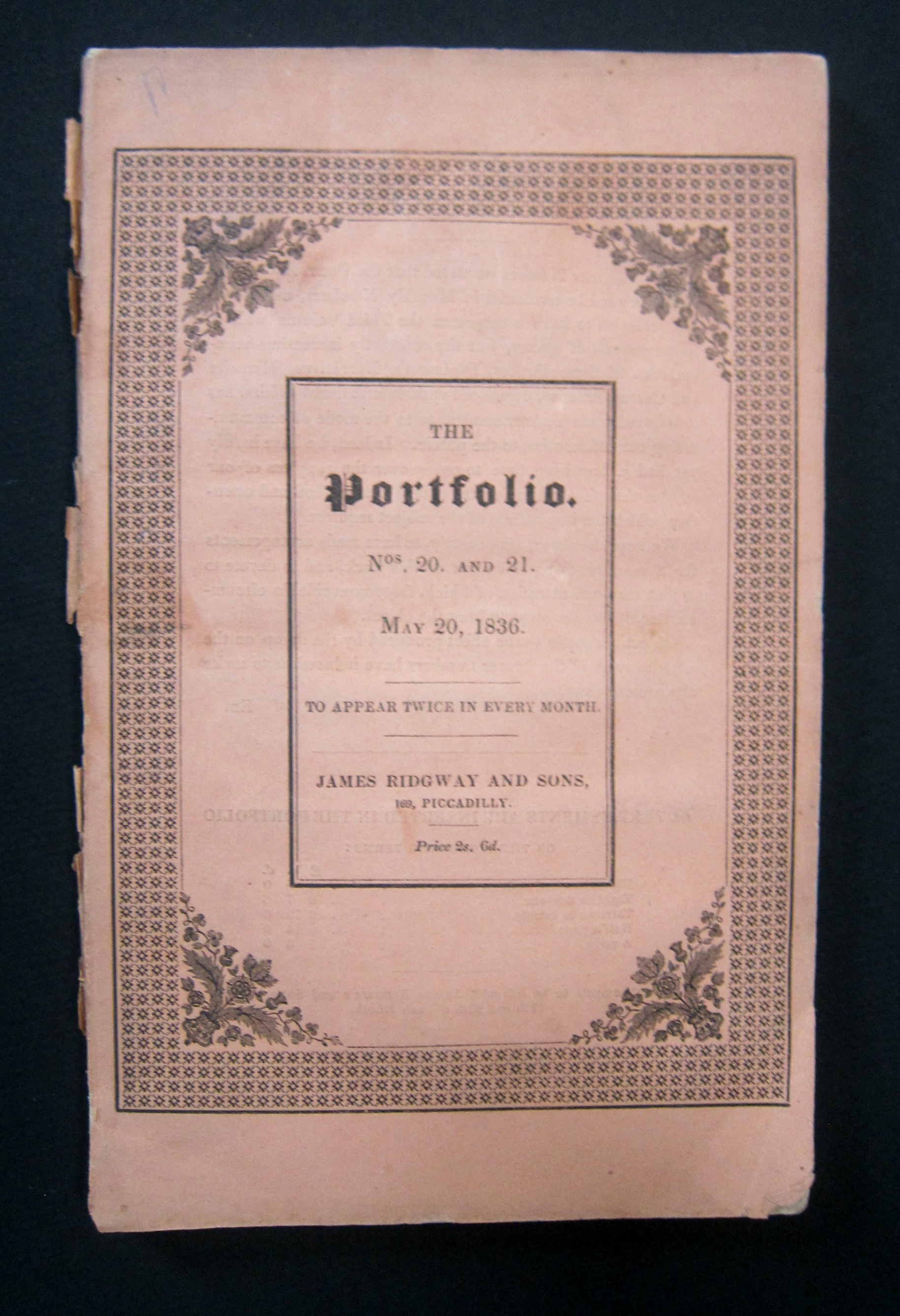
    PortfolioAlphonso William Webster. “The Otaphone,  Patent Invention for Assisting the Hearing.”  This is a tight 4pp “supplement to the uncommon-seen The Portfolio, or a Collection of State Papers…Nos 20 and 21, May 20, 1836. London, James Ridgway and Sons. 9×5″, pp 91-192,8,4,(6),3.   In the original wrappers. The wrappers are in surprisingly nice condition, though there are numerous paper chips out of the spine, and the binding will not take very many openings. Still, a GOOD copy. $75

    This is essentially an extended advertisement, closely written by Webster, who was a specialist practioner in the field of hearing, and who later in 1866 would write a book on the subject, A New and Familiar Treatise on the Structure of the Ear, and on Deafness. The device was a slim silver apparatus that would fit around the ear and extend outward slightly, basically replacing the cupped hand over the ear to help improve hearing. 

    “UK patent #7033, dated 17 March 1836, is the earliest British patent for a hearing aid device, granted to the aurist (19th century term for ear specialist) Alphonso William Webster, for his “curious” invention, the Otaphone (sometimes spelled “Otophone”). In his publication, A New and Familiar Treatise on the Structure of the Ear, and On Deafness (London: published by the author, sold by Simpkin & Marshall, 1836), Webster outlines he was first devised his invention by observing the common practice of cupping the hand to the back of the ear to enhance hearing. He wondered whether the practice could be obtained by “means less troublesome and unsightly”–from the 19th Century Disability website, contributed by Jaipreet Virdi-Dhes

    ·Posted by :

    ·in:


  • Important Very Early Papers and Announcements on Anaesthesia (1847)

    10 papers on Chloroform and Ether in 5 issues of the Comptes Rendus

     Early Works in Patient Comfort 

    “…the discovery that inhalation of various volatile substance caused insensitivity to pain”

    Papers by Flourens,Wells, Pirogov, Jackson, and others. All in the Comptes Rendus, volume 24, 1847, Paris, Gauthier-Villars, issues no. 8, 10, 12, 18, and 22.  

    All four are extracted from a larger bound volume, and so have no spine cover; that said, they do all come with their original wrappers.  Nice copies, at least solid GOOD and probably VERY GOOD.  $750

    (1) Flourens, Marie Jean Pierre (1794-1867). “Notes touchant l’action de l’ether sur les centres nerveux”, No. 10, 8 March 1847 at pp. 340-347, GM 5654

    Flourens here makes an historic obaservation on the life-saving properties of chloroform and ethyl chloride (that is he described the anaesthetic properties of chloroform vapour in non-human animals) —life-saving in that it would allow people to endure surgical procedures that might have otherwise gone badly or not at all due to pain or the promise of it. Flourens was also well known for his neurophysiological and nervous system studies and for his “pioneering efforts in experimental methods in neuroanatomy”.–Fatos Belgin Yildirim and Levent Sarikcioglu, “Marie Jean Pierre Flourens (1794–1867): an extraordinary scientist of his time”, J Neurol Neurosurg Psychiatry. 2007 Aug; 78(8): 852. “Flourens announced that chloroform had an anaesthetic effect analogous to that of ether. Little notice seems to have been taken of his papers, but later in the year Simpson independently demonstrated the value of chloroform ” (Garrison and Morton p. 770)

    Also, in the same issue: 

    (1a) [Wells, Horace] “Reclamation de priorite relative a l’emploi de l’ether admionistre par les voies de la respiration, pour suspendre la sesnsibilite chez les individus destines a subir des operations chirurgical, [Extrait d’une lettre de M. Wells, chirurgien dentiste a Hartford…” pp 372-374 (including a response from Beaumont). Wells was “an American dentist who pioneered the use of anesthesia in dentistry…”–Wikipedia]

    [A letter was sent to the French] ”…Academy to pass judgment upon his claim to priority in the discovery that inhalation of various volatile substances caused insensibility to pain. The letter to the Academie des Sciences was published in their Comptes Rendus for 8 March 1847 (PP- 372 -373)’ and the discussion that followed its presentation £lie de Beaumont reiterated Jackson’s claims…” –John F. Fulton and Madeline Earl Stanton, The centennial of surgical anesthesia; an annotated catalogue of books and pamphlets bearing on the early history of surgical anesthesia, 1946 . [Full text located at Archive dot org!]

    (2) Flourens, Marie Jean Pierre. “Note touchant les effets de l’inhalation de l’ether sur la moelle”, no. 8, 22 February 1847, pp 253-259;

    (3) Flourens, Marie Jean Pierre. “Note touchant l’action de l’ether dans les arteres”, 22 March 1847, no.12, pp 482-485; ALSO BOUND WITH

    (3a) [Charles T. Jackson] “Extrait d’une lettre de M. le docteur Charles T. Jackson a M. Elie de Beaumont (Commission de l’ether)”, pp 492-494; AND BOUND WITH

    (3b) “Expériences tendant a prouver que la cessation de l’hématose pulmonaire est la cause de l’insensibilitè qui suit les inspirations d’éther en vapeur; par MM. Preisser, Pillore et Melays, de Rouen”, pp 490-491; AND BOUND WITH

    (3c) “Comparaison des effets produits par l’inhalation des vapeurs éthérées et de l’acide carbonique; par M. Hossard, d’Angers”, pp 491-2; AND BOUND WITH

    (3d) “Recherches concernant la structure des nerfs qui ont perdu leur fonctions sous l’influence de l’éther”, pp 496-7;

    (4)  Flourens, Marie Jean Pierre. “Note touchant l’action de diverses substances injectees dans les arteres”, 31 May 1847, no 22, pp 905-909.

    “Charles T. Jackson’s letter ‘Antidote to physical suffering’ in Daily Advertiser, Boston 1. March 1847 was sent to the French Academy with a covering letter dated 28 February 1847 in which Jackson’s claims are reiterated. The text of this February letter to the Academy was issued in part in Comptes Rendus for 22 March (pp.492-494). A more popular account was published at Paris in Galignani’s Messenger for 17 February 1847 (reprinted in English in the Boston Atlas for 2 April 1847, columns 2 and 3 of page 2).–John F. Fulton and Madeline Earl Stanton. These are the only references to the Comptes Rendus that I can find in this work.

    (5) Pirogoff/Pirogov, Nicolai (1810-81). “Nouveau procédé pour produire, au moyen de la vapeur, d’éther, l’insensibilité chez les individus soumis ŕ des opérations chirurgicales”, No. 18, p 789.  Another pioneer of anaesthesia, and one of the first to employ the use of ether in a military situation.  
    ·Posted by :

    ·in:


  • Medicated Air Cure for Weak and Diseased Lungs (1893)

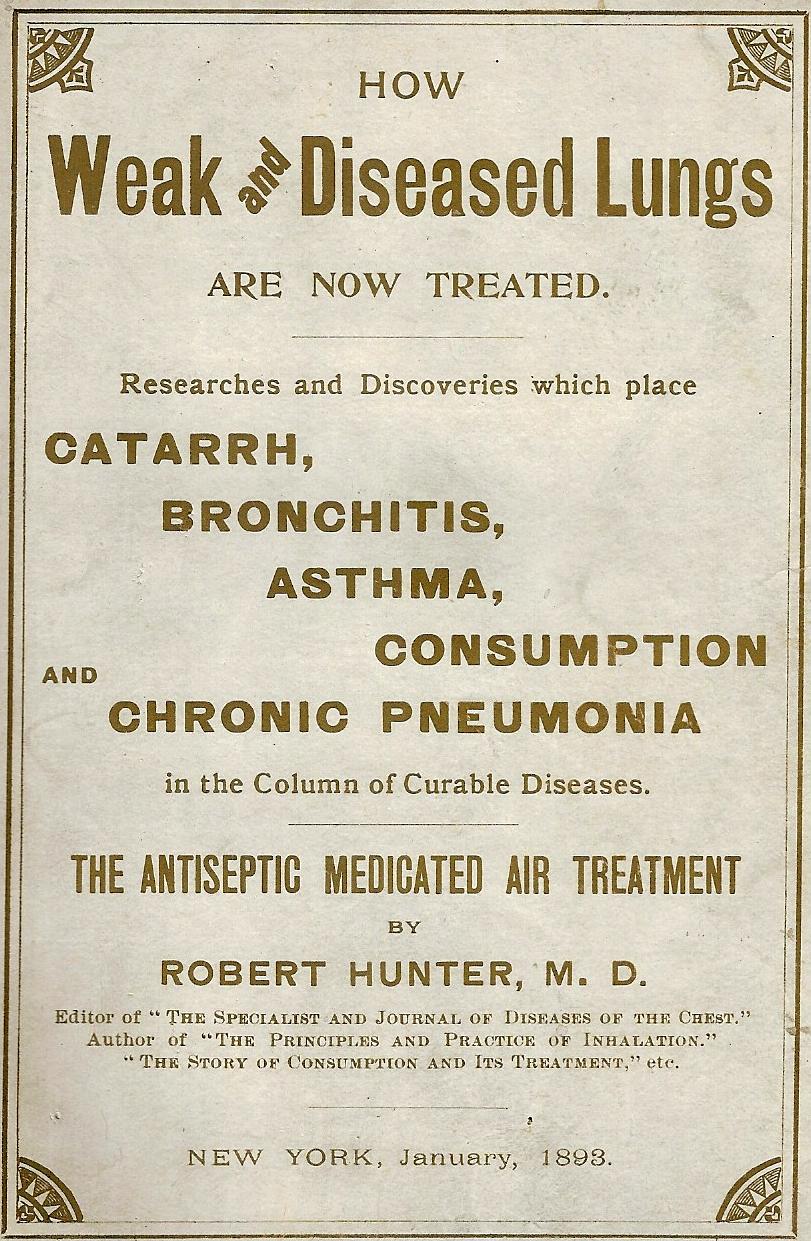
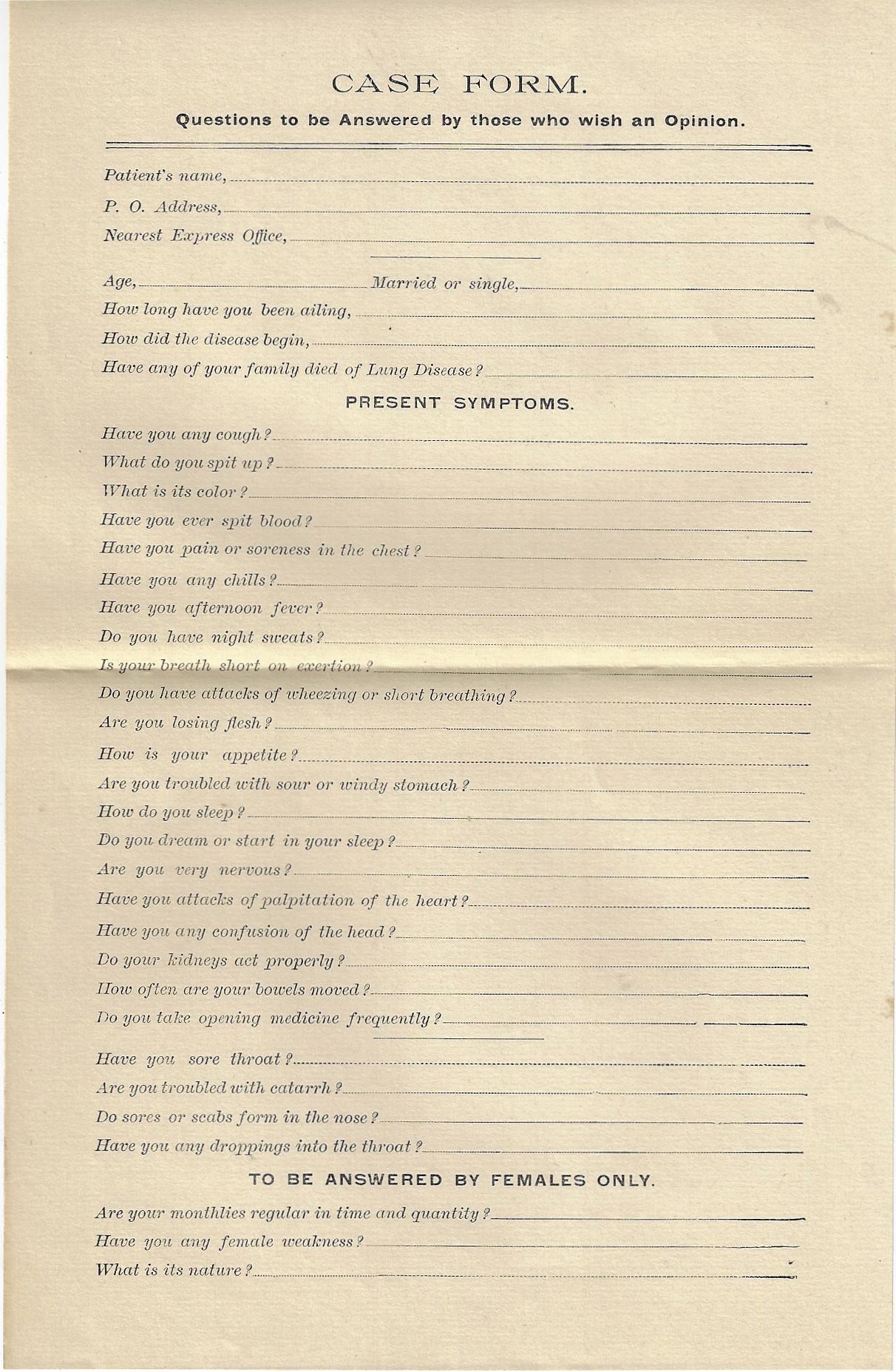
    Robert Hunter, M.D.  How Weak and Diseased Lungs are Now Treated. Researches and Discoveries which place Catarrh, Bronchitis, Asthma, Comsumption, and Chronic Pneumonia in the Column of Curable Diseases. The Antiseptic Medicated Air Treatment. New York, 1893. 7×5″, 32pp, with a 10″x6″ folded questionnaire.  Original wrappers. Very Good condition.  $95

    Hunter lungs_0002


    Hunter lungs form

    ·Posted by :

    ·in:


  • A Major Step in Insuring the “Health” of Wine: Pasteur, 1863 & 1864

    Louis Pasteur, “Études sur les vins. Première partie: De l’influence de l’oxygene de l’air dans la vinification.” Comptes Rendus …, Paris, 1863, volume 57, no 23, pp 936-942 in the issue of pp 925-964; offered with:

    ____. “Deuxiéme partie: Des altérations spontanées ou maladies des vins, particulièrement dans le Jura”, Comptes Rendus, Paris, 1864, volume 58, no. 3, pp, the paper on pp 142-150 in the issue of pp 141- 180

    Both extracts from larger bound volumes of the Comptes Rendus. Good, solid copies. $300

    These are the first two publications on Pasteur’s practical studies on wine(s) that would culminate in 1866 in the publication of his Etudes sur la Vin (dedicated to Napoleon III) a result of his work from 1856 on the fermentation and spontaneous generation and the study on vinegar and wine. For this work in the ready application of his findings he was awarded the 1866 Gold Medal of the Comite Central Agricole de Sologne.

    • “Studies on Wine. In December 1863 Pasteur published the first of the papers that culminated in his Études sur le vin … In that first paper, dealing with the role of atmospheric oxygen in vinification, he sought to establish that the aging of wine resulted from the slow penetration of atmospheric oxygen through the porous wook casks into which new wine was decanted. By virtue of this slow oxidation, he claimed, new wine grows less harsh and acid to the taste as it becomes clearer and lighter from the to the taste as it becomes clearer and lighter from the precipation of dark coloring matters.
    • “In his second paper  Pasteur examined the “alterations” or “diseases of wine, especially wine from the Jura, his native department. Reviewing the familiar disease of “turned,” “acid” “ropy” or “oily “ wine, he associated each with a microscopic organism. He summarized the results of his first two papers by nothing that “wine, which is proudced by a cellular vegetation acting as a ferment [namely, yeast], is altered only by the influence of other vegetations of the same order; and once removed from the effects of their parasitism, it is made or matured principally by the action of atmospheric oxygen penetrating slowly through the staves of the casks.”
    • “Since the diseases of wine are due to the development of foreign orgnaisms, which are present before the wine becomes sensibly “sick” and the germs of which are bottled with the wine, the crucial task was to find a way of killing these germs without damaging the taste or other qualities of wine. On 1 May 1865 Pasteur told the Académie des Sciences that his attempts to cure diseased wines with chemical antiseptics had been less than satisfying, but that he had found a perfectly reliable and practical procedure for preserving healthy wine: by heating it in closed vessels for an hour or two at a temperature between 60° and 100° C. As a result of small-scale preliminary trials, Pasteurprogressively lowered the temperature to between 50° and 60° C. Within this range, he claimed, wine could be perfectly protected from disease at minimum risk to its taste, bouquet, and color.”—“Pasteur, Louis.” Complete Dictionary of Scientific Biography, vol. 10, Charles Scribner’s Sons, 2008, p 366.

    ·Posted by :

    ·in:


  • Classic Papers by Louis Pasteur (1880)

    Foundation Paper in the History of Immunology

    PASTEUR,  Louis “Sur la maladies virulentes, et en particulier sur la maladie appelée choléra des poules.” offered with “Sur le choléra des poules; etudes des conditions de la non-récidive de la maladie et de quelques autres de ses caractères”, 9 February1880 and 26 April 1880. In Comptes Rendus Hebdomadaires des Séances de L’Academie des Sciences, Paris, Gauthier-Villars, 1880, volume 90, number 6 and number 17, pp.239-248 in the issue of pp 233-260 and pp 952-958 in the issue of pp 937-1020 The two papers are offered here, disbound from a larger bound volume but accompanied by their original front wrapper (though without the spine cover); nice, fresh, crisp copies. $600/for the two papers.

    Garrison & Morton No 2537, Parkinson Breakthroughs

    PASTEUR, Louis.  “De l’extension de la théorie des germes à l’étiologie de quelques maladies communes” in Comptes Rendus Hebdomadaires des Séances de L’Academie des Sciences , 1880, volume 90, No 18, the article occupying pp. 1033-1044 in the issue of 1021-1092. Offered in the original issue, removed from a larger bound volume. A nice, crisp issue. $175

    This is the first appearance of a significant, foundational paper [“On the extension of the germ theory to the etiology of certain common diseases”] in the history of immunology.

    From the Pasteur paper:

    • “It seems to me that IMMEDIATELY AFTER CONFINEMENT the application of antiseptics should be begun. Carbolic acid can render great service, but there is another antiseptic, the use of which I am strongly inclined to advise…”
    • “Was I justified in calling this communication “ON THE EXTENSION OF THE GERM THEORY TO THE ETIOLOGY OF CERTAIN COMMON DISEASES?” I have detailed the facts as they have appeared to me and I have mentioned interpretations of them: but I do not conceal from myself that, in medical territory, it is difficult to support one’s self wholly on subjective foundations. I do not forget that Medicine and Veterinary practice are foreign to me. I desire judgment and criticism upon all my contributions. Little tolerant of frivolous or prejudiced contradiction, contemptuous of that ignorant criticism which doubts on principle, I welcome with open arms the militant attack which has a method in doubting and whose rule of conduct has the motto ‘More light.’” -­Translated by H. C. Ernst, M. D. , University of Adelaide


    ·Posted by :

    ·in:


  • The First Record of the Electrical Activity of the Spontaneously Beating Heart (1876)

    Marey Etienne J. 3 foundation papers in the history of cardiology and the electrocardiogram, all from the same volume of the Comptes Rendus Hebdomadaires des Seances de l’Acadamie des sciences volume 82, 1876. All offered in their original weekly issues, removed from the larger bound volume.  Nice, crisp copies. The 3 issues: $400

    These issue include:

    (1) “Des Mouvements que produit le couer lorsqu’il est soumis a des excitations artificielles” in Comptes Rendus… vol 82 no. 7 pp 408-411 in the issue of pp 397-428.

    => In this same issue is bound:  Dmitri Mendeleeff, “Des ecarts dans les lois relatives aux gaz”, same issue, pp 412-415. This is one of the first papers written by Mendeleeff in the area of aerodynamics.

    It is fun to note that Marey and Mendeleeff are found on the same page of the index and just happen to appear one after the other in the 1550pp volume!

    On Marey:

    • “Marey (a superb instrumentalist and experimenter and physician who will in a few years make pioneering breakthroughs in the study of locomotion and become a founder of cinematography) was the first to record the electrical activity of the spontaneously beating (tortoise) heart”, a premier breakthrough in the long line of the history of this graphical presentation, leading to Willem Einthoven (1860 – 1927) who invented and published on the first practical electrocardiogram in 1902, and who began transmitting electrocardiograms from hospital to his laboratory in 1905, for which he received the Nobel Prize.
    • “Marey uses the electrometer to record the electrical activity of an exposed [frog’s] heart.”–“A (not so) brief history of electrocardiography”
    • “Discovery of the waveform of the cardiac signal is due to Marey in France in 1876. With the assistance of Lippmann, a physicist, Marey was the first to record the electrical activity of the spontaneously beating tortoise heart, for which they devised the capillary electrometer that consisted of a mercury–sulfuric acid interface in a capillary tube. A current traversing this interface altered the charge distribution and, therefore, the contour of the meniscus. Continuous photography of the change in the meniscus provided an analog record of the cardiac voltage.”–in Cardiovascular Engineering: An International Journal, Vol. 2, No. 2, June 2002, “The First Electronic Electrocardiograph”, by Geddes and Roeder.

    AND WITH:

    (2) “Des variations electriques des muscles et du couer en particulier etudies au moyen de l’electrometre de M Lippman”, in Comptes Rendus, 1876, volume 82, pp 975-977. The full weekly issue extracted from a larger bound volume. The Lippmann reference in the title is to the French physicist Gabriel Lippmann who in 1872 invented a capillary electrometer which Marey employed. “It is a thin glass tube with a column of mercury beneath sulphuric acid. The mercury meniscus moves with varying electrical potential and is observed through a microscope.” 

    AND WITH:

    (3) “Le Couer eprouve, a chaque phase de sea revolution, des changements de temperature qui modifient son excitabilite”, Comptes Rendus, vol 82, pp 499-501, with EKG illustration. 28 February 1876, vol 82 no. 9, in the issue of pp 469-528. 

    ·Posted by :

    ·in:


  • Gilbreth on Making U.S. Hospitals More Efficient: “the entire structure upon which hospital management is built is wrong” (1914)

    Three rare papers by Frank Gilbreth and (the second) Gilbreth and his wife, Lillian .M. Gilbreth (Ph.D.). The three papers: $800

    First paper:

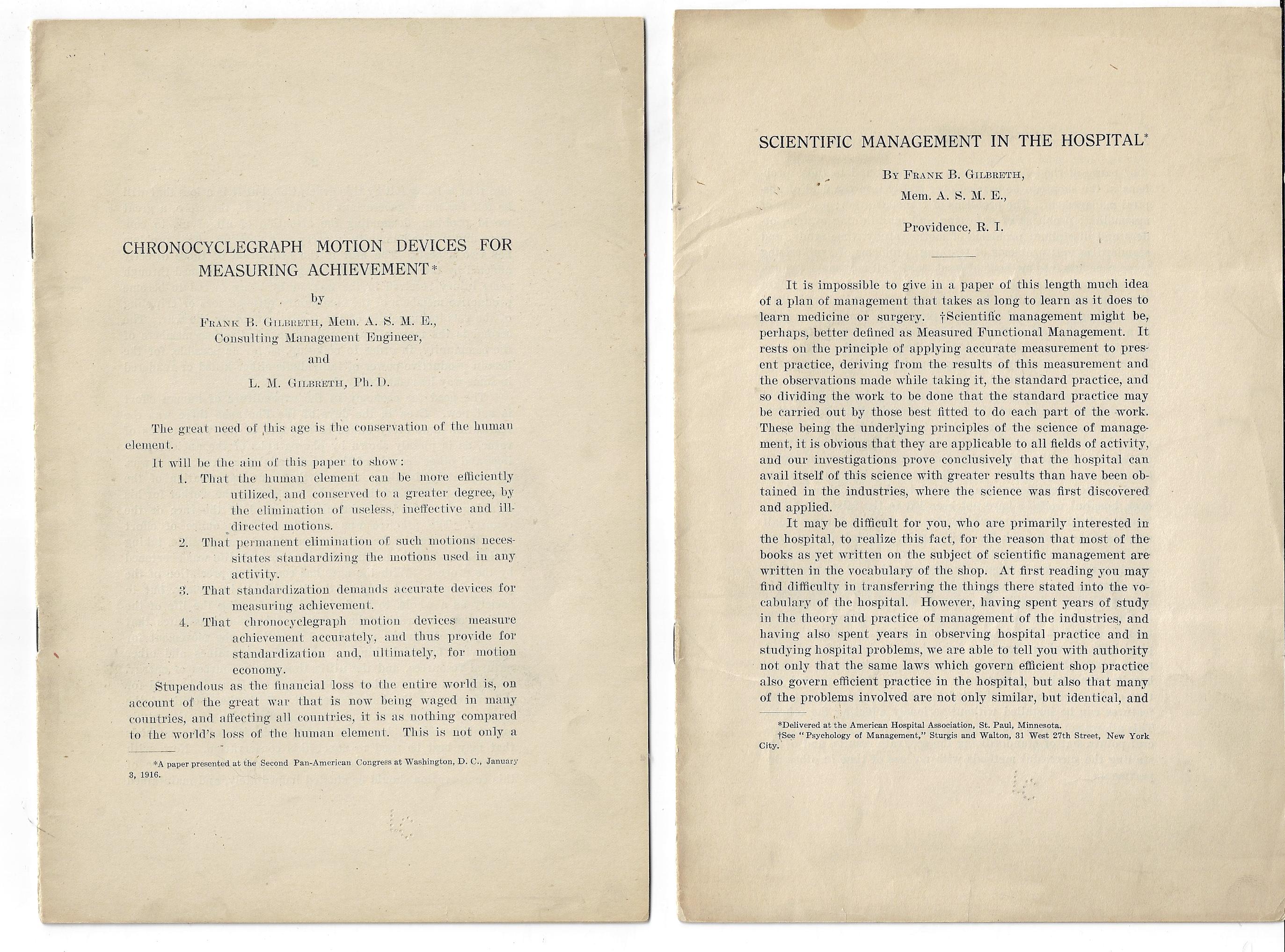
    Frank B. Gilbreth, “Scientific management in the hospital.” (“Delivered at the American Hospital Association, St. Paul, Minnesota”). 1914  (Scott Goodwin, in Mapping the Path to 21st Century Healthcare: The Ten Transitions Workbook, notes this paper as being published in 1914),  9.75 x 6.5″ , 10pp, paginated (1)-10. Original self-wrappers , with no “cover” per se. Condition:  There are two very old horizontal folds in the pamphlet, the indentation from which are almost indiscernible. Provenance: Library of Congress, with their 6mm “LC” perforated stamp on the front page, and the LC surplus/duplicate rubber stamp on the rear page. here is also a very faint and small rubber stamp on the bottom of page 2 stipulating “Gift/Author/[illegible]/191(6?)   There is no indication as to who published this paper, though I suspect it was by the Transactions of the American Hospital Association, vol. 16, for their Sixteenth Annual Conference, and printed on pp 483-492. This offprint version is mostly the same as the version that would be printed in the journal, except that the journal version has an organizational chart, and this paper does not. Overall, near-Very Good.  Scarce. 

    Gilbreth paper

    Frank Gilbreth was a pioneer in scientific management–some think of him (and later, Gilbreth and his wife) along similar lines as F.W. Taylor, though the major difference that I can see is that Taylor would measure efficiency differently, using his methods to make the worker more effective by controlling his action; Gilbreth looked more at the methods and materials, and tried to achieve more or less the same results in efficiency though in a more worker-friendly attitude. 

    In this paper, Gilbreth makes a very very wide statement on how U.S. hospitals could benefit from his motion and materials analysis. His assertion was sort of remarkable, made in the closing sentences of the paper: 

    “Scientific Management will cause elimination not only of waste of materials, but of waste of human effort, which is, in the final analysis, the most pitiful waste of all.
    When your management becomes a science, there will result greater efficiency in you as individuals, and in the great work of the hospitals to which you all devote your lives.”

    “We have been very fortunate in obtaining the attention and interest of such well-known leaders as your President, Dr. Howell, and some of the other leading surgeons of this and other countries; but we have not, as yet, been able to obtain any action to amount to anything, because of the fact that the entire structure upon which hospital management is built is wrong. As the incentive, so will the result be, sooner or later. The incentive necessary to adopt the best from the industries does not exist at present.”

    Also from the Gilbreth paper:

    • ‘There are several concessions you must make at the outset before you can expect to do any valuable work in introducing the science of management into the hospitals. The first is you must submit to having accurate measurement applied to your present methods and practices. The second concession that must be made is the willingness to allow a man not trained in surgery to apply the measurement and determine the resulting standard. We can show you pictures which illustrate plainly the fact that standardization such as used under scientific management is today practically unknown…especially in the operating room.”
    • ‘When your management becomes a science there will result greater efficiency in you as individuals and in the great work of the hospitals to which you devote your lives’’.

    “The Gilbreths’ primary focus was on work performance and worker satisfaction. They conducted pioneering research in the fields of time and motion study. This covered the livelong search for ‘‘The One Best Way’’ in organising and executing work flows and processes…”  See: Frank and Lillian Gilbreth: scientific management in the operating room A Baumgart,1 D Neuhauser2 http://citeseerx.ist.psu.edu/viewdoc/download?doi=10.1.1.1023.2409&rep=rep1&type=pdf

    Second Paper:

    Frank B. Gilbreth and L.M. Gilbreth, “Chronocyclegraph Motion devices for Measuring Achievement” (“A Paper presented at the Second Pan-American Congress at Washington, D.C.m January 3, 1916″). 9.75 x 6.5”, 14pp.  Original self wraps (as above). This paper was written with Gilbreth’s wife, Lillian, who had just been awarded a doctorate in psychology and who was also one of the first women to practice in the U.S. with a doctorate in that field.) Condition:  There are two very old horizontal folds in the pamphlet, the indentation from which are almost indiscernible. Provenance: Library of Congress, with their 6mm “LC” perforated stamp on the front page, and the LC surplus/duplicate rubber stamp on the rear page. here is also a very faint and small rubber stamp on the bottom of page 2 stipulating “Gift/Author/[illegible]/1916”. 

    • “In the early 20th century, efficiency expert Frank Gilbreth used still and motion-picture cameras in place of a stopwatch to try to improve the efficiency, and thereby the effectiveness, of surgery.
    • “ One of its key figures was the industrial efficiency expert Frank Gilbreth (who) employed still and motion-picture cameras in his measurements, and he expanded his visual efficiency services — dubbed “motion study” — from industrial settings to the medical profession in the early 1910s. When he gained access to hospitals, Gilbreth transformed their operating rooms into efficiency laboratories, covering all available surfaces with gridded lines, and requiring the masked surgeons and nurses to don numbered or lettered caps to aid in his analysis of their movements across the axes of the surgical space…”
    • “Surgeons saw in motion-based efficiency study the potential to reduce, through faster operating procedures, their patients’ exposure to what was at the time a leading cause of patient deaths: ether. Furthermore, they found in the process both the challenge and assurance that the outcome of a surgical intervention lay quite literally in their hands. Improving the efficiency and precision of the surgeon was as important as ensuring the quality of the tools he held.”
    • Quotes from: Gainty, Caitjan, “Mr. Gilbreth’s Motion Pictures — The Evolution of Medical Efficiency”.The New England Journal of Medicine; Boston Vol. 374, Iss. 2,  (Jan 14, 2016): 109-111. 

    Third paper:

    Frank Gilbreth and Lillian Moller Gilbreth, “Motion Study and Time Study Instruments of Precision”. 9×6″, with 11 illustrations of the equipment and film samples. Printed 1915. Provenance: Library of Congress, with their 6mm “LC” perforated stamp on the front page, and the LC surplus/duplicate rubber stamp on the rear page. here is also a very faint and small rubber stamp on the bottom of page 2 stipulating “Gift/Author/[illegible]/1916”. 

    ·Posted by :

    ·in:


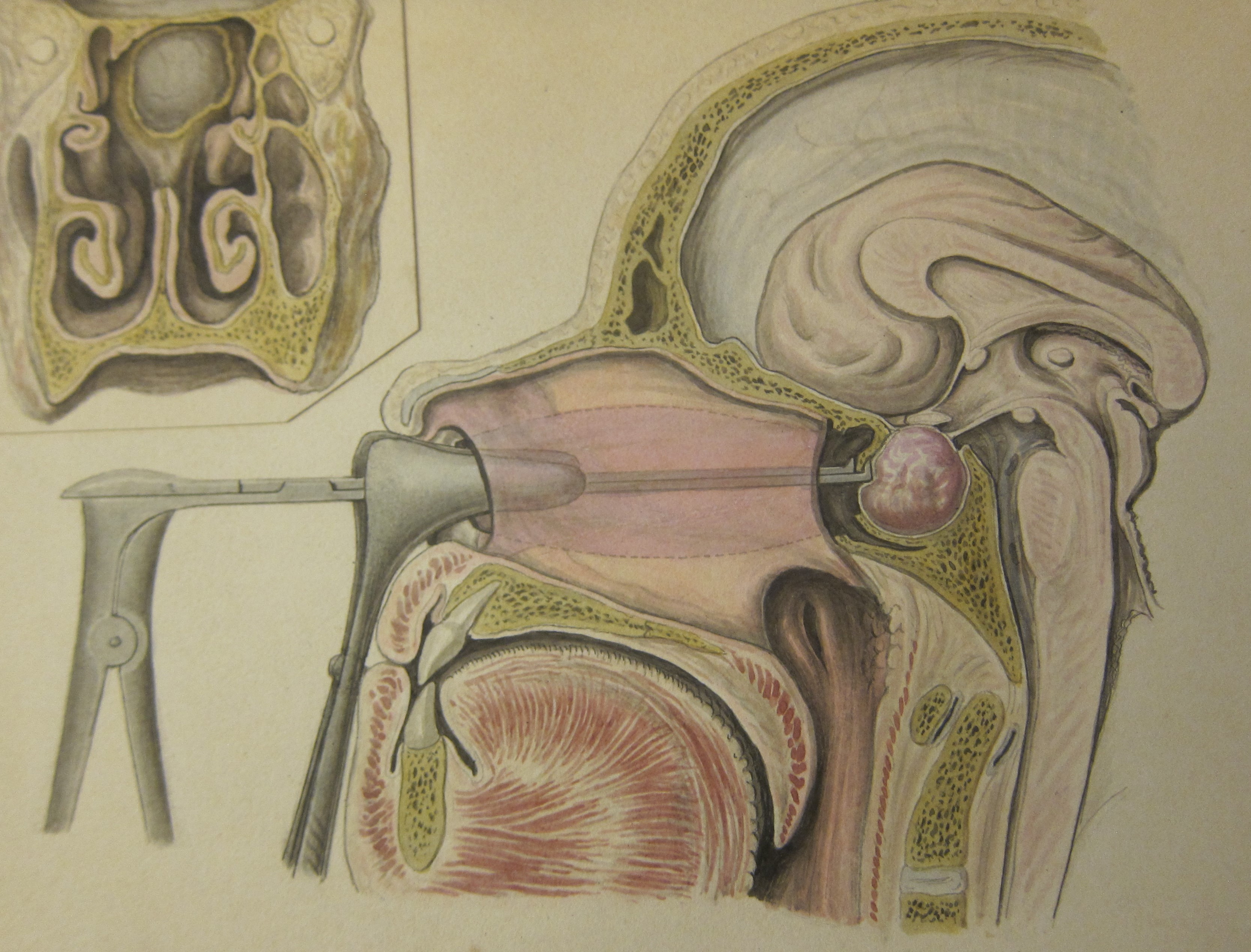
  • Pen and Ink Drawings Showing the Progress of Pituitary Tumor Surgery, 1930

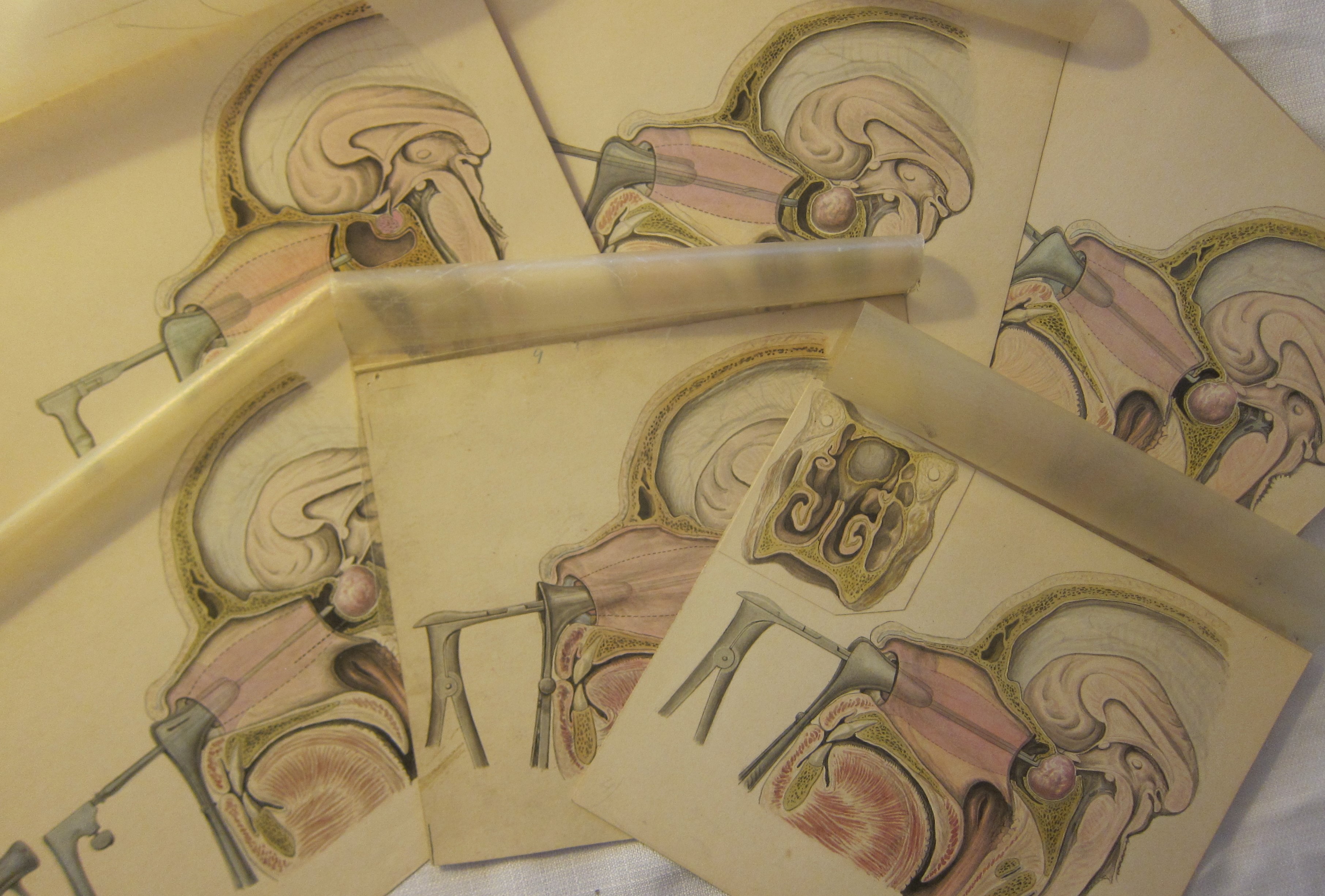
    [Bruno Keilitz and Oscar Hirsch]  12 fine pen and ink images by the prolific anatomical/medical illustrator Bruno Keilitz (b. 1898)  showing the stages of the removal of a pituitary tumor. The illustrations seem to have been for an article written by Dr. Prof. Oscar Hirsch (1877-1965), who was an early and influential Viennese rhinologist who made major contributions to pituitary surgery, performing this transspheroidal procedure for Harvey Cushing in 1911, and who would go on to perform the procedure more than 500 times in his long career.1

    Pituitary _1_

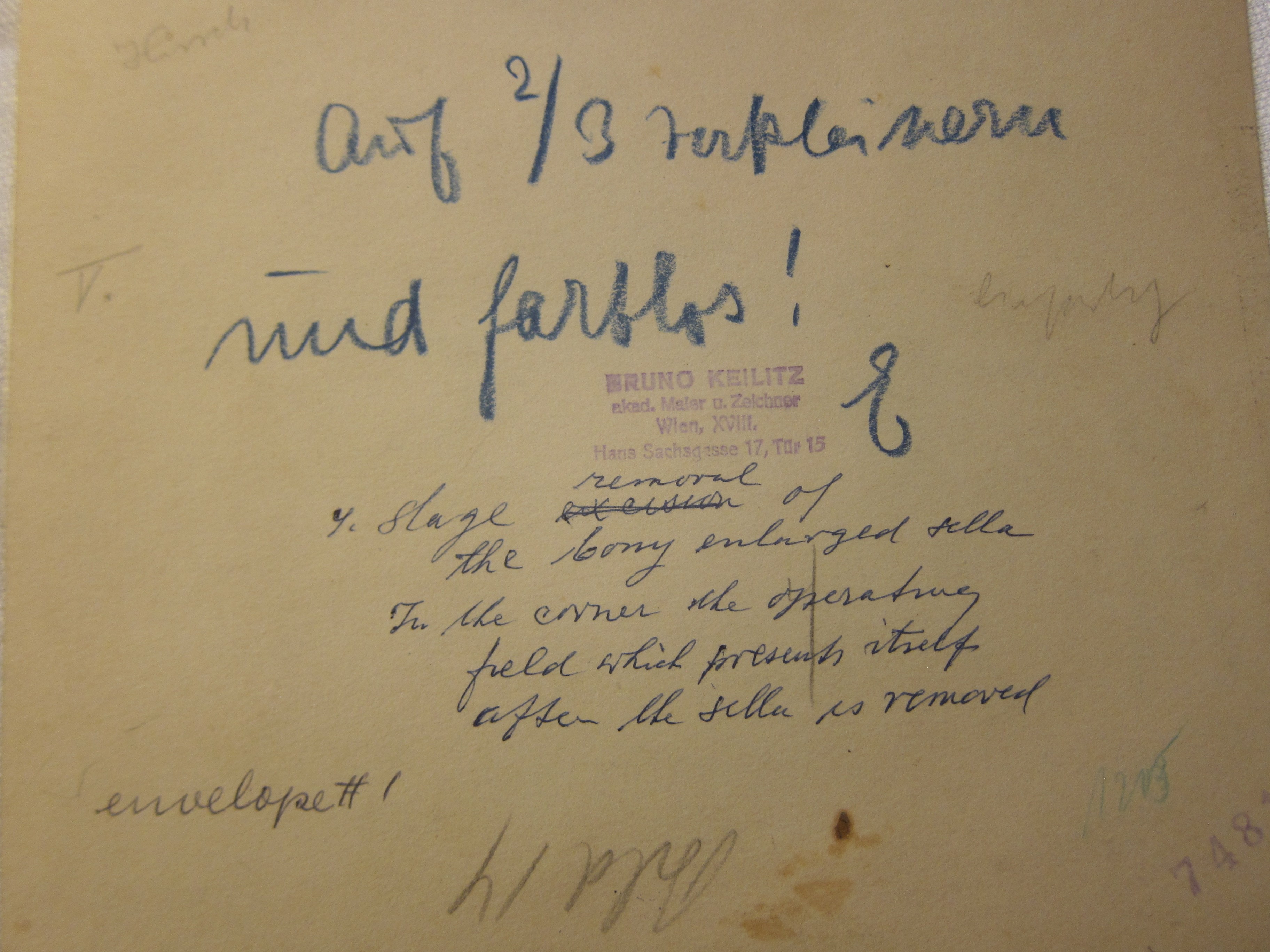
    • Of the 12 drawings, 9 are very closely related and show the progress and route of a transsphenoidal surgery for the removal of a pituitary tumor. I feel pretty confident that these drawings were done in 1930 (see below). These images are labeled I-VIII (including a “Ia”). These images measure about 6×8.5 inches each, drawn on a heavy stock, and done in colors. Each of these images is drawn from the same perspective and show different aspects of the surgery in progression. These drawings I-VIII are all rubbers tamped on the back with Bruno Kelitz’s name and address; two of this series are signed by Kelitz in the drawing, both of which are dated 1930. There are also some other notations in ink on the reverse that I can’t quite place, as well as some later dates, as the images seem to have been used on more than one occasion. 

    Pituitary _2 3d_


    One drawing in this series has an old American Medical Association label (seemingly stamped Feb 11, 1952), identifying the publication of origin (“Arch. Otol” Archives of Otolyrngology), the author (“Hirsch”), and the type of reproduction to be used when illustrating the article.

    The last of this series is signed and dated (1930) by Kleitiz.

    The 10th drawing is similar to the preceding nine, though is smaller and is without color, and shows the interior radium application of the tumor. Measurement: 4.5 x 6 inches.

    The 11th drawing shows six different types of tumors, I think, and is rendered in black and white. Measurement: 4.5 x 6 inches.

    10 of the images have their original wax paper protective covering; one has a plastic cover and the last has no cover at all. All are in fine condition. The 9-drawing series are all quite bright and fine.

    Pituitary _3_ back

    $1500

    Notes:

    1. Transsphenoidal Surgery: Complication Avoidance and Management Techniques, edited by Edward R. Laws, Jr, Aaron A. Cohen-Gadol, Theodore H. Schwartz, Jason P. Sheeha, pg 16. 

    “…Harvey Cushing and Oskar Hirsch, two prominent pituitary surgeons who pioneered the transsphenoidal technique. Cushing championed the sublabial approach, whereas Hirsch was the master of the endonasal route…”–“Harvey Cushing and Oskar Hirsch: early forefathers of modern transsphenoidal surgery” James K. LIU, M.D.,  et alia, Journal of Neurosurgery December 2005 / Vol. 103 / No. 6 / Pages 1096-1104

    Other Notes:

    Bruno Keilitz: “The remaining numerous text illustrations are all from the academic painter Mr. Bruno Keilitz, done with the greatest accuracy and beauty, which we acknowledge gratefully here … “from The Cytoarchitectonics Of The Adult Human Cortex by Professor Constantin Baron von Economo”–Database of Scientific Illustrators, University of Stuttgart

    Oscar Hirsch: (A) “The evolution of pituitary surgery over the past century dates back to the work of Oscar Hirsch and Harvey Cushing in the early 1900s. Hirsch’s dedication to the transsphenoidal technique as the most effective method to approach the sella ran contrary to his contemporary’s opinion. Cushing, with large series’ of cases using both transcranial and.transsphenoidal approaches to the sella, would ultimately choose the former as the more efficacious procedure. Citing its distinct advantage in providing a direct and gross exposure of the gland, Cushing helped establishwidespread employment of the transcranial method throughout Europe by the 1930s.”

    Oscar Hirsch (B): “Oscar Hirsch, also from Vienna, suggested in 1909 an endonasal operation by the ethmoid. But he modified this procedure to an endonasal sub-mucosal rhino-septal approach which he performed on dune 4, 1910, the same day that Cushing, unknowingly, did his first case through a sublabial incision and sub-mucosal resection of the septum.” From: History of Pituitary Tumors and Microneurosurgery by Jules Hardy, MD, from the Cyber History of Neurosurgery website.

    Oscar Hirsch (c) “Prof Oscar Hirsch, a Tribute. Eye, Ear Nose Throat Monthly, 1966; 45 (4) 76-9.

    ·Posted by :

    ·in: