A Daily History of Holes, Dots, Lines, Science, History, Math, Physics, Art, the Unintentional Absurd, Architecture, Maps, Data Visualization, Blank and Missing Things, and so on. |1.6 million words, 7500 images, 4.9 million hits| Press & appearances in The Times, Le Figaro, Mensa, The Economist, The Guardian, Discovery News, Slate, Le Monde, Sci American Blogs, Le Pont, and many other places… 5000+ total posts since 2008.

Book Category: Medicine, History of

  • A Tale of Massive Deceit and Corruption in the Coroner’s Office, NYC (1915)

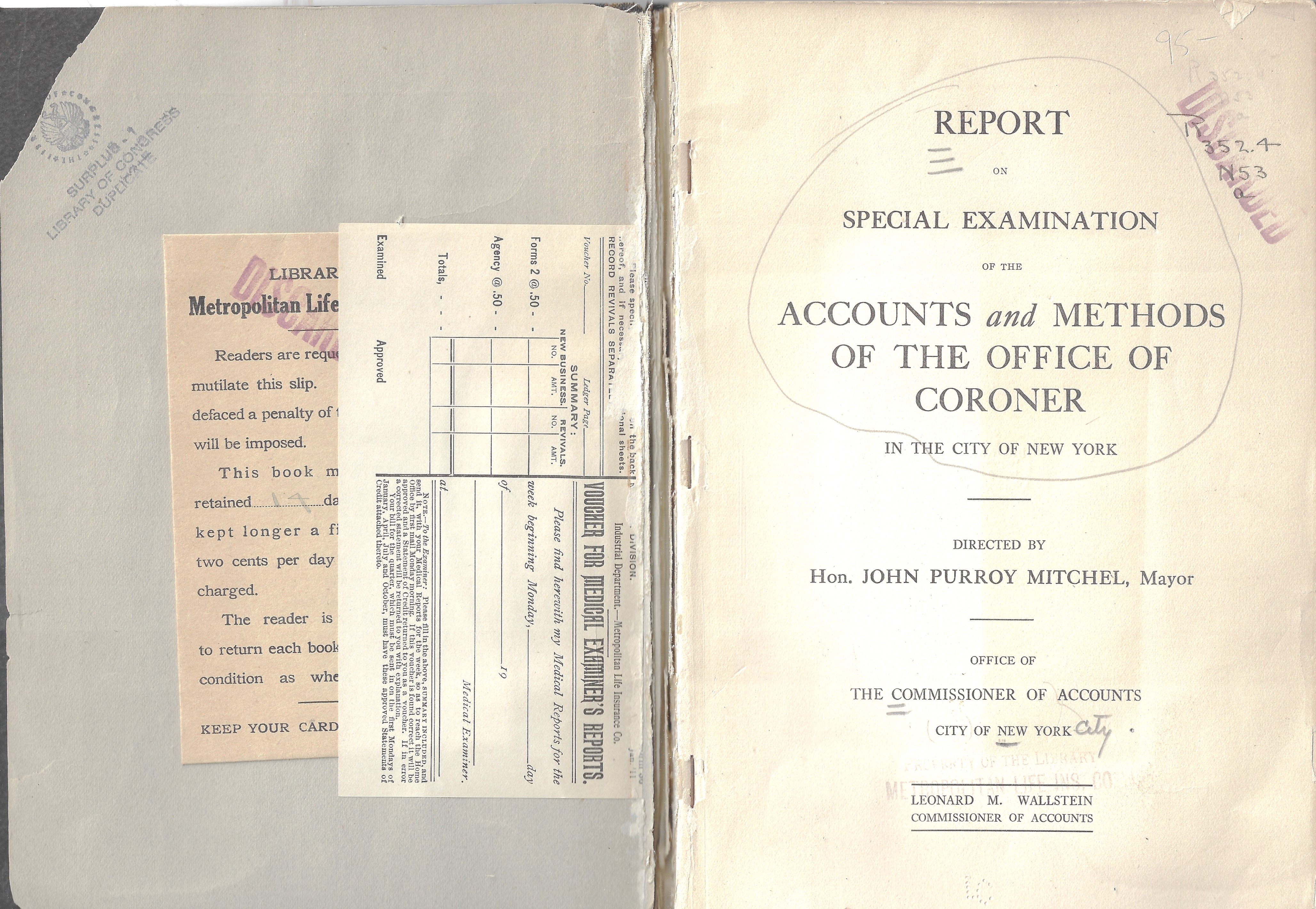
    Report on Special Examination of the Accounts and Methods of the Office of Coroner in the City of New York…Office of the Commissioner of Accounts, City of New York; Leonard M. Wallstein, Commissioner of Accounts. 1915, 10″ x 7″, 82pp. Original wrappers, bound in a workaday black cloth-like cardboard. Bookplate of the library of the Metropolitan Life Insurance Co., and also the NY Public Library, which sent the book to the Library of Congress in 1933. With a pasted-in “voucher for medical examiner’s reports” on the front pastedown. The book is staple bound, and the paper in some areas is becoming brittle. Overall, only a fair copy, but intact. $150

    • WorldCat locates 10 copies, including: Columbia, Cornell, Yale, University of Illinois Urbana, Harvard, U Missouri, U Chicago. It seems as though there is only one copy in NYC. 
    Coroner rept

    If you ever had any interest—known and unknown—in reading about very impressive amounts of corruption and its constituents in the coroner’s office for NYC 104 years ago, here’s your chance to satisfy it. I’ve found a scarce report documenting the extraordinary conditions of that agency.

    You don’t want to be on the other end of this paper—it is scathing, and angry, and well-written and documented. From a quick read of it the office of the coroner of NYC was simply a fantastic mess of incompetent work and very highly competent corruption.

    The report starts at the end, with a summary of findings, and then goes downhill from there:

    • “The elective coroner in New York City represents a combination of power, obscurity and irresponsibility which has resulted in inefficiency and malfeasance in the administration of the office. With constant temptation and easy opportunity for favoritism and even extortion, with utter lack of supervision and control, and without the slightest preparation and training to create in the coroner’s mind a scientific and professional interest in the performance of his duties, the present system could not have been better devised intentionally to render improbable, if not impossible, the honest and efficient performance of the important public function entrusted to his office.

    Of the 65 men who have held the office of coroner since consolidation, not one was thoroughly qualified by training or experience for the adequate performance of his duties….”
    ·Posted by :

    ·in:


  • The Earliest Appearance in the U.S. of an Experiment Showing Lead in the Atmosphere? (1835)

    Arthur Dunn, “Experiments to ascertain the Existence of Lead in the Atmosphere of a White Lead Manufactory”, pp 355-6. In: Journal of the Franklin Institute, Philadelphia, Vol 16 (third series), volume 20 (overall), July-December 1835, 438 pp, with text illustrations.  Half-calf, with raised bands. Ex-library, with some scuffing on the spine; also a few stamps on the title page. Nice copy. Good condition.  $350 (There are dozens of other papers of interest in this volume–this seems to be the most compelling of the group.)

    • This paper seems among the earliest printed in the U.S. to experimentally demonstrate the presence of lead in the atmosphere. It is also suggestive of what would become the concern of human impact on the environment.

    The issue of lead poisoning was considerable—people became sick by touching, drinking, and breathing in lead under many different circumstances. For example, poisoning occurred when lead was used in paint by breathing or touching or eating paint chips, the most harmed of those would be the color mixers who prepared the paint. There was also a problem with lead caused by eating it in the form of food coloring for bread (to give it a yellowish tint using ‘chrome yellow”), candies, bon bons, and an emulsifier for snuff, among many other things. Lead was also ingested via the use of lead utensils, pipes, and drinking ware.

    The deadly problem of lead sickness/poisoning (“colic”) was known to the Hippocrates, Nicander, Celsus, Dioscorides, Galen, Avicenna and other ancients of Greece, Rome, and Persia, and was a known concern through the Dark and Middle Ages, through the Renaissance and up to the present day. (It should be stated that some of these writers described the effects of lead poisoning without the association with lead.) It was Stockhausen, “the father of lead colic”, who would in the 18th establish the connection between lead and the diseases caused by it, with Henkel showing lead as the exclusive vector agent to the diseases (in 1812).

    It has been shown that the “(f)irst article about lead poisoning was published in 1848” by Samuel L. Dana1. This was the first translation and expansion of the article “Traits des Maladies de Plomb, ou Saturines”, by Tanquerel des Planches, which was published nine years earlier, in 1839, which has been noted as one of the earliest papers in the medical literature on lead poisoning. 2,3 The Dana translation, according to the American Journal of Science, was a great contribution to health in the U.S., as the Tanquerel des Planches work was “doubtless unknown to intelligent readers of this country”. American Journal of Science, volume 6, November 1848.

    I have been unable to find anything by Dunn, whose work is reprinted in the Philosophical Magazine five months earlier in the year (series III, vol 7, issue 31). There are other earlier works that come close to what Dunn is doing4, but so far as I can determine this seems to be the first to prove that the lead could be supported in the atmosphere and be breathed into the body (or absorbed through the eyes), something that no doubt was suspected but not demonstrated. 

    Notes

    1.  Lead Diseases: A Treatise from the French of L. Tanquerel Des Planches: With Notes and Additions on the Use of Lead Pipe and Its Substitutes, printed in Lowell, (Ma.), by Daniel Bixby & Co., 1848)–Parissa Karrari  et al., “A systematic review on status of lead pollution and toxicity in Iran; Guidance for preventive measures” (–Daru Jnl Pharmaceutical  Sciences, 2012; 20(1): 2:.
    2. “The medical literature on lead poisoning in children can be traced back to the work of Louis Tanquerel des Planches he remarked on children placing leadpainted toys in their mouths and developing lead colic. As early as 1887, medical authorities in the United States noted cases of lead poisoning. David Stewart reported in Medical News that nine members of a single family developed lead poisoning from lead chromate used to dye bread yellow. [Stewart, “Notes on some obscure cases on poisoning by lead chromate manifested chiefly by encephalopathy.” Med News 1887; 1:676-81. 11.] In the 19th century, lead chromate was often added to lead sulfate to form what was called “chrome yellow,” a substance used by bakers and candy makers as a coloring agent. In 1889, an article in Science reported on the deaths of two children from the ingestion of baked confectioners’ products that contained chrome yellow. [Glenn W. Chrome yellow considered as a poison. Science 1889; 13:347-9. 12.]”— David Rosner, et al, “Lockhart Gibson and the Discovery of the Impact of Lead Pigments on Children’s Health: A Review of a Century of Knowledge”, Public Health Reports (1974-) Vol. 120, No. 3 (May – June., 2005), pp. 296-300
    3. On Louis Tanquerel des Planches (1795-1868): “He is known for his research of lead poisoning, about which, he is credited with conducting one of the first comprehensive studies of occupational illness. By way of analysis of 1200 cases of lead poisoning at the Hôpital de la Charité in Paris, he reported that the disease was more frequently found in workers who were exposed to lead fumes than those who worked with the solid metal. In his studies he used the term encéphalopathie saturnine to point out neuropsychiatric indications of lead poisoning.”—Wiki
    4. But then there’s this earlier paper (1830), which certainly describes the consequences of lead in a closed environment but does not discus at any point any experiment to show that this is so: “…favorables à la production du mal Qui ne sait que parmi les professions qui exposent à la colique on compte celle d imprimeur c est à dire celle de compositeur ou de metteur en page en un mot celle des ouvriers qui manient les caractères Car je ne sache pas qu on voie fréquemment cette maladie attaquer les corrcctcurs ou autres employés qui vivent dans la même atmosphère si l on se rappelle en outre que le plomb n entre que pour une très faible proportion dans l alliage dont on se sert Pour les caractères Qn comprendra qu il est fort difficile qu il s en échappe en grande quantité des émanations saturines et que ce n est que par un contact Inumédiat que l infection doit avoir lieu…” -discussing the problems to employees handling lead type in a print shop.  Fouquier, “Colique de Plombe, Nature et Traitement” (Revue Clinque de la Medicale), in Gazette Medical, vol 1, 1830, pp 430-1


    ·Posted by :

    ·in:


  • Iron Lighthouses, Aluminum, Engineering and Farm Implements, Non-photographic Photographs, and more (1856)

    Journal of the Franklin Institute, Philadelphia, Vol 31 (third series), volume 61 (overall), January-June 1856, 443 pp.,with text illustrations, and three plates, including one folding.. Half-calf, with raised bands. Ex-library, with some scuffing on the spine; also a few stamps on the title page. Nice copy. $225 Contains many articles of interest, including an early report on industrialized aluminum, “nature printing”, the McCormack reaper patent case, lighthouses, the Suez Canal, and a lot more, including:

    “Aluminum, the So-Called New Metal”, pp 27-31 and “History and Properties of Aluminium”, pp 65-7. I’d like to point out that I rarely see the hyphenated word “so-called” in the JFI. That said, aluminum had been around for 100+ years at this point, and then first truly described by Wohler, though it wasn’t until the period of this vol of the JFI that aluminum was produced in such a way as to be industrially useful.

    Henry Bradbury, “On Nature Printing”, pp 37-39. This was a style of printing in which a sample was impressed on a sheet of soft lead and then electroplated and use as a printing block, the result being some very defined imagery. Bradbury perfects a style of this printing and found it very useful even in the early age of mass-produced photo images. 

    “The Canal through the Isthmus of Suez”, pp 150-155, with a lovely litho view of the canal;

    G. Herbert, “On the Construction of Buoys, Beacons, and other stationary floating bodies”, pp79-84;

    J. Vaughan Merrick, “On the History and Construction of Iron Lighthouses, with a description of Coffin’s Patches Light”, pp 145-150, with a lovely lithographic plate.

    George Simmons, “Method of Calculating Excavation and Embankment”, pp 1-4;

    Edward Allen, “Mechanical Engineering as applied to Farm Implements”, pp 41-45, 138-142 (with text illustrations), 186-190, 258-260, 334-338, 397-406 (to be concluded in the next volume)

    C.H. McCormick vs. J.H. Manny, “Law Reports of Patent Cases: the Reaper Case”, pp 176-186;

    David Stevenson, “Remarks on Floating and Fixed Lighthouses”, pp 221-227; John W. Nystrom, “Experiments on Sound for the Application of Ringing Bells”, pp 260-266; R.D. Thomson, “On the Condition of the Atmosphere during Cholera”, pp 202-204.

    Also:

    Erastus W. Smith, “United States Steam Mailer Fulton”, pp 339-340, with a beautiful folding plate of the ship.


    ·Posted by :

    ·in:


  • Contemporary Review of Darwin’s “Descent of Man” April 1871

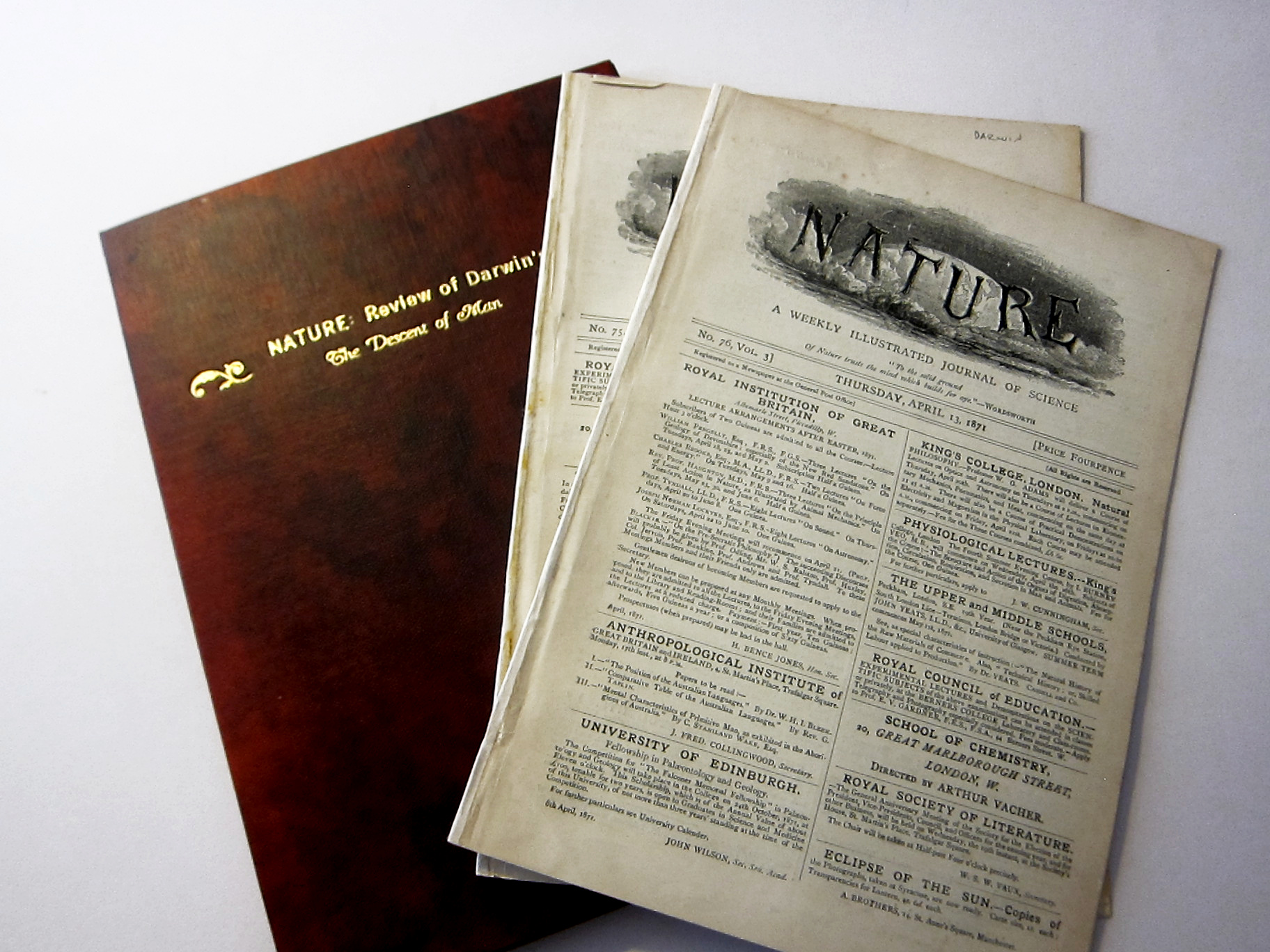
    [DARWIN, Charles]. Pye-Smith, P.H. A review of  The Descent of Man, and Selection in relation to Sex in two issues of Nature, a Weekly Illustrated Journal of Science. Two issues: vol. 3 #75, April 6, 1871, pp 441-460 and vol 3 #76, April 13, 1871, pp 461-480 in the weekly issue.  Both very nice copies with expertly repaired (with minimal invasion and maximum blendedness) spines. Offered in their original wrappers. Housed in a new and fine folding (and gilt-embossed gas).  $250 

    Charles Darwin’s  great classic The Descent of Man, and Selection in relation to Sex was published by John Murray (in two volumes) on 24 February 1871, and Prof /Dr Philip Henry  Pye-Smith (1839-1914) was quickly on board to review it six weeks after publication for Nature magazine in two issues for April 6 and the following issue for April 13, 1871.  pp 442-4 and pp 463-5, respectively. It is noted in the Darwin Online site that Darwin’s use of the word “evolution” first appears in the first page of the first volume of this work (note following) and Pye-Smith’s very favorable and highly complimentary review uses the word (“Evolution”) in the first paragraph, and is so far as I can tell the second appearance of the word in the great journal Nature (of 45,000 more that would follow over the years). His review of the Darwin work is among the earliest, as is his own use of the word “evolution”. (“Darwin wrote, in the preface to the second edition, of ‘the fiery ordeal through which this book has passed’. He had avoided the logical outcome of the general theory of evolution, bringing man into the scheme, for twelve years, and in fact it had, by that time, been so much accepted that the clamour of the opposition was not strident. He had also been preceded in 1863 by Huxley’s Man’s place in nature. The book, in its first edition, contains two parts, the descent of man itself, and selection in relation to sex. The word ‘evolution’ occurs, for the first time in any of Darwin’s works, on page 2 of the first volume of the first edition, that is to say before its appearance in the sixth edition of The origin of species in the following year.”) 

    Darwin descent review

    ·Posted by :

    ·in:


  • Interior Open Spaces in Cities and Reduction of Poor Health and Crime (1883)

    Timothy Newell, M.D. The Sanitary, Physical, and Educational Advantages in Interior Open Areas in Large Cities. A Paper read Before the American Public Health Association. Boston, Press of Rockwell and Churchill, 1883. 9×6 inches, 11pp. Original wrappers. Provenance: Brown University, and then the Library of Congress. Small “LC” perforated stamps on title and last page; LC surplus/duplicate rubber stamp on rear wrapper. Good copy. NO COPIES located in WorldCat/OCLC  $150

    On the efficacy and use of park and open spaces in cities for the good of the health of the population.

    Referred to as “a valuable paper” in the Report of a Conference on Charities and on Other Subjects Pertaining to the Prevention of Suffering, Pauperism, and Crime, published by the Charity Organization Society of Baltimore City, 1887.

    Among  [Newell's]  published   papers are:   "What Changes Does Physiology Demand in  our School
    System ?" read before the American Social Science Association at Saratoga, in 1876, and published in
    the Sanitarian; as chairman of  a committee on school  hygiene, of  the  Rhode  Island  Medical
    Society in 1875, he made a full report with  a series of resolutions, which were copied into several sani-
    tary journals   and  commented;   "Interior  Open Spaces in Large Cities," read before the American
    Public Health  Association.   He is also the  author of several  pamphlets  published  annually  for  ten
    years  by the Public Parks Association,  and is author of  the  "Cyclopedia of Domestic Medicine  and
    Hygiene," Bradley &  Woodruff,  Boston, 1890, a volume of 700 pages and 200 illustrations.”
    --Physicians and Surgeons of America (Illustrated), a Collection of Biographical Sketches of the
    Regular Medical Profession. 1896.

    ·Posted by :

    ·in:


  • On the Accidental Production of Colors in Photographs (1859)

    Palmer, “Palmer’s Patent Arm and Hand” a 4pp illustrated patent review in Journal of the Franklin Institute, Philadelphia, vol 67 (third series vol 37), February 1859, pp 114-118, with a full page plate (illustrated here) and three large text illustrations. Offered in the full volume of 448pp. Bound in half-calf and marbled boards, the spine being rubbed and chaffed. Ex-library, with the shadow of a call number label at spine bottom, plus large bookplate, and library stamps on title page. Overall, a solid Good copy, with a fresh and crisp text. $145

    Also appearing in this volume:

    Henry Fox Talbot, “Improvements in the Art of Engraving”, pp 193-197. (William Henry Fox Talbot (1800-1877) was among the earliest of the photographic pioneers, or pre-pioneers, as he asserted priority of his photographic method for 1835 when Daguerre revealed his own (very different) method in 1839. Talbot (or Fox Talbot)  was also a practitioner of the art, publishing a stone-cold and revolutionary work of photographically illustrated books, The Pencil of Nature.)

    W.O. O’Brien, “Canals and Canal Conveyance”, pp 16-26 and 73-80;

    M. Muguet, “Accidental Production of Colors in Photographs”, pp 126-7, translated from Cosmos. This seems an interesting note in the early history of color photography, though there is no mention of any work being done by any others in this field. (“M Muguet states to the French Academy the circumstances under which he obtained natural colors in a stereoscopic picture of ruins covered with ivy. Each glass plate had been exposed twenty seconds the sun shining brilliantly and on developing I was astonished at finding the color strongly developed the ivy was represented by a deep green tint some old timber of trees by a brown the stones by a gray all with colors in the highest degree varied. Fixing did not alter them but in drying they lost their brilliancy with the exception of the green which has remained as decided as at first. In taking a second picture the same effect was produced but with less strength…In reference to this communication of M Muguet to the Academy Paris M Bertsch reminded the hearers that every photographer had frequently observed that when the development of a positive was arrested at a certain point and the picture placed upon a black ground effects were obtained which imitated the natural color very well….”)

    1859 is a big year in the history of science, but there is no mention (nor was this the place for mentioning most of what is to follow) of Darwin, Huxley, Maxwell, Riemann, Kirchhoff, or Cayley.

    ·Posted by :

    ·in:


  • Leeuwenhoek Correspondence Abstracts (1688)

    [Leeuwenhoek, Antoine van.] “Vervolg der brieven, geschreven aan de wytvermaarde Koninglijke societeit in London” a review in French of an installment of the published letters to the Royal Society (in Dutch, at Amsterdam, by Boutesteyn in 1688) of Antoine van Leeuwenhoek. This review, or abstract, describes 9 published letters (4 April 1687, 9 May, 13 June (which I think is incorrectly described as “3 June” in the Bibliotheque), 11 July, 6 August, 9 September, 17 October, 28 November, and 7 September 1688 overall). The Vervolg of 1688 continues with another five letters. There is one engraved plate in the Bibliotheque with two figures—this corresponds to the plate on page 19, the two figures here being figures 6+7 in the very well illustrated book.

    These articles bound in: Jean Le Clerc and Jean Cornande de al Crose, Bibliotheque Universelle et Historique de l’annee M.D.C. LXXXVIII, Amsterdam; Wolfgang, Waesberge, Boom, & van Someren. 1688. 5.5”x3”, Volume 9. (first edition), (vi), 561, (28)pp, with two small folding plates. 

    Bound in full vellum. Condition: a very nice copy, with a very fresh text block. There is a centuries-old paper label on the spine bottom (“Ephem.gen. 96”), as well as a title in ink in a very old hand at spine top. Engraved bookplate “Friedr. August H.z.B.O”.., with what seems to be a royal coat of arms, and seems to be Friedrich August, Braunschweig-Lüneburg-Oels, Herzog, otherwise Frederick Augustus, Prince of Brunswick-Oels.

    VERY GOOD condition. There is some damage and a bit of a torn out right-corner on the front free flyleaf, otherwise a nice, tight copy. Pretty book.  $500

    “Leeuwenhoek made his most important discovery early in his scientific career, in 1674, when he recognized the true nature of microorganisms…conclud(ing) that the moving objects that he saw through his microscope were little animals. He recorded these observations in his diary, and two years later, in a letter of 9 October 1676, communicated them to the Royal Society, where they caused a sensation…Leeuwenhoek subsequently described, in about thirty letters to the Royal Society, many specific forms of microorganisms, including bacteria, protozoa, and rotifers, as his incidental discovery of ciliate reproduction.”

    “It was through letters—more than 300 of them, written to private scientists and amateurs in both Holland and other countries—that Leeuwenhoek made his work known… he was indebted to the Royal Society of London for the publication of his views, and 190 of his letters are addressed to that body.”

    “This initial communication [28 April 1673] convinced the fellows of the great significance of his microscopic findings, and the Society prepared English translations or summaries of his letters for their Philosophical Transactions (1673—1724)…Beginning in 1679, the French journal Recueil d’expériences et observation sur le combat qui procéde du mége des corps published Leeuwenhoek’s letters, translating them from the Philosophical Transactions, and French summaries of them…appeared in the Journal des Scavans, Latin extracts were made and published in the Acta eruditorum,beginning in 1682.”–Complete Dictionary of Scientific Biography, online, section on Leeuwenhoek. 

    “Leeuwenhoek himself did not publish his work until 1684, when he brought out some of his letters in Dutch; from 1684 onward he also published Latin translations. He initially edited, reprinted, and reissued some of his letters separately or in groups of two or three, a practice that has resulted in some bibliographical confusion.”

    On the Bibliotheque: “Like its great rival, Pierre Bayle’s Nouvelles de la re´publique des lettres, it [the Bibliotheque...] was a source of information and means of communication for members of the nascent Republic of Letters. It was also one of the remote ancestors of the modern academic journal, though much less specialised than most of its successors.”J.R. Milton, “Locke’s Publications in the Bibliothèque Universelle et Historique”, British Journal for the History of Philosophy, 05/2011, Volume 19, Issue 3

    Editors and contributors included: Jean Le Clerc et Jean Cornande de al Crose, vols 1-9; Jean Le Clerc, 10, 12, 14-19; Jean Cornand de La Crose, vol 11; Charles le Cene and Jean Le Clerc, vol 13; Jacques Bernard and Jean Le Clerc, vol 20; Jacques Bernard, vols 24-5. The journal was published every 4 months in vols 1-3; every 3 in 4-19, and then twice a year for 20-25.

    ·Posted by :

    ·in:


  • The Discovery of Blood Platelets (1842)

    DONNE, Alfred. “De l’origine des globules du Sang, de leur mode de formation et de leur fin”, in Comptes Rendus,
    volume 14, #10, pp 349-378, with Donne’s paper on pp 366-368. This is the complete weekly issue, removed/detached
    from a larger bound volume. Nice copy, in GOOD condition. Garrison & Morton #864. $175.00

    • The first announcement of the discovery of blood platelets.

    Alfred Donne (1801-1878), physician, experimenter, microscopist and photographer, is best known for things other than what he should probably be best known for:  his discovery of the third element of the blood, platelets.  Donne had a wonderful vision, and was among the very first on the scene to write about and employ the spectacular invention of the daguerreotype in chemistry and microscopy.  As a matter of fact Donne, along with his collaborator Leon Foucault,  produced the very first engraved images of photomicrographs for his cytology paper of 1840. (He was also the first to use electricity in producing a medical illustration, and was among the first modern physicians to write on the great efficacy of mothers using their own milk in breast feeding their children.)  The discovery of platelets paper of 1842–preceding two other works published in the same year–does indeed identify the new object, but actually fails to make a methodological examination of the new body, calling the new units “globulins du chyle” (or small globules derived from plasma).  He also fails to make a drawing of what he saw; so, the combination of these two important elements asked the reader to accept his findings on faith, the tools of reproduction of his observations not being present.  And so we remember Donne for some other significant things, and less so for his lightly-interpreted and un-illustrated “dots”.

    (Overall the history of the discovery of platelets is convoluted:  Leewenhoek (1675) and Henson (1782)  were the first to fully describe the “undefined” particles of the blood; Donne’s work was then more fully described by Beale in 1850, and then again (identified as “small corpuscles” by Zimmerman in 1860 and then again by Schultze in 1874 and Laptschinski (also in 1874). William Osler then enters the scene in 1880, followed by Giulio Bizzozzero who was the first, in the years 1881 -1882, to establish central role of platelets not only in physiological haemostasis, but also in thrombosis.  Anyway it is a longish and not-clear history.)

    ·Posted by :

    ·in:


  • The Pauper Children of Randall’s Island, NYC (1876)

    William P. Letchworth. Extract from the Ninth Annual Report of the State Board of Charities of New York, relating to PAUPER CHILDREN, New York County.

    Albany, Weeds, Parsons, and Company, 1876. 9×6”, 25pp. Original wrappers. Nice copy. Provenance: Library of Congress, with their surplus/duplicate rubber stamp on front and rear wrapper. Old vertical fold through-and-through. $85

    Includes a folding plan: “Diagram of Nursery and Nursery Hospital Buildings belonging to the Children’s department of the Almshouse of New York on Randall’s Island.”

    • Of Dickensian interest, some of the details I found in this report:
    • There were 91 girls, aged 8-14, housed in the “Large Girls’ Department” ; they were tended by one paid assistant and up to eight women from the alms-house and work house.
    • Large Boys’ Department: no mention of number, but drill master lives with them, plus 3 boys designated as monitors, and six females from the work house.
    • Small Boys’ Department: 136 children, tended by 5-6 women, one of whom received wages with five others being paupers or criminals sent from Blackwell’s Island.
    • Infants’ Department—72 aged 2.5-5, tended by 6 females, 5 from Blackwells.
    • The children on reception were dressed in blue gingham, white linen aprons and slept on straw beds and pillows, with food cooked by steam in six large cauldrons, mostly by inmates from Blackwells.
    • Nursery Hospital held 769 between 2 and 16, most between 5-10
    • There were 1115 children on Randall’s, the near-majority placed there by their parents who promised to pay for care (half did), mostly Irish or “unascertained” ancestry;
    • Occupations of fathers “Unascertained”, mechanics, laborers, and 1 professional
    • Most had other family members in the same institution or Blackwells
    • Female (employed) helpers were mostly 30—40, widowed, and Irish

    ·Posted by :

    ·in:


  • “The Light that Never Fails”


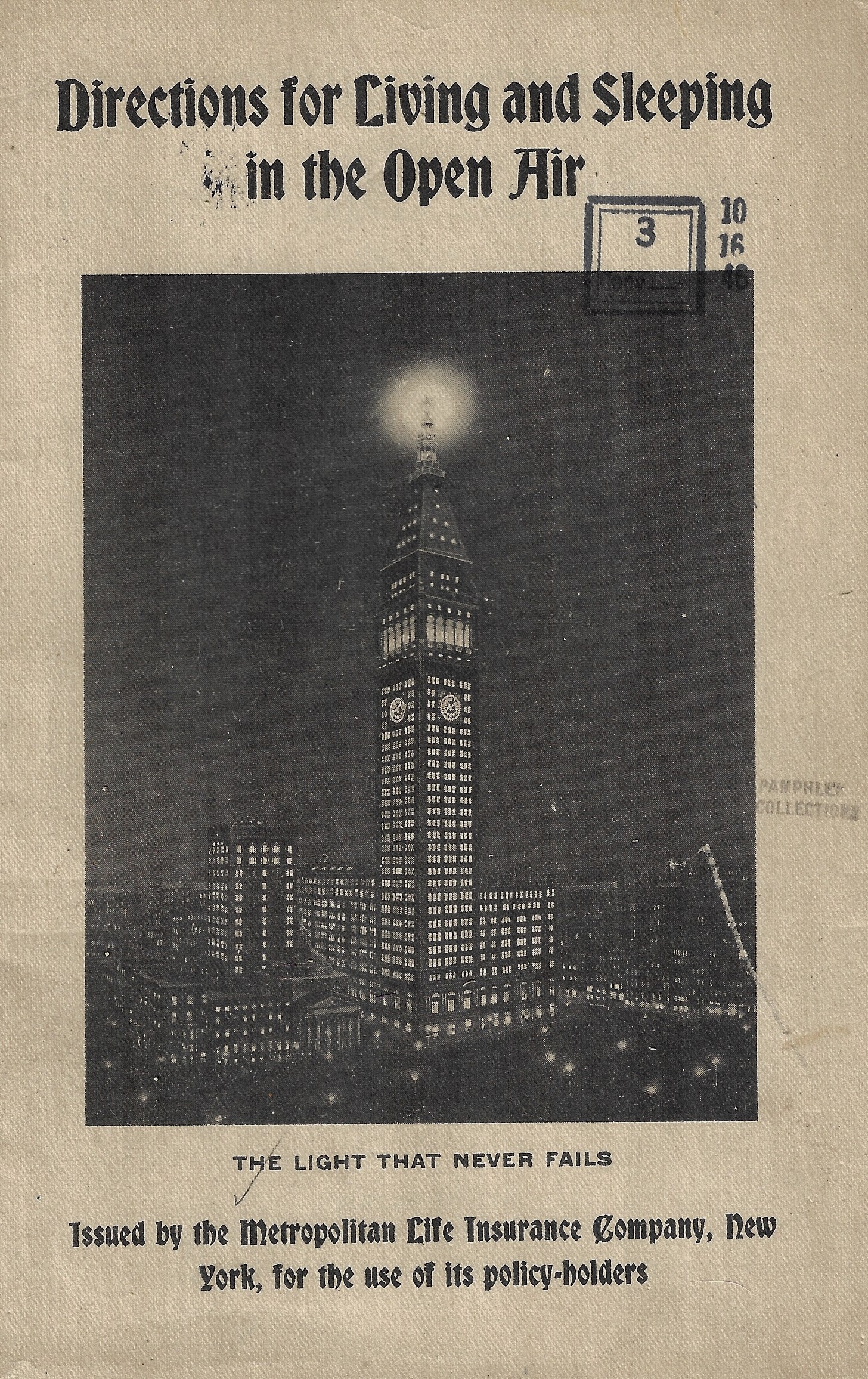
    Thomas Spees Carrington, Directions for Living and Sleeping in the Open Air. Metropolitan Life Insurance Co., 1913 9×6″, 24pp., many photos.  Original wrappers.  Nice copy of a sweet little pamphlet about the benefits of sleeping outside, from the Metropolitan Life Insurance Company.  $75

    “The light that never fails”, a slogan used by the company for decades and one that we see on the front cover of the pamphlet, was an actual light at the top of the tower, and was “one of a few broadly visible features of the New York City nighttime skyline until the mid-20th century”.  

    “The Metropolitan Life Insurance Company Tower, colloquially known as the Met Life Tower, is a landmark skyscraper, built in 1909 and located on Madison Avenue near the intersection with East 23rd Street, across from Madison Square Park in Manhattan, New York City. Designed by the architectural firm of Napoleon LeBrun & Sons and built by the Hedden Construction Company, the tower is modeled after the Campanile in Venice, Italy. The tower was a later addition to the original 11-story, full-block Metropolitan Life Home Office building (the “East Wing”), which was completed in 1893 and was also designed by Napoleon LeBrun & Sons. Plans for the tower were first announced in June, 1905.  In 1953-57, the original Home Office building was replaced with the current building, designed by D. Everett Waid. Then, between 1960 and 1964, the Tower itself was modernized by Lloyd Morgan and Eugene V. Meroni.”

    “The building figured prominently in the Metropolitan Life Insurance Company’s advertising for many years, illustrated with a light beaming from the top of its spire and the slogan, “The Light That Never Fails.” The reference was to a beacon at the top of the tower which flashed once at the quarter hour and the time of day at the hour. The beacon was one of a few broadly visible features of the New York City nighttime skyline until the mid-20th century.”–Wikipedia

    Books covers metropolitan life

    ·Posted by :

    ·in: