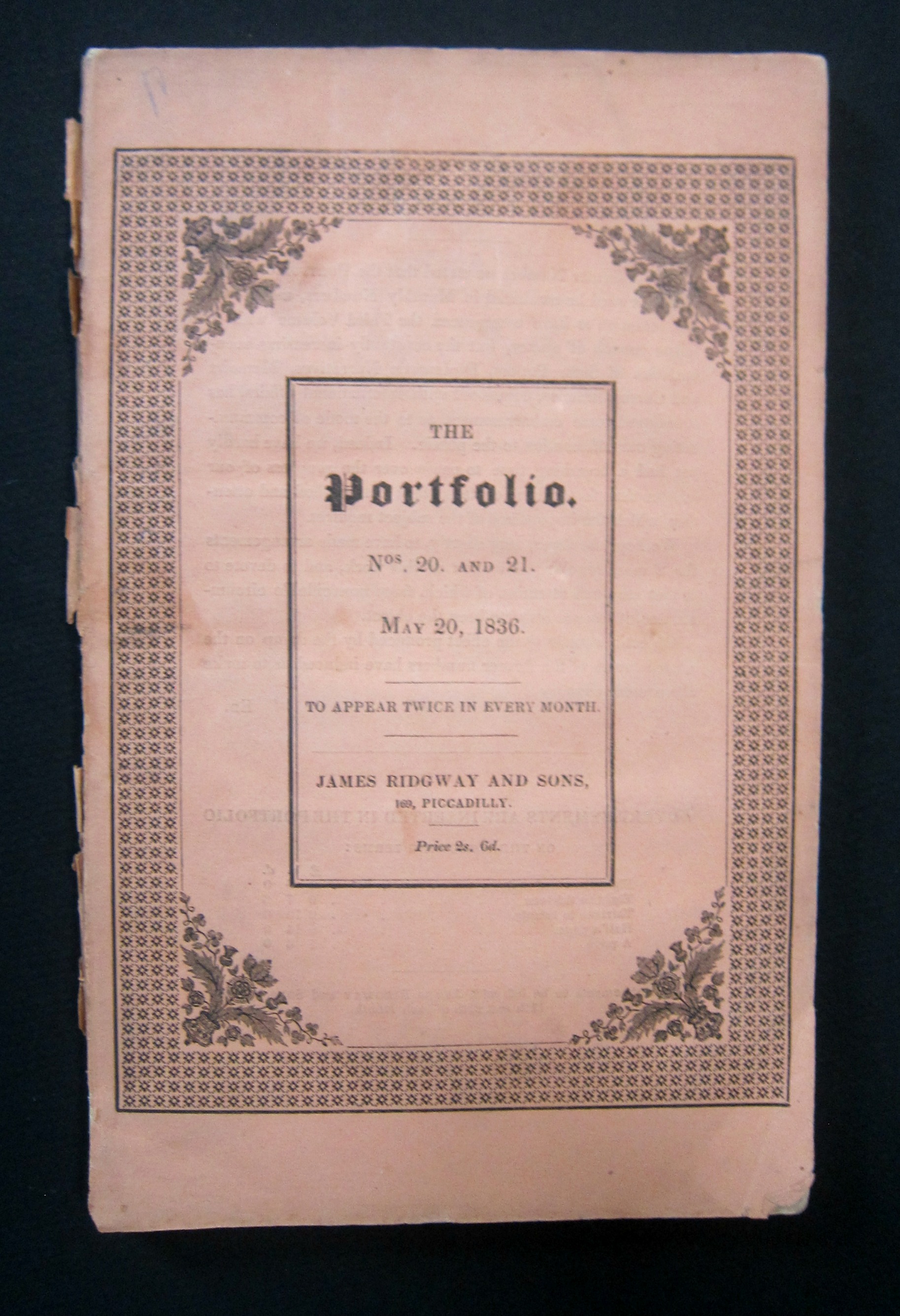
 Alphonso William Webster. “The Otaphone, Patent Invention for Assisting the Hearing.” This is a tight 4pp “supplement to the uncommon-seen The Portfolio, or a Collection of State Papers…Nos 20 and 21, May 20, 1836. London, James Ridgway and Sons. 9×5″, pp 91-192,8,4,(6),3. In the original wrappers. The wrappers are in surprisingly nice condition, though there are numerous paper chips out of the spine, and the binding will not take very many openings. Still, a GOOD copy. $75
This is essentially an extended advertisement, closely written by Webster, who was a specialist practioner in the field of hearing, and who later in 1866 would write a book on the subject, A New and Familiar Treatise on the Structure of the Ear, and on Deafness. The device was a slim silver apparatus that would fit around the ear and extend outward slightly, basically replacing the cupped hand over the ear to help improve hearing.
“UK patent #7033, dated 17 March 1836, is the earliest British patent for a hearing aid device, granted to the aurist (19th century term for ear specialist) Alphonso William Webster, for his “curious” invention, the Otaphone (sometimes spelled “Otophone”). In his publication, A New and Familiar Treatise on the Structure of the Ear, and On Deafness (London: published by the author, sold by Simpkin & Marshall, 1836), Webster outlines he was first devised his invention by observing the common practice of cupping the hand to the back of the ear to enhance hearing. He wondered whether the practice could be obtained by “means less troublesome and unsightly”–from the 19th Century Disability website, contributed by Jaipreet Virdi-Dhes