A Daily History of Holes, Dots, Lines, Science, History, Math, Physics, Art, the Unintentional Absurd, Architecture, Maps, Data Visualization, Blank and Missing Things, and so on. |1.6 million words, 7500 images, 4.9 million hits| Press & appearances in The Times, Le Figaro, Mensa, The Economist, The Guardian, Discovery News, Slate, Le Monde, Sci American Blogs, Le Pont, and many other places… 5000+ total posts since 2008.

Book Category: Information, Artistic Display of Data &

  • Great and Fantastic Images from Kircher’s “Mundus Subterreneus…” 1678


    I’m offering for sale some engravings from Athanasius Kircher’s Mundus subterraneus… (1678) which, in spite of its title, explores/classifies/theorizes on the grand scheme of all creation, hardly limited to just the world going on underground.  Kircher (who has appeared on this blog numerous times, simply enter his name in the Google search box at left and you’ll find many entries) approaches the nature of terrestrial heat, volcanoes, the origins of lakes and rivers, optics, fossils/agates (in “de lapide philosopherum”), distillation, alchemy, ocean currents, insects, plant life, and so on, a real summa cum laude  tour de force, Kircher being the Renaissance man’s Renaissance man.

    All images are printed on 14 3/4 x 8 7/8″ sheets (375x220mm) and have been removed from a defeated and dead copy of the book, the full title of which is Athanasii Kircheri … Mundus subterraneus, in XII libros digestus: quo divinum subterrestris mundi opificium, mira ergasteriorum naturae in eo distributio … universae denique naturae maiestatis & divitiae summa rerum varietate exponuntur …   This copy (lacking the title page and much else) I believe was printed in Amsterdam in 1668 (I believe–the other somewhat later editions to 1678 that I have checked all seem to have added material and different and later pagination, leading me to believe that this is an earlier edition.) The pagination ran 346+487pp, being two volumes printed as one.

    • Please keep in mind that the scans leave off the top 1.5″ or so of each image as well as the bottom half-inch–the paper was simply too long for the scanner bed. The pages are complete (in real life).

    And so the list (of 18), thus far:

    Gallus…serpentina cauda conspicuus…In the chapter, “de Animalibus Subterraneis”, p 97.
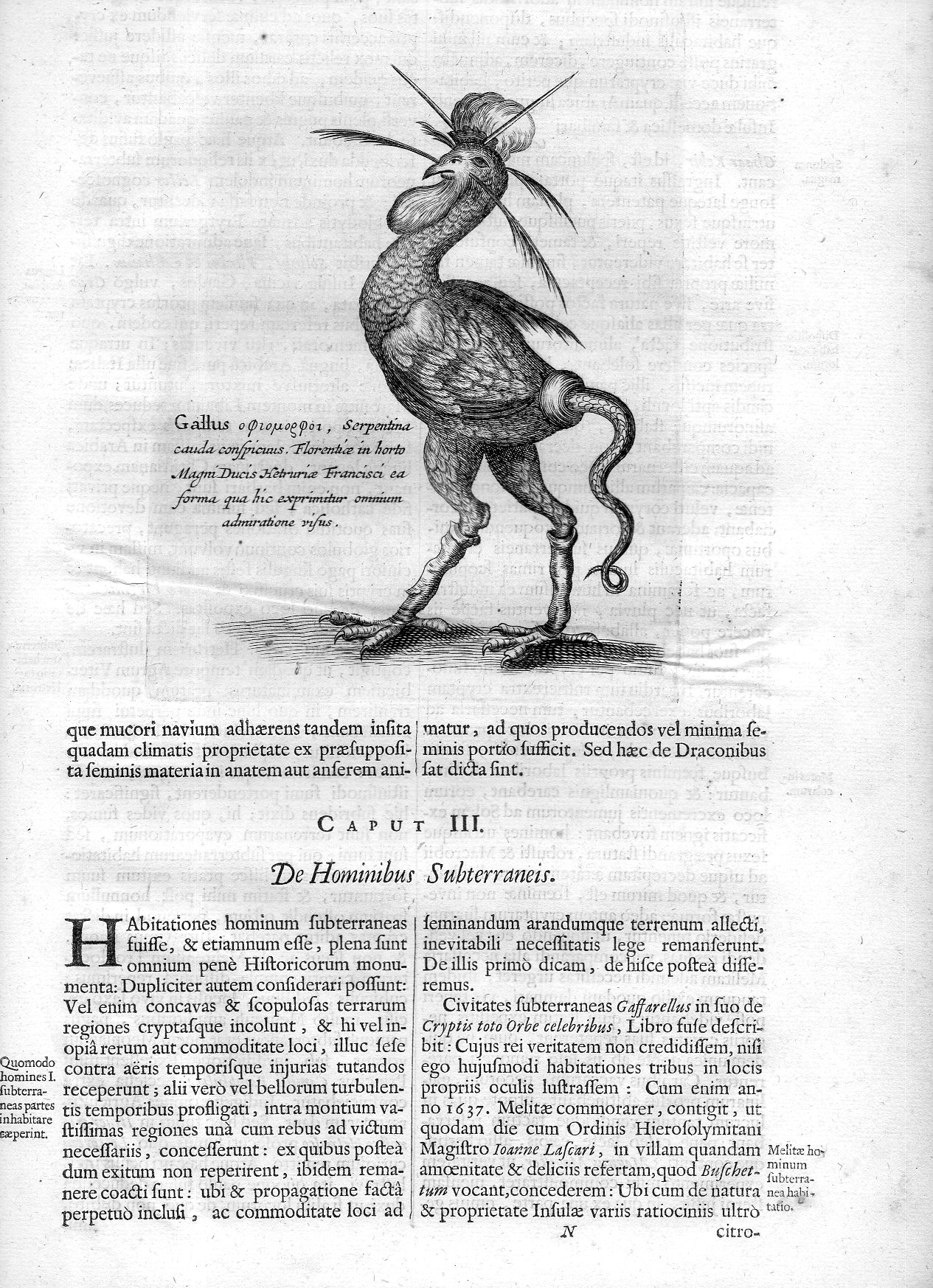
    Kircher 97039Image 6 1/2 x 5 inches, 160x120mm.  $300 (There is some chipping at the top of the sheet, though it does not extend into the sub-head.)  

    (Underground animals) Draco Helveticus bipes et alatus.
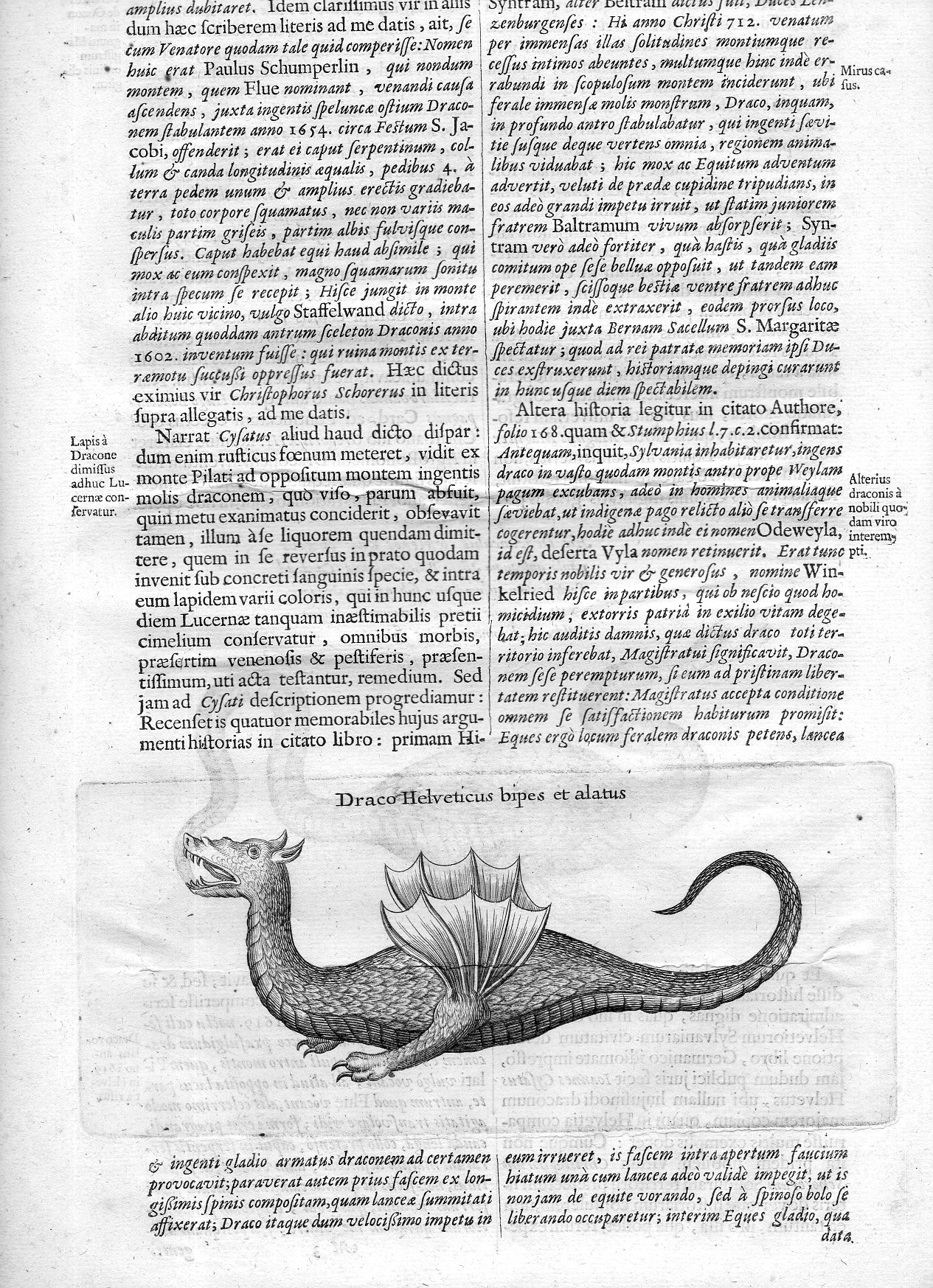
    Kircher 93040Image 3 1/4 x 7 1/2″, 80x185mm.  $375

    On the other side of the page: Hic Dracunuculus…
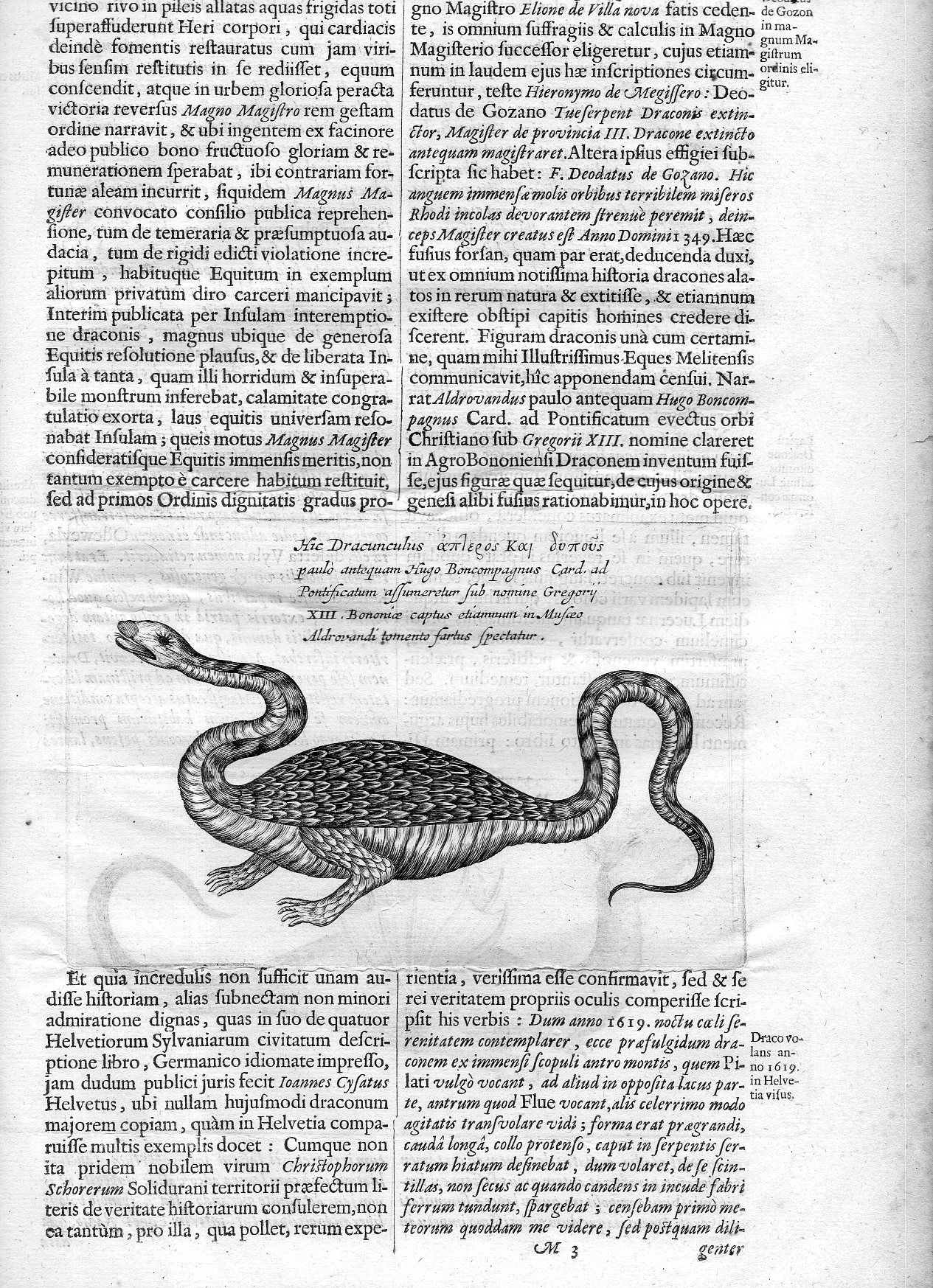
    Kircher 94041Image 4×6″, 115x160mm. 

    ·Posted by :

    ·in:


  • An Attempt at Organizing Fingerprint Collections (1937)

    I wanted to load and launch this yes-this-exists (YTE!) notice of this probably not-found-elsewhere work into the internet spheres for the slight chance of someone finding it existence interesting. 

    William W. Hill and Alfred Coe, “Finger Print Classification. International Laboratories of Forensic Research (Budd Lake, NJ, PO Box 302). 11×8.5”,  (i), 32pp, 9 plates (of close-up fingerprint drawings). Bound in a three-ring binder. The binder is in fair condition, with the spine backstrip broken at the hinge, though it still works as a binder. The text is dusted but crisp.  Good condition, though probably a little better.   $250

    This work states that it is based upon the Henry System1 of fingerprint classification, which buy this point had been around for more than 50 years. It seems that the addition to the field that this work attempts to make is reordering the way in which fingerprint data is stored. The Henry System evidently used a cabinet drawer divided into 32×32 sections–here the sections are 12×12, though there are subdivisions of type patterns that seem to make the organization more extensive along with an additional numerical system (with arithmetical rules and functions) that I haven’t devoted any time to understanding. 

    This work is unknown to WorldCat/OCLC, and is not  findable via standard means online. For one reason or another, this work received little or no circulation.  

    Notes:

    1. The Henry Classification System is a long-standing method (begun ca. 1877) by which fingerprints are sorted by physiological characteristics for one-to-many searching. Developed by Hem Chandra Bose, Azizul Haque and Sir Edward Henry in the late 19th century for criminal investigations in British India, it was the basis of modern-day AFIS (Automated Fingerprint Identification System) classification methods up until the 1990s. 

    ·Posted by :

    ·in: