A Daily History of Holes, Dots, Lines, Science, History, Math, Physics, Art, the Unintentional Absurd, Architecture, Maps, Data Visualization, Blank and Missing Things, and so on. |1.6 million words, 7500 images, 4.9 million hits| Press & appearances in The Times, Le Figaro, Mensa, The Economist, The Guardian, Discovery News, Slate, Le Monde, Sci American Blogs, Le Pont, and many other places… 5000+ total posts since 2008.

Book Category: American Western History

  • “What Shall We Do With Them?” (Dustbowl & Great Depression, 1938)

    Taylor, Paul S. “What Shall We Do With Them?” Address before the Commonwealth Club of California, San Francisco, April 15, 1938. 11″x 8″, 7 lvs, single-spaced typewritten sheets, mimeographed. $450

    Paul S. Taylor is the Paul S. Taylor as in Mr. Dorothea Lange, partner to the great photographer and co-author of one of the greatest illustrated works of the 20th century, The American Exodus, a Record of Human Erosion. Taylor provided a lyrical and insightful text and Lange contributed her incredible photographs, producing one of the leading documents of life in the Great Depression era of the USA. This was one of the great documentarian centerpieces of the 1930’s, and it was published in the same year as The Grapes of Wrath and the release of the Wizard of Oz. (Two years later—1941–came the superb James Agee (text) and Walker Evans (photographs) finally saw their long-developing Let Us Now Praise Famous Men come to life.)

    The document offered here is an interesting and well-written appraisal of the great American exodus of the 1930s. The “Them” in the title refers being the Dust Bowler, the migrant workers, the dispossessed, people eaten away by the weather, and banks, and ill wind.  Paul Taylor was at this time three years into his marriage with Lange—he was a progressive thinker and a FSA operative who helped Lange land her job and was a part of an extraordinary team of very expansive ability that documented a pivotal period in American life. He was also co-creator with Lange of their great

    In this pamphlet Taylor gave testimony on migrant workers and nearly the height of the Depression—he was an expert, having traveled and lived among them and written academic papers on what he found. He outlined possible answers to the question, which had mainly to do with stability, which of course was the primary concern for the many of thousands of individuals and families who were once-stable but now very mobile, not having place to live or places to go. Taylor thought that opening dams and supplying irrigation and affordable government-owned houses would be the first of many steps to take to relieve the widespread suffering.  In all of the alphabet-soup programs undertaken by the Roosevelt administration, none were nearly as “successful” in ending the national social erosion as the events that were to unfold less than a year later.

    This document is an interesting read, particularly when you consider what he and Lange published just a year later.

    ·Posted by :

    ·in:


  • Rare Work on California Oil and Gas Fields–Carbon Copy

    No Copies in WorldCat

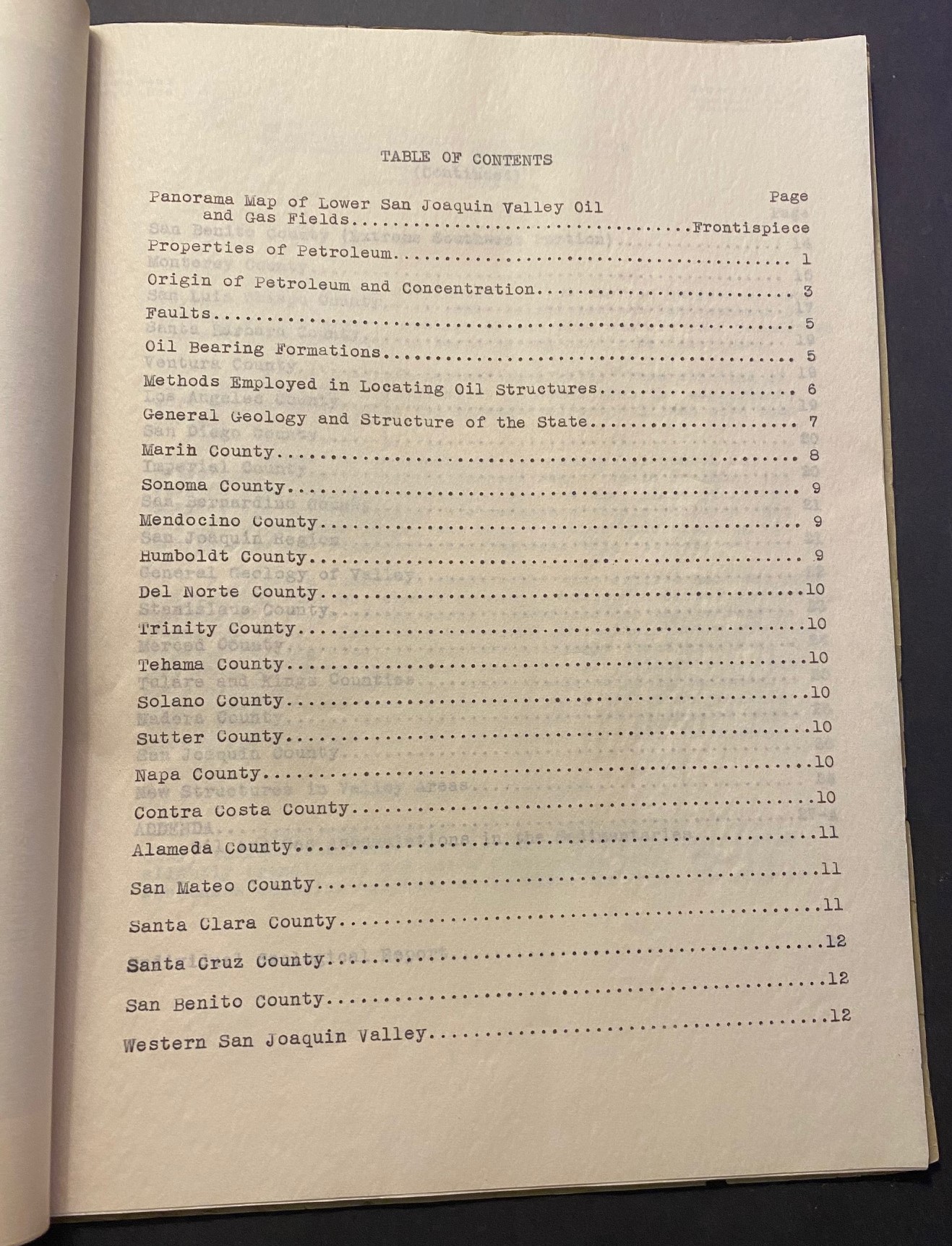
    HUDSON, George H. Geological Summary and Report of California Oil and Gas Fields, with Addenda.

    Compiled by Bureau of Geological Statistics (San Francisco). Copyrighted by J. Miller and George H. Hudson (Geologist and Petroleum Engineer). Carbon copy, with homemade paper wrappers. 11”x 8.5”, 2 (unusual) birds-eye views, ii, 27pp, 4pp appendix. Bound with brass brad fasteners. $1500.00

    Carbon copy on onion-skin-like paper—I don’t think this is the first impression (I mean the original) but an early, Provenance: Library of Congress, with their 10mm “LC” perforated stamp on the title page and rubber stamp surplus on the front wrapper. perhaps first generation, copy, as you can still feel the indentations from the typewriter-struck paper. Laid in are the LC card catalog cards.

    IMG_2789

    ·Posted by :

    ·in:


  • Business Ledger for the “Wichita Advertiser” (Wichita Falls, Texas), 1938-1940

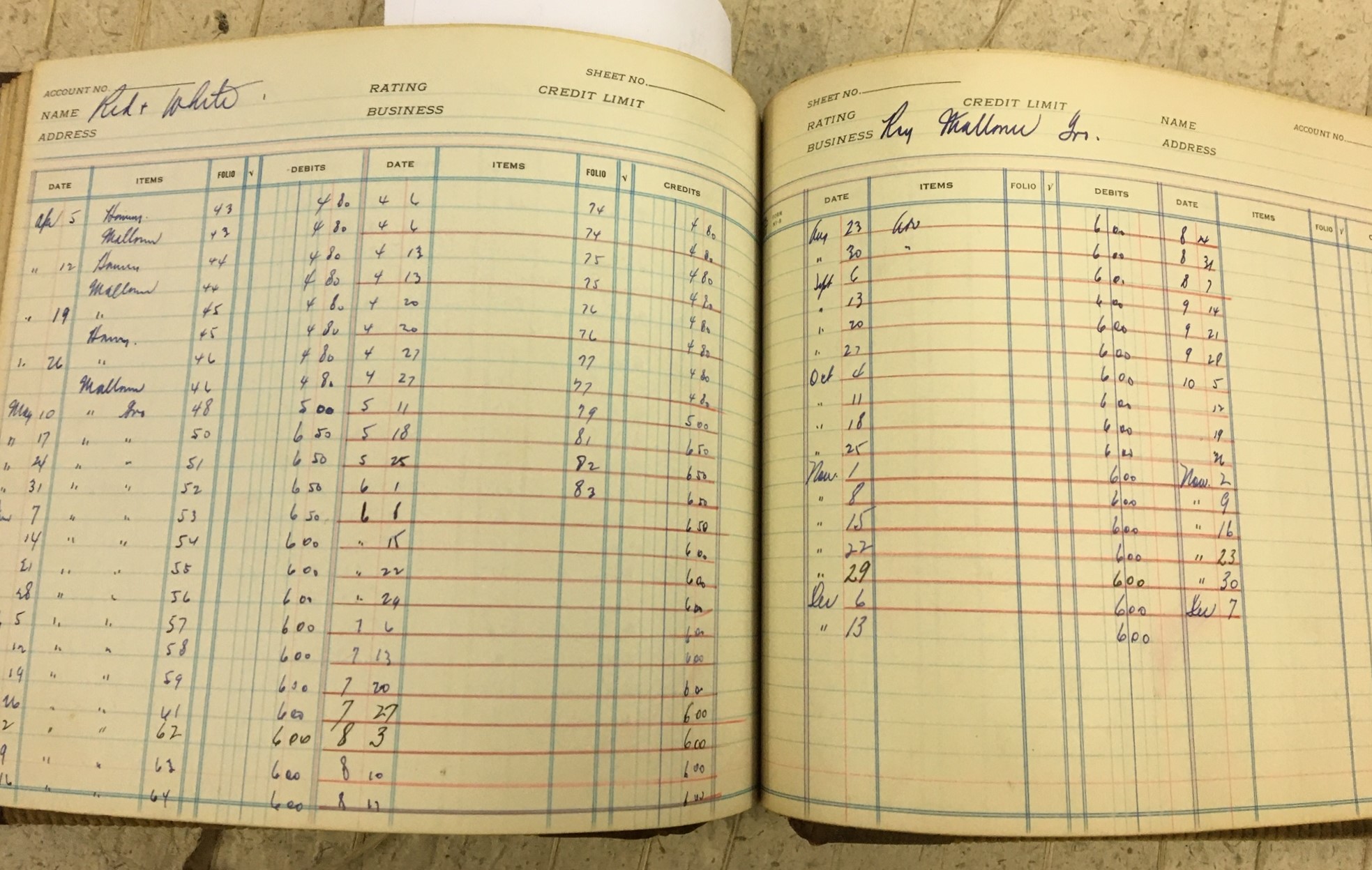
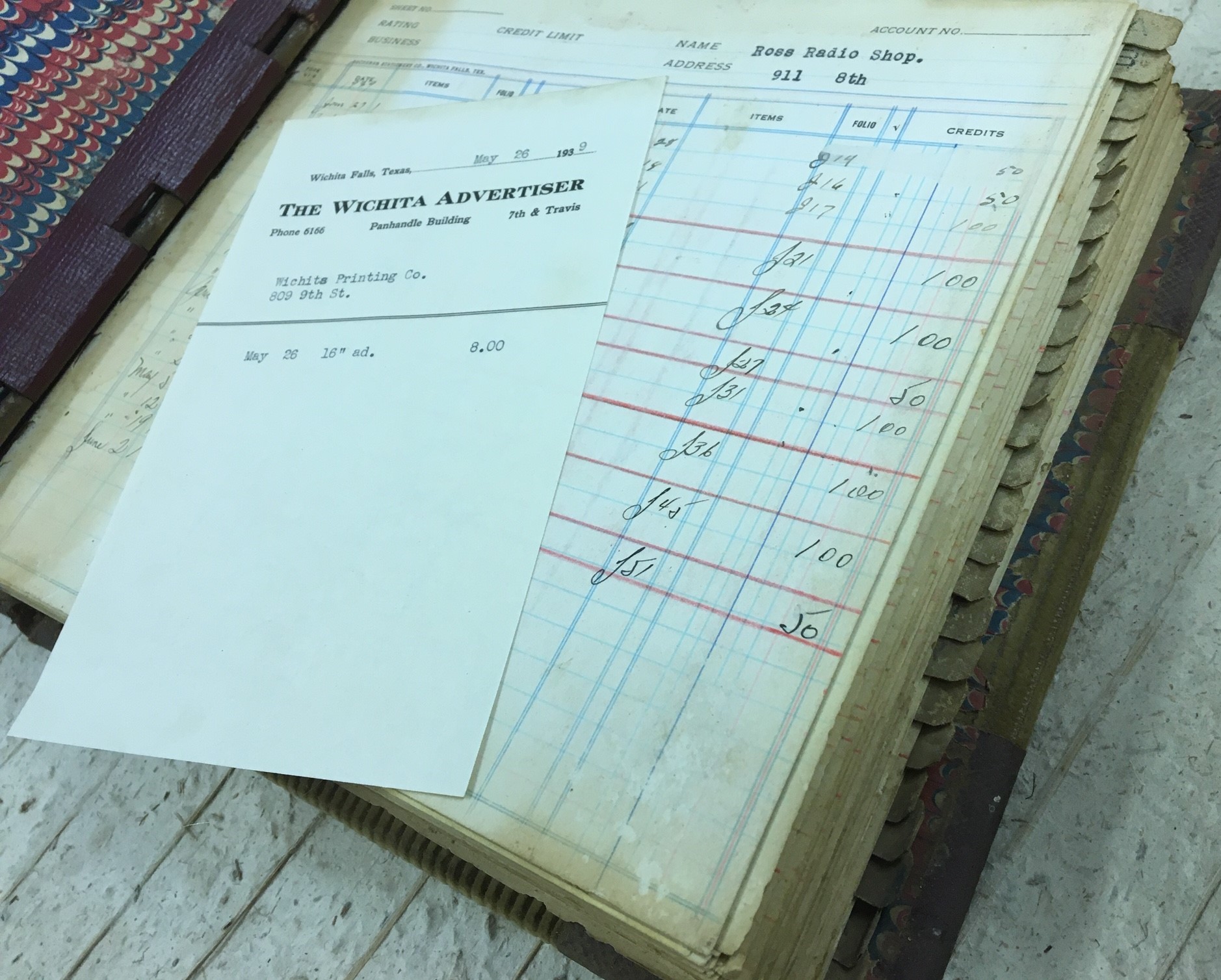
    IMG_2164Ledger from the advertising department of the Wichita Advertiser newspaper, Wichita Falls, Texas, 1938-1940. 8”x 10” (x 3” thick), approximately 270pp, much more than half with entries, featuring 75+ business in Wichita Falls. Bound in very heavy corduroy boards with leather edges and cover label, in a heavy spring-loaded metal spine. Very Good condition. $500

    This seems to indicate the size of an ad, the date, and the cost, all written in a neat hand. The business name appears on upper right for each entry, virtually all with an address.

    Some of the names of businesses include: Texan Theater (Indiana Street), August’s Pie Shop, Reiss Radio, Orvel Beauty, Artistic Beauty Shop, Bowen Motor Coach, Cain’s Cosy Corner, Health Food Store, Ice Service Co., Brumley Funeral, Ray’s Chick Hatchery, Modern Shoe Shop, Muller Furniture (606 Indiana where there is STILL a furniture store), Health Spot Shoe Store, The Famous, Burch Cafe, Brooks Grocery, and many others.

    Note: this is a repurposed ledger for the Nicara Mining Company which seems to have been in Nevada—this has nothing to do with the Wichita Advertiser.

    IMG_2166


    ·Posted by :

    ·in:


  • Juvenile Delinquency in Great Depression Seattle, 1937

    Carbon Copy of an Unpublished WPA-sponsored Work?

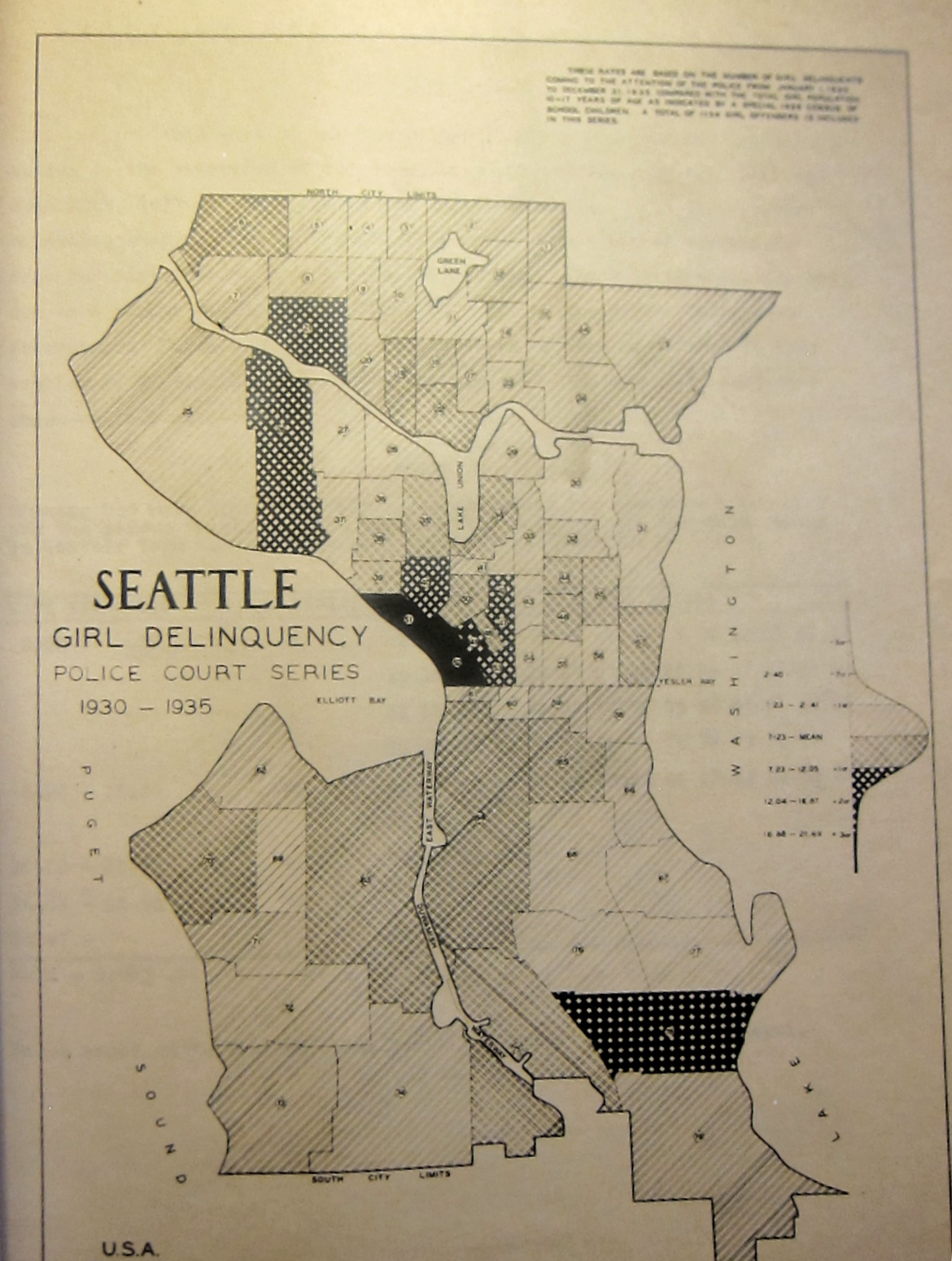
    Seattle juvenile DelinquentLionel H. Chute, Juvenile Court Project, Summary of Findings.  No place of publication; y Lionel H. Chute, “Supervisor, W.P.A., Project #4171”, December 13, 1937.11”x 8.5”, 15 leaves of text, with 5 full-page maps followed by 4 folding maps (16”x11”). The maps all seem to be photographs (on photo stock) of the base maps. VG condition. $250

    This seems to me to be a carbon copy from the typed original, home-bound in a manila report cover with three brass push-clips (which purchased for 5 cents from the University books store according to a sticker on the rear wrapper).

    Provenance: Library of Congress, with their 6mm perforated “LC” on the title, a rubber stamp rear of title identifying receiving the report in February 1938, and the LC surplus stamp on front free fly. Also included are carbons of the LC card catalog card. The paper used in the report has the University of Washington watermark.

    I can find no reference to this work in WorldCat, nor do searches in the relevant databases produce anything for it, nor for Mr. Chute. This seems entirely produced by the author, funded by the WPA, and may never have been published.

    There’s a LOT of data in this work which I suspect would be an interesting and fact-filled look at the situation in Seattle just before the mini-depression sparked into life inside the Great Depression.  

    Seattle Juvenile map

    ·Posted by :

    ·in:


  • The “Beneficial Exercise” of Walking the Trail of Tears (1838)

    Executive Documents 1-9,  including executive document #2, Message From the President of the United States to the Two Houses of Congress, at the Commencement of the Third Session of the Twenty-Fifth Congress.  Printed by Thomas Allen, Washington D.C., 1838. The 9 documents (22,619,56,111,55,116,1556,22,4,24pp)  1072pp. rebound in cloth. Provenance: Library of Congress, with their rubber stamp on front LC endpapers; the title and other printing on the spine mostly faded away, though some of the numerals are highlighted in pen.  Not beautiful, but all intact, and very sturdy, highly usable. $300 

    “…strong men, women, boys and girls, not only capable of marching twelve or fifteen miles a day, but to whom the exercise would be beneficial.”  —General Winfield Scott, military leader in charge of the removal of the Cherokee nation, 1838, on the benefits of enforced marching of men, women and children over an 800-mile course.

    Most people are familiar with the story of the Trail of Tears, the epic tragedy of the “removal” of a class of people—the Cherokee Indians in this case—from their homes in the east to a new land appropriated for them in Indian Territory (present-day Oklahoma). (In the Cherokee language, the event is called Nu na da ul tsun yi (the place where they cried), another term is Tlo va sa (our removal).) The Cherokees were given the ultimatum to leave their homes in Georgia, Texas, Tennessee, Alabama and North Carolina, doing so in the period from 1836 to 1839—the first part of the exodus was prompted by the U.S. Government but not necessarily enforced. The later part, however, in the spring of 1838, was absolutely enforced, with General Winfield Scott arriving on the scene with 7,000 U.S. Troops to round up the last of the remaining Cherokees and take them—by force if necessary—to Indian Territory.
    Cherokee Scott 1838

    There were approximately 12,0001 Cherokees left in the east by the time of Scott’s arrival—by the time their enforced march to the west was completed, around 4,000 Cherokees would be dead.

    The ease with which this re-settlement was partially removed from the broader moral and ethical implications of marching 12,000 men, women and children an 800 miles west in the fall and winter of 1838/9 was accomplished with abstract language in the government reports describing the affair.

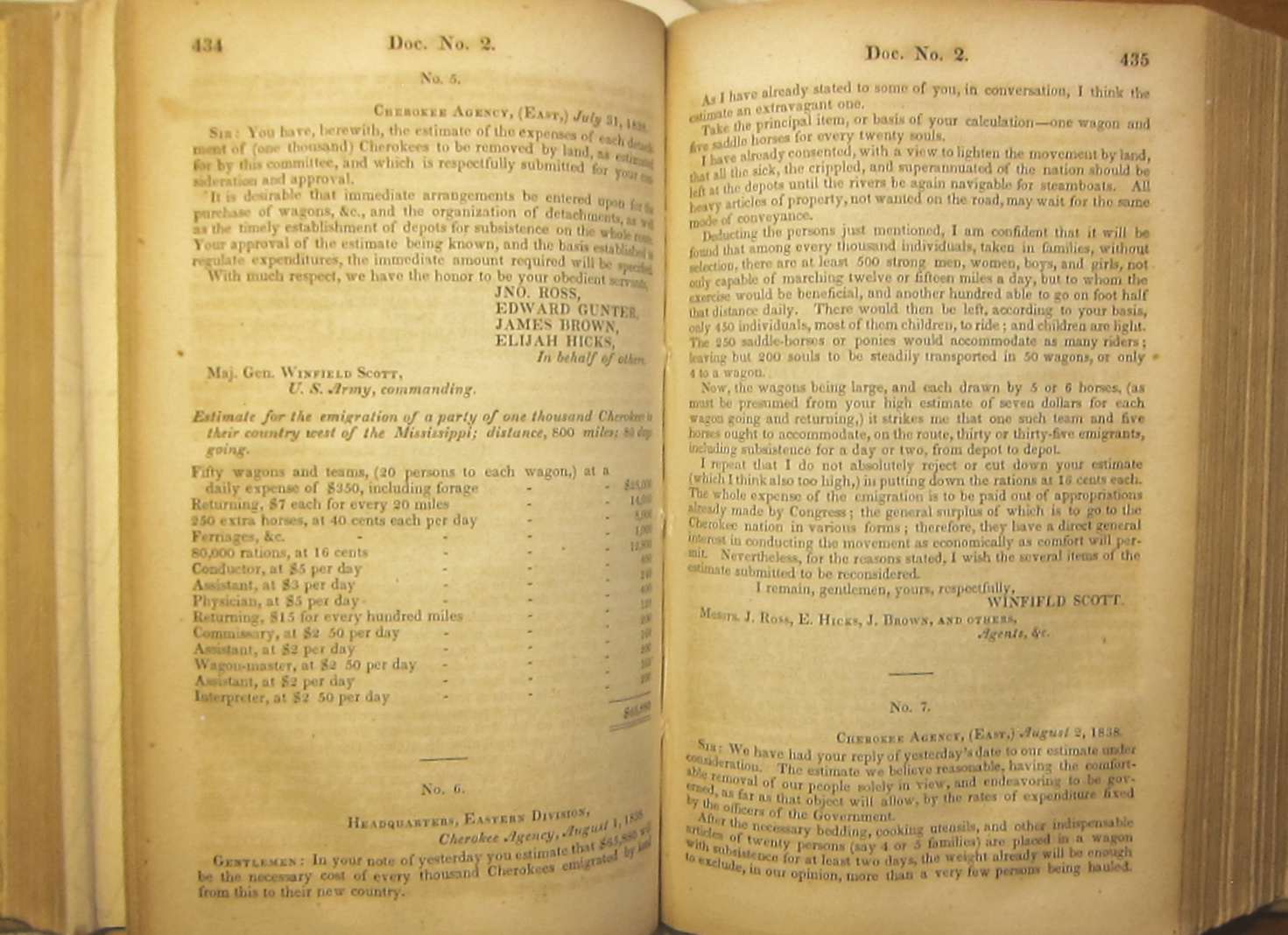
    For example, smothered in the thousand pages of the executive documents printed by Thomas Allen for the U.S. government of the 25th Congress, 3rd session, 1838 of  nine documents printed in volume one is document #2, “Message of the President of the United States to the Two Houses of Congress….”, and in there resides a 94-page section called “Report of the Commissioner of Indian Affairs” (occupying pp 410-506), and in that section is the compelling sub-document, “Emigration of Indians”. It is there that we find the clinical appraisals of the government efforts to scoop the Cherokees up and deposit them far west. For example, we are told that “(an) aggregate of 18,000 Cherokees…have ceased to live east of the Mississippi during the Spring, Summer and Autumn”, this after General Winfield Scott had “collected them”. Removing an entire Indian tribe had been a simple matter of that tribe no longer living there anymore, having been “collected” by the Army and “emigrated” to points west.

    The “collection” part is told elsewhere and often and more brilliantly than I can relate here—it is the material of a deep national tragedy. Suffice to say presently that 16,000+ people were herded together at bayonet and gunpoint, given scant opportunity to collect themselves, and then brought together in concentration camps to await the arrival of the last of their tribe. After that, most were marched in stages to Oklahoma, through bad weather of all descriptions—from drought to rain to high heat and bitter cold—sometimes encamped in stockades to wait for river levels to rise and fall, allowing dysentery and other diseases to come into the population and take hold. 4,000 people would die along the way–each mile would wind up killing five  people, one death per every 1,000 feet.

    The section on the emigration of the Indians is alternately heart-breaking and infuriating. There is a series of correspondence between John Ross, representing the leadership of the Cherokees, and General Winfield Scott, regarding the mechanics and monetization of removal. The Cherokees at this point make every attempt to accommodate their pending future with dignity and humility, acquiescing on almost all government points in what I think were the hopes of gaining a few extra necessities for the people making the trip. Generally, the requests were rejected. Coffee and sugar were at one point presented to Scott as a necessary—Scott refused, saying that the disbursements for the removal had already been made, even though all of the monies were coming from government funds allocated to the Cherokees for the lands they were having stolen on the heals of their exit.

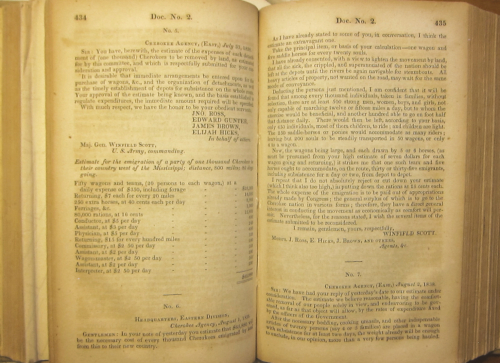
    Another particularly infuriating example of misogynistic governmental neutral-speak—a towering example, really, an incredible, unspeakably-wrong statement—occurs on page 435 in a letter from Scott to John Ross et alia. In response to a request from Scott for extra wagons to help transport the young and the old and possessions and food, Scott refuses. He refutes the estimated expense of $65,000 per every 1000 Cherokees for the entire trip of 800 miles (over 80 days), regarding the estimation of this need as “extravagant”:

    “As I have already stated to some of you in conversation I think the estimate an extravagant one. Take the principal item or basis of your calculation one wagon and five saddle horses for every twenty souls. I have already consented with a view to lighten the movement by land that all the sick the crippled and superannuated of the nation should be Heft at the depots until the rivers be again navigable for steamboats. All heavy articles of property not wanted on the road may wait for the same mode of conveyance.”

    He continues to his incredible statement quoted above:

    “Deducting the persons just mentioned I am confident that it will be found that among every thousand individuals taken in families without selection there are at least [of the 1000-person figure quoted above] 500 strong men women boys and girls not only capable of marching twelve or fifteen miles a day but to whom the exercise would be beneficial and another hundred able to go on foot half that distance daily. There would then be left according to your basis only 450 individuals most of them children to ride and children are light. The 250 saddle horses or ponies would accommodate as many riders leaving but 200 souls to be steadily transported in 50 wagons or only 4 to a wagon.”3

     And just to set the record straight on this, we are talking about 800 miles of marching, in weather good and bad, over a period of many months (and sometimes extending to a year).
    ·Posted by :

    ·in:


  • With a Rare semi-Utopian View of the Arkansas Valley

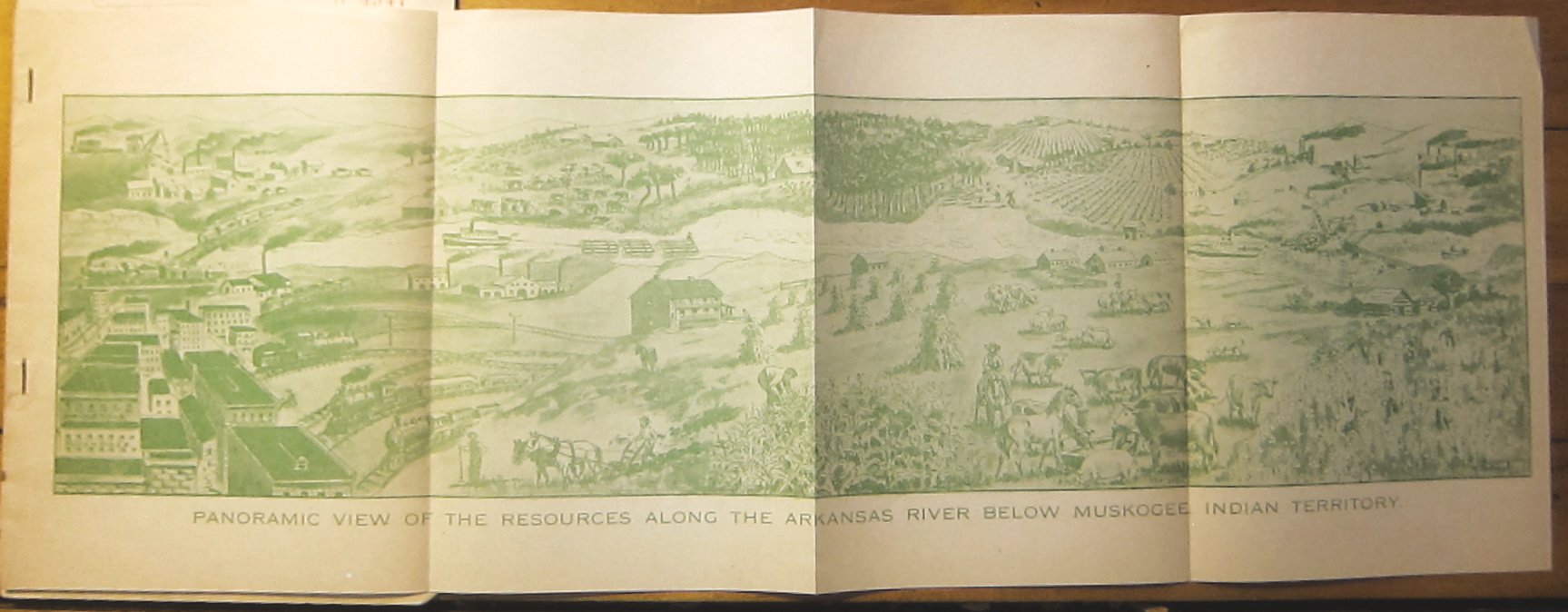
    Theodore W. Gulick, Commercial Value of Arkansas River Improvement in Arkansas and Indian Territory, Government and Commercial Reports.  Published by the Muskogee Commercial Club, Muskogee, Indian Territory, ca. 1907.  8.5” x 6”, 17pp. Original wrappers, detached. Provenance: Bureau of Corporations, dept of Commerce, 1907; Library of Congress, with their surplus stamp. Good copy. SOLD

    Muskogee panorama

    Includes a folding map “Commercial Map of the Arkansas River Valley (26″x8.75”, which has been repair along the length of three folds.

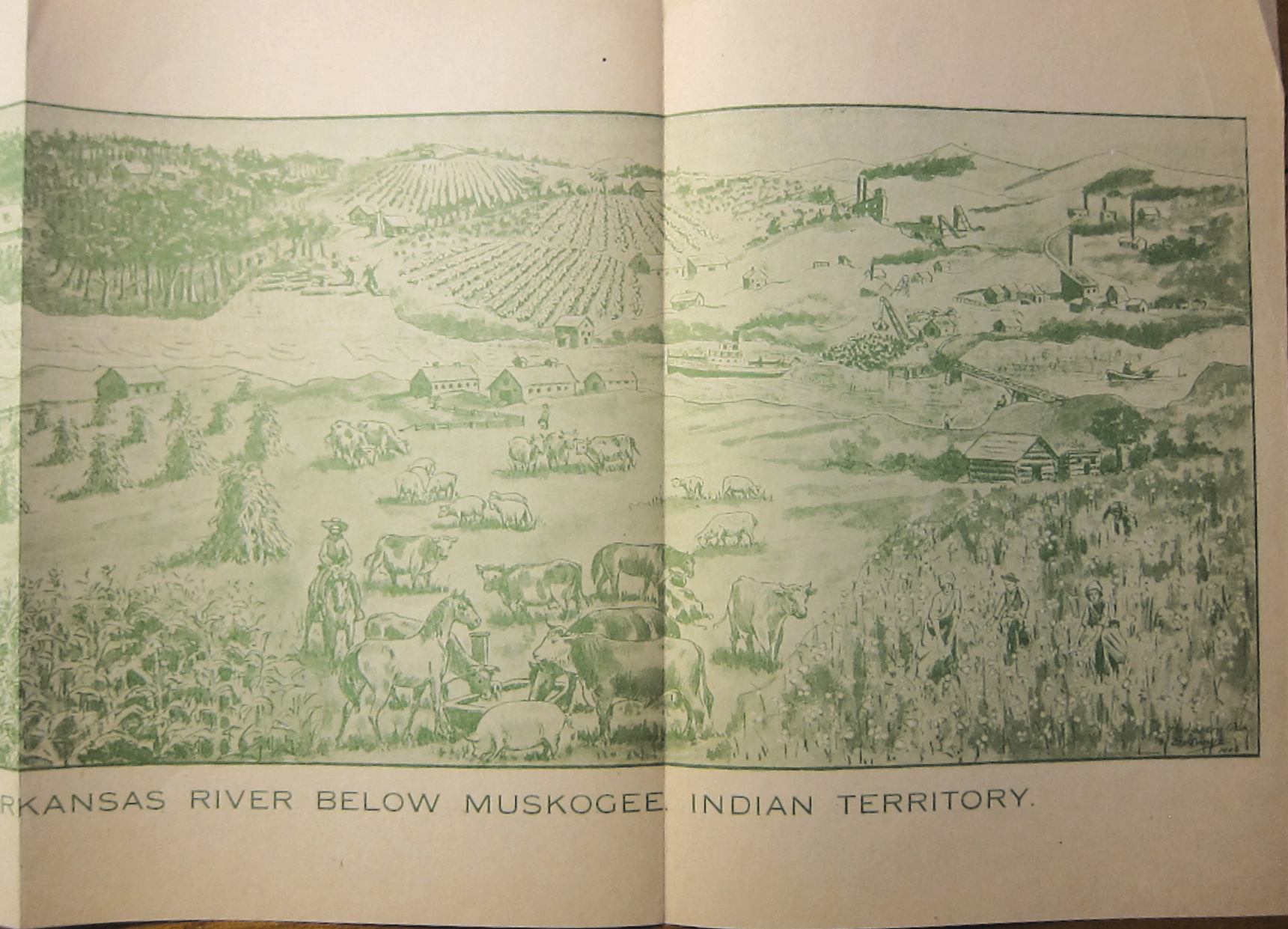
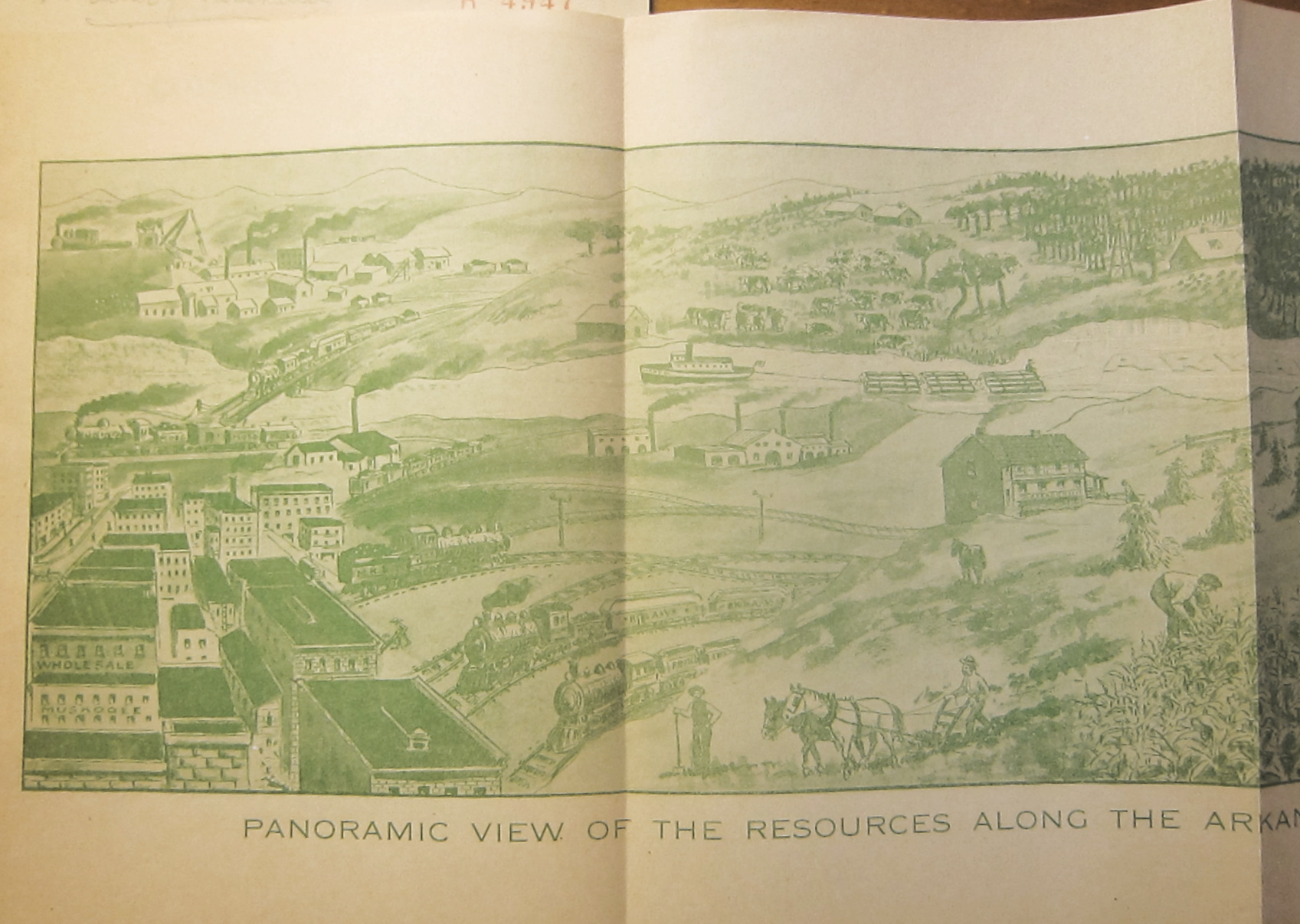
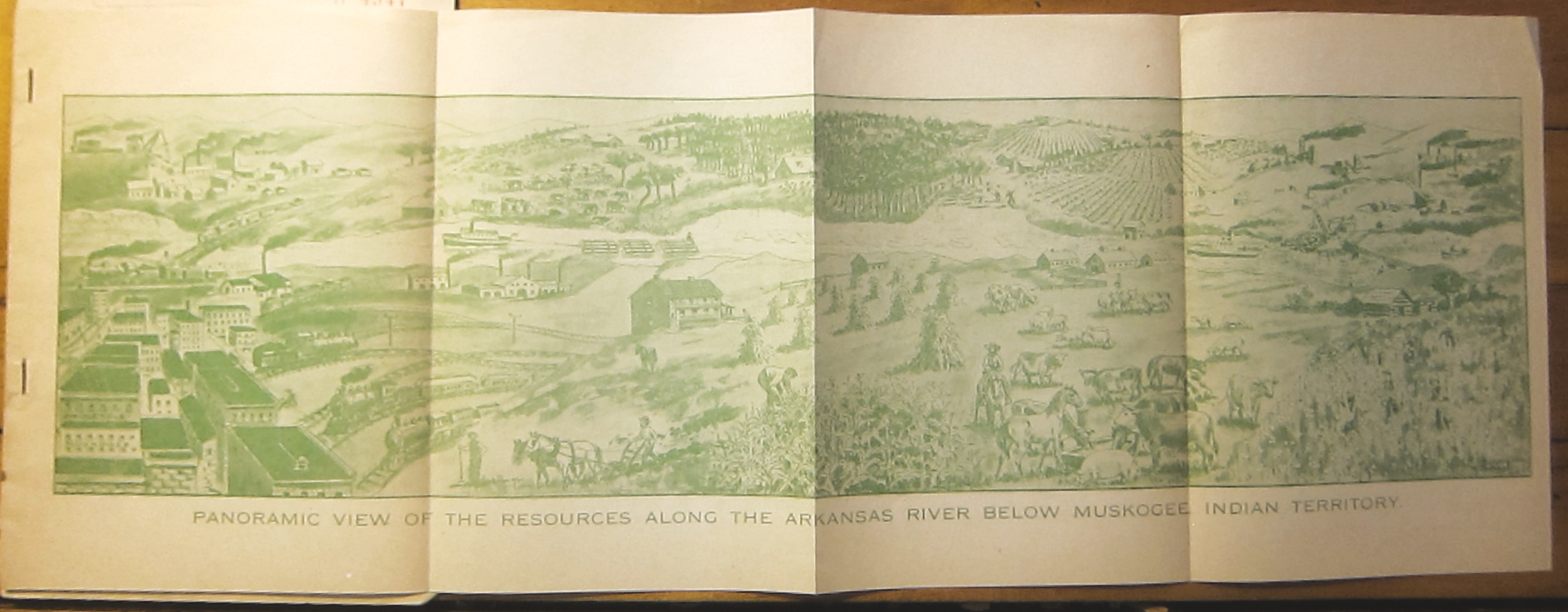
    ALSO: includes an 8″x22″ view, “Panoramic View of the Resources along the Arkansas River Below Muskogee Indian Territory”, printed in green. It shows the best of all possible worlds–a green utopia–flourishing along the Arkansas River.  

    I cannot find this title in the usual places, nor are there any references to it in WorldCat/OCLC, nor is there any mention of the panoramic view or the map. I’d say this was scarce.

    “…Theodore W. Gulick [d. 1913], an early newspaper editor. He is credited with establishing the Muskogee Evening Times which was Muskogee s first daily newspaper. He is also credited with reorganizing the Muskogee Commercial Club into the Chamber of Commerce and served as an officer of the Chamber for many years.”–Muskogee Phoenix

    There must’ve been one of the land rushes in the 1900-1909 period as the Muskogee as the population exploded from 4,500 to 25,000.

    Muskogee Pano right
    Muskogee Pano right

    ·Posted by :

    ·in:


  • Petroleum in Wyoming (1885)

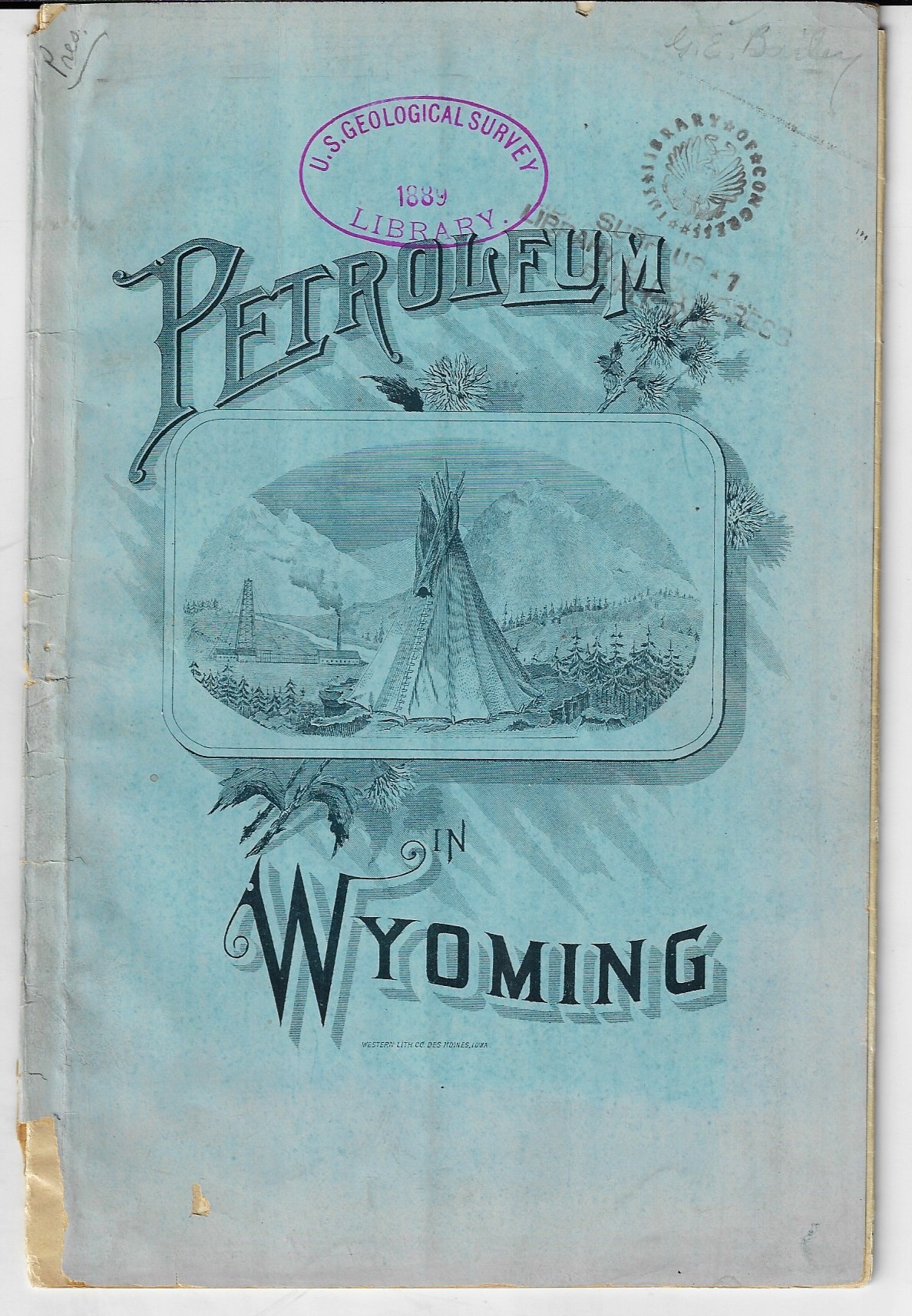
    Gilbert Ellis Bailey (former State Geologist of Wyoming). Petroleum in Wyoming Territory and special report on the Stockade oil district and the property of the Lakota oil and coal mining company in Crook County, Wyoming. No publisher or place of printing is noted. No date (though it is certainly before statehood in 1890); Stanford guesses 1885.  8.25”x5.75”, 19pp, with a small folding map of the county.  Printed wrappers. Provenance: U.S. Geological Survey Library, gifted to the Library of Congress in 1921. Few small rubber stamps on front cover for the two libraries. Outside of a few chips to the cover, and three very old fold shadows running vertically through the pamphlet, a VG copy—now at least a very solid GOOD.   SOLD


    Wyoming

    One copy only (Stanford) located by WorldCat.  

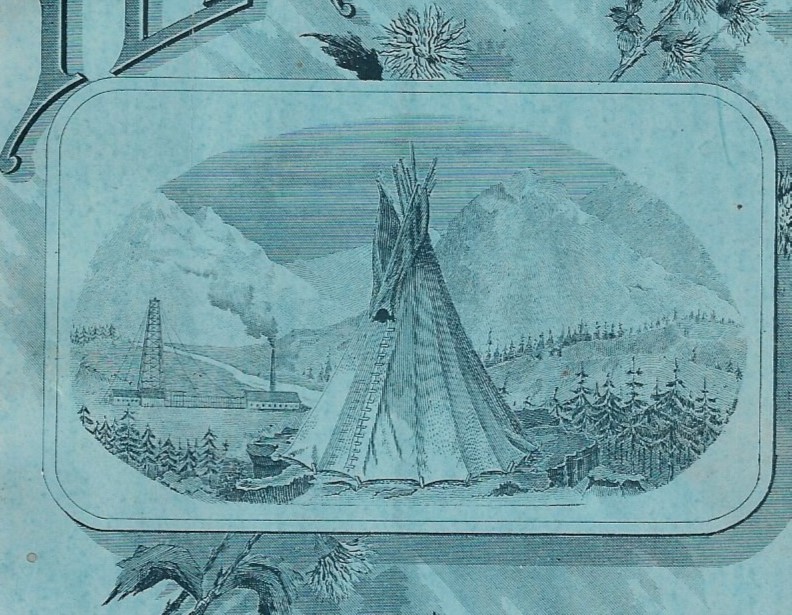
    It is worth taking a note of the cover illustration, which shows a teepee (which would be about right seeing that most of the Indians before White incursion were nomadic)—behind it though we see oil derricks, which I am sure was not the case, unless the derricks were on Indian land. In 1880 the (non-Indian) population of Crook County was 239, which “jumped” to 2,300 in 1890, (then to 6k in 1910 where it has stayed about constant since). In 1890 the Indian population in all of Wyoming was 2,063 (or thereabouts, according to the U.S.1890 census special volume Indians Taxed and Indians Not Taxed), and of that figure nearly the entirety of the population–1,861–were on reservations. And according to the census report of the 189,000 reported Indian population in the country 133,000 were on reservations, while another 50,000 were living in Indian Territory, making for something like 5,000 Indians not on reservations or I.T. territory in the entire U.S. and territories. So, picturing the teepee set before a petroleum industry scene was exceedingly prosaic.

    ·Posted by :

    ·in:


  • Rare Travel Journal, Lake Superior, 1827

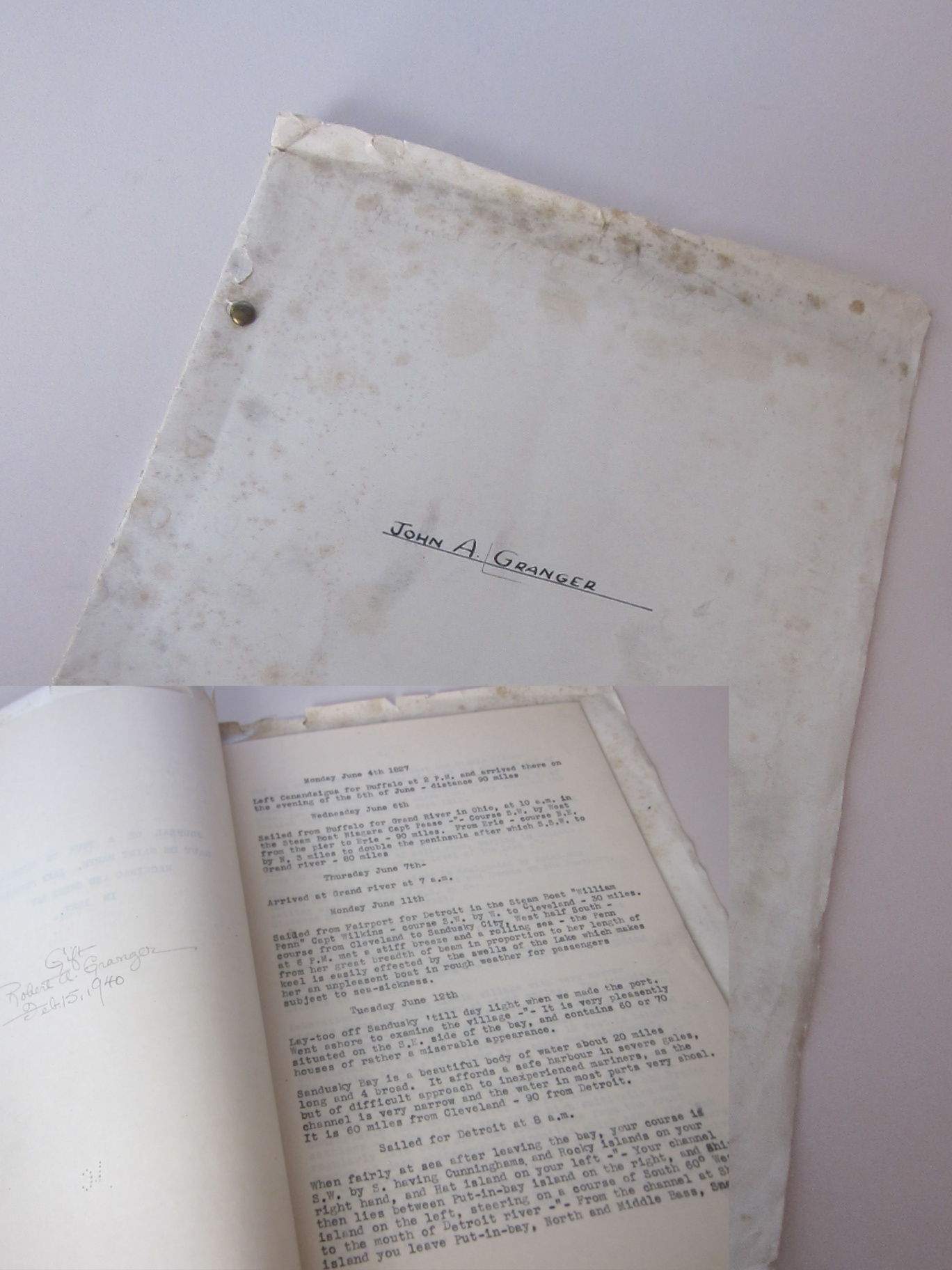
    Granger _montage_John A. Granger, Journal of a Tour to Detroit, Saut de Saint Marie, Lake Superior, Mackinac and Green Bay in 1827. Offset printed.  Self-published: “From an original record owned by Robert A. Granger, Chicago Ill…Jan. 15, 1940.” 11” x 8.5”, 13 + 4 leaves. With two pencil drawings (Sugar Loaf Rock and Arched Rock on Mackinac).  Loosely bound in oversized white wrappers, held together by brass paper gatherers.  $150

    I can find no mention of this work in WorldCat/OCLC, though I did find one (another typescript) online at the Bentley Historical Library at the University of Michigan.

    Provenance: Library of Congress, with their surplus/duplicate stamp on rear cover. 

    ·Posted by :

    ·in:


  • Rare Work on the Illano Estacado (1936)

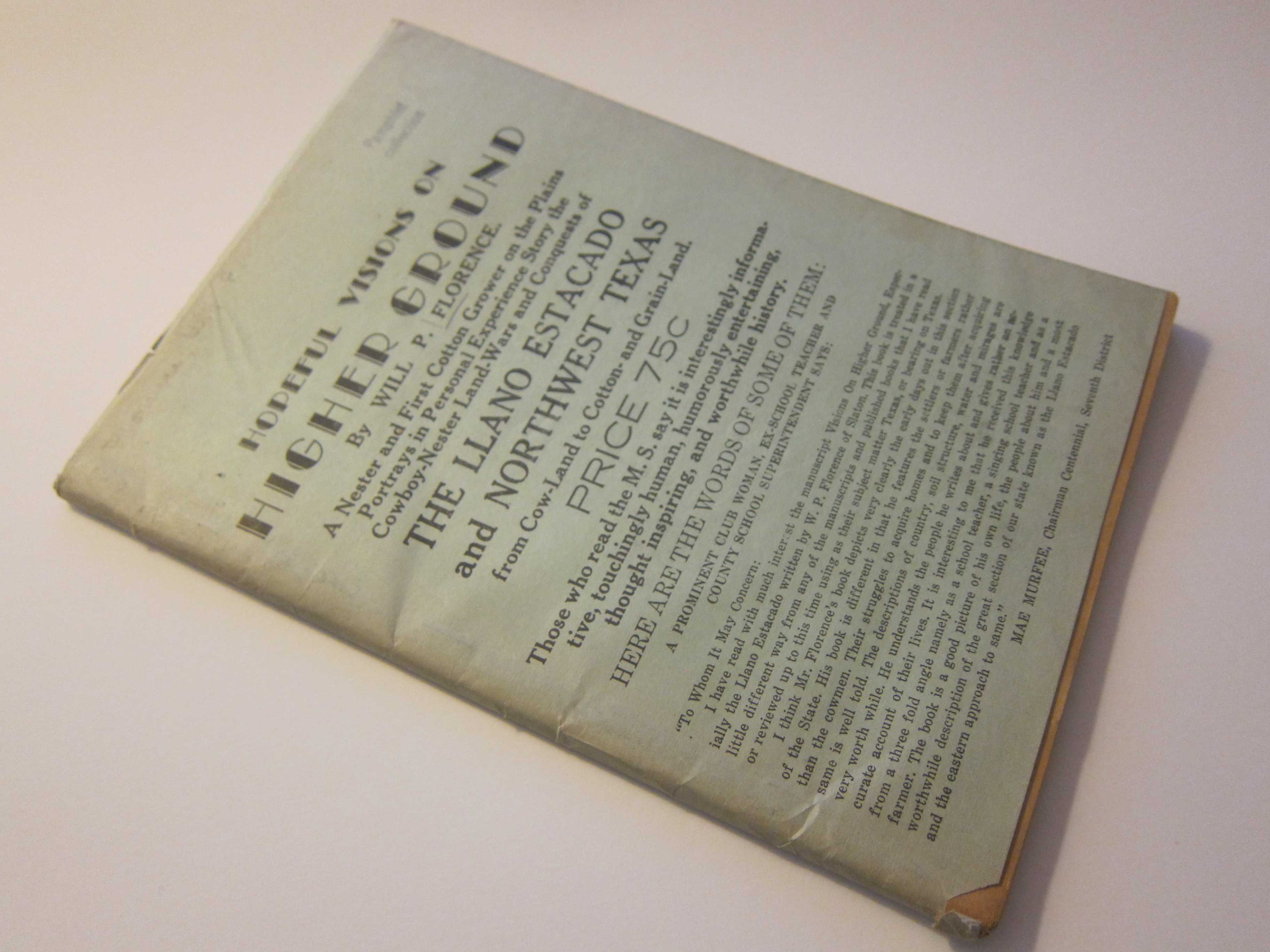
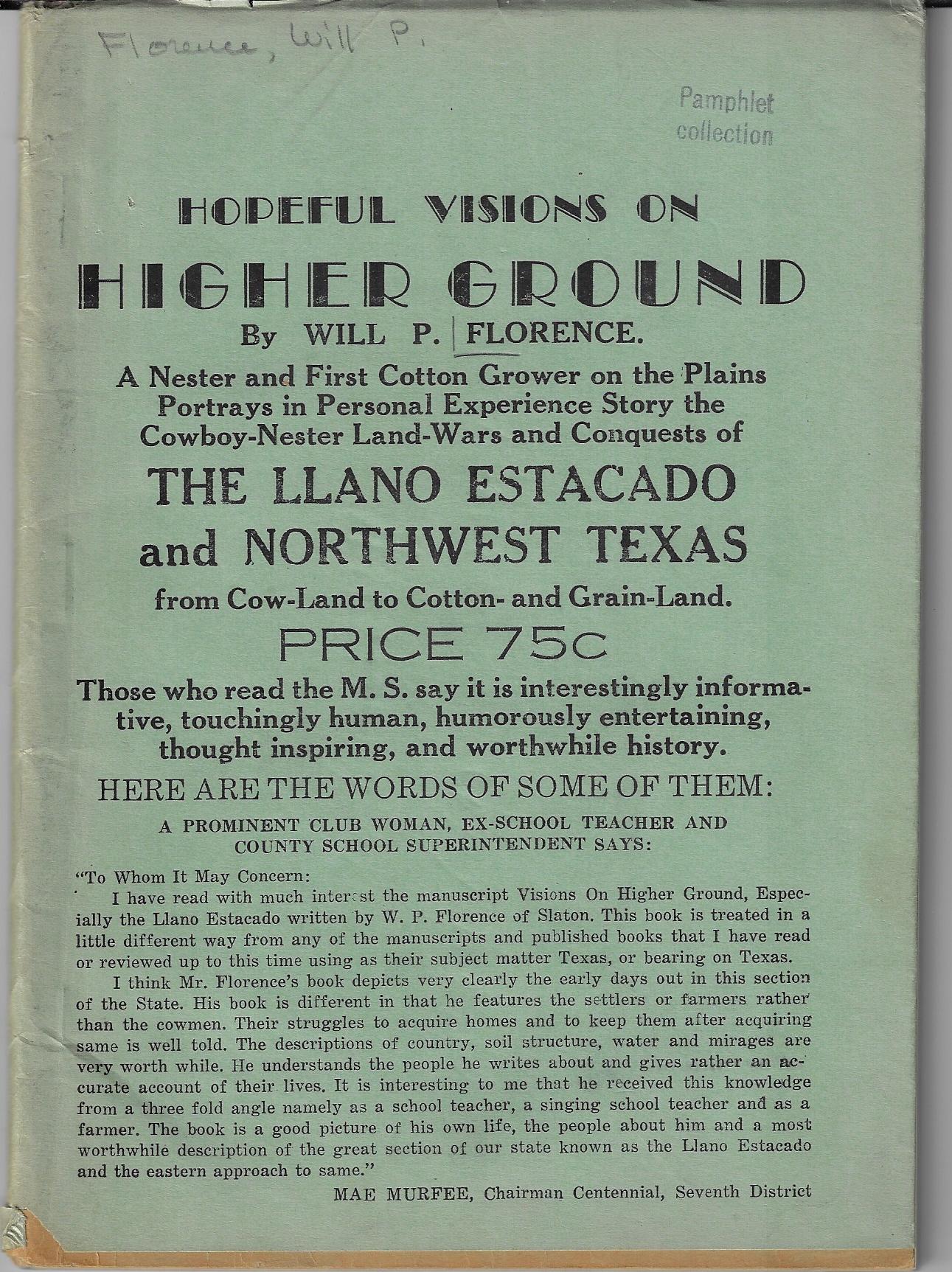
    IMG_8869Will P. Florence, Hopeful Visions on Higher Ground. A Nester and First Cotton Grower on the Plains Portrays in Personal Experience Story the Cowboy-Nester Land-Wars and Conquests of the Llano Estacado from Cow-Land to Cotton- and Grain-Land.  Printed by the Slatonite in Slaton, Texas. Very nice copy, fresh and crisp, a fine copy in a very good dust jacket.    $350

    “Personal narrative story of the Cowboy and Nester contests for West Texas, especially the Llano Estacado, portraying the country’s scenery, resources and development in human history.”

    8.5×6.25″ (22cm), 92pp.  Bound in stiff wrappers WITH a dust jacket (!)  Provenance: Library of Congress, with a small “pamphlet collection” stamp on the front cover and the LC surplus/duplicate stamp on the rear cover.  

    Full text:  https://swco-ir.tdl.org/swco-ir/handle/10605/89474?show=full

    Llano estacado

    ·Posted by :

    ·in: